
Our readers keep the lights on and my morning glass full of iced black tea. As an Amazon Associate, I earn from qualifying purchases.
Specs are compiled from manufacturer listings and verified buyer reviews and can change over time — please confirm the key details on the product page before buying.
You know the feeling—you grab a battery from the junk drawer, pop it into a remote, and nothing happens. Or you toss a perfectly good cell because you can’t tell if it’s dead or just resting. This guide cuts through that frustration by walking you through the top battery testers for household batteries, explaining which specs actually matter and which models deliver reliable, repeatable results.
I’m Min — the founder and writer behind Gadgets Feed. This guide is built by comparing the manufacturers’ published specifications and the patterns across verified customer reviews, so you get each pick’s real strengths and trade-offs instead of marketing spin.
You can find a battery tester for household batteries that fits your budget and needs, from simple analog testers that need no power to advanced digital units that measure internal resistance (the battery’s ability to deliver high current).
Quick Picks
- KKEANIC SL-049 — Best Overall
- Dlypow DB1 — Modern & Convenient
- Dlyfull Universal Battery Tester — Data Geek’s Choice
- ZTS MBT-1 — Professional Grade
- Tenergy T-333 — Digital Value
- VTECHOLOGY BT-168 — Budget Champion
How To Choose The Best Battery Tester For Household Batteries
Not every battery tester gives you the same information. Some simply show you voltage, while others put a small load on the battery and measure how it performs under that demand. The right choice depends on how deep you want to go—and how many types of batteries you need to check.
Load Testing vs Voltage-Only: The Key Difference
A voltage-only tester tells you the static voltage sitting at the terminals. A battery can show a good voltage reading but still fail the moment you ask it to power a toy or a flashlight. Load testers apply a small, controlled drain (like a resistor) and read the voltage under that load—giving you a true picture of the battery’s health.
Battery Compatibility: Which Sizes and Chemistries Matter
Look at what you actually use. Most household testers cover AA, AAA, C, D, and 9V. If you use button cells (CR2032, LR44) or rechargeable lithium-ion cells (18650), make sure the tester you pick has a dedicated slot or leads for those shapes. Some testers only handle alkaline, while others work with Ni-MH, Ni-CD, and Li-ion.
Display Type and Readability
Analog meters have a needle that swings across a colored scale (green, yellow, red). They are simple and need no batteries to run, but they are less precise. Digital LCDs show exact voltage numbers and often add a health bar. Consider lighting conditions—some LCDs are hard to read at an angle or in bright sunlight.
Quick Comparison
| Model | Best For | Display Type | Power Source | Load Testing | Amazon |
|---|---|---|---|---|---|
| KKEANIC SL-049 | Real-world load performance | LCD (no backlight) | Requires AAA battery | Yes (20Ω–1kΩ resistors) | $26.99Amazon |
| Dlypow DB1 | Backlit display + USB-C charging | Backlit LCD | Internal rechargeable (USB-C) | No (open-circuit) | $29.99Amazon |
| Dlyfull 742354388464 | Measuring internal resistance | LCD | Two AAA batteries (included) | Yes (voltage + resistance) | $26.99$29.99Amazon |
| ZTS MBT-1 | Professional pulse-load accuracy | Analog bar (LED) | Requires 4 AA batteries | Yes (pulse load) | $95.00Amazon |
| Tenergy T-333 | Digital ease with wide battery support | LCD | Requires AAA battery (included) | Yes (battery-assisted load) | $12.99Amazon |
| VTECHOLOGY BT-168 | Budget-friendly analog simplicity | Analog needle | No battery needed | No (voltage only) | $12.99Amazon |
In‑Depth Reviews
1. KKEANIC SL-049

The tester that puts your batteries to the test—literally, under a real electrical load.
What makes the KKEANIC SL-049 stand out is its load-testing approach. Instead of just reading the voltage at the terminals, it applies a specific discharge resistor for each battery type—20Ω (about 75mA) for AA/AAA, 30Ω for CR123A, and 1kΩ for 9V and button cells. This means you get a voltage reading under the same kind of demand a toy or a remote would create. As reviewers point out, a standard voltmeter can show a falsely high voltage because of surface charge, but this tester drains that away for a real reading.
The clear LCD shows both a numerical voltage and a colored power bar (Good, Weak, Poor). It works with AA, AAA, AAAA, C, D, N, 9V, CR2, CR123A, and a long list of button cells, plus 1.2V rechargeable batteries. One trade-off: the screen is not backlit, so reading it in dim light takes some angling. Also, the tester requires a single AAA battery for operation (not included), and buyers report you should remove it when not in use to preserve standby life, since there is no on/off switch. At about 3.52 ounces and 4.69 x 2.87 x 1 inches, it is compact enough for any drawer.
precision voltage readings: The real-load resistors mean a battery that passes here will actually power your device—a clear step ahead of voltage-only testers that can report a false positive.
lab-grade accuracy: You want to know which batteries are truly dead versus just showing a ghost voltage. The 20Ω to 1kΩ load resistors give you the truth under demand.
speed tests: You need a backlit screen or a tester that doesn’t require its own battery to operate.
2. Dlypow DB1
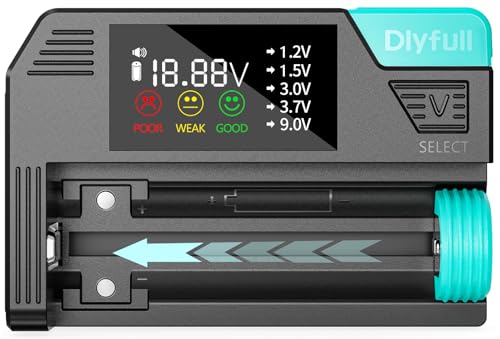
A modern rechargeable tester with a backlit screen that fits today’s USB-C lifestyle.
The Dlypow DB1 feels like an upgrade in everyday usability. It has a backlit LCD display that is far easier to read in low light than most battery testers, and it charges via USB-C so you never have to hunt for a spare AAA battery. The internal lithium battery gives a standby time of 2 to 3 months per full charge. Owners mention the voltage accuracy is within ±0.03V compared to high-end Fluke multimeters—plenty precise for household use.
A standout convenience is the magnetic buckle that helps hold cylindrical batteries in place during testing, and the tester shows results with both a voltage number and fun status faces (Good in green, Weak in yellow, Replace in red). It works with 1.2V Ni-MH/CD, 1.5V alkaline, 3.0V lithium, 3.7V Li-ion, and 9.0V batteries. The main drawback is its open-circuit test method—it does not put a load on the battery, so a cell with ghost voltage might still read as good. Also, at 3.8 x 2.5 x 1.2 inches, some buyers found it less compact for travel.
bright display design: Unlike most testers in this price range, the DB1 has a backlit screen plus a rechargeable battery—two small features that make daily use much less fussy.
night use: You dislike fumbling for AAA batteries and want a clean, modern device with a screen you can actually read in dim light.
wide compatibility: You need load testing to weed out batteries that have good voltage but can’t sustain power under demand.
3. Dlyfull Universal Battery Tester
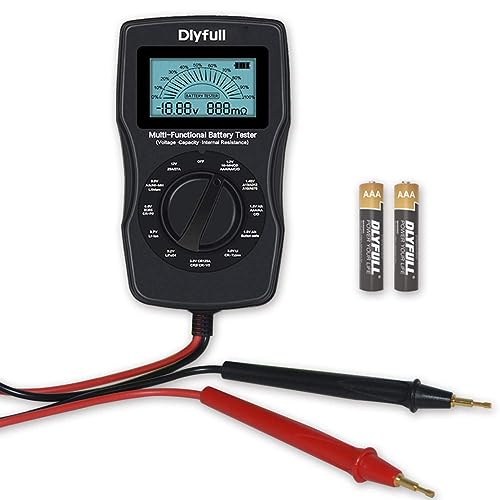
Gives you three data points per battery—voltage, capacity percentage, and internal resistance.
The Dlyfull is the only tester on this list that measures internal resistance alongside voltage and estimated capacity percentage. Buyers confirm it provides repeatable internal resistance measurements consistent with analog meters, making it a useful tool for comparing batteries or checking charger performance. Instead of inserting a battery into a bay, you use the included test leads—just select the voltage range with the rotary dial and touch the probes to the terminals.
It handles a massive range of cell types: AA, AAA, AAAA, C, SC, D, 9V, plus lithium-ion formats like 18650, 21700, 26650, CR123A, and dozens of button cells. The unit is powered by two included AAA batteries. On the downside, the LCD is not backlit and reviewers reported it is hard to read unless you look straight on. The text around the selector dial is very small—some buyers needed a phone camera to read it. The unit weighs about 6 oz, and the stiff probe wires can make it slide around on a table. A buyer noted adding a phone stand and velcro to fix the stability.
complete data display
- Shows voltage, internal resistance, and capacity %
- Works with a wide range of lithium-ion and button cells
- Replaceable test leads give you flexibility for odd-shaped batteries
confusing interface
- No backlight on the display
- Selector dial text is too small to read without magnification
- Stiff probe wires make the unit slide around during use
data lovers: You want more than just a voltage reading—internal resistance gives you a true sense of a battery’s age and health.
quick checks: You want a quick drop-in tester without fiddling with probe wires and a tiny dial.
4. ZTS MBT-1

The heavy-duty pulse-load tester that professionals trust to find every weak cell.
The ZTS MBT-1 uses a patented Pulse Load Test that applies a precise load pulse to measure a battery’s true capacity, not just its terminal voltage. It is dead simple—no buttons, no switches, no settings. You just insert the battery, and the tester shows the charge level as a percentage (100%, 80%, 60%, 40%). One buyer in TV production reported saving about by reusing 75 out of 100 discarded lithium batteries after testing them with this unit—15 were full, 40 were at 80%, and 20 were at 60%.
It handles AA, AAA, C, D, 9V, CR123A, CR2, 18650, and button cells, among many others. The build quality is solid, with a rubber bumper and U.S. manufacturing. At 4.5 x 1.25 x 8 inches, it is larger and heavier than most household testers. It also requires 4 AA batteries to operate (not included), and the price is a significant jump into premium territory. One reviewer noted it misread an LR44 coin cell, suggesting using silver oxide SR44SW for precision devices.
reliable load testing: The pulse load method catches batteries that pass a voltage-only test but fail under demand—saving you from tossing good batteries or keeping dead ones.
professional use: You go through dozens of batteries a week or manage a collection of rechargeable cells and want the most accurate assessment of remaining life.
budget buys: You only test an occasional AA or AAA—the cost and size are overkill for light household use.
5. Tenergy T-333
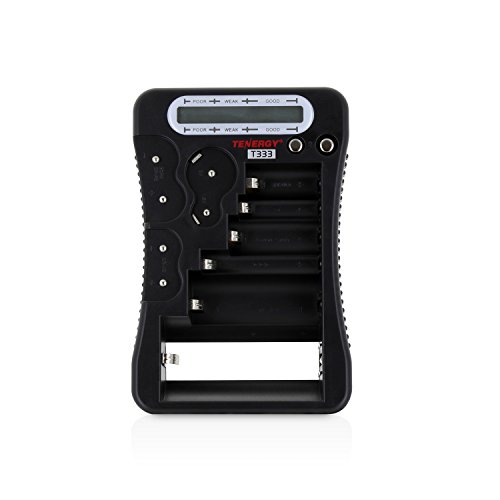
A reliable digital tester that uses its own power to load-test your batteries.
The Tenergy T-333 uses a AAA battery (included) to power load testing, which reviewers describe as “battery-assisted load testing” for outstanding accuracy. Instead of just reading open-circuit voltage, it applies a small load to see if the battery can sustain its power. The LCD gives an instant reading, and the tester snaps batteries in place for a solid connection.
It works with 12 different battery sizes, including AA, AAA, C, D, 9V, CR123A, CR2, CRV3, 2CR5, CR-P2, and button cells. At 5.25 x 3.5 x 1 inches, it takes up more drawer space than the analog models. A few buyers noted it lacks a storage case, which would help protect the LCD. The clear LCD readout is easy to read, and the unit is well-built and accurate. It is a strong middle-ground choice between the cheap analog testers and the premium ZTS.
advanced load tech: The battery-assisted load test gives you more reliable results than voltage-only testers, at a fraction of the cost of professional-grade units.
heavy duty: You want the accuracy of a load tester in a straightforward digital package that tests a wide range of batteries without a steep learning curve.
portability: You need to test larger lithium-ion cells like 18650s or want a tester that does not need its own battery.
6. VTECHOLOGY BT-168
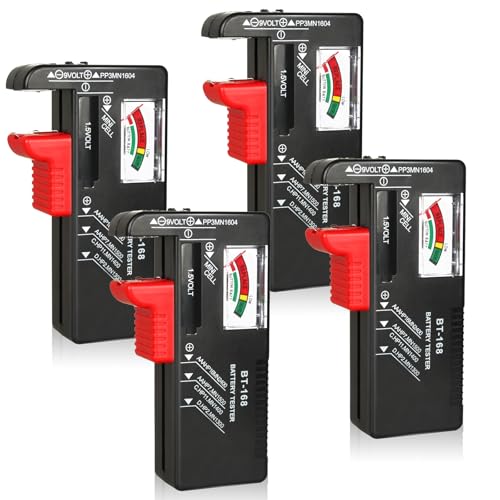
A no-frills analog tester that runs on the battery you’re checking—no power needed.
The VTECHOLOGY BT-168 is the simplest tester here. It does not need a battery of its own—it is activated entirely by the battery being tested. The analog needle shows three zones on the display: green for Good, yellow for Low, and red for Replace/Recharge. At 4.13 x 1.57 x 0.78 inches, it is also the smallest and most pocketable option on the list, by a 27% smaller margin compared to the Tenergy T-333.
It works with AA, AAA, C, D, 9V, and 1.5V button cells. Customers note it gives a “rough gauge of charge” rather than a precise measurement—one reviewer who bought a two-pack tested the same battery on both and got slightly different readings. The build is cheap plastic, and the needle on one unit was a bit sticky. Still, the reviewer noted that at this price, you can buy three for the cost of one premium tester and not worry about losing or breaking it. It is a good backup or a way to quickly sort batteries without any setup.
easy operation
- No battery needed—it powers on from the test battery itself
- Ultra-compact size fits anywhere
- Instant visual readout with color-coded zones
less precision
- Analog needle gives rough estimates, not exact voltage
- Build quality is cheap plastic with minimal quality control
- No load testing—voltage only
beginners: You want a throw-it-in-a-drawer tester for a quick pass-fail check of everyday alkaline batteries, without worrying about losing or breaking it.
lab work: You need precise voltage numbers, load testing, or the ability to test rechargeable lithium cells like 18650s.
Understanding the Specs
Load Testing vs Open-Circuit Voltage
A voltage-only tester reads the static voltage at the battery terminals. That number can look fine even on a dying battery because surface charge builds up over time. A load tester applies a resistor (like 20Ω for an AA) and reads the voltage under that demand. The KKEANIC SL-049 and ZTS MBT-1 use load testing; the Dlypow DB1 and VTECHOLOGY BT-168 do not. If you want to know whether a battery can actually power a toy or a flashlight, load testing is the spec that matters.
Internal Resistance
This is a measurement of how much a battery resists the flow of current. As a battery ages or deteriorates, its internal resistance rises. A high internal resistance means the battery will drop voltage quickly under load, even if its resting voltage looks okay. The Dlyfull tester is the only one here that explicitly measures internal resistance, making it a useful tool for comparing the health of rechargeable cells or spotting a battery that is about to fail.
FAQ
Can a battery tester check rechargeable Ni-MH batteries?
What is the difference between an analog and a digital battery tester?
Will a battery tester work on lithium-ion cells like 18650 or CR123A?
How do I interpret the reading from a battery tester that says Good, Weak, and Replace?
Why does my battery show a good voltage on a multimeter but fail in a device?
Can I test button cell batteries like CR2032 and LR44?
How often should I replace my battery tester?
What batteries do the testers themselves need to operate?
Is a more expensive battery tester worth it for household use?
What does internal resistance tell me about a battery?
Final Thoughts: The Verdict
For most buyers, the battery tester for household batteries winner is the KKEANIC SL-049 because it combines real load-testing resistors, support for over 20 battery types, and a clear digital display at a sensible price. If you want a backlit screen and USB-C charging, grab the Dlypow DB1. And for professional accuracy that pays for itself with heavy battery use, the standout is the ZTS MBT-1.
How We Picked
We do not accept paid placement. Every pick is matched to a real buyer and a real use-case; we do not hands-on test units.
Sources & Methodology
Specifications: manufacturer listings and product documentation. Review insights: verified customer reviews, as of July 2026. Pricing: not shown on this page (it changes often); check the current price via the retailer link.
As an Amazon Associate, Gadgets Feed earns from qualifying purchases. This does not affect which products we feature.
Related Guides
Product prices and availability are accurate as of the date/time indicated and are subject to change. Any price and availability information displayed on Amazon at the time of purchase will apply to the purchase of this product. As an Amazon Associate I earn from qualifying purchases.
CERTAIN CONTENT THAT APPEARS ON THIS SITE COMES FROM AMAZON. THIS CONTENT IS PROVIDED "AS IS" AND IS SUBJECT TO CHANGE OR REMOVAL AT ANY TIME.
Amazon and the Amazon logo are trademarks of Amazon.com, Inc. or its affiliates.