
Our readers keep the lights on and my morning glass full of iced black tea. As an Amazon Associate, I earn from qualifying purchases.
Specs are compiled from manufacturer listings and verified buyer reviews and can change over time — please confirm the key details on the product page before buying.
Your junk drawer is probably hiding batteries that still work. A good tester tells you in seconds which ones can keep your TV remote alive and which are truly dead, so you stop throwing away good cells and stop storing the useless ones.
I’m Min — the founder and writer behind Gadgets Feed. This guide is built by comparing the manufacturers’ published specifications and the patterns across verified customer reviews, so you get each pick’s real strengths and trade-offs instead of marketing spin.
The rundown below covers seven ways to test your stash, from simple voltage readers to load testers that measure real capacity. battery tester for small batteries is the one tool that finally tells you what is actually worth keeping.
Our Picks at a Glance
How To Choose The Best Battery Tester For Small Batteries
Choosing a tester depends on two questions: which batteries do you own, and how deeply do you need to test them? A simple reader sorts a junk drawer fine, while a load tester tells you if a rechargeable cell still holds a useful charge.
Match the tester to your battery types
Most household testers cover the basics: AA, AAA, C, D, and 9V. If you use button cells for watches or key fobs, check that the tester has a dedicated slot for those. If you use 18650 cells for flashlights or vapes, you need a tester that explicitly lists Li-ion support.
Voltage reading vs. load testing
A basic tester measures voltage with no load attached. That tells you voltage but not how the battery behaves under real use. A load tester applies a simulated draw and measures how voltage holds, which gives you a truer picture of remaining capacity.
Consider how it powers itself
Some testers use the battery you insert to power the reading, needing no internal battery at all. Others run on their own AA or AAA cells, and newer models come with a rechargeable USB-C battery built in. Think about if you want to keep a tester stocked with its own batteries or simply charge it every few months.
Quick Comparison
| Model | Best For | Minimum Voltage | Power Source | Key Feature | Amazon |
|---|---|---|---|---|---|
| Dlyfull B2★ Best Overall | Household sorting | 1.5V | AAA battery | Wide compatibility | Amazon |
| Amprobe BAT-200Best Value | No-power simplicity | 1.5V | Tested battery | Color-coded display | Amazon |
| Dlypow DB1 | Rechargeable convenience | 1.2V | USB-C rechargeable | Magnetic hold | Amazon |
| Dlyfull B2 Pro | Internal resistance checks | 1.2V | 2x AAA batteries | Test leads | Amazon |
| Dlyfull DB1 | One-hand testing | 1.2V | USB-C rechargeable | Magnetic slider | Amazon |
| ZTS Mini-MBT | Real load testing | 1.2V | 4x AAA batteries | Pulse Load Technology | Amazon |
| ZTS MBT-1 | Precision capacity % | 1.2V | 4x AA batteries | 8-state capacity readout | Amazon |
In‑Depth Reviews
1. Dlyfull Battery Tester
Our pick — 4.5★ from 12,000+ verified ratings; the strongest balance of quality and price.
The drawer-sorting workhorse that rescues dead-looking batteries from the trash.
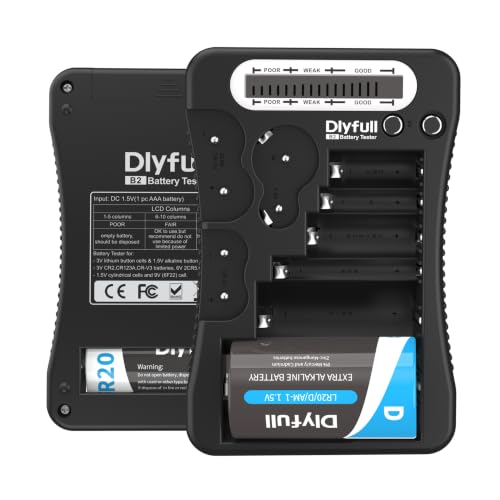
The Dlyfull B2 covers more household sizes than any other pick here—AA, AAA, C, D, 9V, N, CR123A, CR2, CRV3, 2CR5, and CR-P2 cylindrical batteries, plus a wide range of button cells—so nearly everything in your junk drawer is handled. Its crisp LCD screen shows a clear poor, weak, or good condition readout.
What wins people over is its sheer functionality, backed by over a thousand owners praising how well it works. The anti-slip compact chassis is small and light enough to hold comfortably in one hand while you work through a pile of cells. It even includes one AAA battery in the box, so it works right out of the package.
Buyers report: “It works as advertised. So easy to use and test every battery.” The honest caveat here is that this tester is not powered by a rechargeable battery, and you should not use it to test rechargeable batteries—it is strictly for your single-use household cells.
What Owners Rave About
- Instant poor/weak/good verdicts take the guesswork out of sorting
- Pocket-friendly chassis with anti-slip finish is easy to grip
- Works on a huge list of household battery types
Honest Trade-Offs
- Not meant for testing rechargeable batteries
- The + and – markings for button cells can be hard to read
Grab this for: the all-around household cell sorter that keeps good batteries out of the trash and works on the widest range of common sizes.
Look elsewhere if: you mainly test rechargeable NiMH or Li-ion cells, since that is outside this unit’s design.
2. Amprobe BAT-200 Battery Tester
A featherweight, battery-free checker that powers itself from the cell you insert.
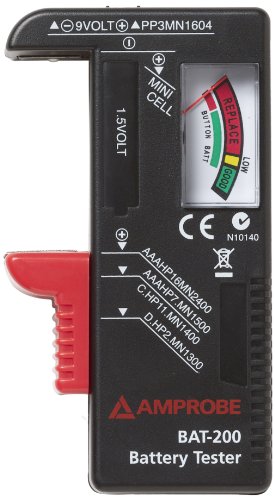
The Amprobe BAT-200 is the most straightforward device here because it needs no batteries to operate—it draws power from the cell you test. That makes it an excellent lightweight alternative to a multimeter, and at just 1.6 ounces it disappears into a drawer or a bug-out bag. Its easy-to-read color-coded display shows “Good”, “Low”, and “Replace/Recharge” indicators.
It handles 9V, AA, AAA, C, D, and 1.5V button types, covering standard and rechargeable batteries. The quality here is the standout—thousands of owners single it out as the biggest strength of this unit. Owners mention finding 8 of 30 discarded AA batteries fully charged and 6 partially usable, which is real money saved on replacements.
The one recurring difficulty is button cells, which can be tricky to seat and sometimes need a bit of wiggling to get a stable reading. Coin batteries like CR2032 are the weak spot, so if your drawer is mostly tiny watch cells, this is the trade-off to weigh.
The Case For It
- No internal battery means one less thing to charge or replace
- Extremely lightweight at 1.6 ounces
- Color-coded scale makes results obvious at a glance
The Catch
- Coin cell readings can be unstable and unreliable
- Not built for heavy button-cell users
Reach for this if: you want a dead-simple, always-ready tester that never needs its own batteries and handles the standard household sizes.
Think twice if: your testing needs center on CR2032 or other coin cells, where readings get finicky.
3. Dlypow Magnetic Battery Tester
The rechargeable one that magnetically grips cells and sits in standby for months.
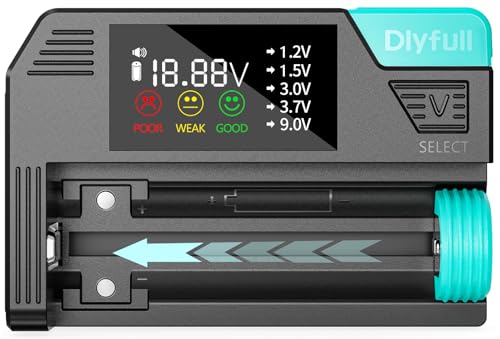
The Dlypow DB1 is the modern pick for households that want to stop feeding their tester fresh batteries. It is smaller than the Amprobe at 3.8 x 2.5 x 1.2 inches, and its USB-C port means a full charge keeps it in standby for 2 to 3 months. The magnetic buckle holds the battery securely so you can load and read with one hand.
It steps down to test 1.2V Ni-MH/CD cells, so rechargeable batteries are fair game here, along with 1.5V alkaline, 3.0V lithium, 3.7V Li-ion, and 9.0V types. Customers note accuracy within ±0.03V compared with dedicated digital multimeters, with the LCD showing clear poor, weak, or good labels. The open-circuit test draws no power from the tested battery.
The magnetic hold is the thing owners praise most, making it genuinely easy to use one-handed. The display can flicker when recorded on video, and reading 9V and D batteries takes a little practice, but the long battery life and wide compatibility make it a strong daily driver.
Why it stands out: the combination of a magnetic grip, USB-C recharging, and the ability to test rechargeable cells puts it ahead of simpler voltage readers.
Best for: the tech-friendly home that wants one rechargeable device to handle both alkaline and rechargeable cells.
Who should pass: anyone who mostly checks large D cells, where this unit’s readout takes a bit of fiddling to get right.
4. Dlyfull Battery Tester with Test Leads
The lead-probe analyzer that reads voltage, capacity percentage, and internal resistance.
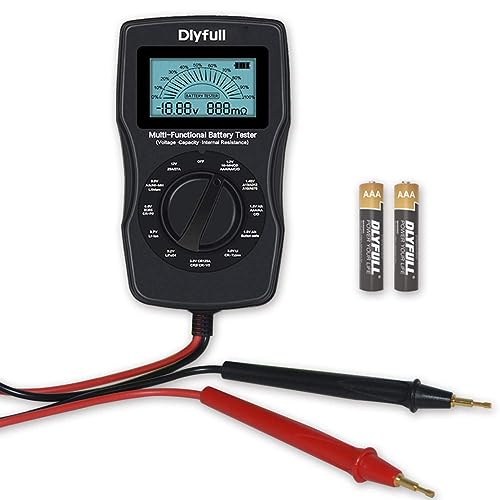
The Dlyfull B2 Pro is the one that goes beyond a simple good-or-bad verdict. Instead of inserting the battery into a bay, you select the voltage on a rotary dial and connect test leads, which lets it handle an unusually wide range: A, AA, AAA, AAAA, C, SC, D, 9V, and a full family of Li-ion cells like 26650, 21700, 18650, 16340 (CR123), 10440, CR2, and more. It measures battery capacity percentage, voltage, and internal resistance.
The quality feel is what wins people over, with the sturdy build standing up to long use. Reviewers point out it detects “ghost voltage” duds that simpler readers miss, and the internal resistance readings match analog reference meters. That makes it a genuine learning tool for comparing batteries and chargers.
The honest weak spot is usability. The display is hard to read in low light because there is no backlight, and the tiny selector dial text can require a phone camera to zoom in on. Some owners rig up a phone stand and velcro to keep the 6-ounce unit from sliding around.
what separates it
- Measures internal resistance, not just voltage
- Test leads reach cells that do not fit standard bays
- Wide Li-ion support for 18650 and 21700 users
What Holds It Back
- No backlight makes the screen tough to read in dim rooms
- Selector dial text is very small
Choose this for: the enthusiast who wants voltage plus internal resistance on a wide range of cylindrical and Li-ion cells.
skip it if: you prefer a bright screen and a simple one-step test, since this one demands a little more setup.
5. Dlyfull Magnetic Battery Tester

The magnetic-slider tester that frees your second hand for holding batteries.
The Dlyfull DB1 is the sibling of the Dlypow above, but it leans into one-handed usability. A magnetic battery slot with a sliding tab secures the cell firmly, so you can drop a battery in and read the LCD without juggling. Shoppers say the magnetic channel holds batteries so well that one hand is genuinely enough.
It covers 1.2V Ni-MH/CD, 1.5V alkaline, 3.0V lithium, 3.7V Li-ion, and 9.0V batteries, including sizes like AAA, AA, C, SC, D, N, 18650, CR123A, and button cells. A single press of the V-SELECT button powers it on and cycles through battery types, a double press toggles the buzzer, and a long press shuts it down.
Accuracy is the top praise here, with owners noting readings land within a few percent of a calibrated Fluke multimeter. The built-in USB-C battery lasts up to 15 hours on a full charge. The main complaint is a missing legend showing the target voltage for each battery type, so you have to know your specs—though 9V is obvious enough.
The standout feature: a magnetic slider that holds larger cylindrical cells like 18650 and even 32650 securely, which most bay-style testers simply cannot do.
Reach for this if: you test lots of loose cylindrical cells and want a rechargeable, one-handed tool.
Look elsewhere if: you need a printed voltage legend on the device, since you will want a reference chart nearby.
6. ZTS Mini Multi-Battery Load Tester

The deck-of-cards load tester that applies real pressure to reveal true capacity.
The ZTS Mini-MBT is the first device here that measures charge under a load rather than just reading voltage. Its patented high accuracy Pulse Load Technology applies a simulated draw and measures how the battery holds up, which is far more reliable than a bare voltage readout for judging real remaining life. There are no switches or settings—the test is fully automatic and takes about 2 seconds.
It identifies weak or failing 1.5V AAA, AA, C, D, and N batteries, plus 1.2V NiMH, NiCd, 3.6V Li-Ion, 3V photo lithium, and 9V alkaline. At 3.68 ounces and roughly the size of a deck of cards, it packs easily, and the probe and lead wire tuck into a seam for storage. Buyers report it handles 18650 3.6V cells too.
The quality and accuracy are the biggest draws—hundreds of owners highlight them as the top strengths. It is ideal for heavy battery users but arguably overkill for someone who tests one cell a month. The recurring gripe is the side power button, which can get bumped on accidentally and drain the four AAA batteries it runs on.
Why It Leads On Accuracy
- Pulse load testing shows real capacity, not just voltage
- Fully automatic 2-second test with no settings
- Compact enough for a bug-out bag
The Honest Trade-Off
- Runs on 4 AAA batteries that it can waste if the power button gets bumped
- More tester than a casual user really needs
Grab this for: the power user with drawers full of rechargeables who wants a true load test before deciding what to recycle.
Pass on it if: you only sort a few alkalines a year, where a simpler reader beats the extra cost.
7. The ZTS Multi-Battery Tester

The US-made reference unit that reads remaining capacity as a percentage.
The ZTS MBT-1 is the serious multitool for battery management and cell matching. It uses the battery’s own power to run the test, so it needs no internal batteries of its own, and its patented pulse load test reports remaining capacity across 8 states, from dead up to 100%. That percentage readout is what separates it from every other tester in this lineup.
It covers AA, AAA, C, D, and 9V alkaline, 1.5V lithium, CR123, CR2032, CR2016, CR2, and 18650 Li-ion cells. The 3-second scan with an LED and relay click is quick and clear. Owners describe it as the best tester on the market, with effectiveness and reliability being the two most-praised qualities after thousands of tests.
There are two honest caveats. First, the price is high and it is not a budget tool. Second, the LR44 coin cell reading has a known glitch—one that read “good” was actually low at 1.342V. The build is solid and US-made, and owners mention it lasting more than five years without issues, but its size is more suited to a workbench than a drawer.
The Big Advantage
- Capacity percentage readout tells you exactly how much life is left
- No internal batteries to maintain
- Handles button cells, lithium, and Li-ion types
What To Weigh
- Premium price that keeps rising
- LR44 coin cell readings are not always reliable
Choose this for: the enthusiast managing a large battery collection who wants true capacity percentages and reliable cell matching.
pass on it if: you just want to sort the kitchen drawer, since the simpler testers cover that for far less.
Understanding the Specs
Minimum Operating Voltage
This tells you the lowest voltage a tester can measure. Most household testers start at 1.5 volts for alkaline cells, while rechargeable-ready models drop to 1.2 volts to handle NiMH and NiCd cells. If you test rechargeables, you need that 1.2V floor.
Load Testing vs. Voltage Reading
A voltage-only tester tells you the cell’s resting voltage, which can look fine even when the battery dies under real use. A load tester applies a simulated draw and measures how the voltage holds. That gives you a truer picture of remaining capacity, which matters most for rechargeables.
FAQ
Can a battery tester check rechargeable batteries?
What is the difference between a voltage tester and a load tester?
Will these testers work with 18650 Li-ion batteries?
Do I need a tester that tests button cells?
How long does a rechargeable tester last on a charge?
Do any testers run without their own batteries?
Can a tester tell me the percentage of battery life left?
What does internal resistance tell me about a battery?
Final Thoughts: The Verdict
For most households, the battery tester for small batteries winner is the Dlyfull B2 because it sorts the widest range of common cells with a clear good-or-bad verdict. If you want a rechargeable tester that handles NiMH cells, grab the Dlypow DB1. And for real load-testing accuracy on a bigger battery collection, the ZTS MBT-1 is the one to reach for.
How We Picked
We do not accept paid placement. Every pick is matched to a real buyer and a real use-case; we do not hands-on test units.
Sources & Methodology
Specifications: manufacturer listings and product documentation. Review insights: verified customer reviews, as of August 2026. Pricing: not shown on this page (it changes often); check the current price via the retailer link.
As an Amazon Associate, Gadgets Feed earns from qualifying purchases. This does not affect which products we feature.