
Our readers keep the lights on and my morning glass full of iced black tea. As an Amazon Associate, I earn from qualifying purchases.
Specs are compiled from manufacturer listings and verified buyer reviews and can change over time — please confirm the key details on the product page before buying.
A car battery that looks fine on a multimeter (a tool that measures voltage) can still be dead when you need it most — a simple voltage reading tells you about charge, not about the battery’s actual ability to deliver power. That is why you need proper battery testing equipment: it puts a real load on the battery and measures its health in cold cranking amps (CCA, the measure of starting power in cold weather), state of health (SOH, the battery’s condition compared to new), and internal resistance, so you know if it will start the engine tomorrow or leave you stranded.
I’m Min — the founder and writer behind Gadgets Feed. This guide is built by comparing the manufacturers’ published specifications and the patterns across verified customer reviews, so you get each pick’s real strengths and trade-offs instead of marketing spin.
These six battery testers span from simple load-test pens to pro-grade analyzers with cloud printing. This breakdown of the best battery testing equipment shows you exactly which one fits your workbench and your budget.
Quick Picks
- FOXWELL BT301 12V Car Battery Tester — Top Performer
- BT90 PRO 2-360Ah Battery Tester — Fleet & Lithium Ready
- ZTS – Mini Multi-Battery Load Tester Mini-MBT — Household Battery Guru
- Clore Automotive SOLAR Digital 12V Battery — Quick Check Champion
- OTC 3181 130 Amp Heavy-Duty Battery Load Tester — Analog Workhorse
- TOPDON BT600 12V/24V Battery Tester — Shop Printer Built In
How To Choose The Best Battery Testing Equipment
Battery testers look similar from the outside, but the internal testing method — and what it tells you — varies a lot. Understanding these three specs first will keep you from buying a tester that does not match your batteries.
Test Method: Load vs. Conductance
Analog load testers (like the OTC 3181) push a heavy current through the battery for a few seconds and measure the voltage drop. That is a true stress test — it mimics the starter motor’s demand. Conductance testers (like the FOXWELL BT301 and the BT90 PRO) send a small AC signal (an alternating current test signal) through the battery and calculate internal resistance. They are faster, safer on electronics, and great for AGM (Absorbent Glass Mat) and gel batteries, but they do not physically stress the battery the way a load does.
CCA Range and Battery Chemistry
Cold Cranking Amps (CCA) is the number that matters for starting batteries — it tells you how much current the battery can deliver at 0°F (-18°C). A tester with a 100-2000 CCA range covers most cars and light trucks. But if you use AGM, EFB (Enhanced Flooded Battery), or lithium batteries, you need a tester with chemistry-specific algorithms. The BT90 PRO explicitly supports lithium and AGM, while older analog testers treat every 12V battery the same.
Display and Reporting
A cheap tester with a simple “Good/Bad” LED is fine for a quick check, but if you are diagnosing intermittent issues, you need a screen that shows SOH (state of health), internal resistance, and cranking voltage. For shop use, a built-in printer (like the TOPDON BT600) or cloud report sharing (like the BT90 PRO) saves time and gives customers proof.
Quick Comparison
| Model | Best For | CCA Range | Voltage Support | Test Method | Amazon |
|---|---|---|---|---|---|
| FOXWELL BT301 | DIYers wanting pro-grade accuracy | 100-2000 CCA | 12V only | Conductance | $59.49$69.99PrimeAmazon |
| BT90 PRO | Multibattery fleet and lithium users | 30-3800 CCA | 6V/12V/24V | Conductance + ambient temp | $59.99Amazon |
| ZTS Mini-MBT | Testing household batteries (AA/AAA/9V) | N/A | 1.2V-9V | Pulse load | $45.99Amazon |
| Clore Automotive BA9 | Simple 12V car battery check | 40-1200 CCA | 12V only | Conductance | $60.88Amazon |
| OTС 3181 | Old-school stress testing of 6V/12V | N/A | 6V/12V | Analog load (130A) | $104.52Amazon |
| TOPDON BT600 | Shop techs needing printed reports | 100-2000 CCA | 12V/24V | Conductance | $145.99$179.99PrimeAmazon |
In‑Depth Reviews
1. FOXWELL BT301 12V Car Battery Tester
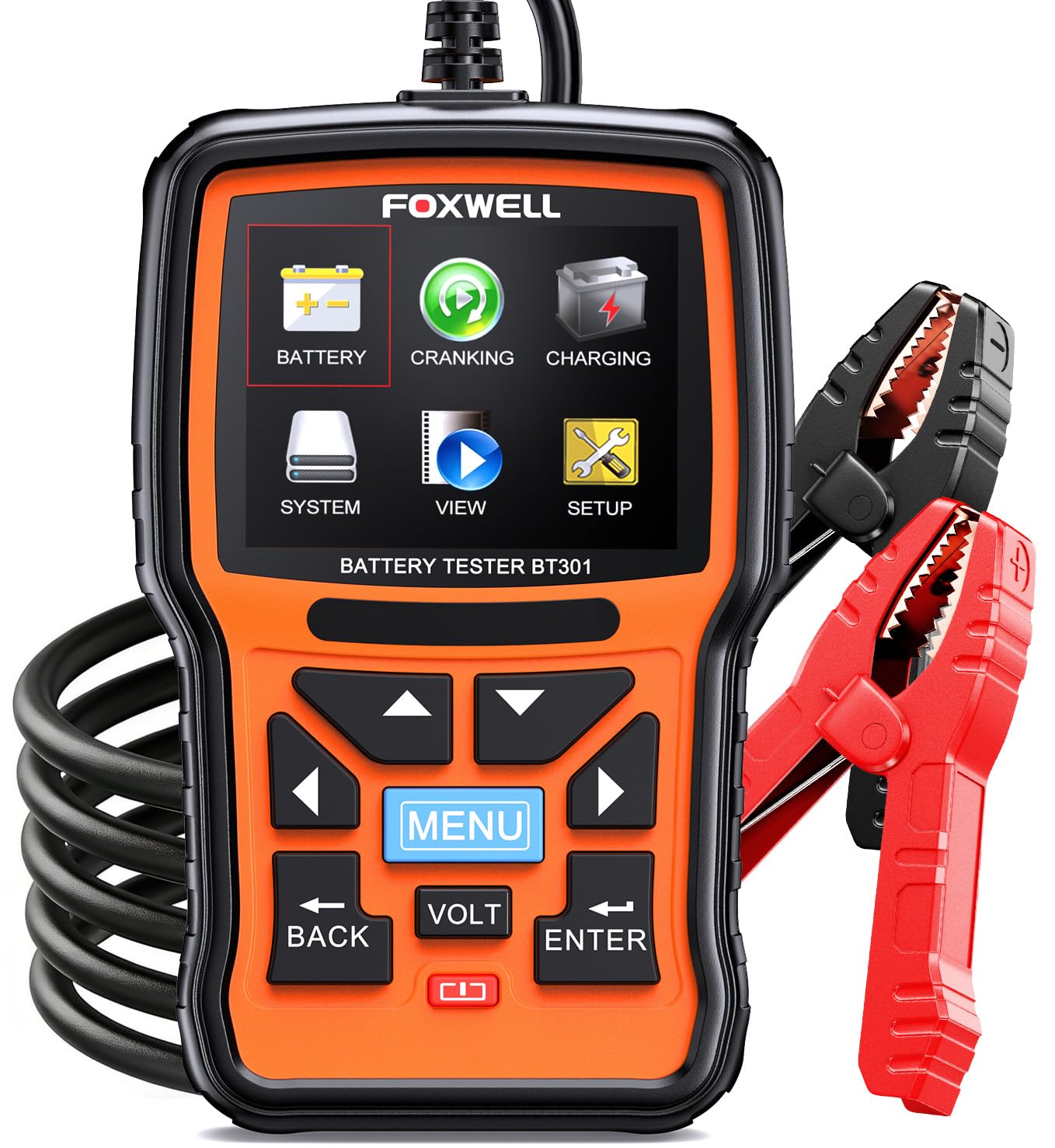
A compact digital analyzer that brings pro-shop diagnostics to your driveway without the learning curve.
If you want to know exactly how much life is left in your car battery — not just if it is “good or bad” — the FOXWELL BT301 is your pick. It delivers battery health readings (SOH and SOC, or state of charge), cranking system checks, and alternator output tests with up to 99.9% accuracy, according to the maker. The 2.8-inch color display makes it easy to read the results even in direct sunlight or a dim garage, so you see the numbers clearly. The 6.5-foot cable lets you sit in the driver’s seat while testing the cranking voltage without needing a helper.
The BT301 works on a wide range of 12V batteries — flooded, AGM (flat and spiral), EFB, and gel — but it does not support lithium or 24V systems. It is powered entirely by the battery you are testing, so you never need to replace internal batteries. Buyers report that the readings match expensive shop testers within a few CCA; one owner said his new Odyssey battery rated at 765 CCA showed 770 CCA on the BT301.
Unlike the basic Clore BA9 below, which only handles 40-1200 CCA in a simple pass/fail format, the BT301 shows you the actual numbers — CCA value, internal resistance, and a detailed state-of-health percentage. It is the best blend of depth and simplicity for the home mechanic.
Why the BT301 wins
- 99.9% accuracy claim backed by consistent user reviews
- 6.5 ft cable for easy in-cabin cranking tests
- 2.8″ color screen readable in low light and sunlight
- Powered by the battery under test — no extra batteries needed
One gap you should know
- 12V only — cannot test 6V or 24V systems
- No support for lithium batteries
- Red button on the keypad is not explained in the manual
Reach for it if: you want a professional-grade battery and charging system diagnosis without spending several hundred dollars, and you only work on 12V cars, boats, and trucks.
Look elsewhere if: you need to test 6V classic car batteries, 24V heavy trucks, or lithium battery packs — the BT301 does not support those.
2. BT90 PRO 2-360Ah Battery Tester with Cloud Printing
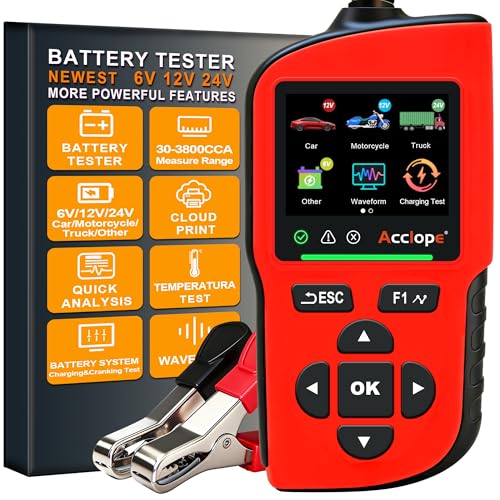
This tester reads 6V, 12V, and 24V — including lithium — and gives you shareable cloud reports in one scan.
The BT90 PRO from Acclope is the most versatile tester on this list because it covers the widest voltage and chemistry range: 6V, 12V, and 24V systems, from small motorcycle batteries (2Ah, meaning 2 amp-hours) up to heavy-duty 360Ah packs, with a CCA range of 30 to 3800. It is explicitly compatible with lithium (LiFePO4, a type of lithium battery) batteries, which the FOXWELL BT301 and Clore BA9 cannot handle. That alone makes it the go-to for anyone with a mixed fleet or a lithium conversion project.
What sets the BT90 PRO apart is its cloud-based reporting system. You scan a QR code (a type of barcode) on the screen after each test, and the full report — including SOH, SOC, voltage, internal resistance, cranking voltage, and alternator output — is saved to a shareable link. That means no more taking photos of a screen or printing paper slips for customers. It also feeds real-time ambient temperature into its algorithm to correct for cold-weather under-reads and hot-weather over-reads, so you avoid misdiagnosis that leads to warranty claims.
The display is bright and the menu is intuitive. One reviewer noted it “left no question the battery had to be replaced” after the old-style tester was ambiguous. The user interface offers Car, Motorcycle, and Truck modes, plus thickened clamp contacts for stable readings. It is a piece of equipment that grows with you — firmware upgrades are supported.
What stands out
- Supports 6V, 12V, and 24V systems in one unit
- Chemistry-aware for flooded, AGM, EFB, gel, and lithium
- Cloud printing via QR code — no printer needed
- Ambient temperature compensation for accurate cold-weather readings
What is missing
- No built-in printer like the TOPDON BT600
Grab this for: a shop or home garage that handles everything from 6V motorbikes to 24V trucks and wants digital records that customers can access.
skip it if: you only need to test household AA/AAA batteries — that is the ZTS Mini-MBT’s job, not this.
3. ZTS – Mini Multi-Battery Load Tester Mini-MBT

The only tester here that tells you the real remaining capacity of your AA, AAA, 9V, and lithium photo batteries.
If you have a drawer full of orphaned batteries and never know which ones are dead, the ZTS Mini-MBT is the tool you have been missing. Instead of just reading voltage (which tells you nothing about actual charge), it uses patented Pulse Load Technology — it applies a small load to the battery and measures how it performs under stress. The result is a percentage reading of remaining capacity, shown on a simple scale, in about two seconds.
It handles 1.5V alkaline (AAA, AA, C, D, N), 1.2V NiMH and NiCd (types of rechargeable batteries), 3.6V Li-Ion, 3V photo lithium, and 9V alkaline batteries. There are no switches or settings — the unit detects the battery type automatically. One buyer mentioned testing several dozen AA NiMH batteries side by side with a Fluke 115 multimeter and a 1-ohm resistor, and concluded that the ZTS Mini-MBT was the most reliable and easiest to use of all five testers he had. That is strong praise from someone who cross-checked with lab-level gear.
At 3.68 ounces and measuring 2.5 x 0.75 x 4 inches, it disappears into a tool bag or kitchen drawer. The probe and lead wire stow in the seam, so nothing gets lost. It requires 4 AAA batteries (not included) to power the tester itself.
Brilliant for home use
- Tests 8 battery types automatically — no settings to mess with
- Pulse load is far more accurate than a simple voltmeter
- Compact and lightweight at 3.68 oz
- Made in the USA with a 1-year warranty
Not for car batteries
- Cannot test 12V automotive batteries at all
- Does not test button/coin cells
- Needs 4 AAA batteries to operate
Best for: anyone who goes through piles of household batteries — photographers with lithium cells, parents with toy drawers, or preppers rotating stock.
Not for: car or truck battery diagnosis — the FOXWELL BT301 or BT90 PRO handles those.
4. Clore Automotive SOLAR Digital 12V Battery and System Tester (BA9)

A no-frills digital tester that tells you if your 12V battery is good, bad, or borderline in seconds.
The Clore Automotive SOLAR BA9 is the straightforward option for car owners who want a simple “pass or fail” answer without navigating menus or connecting to an app. It tests 12V batteries with a CCA range of 40 to 1200, covering most passenger cars, SUVs, and light trucks. It works with flooded, AGM, spiral, and gel cell batteries — just clip it on, set the CCA rating, and the LCD screen displays the result.
One owner reported that it let him know the battery in his 2020 Subaru was bad before it failed to start the car, which is exactly the confidence this tester provides. The BA9 also displays the battery’s resting voltage immediately upon connection — a nice touch for a quick sanity check.
The BA9 has a CCA range up to 1200, while the FOXWELL BT301 handles up to 2000 CCA, and a simpler display — it does not show state of health as a percentage or internal resistance. But if you just need to confirm whether a battery is good enough to start the car, this is the easiest path to that answer.
Why it is so popular
- Simple three-button operation — set, test, read
- Works on flooded, AGM, spiral, and gel batteries
- Very affordable entry point for car battery testing
- Compact at 0.6 lb
Where it falls short
- No state of health percentage or internal resistance reading
- CCA range maxes out at 1200 — no heavy-duty trucks
- The instruction manual is small and hard to read in the field
Ideal for: the casual car owner who just wants to know “is my battery going to die this winter?” without learning a new tool.
Pass if: you need detailed diagnostics like SOH and internal resistance — step up to the FOXWELL BT301 instead.
5. OTC 3181 130 Amp Heavy-Duty Battery Load Tester

A classic analog load tester that physically stresses the battery — no software, no surprises.
The OTC 3181 takes a different approach from every other tester on this list: it uses a 130-amp resistive coil to pull real current from the battery for 10 seconds and measures the voltage drop on an analog meter. This is the traditional method mechanics have used for decades, and it remains the most direct way to test a battery under actual starting conditions. There is no algorithm, no temperature correction, no chemistry selection — just raw electrical load and a needle on a dial.
It works on both 6V and 12V batteries, which makes it useful for classic cars and tractors that the digital-only testers cannot touch. The clamps are heavy-duty and designed to grip both top and side post terminals securely, with side tabs for on-tool clamp storage. One reviewer who tested it against a Fluke multimeter confirmed the meter was accurate right from the start with no zero-adjust needed.
The trade-off is the analog meter and the manual operation — you have to read the needle and interpret the result yourself, though the dial is clearly marked. It also cannot test deep-cycle or lithium batteries the way a conductance tester can, and it requires the battery to have at least some charge to deliver the 130-amp load.
Built to last
- True 130-amp load test — tells you what the battery can actually deliver
- Works on both 6V and 12V batteries
- Heavy-duty clamps and cables feel professional-grade
- On-tool clamp storage and wall-mount brackets
Old-school limitations
- No digital display or SOH percentage
- Cannot test AGM, gel, or lithium accurately
- Requires manual needle reading and interpretation
Grab this if: you work on older vehicles, tractors, or 6V systems and trust a real load test over a digital guess.
pass on it if: you need to test AGM or lithium batteries, or you want a printed report — go with the BT90 PRO or TOPDON BT600.
6. TOPDON BT600 12V/24V Battery Tester with Built-in Printer

A professional-grade analyzer with a 3.5-inch screen and a thermal printer (a device that prints using heat-sensitive paper) for instant customer reports.
The TOPDON BT600 is built for auto shops and used-car dealers who need to hand customers a printed receipt showing the battery’s condition. It has a 3.5-inch color display and a built-in thermal printer that prints results on thermal sensitive paper. The data playback function stores the last test results, so you can recheck without re-testing.
It supports 12V and 24V lead-acid batteries from 100 to 2000 CCA, including flooded, AGM flat, AGM spiral, gel, and EFB types. The tester uses conductance technology and claims up to 99.5% accuracy. A USB mini port allows firmware updates (Windows only), so the device can be updated as new battery chemistries or testing protocols emerge. One customer observed he chose it over his shop’s Interstate tester because the results were reliable and his customers appreciated the printed receipt every time.
Unlike the BT90 PRO, which offers cloud-based sharing via QR code, the BT600 gives you a physical piece of paper immediately — no smartphone or app required. However, it weighs 1.29 kg (about 2.8 lb), so it is heavier than the handheld testers, and it does not support 6V batteries or lithium chemistries. One user highlighted that it refused to give readings when a battery voltage exceeded 13 volts, which could be a firmware limitation.
Shop-ready features
- Built-in thermal printer for instant reports
- 3.5″ color display — larger than most competitors
- 12V and 24V support for cars and heavy trucks
- Firmware upgradable via USB for long-term updates
Know before you buy
- No 6V support — cannot test classic cars or motorcycles
- No lithium battery compatibility
- Heavy at 1.29 kg
Best for: a professional mechanic or service writer who needs to close the sale with a printed proof of a failing battery.
Not for: homeowners testing a single car battery in the garage — the Clore BA9 or FOXWELL BT301 is simpler and cheaper.
Understanding the Specs
Cold Cranking Amps (CCA)
CCA is the most important number for a starting battery. It measures how many amps the battery can deliver at 0°F (-18°C) for 30 seconds while maintaining at least 7.2 volts. A higher CCA means more starting power in cold weather, so your engine turns over reliably. The FOXWELL BT301 and TOPDON BT600 both handle up to 2000 CCA, covering most cars and light trucks, while the BT90 PRO goes to 3800 CCA for heavy-duty diesels. Always match the tester’s CCA range to your largest battery.
Conductance vs. Load Testing
Conductance testers (like the FOXWELL, BT90 PRO, Clore, and TOPDON) send a small AC signal through the battery to measure internal resistance. They are fast, safe on electronics, and work well on sealed AGM and gel batteries. Analog load testers (like the OTC 3181) physically draw 130 amps from the battery — that is a true stress test that mimics the starter motor. Load testing is more definitive for flooded batteries but can generate heat and sparking. For modern AGM and lithium batteries, stick with a conductance tester.
FAQ
Can a battery tester tell me if my alternator is bad?
Will any of these testers work on lithium (LiFePO4) batteries?
What does SOH mean on a battery tester?
Can I test a 6V battery with these testers?
How accurate are these battery testers?
Do I need a built-in printer on a battery tester?
Can these testers handle marine or RV batteries?
What is the difference between the FOXWELL BT301 and the older BT100?
How do I test a battery if the tester says “voltage too high”?
Can I leave the tester connected while the battery is charging?
Final Thoughts: The Verdict
For the majority of shoppers, the best battery testing equipment winner is the FOXWELL BT301 because it delivers pro-grade 99.9% accurate diagnostics, a readable 2.8-inch color screen, and a long 6.5-foot cable at a mid-range price that makes sense for any garage. If you want to test 6V classic cars, 24V trucks, and lithium batteries under one device, grab the BT90 PRO — its cloud-based reporting and ambient temperature compensation make it the most versatile option. And for shop professionals who need instant printed proof for customers, the TOPDON BT600 with its built-in thermal printer is the clear choice.
How We Picked
We do not accept paid placement. Every pick is matched to a real buyer and a real use-case; we do not hands-on test units.
Sources & Methodology
Specifications: manufacturer listings and product documentation. Review insights: verified customer reviews, as of July 2026. Pricing: not shown on this page (it changes often); check the current price via the retailer link.
As an Amazon Associate, Gadgets Feed earns from qualifying purchases. This does not affect which products we feature.
Related Guides
Product prices and availability are accurate as of the date/time indicated and are subject to change. Any price and availability information displayed on Amazon at the time of purchase will apply to the purchase of this product. As an Amazon Associate I earn from qualifying purchases.
CERTAIN CONTENT THAT APPEARS ON THIS SITE COMES FROM AMAZON. THIS CONTENT IS PROVIDED "AS IS" AND IS SUBJECT TO CHANGE OR REMOVAL AT ANY TIME.
Amazon and the Amazon logo are trademarks of Amazon.com, Inc. or its affiliates.