
Finding a sealed, maintenance-free power source that reliably cycles through charge and discharge without venting acid fumes or requiring water top-ups is the core challenge in backup and off-grid systems. A Valve-Regulated Lead-Acid (VRLA) battery using Absorbent Glass Mat (AGM) technology solves this by binding the electrolyte in a fiberglass mat, allowing stable recombination of oxygen and hydrogen internally and making the battery spill-proof in any orientation. This guide focuses on the specific performance metrics—capacity in amp-hours, cycle life at depth of discharge, self-discharge rate, and terminal type—that determine whether a VRLA AGM battery will actually serve your solar array, UPS, trolling motor, or sump pump backup for years rather than months.
I’m Min — the co-founder and writer behind Gadgets Feed. I’ve spent over many hours analyzing customer feedback, technical datasheets, and long-term reliability reports for dozens of sealed lead-acid batteries to isolate the models that genuinely deliver on their amp-hour ratings and withstand repeated deep discharges without premature failure.
Whether you are wiring a cabin solar bank, replacing a scooter battery, or safeguarding a basement from flooding, this analysis of the best battery vrla agm options on the market will give you the specific specs and real-owner experiences needed to make a confident purchase.
How To Choose The Best Battery VRLA AGM
Selecting the right sealed lead-acid battery comes down to matching three core variables to your specific load and charging profile: capacity, cycle life, and physical dimensions. Beginners often overindex on cold cranking amps (CCA) for deep-cycle applications or pick a battery that is physically too tall for their battery tray. Here is the focused criteria that matter for VRLA AGM.
Capacity in Amp-Hours (Ah) and Your Daily Load
The Ah rating tells you how many amps the battery can deliver for one hour before reaching the cutoff voltage. For deep-cycle use, you should never plan to discharge below 50% depth of discharge (DoD) if you want hundreds of cycles from a standard AGM. Calculate your daily watt-hour load, divide by 12 volts, then double that number to find the minimum Ah you need to avoid regularly draining past 50%. A 100Ah battery realistically gives you 50Ah of usable capacity per cycle.
Terminal Type and Physical Fit
VRLA AGM batteries come with a confusing variety of terminals: flag terminals (flat tabs with a hole), internal thread (INT) posts, automotive taper posts, and marine stud terminals. Flag terminals are common in UPS and lawn mower replacements. INT terminals are used in some solar and mobility applications where a bolt-on connection is preferred. Always measure your existing battery tray length, width, and height and check the terminal orientation (which side is positive) before ordering. A 0.25-inch height difference can force you to modify the hold-down bracket.
Self-Discharge Rate and Storage
All VRLA AGM batteries self-discharge, but the rate varies significantly by quality. A premium SLA battery should lose only 1-3% of its charge per month at 25°C, while lower-tier units can lose 5-8% monthly. If you are storing the battery for a season (winterizing a boat, for example), a low self-discharge rate is critical to avoid sulfation damage. Batteries that maintain 12.5V or higher after 30 days of storage indicate solid internal purity and separator quality.
Quick Comparison
On smaller screens, swipe sideways to see the full table.
| Model | Category | Best For | Key Spec | Amazon |
|---|---|---|---|---|
| WEIZE 12V 100Ah | Premium Deep Cycle | Off-grid solar and RV banks | 100Ah / 1150A max discharge | Amazon |
| Mighty Max ML100-12 (INT) | Premium AGM | Riding mower and UPS upgrades | 100Ah / UL Certified | Amazon |
| Mighty Max ML100-12 (Group 27) | Premium Solar | Solar wind storage and trolling motors | 100Ah / Group 27 case | Amazon |
| Basement Watchdog BW-27AGM | Specialty Backup | Sump pump emergency backup | Group 27 / 22.6 kg weight | Amazon |
| Newport 12V50Ah Marine | Mid-Range Marine | Light kayak and trolling motor setups | 50Ah / 32 lbs weight | Amazon |
| Interstate SLA1155 | Mid-Range Utility | Lawn mower and scooter replacements | 35Ah / Flag terminal | Amazon |
| Mighty Max ML35-12GEL | Entry-Level Gel | Gate openers and electric wheelchairs | 35Ah / GEL chemistry | Amazon |
In‑Depth Reviews
1. WEIZE 12V 100Ah Deep Cycle Battery

The WEIZE 100Ah hits the sweet spot for off-grid and RV users who need genuine deep-cycle capacity without moving to the expense and BMS complexity of LiFePO4. Real owners report running four of these in parallel feeding a 2000W inverter to provide 4.8 kWh of backup, or powering a full RV with 300W solar for two continuous years. The 1150A max discharge current means it can handle inverter surge loads without voltage collapse.
At 63 pounds, this is a heavy battery, but the weight correlates with dense lead plates designed for repeated deep cycling. Owners consistently note it arrives at 12.3V or higher, indicating minimal self-discharge during shipping. The sealed AGM construction eliminates the acid level checks required by flooded lead-acid batteries, which is a huge convenience for year-round use in a hard-to-reach battery compartment.
The terminal configuration (left positive, right negative) is standard for Group 31, but double-check your existing cable orientation. Several customers paired two units for emergency backup in condos where gas generators are banned, preferring these AGMs over flooded units for their cleaner, maintenance-free operation and lower risk of corrosion.
Why it’s great
- True 100Ah capacity with excellent real-world voltage stability under inverter loads
- Low self-discharge rate of 3% per month keeps battery ready for seasonal use
- No fluid maintenance required and spill-proof design for indoor or mobile installations
Good to know
- At 63 pounds, it is very heavy and may require two people to lift into a battery tray
- No built-in battery management system (BMS) — you must set your own charge controller voltage limits for AGM (14.4V absorption, 13.8V float)
2. Mighty Max ML100-12 (INT Terminal)

The Mighty Max ML100-12 is a well-established 12V 100Ah AGM with a dedicated user base in riding mower and UPS upgrades. Owners replacing Ryobi 75Ah mower batteries report that the 100Ah upgrade fits the existing tray with a minor spacer adjustment and provides substantial runtime margin for mowing large lots. One user confirms cutting a one-acre lot while consuming less than one bar on the meter, indicating the battery is barely stressed.
The internal thread (INT) terminal is a defining feature here — it accepts a bolt directly into the lead post, creating a very secure mechanical connection that resists vibration loosening. This is a critical advantage for applications like lawn equipment and mobile setups where standard automotive posts can twist or corrode. The UL certification adds an extra layer of quality assurance that some cheaper batteries lack.
One potential concern is that the max discharge current (around 900A sustained) is lower than some OEM mower batteries rated at 1200A. A reviewer noted reduced performance in tall, wet grass compared to the original battery, but considered it an acceptable trade-off given the significantly lower cost. The battery is also a favorite for large UPS units running pellet stoves and boilers during outages.
Why it’s great
- Internal thread terminals provide secure, vibration-resistant connections ideal for mowers and vehicles
- UL certified for safety and consistent manufacturing quality
- Well-packaged in double layers and arrives nearly fully charged (12.98V reported)
Good to know
- Lower max discharge current than some OEM mower batteries, which may affect performance in heavy grass
- Supplied bolts fit two cables per pole but longer bolts risk hitting the internal plates
3. Mighty Max ML100-12 (Group 27 Solar)
The Group 27 version of Mighty Max’s 100Ah battery targets solar and trolling motor users who need a slightly different form factor. At 28 pounds, it is dramatically lighter than the WEIZE Group 31 (63 pounds), making it a practical choice for portable applications like a 12-foot Jon boat where weight matters. Real-world trolling motor testing shows 8+ hours of runtime on a 44lb thrust motor at moderate speeds, still retaining about 35% charge.
For solar setups, owners report running three of these in parallel with 8x100W solar panels and two 50A charge controllers, powering a full-size refrigerator, computers, and a 52-inch TV for up to five days without sun. The Group 27 dimensions (12.09 x 6.65 x 8.48 inches) make it compatible with many RV battery compartments that cannot physically fit a longer Group 31 case.
One recurring detail is the warranty return process: the 30-day Amazon return window is straightforward, but the one-year manufacturer warranty requires the buyer to pay return shipping on a 60-pound hazardous box, which can be expensive. Several long-term owners (2-3 years) report no degradation in capacity, solidifying the value proposition when these batteries are paired with proper charge controller settings.
Why it’s great
- Lightweight 28-pound design for its 100Ah capacity, ideal for portable marine or solar use
- Consistent performance in parallel banks running full off-grid loads for days
- Group 27 case fits many RV and boat trays that cannot accommodate larger sizes
Good to know
- Return shipping for warranty claims is expensive due to hazardous material handling fees
- No wire harness or mounting accessories included — only the battery and screws
4. Basement Watchdog BW-27AGM

The Basement Watchdog BW-27AGM is specifically engineered for sump pump backup systems, and its design reflects the unique demands of that role. It provides up to 80 hours of intermittent pump protection on emergency sump pump systems at a 10% duty cycle. This is not a general-purpose deep-cycle battery — it is optimized for standby float charging, where it sits at 13.6V most of its life and only delivers high current during a power outage.
The AGM construction is critical here because sump pits are often damp or humid environments. A flooded lead-acid battery would vent hydrogen and potentially corrode terminals; the sealed VRLA design eliminates that risk entirely. Owners consistently report it “just works” when connected to a compatible inverter and pump setup, with minimal maintenance required for years. The 22.6 kg (50 lb) weight indicates substantial lead content for energy storage.
Compatibility is the main thing to verify before buying. If you own an older Basement Watchdog system (pre-2014) with a Remote Terminal, you need to confirm it supports AGM batteries specifically—using this battery with an incompatible system can cause false alarms. Most modern systems recognize it automatically, and the battery includes clear instructions on how to silence any alarm after swapping from a flooded unit.
Why it’s great
- Purpose-built for continuous float charging in sump pump applications
- Sealed AGM design eliminates acid fumes and corrosion in damp basements
- Provides up to 80 hours of intermittent protection on compatible emergency pumps
Good to know
- Not a general-purpose deep-cycle battery — optimized for standby rather than daily cycling
- Older Basement Watchdog systems with Remote Terminals may trigger false alarms with AGM batteries
5. Newport 12V50Ah Marine Deep Cycle
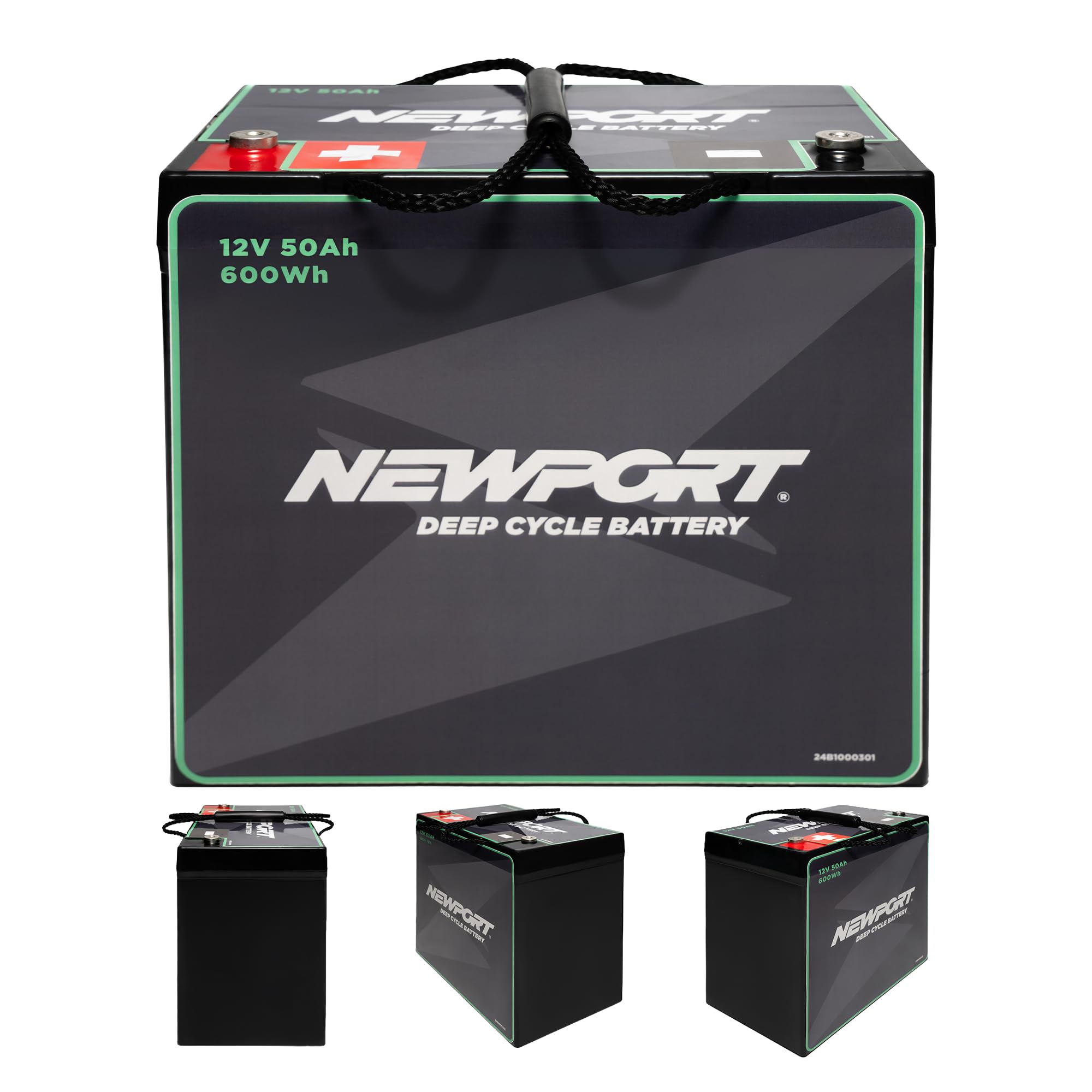
The Newport 12V50Ah hits a specific niche for kayak and small boat anglers who need a battery light enough to carry one-handed (32 pounds) but with enough capacity for a full day on the water. The 50Ah rating translates to about 4+ hours of runtime on a 55lb thrust trolling motor at moderate speeds, with owners reporting stable voltage with no sag. One reviewer even noted the battery survived a 20 MPH tumble from a truck bed with only cosmetic damage — a testament to the robust ABS case.
The marine terminal is a stud-type connector with a threaded post, which is the standard for trolling motor connections and accepts ring terminals easily. This eliminates the need for adapters that automotive post batteries would require. The sealed AGM construction means you can install it in any orientation inside a kayak hatch without worrying about acid leaks.
One limitation is the lack of a built-in charge indicator. Several owners recommend buying an external battery meter to track the state of charge accurately. Also, a customer running a 25lb thrust motor at full power got about 7 hours of runtime, which was less than expected — but it is unclear whether the battery shipped fully charged. For most casual day-use scenarios, the capacity is adequate, but long-haul overnight trips may require a second battery or a solar charging solution.
Why it’s great
- Lightweight 32-pound design makes it easy to carry and install in small kayaks or boats
- Sturdy ABS case that resists damage from drops and tumbles
- Marine stud terminals compatible with standard trolling motor ring connectors
Good to know
- No built-in state-of-charge indicator — you will need an external battery monitor
- 7-hour runtime on a 25lb motor at full power may be less than expected for some users
6. Interstate Batteries SLA1155

The Interstate SLA1155 is the quintessential 12V 35Ah drop-in replacement for a huge range of consumer equipment — lawn mowers, mobility scooters, UPS systems, emergency lighting, and solar gate openers. The flag terminal is exactly what most UPS and lawn tractor battery trays expect, making this a direct swap in many cases. The 7.76 x 5.16 x 6.26-inch dimensions fit standard Group U1 battery boxes.
The brand recognition of Interstate (founded 1952) carries weight, and the 12-month warranty is standard for the category. Owners report successful replacements on Grasshopper mowers, Drive mobility scooters, and various UPS units. The AGM/VRLA technology ensures zero maintenance and no spill risk. Some users noted that the battery seemed to last longer and felt stronger than the original equipment batteries they replaced.
There is a mixed reliability signal in the feedback. While most reports are positive, one 1-star review indicates the battery failed to hold a charge within six months in a Polaris Mule. Another reviewer mentioned the flag terminal requires different connectors than automotive post batteries they had previously used, so check your cable ends before buying. At 22.1 pounds, it is manageable for most users to transport.
Why it’s great
- Flag terminal design is a direct fit for most UPS, lawn mower, and scooter battery trays
- Backed by Interstate’s brand reputation and 12-month warranty
- Spill-proof and maintenance-free AGM construction
Good to know
- Some customers report premature failure (under 6 months) in high-vibration UTV applications
- Flag terminal may require different connectors than automotive-style post batteries
7. Mighty Max ML35-12GEL

This Mighty Max battery uses GEL electrolyte rather than the AGM format, which is an important distinction. GEL batteries have a slower self-discharge rate than AGM and excel in extreme temperature performance, making them a strong choice for outdoor gate openers, electric wheelchairs, and seasonal solar applications where the battery may sit idle for long periods. The 35Ah capacity is suited for low-power applications that cycle infrequently.
Owners specifically praise the ML35-12GEL for solar-powered gate opener setups. One verified review describes a system running a Mighty Mule gate opener with a 50W solar panel and Victron controller, plus a Wyze camera 24/7 — with no voltage drop issues and the battery recovering well after cloudy days. The GEL chemistry handles the slow, trickle charging from small solar panels better than standard AGM because it is more tolerant of undercharging.
There is a mixed experience regarding longevity in wheelchair use. One owner found the batteries did not hold charge as long as hoped in a mobile chair. However, another customer reports three batteries still going strong after five years in an off-grid pump application. The internal thread (INT) terminal is the same design found on the larger Mighty Max models, providing a secure bolt-on connection.
Why it’s great
- GEL electrolyte provides slower self-discharge than AGM, ideal for seasonal or standby use
- Excellent performance in extreme temperature environments
- Thick, non-spillable gel paste resists vibration and prevents acid leaks
Good to know
- GEL chemistry requires a specific charge profile (lower absorption voltage than AGM) — standard AGM chargers may overcharge it
- Some users report insufficient runtime in high-drain wheelchair applications
FAQ
What is the difference between AGM and GEL VRLA batteries?
Can I use an AGM battery in my flooded lead-acid charger?
How often should I charge a VRLA AGM battery in storage?
What does the “Group” size mean for VRLA AGM batteries?
Why does my VRLA AGM battery feel warm when charging?
Final Thoughts: The Verdict
For most users, the best battery vrla agm winner is the WEIZE 12V 100Ah because it delivers genuine deep-cycle capacity with a low 3% self-discharge rate and the max discharge current to handle inverter surges. If you need a drop-in replacement for a riding mower or UPS with internal thread terminals, grab the Mighty Max ML100-12 (INT). And for a compact marine battery that won’t weigh down a kayak, nothing beats the Newport 12V50Ah.