
Blackouts don’t send a warning. Neither does a drained battery at the worst possible moment. A battery with solar panel bridges that gap — converting daylight into stored energy you can tap for refrigeration, medical devices, work tools, or simply keeping the lights on when the grid goes silent. The trick is matching stored capacity, panel wattage, and inverter output to your actual appliances, not marketing claims.
I’m Min — the co-founder and writer behind Gadgets Feed. I’ve spent dozens of hours cross-referencing battery chemistry specs, real-world solar input data from customer tests, and AC output limits to separate the systems that deliver from those that look good on a spec sheet.
Whether you need a weekend camping companion or a home backup that runs a refrigerator for days, the right best battery with solar panel depends on balancing capacity, recharge speed, and physical weight against your real-world power demands — a balance this guide helps you strike.
How To Choose The Best Battery With Solar Panel
Every solar generator combines at least two components: a battery power station and one or more solar panels. The battery stores energy in watt-hours (Wh), the panels convert sunlight into electricity measured in watts (W), and the inverter determines what appliances you can actually run. A mismatch anywhere — too little panel wattage for your climate, insufficient inverter power for your fridge — turns a promising investment into a frustrating paperweight.
Battery Capacity and Chemistry
Capacity is measured in watt-hours (Wh). A 1000Wh unit can theoretically run a 100W refrigerator for 10 hours, though inverter losses and idle draw reduce that. For chemistry, LiFePO4 (lithium iron phosphate) dominates the premium tier because it delivers 3,000 to 4,000 charge cycles before degrading to 80% capacity — roughly 10 years of regular use. Lead-acid and older lithium-ion chemistries degrade faster and carry fewer cycles. If you plan to keep this system for emergencies over many years, LiFePO4 is not optional.
Solar Panel Wattage and Real-World Output
A 200W panel rarely produces 200W in real conditions. Customer tests show typical output ranges from 140W to 180W in full summer sun, dropping to 30W–60W under heavy cloud cover. The panel’s angle, temperature, and latitude all affect yield. When sizing, assume 70–80% of the panel’s rated wattage as your usable average. For daily top-offs, a single 200W panel works. For full recharges of larger 2000Wh+ batteries, you’ll want two panels or a single 400W panel to avoid relying solely on AC wall charging.
AC Output Power and Port Selection
The inverter’s continuous wattage rating determines which appliances you can run simultaneously. A 1800W unit handles a refrigerator (150–800W) plus lights and a laptop, but won’t start a well pump or 1500W space heater. Some units offer surge or boost modes that briefly double the output for motor startups. Also check the number of AC outlets, USB-C PD ports (useful for modern laptops at 60W–100W), and a 12V car port for DC devices. More ports reduce the need for external power strips.
Weight, Portability, and Expansion
Solar generators span from 27-pound weekend camping kits to 100-pound home backup behemoths. Heavier units often include wheels and a retractable handle — essential if you need to move them between garage and living room. Some systems, like the EcoFlow DELTA series, support expansion batteries that bolt on to double or triple capacity without buying a whole new unit. If your power needs might grow over time, expansion support saves significant cost compared to replacing the entire system.
Quick Comparison
On smaller screens, swipe sideways to see the full table.
| Model | Category | Best For | Key Spec | Amazon |
|---|---|---|---|---|
| Anker SOLIX C1000 + 200W Panel | Mid-Range | Camping & light home backup | 1056Wh / 1800W AC / 200W panel | Amazon |
| BLUETTI AC180 + 200W Panel | Mid-Range | Fast AC charging & versatile ports | 1152Wh / 1800W AC (2700W surge) / 200W panel | Amazon |
| EF ECOFLOW DELTA 2 Max + 220W Panel | Premium | Home backup with expansion capability | 2048Wh / 2400W AC (3400W boost) / 220W panel | Amazon |
| Anker SOLIX F3000 + 400W Panel | Premium | Whole-home or RV backup | 3072Wh / 3600W AC / 400W panel | Amazon |
| Jackery HomePower 3000 + 2×200W Panels | Premium | Lightest 3kWh for home/RV | 3072Wh / 3600W AC (7200W surge) / 2×200W panels | Amazon |
| EF ECOFLOW DELTA Pro + 400W Panel | Premium | High-capacity expandable system | 3600Wh / 3600W AC / 400W panel | Amazon |
| OSCAL PowerMax 6000 + 3×400W Panels | Premium | Split-phase 120V/240V whole-home | 3600Wh / 6000W AC (9000W surge) / 3×400W panels | Amazon |
In‑Depth Reviews
1. EF ECOFLOW DELTA 2 Max with 220W Solar Panel
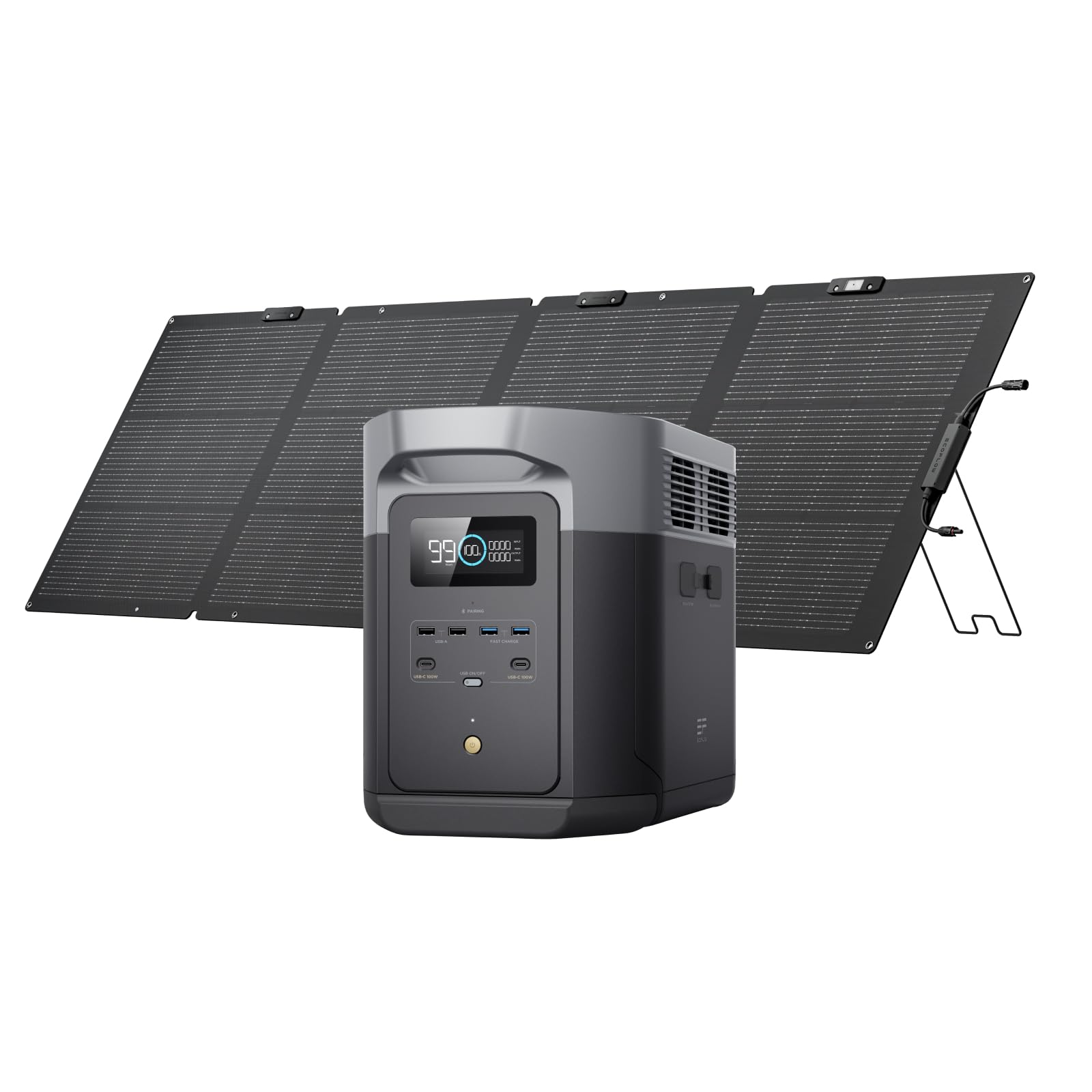
The DELTA 2 Max packs 2048Wh of LiFePO4 storage rated for 3,000 cycles, backed by a 2400W AC inverter that can boost to 3400W via X-Boost. That’s enough to run a refrigerator, freezer, and a washing machine in staggered use for 2–3 days — verified by customers who ran reef tank setups at 280W for over 6 hours. The bundled 220W solar panel delivers 140–160W in full sun and still pulls 20W under solid cloud cover, a meaningful edge over competitors that drop to zero in similar conditions. Dual charging (AC + solar simultaneously) pushes the unit from 0% to 80% in about 43 minutes, making it one of the fastest recharging options under 2kWh.
At 71 pounds, the DELTA 2 Max is heavy but manageable with its built-in handle and wheel kit. The 15 outlets — including 6 AC ports, 4 USB-A, 2 USB-C, and 2 DC ports — cover nearly every device without a power strip. The EcoFlow app provides real-time monitoring, charge automation, and remote control, though some customers report intermittent Wi-Fi connectivity during setup. The unit operates at around 30 dB, quiet enough for overnight use in a bedroom or camper. Expansion batteries can stack up to 6kWh total, offering a clear upgrade path if your power needs grow.
Where it falls short: the 220W panel’s output in real-world testing rarely matched its rating (customers report 140–160W in direct sun), and the panel stand angles are somewhat fiddly. The unit also loses efficiency below freezing, though LiFePO4 handles cold better than standard lithium-ion. For most home backup and RV scenarios, however, the balance of capacity, charging speed, and expandability makes this the most versatile all-in-one system in its class.
Why it’s great
- Fast AC + solar dual charging reaches 80% in 43 minutes
- Expandable to 6kWh with plug-and-play extra batteries
- 15 outlets cover 99% of household appliances
- 30 dB noise level for quiet overnight operation
Good to know
- 71 lbs — needs wheel kit or dolly for regular moves
- Included 220W panel outputs ~140–160W in real sun conditions
- Cold weather reduces charging efficiency despite LiFePO4 chemistry
- Panel stand angles can be finicky to adjust
2. Jackery HomePower 3000 with 2×200W Solar Panels
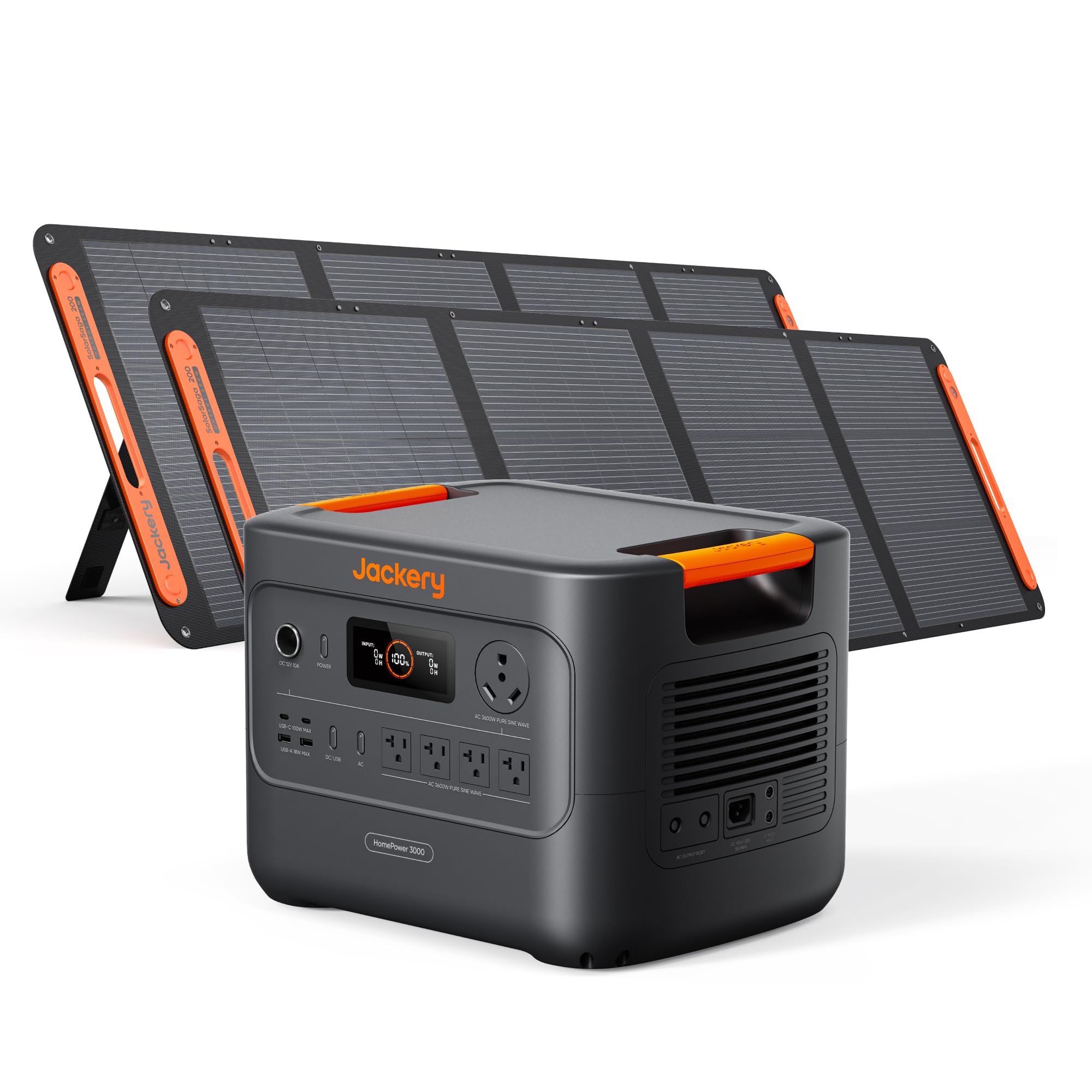
Jackery’s HomePower 3000 brings 3072Wh of LiFePO4 capacity with 3,600W continuous AC output and a 7,200W surge — the highest surge rating in this roundup, crucial for starting motors in well pumps or full-size refrigerators. The two bundled 200W SolarSaga panels can recharge the unit to 80% in about 9 hours in full sun, or you can mix AC and DC inputs for a full charge in 1.7 hours. Customers report reliably running a refrigerator for 1–2 days, while also powering two e-bikes, phones, a TV, and an internet router simultaneously without tripping the inverter.
At 59.5 pounds, the HomePower 3000 uses Jackery’s CTB (Cell-to-Body) technology to shrink the physical footprint by 47% compared to similarly rated competitors. The honeycomb bottom shell adds structural rigidity, and the integrated PV and inverter design reduces internal cabling failure points. The built-in TT-30 RV port makes plug-and-play use with travel trailers effortless, and the dual 100W USB-C PD ports charge laptops and drones at full speed.
The downsides are about weight distribution and panel logistics. The unit is heavy enough that a wheel kit or small dolly is recommended for moving between rooms. The panel instructions are sparse, and the QR code registration system has occasional connectivity issues. A few customers note that the output readings on the display differ slightly from their own metered measurements. But for home backup where you need maximum surge power in a compact footprint, the HomePower 3000 is the standout performer at this capacity tier.
Why it’s great
- 7,200W surge handles motor-starting appliances with ease
- 4,000-cycle LiFePO4 battery outlasts most competitors
- 47% smaller and 43% lighter than comparable 3kWh units
- Built-in TT-30 RV port for direct camper connection
Good to know
- About 60 lbs — wheel kit or dolly strongly recommended
- Solar panels arrive in separate packages with sparse instructions
- QR registration system had intermittent issues at launch
- Display readings occasionally differ from external metering
3. EF ECOFLOW DELTA Pro with 400W Solar Panel

The DELTA Pro is the heavyweight champion at 3,600Wh (3600W continuous / 7200W surge) with a 400W foldable solar panel rated at 22.4% conversion efficiency. Customers confirm it runs a car refrigerator for 3+ cloudy days with power to spare, and home users report keeping two refrigerators running through multi-day outages. The panel weighs 35.3 lbs and folds into a carry case with an IP68 waterproof rating — meaning it’s fully dust-tight and submersible, a rare spec for portable panels. AC charging fills the unit in about 2.2 hours, and with 3×400W panels you can achieve a full solar recharge in 3.5 hours.
The unit itself tips the scales at 99 pounds, but the integrated wheel set and pull handle make it rollable across flat surfaces. The 15 outlets include 5 AC ports, 4 USB-A, 2 USB-C (up to 100W PD), and 2 DC ports, plus an Anderson port for high-current DC loads. The EcoFlow app provides granular control over charge limits, discharge thresholds, and output scheduling. Two expansion ports allow stacking of extra batteries to reach 10.8kWh or more, making this the most scalable option short of a full home installation.
The main trade-off is weight and usable capacity. Some customers note the unit shuts off at 25% remaining charge to protect the battery, reducing real-world usable capacity to about 2,700Wh out of 3,600Wh — a significant consideration if you’re budgeting runtime for critical appliances. The 400W foldable panel’s carry bag lacks storage for cables, and the panel’s kickstand angles are limited compared to frame-style competitors. But if you need expandable whole-home backup with a truly weatherproof solar panel, the DELTA Pro is unmatched in its class.
Why it’s great
- IP68 waterproof foldable panel withstands rain, dust, and submersion
- Two expansion ports support up to 10.8kWh total capacity
- 15 outlets including 100W USB-C PD and Anderson DC
- Integrated wheels and handle for mobility despite 99 lbs
Good to know
- Shuts off at 25% capacity — effective usable power ~2,700Wh
- 99 lbs — not portable in the traditional sense
- Solar panel carry bag lacks cable storage compartments
- Panel kickstands have limited angle adjustment range
4. Anker SOLIX F3000 with 400W Solar Panel
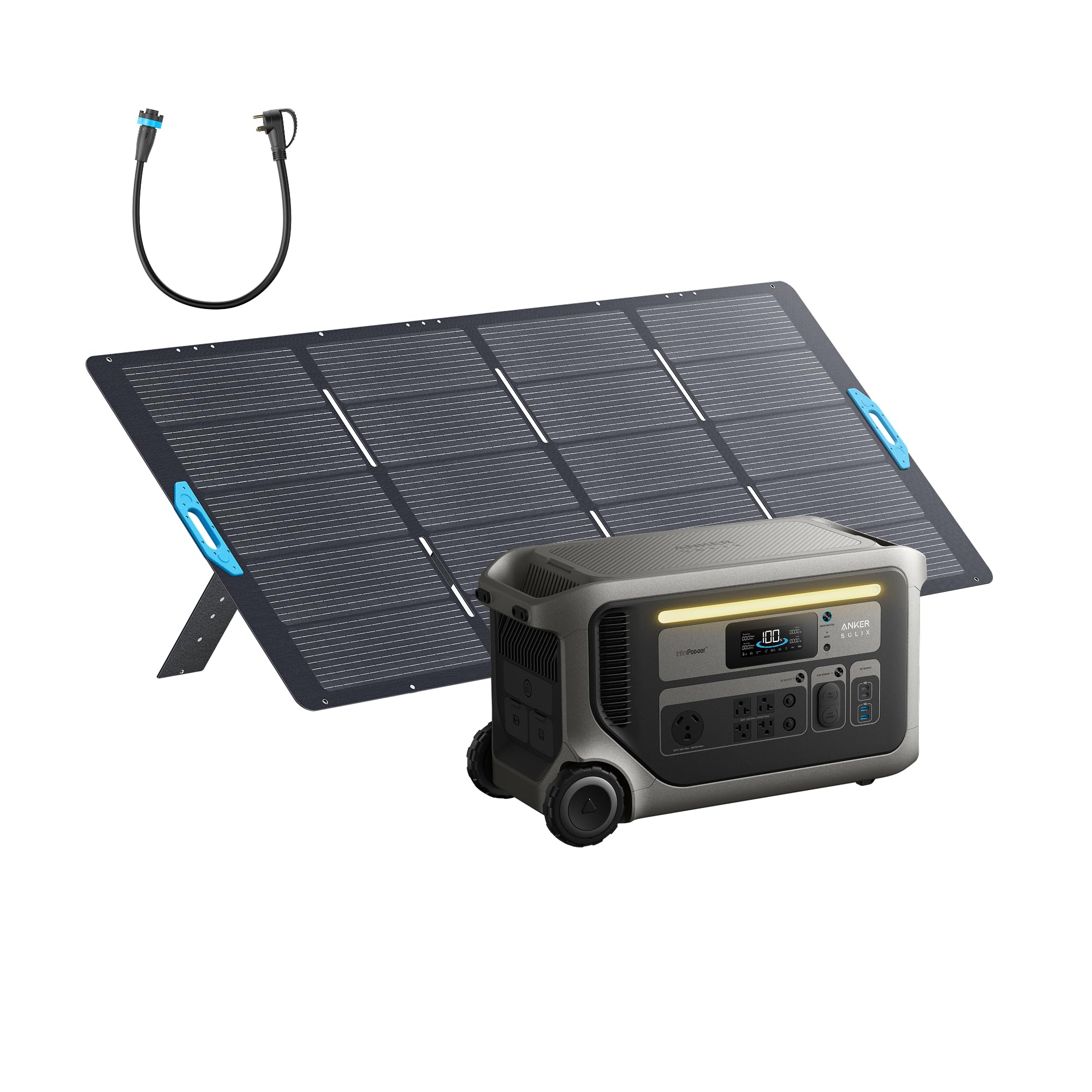
The Anker SOLIX F3000 combines a 3,072Wh LiFePO4 battery with a 400W portable solar panel — and a headline feature: 6,000W recharge speed when combining a fuel generator and solar simultaneously. That means in an extended outage you can recharge the battery from near-empty to full in roughly 90 minutes using a 30A AC input, while the solar panel adds top-up current in parallel. Customers have validated this setup powers a 13,000 BTU RV roof air conditioner on low cool for 6–8 hours, and runs home refrigerators and freezers for 4 continuous days. The ultra-low idle consumption (125 hours of AC standby) means less wasted energy when the unit is on but not actively powering loads.
The F3000 supports 120V/240V dual voltage when pairing two units, and its 30A TT-30 RV port is standard for direct connection to travel trailers. The included PS400 panel uses monocrystalline cells rated at 23% efficiency, though customer tests show practical output around 160W at noon and ~100W under cloud cover — about 40% of the rated spec, which is typical for portable panels. The six-inch wheels and retractable handle make this 91.5-pound unit rollable across a garage or yard, though carrying it upstairs is not realistic without help.
The biggest caveat: the solar panel’s stand is weak and hard to deploy, with snaps that don’t hold the panel securely in windy conditions. The panel itself is also large and heavy, which customers note reduces the “portable” aspect. The Wi-Fi connection for app control can be finicky, and the retracting handle requires two hands to operate smoothly. But for home backup where AC charging speed and simultaneous generator+solar input are priorities, the F3000 delivers the fastest recharge of any unit in its capacity class.
Why it’s great
- 6,000W combined recharge (solar + generator) for near-empty to full in ~90 minutes
- 125 hours of AC idle standby — lowest standby draw in this class
- 30A TT-30 RV port standard for direct camper hookup
- Expandable to 24kWh with additional batteries
Good to know
- 91.5 lbs — carrying upstairs is impractical
- Solar panel stand is weak with unreliable snaps in wind
- 400W panel only delivers ~160W in real sun tests
- Wi-Fi connectivity for app control can be inconsistent
5. BLUETTI AC180 with 200W Solar Panel

The BLUETTI AC180 delivers 1152Wh of LiFePO4 capacity with 1800W continuous AC output (2700W surge) — enough to run a full-size refrigerator, microwave, or sump pump. The bundled 200W solar panel fully recharges the unit in 4.8 to 9.6 hours depending on sun conditions, and customer tests show the panel pulling 161W in clear sun and 57W on cloudy days. The real standout is the 1440W AC flash charge: no bulky adapter needed, just a single cable that hits 80% in about 45 minutes. At under 35 pounds, the AC180 is one of the lightest units in the 1000Wh+ class, making it genuinely portable for camping trips or truck use.
The 11 outlets include four AC ports, two USB-C (one at 100W PD), four USB-A, a car port, and a wireless charging pad on top. The ≤10ms UPS switching protects sensitive electronics during power drops, and the Bluetooth app provides real-time power monitoring from up to 100 feet away.
The drawbacks: the solar panel had a mildew odor issue in some units (though BLUETTI replaced affected panels under warranty), and the fan is audible under high load — about 35–40 dB based on customer reports. The unit also consumes up to 20W when idle, so the auto power-off feature is essential for preserving stored energy overnight. For buyers who need a solid mid-range system that doesn’t break the bank, the AC180 is the best balance of capacity, weight, and charging speed in this segment.
Why it’s great
- 1440W AC flash charge hits 80% in 45 minutes with a single cable
- Under 35 lbs — genuinely portable for camping and truck use
- 11 outlets including 100W USB-C PD and wireless charging pad
- ≤10ms UPS switching for sensitive electronics
Good to know
- Solar panel may have a mildew odor issue in some units
- Fan is audible (~35–40 dB) under high AC load
- Uses up to 20W when idle — auto power-off needed to conserve
- Solar panel delivered separately from the power station
6. Anker SOLIX C1000 with 200W Solar Panel

The Anker SOLIX C1000 packs 1056Wh of LiFePO4 capacity with a 1800W inverter (2400W SurgePad) into a 27.6-pound chassis — the lightest unit in this roundup relative to its capacity. The headline spec is the 80% recharge in 43 minutes via AC with UltraFast mode enabled through the Anker app, and 100% in 58 minutes. The bundled 200W PS200 solar panel features IP67 waterproof construction (fully dust-tight and protected against immersion), four adjustable angles (30°, 40°, 50°, 80°), and monocrystalline cells rated at 23% conversion efficiency. Customer tests show steady 180W output in full sun with peaks above 200W, and the panel can be angled to maximize winter sun capture.
In real-world use, customers report the C1000 running a 1/3hp sump pump running every 5 minutes for 15 seconds over an hour — consuming just 6% of the battery. Truck drivers use it for microwaves (8% per meal) and coffee makers (4% per brew). A CPAP with full humidity and heated tubing drained to 48% overnight, and in 34°F camping conditions dropped to 16% over 9 hours. The 11 ports include 6 AC outlets, 2 USB-C (one at 100W PD), and 4 USB-A, and the Anker app provides wattage monitoring and remaining runtime estimates.
The weaknesses are specific but real. The 200W panel is not enough to fully recharge the C1000 from a deep discharge in a single day unless conditions are perfect — customers in 34°F camping conditions saw only 16% solar recovery overnight. The unit itself is not weatherproof (only the panel is), so it must be kept dry. A few customers noted a mild mildew odor on the panel that required replacement. But for anyone needing a lightweight, fast-recharging system for camping, trucking, or light home backup, the C1000 offers the best portability-to-speed ratio in the sub-1100Wh category.
Why it’s great
- 80% AC recharge in 43 minutes — fastest in its capacity class
- 27.6 lbs — lightest 1000Wh+ unit in this roundup
- IP67 waterproof solar panel withstands heavy rain and dust
- Four adjustable panel angles optimize winter and summer sun
Good to know
- Single 200W panel may not fully recharge in one day in winter/cold
- Power station is NOT weatherproof — keep dry at all times
- Some panels shipped with a mildew odor needing replacement
- UltraFast charging requires smartphone app activation
7. OSCAL PowerMax 6000 with 3×400W Solar Panels
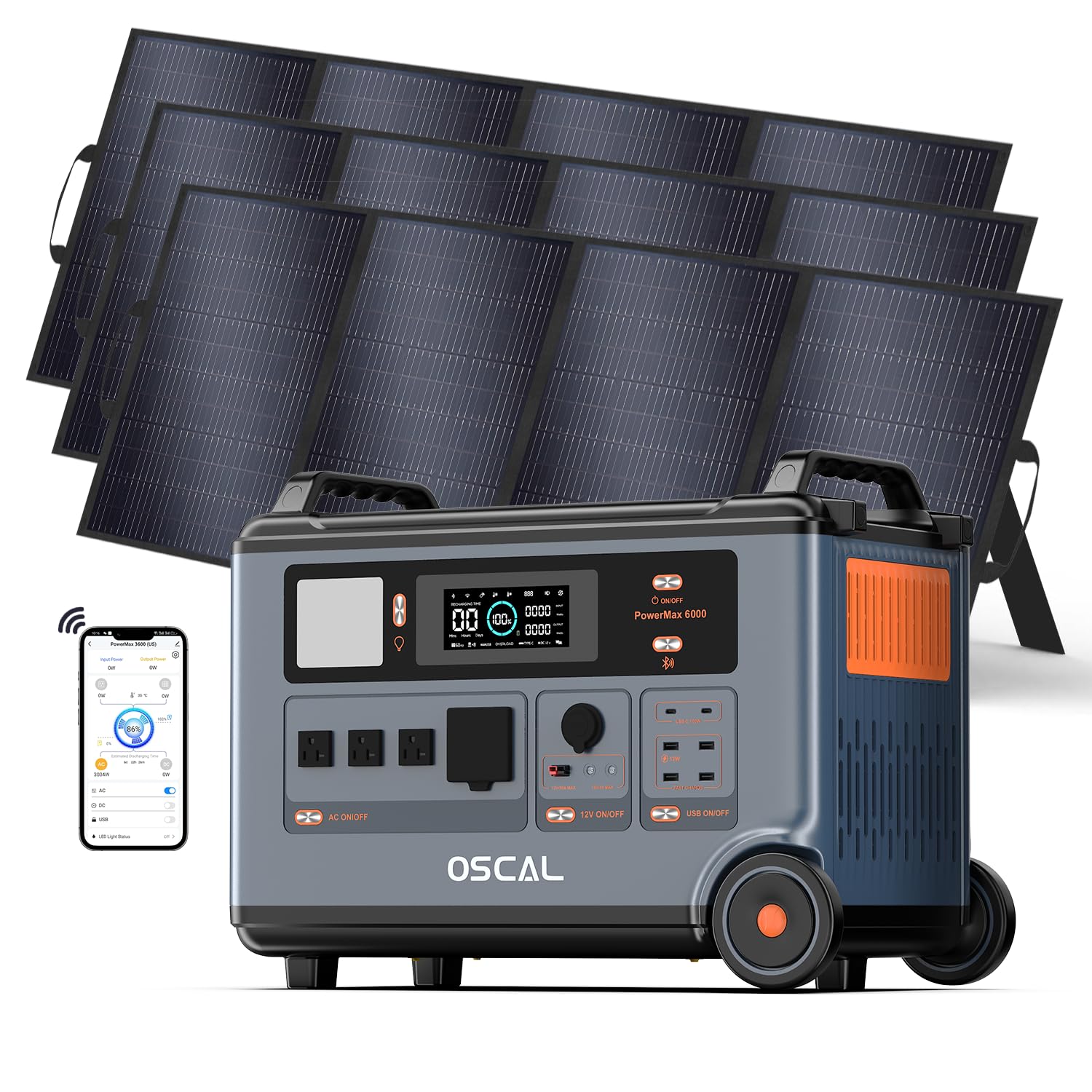
The OSCAL PowerMax 6000 is the only system in this roundup that natively supports 120V/240V split-phase output, making it compatible with heavy 240V appliances like well pumps, central air handler blowers, and electric dryers. It delivers 3600Wh of LiFePO4 capacity with 6000W continuous AC output (9000W surge) across four AC outlets. The three bundled 400W solar panels can charge the unit at up to 2400W solar input — meaning you can go from 0% to 100% in about 1.5 hours in full sun, or combine AC charging at 2200W for a full recharge in under 2 hours. The EPS system switches to battery backup within 5–8ms, suitable for sensitive electronics and network equipment.
The unit weighs about 100 pounds (45.5 kg), but the integrated handle and wheel set make it rollable across a garage or patio. Customers report the fan is quiet and the unit emits a beep when fully charged — a useful audible indicator. The OSCAL app provides remote monitoring, charge scheduling, and power usage tracking. The LiFePO4 battery is rated for 3,500 cycles (about 25 years of service at one cycle per two days), and the eight-layer BMS protects against overvoltage, short circuit, and thermal events. The three 400W panels deliver a combined 1,200W of rated solar input, which is enough to fully recharge the battery in a single sunny day even accounting for real-world efficiency losses.
The biggest concern is the solar panel yield — some customers report the panels only output a fraction of their rating (one test shows a single LED bulb dropping from 100% to 85% in 2 hours, suggesting higher standby draw than expected). The AC charging cable is also noted as too short for convenient wall plug placement. The 240V function is hidden behind a specific outlet and requires understanding that it works for woodworking equipment as tested, but documentation is sparse. Still, for any homeowner needing split-phase 240V backup without installing a transfer switch and generator, the PowerMax 6000 is the only all-in-one solar bundle that delivers that capability out of the box.
Why it’s great
- Native 120V/240V split-phase output — runs well pumps and dryers
- 2400W solar input charges fully in ~1.5 hours in good sun
- 3,500-cycle LiFePO4 rated for up to 25 years of service
- 5–8ms EPS switching protects network equipment
Good to know
- ~100 lbs — needs wheels for movement, not truly portable
- Solar panel yield in testing was significantly below rated spec
- AC charging cable is shorter than ideal for most wall outlets
- 240V setup documentation is sparse and takes trial to understand
FAQ
How many watts of solar panel do I need for a 1000Wh battery?
Can I add more solar panels to my system later?
Do these units work during a power outage without internet?
How long does a solar generator typically last before the battery needs replacing?
Will my solar panels still charge under cloud cover or rain?
Final Thoughts: The Verdict
For most users, the best battery with solar panel winner is the EF ECOFLOW DELTA 2 Max with 220W Solar Panel because it packs 2048Wh of expandable LiFePO4 capacity, 2400W AC output, and blazing-fast dual charging into a package that balances weight, performance, and real-world solar input better than any single competitor. If you want maximum surge power and long-term cycle life in the most compact 3kWh footprint, grab the Jackery HomePower 3000 with 2×200W Panels. And for split-phase 240V whole-home backup that can run well pumps and heavy appliances, nothing beats the OSCAL PowerMax 6000 with 3×400W Solar Panels.