
Our readers keep the lights on and my morning glass full of iced black tea. As an Amazon Associate, I earn from qualifying purchases.
Specs are compiled from manufacturer listings and verified buyer reviews and can change over time — please confirm the key details on the product page before buying.
Choosing the right batting cage net means deciding between a free-standing frame you can move and a hanging barrier you attach to an existing structure. Get that wrong and you either wrestle with a wobbly frame or try to hang a heavy net from a flimsy fence. This guide separates the pop-up nets from the hanging backstops, so you can match the right style to your yard, garage, or team practice.
I’m Min — the founder and writer behind Gadgets Feed. This guide is built by comparing the manufacturers’ published specifications and the patterns across verified customer reviews, so you get each pick’s real strengths and trade-offs instead of marketing spin.
We break down the top batting cage nets by size, frame material, and the real-world durability buyers report after months of use.
Our Picks at a Glance
How To Choose The Best Batting Cage Nets
Before you buy, you need to decide if you want a self-supporting net that sets up anywhere or a permanent net you hang on a frame, fence, or garage beam. Each style serves a completely different practice setup, and picking the wrong one means wasted money.
Portable Frame vs. Hanging Backstop
A portable frame net, usually 6×6 or 7×7 feet, stands on its own with bow poles, so you can set it up in the yard or take it to the field. A hanging net, often 55 feet long or more, needs a structure like a pole system or garage beams, but gives you a full enclosed cage for live pitching and machine work.
Frame Material and Pole Thickness
The frame is what keeps the net from tipping over when a hard line drive smacks it. Fiberglass bow poles offer flexibility and shock absorption, while steel frames add weight and stability. Look for thicker poles — a 12.7mm fiberglass pole is noticeably more rigid than a 10mm one, which means less wobble during a powerful swing.
Netting Ply and Mesh Density
Netting strength comes from how the twine is braided and how tightly it’s woven. A 7-ply knotless net spreads impact better than a basic single-ply net, and mesh size matters: a 1.8-inch or 2-inch square mesh stops baseballs cleanly, while larger gaps may let balls through. If you plan to leave the net outside, UV-treated and weatherproof materials prevent the sun from weakening the twine.
Quick Comparison
| Model | Best For | Size | Frame Material | Frame Type | Amazon |
|---|---|---|---|---|---|
| Bownet Big Mouth X★ Best Overall | Portable, tool-free setup | 7×7 ft | Aluminum | Pop-up | Amazon |
| PowerNet Triple ThreatMulti-Station | Multi-player team drills | 7×7 ft | Nylon/Polyester | Pop-up | Amazon |
| YeahChi 7×7Best Starter Set | Complete starter set | 7×7 ft | Alloy Steel | Pop-up | Amazon |
| BAGAIL 7×7 | All-around value pick | 7×7 ft | Alloy Steel/Fiberglass | Pop-up | Amazon |
| WOVUO 6×6 | Compact starter net | 6×6 ft | Alloy Steel/Fiberglass | Pop-up | Amazon |
| ZivPlay 30x12x8 | Full walk-in cage | 30x12x8 ft | Fiberglass | Pop-up Cage | Amazon |
| NQB Backstop Net | Versatile hanging barrier | 15×50 ft | Nylon | Hanging | Amazon |
| NWS Backstop Net | Professional-grade netting | 25×50 ft | HDPP Twine | Hanging | Amazon |
| ORIENGEAR 55x12x12 | Enclosed cage net only | 55x12x12 ft | PE Mesh | Hanging | Amazon |
In-Depth Reviews
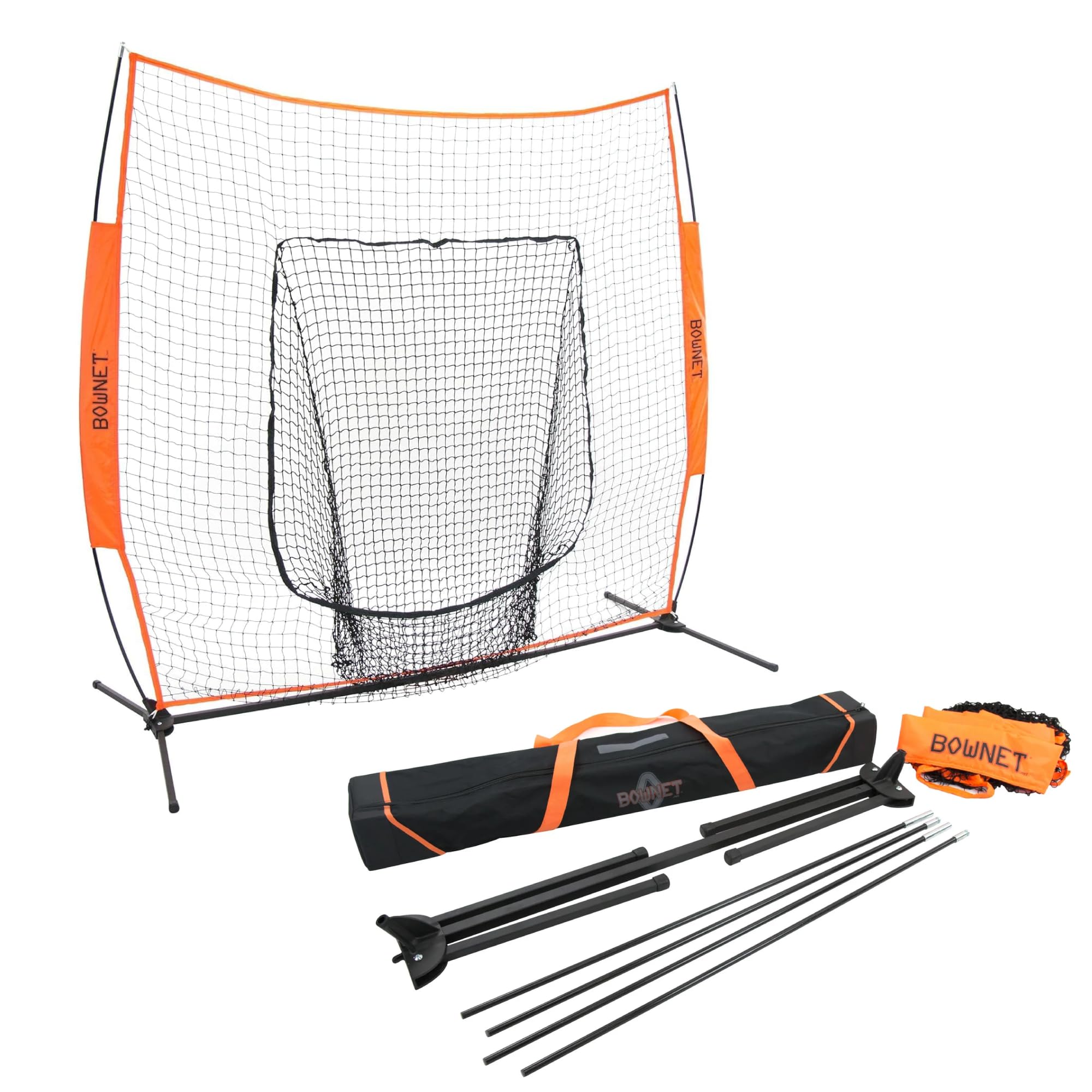
1. Bownet Big Mouth X Net
Our pick — over 4.5★ from 950+ verified ratings; the strongest balance of quality and price.
The gold standard for portable batting practice, offering a minute and a half setup that rivals pricier alternatives.
While other nets wobble and need constant re-anchoring, the Bownet stands on its own without guy ropes — that’s the first thing that strikes you. The one-piece base frame combines the hinge and pole sockets into a single piece, so there are fewer parts to lose and setup takes about a minute. Owners timed assembly at 1:37, beating the Jugs Travel net’s 2:48 for quick between-innings setup.
At 17 lb, it fits in the included carry bag and any car trunk, so it’s the portable option that gets used at tournaments and parks. Owners praise quality most (480+ mentions), with the aluminum frame surviving hardest hits without bending or tipping.
The honest trade-off is the netting — a few owners note it’s thin and rip-prone if you leave it out in rain or pile weight on it. It’s designed for practice sessions, not permanent outdoor installation, so treat the netting with care and it will last. Owners mention the bag rips quickly too, which is a minor annoyance given the quality of the rest of the package.
What Owners Love
- Stands on its own without anchors or guy ropes
- Setup is genuinely tool-free and takes about a minute
- Aluminum frame withstands hard hits without bending
- Compact 17 lb design with carry bag
The Trade-offs
- Netting is thin and prone to rips if left in weather
- Carry bag tears quickly with regular use
Grab it if: you want a portable net for tournaments, team practice, and regular drills that sets up faster than the competition.
Think twice if: you plan to leave it outdoors in rain and sun year-round — the netting needs the dry treatment to stay intact.
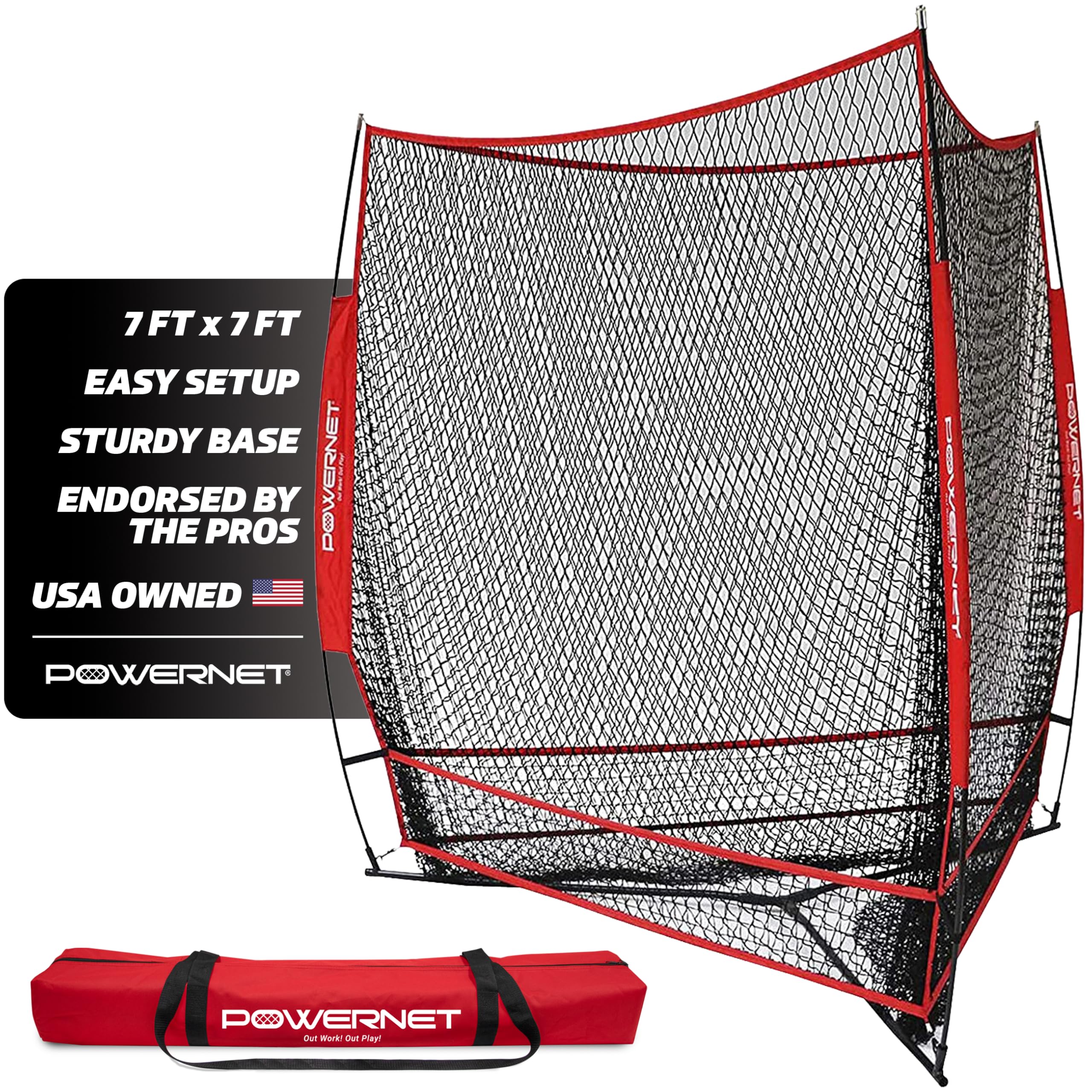
2. PowerNet Triple Threat Baseball Net
Three training stations in one frame, letting a whole team rotate through drills without touching a single net.
Instead of buying three separate nets, this 7′ x 7′ design gives you three usable sides that cover 147 sq ft of practice surface — hitting, pitching, and fielding drills can all run simultaneously. Owners note it replaces multiple nets for youth teams, with all three sides usable at once for hitting and pitching. It’s the rare net that earns its keep during team practices, not just solo sessions.
Setup stays under 2 minutes with no tools, and the collapsible frame packs into a carrying bag. Stability is the recurring concern though — the aspect that gets the most negative feedback. It needs staking on windy days, and the side chord occasionally slips loose, though owners say it’s easily fixed. A 6’2″ hitter at 220 lbs tested it without issues, but the frame does show its limits in a stiff breeze.
The upsides, though, are substantial for team use. Owners running gym practices for 4-6 athletes at once love that you get three nets for a modest step up from a standard single net price. The included ground stakes and four sand bags add security, though a foam mat under the tee is recommended to protect gym floors.
Reach for this if: you coach a team and need multiple simultaneous practice stations without buying several separate nets.
Look elsewhere if: you practice alone in windy conditions — this frame demands staking and a calm day to stay put.
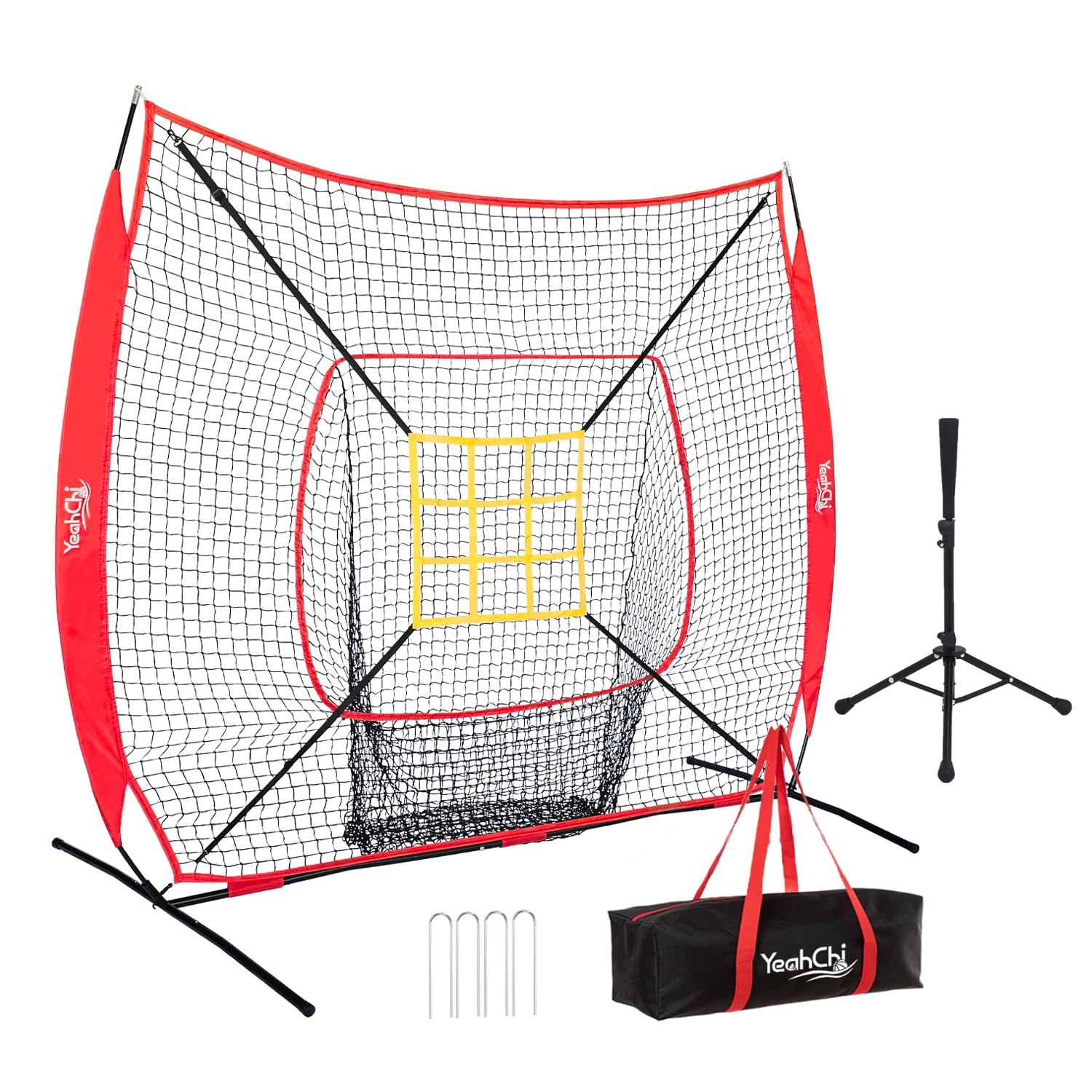
3. YeahChi 7×7 Ft Baseball Training Net
Everything a young player needs in one box — net, tee, and strike zone — at an entry-level price point.
This set bundles a 7×7 ft net, an adjustable batting tee, a built-in yellow strike zone target, ground stakes, and a carry bag, so a family gets a full practice setup without buying pieces separately. For a parent introducing a young player to batting and pitching drills, that completeness is the whole value proposition. The steel frame is built for repeated use, and the included strike zone helps batters focus on accuracy during both hitting and pitching work.
You can leave this net outside all year, and it will still hold up — one buyer reports it “has sat out in the rain, high wind, scorching sun and high heat and is still just as good as the day I bought it.” That durability matters for a backyard net that stays in the elements. Buyers most often mention quality and value for money, and the 7×7 size works well for tee work and soft toss.
The catch is wind stability. One owner notes the stand will fall if the batter hits the balls into the net, so you may need to weight the stands down. The included stakes help, but this isn’t a set-and-forget structure in a gusty yard. A 2-year manufacturer warranty backs the purchase, which adds some confidence.
Bottom line: the most complete starter package for a family that wants a net, tee, and target in one box, built to handle outdoor weather.
Watch for: wind knock-over in exposed yards — use the stakes and consider weighting the base on breezy days.
4. BAGAIL 7×7 ft Baseball Training Net

The value champion that packs a complete kit — net, tee, baseball, and targets — for less than most bare nets cost.
The 7-ply knotless thickened polyester mesh makes this net durable against the hardest hits, while the heavy-duty steel rod and reinforced fiberglass tubes provide the cushioning that maintains shape over time. Quality is the top-mentioned aspect, with over 140 owners praising it, and a full kit is included: adjustable batting tee, a baseball, two strike zone targets, and four ground stakes all ship in the box.
Setup is genuinely quick — you can install the net within 2 minutes with no tools, and the detachable bow frame packs into the carry bag for travel. Owners note it doesn’t blow over in storms because the base is sturdy, and the size catches most hits during practice. The netting is thick enough to produce minimal bounce, which keeps the ball in the collection pocket and reduces chasing.
Durability gets mixed feedback though — the weakly sewn target straps came apart for one owner, and the build quality of the accessories has drawn some criticism. The main net itself holds up, but the add-ons like the target straps and ball cradle are where cost-cutting shows. A minor tear appeared for one owner after a week, though that was self-inflicted.
Grab it if: you want the most complete kit for the money, with a sturdy net and all the extras included.
Think twice if: you need a net that lives outdoors permanently — the accessory straps and cradle are the weak points, not the main netting.
5. WOVUO 6×6 ft Baseball Net

The 6×6 option that doesn’t skimp on materials, with 12.7mm fiberglass poles and a coated steel base.
If a 7×7 feels too big for a small yard or garage, this 6×6 ft net keeps the heavy-duty build in a tighter footprint. The 7-ply knotless thickened netting handles hard batting, and the coated heavy-duty steel support base provides weight-bearing stability. Each bow frame leg has rubber feet and ground stakes, which helps it stay put on concrete or grass.
The 12.7mm thick fiberglass bow poles are more rigid than the 10mm poles on cheaper nets, so they keep their shape for long-term use. Northeast customers note four months of snow coverage left it “still looks brand new.” That weather endurance is rare in this size class, and the 365-day warranty backs the build.
The 17% smaller surface area versus a 7×7 net means it catches slightly fewer wild balls, but the included ball caddy holds at least 50 balls and the sock net holds multiple buckets’ worth. The adjustable tee’s tripod legs are sturdy, though one owner notes the tee is too tall for kids under 10. It’s more of a fit note than a flaw — the height adjustment has limits for young children.
Perfect for: families with limited yard space who still want a net that survives real weather and hard hits.
Keep in mind: the tee runs tall for the youngest players, so small kids may need a box or a shorter setup.
6. ZivPlay 30x12x8 Baseball Batting Cage

A full 30-foot walk-in cage with a 20×40-inch opening for pitching machines, turning a backyard into a real practice facility.
This is the net for families who want the real cage experience at home. The 30x12x8 ft enclosure lets a hitter take a full stride and follow through without worrying about the net, and the 20″ x 40″ pitching hole means you can feed a machine or pitch live from inside. The 3-ply stretchable polyester net rebounds softly, so balls drop rather than rocket back at the hitter.
The 12.7mm fiberglass poles are thicker than the 10mm frames on cheaper cages, which helps it survive heavy winds. Eight supporting ropes with ground pegs anchor the cage, and reviewers point out it survives daily abuse from a 5’11” hitter without the frame failing. Setup takes under 30 minutes with no tools, and a step-by-step visual manual walks you through it.
The mixed feedback centers on assembly and the hardware. Some owners found the initial setup difficult as poles separate during insertion, and the included yellow ground pegs broke in wind and rain — several replaced them with metal stakes. A couple of owners reported a hole developing in the net after a couple months of hard use, and gaps at the machine opening can let balls escape unless you zip-tie them shut. It’s a solid cage for the money, but the accessories are where corners get cut.
Why It Wins
- Full 30-foot cage for realistic practice space
- 3-ply net rebounds softly and stops balls instantly
- Thicker 12.7mm poles resist wind and hard hits
Where It Strains
- Initial assembly is a 2-person job and takes patience
- Yellow ground pegs break in weather — swap for metal
- Gaps at the machine opening can leak balls
Best if: you have the yard space and want a full cage for live pitching and machine work, not just tee drills.
Not ideal if: you want a quick pop-up for occasional use — this is a permanent or semi-permanent backyard structure.
7. NQB Baseball Backstop Net
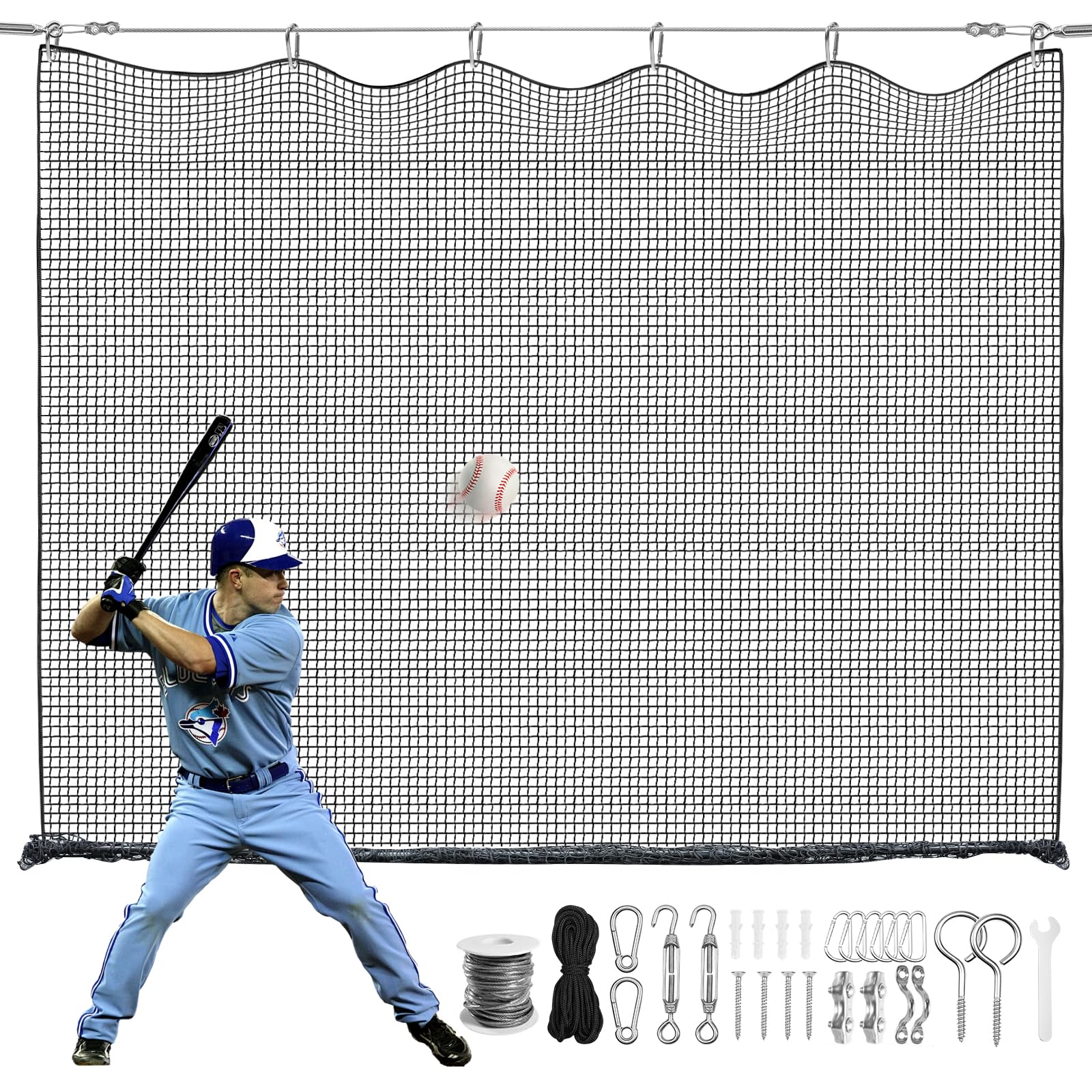
One massive 15×50-foot nylon sheet that hangs on anything, protecting windows and cars while catching every sport’s projectiles.
This isn’t a frame net — it’s a hanging barrier that uses premium nylon netting for stronger abrasion resistance than ordinary PE options, and it’s built to stop baseballs, softballs, and even hockey pucks. The 1.8-inch square mesh and durable twine make it a dependable backstop for protecting windows, cars, and walls during backyard drills. Owners have also used it as a dog kennel top cover and a soccer field fence extension, which tells you how versatile the material is.
The kit includes a 33-foot rope plus a steel hanging kit, so you can attach it to fence, poles, frame structures, or garage beams without buying extra hardware. One owner hung it across a 10-foot span on coated stainless wire with no wear after 18 months of intense sun. Installation takes about 20 minutes, and the 15×50 ft size covers a large practice area.
Because it’s a hanging net, it needs something solid to attach to — it won’t stand on its own. That’s not a flaw, just a different use case. The quality gets positive feedback at 25 mentions, and durability at 13, with owners noting it holds up well against repeated impacts. It’s the right choice for turning an existing structure into a safe training space.
Built for: families and coaches who have a fence, poles, or garage beams and want to create a large protected practice zone.
Requires: a mounting structure and about 20 minutes of hanging time — this is not a pop-up net.
8. NWS Baseball Backstop Net

The heavy-duty netting that survives years of ice, snow, sun, and rain without losing its edge.
When a net needs to last for years, the material is everything, and this one is crafted from High-Density Polypropylene (HDPP) twine in a 2-inch knotted square mesh. Its 200-pound breaking strength stops hard-hit baseballs and survives years of outdoor weather. It’s fully weatherproof and UV treated, so the sun won’t degrade the twine over time.
At 25×50 ft, this net is big enough to serve as a batting cage side, a backstop, or a facility protection barrier. It’s available in 82 sizes, so you can find a fit for your specific space. Owners use it for soccer, basketball, and as a predator deterrent for cats — one 12-foot high panel stopped cats from vaulting over a fence without any chewing damage.
Durability is the most-discussed positive aspect at 69 mentions, with value for money close behind at 43. One owner reports it endured ice, snow, sun, and rain year-round for 4-5 years. The honest caveat is size — some owners wish for more size options, and the 128 lb weight means installation is a two-person job. It’s easy to hang on wires or tie onto frames, but you’ll need sturdy mounting points and some muscle.
The Long Game
- 200 lb breaking strength stops hard hits
- Weatherproof and UV treated for years outdoors
- Available in 82 sizes for a custom fit
The Heavy Side
- 128 lb weight needs a sturdy structure and two people
- Some owners wanted even more size variety
Choose this if: you’re building a permanent facility-quality backstop that must last through years of weather.
skip it if: you need something portable — at 128 lbs, this net is a permanent installation.
9. ORIENGEAR Baseball Batting Cage Nets
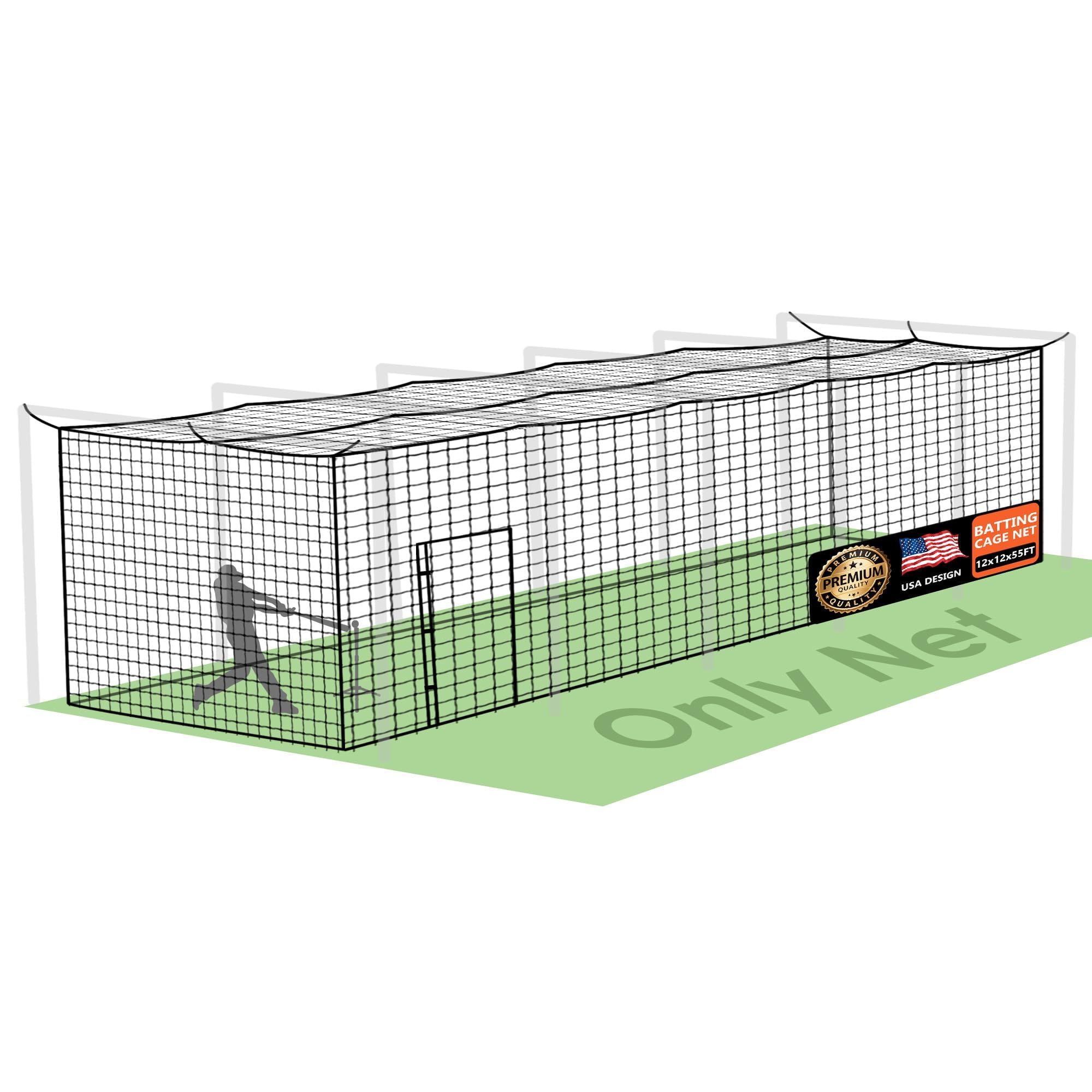
A fully enclosed 55-foot net with a self-closing side door, built for a permanent backyard or garage cage.
This is the net-only option for someone who already has poles or a frame structure. The 55x12x12 ft PE mesh is UV-stabilized, so it keeps its form through bright sunshine, wind, and rain season after season. The 1.8″ #45 mesh does a great job intercepting baseballs, and the reinforced edge design prevents fraying. It’s a professional-grade option at a price that’s lower than the other full-cage netting.
The one-piece design includes three pull cords long enough to pull taught, plus two tethers and an additional center roof tether, so installation to a frame system is straightforward. The side entry door is 78.7 inches high by 31.5 inches wide, with a closable design that naturally sags and closes when not in use — preventing balls from flying out mid-session. Two people can set it up in one afternoon, and daily shop use for a year left no rips or tears.
The critical thing to know: this is the net only. Poles and hooks must be purchased separately, so measure your space before buying. One owner noted it lacked the opening for a pitching machine as described in the listing, though the build quality itself held up to constant Hawaiian rain and sun. It’s a great value if you already have the frame, but expect to source mounting hardware yourself.
Best for: anyone with an existing pole structure or frame who wants to upgrade to a fully enclosed, weatherproof cage net.
Remember: this ships with no poles or hooks — factor in buying the frame before you commit.
Understanding the Specs
Mesh Density and Ply
Mesh density is the number of strands woven together and the size of the gaps between them. A 7-ply knotless net spreads the impact of a hard-hit ball across more strands, which absorbs energy better and protects the netting from tearing at a single point. Mesh size like 1.8-inch or 2-inch square matters too — that’s the hole between strands. A smaller gap stops baseballs cleanly, while larger mesh can let balls punch through on a hard line drive. If you’re practicing with regulation baseballs, look for a denser mesh with a smaller opening.
Frame Material and Pole Thickness
The frame determines whether your net stays standing after a hard impact. Fiberglass bow poles offer flexibility — they bend under impact and bounce back to shape, which adds shock absorption. Steel or aluminum frames are more rigid and provide better stability against wind. Pole thickness is measured in millimeters, and thicker poles like 12.7mm are significantly more rigid than 10mm frames. That difference matters most when a powerful hitter generates hard line drives that hit the frame directly. For a net that stays standing and keeps its shape, prioritize pole thickness over other frame features.
FAQ
Will a 6×6 net be big enough for my teenage player?
Do I need ground stakes for a 7×7 pop-up net?
What is the difference between a pop-up net and a hanging backstop net?
Can I leave a batting cage net outside year-round?
Will a batting cage net stop a hard-hit ball from a pitching machine?
What is the difference between a 7-ply and a 3-ply net?
Can I use a baseball net for softball practice?
How long does it take to set up a pop-up batting net?
What size batting cage net do I need for a pitching machine?
Are batting cage nets easy to take down and store?
Final Thoughts: The Verdict
The batting cage nets winner for most players is the Bownet Big Mouth X because its tool-free, 90-second setup and a sturdy frame that stands without anchors make it the portable option that actually gets used. If you want a full kit with a tee and strike zone included, grab the YeahChi 7×7 for a family-friendly starter set. And for a permanent backyard cage that can handle a pitching machine and live pitching, the ZivPlay 30x12x8 turns your yard into a true practice facility.
How We Picked
We do not accept paid placement. Every pick is matched to a real buyer and a real use-case; we do not hands-on test units.
Sources & Methodology
Specifications: manufacturer listings and product documentation. Review insights: verified customer reviews, as of August 2026. Pricing: not shown on this page (it changes often); check the current price via the retailer link.
As an Amazon Associate, Gadgets Feed earns from qualifying purchases. This does not affect which products we feature.