
Our readers keep the lights on and my morning glass full of iced black tea. As an Amazon Associate, I earn from qualifying purchases.
Specs are compiled from manufacturer listings and verified buyer reviews and can change over time — please confirm the key details on the product page before buying.
Every backyard slugger knows the real game: it’s not just about the swing, it’s about the 15 minutes you spend hunting for the ball that flew over the neighbor’s fence. A proper batting cage changes that entire equation, turning a frustrating chore into pure, focused repetition. The challenge is matching frame, netting, and size to your hitters’ power and your yard’s dimensions.
I’m Min — the founder and writer behind Gadgets Feed. This guide is built by comparing the manufacturers’ published specifications and the patterns across verified customer reviews, so you get each pick’s real strengths and trade-offs instead of marketing spin.
Whether you are a parent setting up for a young slugger or a player building a home training facility, finding the best batting cages for backyard means weighing portability against durability and size against your actual space.
Our Picks at a Glance


How To Choose The Best Batting Cages For Backyard
Measure your yard, assess hitter power, and decide between a permanent or portable setup before purchasing. Match the cage’s durability to the strongest hitter who will use it regularly.
Measure your space before you measure the cage
Cage length (20ft, 30ft, or 40ft) dictates reaction time and how far back a pitcher or machine can stand. Width and height (e.g., 12ft x 12ft or 13ft x 9ft) must accommodate a full swing without hitting the net. Verify the full footprint, including stakes and guide ropes, fits your yard before buying.
Netting ply is your first defense against wear
Netting ply count directly determines how long the net survives repeated line drives. You will see terms like “3-ply” or “5-ply” which refer to how many layers of polyester or polyethylene are woven together; a higher ply count generally absorbs impact better and resists tearing from repeated line drives. Choose stretchable netting with a mesh size like 1.25 inches to catch balls softly and block most baseballs.
Decide between a full frame kit and a net-only setup
Some cages come as a complete system with fiberglass or steel poles, ground stakes, and guide ropes, ready to set up on grass in under an hour. Others are just the net, meant to be hung from existing structures like a barn beam, fence, or between trees using rope or a wire tension kit. Net-only options are usually far heavier duty and cheaper per square foot, but they require a solid anchor point and more initial engineering on your part.
Quick Comparison
| Model | Best For | Length | Frame Material | Netting Type | Amazon |
|---|---|---|---|---|---|
| Skywalker Sports 40FT★ Best Overall | Serious practice & wind stability | 40 ft | Steel | UV-Treated | Amazon |
| ORIENGEAR 20FTTop Performer | Enclosed all-around protection | 20 ft | Fiberglass & Iron | Polyester 1.25″ Mesh | Amazon |
| POWSAWER 12x12x55FTNet-Only Giant | Permanent net-only installations | 55 ft | None (Hang it) | PE 2.0mm Twisted Rope | Amazon |
| RIIFRILY 70FT | Pros needing massive net-only space | 70 ft | None (Hang it) | #42 HDPE | Amazon |
| Arikit 30FT | Quick 15-min setup with portability | 30 ft | 1/2″ Fiberglass | 3-ply Polyester | Amazon |
| Apex Sports 22FT | Small yards & young hitters | 22 ft | 12.7mm Fiberglass | 3-ply Polyester | Amazon |
| ZivPlay 30x12x8 | Budget-conscious families | 30 ft | 12.7mm Fiberglass | 3-ply Polyester | Amazon |
| NaxKizo 22ft | Budget-friendly & easy assembly | 22 ft | 13.4mm Fiberglass | 5-ply Polyester | Amazon |
| VEVOR 19FT | Budget-friendly value | 19.9 ft | Carbon Steel & Fiberglass | HDPE 1.73″ Mesh | Amazon |
In‑Depth Reviews
1. Skywalker Sports 40 Foot Competitive Batting Cage
Our pick — over 4★ from 150+ verified ratings; the strongest balance of quality and price.
The permanent backyard fixture that laughs at 40 mph wind gusts on a sloped yard.
This is the cage you buy when you are done upgrading. You get a full 40 ft of hitting length with 10 ft of overhead clearance, so high-arcing pitches and full swings have room to develop. At 99 pounds, it is the heaviest option here, signaling a semi-permanent structure rather than a pop-up net.
The stability is the thing that wins people over. Buyers report: “Survived 40mph gusts on sloped ground without support wires or concrete; legs spread wider than standard.” That resilience comes from angled leg braces and a rust-resistant steel frame paired with UV-treated netting built for advanced hitters. It is also genuinely collapsible, so you can break it down and store it indoors when the snow flies, though you will want a second person — moving it is a two-person job.
The assembled size dwarfs every other pick here, standing a full 25% taller than the NaxKizo option at 120 inches versus 96 inches. Assembly is where the 99-pound weight makes itself felt; plan for a few hours with three people, but buyers consistently note the clear instructions and sturdy end result make the effort worth it. The recurring caveat is the net needing a little extra tensioning, and some owners weave wire through the top loops to reduce sag.
What Owners Rave About
- Assembly gets the most praise by far, with 40 owners finding the step-by-step setup straightforward.
- Durability is a close second, with 25 owners noting it shrugs off serious weather and heavy hitting.
- The 40 ft length plus extra height makes it the only cage here that feels truly professional-grade.
Honest Trade-Offs
- At 99 pounds, it is not the cage you move around the yard casually; it needs two people to relocate.
- The net can sag more than the product photos suggest until you add tensioning.
- Some hitters wish an extender kit existed to make it even longer.
Get this if: you have the space and want a cage that handles real wind, real hitters, and year-round outdoor use without feeling flimsy.
Think twice if: you need something you can take down solo after every practice, because this one is a commitment to assemble.
2. ORIENGEAR 20 x 13 x 9 ft Fully Enclosed Batting Cage
The fully enclosed 20-footer that protects your neighbors and your windows from every wild swing.
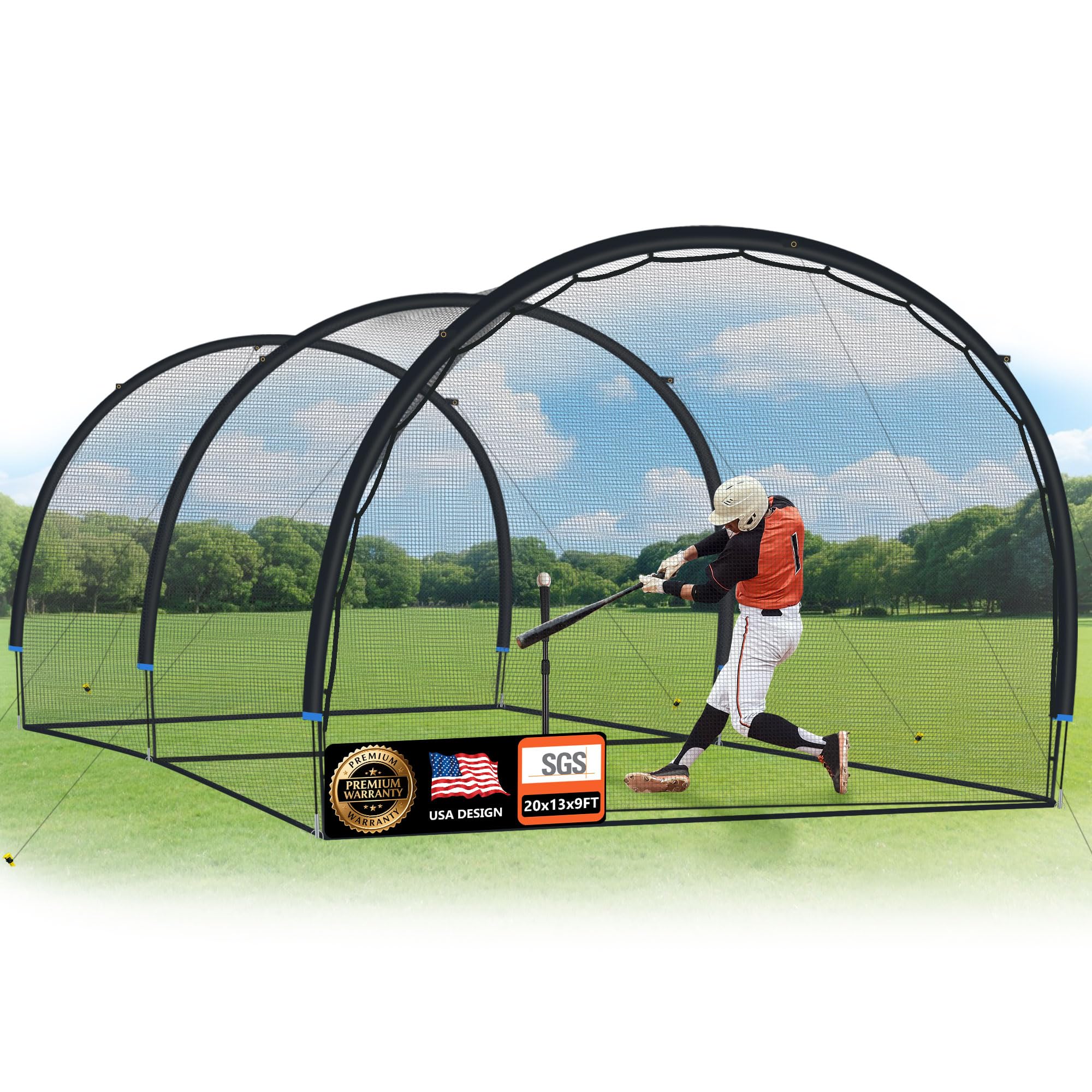
If containing every ball is your top priority, this is the pick. Its defining feature is the omni-directional coverage: the 20ft (Length) ×13ft (Width)× 9ft (Height) footprint is completely wrapped in a 1.25-inch mesh polyester net with oxford cloth seams, so nothing escapes sideways or over the top. One side unbuttons for easy entry, making it simple to step in and out during a drills session.
Build quality is a genuine bright spot, with 19 owners (the most-praised aspect) confirming it suits both kids and adults. The 14mm fiberglass poles paired with iron components give it a sturdy feel, and one owner’s story of it surviving six months including a hurricane and snowstorm without ever being disassembled is proof of its wind handling. It does carry a 33-pound weight, which helps it stay anchored during storms.
The honest downside is that durability and assembly draw the harshest feedback in its block, with the highest count of 66 owners flagging durability concerns and 34 calling the assembly tough. The plastic stakes are the weak link, and some owners mention the fiberglass poles can snap, though a spare is included. This is a cage that rewards careful setup and works best on grass where stakes bite deep.
Our take: For families who want a completely contained hitting space and are okay with a challenging first assembly, the 6-month hurricane survival story makes this a confident buy.
The catch: The poles are the fragile point, so this suits gentle hitters or those willing to handle the poles with care.
3. POWSAWER 12×12×55 ft Heavy Duty Enclosed Batting Cage Net
A massive 55-foot professional net designed for permanent suspension, not for pop-up convenience.
This is a different breed of batting cage entirely: it is a net-only product with no poles or frame, meant to be suspended from existing structures like barn beams, fence lines, or between trees. The sheer scale is the appeal — at 12×12×55 ft in its largest configuration, it gives you a full 55 feet of hitting depth that swallows up errant balls and stops them from breaking windows.
The material is where the value lies. The netting is made from 2.0mm/0.08in PE twisted rope with a 4.5cm mesh size, and customers note it handles rain for months on end without degrading. The integrated design includes a closable side door, so you can walk in and out easily while the net naturally sags shut to keep balls contained.
Because this is a permanent installation, buyers consistently note it requires patience and a helper to set up properly, and the reviews suggest grabbing quality tarp clips to tension it against the frame. Once hanging, it is the most durable option here, suitable for baseball, softball, and even soccer practice. Waterproof and UV-resistant construction means you leave it up year-round, which saves you from the back-and-forth of disassembly.
The setup reality: This is a weekend project, not a 30-minute job, and you need a solid anchor point to hang it from.
Who it’s for: Anyone with a barn, a tall fence, or a pair of sturdy trees who wants max coverage per dollar and never wants to buy a cage again.
4. RIIFRILY #42 HDPE Batting Cage Net (Net Only)

The 70-foot net with 220-pound burst strength built for barns and serious home facilities.
This net suits a player who has outgrown backyard pop-ups and is building a permanent training space. It comes in lengths up to 70 ft, and the key spec is the netting: #42 HDPE (High-Density Polyethylene, a tough plastic) with a burst strength of 220 pounds per strand, which the maker says is tested for 5+ years outdoors. That beats standard polypropylene nets that may only last 6 months.
The net-only design means you hang it virtually anywhere using nails, rope, wood beams, fences, or trees, and it comes with 8 climbing buckles to lock the entry door shut and 6 tie cords totaling 120 ft. Buyers with a 10.5-foot-tall frame found the sizing perfect, with enough slack to stop ground balls dead. The included repair patch kit is a thoughtful addition for extending its life even further.
Because it is a net-only product, your existing poles or a wire hanging kit (sold separately) are required. The material is praised as a solid “starter net” for a batting barn, and while some expected stiffer material, it is soft enough to protect young hitters. This is a long-term investment for families who plan to build a cage around it.
Why It Stands Out
- 220-pound burst strength per strand means it shrugs off line drives that shred thinner nets.
- The 70 ft length offers more training depth than any complete kit on this list.
- Comes with a repair patch kit and a 2-year warranty for extra confidence.
Before You Buy
- It is net only, so you must supply the frame, poles, or a hanging structure.
- You may need a separate wire tension kit (sold separately) to keep the top tight.
- It is a big, heavy roll to handle, so a helper makes installation easier.
Reach for this if: you are ready to commit to a permanent cage structure and want professional-grade netting that outlasts the kids’ entire youth career.
Look elsewhere if: you need a self-contained kit with poles, because this is just the net that makes the magic happen.
5. Arikit 30FT Baseball and Softball Batting Cage

A 30-foot cage that two people can have standing in 15 minutes, ready for a year of daily pitching-machine work.
Speed of setup is what separates this cage from the pack. The one-piece design uses innovative elasticated poles, allowing two people to have the full 30 feet long × 13 feet wide × 9 feet tall enclosure up in about 15 minutes. It comes with a carry bag, so you can break it down and take it to a field or grandparents’ house, and the adjustable guy ropes with steel ground pegs help it hold firm.
The build quality gets consistent praise, with owners describing it as a better build than pricier competitors and noting it survived a windy storm without issues. The frame uses high-strength 1/2-inch fiberglass poles, and the net is a 3-ply lightweight polyester with oxford cloth seams. The removable gate does double duty, letting balls stop at the net while also stopping them from flying into the neighbor’s backyard.
The main trade-off is assembly tension: some owners note the hoops can fall during heavy storms, though the stakes held the whole structure in place and prevented it from flying away. The instruction manual gets some criticism, so be patient with it. It also includes a free target to help improve batting accuracy, which is a nice bonus for young players working on placement.
The verdict: The easiest large cage to move and set up, ideal for families who want flexibility without sacrificing a full 30 feet of hitting room.
The caveat: Wind resilience is good but not perfect, so rope tension needs to be tuned evenly and tautly.
6. Apex Sports 22ft x 12ft x 8ft Batting Cage
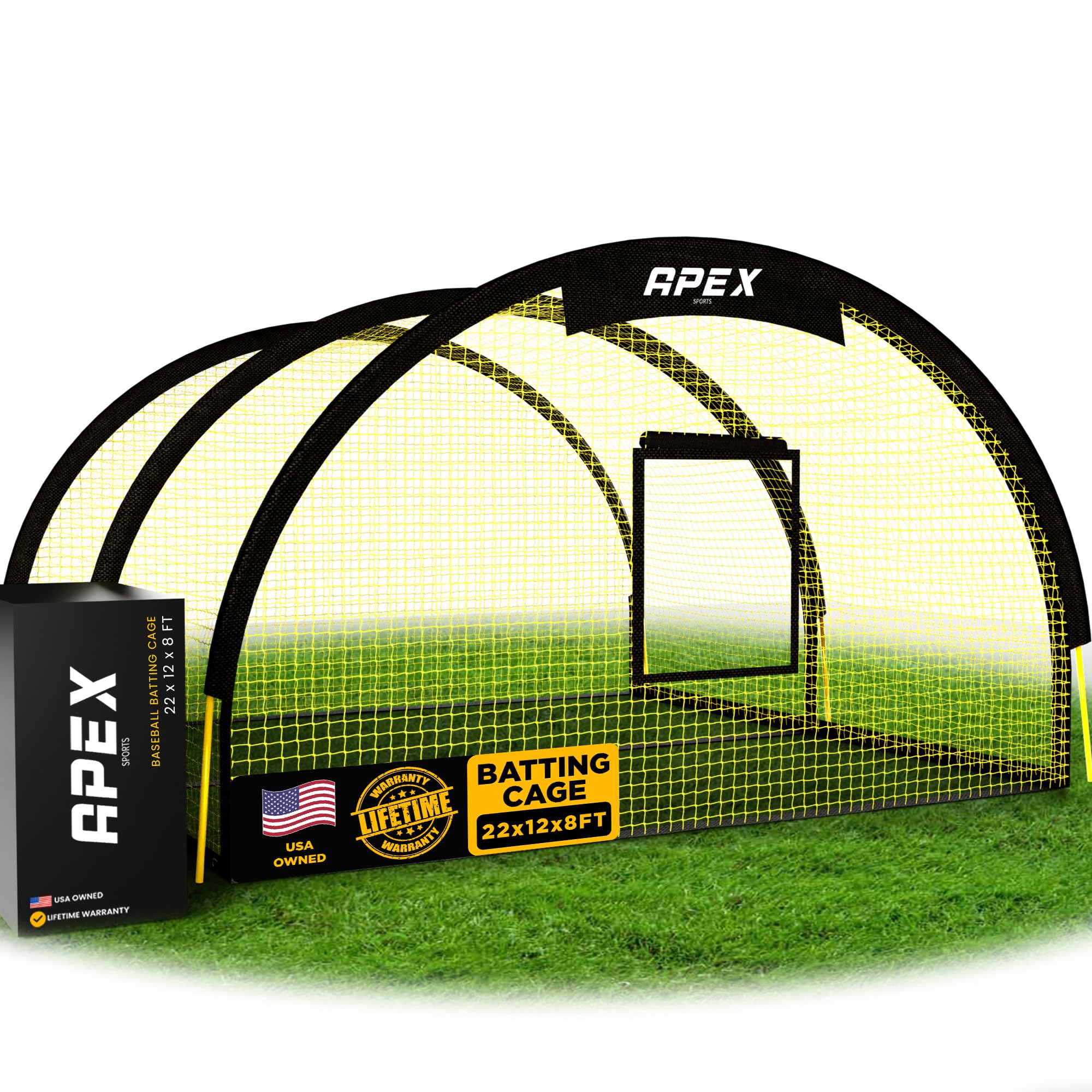
The 22-foot space-saver with sturdy 12.7mm fiberglass poles that fits tight yards without feeling cramped.
Small yards get a dedicated champion here. The 22ft x 12ft x 8ft footprint is snug enough for a standard suburban lot, yet buyers confirm it works great for 13-year-olds hitting real baseballs. The netting is a 3-ply stretchable polyester with a 3.5’x2′ pitching machine hole, so you can feed a machine or a pitching screen for consistent reps.
Quality is the most-praised aspect here, with 27 owners (the top count) confirming the net holds up to daily use. It is also the only cage in this range praised as a one-person assembly job by some owners, although most recommend a second pair of hands. The 12.7mm fiberglass poles give it a reassuring stiffness, and it comes with 8 plastic stakes and a carry bag.
The known weakness is the hardware: plastic clips can bend in summer heat, and the included stakes are on the light side. Many owners simply swap in metal stakes from a hardware store for a few dollars. Wind can also pull the light stakes loose, so it is best on grass in a sheltered spot.
The Strong Points
- Quality is what owners praise most, with 27 confirming solid netting and a sturdy frame.
- Easy to assemble, with some buyers doing it solo after watching the setup video.
- The 3.5’x2′ pitching machine hole is generous for feeding consistent practice.
The Weak Points
- Plastic clips can bend in the heat and may need replacing with metal.
- The stakes are weak and can pull loose in a strong wind, so upgrades are common.
- A fiberglass pole can snap under heavy wind stress.
Ideal for: families with modest backyards who want a sturdy, quality-feeling cage for a young player without the 40-foot footprint.
Not ideal for: anyone who refuses to upgrade the stakes, because wind is this cage’s main vulnerability.
7. ZivPlay 30x12x8 ft Portable Pop Up Cage

A 30-footer with thicker 12.7mm poles and a pitching machine port, tailored for ages 6 to 10.
This cage suits families with younger players. The 30x12x8 ft dimensions give plenty of depth, and the 20″ x 40″ pitching hole lets you feed a machine or have a parent pitch from outside. The frame uses 12.7mm fiberglass poles, which the manufacturer says are thicker than the 10mm frames on cheaper pop-ups, and 8 supporting ropes with ground pegs keep it planted.
Value is the most-praised aspect here, with 22 owners confirming it is a smart buy for the price. It is positioned as perfect for ages 6-10, and functionality scores well too, with 19 owners confirming it works well in their yard space. The 3-ply stretchable polyester net rebounds balls softly rather than firing them back, which is safer for kids who wander behind the cage.
The honest limits show up in the durability column, with 43 owners (the highest count) flagging that poles can break if the cage is moved frequently or left up in windy conditions. One owner found the top net doesn’t stay tight enough for an adult to take a full swing, so this leans toward younger hitters. Assembly is a two-person job, and the lengthy poles can separate while you thread them through the sleeves.
Our read: A genuine value pick for families with young kids who want a real 30-foot cage without the pro price tag.
The trade-off: Keep it set up in a sheltered spot and don’t move it constantly, and it will treat you well.
8. NaxKizo 22ft x 12ft x 8ft Batting Cage
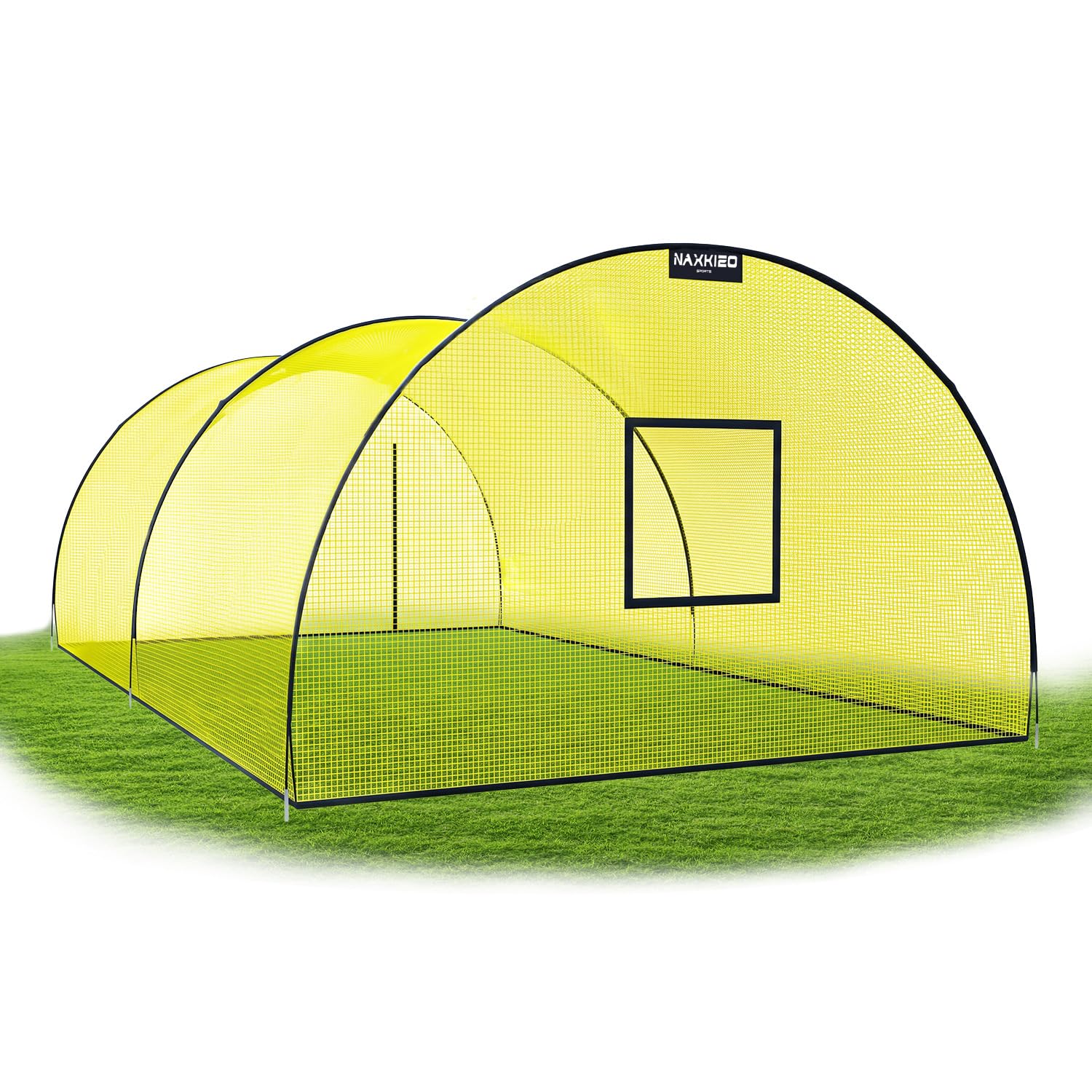
The rare budget cage that puts 5-ply netting and 13.4mm poles where others cheap out.
Most cages in this price range cut corners on the net, but this one leads with a 5-ply stretchable polyester net, which is a thicker build than the 2 or 3 ply options common at this tier. It also uses thickened 13.4mm fiberglass support poles, the thickest in its price class, giving it better wind resistance and stability for the money. The 31″ x 31″ pitching hole has a zipper so you can close it off when you are not using a machine.
Assembly is the most-praised aspect here, with 7 owners (the top positive count) confirming the setup is straightforward, though it does take two people. The kit includes 3 sets of fiberglass poles, 10 ground stakes with windproof ropes, 6 pins, and a storage bag, so everything you need is in the box. The zippered backing door is a smart design that prevents balls from escaping through a gap.
Durability is the honest mixed bag: the highest count of 19 owners has mixed feelings, with a few reporting holes appearing quickly, while others got a full season of daily use before seeing wear. One owner put it plainly, “for the price if I get a summer or 2 out of it, I’m happy.” This is a cage you buy hoping for a couple of good seasons, not a decade.
Best for: casual family use where the budget matters more than pro-level longevity, and you want the best netting specs at the lowest price.
Skip if: your hitter is smashing line drives daily and you need something that will survive years of abuse.
9. VEVOR 19.9 x 12.0 x 8.2 ft Portable Batting Cage

The cheapest way into a real, fully enclosed steel-framed cage that survives storms and summer abuse.
Starting with the price, this is the entry ticket to a proper batting cage. The 19.9 x 12.0 x 8.2 ft / 6060 x 3660 x 2500mm frame is built from Carbon Steel pipes, making it one of the few budget cages with a metal frame rather than all-fiberglass. The netting is a thick HDPE with a generous 1.73 inch/44 mm mesh, which is why it handles daily high school use so well.
Value for money is the most-praised aspect, with 6 owners confirming it is a solid deal for a summer of use. One owner used it daily instead of going to the park for high school kids, and after 8+ months outdoors 24/7, it only showed a couple of small holes from balls — which they considered “expected given heavy use.” Reviewers point out: “2 small holes from balls after 8+ months outdoors 24/7; expected given heavy use.”
The catch is the assembly, which gets the harshest feedback in its block with a 13-count mixed verdict. Instructions are widely described as the worst ever seen, and some owners found the net catches bolts during setup. The stakes are too small for soft ground, so plan to upgrade to longer spikes. This cage rewards handymen who can figure out the puzzle.
The bottom line: Incredible storm survival and durability for the price, but only if you can get past the infuriating assembly.
Who it beats: It outlasts many pricier fiberglass cages in weather, but it demands more patience to build than any other pick here.
Understanding the Specs
Netting Ply and Mesh Size
The ply number (like 3-ply or 5-ply) tells you how many layers are woven into the net, which affects how well it absorbs a line drive without tearing. A higher ply count generally means a thicker, more durable net, and a smaller mesh size (like 1.25 inches) stops a baseball better while still letting wind pass through, so the cage doesn’t act like a sail.
Frame Material and Pole Diameter
The poles that hold the net up are usually fiberglass or steel, and the diameter matters. Fiberglass poles measured in millimeters (like 12.7mm or 13.4mm) are common for portable cages, with thicker poles being stiffer and more wind-resistant. Steel frames are heavier and more permanent but offer the best stability for advanced hitters, while a net-only option requires you to supply your own structure entirely.
FAQ
How much space do I need for a backyard batting cage?
Will a fiberglass cage survive high winds?
What is the difference between 3-ply and 5-ply netting?
Can I leave my batting cage up all year outdoors?
Do I need a pitching machine to use a batting cage?
What is a net-only batting cage?
How many people does it take to assemble a batting cage?
Is a batting cage safe for young kids?
Why are the stakes important for a batting cage?
Final Thoughts: The Verdict
Across the board, the batting cages for backyard winner is the Skywalker Sports 40FT because its steel frame, 40-foot length, and proven wind stability make it the only cage that finally ends the upgrade cycle. If you want the best balance of portability and full-size training space, grab the Arikit 30FT. And for a permanent, professional-grade setup hung from a barn or fence, the RIIFRILY 70FT net is the one to reach for.
How We Picked
We do not accept paid placement. Every pick is matched to a real buyer and a real use-case; we do not hands-on test units.
Sources & Methodology
Specifications: manufacturer listings and product documentation. Review insights: verified customer reviews, as of August 2026. Pricing: not shown on this page (it changes often); check the current price via the retailer link.
As an Amazon Associate, Gadgets Feed earns from qualifying purchases. This does not affect which products we feature.