
Our readers keep the lights on and my morning glass full of iced black tea. As an Amazon Associate, I earn from qualifying purchases.
Specs are compiled from manufacturer listings and verified buyer reviews and can change over time — please confirm the key details on the product page before buying.
The best beach canopy is the one that is still standing, still shaded, and still quiet when the afternoon sea breeze kicks up — not the one that tumbled past three strangers while you chased it. A beach canopy does one job: hold shade over your spot on sand for hours without collapsing, flipping, or needing you to keep fixing it. The picks below solve that job in completely different ways, from wind-powered sails to sandbag-anchored tents, so you can match the design to the beach you actually visit.
I’m Min — the founder and writer behind Gadgets Feed. This guide is built by comparing the manufacturers’ published specifications and the patterns across verified customer reviews, so you get each pick’s real strengths and trade-offs instead of marketing spin.
Wind is the make-or-break factor on any open beach, and the canopy you pick either fights it or rides it. Below you will find the setups that keep their footing in a stiff onshore breeze, sorted by how they handle wind, shade, and the walk from the car. If you want shade that survives a gusty afternoon, this is the best Beach Canopy breakdown you can read before you buy.
Our Picks at a Glance

How To Choose The Best Beach Canopy
A beach canopy fails for one reason almost every time: the wind. Traditional umbrellas catch air like a sail and either pull their anchor out of the sand or tip and roll. So the first question is not how big the canopy is — it is how the design handles a gust. There are three main approaches on a beach today, and each suits a different kind of beachgoer.
Wind-powered sails vs anchored tents
A wind-powered shade (sometimes called a wind sail) uses the breeze itself to hold the fabric aloft, so the stronger the wind, the more stable it stands. That works beautifully on open beaches with a steady sea breeze, but it needs at least some moving air to stay up. A sandbag-anchored tent is the opposite: it holds shade no matter what the air is doing, as long as you fill those bags and bury them. If your beach is often glassy-calm, a tent is the safer bet; if it is usually breezy, a sail is the calmer, quieter experience.
UPF rating and shade square footage
The UPF number tells you how much of the sun’s ultraviolet radiation the fabric blocks — UPF 50+ is the highest common rating and blocks the large majority of UV rays, while UPF 30+ blocks somewhat less. Square footage is the other half of the story: a sail rated at 75 square feet covers one or two people, while a 100-square-foot tent holds a family and their chairs. Match the coverage to your group, not to the biggest number on the page.
Sand anchoring and pole strength
Look at how each canopy grabs the sand. Sandbags that you fill and bury are the most forgiving on soft, dry beach. A sand screw or auger anchor twists into packed sand and holds well where the ground is firm. Pole material matters too: aluminum poles are lighter to carry but bend more easily under a heavy gust, while thicker aluminum keeps its shape longer. Fill your anchoring method fully and bury it, and almost any of these canopies will hold through a normal beach day.
Quick Comparison
| Model | Best For | Shade Coverage | UPF Rating | Weight | Amazon |
|---|---|---|---|---|---|
| Solbello Shade★ Best Overall | Windy open beaches | Ample for several people | UPF 50+ | 4.52 lb | Amazon |
| Sport-Brella PremiereBest Value | Families and sports sidelines | Fits 3 camping chairs | UPF 50+ | — | Amazon |
| Rhino Valley 10 x 10 FTMost Spacious | Big shaded family area | 100 sq ft | UPF 50+ | 8.7 lb | Amazon |
| COZEER 10x10FT | Windy days, easy packing | 100 sq ft | UPF 50+ | 4.74 kg | Amazon |
| COMMOUDS Beach Tent | Large groups, stand-up room | 100 sq ft | UPF 50+ | 7.9 lb | Amazon |
| Purebox Beach Tent | Windy beach, easy cleanup | 100 sq ft | UPF 50+ | — | Amazon |
| Shibumi Shade Mini | Travel and solo-trippers | 75 sq ft | UPF 30+ | 2.3 lb | Amazon |
| Shibumi Shade | Groups up to 8 people | 150 sq ft | UPF 50+ | 4.3 lb | Amazon |
| ShadeSock | Silent shade for small groups | 80 sq ft | UPF 50+ | 9 lb | Amazon |
In‑Depth Reviews
1. Solbello Shade – The Ultimate Wind-Driven Beach Umbrella
Our pick — over 4.5★ from 950+ verified ratings; the strongest balance of quality and price.
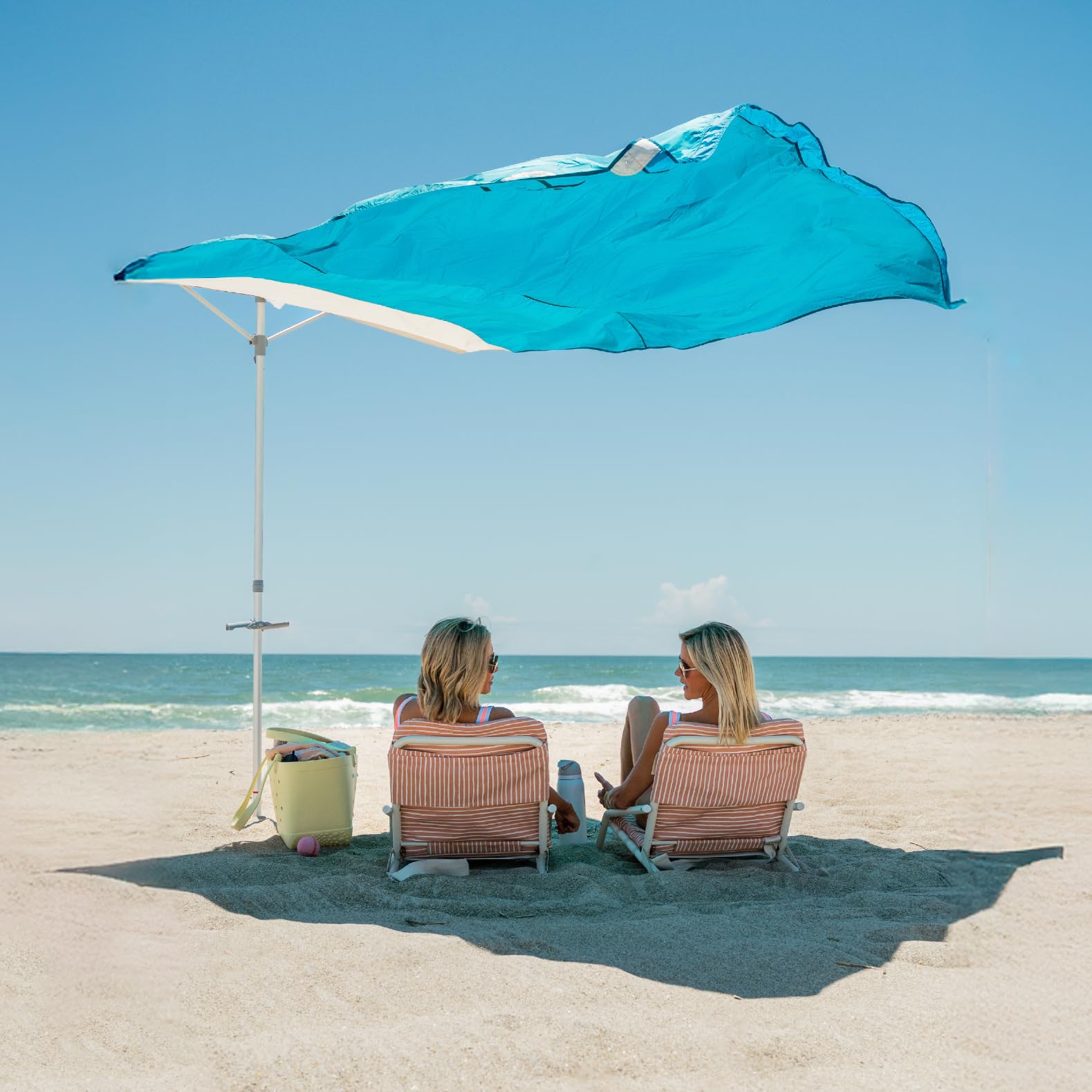
A wind-driven sail that screws into the sand and rides gusts instead of tumbling
If you have ever watched a beach umbrella break loose and go rolling past the sunbathers, this is the fix. The Solbello Shade screws its anchor pole into the sand and uses the wind itself to keep the canopy aloft, so a gust that would topple a traditional umbrella only makes this one flutter a little and hold its ground. Set up runs about two minutes for one person, and the whole thing weighs 4.52 pounds — light enough that one person can carry it down the sand alone. The published UPF 50+ rating means the fabric blocks the large majority of UV rays, and the shade reaches several people, not just a single lounger.
The crowd favorite here — 4.7 stars across 950+ ratings — earns that score on exactly this point. What buyers keep coming back to is how little it asks of you: screw the anchor into the sand, and it stays put while the wind shifts direction without anyone getting up to reposition it. It also runs quiet, without the constant snap-and-flap of a canvas umbrella in a crosswind. And because the canopy floats above the sand rather than sitting on posts, there is no cramped duck-under to get into the shade. The shade footprint covers three chairs and a couple of adults easily, and a small group on a blanket fits comfortably underneath. On the beach, the difference between this and a budget umbrella is the same as the difference between a sailing dinghy and a kite in a tree.
The honest catch is the anchoring itself. The stability aspect draws mixed feedback in the owner reviews — the anchor screws in and holds in normal sand, but it is a screwing motion rather than a drop-and-go bag, and a few owners find that takes a bit more effort than expected on wet, compacted sand. And the wind-driven design needs wind to fully shine; on a dead-calm morning the sail can go slack. At 4.52 pounds it is also heavier than the lightest wind sails, so if you are packing for a flight, the Mini down the list is the one you want instead.
Where It Wins Big
- Wind-driven design that refuses to blow down the beach in a gust, per the manufacturer
- Roughly two-minute solo setup that even a first-timer can manage by the water
- UPF 50+ fabric and a shade footprint that covers a small group, not just one seat
- Quiet canopy with no constant flap-and-snap in a crosswind
Where It Makes You Work
- Screwing the anchor into wet, packed sand is a little more effort than dropping sandbags
- The wind-driven sail goes flat on a dead-calm day
- At 4.52 pounds it is a touch heavier than the lightest wind sails for airline travel
Best for: beachgoers on an open, breezy shore who want shade that holds its own without anyone babysitting it, and who value a light 4.52-pound carry down the sand.
Look elsewhere if: your beach is usually glassy-calm, or you need the lightest possible fold for a plane trip — the Shibumi Shade Mini below fits a carry-on far more calmly at 2.3 pounds.
2. Sport-Brella Premiere UPF 50+ Umbrella Shelter with Patented Side Panels
The foldable shelter that doubles as a wind block and a bit of privacy
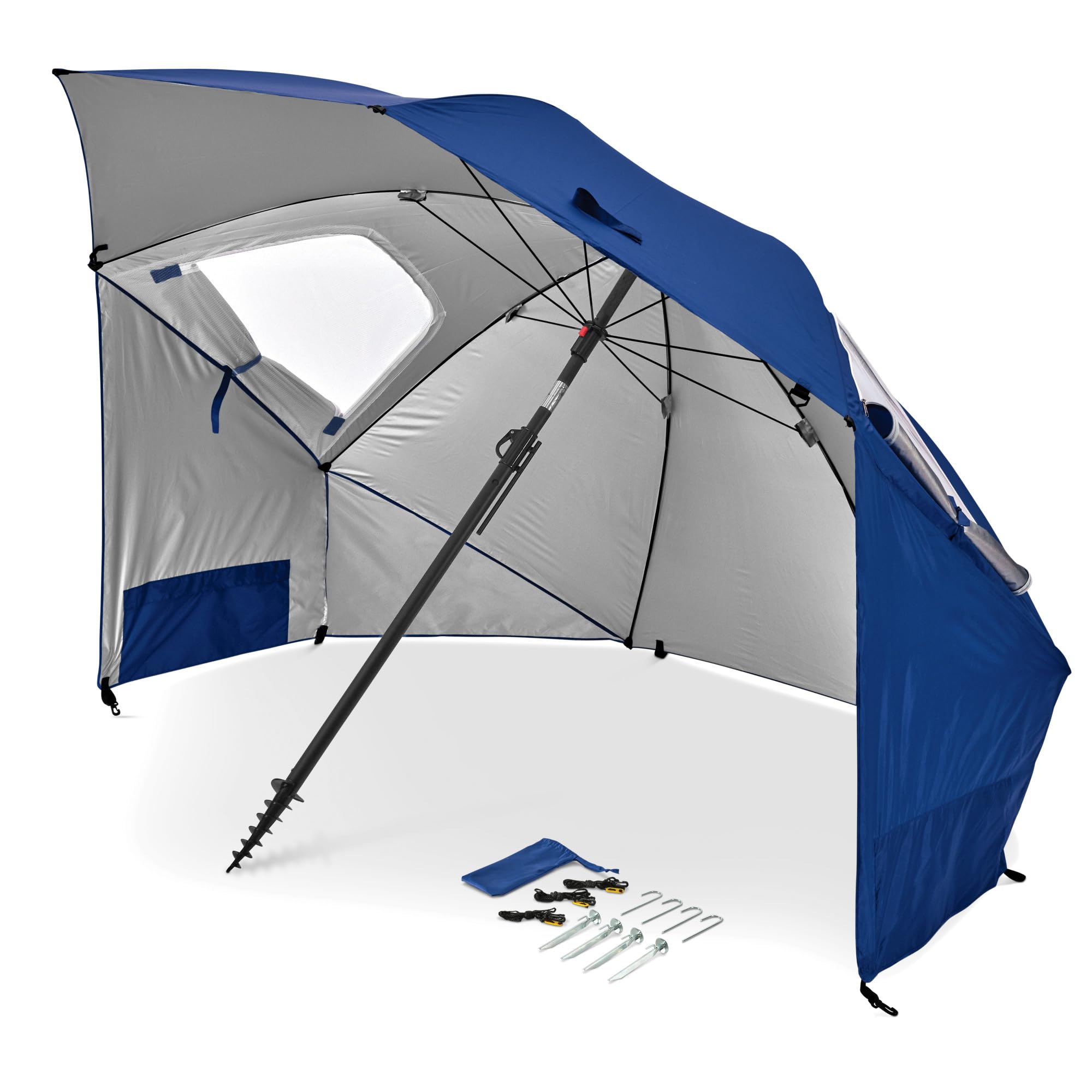
Here is the one for the family that camps, plays, and beaches with the same shade. The Sport-Brella Premiere opens much like a regular umbrella — you literally just open it — and then twists its auger anchor into the sand or grass (the anchor is a screw-in base that bites into soft ground). At 8 feet across with patented side panels, it is big enough to fit up to three camping chairs underneath, and the side panels add wind and privacy cover that a bare umbrella does not offer. The published UPF 50+ rating covers the standard. Buyers report it deploys in a minute or two once you know the twist, and one buyer praised exactly that easy solo deployment when you are at the beach by yourself.
Where this earns its place is the multi-use value. Owners mention using it for soccer games, camping, and the beach from the same shelter, and the tilt mechanism plus fillable sand pockets let you angle it against the sun or brace it down in wind. It also holds up in the cool months — one owner used it as a windbreak near a campfire when perfectly upwind. With 7,800+ owners weighing in, this is the most-reviewed pick on this list, and it is the overwhelming confidence pick for anyone who wants one shade for every outdoor event, not just a single sand day.
The trade-off you should know before you buy: durability is the most-discussed topic in this product’s reviews, and it is genuinely mixed. Some customers note years of use, while others find the hinged center pole — a slip joint made of plastic and pot-metal — is the weak point, lasting a couple of seasons of heavy use. The zippered windows have also been reported to seize up over time near salt and sand. For occasional beachgoers and families who want a versatile shelter at a fair price, it is a strong buy; for someone who needs it standing every single day through a full summer, a sturdier tent design holds up better. A fair note, too: side panels need sandbags to stay down in a stiff crosswind.
The Case For It
- 8-foot canopy with patented side panels for wind block and a little privacy
- Twist-in auger anchor for sand and grass, ready in a minute or two once familiar
- Doubles as a campsite or sideline shelter, not just a beach umbrella
- UPF 50+ fabric and enough room to fit up to three camping chairs
The Case Against It
- Durability is genuinely mixed — the hinged center pole wears over a couple of heavy seasons
- Zippered windows have been reported to corrode shut near salt and sand
- Side panels need sandbags in a crosswind to stay anchored
Reach for this if: you want one shelter that works for the beach, the campsite, and the soccer sideline, and you value quick solo setup and side-panel wind cover.
Skip the side panels on: an exposed, gusty beach where you need it standing every single day — a full sandbag tent holds up better as a daily driver.
3. Rhino Valley 10 x 10 FT Beach Tent UPF50+ with 8 Sandbags
A full 100 square feet of family shade that folds into a space you barely notice packing
For a family that needs everyone — plus the cooler, the towels, and the sand toys — under one roof, this is the shade that delivers the floor. The Rhino Valley tent spreads to a 10 x 10 ft footprint, or 100 square feet, with 6.5 ft of headroom, and it anchors with 8 sandbags on 4 thickened aluminum poles plus 4 windproof ropes. That is a lot of holding power for the coverage. The published UPF 50+ fabric keeps the UV off, and the four-sided ventilation keeps the air moving so the interior does not turn into an oven. It packs down small enough to disappear in a trunk, which is the part that surprises first-time owners most.
The setup is the headline strength — this tent is routinely described as one of the easiest to raise, with independent owners timing it around five minutes for three adults and calling it a must-buy for beach days. The 100 square feet is real shade, not a token patch: 4 adults and 3 kids fit under it comfortably, and reviewers point out using it as a replacement for a heavy gazebo. The Lycra-and-triple-stitching construction is built for repeated folding and sun exposure, and a few shoppers say getting three summers out of it before it needed replacing.
Two honest limits to plan around. First, the 6.5 ft height is real but the canopy center sags a little lower, so a 6 ft adult will need to duck at the peak rather than stand fully upright — owners suggest a longer center pole to fix that. Second, stability is genuinely mixed in the reviews: this tent holds well when the bags are filled and buried in the sand, but it can be pushed around in high gusts, and a few buyers report the canopy loosening and dropping in stronger wind if the bags are only partly filled. Stretch the fabric tight and bury the bags, and it behaves; skimp on either, and it will not. On a crowded beach, the 10 x 10 footprint is also large enough to need careful placement so you are not crowding your neighbors.
What it does best: it turns a small plot of sand into a shaded base camp — 100 square feet under UPF 50+ fabric with 6.5 ft of headroom, all folding into a bag you can pick up with one hand.
What to plan around: the center sags below the peak height, so a 6 ft adult ducks at the middle, and high gusts can push the canopy around unless the 8 sandbags are fully filled and buried.
Suits: big families and beach-day groups who want maximum shaded floor area for the money and do not mind a five-minute group setup.
Not ideal for: a solo lounger on a tiny crowded stretch — the 10 x 10 footprint and 8.7-pound pack are more than one person needs.
4. COZEER Beach Tent Sun Shelter 10x10FT, UPF 50+ with 8 Sandbags
The tent that pairs a roomy 10 x 10 shade with the lightest carry in its class
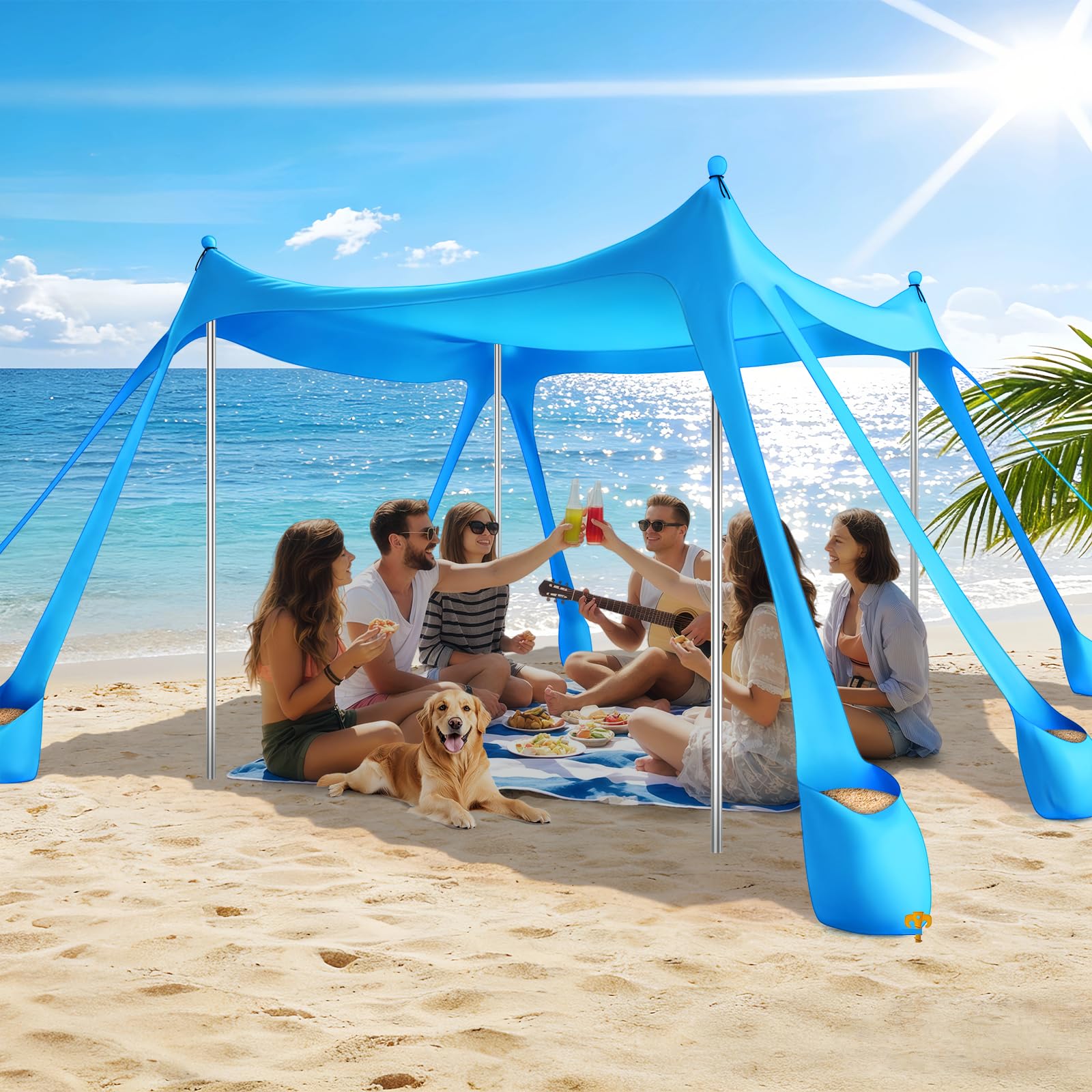
This is the pick for a family that wants the spacious 100-square-foot footprint of the tent above but hates lugging weight to the water. The COZEER tent spreads to 10 x 10 ft with a 79.2-inch peak height, spreads UPF 50+ fabric that the maker says blocks 98% of harmful rays, and anchors with a triangular windproof structure using 8 sandbags, 4 aluminum poles, 8 sand stakes, and 8 grass stakes. The stated wind rating is up to 25 mph, and the four-sided ventilation lets air move through so it does not trap heat. The elastic-cord pole connections keep the frame from drifting as you raise it. The carry is the quiet win: it weighs 4.74 kg, which is far less on your shoulder than the 8.7-pound Rhino Valley pack when you include its own storage bag. The Lycra-and-spandex fabric is stretchy to fold and stretch again without tearing.
For a smaller review base, the agreement is unusually tight — setup and quality are the two things owners mention most, and they run almost entirely positive. The 10 x 10 size fits a whole family with room to spare, the tall 79.2-inch height means you stand up without bending, and by all accounts it stays put in the wind once the sandbags and stakes are set. Owners mention it packs back into its bag easily and slips into a car trunk. If you compare it to a bare umbrella, the shade is a different category of comfort: no chasing a tilted canopy across the sand, just a stable spot for the afternoon.
The one clear limitation is rain. This is a sun shelter first, and at least one owner notes it is not rainproof — the fabric sags under collected water and rain passes through, which the maker’s “waterproof coating” language oversells a touch. On a fair-weather beach day that is irrelevant; if you are shading a lawn in a drizzle, look elsewhere. It is also on the lighter side of tent builds, so treat the poles with normal care when packing and it will serve you well for seasons.
Praise-Worthy Details
- Full 10 x 10 ft / 100 sq ft shade with a 79.2-inch peak that avoids all the head-bending
- UPF 50+ Lycra-and-spandex fabric that the maker says blocks 98% of harmful rays
- Tested to 25 mph wind with a triangular structure and 8 sandbags plus stakes
- Lighter carry than most tents in this size, packing into its own storage bag
Limits To Know
- Not rainproof — the canopy sags and lets water through in a downpour
- Lighter build means the poles deserve careful handling when packing up
Ideal for: families who want the biggest shade area but need it light enough for one person to carry from the parking lot.
Look past it if: you need genuine rain cover — this is a fair-weather sun shelter, not a wet-weather tent.
5. COMMOUDS Beach Tent Sun Shelter, UPF50+ Beach Shade Canopy
A stand-up-height canopy built for a crowd that wants to be in the shade together
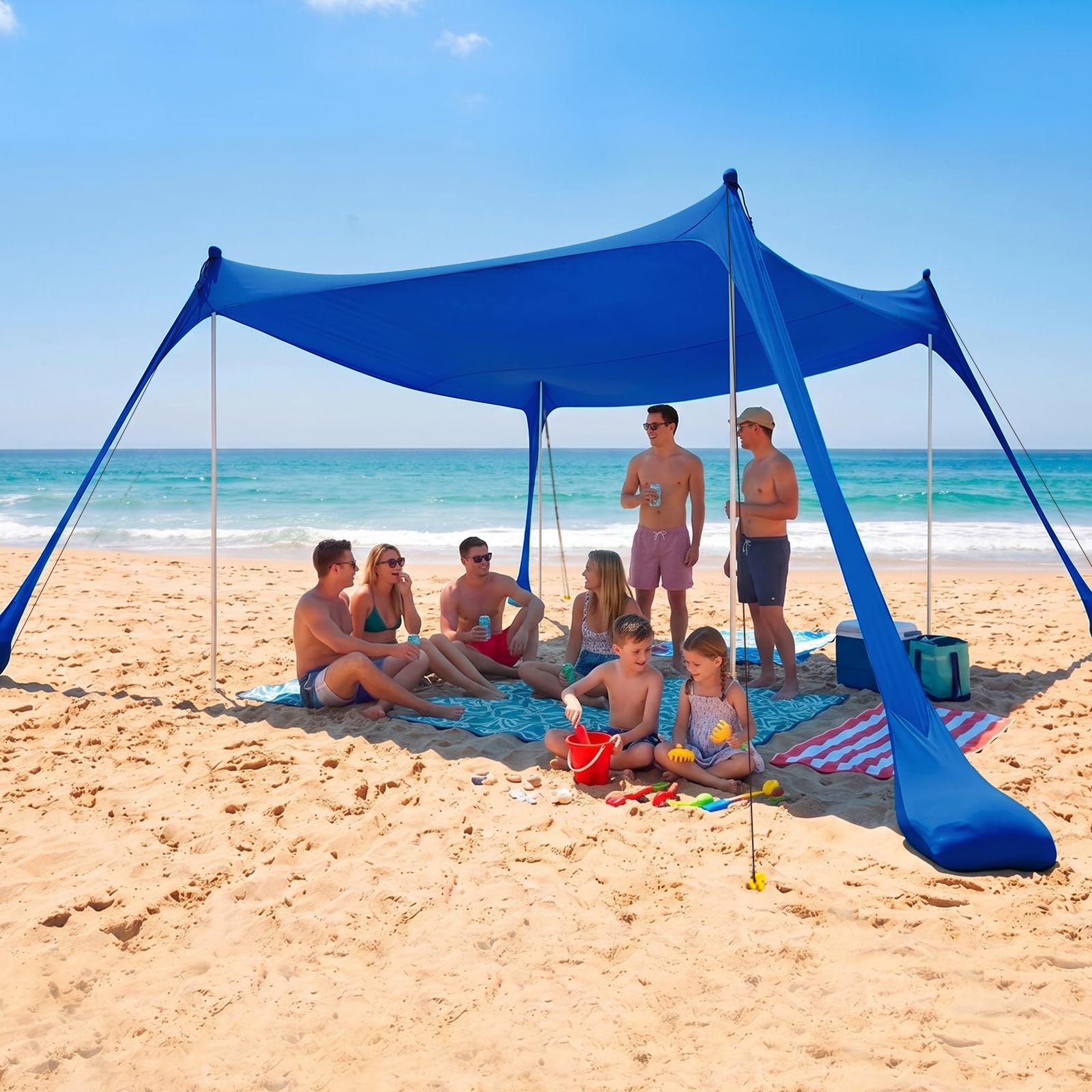
When your beach party runs toward 6 to 8 people, this is the tent designed for the job. The COMMOUDS shelter spreads 100 square feet under 6.56 ft poles, so adults can stand freely instead of crouching, and the extra-wide design takes beach chairs, coolers, and kids’ toys without a fight. The fabric is a 180 g polyester Lycra with a UPF 50+ rating that the maker says blocks 98% of UV rays, plus a water-resistant coating and airflow vents. It anchors with 4 sand anchors, 4 rustproof aluminum poles, and a 3-layer windproof setup using elastic cords, upgraded ropes, and conical pole bases, stated to hold against 25 mph winds. The maker also builds in quick-tilt poles so you can chase the shade without taking the canopy down.
What wins people over here is the standing headroom combined with the tilt feature — you get a genuinely open, walk-in shelter rather than a low ceiling you limp under. Owners say it out-shines a standard umbrella for a group, and both independent reviewers and the manufacturer agree it functions well even in strong wind when set up correctly. The 7.9-pound pack folds into a 24-inch carry case sized for a car trunk or even an airplane overhead, which is rare for a full-height group tent. That combination of tall, wide, and packable is why it lands in the middle of this list as a value pick for gatherings.
The one thing that genuinely matters with this design: you must fill the sandbags fully. Reviews are split on stability, but the split tracks almost exactly to how much sand went in. Owners who filled the corner bags completely, roughly 60 pounds of sand, report it standing firm through serious wind; those who left the bags half-filled watched it slide. So if you accept that a beach canopy is a hands-on setup, this one rewards the effort. The low-wind and no-wind story is real, too — it needs properly weighted corners to stay put on a calm day, same as any sandbag tent.
The group answer: 100 square feet under 6.56 ft poles means you and your whole party stand upright in the shade, and the tilt poles let you swing the canopy toward the sun without a teardown.
The one rule: fill every sandbag fully — the mixed stability reports follow how much sand went into the corners, so half-filled bags on a breezy day is where this one struggles.
Choose it when: you need stand-up headroom and room for 6 to 8 people and want a packable case that fits a trunk or an overhead bin.
Pass if: your beach is mostly calm with little wind and you want the calmest possible shade — a wind-driven sail needs far less filling and burying.
6. Purebox Beach Tent Sun Shelter 10x10FT Beach Shade Canopy UPF50+
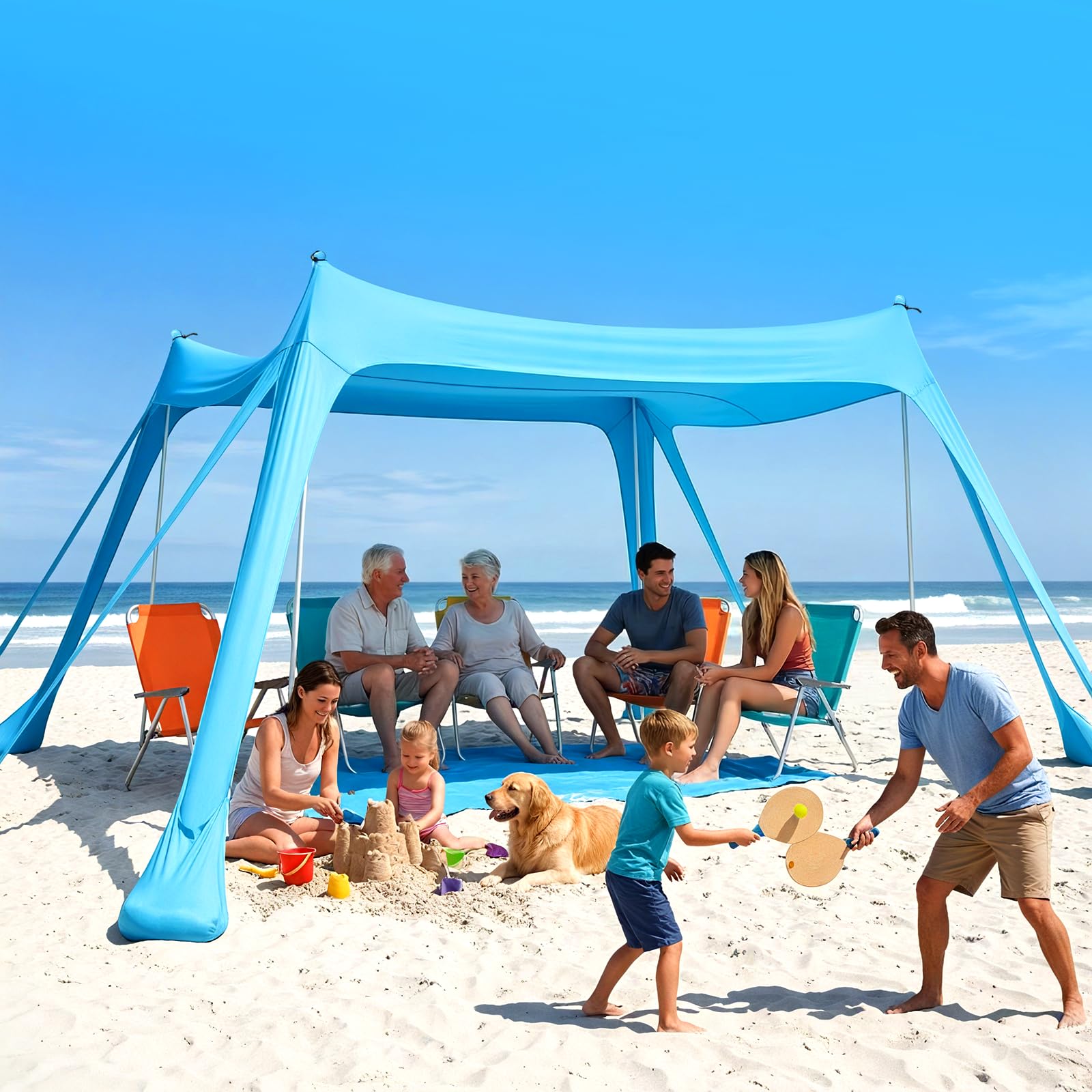
The tent that shrugs off a stormy afternoon and then goes straight in the washer
If your beach is the windy kind — the kind that folds other canopies by lunch — this is the one built to stay. The Purebox shelter spreads 10 x 10 ft with a 79-inch peak, anchoring with 8 sandbags and 4 thickened aluminum poles arranged in a triangular support that spreads wind pressure. UPF 50+ Lycra fabric blocks the large majority of UV rays and, per the maker, 98% of UV. The four-sided ventilation keeps the inside from turning stuffy. It folds into a sturdy carry bag that is genuinely light for a 100-square-foot tent, and the Lycra shell is machine-washable or hand-washable, which is unusual for a shelter this size and a real convenience after a season of salt and sunscreen.
Owner consensus here leans hard on two things: it handles wind, and it is easy to live with. Customers note it holding up in stormy 9-hour stretches, several owners getting six days of use including windy and choppy conditions, and a stretch of daily use over a hot Florida beach week where it blocked the sun for about five hours at a time. It fits 3 adults and 2 kids with gear and up to 6 people without it. The 8-sandbag anchoring is the key to its wind behavior — reviewers point out success by filling the bags first, then raising the poles, and by burying the poles about six inches into the sand on a gusty day. Do that and it stays rock solid; skip it and the wind will find a way in.
The recurring honest gripe is durability at the pole joints. The most-mentioned topic in this product’s reviews, size, is a strength; the odd failure, though, is a pole flange slipping under normal use and rendering a unit inoperable after just a few trips. With this review base still small, treat the poles gently, follow the fill-first setup, and it is a dependable sunny-day tent that cleans up in the wash. A fair note on versatility: owners point out there are only 4 tie-downs and no stake loops for yard or camping use, so this one is best kept to sand.
What Earns It A Spot
- 100 sq ft under UPF 50+ Lycra with a 79-inch peak and four-sided ventilation
- 8 sandbags and 4 thickened aluminum poles in a triangular wind-spreading frame
- Machine-washable shell — rare for a full-size shade tent after salt and sunscreen
- Shoppers say it holding through stormy, windy stretches when the bags are filled and buried
What To Watch
- Pole joints are the weak point — a flange can slip on a rough day using normal care
- Only 4 tie-downs and no stake loops, so it is a sand shelter rather than a yard or camping tent
- Smaller review base, so long-term durability is less proven than the bigger names on this list
Made for: windy, exposed beaches where you need a 100-square-foot tent that holds through a stormy afternoon and washes clean at home.
Think twice if: you plan to stake it in a yard or campsite — no stake loops here, and the pole joints reward gentler handling than a heavier build.
7. Shibumi Shade Mini (Previous Generation)
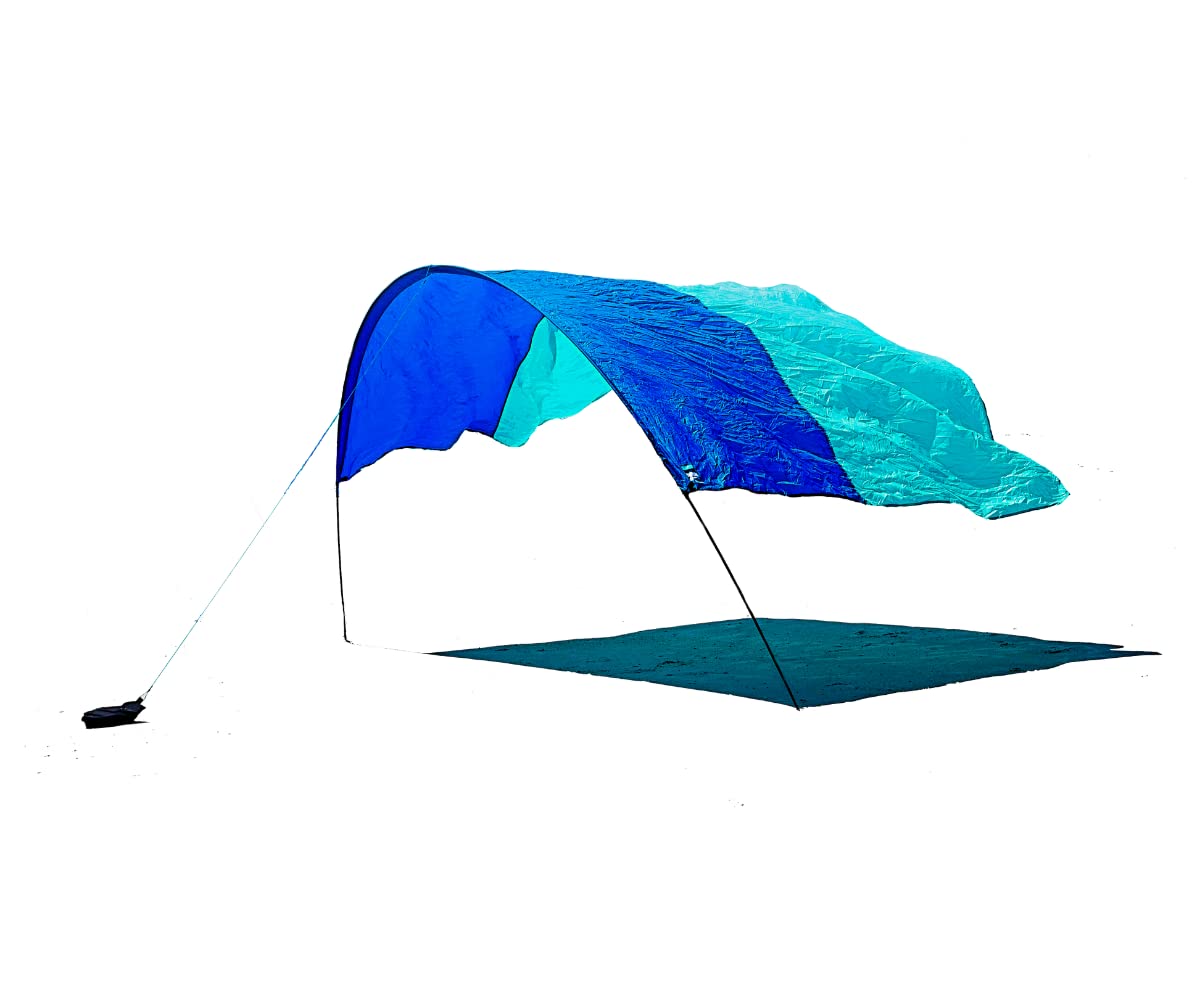
The 2.3-pound sail that slips into a carry-on and shades a solo parent’s whole setup
At 2.3 pounds, this is the lightest pick on the entire list, and it is the one to grab when the beach is a plane ride away. The Shibumi Shade Mini uses the original wind-powered design: it floats on the breeze with as little as 3 mph of wind (that is a very light air movement, barely enough to move leaves), it faces the wind, and it holds its shape instead of blowing away or breaking. It provides 75 square feet of shade with UPF 30+ protection, sized for 1 to 2 people with room for bags and coolers, and it assembles in about two minutes with one set of hands. The hard-anodized aluminum frame folds compact enough to pack in a carry-on suitcase, which is a category of portability the tents on this list simply cannot match.
The community around the Shibumi design is small but devoted — easy setup is what owners bring up most, followed by sun protection. It stays put in strong beach wind as long as there is a sea breeze to work with, which is the whole premise of the design. Owners describe it as a genuine upgrade for solo trips and for two people who want shade without hauling eight sandbags down the sand. It is also quiet enough that it does not set off the noise a flapping umbrella makes, and it fits in a regular beach bag when folded.
The trade-off is the design itself: this shelter needs wind to function. When the breeze dies, the sail goes slack and stops holding shade, so a glassy-calm day is its worst case. That is the nature of a wind-powered shade, not a defect — but if your beach is often still, a sandbag tent does the job more reliably. It is also pricier than the tents relative to its 75-square-foot footprint, and at UPF 30+ it blocks somewhat less UV than the UPF 50+ picks here. Worth noting: some beaches regulate the size of shade structures, so check local rules before you sail — if your beach has a restriction, a smaller sail like this Mini is the safer call than a full tent.
The travel verdict: for 1 to 2 people who want real shade from a 2.3-pound pack that fits a carry-on, nothing else here comes close on portability.
The wind caveat: it sails on as little as 3 mph of breeze but goes flat on a genuinely still day, so it is best for open beaches with a steady sea breeze.
Pick this for: flights to distant beaches, solo trips, and parent-and-child afternoons where 75 square feet of shade and a 2.3-pound carry beat everything else.
Rule it out if: your beach is usually glassy-calm or you want the highest sun-blocking rating — the UPF 50+ tents handle both better.
8. Shibumi Shade (Previous Generation) – Wind Powered Beach Shade
The wind-powered original scaled up to shade a whole group under 150 square feet
Take everything good about the Mini and double the coverage: this full-size Shibumi Shade spreads 150 square feet with UPF 50+ protection and holds up to 8 people, all from a 4.3-pound pack. It weighs only 4 pounds by the maker’s figure (4.3 pounds in the shipped spec, close enough that your shoulder will not notice). One person can assemble it in three minutes, and because it is wind-powered, it will not break or blow away in high wind — it simply rides the breeze. For a family of six or a group of friends, that is a huge shaded zone you can raise by yourself while everyone else sets up chairs.
Buyers report roughly 4 to 5 minutes for a solo first setup, great coverage for a family of six, and lightweight, compact packing into its own bag. It replaces traditional umbrellas for frequent beachgoers and is the choice when you want the spaciousness of a big tent without the sandbag-filling chore. The wind-powered approach means no anchors to twist into packed sand and no bags to bury — you plant the two poles, face the wind, and the canopy fills. When it works, it is a fraction of the effort of a full tent.
Two real-world caveats pull it down the list from the Mini’s top travel slot. First, it needs wind to work — the same design strength the Mini relies on, so a no-wind day leaves the sail flat. Second, wind resistance is genuinely mixed in this product’s reviews: many owners mention it sailing beautifully, while others note it can be inconsistent, and some find it needs a second person to anchor one side when the breeze shifts. It is also the priciest sail here, and because it is a big, wind-catching shape, some beaches regulate shade structures of this size — one disappointed owner discovered theirs was not allowed on their local shore. Check your local rules, and it earns its keep on an open, breezy beach where the coverage matters.
Why It Stands Out
- 150 square feet of UPF 50+ shade — the largest wind-powered footprint on this list, sized for up to 8 people
- 4.3 pounds and a three-minute solo setup with no sandbags to fill
- Wind-powered, so it will not break or blow away in high wind
- Packs compact into its own bag and replaces a traditional umbrella for regulars
Where It Falls Short
- Needs wind to function — a still day leaves the sail flat
- Wind resistance is mixed, and some setups want a second set of hands to anchor a side
- Large enough that some beaches restrict shade structures of this size — check local rules first
The right buy for: groups up to 8 who want maximum wind-powered shade with no sandbags to fill, on an open beach with a reliable breeze.
skip it if: your shore restricts large shade structures or your wind is patchy — the smaller Mini or a sandbag tent is the safer pick.
9. ShadeSock – The Ultimate Wind-Inflating Beach Shade

The inflatable sail that turns a windy beach into a whisper-quiet afternoon
If the flapping noise of a beach shade is what drives you up the wall, this is the fix. The ShadeSock uses a patent-pending wind-inflating design that captures more wind than it releases, so the canopy fills and holds rather than snapping back and forth — customers describe the floating canopy as unique and peaceful, like a cloud. It carries a 360° frame that rotates freely to align itself with the wind, so there is no manual repositioning as the breeze shifts. The 8 x 10 ft / 80-square-foot canopy shades up to 4 people, and its design forces UV rays through two layers of UPF 50+ material for extra protection. Setup runs about two minutes, and a High-Wind and No-Wind Support Kit handles both gusty days (a support rope braces it) and the rare still day (support pegs hold it until the wind returns).
This is a premium pick, and the extra spend goes toward two things you feel immediately: silence and self-adjustment. Customers note it working in both low and high wind, holding stable edges, and — the standout — staying noiseless where other sails flap. The double-layer canopy gives a darker, cooler shade than a single sheet, and the 2-minute setup means one person can raise it solo. It is also designed for the family of four, with shade ample for two and sufficient for four. Where the Shibumi sails need you to work the angle of the sun as the day moves, the ShadeSock’s rotating frame does that part for you.
The honest downsides, sized to what this is: first, at 9 pounds in its dual-compartment canvas bag, it is the heaviest pick here, and the maker notes it will not fit in a suitcase — this is a car-and-cooler shelter, not a fly-with-it one. Second, the shade patch moves with the sun over the day, so you may reposition your chair a couple of times (a minor thing the self-adjusting frame cannot fully solve). Third, the auger anchor can be awkward to seat in wet, compacted sand, its known weak point. And it shades roughly 4 people, not a big group — for 8, the full-size Shibumi covers more ground. Two notes: the maker supplies a support rope and carabiner for high wind, and the shade may feel tighter than a broad canopy at the edges of a crowded beach. For a small group who wants quiet, self-managing shade at the top of the range, this delivers exactly that.
The premium case: silence, double-layer UPF 50+ shade, and a 360° frame that finds the wind on its own make this the calmest-to-live-with sail here — for two to four people, it is the least fussy shade you can raise.
The price of admission: 9 pounds in a bag that will not fit a suitcase, an auger that fights wet sand, and a shade patch that drifts as the sun moves — so it suits car trips and small groups, not fliers or crowds.
Worth it for: small groups of up to 4 who drive to the beach and want the quietest, most self-adjusting shade available, with a kit that handles both high and no wind.
Not for: fly-away trips — the 9-pound bag will not fit a suitcase — or parties larger than about 4 people.
Understanding the Specs
UPF Rating Explained
UPF stands for Ultraviolet Protection Factor — a rating of how much ofthe sun’s UV radiation (the burning part of sunlight) a fabric blocks. UPF 30+ blocks the large majority of UV rays, and UPF 50+ blocks somewhat more, making it the highest common rating on beach fabric. On a canopy, a higher UPF keeps more of that radiation off your skin during a long afternoon. Pair it with the shade square footage, since a small patch of UPF 50+ still leaves a lot of you in the open sun.
Wind Resistance and Anchoring
Wind is what really decides whether a canopy survives the day. A traditional umbrella catches air and pulls its anchor free; a wind-powered sail uses that same breeze to stay aloft; a sandbag tent spreads the load across weighted corners. Sand anchoring comes in three common forms — fillable sandbags (the most forgiving on soft sand), a screw-in sand auger that bites packed ground, and stakes for grass. Whichever your canopy uses, fill it fully and bury it, because partly filled anchors are where almost every stability complaint begins.
Shade Coverage and Square Footage
Square footage is the honest measure of how many people a canopy can shelter. A 75-square-foot sail covers one or two people with gear; 80 square feet handles a small group of four; 100 square feet takes a family and their chairs; and 150 square feet is genuinely a crowd. Read the coverage number rather than the marketing claim, because the printed size on the box rarely equals the shaded patch on the sand once the sun moves to a low angle.
Pole Material and Headroom
Poles set both the headroom and the longevity. Aluminum is light to carry but bends more easily in a heavy gust, while thicker aluminum keeps its shape longer under load. The frame height decides whether you stand upright or duck, so check the listed peak height if anyone in your group is tall — a canopy that tops out around six and a half feet clears most adults, but a drooping center can still catch a forehead. Hard-anodized aluminum, used on the wind sails here, resists corrosion better over seasons of salt air.
FAQ
Will a beach canopy stay up in strong wind?
Does a beach canopy need wind to work?
How much shade does each beach canopy actually provide?
Is UPF 50+ better than UPF 30+ on a beach canopy?
Can one person set up a beach canopy alone?
How do I anchor a beach canopy in soft sand?
Are large beach canopies allowed on all beaches?
Which beach canopy is easiest to carry to the water?
Should I choose a wind-powered sail or a sandbag tent?
Final Thoughts: The Verdict
For most beachgoers, the beach canopy winner is the Solbello Shade because its wind-driven design refuses to blow down the beach, it sets up in about two minutes solo, and its UPF 50+ fabric shades a small group — the crowd favorite at 4.7 stars across 950+ ratings. If you want the biggest shaded area for a family and do not mind a five-minute group setup, grab the Rhino Valley 10 x 10 FT with its 100 square feet and 8 sandbags. And for flying to a distant beach or grabbing quick shade on a solo trip, the Shibumi Shade Mini is the one to reach for at just 2.3 pounds.
One last honest note before you buy: match the design to your wind. The wind-powered sails — the Solbello, the two Shibumi picks, and the ShadeSock — give you quiet, self-adjusting shade as long as your beach has a steady breeze, while the sandbag tents from Rhino Valley, COZEER, COMMOUDS, and Purebox hold their ground on calmer shores where the air often sits still. Decide which kind of beach you actually visit, fill every anchor completely, and you will be the one relaxing in the shade while everyone else chases a tumbling umbrella down the sand.
How We Picked
We do not accept paid placement. Every pick is matched to a real buyer and a real use-case; we do not hands-on test units.
Sources & Methodology
Specifications: manufacturer listings and product documentation. Review insights: verified customer reviews, as of September 2026. Pricing: not shown on this page (it changes often); check the current price via the retailer link.
As an Amazon Associate, Gadgets Feed earns from qualifying purchases. This does not affect which products we feature.