
Forming a crisp, uniform radius or a stepped bead in sheet metal is a non-negotiable skill in custom fabrication, whether you are building a custom fender, a race car panel, or a decorative HVAC duct. The difference between a professional, structurally reinforced edge and a deformed, wavy mess comes down to the dies you mount on your bead roller.
I’m Min — the co-founder and writer behind Gadgets Feed. My analysis of this category is built on weeks of cross-referencing material hardness ratings (Rockwell HRC), shaft diameter compatibility (22mm vs 0.866-inch), die count per set, and real-world customer accounts of thread stripping and panel thickness limits across the most popular die offerings.
This guide breaks down the top options to help you match the right dies to your metalworking projects, whether you need multi-die sets for a hydraulic press or dedicated radius pairs for a manual bead roller. After evaluating durability, precision, and value across a wide price spectrum, here are the best bead roller dies for your shop.
How To Choose The Best Bead Roller Dies
Selecting bead roller dies isn’t just about picking a set that looks shiny. You need to match the die type, shaft bore, material hardness, and intended gauge to your specific bead roller machine and your typical sheet metal thickness. A mismatch here means wasted money or dangerous tool flexing.
Match the Die Type to Your Machine
Bead roller dies come in two primary families: radius edge dies (for rolling a smooth bead along a panel’s edge using a bead roller) and dimple dies (for creating flared, recessed holes using a hydraulic or arbor press). Radius dies typically have a 22mm (0.866-inch) shaft to fit most manual bead rollers, while dimple dies are solid cylinders with no center hole. Buying the wrong type means the dies simply will not mount to your equipment.
Steel Hardness and Material Composition
The best dies are machined from Cr12 steel at 35 HRC or premium SAE 8620 alloy steel at Rockwell 80. Softer steel dies will deform after a few hundred holes, losing their precise radius. Black oxide coatings add corrosion resistance but do not substitute for a high Rockwell rating. Always check the HRC spec — if a product page does not list it, the dies are almost certainly too soft for 16-gauge steel.
Shaft Diameter and Bore Compatibility
Most standard bead rollers from Eastwood, KAKA, and Woodward Fab accept a 22mm (0.866-inch) shaft diameter. However, some budget or vintage machines use 18mm or 20mm shafts. Measure your bead roller’s die mounting holes with a digital caliper before ordering. A die set with the wrong bore is essentially scrap steel unless you have a lathe to ream it out.
Quick Comparison
On smaller screens, swipe sideways to see the full table.
| Model | Category | Best For | Key Spec | Amazon |
|---|---|---|---|---|
| Kastforce KF5015 | Radius Die Set | General Bead Rolling | Cr12 Steel / 35 HRC | Amazon |
| Grneric 12-Piece Set | Radius Die Set | Multi-Profile Projects | 12 Dies / Integrated Back-Stop | Amazon |
| Eastwood Bead Roller | Complete Machine + Dies | Heavy Fabrication | 19-inch Throat / 18 Ga Steel | Amazon |
| KAKA INDUSTRIAL RM-12 | Complete Machine + Dies | Deep Panel Work | 12-inch Throat / 6 Die Sets | Amazon |
| Woodward Fab WFBR6 | Complete Machine + Dies | 22 Ga Steel Precision | 6 Die Sets / 52 lbs Frame | Amazon |
| Dimple Die Set 3-Piece | Dimple Die Set | Press Flared Holes | SAE 8620 / Rockwell 80 | Amazon |
| Speedway Motors 1-Inch | Single Dimple Die | Single Size Flared Holes | Hardened Steel / Black Oxide | Amazon |
In‑Depth Reviews
1. Kastforce KF5015 Bead Roller Radius Edge Die Set

The Kastforce KF5015 offers the best balance of die size range and material quality for the serious home fabricator. This set includes four die pairs—5/16-inch, 1/2-inch, 1-inch, and 1.5-inch radius dies—all machined from Cr12 steel at a 35 HRC hardness rating. That is a meaningful spec because Cr12 holds its edge better than basic carbon steel when rolling 18-gauge aluminum or 20-gauge steel repeatedly.
Every die in this set uses the universal 22mm (0.866-inch) shaft diameter, which is the most common standard for bead rollers from brands like Eastwood, KAKA, and Woodward Fab. The 1.5-inch radius die is a standout, letting you form large-radius edges that few other sets in this price range offer. Customer reviews confirm the steel feels solid and produces smooth, defined curves on 20-gauge steel without vibration or chatter.
The only trade-off is the relatively small total die count compared to 12-piece sets. If you need extremely tight radii below 5/16-inch or specialty step dies, you will need to supplement this set with additional purchases. But for 90% of general fabrication work—panels, brackets, fenders—this is the most versatile and cost-effective die package available.
Why it’s great
- Four radius sizes (up to 1.5″) cover most panel forming needs
- Cr12 steel at 35 HRC resists deformation on 18-20 gauge materials
- Standard 22mm shaft fits the vast majority of bead rollers
Good to know
- No step dies or tight-radius options below 5/16-inch
- Included dies are bare steel with no protective coating
2. Grneric 12-Piece Round-Over Die Set

When your projects demand a wide variety of radius profiles without buying separate sets, the Grneric 12-piece round-over die set is the most comprehensive single purchase you can make. Unlike smaller sets that cap out at four or six dies, this kit includes twelve individual dies that cover everything from tight curves to sweeping panel edges, giving you the flexibility to match the exact radius your design calls for.
A notable design detail is the integrated back-stop on the lower roll, which prevents lateral die drift during rolling. This is a real time-saver because misaligned dies produce uneven beads that require grinding and rework. The dies work best on aluminum and steel up to 18-gauge, and customer reports consistently mention the machining quality is surprisingly high for the cost, with smooth surfaces that do not scratch the workpiece.
The main drawback is that the manufacturer does not publish the exact steel type or Rockwell hardness rating, which is a risk if you plan to roll heavy 16-gauge steel daily. Some users have reported minor burrs on die edges out of the box that require light deburring. For hobbyists and light-to-medium fabrication, the sheer die variety outweighs those concerns.
Why it’s great
- Twelve dies cover a wider radius range than any other set reviewed
- Integrated back-stop eliminates alignment issues during rolling
- Smooth machining leaves no scratches on aluminum panels
Good to know
- Steel hardness spec is not disclosed by the manufacturer
- Some dies may need light deburring before first use
3. Eastwood Metal Fabrication Bead Roller with Dies

The Eastwood bead roller is not just a die set—it is a complete industrial-grade forming machine that includes offset dies for creating channels, flanges, and various profiles. The standout spec is the 19-inch throat depth, which is massive compared to the 12-inch throat on most competitors. That extra reach lets you work the center of a 38-inch panel without having to flip and re-align your workpiece.
This machine is gear-driven, which delivers maximum forming power with less handle effort than belt-driven units. It handles 18-gauge steel, 16-gauge aluminum, and 20-gauge stainless steel at its rated maximum, but many users report successfully rolling 16-gauge mild steel with multiple passes. The black finish is purely cosmetic, but the alloy steel construction keeps frame flex to a minimum even under heavy load.
The all-in-one package means you are paying for the entire machine, not just dies. If you already own a bead roller, buying this just for the dies is overkill. Additionally, the unit weighs 50 pounds and requires a sturdy mounting surface or a heavy-duty stand. If you need a complete high-throat bead roller with included dies, this is the benchmark.
Why it’s great
- 19-inch throat depth handles extra-wide panels without repositioning
- Gear-driven system requires less handle force than belt alternatives
- Includes multiple offset dies for flanges and channels
Good to know
- Does not include specialty radius dies beyond the provided set
- 50-pound weight demands a permanent mounting solution
4. KAKA INDUSTRIAL RM-12 Bead Roller with Dies
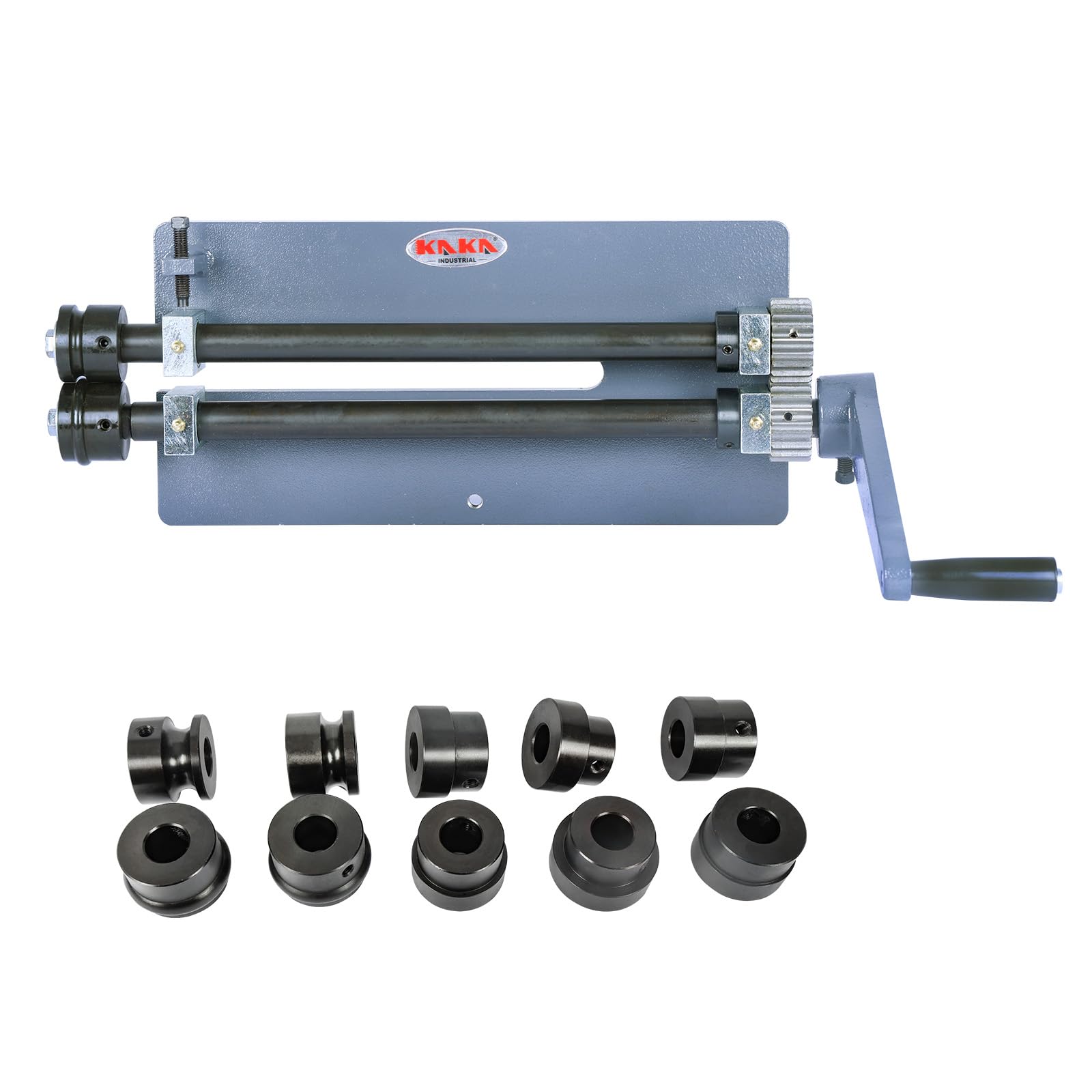
The KAKA RM-12 is a dedicated bead roller machine that comes with six sets of forming rolls, covering 1/16-inch, 1/8-inch, and 1/4-inch step dies plus 1/4-inch, 3/8-inch, and 1/2-inch bead dies. This gives you both structural step profiles and decorative beads in one purchase. The 12-inch throat depth is ideal for roof pans, hoods, and deck panels where you need to reach deep into the workpiece.
Adjustable depth control allows you to fine-tune bead height for repeatable results, which is a feature often missing on entry-level rollers. The machine is built from rigid steel with grease fittings for long-term maintenance, and the hand crank drives both top and bottom rolls simultaneously for even pressure. The 46-pound steel frame keeps flex minimal when rolling 18-gauge aluminum.
The critical catch is that some users report the included step dies require an extra spacer that does not ship with the unit, rendering those dies unusable without a separate purchase. KAKA has not consistently provided the spacers upon request. Verify with the seller before buying if you specifically need the step dies. For the bead dies alone, the machine performs excellently.
Why it’s great
- Six die sets include both step and bead profiles for versatility
- Adjustable depth control enables repeatable bead heights
- Rigid steel frame with grease fittings for long service life
Good to know
- Step dies may require spacers not included in the box
- Customer support from KAKA is inconsistent on missing parts
5. Woodward Fab WFBR6 Bead Roller

The Woodward Fab WFBR6 is a heavy-duty bead roller with a 52-pound steel frame, which is the heaviest in this roundup. That mass directly translates to rigidity—less frame flex means crisper beads on 20-gauge to 22-gauge steel, the unit’s sweet spot. It ships with six die sets that include a variety of bead and step profiles, giving you immediate options out of the box.
Customer reviews highlight that the dies leave no scratches on material, indicating good surface finishing from the factory. The 29-inch tool height and 11-inch width require a solid mounting solution; a vise alone is insufficient for this weight, and most users clamp it to a custom stand or welding table. The hand crank produces enough torque for 18-gauge steel at the machine’s limit, but expect degraded bead shape at that thickness.
The main complaint revolves around the adjusting hardware and zerk fittings, which feel cheap relative to the heavy frame. Some units require immediate replacement of the die separation spring and edge rounding to prevent cutting thin material. With a few modifications (easily found in fabrication forums), this machine punches well above its price point.
Why it’s great
- 52-pound frame provides excellent rigidity for crisp beads
- Six die sets included with scratch-free surface finish
- Capable of professional results on 20-22 gauge steel
Good to know
- Struggles with 18-gauge steel without modification
- Cheap adjusting hardware and zerk fittings feel out of place
6. Dimple Die Set 3-Piece 1/2″, 3/4″, 1″

If your work involves creating flared dimples for race car panels, UTV chassis, or Jeep brackets, this three-piece hydraulic press die set from LANHO delivers the hardness needed to survive repeated high-pressure cycles. The dies are CNC-machined from SAE 8620 alloy steel with a Rockwell hardness rating of 80, which is substantially harder than the Cr12 dies typically used in bead rollers. This rating directly correlates to die longevity—these will maintain their shape far longer than softer alternatives.
The set includes three sizes: 1/2-inch, 3/4-inch, and 1-inch. Each die is a solid cylinder with no center hole, designed exclusively for use with a hydraulic press or arbor press. Customers confirm they work cleanly on aluminum without distortion, adding significant rigidity to thin panels. The smooth surface finish means no cleanup after forming.
Note that these are not bead roller dies. You cannot mount them on a bead roller because there is no shaft or bore. If you need dimple dies for a press, this set is the best value due to the hardened SAE 8620 material. If you need bead roller radius dies, look at the Kastforce or Grneric sets instead.
Why it’s great
- SAE 8620 steel at Rockwell 80 is the hardest material in this guide
- Three common sizes cover most dimpling applications
- Clean surface finish leaves no marks on aluminum
Good to know
- Not compatible with bead rollers—requires a hydraulic press
- Limited to three sizes; no option for larger flared holes
7. Speedway Motors 1-Inch Dimple Die

Sometimes you need just one size of dimple die for a specific project, and that is where the Speedway Motors 1-inch flared hole forming tool excels. It is designed for creating clean, professional flared dimples in pre-cut sheet metal holes up to 16-gauge thick. The dies are machined from hardened steel with a black oxide coating that adds a layer of corrosion resistance and wear protection, useful in humid shop environments.
The die produces a consistent 1/4-inch radius flare, which is ideal for adding strength to race car panels, brackets, and supports. Customers have successfully rolled over 22 holes in material slightly thicker than the rated 16-gauge maximum without issue. The black oxide coating does not flake off during use, which preserves the die’s longevity.
The major design limitation is that the female threads can strip after extended use—one user reported failure after 102 holes on 16-gauge steel. The recommended fix is to drill the thread out to 3/8-inch and use a nut-and-bolt assembly. For occasional use on a single project, this is a great low-cost option. For production-level dimpling, invest in the SAE 8620 set instead.
Why it’s great
- Hardened steel with black oxide coating resists rust
- Clean 1/4-inch radius produces professional flares
- Works on 16-gauge steel with consistent results
Good to know
- Threads may strip after 100+ holes on thick material
- Single size only—no versatility for different hole diameters
FAQ
Can I use bead roller dies in a hydraulic press?
What gauge steel can a Cr12 steel die handle?
Why do some bead roller dies require spacers?
How do I prevent bead roller dies from scratching my panel?
What is the lifespan of a typical bead roller die?
Final Thoughts: The Verdict
For most users, the best bead roller dies winner is the Kastforce KF5015 because its Cr12 steel, 35 HRC hardness, and four versatile radius sizes (up to 1.5-inch) cover the vast majority of bead rolling needs at a price that leaves room for other shop investments. If you want maximum die variety without buying separate sets, grab the Grneric 12-piece set. And for heavy-duty dimple forming in a hydraulic press, nothing beats the SAE 8620 3-piece dimple die set.