
That bag of alfalfa sprouts in the grocery store costs more per ounce than a good cut of steak, and by the time you open it, half the batch is already turning into a slimy science experiment. Growing your own at home removes the premium pricing, puts you in control of the growing conditions, and delivers a harvest that is genuinely crisp, nutty, and alive in a way store-bought greens never are. The right kit does not just hold seeds — it manages airflow, drainage, and light exposure so your lentils, broccoli seeds, or mung beans transform into a crunchy harvest without mold or stagnation.
I’m Rikta — the co-founder and writer behind Gadgets Feed. I have spent years combing through technical specs and user data on home sprouting systems, analyzing mesh micron sizes, material grades, stand designs, and drainage angles to separate the kits that actually breathe from the ones that trap moisture and rot your crop. (And Homer 🐱 sat guard on the kitchen sprouting station each day, watching the jars tilt like tiny towers and meowing for a nibble of the finished batch).
Whether you are a first-time grower looking for a foolproof starter system or a seasoned sprouter wanting a dual-jar setup for continuous harvests, this guide breaks down the best options on the market today and explains exactly which features matter most for consistent, healthy results. At the end of this guide you will know exactly which bean sprouting kit fits your kitchen routine and seed preferences.
How To Choose The Best Bean Sprouting Kit
A great sprouting kit does two things well: it lets air circulate freely through the seeds and it drains every last drop of water after each rinse. Without those two conditions, even the most expensive organic seeds will turn into a sour, moldy mess. Focus on material quality, drainage design, and how many jars you actually need for your weekly sprout consumption.
Mesh Material and Micron Size
The screen that keeps seeds in while letting water out is the single most important component. Standard 304 stainless steel works well for most seeds, but 316 stainless steel offers superior corrosion resistance if you plan to use the kit daily or live in a humid environment. Plastic lids are lighter and quieter but tend to warp over time in the dishwasher. The mesh holes need to be fine enough to contain tiny alfalfa or broccoli seeds — generally around 0.5 to 0.8 mm openings — while still allowing water to drain quickly after rinsing.
Tilt Angle and Drainage Stand
A jar left upright after rinsing pools water at the bottom, which is an open invitation for mold and bacteria. The best kits include a stand that holds your jar at a 30- to 45-degree angle so excess water runs off and air can circulate through the mesh lid. Look for stands that elevate the jar high enough that the drip tray sits completely underneath, catching all runoff without creating a puddle around the jar rim. Some kits use a hanging design instead of a stand, which achieves the same draining effect with a slightly different footprint on your counter.
Light Control and Blackout Sleeves
Different seeds demand different light conditions during germination. Leafy sprouts like broccoli and alfalfa benefit from indirect sunlight, while mung beans and lentil sprouts grow longer, sweeter, and more tender in complete darkness. A kit that includes removable blackout sleeves gives you the flexibility to match the light environment to whatever seeds are in the jar. Without sleeves, you will need to stash jars in a dark cabinet for the first few days and then move them to indirect light, which adds steps and forgetability to the routine.
Jar Capacity and Number of Jars
Most standard kits use quart-sized (32 oz) wide-mouth mason jars, which yield roughly one to two cups of finished sprouts per batch depending on the seed type. If you plan to add sprouts to salads, sandwiches, and stir-fries a few times a week, a single jar setup works fine when you stagger your batches by a few days. For families or heavy sprout eaters, a dual-jar kit lets you grow two varieties simultaneously or keep a continuous rotation so you are never between harvests. Larger capacity jars around 1000 ml fit more seeds but also require a stable stand that can support the extra weight when wet.
Quick Comparison
On smaller screens, swipe sideways to see the full table.
| Model | Category | Best For | Key Spec | Amazon |
|---|---|---|---|---|
| Lulonpon Sprouting Kit | Dual Jar | Complete all-glass setup | 1000 ml jars X 2 | Amazon |
| Haswe Sprouting Kit | Starter Kit | Easy draining stand | ABS plastic + stainless steel lid | Amazon |
| Boombamo Sprouting Kit | Dual Jar | 304 stainless steel durability | 32 oz jars X 2 | Amazon |
| Malastar Sprouting Kit | Dual Jar | 316 stainless mesh | 316 stainless mesh lid | Amazon |
| ALCEDIA Sprouting Kit | Single Jar | Borosilicate glass jar | 850 ml Borosilicate glass | Amazon |
| Elementi Sprouting Kit | Dual Lids | Mason jar lid upgrade | Detachable mesh screen disk | Amazon |
| Masontops Bean Screen | Lid and Seed Pack | Seeds included | BPA-free plastic lids | Amazon |
In‑Depth Reviews
1. Lulonpon Sprouting Kit
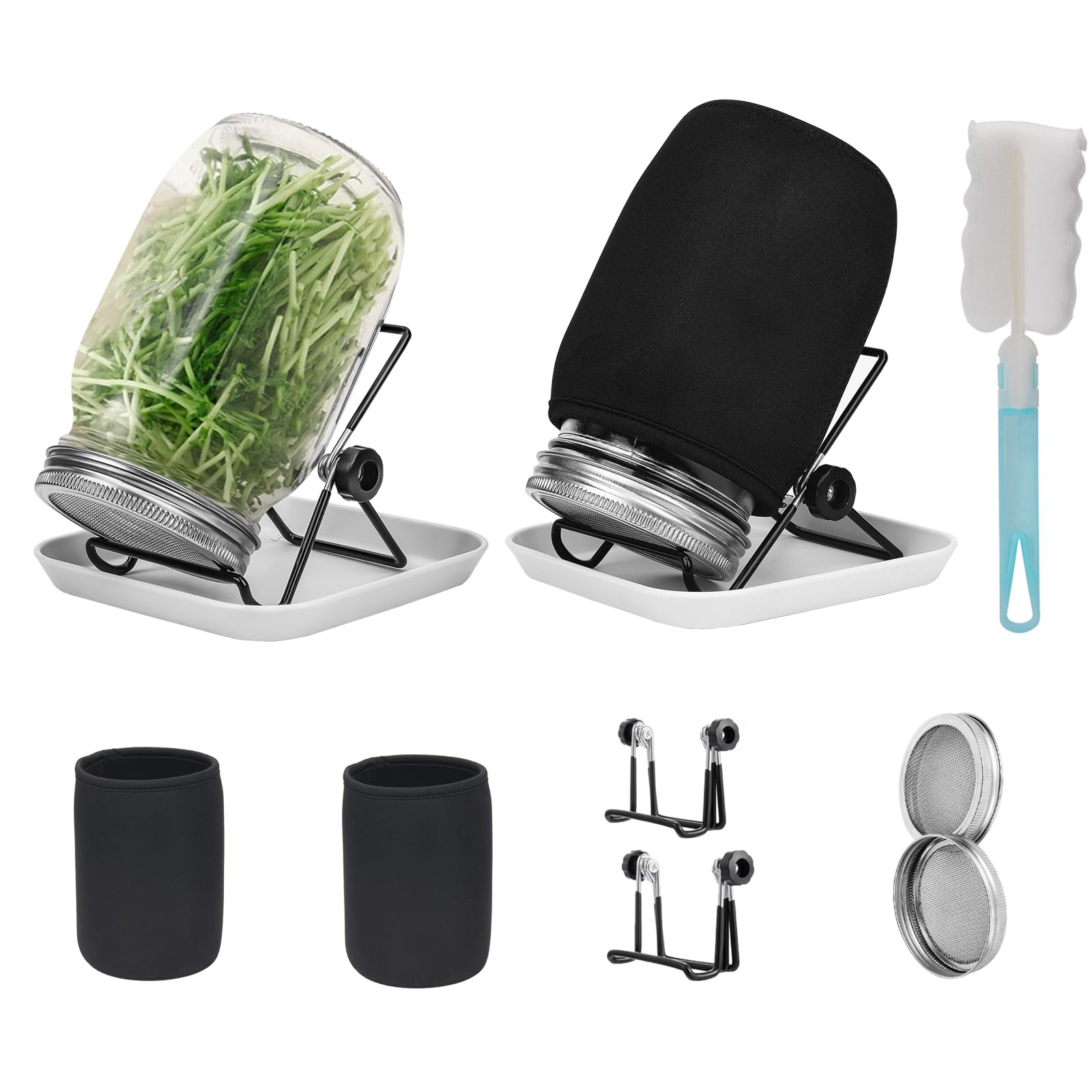
The Lulonpon kit brings together two full-sized 1000 ml wide-mouth mason jars with 304 stainless steel germination lids, making it one of the most complete dual-jar setups available at a mid-range price point. Each lid is paired with a fine mesh screen that easily retains even tiny alfalfa seeds while allowing rapid water drainage after rinsing. The inclusion of two drip trays, two shade covers, two stainless steel brackets, and a cleaning brush means you do not need to purchase any additional accessories to start growing immediately.
Customer feedback highlights the thoughtful shading sets that block light completely for the first few days of germination, which is particularly important when sprouting mung beans or lentils that grow longer and sweeter in darkness. The glass jars hold up well to daily rinsing cycles, and the stainless steel brackets tilt each jar at an optimal angle for drainage without wobbling. Several long-term reviewers noted that after months of repeated use the mesh lids show no signs of rust, which confirms the food-grade durability of the 304 steel.
The only practical downside is that the brackets require a bit of fiddling to seat the jar perfectly the first time, but once positioned they stay stable through multiple rinse-and-drain cycles. The wide mouths make cleaning easy, and both the jars and lids are dishwasher safe for quick sanitation between batches. For anyone who wants a reliable, two-jar system that handles everything from broccoli seeds to chickpeas, this is the most balanced option on the list.
Why it’s great
- Two full 1000 ml glass jars included, no extra purchases needed
- 304 stainless steel lids resist rust and clean up in the dishwasher
- Shade covers provide full blackout for dark-germinating seeds
Good to know
- Bracket assembly requires a short learning curve to align
- Jars are slightly lighter than traditional canning jars but still sturdy
2. Haswe Seed Sprouting Jar Kit

The Haswe kit strips away unnecessary complexity and delivers a functional single-jar starter system at a budget-friendly entry point. The wire screen lids are constructed from food-grade ABS plastic with a stainless steel mesh interior, providing a good balance of durability and lightweight handling. The stand holds the jar at a perfect downward tilt so water drains directly into the included tray, and the blackout sleeve slides over the jar to create darkness for seeds that need it during the first 48 to 72 hours of germination.
Users consistently report that sprouts reach harvest size in as little as three to five days, matching the performance of more expensive kits. The plastic lid is noticeably quieter than metal lids during rinsing and does not develop sharp edges over time. The stand has a small footprint that fits easily on a kitchen counter or windowsill without dominating the space.
The main drawback is that the plastic lid may gradually warp if exposed to high heat in the dishwasher over many cycles, so hand washing is recommended to extend its lifespan. The included instructions are clear enough for first-time growers, although some experienced sprouters wished for a second jar to run continuous batches. For a single-jar entry into home sprouting at an affordable cost, this kit delivers reliable results without wasted features.
Why it’s great
- Simple design with clear instructions, great for beginners
- Blackout sleeve and drainage tray included in the package
- Fast three- to five-day turnaround for most seed types
Good to know
- Plastic lid may warp if machine washed on high heat
- Only one jar included, limits batch staggering
3. Boombamo Premium Sprouting Jar Kit
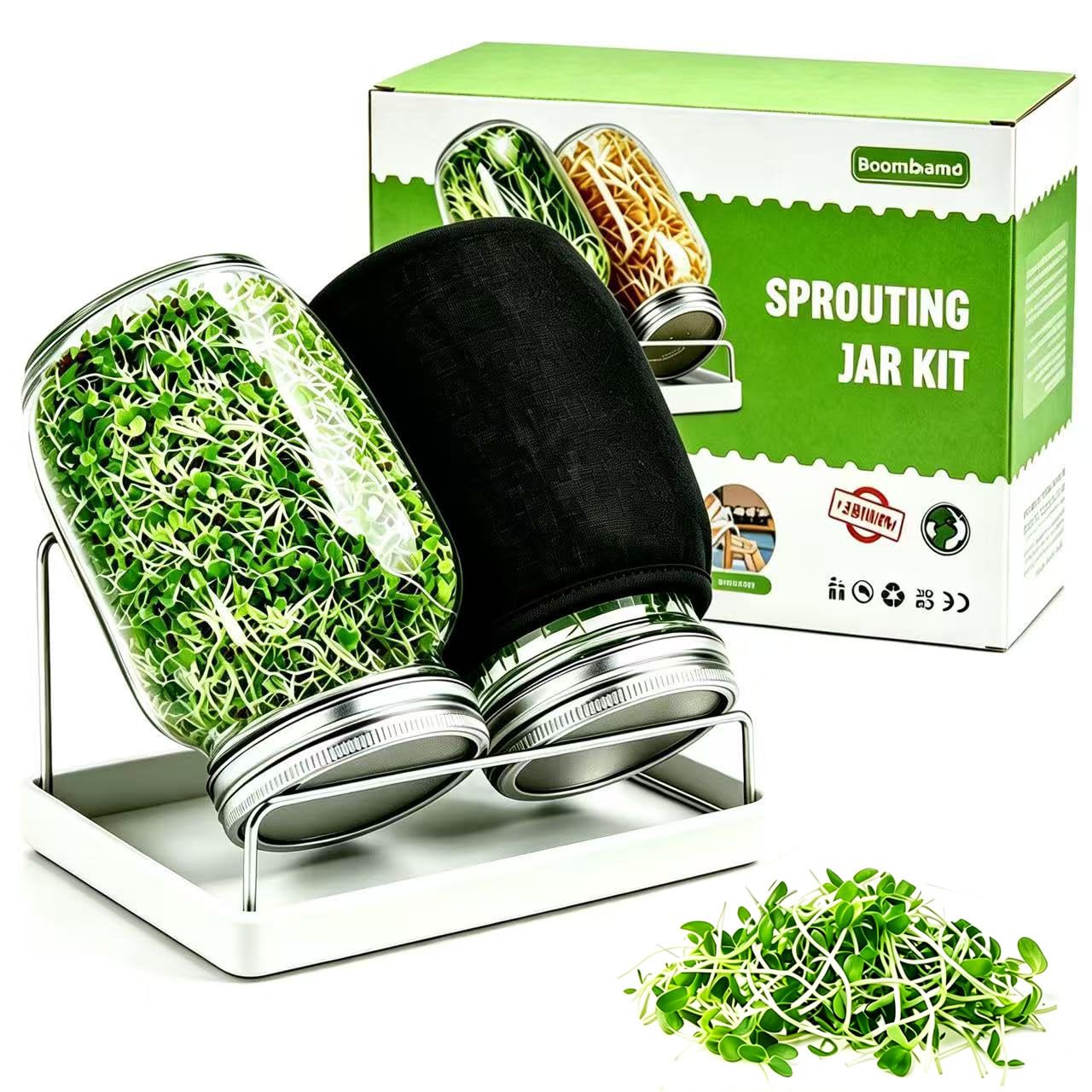
Boombamo’s kit is built around two 32 oz wide-mouth mason jars paired with 304 stainless steel lids, making it a premium dual-jar system that feels robust from the moment you open the box. The steel lids screw on smoothly and create a secure seal against the jar rim while the fine mesh does an excellent job holding in even the smallest broccoli and alfalfa seeds during the rinse-and-drain cycle. Each jar comes with its own blackout sleeve, and the entire system includes a sturdy metal stand and a drip tray that sits flush underneath to keep the counter dry.
Customer reviews repeatedly praise the kit for its ease of use — the four-step growing process outlined in the instructions is straightforward enough for an 83-year-old first-time user to achieve a successful harvest on the first try. The blackout sleeves are washable and reusable, and the metal stand keeps the jar tilted consistently without slipping. Several users noted that the kit helped them transition from store-bought sprouts to homegrown in under a week, and many reported gifting the kit to family members who also had immediate success.
The only recurring issue is that the metal stand can develop light rust at the soldered joints if left in contact with standing water between uses. Drying the stand thoroughly after each rinse cycle prevents this entirely, and most users found the trade-off acceptable given the overall build quality. The plastic blackout sleeves also fit snugly, which some reviewers found slightly difficult to slide on and off, but this tight fit ensures complete light blockage during the critical dark-germination phase.
Why it’s great
- Two 32 oz wide-mouth jars with rust-resistant 304 steel lids
- Washable blackout sleeves for optimized light control
- Simple four-step process yields sprouts in three to seven days
Good to know
- Metal stand may rust at solder points if not dried after use
- Blackout sleeves fit tightly, requiring some effort to remove
4. Malastar Complete Sprouting Jar Kit

What sets the Malastar kit apart from the competition is its use of 316 stainless steel for the mesh screen — a grade that offers significantly higher corrosion resistance than the standard 304 steel found in most kits. This matters most for daily sprouters who rinse their jars multiple times a day and want the mesh to stay pristine and rust-free for years. The kit includes two 32 oz glass jars, two ABS plastic lid rings that hold the steel mesh, two blackout sleeves, a stainless steel stand, and a drip tray — everything needed for a dual-jar rotation.
Reviewers consistently note that the design is both practical and tidy, with the mounting tray ensuring proper drainage and the cloth covers blocking light effectively for dark-germinating seeds like mung beans. The lids with built-in strainers allow for quick rinsing without having to disassemble the mesh every time, which saves a noticeable amount of time during the daily rinse routine. Several users reported that the kit works beautifully for broccoli and alfalfa sprouts, with harvests ready in three to five days when using two tablespoons of seeds per jar.
One minor criticism is that the jar covers use a fitted sleeve design rather than a drawstring closure, which some users found slightly harder to put on and take off. The drip tray also showed a tendency to warp slightly after repeated dishwasher cycles, so hand washing is recommended to keep it perfectly flat. For those who prioritize material quality and plan to use their sprouting kit daily, the 316 stainless mesh alone makes this kit a compelling investment.
Why it’s great
- 316 stainless steel mesh offers top-tier corrosion resistance
- Lids with integrated strainers speed up the daily rinse process
- Practical stand design ensures consistent angled drainage
Good to know
- Fitted sleeve covers are slightly harder to apply than drawstring versions
- Drip tray may warp in high-heat dishwasher cycles
5. ALCEDIA Premium Sprouting Jar Kit
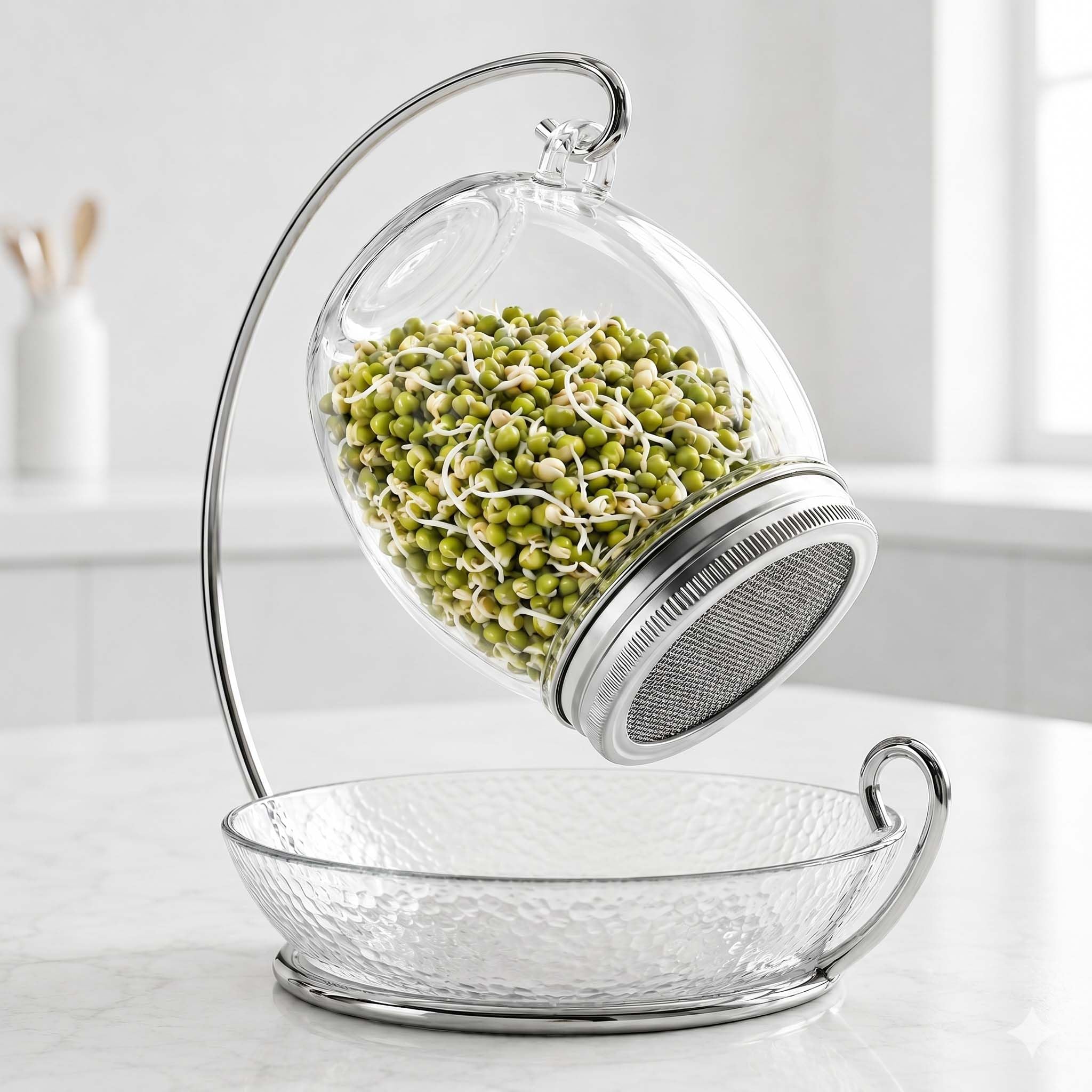
ALCEDIA takes a different approach by using a borosilicate glass jar instead of the standard soda-lime glass found in most mason jars. Borosilicate glass is stronger, more resistant to thermal shock, and has a noticeably cleaner appearance that makes this kit look like a decorative kitchen piece rather than a utilitarian tool. The 30 oz (850 ml) jar is slightly smaller than a standard quart jar, but the rounded wide-mouth shape prevents moisture from pooling at the corners, which is a smart design for sprout hygiene. The 316 stainless steel screen lid provides the same high-end corrosion resistance as the Malastar kit, and the hanging design suspends the jar at a consistent angle for drainage without needing a bulky stand.
User feedback consistently highlights how attractive the kit looks on a windowsill or dining table, with multiple reviewers saying they kept it out in the open as a decorative piece rather than hiding it in a cabinet. The sprouts grow reliably — alfalfa and broccoli seeds produce crisp, fresh results in just a few days — and the included stand and drip tray keep the counter clean. The instructions are clear, and the borosilicate glass is microwave and dishwasher safe without any risk of cracking from temperature changes.
The trade-off is that the smaller jar capacity means you yield less per batch compared to a full quart jar, which may require more frequent cycles if you eat a lot of sprouts. The hanging design also means the jar cannot be placed on its side in a cabinet without the stand, so it is best suited for countertop use. For anyone who values aesthetics and material purity alongside function, this is the most thoughtfully designed single-jar kit available.
Why it’s great
- Borosilicate glass is stronger and more thermally stable than regular glass
- 316 stainless steel mesh resists rust and corrosion over time
- Elegant design that looks good displayed on a countertop
Good to know
- 850 ml capacity is smaller than standard quart jars
- Hanging design requires the included stand for proper drainage
6. Elementi Sprouting Jar Kit
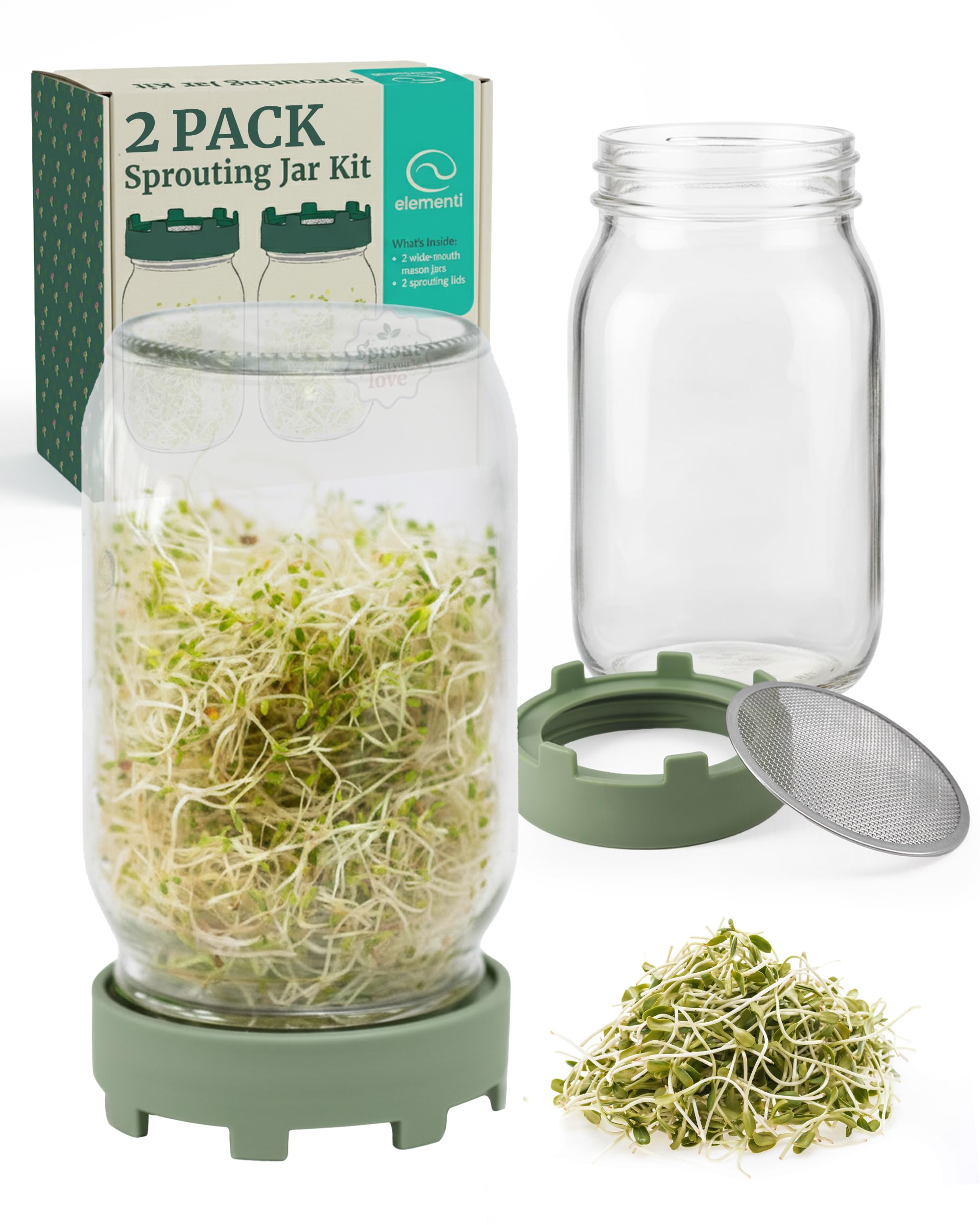
The Elementi kit focuses on what matters most: the lid system. It includes two plastic sprouting lids with detachable stainless steel mesh disks, designed to fit wide-mouth quart mason jars. The detachable mesh is a smart innovation — it comes out for thorough cleaning and can be replaced individually if needed, extending the overall lifespan of the kit. The fine mesh retains even quinoa and tiny alfalfa seeds while allowing strong airflow and water drainage, and the plastic lid ring is easy to thread onto standard mason jars without cross-threading.
Customer reviews confirm that the kit works well for a variety of seed types and produces consistent results within the expected three- to seven-day window. The mesh disks are rigid and do not deform during rinsing, and the stainless steel shows no signs of rust in early use. The sage green color of the lids adds a subtle aesthetic touch that coordinates with modern kitchen decor better than plain white or black plastic. Several users appreciated that the kit can be used as a lid upgrade for mason jars they already own.
The main criticism is that the drainage performance is not as fast as some bean-screen-style lids, because water tension can cause droplets to cling to the underside of the mesh. Users report needing to press or shake the jar firmly during rinsing to ensure all residual water exits. The green plastic rim also felt slightly stiff initially on some wide-mouth jars, though it loosened up after a few uses. For those who want a versatile lid system that works with existing jars and prioritizes easy cleaning, this kit delivers solid value.
Why it’s great
- Detachable mesh disk allows thorough cleaning and easy replacement
- Fine mesh retains even the smallest seeds like quinoa and alfalfa
- Attractive sage green color complements modern kitchen styles
Good to know
- Drainage is slower than bean-screen designs, requires firm shaking
- Plastic rim may be stiff on some jars during initial use
7. Masontops Bean Screen Sprouts Growing Kit

The Masontops Bean Screen kit takes a different approach from the jar-heavy kits on this list — it provides two plastic screw-on lids and two packs of organic, GMO-free seeds (Sandwich Booster and Crunchy Bean mixes), but relies on you to supply the wide-mouth mason jars. This makes it an excellent option if you already have a collection of quart jars in your pantry, since you are only paying for the sprouting mechanism and seeds rather than duplicating glassware. The BPA-free plastic lids feature inverted spouts and standing pegs that elevate the jar for full drainage, and the faceted side design prevents the jar from rolling on the counter during rinsing.
Customer feedback is consistently positive, with users praising how easy the lids are to use — soak seeds overnight, rinse and drain daily, tilt the jar using the standing pegs, and watch sprouts appear in as little as two days. The included seed packs from Mumm’s Seeds are grown in Canada and have been a trusted source for over three decades. Several reviewers noted that the kit works especially well for growing sprouts for chickens and other pets, making it a versatile choice beyond human consumption.
The main limitation is that the plastic lids are not ideal for extremely tiny seeds like amaranth, which can slip through the drainage holes during rinsing. Some users also found the included cone-shaped drain insert unnecessary and stopped using it after the first batch. The plastic material is durable and dishwasher safe, but it does not have the same premium feel as stainless steel lids. For budget-conscious buyers who already own mason jars and want to start sprouting immediately without paying for extra glassware, this is the most resource-efficient entry point.
Why it’s great
- Two packs of organic, GMO-free sprouting seeds included
- BPA-free plastic lids are lightweight and dishwasher safe
- Faceted jar design prevents rolling on the counter
Good to know
- Plastic lids may not retain the smallest seeds like amaranth
- Requires your own wide-mouth mason jars to use
FAQ
How often should I rinse my sprouts during the growing cycle?
Can I grow different types of seeds in the same jar at once?
Why do my sprouts sometimes smell sour or develop mold?
Final Thoughts: The Verdict
For most users, the bean sprouting kit winner is the Lulonpon Sprouting Kit because it delivers two full-sized 1000 ml glass jars with 304 stainless steel lids, dual shade covers, and a cleaning brush at a price that undercuts most single-jar competitors. If you want the highest corrosion resistance and plan to sprout daily for years, grab the Malastar Complete Sprouting Kit with its 316 stainless mesh. And for the best bang when you already own mason jars, nothing beats the Masontops Bean Screen Growing Kit with its two organic seed packs included.