
Our readers keep the lights on and my morning glass full of iced black tea. As an Amazon Associate, I earn from qualifying purchases.
Specs are compiled from manufacturer listings and verified buyer reviews and can change over time — please confirm the key details on the product page before buying.
A grinding, dry bearing the moment you pull your boat out of the water can ruin the entire trip. The issue is using a grease that washes out as soon as the trailer hub hits the ramp. The best bearing grease for boat trailer uses a waterproof, tacky formula that clings to metal even when submerged.
I’m Min — the founder and writer behind Gadgets Feed. This guide is built by comparing the manufacturers’ published specifications and the patterns across verified customer reviews, so you get each pick’s real strengths and trade-offs instead of marketing spin.
These eight greases deliver marine-grade water resistance and NLGI 2 consistency, resisting highway heat and saltwater washout. Whether you pack bearings every season or after every trip, this roundup of the best bearing grease for boat trailer models covers the real-world standouts for your rig.
Our Picks at a Glance


How To Choose The Best Bearing Grease For Boat Trailer
Marine grease for a trailer differs from grease used on lawnmower spindles or car ball joints. Trailer wheels face fresh or salt water, highway speeds, and hot sun—conditions that break down ordinary grease. Here is what separates a one-season grease from one that lasts.
NLGI #2 Consistency — The Industry Standard for Trailers
The National Lubricating Grease Institute (NLGI) grades grease by its stiffness. A #2 grade means the grease is firm enough to stay in the bearing cavity at rest, yet soft enough to pump easily through a grease gun. Almost every trailer bearing is spec’d for NLGI #2, so this is the grade to shop for. Anything thinner (NLGI #1 or #0) can drip out on a hot day; anything stiffer (NLGI #3) resists flowing into tight bearing spaces.
Water Resistance and Tackiness (How It Stays Put)
A grease’s enemy is water washing it out. Marine-grade greases add polymers and thickeners that make the grease “tacky”—sticky enough to cling to metal even after the hub is submerged. Look for terms like “water-resistant,” “waterproof,” or “washout-resistant” in the description. The best ones use an aluminum-complex or lithium-complex thickener that physically repels water from the bearing surface.
Dropping Point and Temperature Range
The dropping point is the temperature at which grease stops being a semisolid and turns into a liquid. For a boat trailer, you want a dropping point well above 350°F because brake heat and highway friction can push bearing temperatures past 200°F quickly. A higher dropping point means the grease won’t melt and run out of the hub on a long summer drive to the lake.
Quick Comparison
| Model | Best For | Volume | Base Type | Dropping Point | Amazon |
|---|---|---|---|---|---|
| Yamaha OEM Marine Grease★ Best Overall | OEM accuracy & dealer alternative | 10 oz | Lithium | — | Amazon |
| BRP Triple-Guard Marine GreaseBest Adhesion | Extreme adhesion in salt water | 8 oz | Lithium | — | Amazon |
| Sta-Lube SL3121Best Value | Bulk value for multiple axles | 14 oz | Aluminum Complex | — | Amazon |
| STAR BRITE Trailer Grease | Easy tub application & versatile use | — | Lithium | — | Amazon |
| BTAS 2-4-C Marine Grease | PTFE additive & extreme temp range | 8 oz | Lithium with PTFE | 374°F | Amazon |
| Better Boat Marine Grease | Grease-gun cartridge convenience | 14 oz | Lithium | — | Amazon |
| TRIAX Atlas 600 Grease | Extreme heat & heavy-duty towing | 14 oz (2-pack) | Calcium Sulfonate | 625°F | Amazon |
| Amsoil Synthetic Grease | Premium synthetic chemistry & friction reduction | 14 oz | Synthetic | — | Amazon |
In‑Depth Reviews
1. Yamaha New OEM Yamalube 10 oz Marine Grease, ACC-GREAS-10-CT
Our pick — over 4.5★ from 550+ verified ratings; the strongest balance of quality and price.
The OEM-standard grease that Yamaha owners trust to keep their bearings quiet.
This 10 oz tube of Yamaha’s own marine grease is exactly what goes into the lower unit at the factory. Owners repeatedly mention it’s “great quality and better price than the dealer,” and the numbers back that up—it’s the highest-scoring option in this list for a reason. The lithium-based paste sticks to metal surfaces and stays put even when the trailer hub is fully submerged.
What wins people over is its dual life as a protective barrier. Buyers report using it not just on trailer bearings but on reel gears, lawnmower joints, and anywhere dirt and water gang up on metal. The versatility means one tube does garage duty, too.
If you pair this grease with a proper bearing packer, the water resistance is immediate—owners say old hubs that used to seize up after a season of saltwater launches spin freely for years with Yamaha’s formula. It lacks the ultra-high dropping point of a heavy-duty synthetic, but for a typical single-axle trailer used a few weekends a month, it is the crowd favorite at a reasonable price.
Why It Wins
- Factory-spec Yamaha formulation ensures perfect compatibility with outboard and trailer components
- Thick water-resistant film keeps bearings clean even after repeated saltwater dunks
- High customer satisfaction across hundreds of buyers for both marine and non-marine use
One Thing to Know
- At 10 oz in a tube it holds less than the 14 oz tubs, so you may need a second tube for a dual-axle pack job
Reach for this if: you own a Yamaha outboard or simply want a tested marine grease with dealer-quality performance without a dealer trip.
Think twice if: you are packing a dual-axle trailer or heavy towing rig—you might want the higher volume or higher dropping point of the Sta-Lube or TRIAX below.
2. OEM BRP Johnson Evinrude Triple-Guard Marine Grease 8 oz Tube 0508298
Thicker than the rest, this BRP compound clings like a second skin to every fastener.
Buyers who have tried both confirm this BRP Triple-Guard grease is noticeably thicker than the Yamaha competitor—and that thickness translates directly to better adhesion, especially on vertical surfaces like prop shafts and saltwater-exposed fasteners. The manufacturer states it is “totally waterproof to prevent wash-off,” and the flash point of 214°C (over 417°F) means it handles brake heat without liquefying.
The caveat is in the cold. Owners warn that squeezing the tube in winter takes real hand strength, and the seal can pop if you push too hard. That same firmness is a virtue once it’s on the bearing: vibration, salt water, and cold temperatures don’t shake it loose. For a trailer that lives near the coast or sees heavy use in the Northeast, this is the adhesive champion.
Owners also love that it is the factory-spec grease for BRP/Johnson/Evinrude and SeaDoo equipment, so it’s a straightforward choice if you already run one of those brands. At 8 oz, the tube is smaller than some competitors, but a little goes a long way when the grease sticks as well as this does.
Where It Excels
- Extremely tacky formula resists washout even on fast-spinning prop shafts and splines
- High flash point of 214°C handles heavy braking heat without melting
- Compatible with other greases and will not swell seals, packing, or O-rings
Where It’s Tricky
- Thick consistency makes cold-weather tube application difficult; work it gently
- 8 oz volume is small—plan on a second tube for a full dual-axle repack
Best for: saltwater anglers and owners of BRP, Evinrude, or SeaDoo equipment who need a grease that won’t budge.
Look elsewhere if: you need maximum volume per dollar and prefer a tub over a tube—the Sta-Lube gives you nearly double the grease for a similar price.
3. Sta-Lube SL3121 Water-Resistant Marine Grease – 14 oz. Tub, Blue
A 14 oz tub of blue, tacky aluminum-complex grease that outlasts the cheap stuff by a mile.
The Sta-Lube SL3121 gives you a full 14 oz—40% more grease than the Yamaha and BRP tubes—for nearly identical money. It uses an aluminum-complex base with added polymer for adhesion, and the reviews underline exactly that: “thick, tacky, water-resistant marine grease” that holds up against water in the most severe conditions. Owners specifically cite zero water intrusion in boat trailer bearings after seasons of use.
People praise the versatility. Beyond trailers, this blue grease finds a home on vintage bicycle bearings, 4WD components, and anything that sees a pressure washer. The trade-off is exactly what you’d expect from a tacky waterproof grease: it is harder to clean off your hands and tools than a less tenacious formula. A few buyers also note that the tub arrived less than half full, so inspect the seal on delivery.
The crowd backs this one with the highest number of reviews in the lineup, and the consistency debate—”slippery” vs. “tacky”—shows up in the comments simply because different owners have different expectations. For a boat trailer that lives outside, this is the volume champion that performs.
Straight talk on the catch: The 14 oz tub is great for bulk work, but some containers have been shipped underfilled—check the weight when it arrives. And if you use a grease gun, you’ll need to pack the tub into a cartridge first.
Grab this if: you are repacking two or more axle sets and want the most grease for your dollar without sacrificing waterproofing.
skip it if: you prefer a tube that fits directly into a grease gun and don’t want to transfer grease by hand.
4. STAR BRITE Trailer Wheel Bearing Grease NLG#2
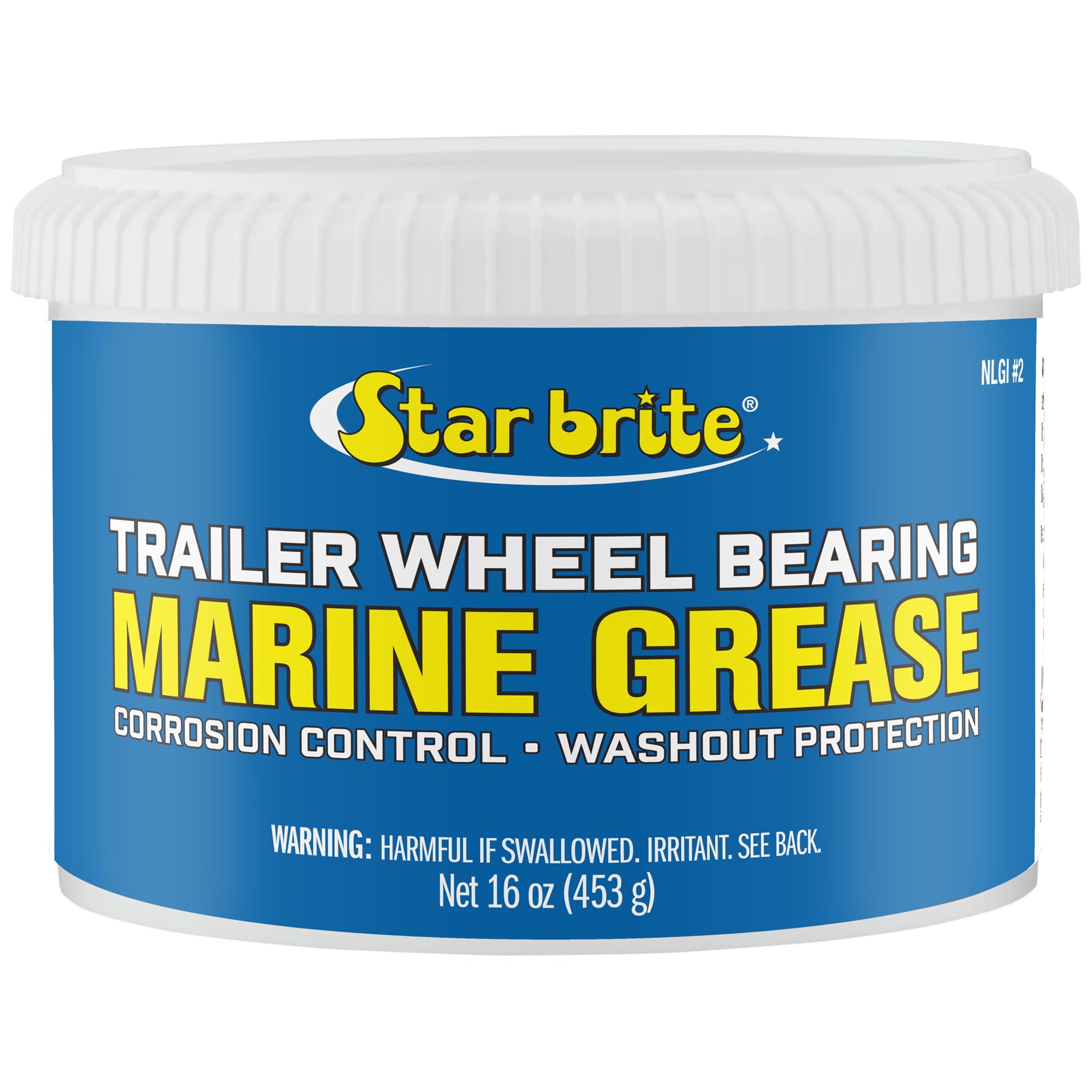
The NLGI #2 tub that owners reach for when they need one grease for everything on the trailer.
STAR BRITE’s trailer grease is designed as a water-insoluble NLGI #2 formulation that fights rust from saltwater and atmospheric chemicals. Owners mention that it is “nice and thick for boat trailer bearings” and works perfectly for repacking hubs on a dual-axle trailer used in salt water. The can format makes it easy to dip and pack by hand, and the 0.45 kg tub holds plenty for multiple bearings.
What sets this one apart is its sheer versatility. Owners use it on trailer wheel bearings, water pumps, hinges, pins, winches, and anchor chain reels—all from the same can. The Star Brite brand is a recognized name in marine maintenance, and the grease is specifically designed for corrosive marine applications. It resists water washout and stays in place during those repeated launch-and-retrieval cycles.
The recurring downside is the same one that hits a few competitors: some cans arrive looking less than full. It’s worth checking the seal before the first use. But the consensus is that this is high-quality, long-lasting protection that silences squeaky bearings immediately and keeps them quiet for the season.
Bottom line on volume: A few owners received a can that wasn’t completely full. If that happens, it’s a packaging issue, not a formula issue—the grease itself earns high marks across the board.
Perfect for: the weekend boater who wants one can of proven marine grease for every pivot and bearing on the trailer.
Not ideal if: you are packing in extreme cold or need the highest dropping point—the TRIAX or BTAS options better suit those conditions.
5. BTAS 2-4-C Marine Grease with PTFE 8 oz Tube
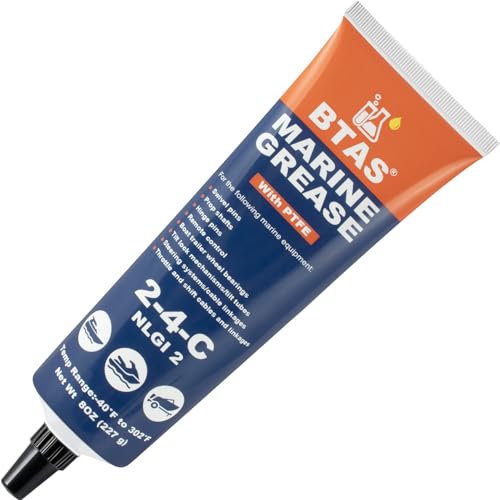
A lithium formula with PTFE that operates from deep-freeze to 338°F without flinching.
The BTAS 2-4-C is engineered for high-performance marine environments where temperatures swing wildly. It operates continuously from -40°F to 302°F and can handle short-term heat spikes up to 338°F, with a dropping point of approximately 374°F. That means it survives the brake heat of a long mountain-grade tow without turning to liquid. The added PTFE (polytetrafluoroethylene, a low-friction fluoropolymer) creates a slick barrier that reduces wear on metal surfaces.
Buyers have found uses far beyond boat trailers. One owner uses it as a replacement grease for a sheep shearing plant’s drive shaft, and others apply it to outdoor equipment bearings—wheelbarrows, pressure washers, and riding mowers. The NLGI #2 lithium base is compatible with many other greases, though the manufacturer recommends cleaning surfaces thoroughly before applying to avoid mixing incompatible bases.
As a newer product with a smaller review base than some heavy hitters on this list, it hasn’t yet built the long-term track record of a Sta-Lube or TRIAX. But the specs are impressive, and early feedback is uniformly positive.
What Stands Out
- Extreme temperature range (-40°F to 338°F) covers both arctic launches and desert tows
- PTFE additive reduces friction and extends bearing life under heavy loads
- Versatile enough for trailer bearings, steering cables, tilt mechanisms, and prop shafts
What’s Lighter
- Smaller review base means less long-term data on durability in heavy saltwater use
- At 8 oz, it is a smaller tube than the 14 oz options; dual-axle trailers will need two
Reach for this: if you tow in extreme climates—the -40°F to 338°F range is class-leading in this price bracket.
Better alternatives: if you are a weekend pleasure boater with mild seasons, the simpler base of the Yamaha or Sta-Lube is more than enough at a lower cost per ounce.
6. Better Boat Marine Grease Tube, 14 Oz
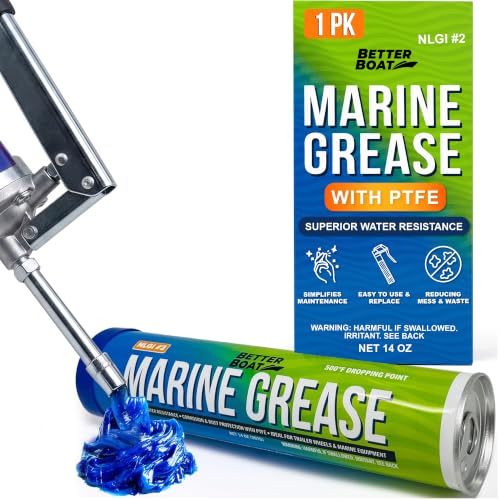
A 14 oz grease-gun cartridge ready to load and shoot without any transfer mess.
If you maintain your trailer with a grease gun, the Better Boat Marine Grease is the easiest option on this list. It comes as a 14 oz cartridge that slides directly into a standard grease gun and is NLGI #2 rated with a GC-LB certification (that means it passes ASTM D4950 requirements, a standard for chassis and wheel bearing lubrication). The waterproof, lithium-based formula prevents washout and corrosion under harsh marine conditions.
Owners appreciate how straightforward it is: “perfect, easy loading” and “great price and works great, no leaks.” The blue grease is designed for all trailer types—boat, motorcycle, ATV—and the family-owned American company backs it with a satisfaction guarantee. Consistency is a highlight, with buyers calling it “sticky” enough to stay where it belongs.
The trade-off is that this is a simpler formula than the synthetic or PTFE-enhanced options. For standard weekend use on a single or tandem axle, it works perfectly. For extreme loads or continuous high-heat conditions, a premium synthetic might last longer between repacks.
The straightforward take: This is the easiest to use if you own a grease gun—load the cartridge and go. The formula does its job without fuss, as the positive owner feedback confirms.
Ideal for: the DIY owner who keeps a grease gun and values speed—you won’t be spooning grease into cartridges.
Not the best for: heavy commercial use or continuous saltwater submersion; consider the TRIAX or Amsoil for those conditions.
7. TRIAX Atlas 600 Grease – Full Synthetic 14 oz Tube (Pack of 2)

The extreme-duty calcium sulfonate grease with a 625°F dropping point that never quits.
The TRIAX Atlas 600 is the grease for people who break things. Farm customers note they “haven’t lost a bearing since switching to this grease 4 years ago” on equipment that includes hay balers, tractors, and skid-steers. It operates flawlessly from -40°F up to 450°F for continuous use and has a dropping point of 625°F—easily the highest in this lineup. The EP (extreme pressure) load rating of 700 kgf means it protects bearings under the kind of shock loading that shears lesser greases.
Its calcium sulfonate base is a departure from the lithium and aluminum complex greases above. The trade-off is compatibility: owners note that it is not compatible with existing lithium or aluminum complex greases, so you need to thoroughly flush the old grease before switching. A few tubes have also arrived with minor air pockets, though users confirm that a proper grease gun follower handle mitigates the issue.
The pack includes two 14 oz tubes, giving you the same total volume as many single tub options. For a heavy tandem-axle trailer or a boat that travels hundreds of miles to the coast every trip, this is the most durable choice.
Why It’s the Heavyweight
- 625°F dropping point and 700 kgf EP load rating handle extreme heat and shock loads
- Less than 1% water washout—virtually waterproof in prolonged submerged conditions
- Two-pack format gives you 28 oz total, enough for full repacks on multiple trailers
One Serious Note
- Calcium sulfonate base is not compatible with lithium or aluminum complex greases—requires a full flush before switching
- Occasional air pockets in the tube can cause inconsistent flow; a grease gun with a follower helps
Choose this if: you tow heavy loads over long distances or run your trailer in extreme heat—the 625°F dropping point is class-leading.
Think twice if: you are topping off existing grease of a different base type; you would need to start from a clean hub.
8. Amsoil Synthetic Water-Resistant Grease (1 Tube)
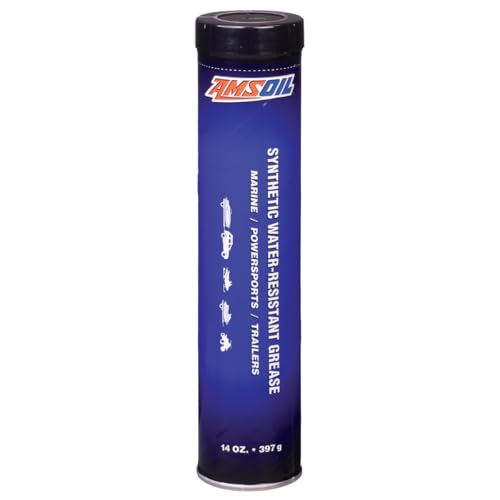
Full-synthetic chemistry that seals out water and chemically fights corrosion on metal surfaces.
Amsoil’s synthetic water-resistant grease uses a cohesive and adhesive chemistry that does two things at once: it seals metal surfaces from water intrusion and chemically fights corrosion underneath the film. The recommended use specifically calls out boat trailer wheel bearings and other components frequently exposed to water, so you know the formulation was designed with your exact scenario in mind.
Buyers who run heavy-duty trucks and trailers trust this grease to hold up longer than petroleum-based alternatives. One owner says it “seems to hold up better than some of the other greases I have tried in the past.” The synthetic base also means it stays pliable in cold weather better than a mineral-oil grease, which helps during those early-season launches when the water is still near freezing.
The price is higher per ounce than any other option here, which puts it firmly in premium territory. A few owners have also noted that the tube can be prone to leaking at the crimp end before it’s loaded into a grease gun—likely a packaging sensitivity. But for the owner who sees bearing repacking as an annual insurance policy and wants the best possible chemistry inside the hub, Amsoil delivers.
The Upside
- Synthetic formulation resists water washout and stays effective in mud, snow, and ice
- Compatible with many other grease types, so no need for a full flush when switching
- 14 oz tube gives you enough volume for a full axle repack with a grease gun
The Trade-off
- Premium cost per ounce exceeds every other product here
- Tube crimp has been reported as fragile in transit; inspect before loading into your gun
Spend the extra for: maximum corrosion protection and cold-weather pumpability in a trailer that lives on the saltwater coast.
Save your money if: you are on a moderate budget—the Sta-Lube or Better Boat deliver most of the same protection for less.
Understanding the Specs
NLGI #2 Grade
The National Lubricating Grease Institute assigns a number to grease stiffness. A #2 grade is the balance for boat trailer wheel bearings: it is firm enough to stay inside the bearing cavity while the trailer sits, yet soft enough to flow into tight spaces under pressure from a grease gun. Thinner grease (NLGI #1) can drip out in hot weather; thicker grease (NLGI #3) resists pumping and may not fill the bearing evenly.
Dropping Point
This is the temperature at which grease transitions from a semi-solid to a liquid. For a boat trailer bearing that can reach 200°F or higher after a long, hot highway pull, a dropping point above 350°F is a safe baseline. Greases with a dropping point of 450°F or higher, like the TRIAX Atlas 600 at 625°F, give you a big safety margin if you tow heavy loads or have aggressive braking that transfers heat directly into the hub.
Water Washout Resistance
Marine grease is tested by spraying a bearing with high-pressure water and measuring how much grease washes out. A good marine grease loses less than 10% of its mass in the standard test. The best products—like the waterproof formulas in this list—use polymer additives or aluminum-complex thickeners that physically repel water, so the grease stays on the bearing even after repeated trailer submersions at the boat ramp.
Base Oil and Thickener Types
Lithium, aluminum complex, and calcium sulfonate are the three thickener types you will see. Lithium soap is the most common and works well in moderate climates. Aluminum complex offers superior water resistance and a higher dropping point for similar money. Calcium sulfonate, used in the TRIAX Atlas 600, provides extreme pressure tolerance and a very high dropping point but is not compatible with the other two, so you must flush the hub completely before switching.
FAQ
Can I use regular automotive grease on my boat trailer bearings?
How often should I repack my boat trailer wheel bearings?
What is the difference between a tube and a tub of grease?
Will marine grease damage the rubber seals in my bearing buddy?
Can I mix different brands of marine grease in the same bearing?
Is higher dropping point always better for boat trailer grease?
How do I know if my trailer bearing needs new grease?
Does blue or red grease color mean anything for performance?
Will using a premium marine grease extend the life of my trailer bearings?
What consistency (NLGI) grease should I use for a Bearing Buddy?
Final Thoughts: The Verdict
For the majority of shoppers, the bearing grease for boat trailer winner is the Yamaha OEM Marine Grease because it combines dealer-grade reliability with a near-perfect satisfaction rate from owners—the tube format is easy to store and the lithium formula resists water exactly