
Our readers keep the lights on and my morning glass full of iced black tea. As an Amazon Associate, I earn from qualifying purchases.
Specs are compiled from manufacturer listings and verified buyer reviews and can change over time — please confirm the key details on the product page before buying.
Bed rails for hospital beds are one of those purchases you make under pressure — after a fall, after a surgery, or after a facility tells you exactly which model it allows. The difference between a good rail and a bad one is rarely the price tag; it’s whether the rail actually fits your specific bed frame and whether it gives your loved one a solid grip to roll and stand. This guide cuts through the compatibility headaches to help you match the right rail to your bed, your care setting, and your budget.
I’m Min — the founder and writer behind Gadgets Feed. This guide is built by comparing the manufacturers’ published specifications and the patterns across verified customer reviews, so you get each pick’s real strengths and trade-offs instead of marketing spin.
From twin-size home frames to full institutional beds, these are the details that decide which bed rails for hospital beds actually keep someone safe at night and steady at the edge in the morning.
Our Picks at a Glance


How To Choose The Best Bed Rails For Hospital Beds
Before you compare brands, you need to answer one question: what kind of bed frame are you attaching to? Hospital rails clamp or mount onto the metal frame of an institutional bed, not the wooden frame of a standard home bed. Mixing those up is the number one reason a rail ends up returned.
Match the rail to your bed frame
Institutional beds come in a few deck styles — spring deck, rectangular tube deck, and pan-style being the most common. Some rails only fit one style, so a rail that is perfect for an Invacare electric bed may be completely useless on a different model. Read the compatibility notes carefully before ordering, and if a facility is involved, ask which models they permit.
Decide between full, half, and ring-style rails
A full-length rail runs most of the bed’s side and is ideal for someone who rolls a lot or needs help repositioning. A half-length rail covers roughly the upper half and is often favored by ambulatory patients who just need a grip to sit up. Ring-style or assist rails mount on one side and give a dedicated handle for getting in and out — some facilities restrict full rails, so the ring becomes the only allowed option.
Quick Comparison
| Model | Best For | Style | Adjustability | Weight | Amazon |
|---|---|---|---|---|---|
| Mybow Double Bed Rail★ Best Overall | Home beds with 8–11 in mattresses | Dual full-side rails | 3 height settings, width extender | 7.2 lbs | Amazon |
| Drive Medical Deluxe Full LengthFacility Standard | Hospital beds with a full side rail | Full-length side rail | Spring-loaded up/down | 1.51 lbs | Amazon |
| Drive Medical No Gap Half Length | Ambulatory patients on steel frames | Half-length steel rail | Raise/lower bar | 2.16 lbs | Amazon |
| AireMed Assist Rails (Set of 2) | Spring and rectangular tube deck beds | Fixed assist rails, 15 in tall | Fixed height | 5 lbs | Amazon |
| Comfort Company Halo Ring (77301) | Institutional beds where full rails are banned | Single-sided ring with pad | Fixed | 12.1 lbs | Amazon |
| Comfort Company Halo Ring (77121 style) | Hospital beds up to 42 in wide | Single-sided ring | Fixed | 12.55 lbs | Amazon |
In‑Depth Reviews
1. Mybow Dual Side Bed Rails for Elderly Adults
Our pick — over 4★ from 100+ verified ratings; the strongest balance of quality and price.
The dual-side rail that transforms a home bed into a secure care setup in minutes.
This is the pick for families caring for someone at home, because it turns a standard home mattress into a protected space on both sides. You get two rails that fit Twin, X-Long Twin, Full, and Queen beds as long as the mattress is under 11 inches thick, and the width adjusts via an extension tube to span beds from 35 to 62 inches. At 7.2 pounds per rail set, this is a hefty, heavy-duty iron build — more than four times the weight of the lighter full-length hospital rail below, which translates to real stability when someone rolls against it.
The integrated frame hugs the mattress to minimize gaps and slipping, while a bottom stabilizing bar locks the rails in place. Three height settings from 18 to 20 inches let you fine-tune the grip level, and the anti-slip foam handrails make getting in and out feel secure. Fifteen owners praise the build quality, and 11 note it functions well in daily use. Buyers report it works beautifully on a Sleep Number bed and that it “works great on my mom’s bed,” though they warn the assembly takes patience.
The honest catch is in that assembly. Owners mention the pieces do not slide together easily, the pins and holes do not line up well, and adjusting it after the fact is genuinely difficult. If you are handy or have someone who can muscle the fit, this is a remarkable value; if you need instant, tool-free simplicity, budget extra time on day one. The flannel storage bags on each side are quieter and softer than mesh, and they remove easily for cleaning — a small touch that keeps the bed area tidy.
What Owners Rely On
- Dual-side protection stops rolling out on both edges
- Three height settings from 18 to 20 inches suit varied mattress depths
- Heavy-duty iron frame with a stabilizing bar stays put
What Takes Patience
- Assembly is tricky — pins and holes do not align easily
- Adjustments after setup are difficult to make
- Only fits mattresses under 11 inches thick
Reach for this if: you are equipping a home bed and want both sides protected with a sturdy, adjustable rail that needs no tools.
Look elsewhere if: you cannot spare 30-plus minutes for a stubborn assembly, or your mattress is thicker than 11 inches.
2. Drive Medical Deluxe Full Length Hospital Bed Side Rails
A featherweight full-length rail that mounts directly to institutional bed notches.
This is the classic facility-grade rail, and at just 1.51 pounds it is the lightest option here — a striking contrast to the dual home rail’s 7.2 pounds. Built for genuine hospital beds, not home frames, it mounts via the bed’s side notches and uses a spring-loaded release to adjust the rail up or down to match the bed’s angle. It arrives in a 44.5 x 20.25 x 3-inch footprint, which is roughly 37% longer than the half-length steel option below, giving full-side coverage for someone who shifts around at night.
Fourteen owners praise its precise fit on hospital beds, and 11 highlight easy installation, especially on Invacare models. Customers note these “work well for keeping patients safely in bed at night” and describe the build as “very sturdy” and trustworthy. The rail adapts to bed angles through its spring-loaded bars, which is a genuine advantage when the head of the bed is improve for breathing or reading.
The trade-off is height and shipping fragility. Reviewers point out the rails sit “way too low” on beds that use a box spring and mattress combo, so this is strictly for a true hospital frame, not a home bed with a box spring. The adjustability gets mixed feedback — some find it easy, others report the tension rod popping off, and there is a warning not to lower the rail past the last hole or it jams and needs a forceful jerk to free. An occasional unit also arrives with broken pieces from rough shipping, so inspect on arrival.
Bottom line: The standard-issue full rail for real hospital beds, valued for its easy notch mounting and sturdy feel. Shoppers say it is “easy to install on Invacare bed” and solid once in place.
Think twice if: your bed has a box spring — the rail height will sit too low to be useful, and this is not the right tool for a home frame.
3. Drive Medical No Gap Half Length Steel Bed Rails (2 Count)

Half-length steel rails with a no-gap design and the most community buy-in here.
If you are equipping a facility or a home hospital bed and want proven compatibility, this two-pack is the crowd favorite — the highest-rated and most-reviewed option in this lineup. The no-gap design prevents entrapment between bars, a key safety feature for restless sleepers. Each rail measures 32.4 x 18.1 x 5.1 inches, a shorter profile than the full-length Deluxe, and the pair weighs 2.16 pounds per rail.
Forty-nine owners confirm compatibility with steel-frame hospital beds, especially Invacare electric models, and 29 praise the value. Buyers report they are “easy to install,” the length is “perfect for an ambulatory patient,” and there is “no problem lifting or lowering rail, big plus.” The whole point of the half-length design is to help someone who can walk but needs a grip to sit up, roll, and get out — and the simple raise/lower bar is the standout feature in actual use.
There are two honest caveats. Fit is mixed — about 32 owners mention some beds don’t accept them, so measure your frame and confirm the steel style before ordering. And the instructions are unclear, with 12 owners flagging confusion; a practical tip from the review pages is to keep the plastic collar on the screw for a tight fit and to expect a slight initial wobble that disappears once snug. This is also not for “pan-style” bed surfaces, so confirm your deck type.
Why Caregivers Choose It
- No-gap bar spacing prevents entrapment between rails
- Raise and lower bar is easy even for weak hands
- Two-pack cost makes outfitting a facility affordable
Before You Order
- Not every steel bed accepts it — fit is mixed across models
- Instructions are unclear and need some trial and error
- Does not work with pan-style bed surfaces
Best for: an ambulatory elder who needs a reliable grip to sit up and stand, on a steel-frame hospital bed, especially an Invacare.
Who it misses: anyone with a pan-style deck or a bed model outside the common steel-frame compatibility list.
4. AireMed Bed Assist Rails (Set of 2)
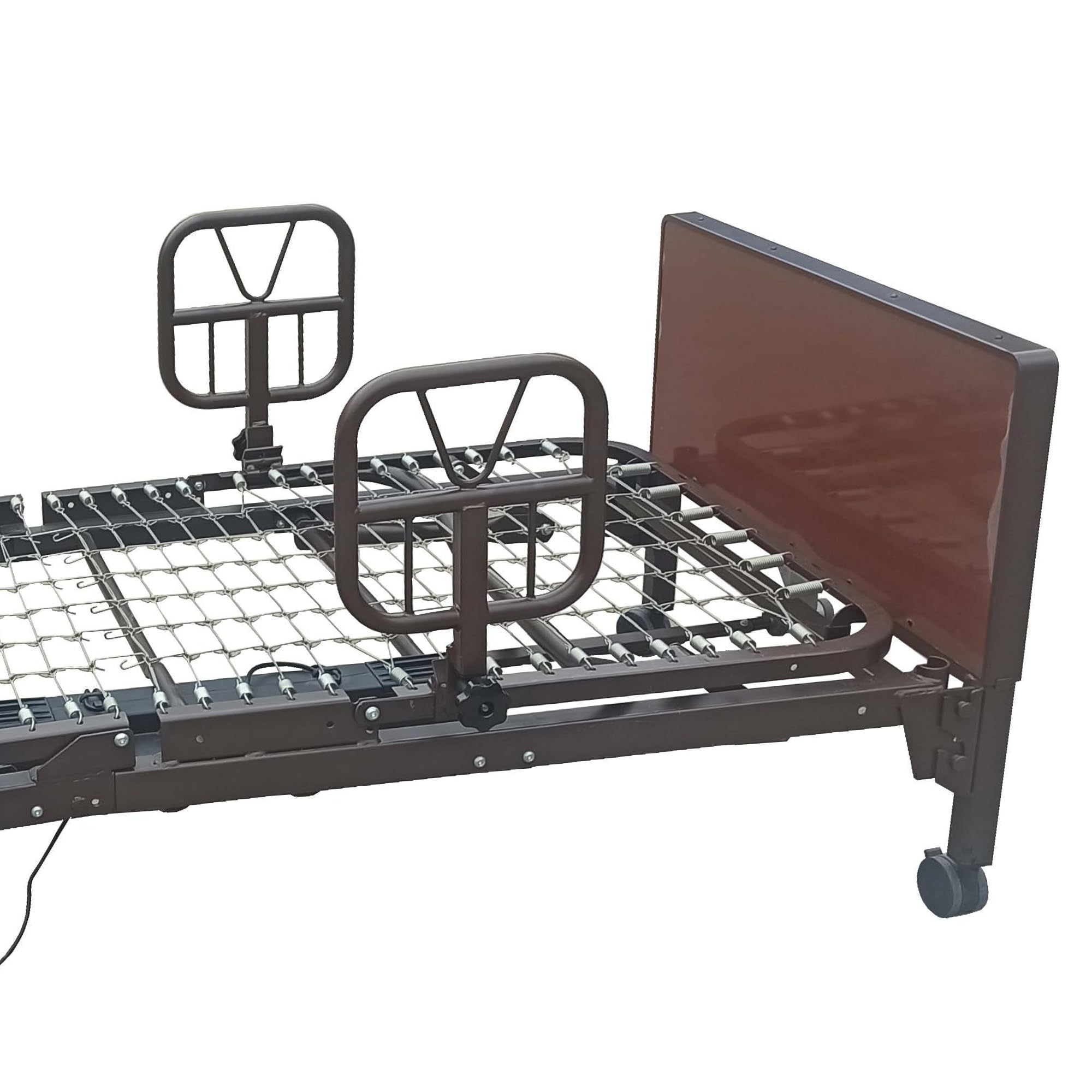
Fixed-height assist grips that clamp onto spring and rectangular tube deck beds.
These are not full rails — they are T-shaped assist grips, and that distinction matters. Standing at a fixed 15 inches from the bed deck to the top, they give someone a sturdy handle for repositioning and for getting in and out, without the full-barrier feel some residents dislike. Each rail is built from 1-inch alloy steel with a 300-pound weight capacity, and the set weighs 5 pounds total. The universal clamp mounts directly to the metal frame, so there is no drilling and no tools required — customers note installation takes minutes.
The targeted design is exactly what some facilities require. Because many states restrict full bed rails, these fixed-height grips are the compliant middle ground — buyers specifically note they are “the right size for a state that does not allow full bed rails” while still giving someone “something to grab onto.” The sturdiness is the consistent praise, with owners calling them “sturdy grip bars” that are “heavy duty” and a “good fit” for adjustable hospital beds. They are ASTM Certified, a recognized safety standard for medical equipment.
The catch is compatibility, and the listing is upfront about it: these only fit spring deck and rectangular tube deck beds from makers like Medline, Drive, and Invacare. They will not fit homestyle adjustable beds, pan decks, queen/full/twin frames, or any home metal bed frame. Assembly itself is mixed — one buyer reports the attachment pieces cannot fit between the springs on a standard bed without cutting, so confirm your deck style before ordering. Also note the fixed 15-inch height: most hospital foam mattresses are 5-6 inches tall, leaving 8-9 inches of rail above the mattress, which suits most people but may feel short if you add thick toppers.
Strong suit: Compliance-friendly assist grips with real 300-pound support and a fast clamp-on install.
Reality check: This is a narrow-fit product — verify your bed is a spring or rectangular tube deck, or it will not mount at all.
5. Comfort Company Halo Safety Bed Ring with Pad Protector

The patented single-sided ring that is the only rail some institutions will allow.
When a facility says “no bed rails,” the Halo Ring is often the exception they name. This model is the single-sided version for institutional and hospital beds with a metal frame, and it includes a removable pad protector on the ring itself to help prevent bruising. Its patented design prevents lateral mattress movement, making it the only rail style many assisted living facilities permit. At 12.1 pounds, this is the heaviest, most substantial unit here — a clear step up in perceived build quality.
For families navigating facility rules, this is frequently the only compliant path. Reviewers point out it is “the only kind they allow in her assisted living home” and that “he has not fallen getting out of bed since installed.” The quality is the consistent praise — owners call it “very sturdy” and “premium quality,” and from a care perspective it beats the risk of a patient walking unassisted at night. The design keeps the bed from rolling out laterally while still giving a secure ring to grip for standing.
The honest drawbacks are price and fit. It carries a premium cost that owners repeatedly describe as “crazy expensive,” and it does not fit beds wider than 42 inches — a real limitation for larger frames. It also prevents the hospital bed from going fully flat, which matters if your care routine requires that position. Functionality and installation both earn mixed feedback, with some finding the two-piece design wobbly and hard to install. This is a specialist tool for a specific regulatory situation, not a general-purpose rail.
Choose this when: your facility mandates this exact style and you need a compliant, sturdy ring with bruise protection.
skip it if: cost is a serious constraint or your bed is wider than 42 inches — both are real limits here.
6. Comfort Company Halo Safety Ring (One Sided)

The original Halo ring for hospital beds up to 42 inches wide, without the pad.
This is the earlier sibling of the ring above — same single-sided design, same metal-frame requirement, but without the removable pad protector and at a slightly lighter 12.55 pounds total package weight. It fits most hospital and long-term care beds with metal frames, with a firm limit of 42 inches wide. The listing is explicit: this will not fit a standard homecare bed, so it is strictly an institutional purchase.
It delivers fall prevention and a dependable grip for standing. The most-discussed strength is effectiveness — owners describe it as “a great tool” for keeping an aging parent in bed at night and sturdy enough to provide support when standing. Shoppers say their mother “no longer struggles having to try and sit down between two bars,” which captures the real daily win: a clear, open handle instead of trying to grip between vertical bars. Durability is the second pillar of praise, with the ring holding up to repeated daily use.
The recurring gripe is the price, which owners call “really expensive” even when they admit it works well. That cost complaint is the single most common theme across reviews, so weigh it against how long you expect to need the ring. The 42-inch width limit also rules it out for wider beds, and like its sibling, it mounts only on metal institutional frames. If your loved one is in a facility that requires this style, the effectiveness justifies the cost; for a home setup on a wider frame, look at other options.
What it does best: Delivers a sturdy, effective single-sided grip that keeps a sleeper from rolling and gives a dependable handle to stand.
What holds it back: The premium price and the hard 42-inch width ceiling make it a niche purchase for facility use.
Understanding the Specs
Bed Frame Compatibility
This is the make-or-break spec. Hospital rails mount to the metal deck of an institutional bed — spring deck or rectangular tube deck in most cases. Pan-style decks and home bed frames reject most of these rails. Always confirm your bed’s deck style against the rail’s stated fit before buying, and check with the facility which models they permit.
Rail Height and Mattress Thickness
Height settings range from fixed (like the AireMed’s 15 inches) to adjustable (18 to 20 inches on the Mybow). The usable grip height above the mattress depends entirely on mattress thickness — a 5-6 inch foam mattress leaves 8-9 inches of rail. Measure your mattress and any toppers first so the grip lands where it actually helps.
FAQ
Will these rails fit a standard home bed frame?
What is the difference between a full-length and half-length rail?
Why do some facilities only allow ring-style rails?
How do I know if a rail fits my specific hospital bed model?
What mattress thickness do adjustable rails accommodate?
Is assembly difficult for these bed rails?
What is the weight capacity of these rails?
Do these rails work with a box spring and mattress setup?
Final Thoughts: The Verdict
For most home caregivers, the bed rails for hospital beds winner is the Mybow Dual Side Rail because it brings hospital-grade dual-side protection to a standard home bed with adjustable 18-20 inch heights and a stabilizing bar. If you need a compliant option for a facility that restricts full rails, the Comfort Company Halo Ring is the one facilities actually accept. And for an ambulatory patient on a steel-frame hospital bed, the Drive Medical No Gap Half Length pair delivers proven compatibility at a sensible cost. Match the rail to your bed frame first, and the rest falls into place.
How We Picked
We do not accept paid placement. Every pick is matched to a real buyer and a real use-case; we do not hands-on test units.
Sources & Methodology
Specifications: manufacturer listings and product documentation. Review insights: verified customer reviews, as of August 2026. Pricing: not shown on this page (it changes often); check the current price via the retailer link.
As an Amazon Associate, Gadgets Feed earns from qualifying purchases. This does not affect which products we feature.