
Our readers keep the lights on and my morning glass full of iced black tea. As an Amazon Associate, I earn from qualifying purchases.
Specs are compiled from manufacturer listings and verified buyer reviews and can change over time — please confirm the key details on the product page before buying.
If you wake up congested every single morning, the problem is probably not your sinuses — it is the mattress under you. Dust mites live by the million in ordinary fabric, and the fix is not another vacuum session. It is a barrier: a zippered encasement or tightly woven cover that physically seals the mites and their allergens away from you. Below are eight covers that actually do that job, sorted by what they are best at.
I’m Min — the founder and writer behind Gadgets Feed. This guide is built by comparing the manufacturers’ published specifications and the patterns across verified customer reviews, so you get each pick’s real strengths and trade-offs instead of marketing spin.
The short answer: a six-sided zippered encasement is the only style that seals the whole mattress, and the SureGuard is the one that does it with the broadest owner track record. Everything else here covers a specific piece of the bed — pillows, duvet, or the top of the mattress only. Read on for the full breakdown of the bedding for dust mite allergy that fits your bed and your laundry habits.
Our Picks at a Glance


How To Choose The Best Bedding For Dust Mite Allergy
Dust mites are tiny arachnids (bug-like creatures too small to see) that live in fabric and feed on shed skin flakes. You cannot see them, and washing alone will not clear them out of a mattress. What you can do is put a physical wall between them and your face. Every cover here works on that one idea — the difference is how much of the bed it covers and how tightly it is woven.
Seal the whole mattress, not just the top
A fitted pad covers one surface. Mites live on all six sides of a mattress, plus the seams and the underside. That is why a zippered encasement — a full sleeve that swallows the mattress — is the baseline pick for anyone with a real allergy. Look for six-sided construction, a sealed zipper, and a stated depth range so you know it will close around your mattress.
Watch the pore size, not the thread count claim
The number that matters is the pore size — the width of the gaps in the weave, measured in microns (a micron is one thousandth of a millimetre). Dust mite allergen particles are larger than the tightest weaves, which is why covers state figures like ≤ 10 μm or less than 3 microns. A tighter number means a stronger barrier. Thread count is a comfort and feel figure, not a barrier figure.
Decide how you will wash it
Any barrier collects dust over time, so washing matters as much as the weave. A full encasement has to come off the mattress to be laundered, which is a two-person job on a queen. A zip-off top or a pillow protector set is far easier to rotate through the wash. Think honestly about how often you will actually do it before you pick a style.
Quick Comparison
| Model | Best For | Coverage | Barrier Fabric | Stated Depth Fit | Amazon |
|---|---|---|---|---|---|
| SureGuard Mattress Encasement★ Best Overall | Whole-mattress sealing | Six-sided zippered | Cotton terry top, polyurethane backing | 13–16 in. | Amazon |
| Hospitology Products EncasementBest Fit Range | Easy install and value | Six-sided zippered | Polyester knit, polyurethane lining | 12–18 in. | Amazon |
| FAUNNA Pillow Protectors (6 Pack)Best Pillow Set | Covering every pillow | Zippered pillow, 6 count | 600-thread-count cotton, TPU backing | 20 x 36 in. King | Amazon |
| FAUNNA Cotton Duvet Cover | Sealing the comforter | Zippered duvet cover | Cotton, ≤10 μm weave | 90 x 90 in. Queen | Amazon |
| Allersoft Cotton Duvet Protector | Breathable duvet layer | Zippered duvet cover | 100% cotton, under 3 micron weave | 90 x 96 in. | Amazon |
| CleanRest PRO Presto! Encasement | Laundry rotation | Six-sided, zip-off top | MicronOne fabric | 9–18 in. | Amazon |
| Protect-A-Bed AllerZip Encasement | Quiet waterproof barrier | Six-sided zippered | 100% polyester knit, Liquidry layer | 6–11 in. | Amazon |
| Mission:Allergy Barrier II Cover | Allergist-designed barrier | Fitted cover | Woven microfiber polyester | 9 in. | Amazon |
In‑Depth Reviews
1. SureGuard Mattress Encasement
Our pick — 4.5+★ from 21,500+ verified ratings; the strongest balance of quality and price.
The one that swallows your whole mattress and seals it shut.
Start with the zipper, because that is where mite bedding either works or fails. This cover zips around all six sides of the mattress, so there is no exposed underside or seam for mites to slip past. The top panel is a cotton terry surface — the same looped towel texture you know from a bath towel — which means it feels like fabric under your sheets rather than plastic.
It fits a Queen mattress measuring 60 x 80 inches with a depth of 13 to 16 inches, and SureGuard lists a 10-year quality guarantee. Waterproofing comes from a 100% polyurethane backing on the five non-top panels; the maker states the cover is free from vinyl, PVC, phthalates and fire retardants. The buyer consensus over many thousands of ratings is a well-made cover that goes on and comes off without a fight, and the cotton top is the part people keep mentioning. It also has the deepest owner track record here: 4.5+ stars across 21,000+ ratings.
The honest catch is the material. Five of the six sides are polyester with a polyurethane backing (a thin plastic layer that blocks mites), not cotton, so this is not a pure-natural cover. The zipper is the most argued-about part: the maker’s Invisi-Zip and SureSeal closure is designed to lock shut, but buyers split between those who find it solid and those who find it fiddly. Treat the zip gently when you install it and you sidestep most of that.
What earns the top spot
- Six-sided zippered design seals the entire mattress, including the underside
- Cotton terry top keeps the mattress feel instead of a plastic sheet
- Machine wash and dry, with a 10-year quality guarantee stated
- GREENGUARD Gold certified and independently lab tested per the maker
What to know before you buy
- Zipper divides opinion — a fair number of buyers find it finicky
- Only the top panel is cotton; the other five sides are polyester with polyurethane backing
- Depth fit is 13–16 inches, so a thinner mattress will sit loose
Buy this if: you want a single purchase that seals the mattress on every side and you can live with a fitted zip.
Think twice if: your mattress is under 13 inches deep or you want an all-natural fabric throughout.
2. Hospitology Products Mattress Encasement
A stretchy six-sided barrier that swallows a deeper mattress than the SureGuard will.
The figure that sets this pick apart is 12 to 18 inches of stretch. Where the SureGuard tops out at 16 inches, this one stretches down to a 12-inch standard mattress and up to 18 inches, so a pillow-top or a deep hybrid bed is covered without a fight. The barrier is a polyester knit face over a 100% polyurethane waterproof lining, applied to all six sides of the mattress and described as lab-tested by the maker.
Breathability is the design goal here. The waterproof membrane is described as breathable so it will not trap heat, and the knit face is deliberately soft rather than plasticky. That lines up with what the buyer pages show — the fabric feel and the lack of a crinkle are what get praised, and it is also noted for holding up in the wash. Quality and fit are the two things people talk about most, and both come out positive across the wider review base.
Where it falls short of the top pick is in the material list: the face is 100% polyester, not cotton, so you lose the towelling feel of the SureGuard under your sheets. This one carries a 5-year limited warranty; the pick above carries a 10-year guarantee. Neither is a defect — it is a different trade at a different tier.
Why it earns second place: the 12–18 inch stretch is one of the widest depth ranges among the full encasements here, which matters if your mattress is thick or you are not sure of its depth. It is also remarkably light for a six-sided cover at 16 ounces, so wrestling it on is less of a job.
The fair caveat: polyester face instead of cotton, and a 5-year limited warranty rather than 10 years. The waterproof membrane is the source of the barrier, so wash this on the gentle cycle and tumble dry low as the maker specifies to protect it.
The right call for: deep mattresses and pillow-tops that a 16-inch maximum would leave baggy.
Look past it if: you specifically want a cotton sleep surface or the longest warranty on the list.
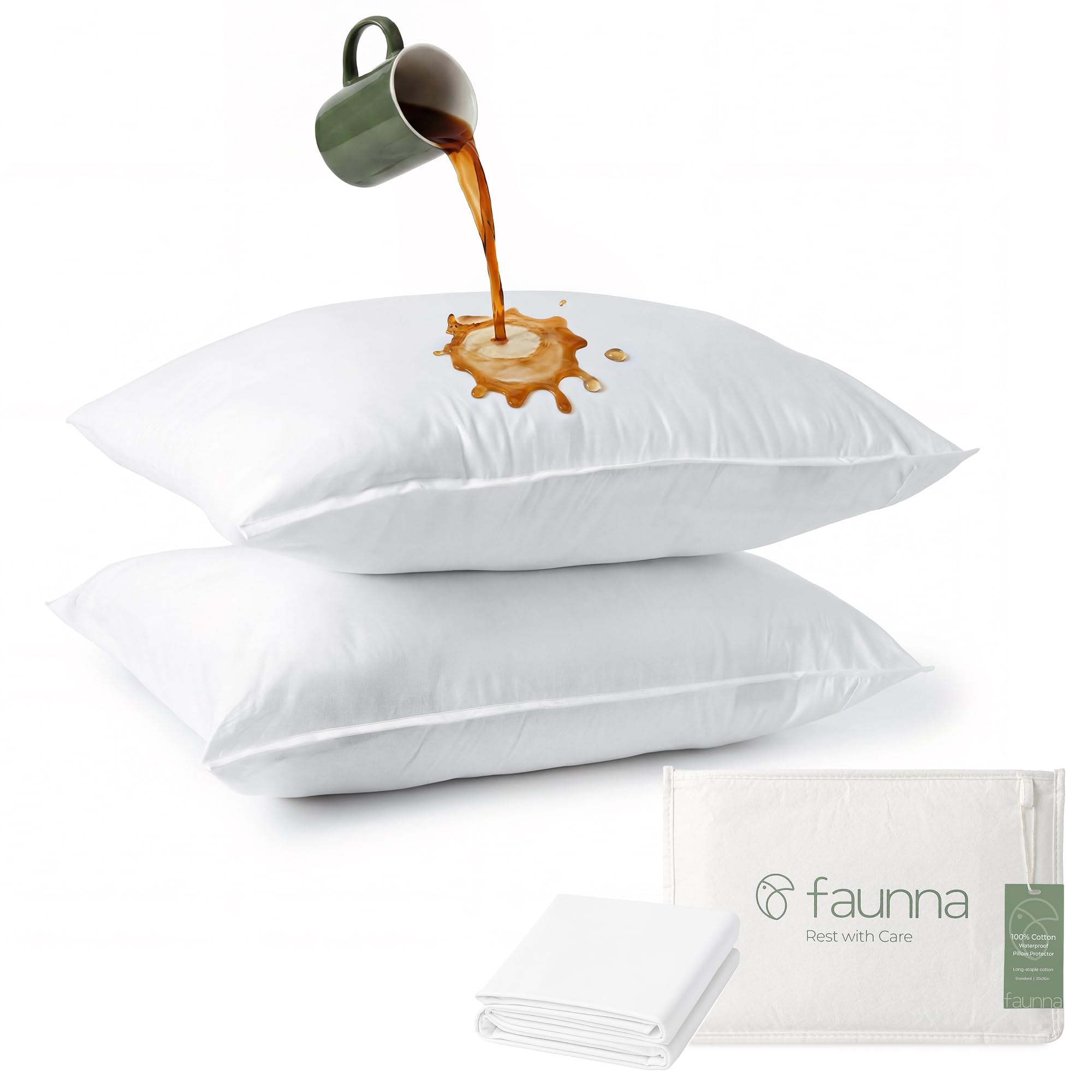
3. FAUNNA 100% Cotton Pillow Protectors, King, 6 Pack
Six zippered cotton pillow sleeves, so every pillow in the house gets a barrier.
Your face rests on a pillow for hours a night, so the pillow is the piece of bedding most worth sealing. This set covers six King pillows at 20 x 36 inches each, in a 600-thread-count cotton (a measure of how densely the threads are woven) with a stated pore size of ≤ 10 μm — ten microns, a hole too small for a mite to pass through, which the maker describes as a physical barrier against mites. Each sleeve zips fully closed with a hidden zip and an internal flap, so there is no open end for dust to drift in.
A TPU backing (a thin flexible waterproof film) handles spills and sweat, and the maker states the fabric is OEKO-TEX certified and treated with antimicrobial technology to hold down odour between washes. All six are machine washable and tumble dry low. What buyers praise most is the overall quality of the build — for a six-piece set, that is the thing worth knowing before you commit.
The trade-off is comfort, and it is genuinely mixed. Some sleepers describe the cotton as silky; others say it feels less comfortable against the cheek than a bare pillowcase. A few mention a slight noise from the waterproof layer. If you are sensitive to how a pillow feels on your face, buy one set and test it before you outfit every bed.
Where the value sits: one box seals six King pillows, so the guest room, the kids’ beds and the spares all get covered in a single purchase. The fully enclosed zip works the same way as a full mattress encasement, just scaled down to pillow size.
The felt trade-off: that TPU layer is what makes it waterproof, and it is also what some sleepers notice against the cheek — either as a texture or a faint rustle. Slide your usual pillowcase over the top and most of that disappears.
Go for it when: you are outfitting several beds and want one order to cover every pillow.
Pause if: you sleep with your face directly on the protector and you are picky about fabric against the skin.
4. FAUNNA 100% Cotton Duvet Cover

A zippered cotton wrapper that stops your comforter from becoming a mite reservoir.
Your duvet is the biggest fabric surface on the bed, and it is usually the last thing anyone thinks to cover. This Queen cover measures 90 x 90 inches and zips fully closed with a hidden zip rather than buttons, which is the difference between a decorative cover and a barrier. The cotton weave is stated at ≤ 10 μm, the same tight pore figure as the pillow set above, so it works as a physical wall rather than a loose shell.
Comfort is not sacrificed for that. It is a high-thread-count cotton, OEKO-TEX certified, and treated with Microban antimicrobial technology — the maker notes Microban is registered with the U.S. Environmental Protection Agency and certified under the EU Biological Products Regulation. Buyers consistently describe the weight as neither heavy nor hot, which is the right outcome for an all-season comforter cover.
One thing to order separately: the comforter itself is not included. And the corner ties are the weakest link in the design — there are only four tie points, one at each corner, so a restless sleeper may find the duvet shifts inside the shell. If your comforter has mid-side loops, expect to leave them unattached.
The case for it
- Full zipper closure rather than buttons gives a proper sealed barrier
- ≤ 10 μm cotton weave, OEKO-TEX certified
- Breathable and moisture-wicking, described as neither heavy nor hot
- Machine wash and low tumble dry, with the treatment said to survive washing
Where it gives ground
- Only four corner tie points, so a restless sleeper can shift the inner duvet
- Comforter sold separately, so this covers the shell only
- Queen-only sizing at 90 x 90 inches
Worth the swap if: your comforter is the last uncovered fabric on the bed and you want a zip instead of button gaps.
Hold off if: you have a king duvet, or you like a cover with mid-side ties to hold the insert still.
5. Allersoft Cotton Duvet Protector

A tighter pore figure than any other cover here, in a plain cotton shell.
Read the weave number against the FAUNNA above and the difference is real: this Allersoft uses a patented super-tight weave with a mean flow pore size of less than 3 microns, against the FAUNNA’s ≤ 10 μm. For a dust mite barrier, a tighter pore is a stronger wall. The maker describes it as blocking dust, feathers, pollen and pet dander rather than just mites, which matters if your congestion has more than one trigger.
It is all lightweight cotton at 3.5 pounds, with no waterproof or vinyl lining. That is deliberate — the maker points out that linings add weight, heat and noise, and this cover is designed not to weigh the comforter down or radiate heat. It fits 90 inches wide by 96 inches long and has both inner and outer ties, so it attaches to your comforter and holds it against bunching. The quality of construction is what owners come back to praise, alongside how well it actually blocks.
There is no waterproof layer, so spills go straight through to the comforter. And the fabric feel splits opinion: it is cotton, but it is a tight plain weave and it is not soft in the plush sense. If you want a hotel-soft shell, look at the FAUNNA instead.
The number that does the work: a mean flow pore size (the average hole size air passes through) of under 3 microns is the tightest barrier figure stated anywhere in this guide. It comes from the weave alone rather than a membrane, which is why you get no plastic crunch and no trapped heat.
What you give up: waterproofing. Sleep with a drink in bed or have kids who spill, and the comforter underneath is exposed.
Reach for this if: allergies beyond dust mites — pollen or pet dander — are part of your picture and you want the tightest cotton weave here.
skip it if: spill protection matters, because there is no waterproof barrier in this one.
6. CleanRest PRO Presto! Zip-Off Top Encasement

The barrier you will actually keep clean, because the top unzips in seconds.
Here is the problem with every full encasement: washing it means stripping the whole mattress, and most people do it far less often than they should. This CleanRest solves that by splitting the piece in two. A zip-off top comes off in about 45 seconds by one person with no mattress lifting, and it is the only part that needs the machine. Extra washable tops are sold separately, so you can swap a fresh one on while the old one is in the laundry.
The Queen size covers 60 x 80 inches with a 9 to 18 inch depth range, one of the widest in the group. The MicronOne fabric is stated to block bed bugs, dust mites and allergens without harsh chemicals, and the Zip-N-Click 2X locking zipper is designed to run the full 360 degrees so nothing gets past the closure. It is also built for repeated hot-water washing, with a 10-year warranty behind an oversized zip and tear-resistant stretch fabric.
The zipper is the weak point, and it is the most-discussed part of the design. Some buyers find the zip-off top easy to remove; others report breakage. Fitted mattresses are not a problem here — the fit is what people praise most, followed by how easy the top is to wash. Value gets a split verdict, since the extra tops are an added cost if you want a true rotation.
Why the design wins
- Zip-off top means washing no longer requires lifting the mattress
- 9–18 inch depth range covers thin and pillow-top mattresses
- MicronOne barrier blocks mites and allergens without harsh chemicals
- Vented airflow design is meant to reduce humidity for hot sleepers
The parts to weigh
- Zipper durability is the recurring complaint — treat the zip with care
- Extra washable tops cost more, so a true rotation is not free
- Value gets a mixed verdict from owners
Best for: a household that will genuinely wash the cover monthly and wants that to be a one-person, one-minute job.
Not ideal if: you want to buy once and never think about the zipper again.
7. Protect-A-Bed AllerZip Encasement

A waterproof sleeve engineered to stay silent, not to crinkle under your sheets.
Most waterproof mattress covers announce themselves with a plastic rustle. This one is built the opposite way. The Liquidry waterproof layer is described as an impenetrable barrier that is still highly breathable and whisper quiet, and the fabric is a 100% polyester knit rather than a woven sheet. The Bug Lock patented closure is the sealing mechanism — a six-sided encasement that runs a full zip around the mattress to keep bed bugs and dust mites out.
Two details keep it practical long-term. A FUZE antimicrobial treatment (an additive that slows odour-causing microbes) sits on the fabric to hold down smells. And the maker states the encasement is machine washable in hot water at 130°F — hot enough to kill dust mites and bed bugs rather than just rinse them off. Owners describe it as a good balance of quality and softness.
The fit is the thing to check before ordering. This cover is built for mattresses 6 to 11 inches deep, so it will not work on a thick pillow-top — and a few buyers find it runs slightly big even in that range. Measure your mattress depth first. If yours is 13 inches or more, the SureGuard above goes deeper.
The quiet factor: a whisper-quiet waterproof layer is genuinely rare at this level, and it is the reason to pick this cover over a noisier membrane. The polyester knit face is also soft, which is not something many waterproof encasements can claim.
The depth catch: 6–11 inches only. Measure before you buy, and expect a slightly loose fit if your mattress sits at the low end of that range.
Choose it when: silence and hot-water washability matter more than covering a deep mattress.
Rule it out if: your mattress is thicker than 11 inches.
8. Mission:Allergy Barrier II Mattress Cover
The one designed by a board-certified allergist and tested by an independent lab.
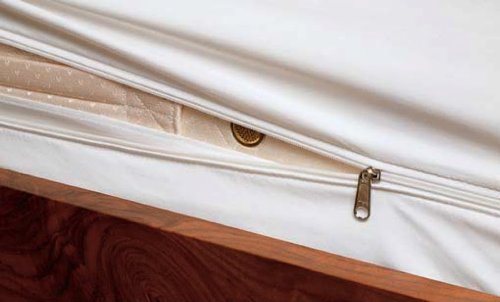
This is the only cover in the guide that states it was designed by a Board-Certified Allergist and tested by an independent lab, Indoor Biotechnologies. The maker claims it blocks 100% of dust mite and animal dander allergens, and it is certified bedbug-proof. Allergist design plus independent lab testing is what separates this from a plain waterproof pad.
The material is a tightly woven 100% microfiber polyester, described as air- and water-vapour permeable so it breathes while remaining water repellant rather than fully waterproof. Sewing details are the ones that matter in an encasement: bound seams, an interior zipper flap, and an extra-long zip so you can get it over a mattress without a fight. A ten-year warranty backs it, and it is made in the USA.
Two limits stand out. This Queen is cut for a 9-inch-deep mattress at 60 x 80 x 9 inches, so it is a fitted cover, not the six-sided zippered encasements that dominate this list. And the all-in build is reflected in the price tier — owners split on whether the cost is justified, though buyers report the breathing improvement they were after. This is a bet on the allergist-designed, lab-tested build, not on budget value.
What you are paying for: lab testing, an allergist-designed construction, bound seams and a ten-year warranty — details most mattress covers skip. Owners praise the silky, non-crunchy microfiber face almost as much as the relief.
The honest limit: a fitted 9-inch cover will not seal the underside of a mattress the way a zippered encasement does, and it will not fit a deep mattress at all.
The considered choice for: a 9-inch mattress and a buyer who wants a documented, allergist-designed barrier and will pay for that reassurance.
Think twice if: you have a deep mattress or you want the full six-sided seal of a zippered encasement.
Understanding the Specs
Pore size in microns
Pore size is the width of the gaps in a woven fabric, measured in microns — a micron is one thousandth of a millimetre, so smaller is better. A cover rated ≤ 10 μm has gaps narrow enough to block dust mite allergen; one at under 3 microns is tighter still. This is the single most important figure for an allergy buyer, and it is different from thread count, which describes how the cotton feels rather than what it blocks. A high thread count with a loose weave is not a barrier.
Six-sided encasement vs. fitted cover
A six-sided zippered encasement closes around the whole mattress, including the underside and the seams, so there is no path for mites to reach the surface. A fitted cover sits over the top and sides but leaves the base exposed. For a genuine allergy, the encasement is the stronger option; a fitted cover is a lighter, easier-to-wash alternative for someone mildly sensitive. If you go fitted, check the stated depth so it hugs the mattress rather than sliding loose.
Waterproof vs. water-repellent
A waterproof cover uses a polyurethane or TPU membrane or backing to stop liquid entirely. A water-repellent cover resists liquid but lets vapour through. Waterproofing adds spill protection, but the membrane is also the part that can feel warm or rustle, so makers either soften it or skip it in favour of a pure tight-weave cotton shell. Pick based on whether spills are a real risk in your household.
Washing and the hot-water rule
Washing removes the allergen that has collected on the surface, and heat is what kills the mites themselves. Protect-A-Bed states hot water at 130°F for its encasement; other makers specify machine wash and tumble dry low to protect the membrane. Never wash a waterproof membrane hotter than the care label allows, or you risk shortening the barrier’s life. A zip-off top or a pillow set makes frequent washing far more realistic.
FAQ
Will a mattress encasement actually stop dust mites if they are already in the mattress?
How do I know which depth of encasement to order for my mattress?
Is a waterproof encasement hot or noisy to sleep on?
Do I need to cover my pillows and duvet as well as the mattress?
How often should I wash dust mite bedding?
What does the micron pore size figure mean for a dust mite allergy?
Is a cotton cover better than a polyester one for dust mite allergy?
Will a duvet cover from this list fit my comforter?
Can I put a waterproof cover in the washing machine?
How long do dust mite mattress covers last?
Final Thoughts: The Verdict
Start with the SureGuard Mattress Encasement: it seals all six sides of the mattress with a zippered closure and a soft cotton terry top, and it is the most thoroughly proven cover here. If your mattress is deep or you are unsure of its exact depth, the stretchy 12–18 inch Hospitology encasement is the safer fit. And if you want the barrier you will genuinely keep clean, the CleanRest Presto with its zip-off top turns washing into a one-person, one-minute job. Cover the mattress, pillows and duvet, wash on schedule, and your mornings should get easier.
How We Picked
We do not accept paid placement. Every pick is matched to a real buyer and a real use-case; we do not hands-on test units.
Sources & Methodology
Specifications: manufacturer listings and product documentation. Review insights: verified customer reviews, as of November 2026. Pricing: not shown on this page (it changes often); check the current price via the retailer link.
As an Amazon Associate, Gadgets Feed earns from qualifying purchases. This does not affect which products we feature.