
Our readers keep the lights on and my morning glass full of iced black tea. As an Amazon Associate, I earn from qualifying purchases.
Specs are compiled from manufacturer listings and verified buyer reviews and can change over time — please confirm the key details on the product page before buying.
Russian tortoises are natural-born diggers, spending their days in the wild scraping through dry, rocky soil and sandy clay. The wrong bedding — something dusty, sharp, or mold-prone — can lead to respiratory trouble, shell issues, or a tortoise that simply refuses to burrow. The right substrate does the opposite: it lets your tortoise dig a cool hide on hot days, holds just enough humidity to keep the shell smooth, and makes cleanup simple.
I’m Min — the founder and writer behind Gadgets Feed. This guide is built by comparing the manufacturers’ published specifications and the patterns across verified customer reviews, so you get each pick’s real strengths and trade-offs instead of marketing spin.
A Russian tortoise needs a substrate that holds burrow shape, tolerates dry conditions, and won’t irritate its eyes or respiratory tract. That is exactly what this guide to the bedding for russian tortoise is built to help you choose — a safe, functional, and comfortable floor for your pet’s home.
Quick Picks
- ReptiChip 36 Quart Loose Coconut Chip — Best Overall
- Legigo 10LBS Coconut Chip Substrate — Best Value
- ZeeDix 10LBS Coconut Husk Chip Substrate — Top Performer
- BabiChip 12 Quart Loose Small Coconut Chip — Compact Pick
- RediChip 12 Quart Loose Medium Coconut Chip — Best for Bioactive
- Halatool 6 Pack Coconut Fiber Tortoise Substrate — Budget Champion
- Legigo 4 Pack Coconut Fiber Substrate — Entry-Level
How To Choose The Best Bedding For Russian Tortoise
Your Russian tortoise’s entire enclosure floor is its environment — it eats, sleeps, digs, and walks on it all day. Picking the wrong substrate can make your pet stressed or sick, while a good one lets it act like a tortoise. Here is what to focus on.
Material Safety — No Pine, No Cedar, No Artificial Fibers
The first rule of tortoise bedding is to avoid any softwood shavings. Pine and cedar release aromatic oils (phenols) that are toxic to reptiles, and they can cause liver damage and respiratory failure over time. Stick to natural plant fibers — coconut husk, cypress mulch, or plain organic soil. Every product in this list is verified as safe for tortoises, so you do not have to worry about hidden chemical treatments.
Chip Size and Texture — The Key to Burrowing
Russian tortoises are strong diggers, and they need a substrate with enough weight and structure to hold a burrow. Fine, dusty coco coir can get inhaled or clump and cause eye irritation. Loose medium coconut chips (roughly 10mm to 35mm in size) give your tortoise the right texture to push aside and tunnel into without collapsing. Chips that are too large or too sharp can be uncomfortable, while very fine sand or soil might lead to impaction if the tortoise eats it with its food.
Humidity Retention Without Sogginess
Russian tortoises come from arid Central Asia, but they still need a humid microclimate inside their burrow — especially for healthy shell growth and smooth shedding. A good coconut chip substrate holds moisture without becoming waterlogged. You want bedding that you can lightly mist in one corner, and that stays damp underneath while the top layer dries out. This mimics the natural dry-surface, damp-below environment of their native steppes. Soggy bedding, on the other hand, breeds bacteria and causes shell rot.
Dust Level — Breathing First
Dusty substrate is a hidden danger for tortoises. Because they are close to the ground, their nostrils are constantly bombarded with whatever particles are loose in the cage. The cleanest substrates are pre-sorted and refined to be nearly dust-free. If you open a bag and a cloud of fine particles floats up, that is a bad sign. The premium brands sold under the ReptiChip line advertise that their products are “sorted and refined here in the United States” and free of the dust and debris found in other products.
Cost Per Quart vs. Convenience
Compressed bricks are usually cheaper per quart, but they require you to soak them in water and wait for expansion before you can use them. Loose bagged substrates cost slightly more per quart but come ready to scoop straight into the enclosure. The trade-off is time and effort versus a higher upfront price. For a single tortoise enclosure, a 12-quart bag typically provides a few inches of depth, while a 36-quart bag can fill a large tank or a custom tortoise table completely.
Quick Comparison
| Model | Best For | Quarts (Expanded) | Form | Item Weight | Amazon |
|---|---|---|---|---|---|
| ReptiChip 36 Quart | Deep burrows, large enclosures | 36 Quart | Loose, ready-to-use | 7.01 pounds | $39.95Amazon |
| Legigo 10LBS Chip | Best value per quart | 72 Quart | Compressed Brick | 8.98 pounds | $22.79$25.99Amazon |
| ZeeDix 10LBS Chip | High volume, low dust | 72 Quart | Compressed Brick | 9.27 pounds | $22.79$26.99Amazon |
| BabiChip 12 Quart | Smaller species, grow tents | 12 Quart | Loose, ready-to-use | 2.16 pounds | $21.95Amazon |
| RediChip 12 Quart | Humidity control, bioactive set-ups | 12 Quart | Loose, ready-to-use | 2.68 pounds | $19.95Amazon |
| Halatool 6 Pack | Budget-friendly brick set | ~36 Quart | Compressed Bricks | 8.62 pounds | $22.79Amazon |
| Legigo 4 Pack Coir | Lightweight starter bricks | ~24 Quart | Compressed Bricks | 5.7 pounds | $18.04$19.99Amazon |
In‑Depth Reviews
1. ReptiChip 36 Quart Loose Coconut Chip

The premium loose chip that arrives ready for your tortoise to dig from the moment you open the bag.
Your tortoise can start burrowing within seconds, not hours, because this substrate is already loose and fluffy. At 16 x 12 x 6 inches per bag, the 36-quart size gives you enough bedding to create a deep layer in a large tortoise table or a 55-gallon tank without needing to expand bricks. The medium coconut chips are sorted and refined in the United States, and buyers report that this is the cleanest substrate they have ever used — virtually no dust at all. One reviewer noted that after switching to this bedding, they had to “turn down the humidifier” because the chips hold moisture so effectively.
Unlike compressed bricks that need soaking and drying time, this loose chip lets you control moisture by simply adding water to one corner. The chips are large enough to hold a burrow’s shape but soft enough that a tortoise can push through them easily. The item weight is 7.01 pounds, making it lighter than the compressed brick alternatives when comparing total volume. While the upfront cost is higher than the brick bundles, you skip the mess and preparation time entirely.
Best for deep enclosures: If you run a large bioactive habitat or want a strong 4-inch plus burrowing layer, the 36-quart bag covers more floor area than any loose-chip competitor in this list without requiring you to mix or hydrate bricks first.
The trade-off: The bag is bulky and heavy to ship, and if you prefer the sensory experience of crumbling bricks apart, this ready-to-use format feels less like “building” a habitat. Also, it is the most expensive single purchase here.
Reach for this if: you want the absolute cleanest, lowest-dust substrate that is ready to use out of the bag and holds a burrow without collapsing.
Consider bricks instead: if you are working with a smaller budget per quart or you enjoy the hands-on process of expanding coco coir from a compressed block.
2. Legigo 10LBS Coconut Chip Substrate
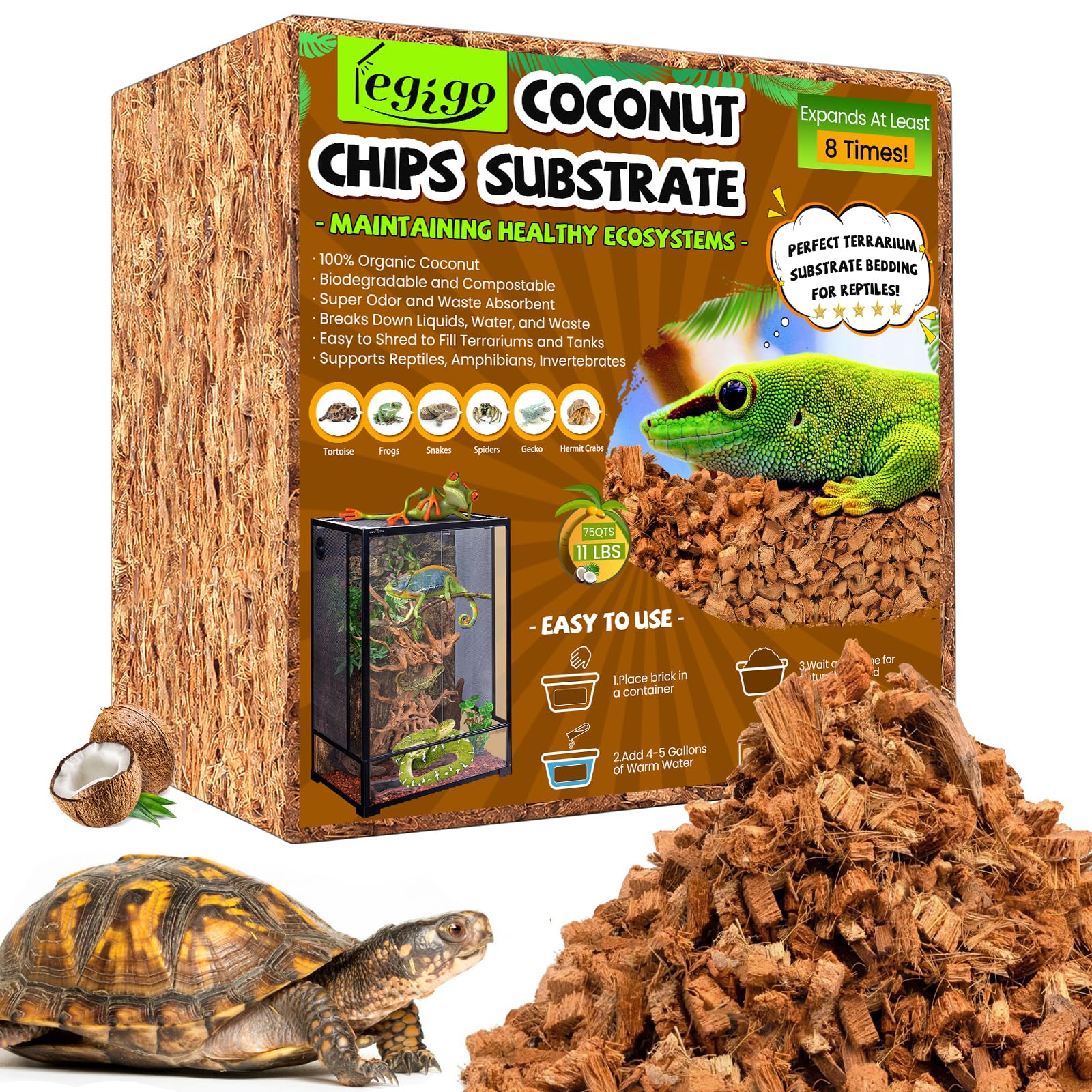
A 10-pound compressed brick that expands to 72 quarts — the most bedding per dollar on this list.
If you are setting up a large enclosure for the first time or you want a deep substrate layer that your tortoise can truly dig into, this brick offers the highest volume for the price. At 8.98 pounds item weight, the compressed block measures 11.81 x 11.81 x 5.31 inches before expansion. One buyer mentioned that it is not as sharp as some other coconut chips, and the natural texture is fluffy enough to let a tortoise push through without struggling. The chips are made from 100% organic coconut husk, with no artificial additives or chemical treatments.
The main task is expansion — you need to add water and wait for the brick to swell, then let it dry out partially before adding the tortoise. This is a quick 20-minute process, but it does require a large container and some manual breaking apart. Once expanded, the 72-quart yield is enough to fill a 4×2 foot tortoise table with 4 to 5 inches of depth. Unlike the lighter Legigo 4-pack of coir bricks, this one delivers larger chip pieces that are less prone to turning into a muddy paste when wet.
Massive coverage: At 72 quarts, this single brick replaces about six of the smaller 12-quart bags. For keepers with multiple tortoises or a very large custom habitat, this is the most efficient way to buy substrate.
Patience required: Because it is one giant compressed block, you have to be thorough about soaking and crumbling. If you rush the process, you end up with a wet, uneven layer that takes days to dry out properly.
Grab this if: you are on a budget and need a massive amount of bedding that will last through several full cage cleanings.
skip it if: you want a substrate you can pour straight into the tank and use immediately without any prep work.
3. ZeeDix 10LBS Coconut Husk Chip Substrate
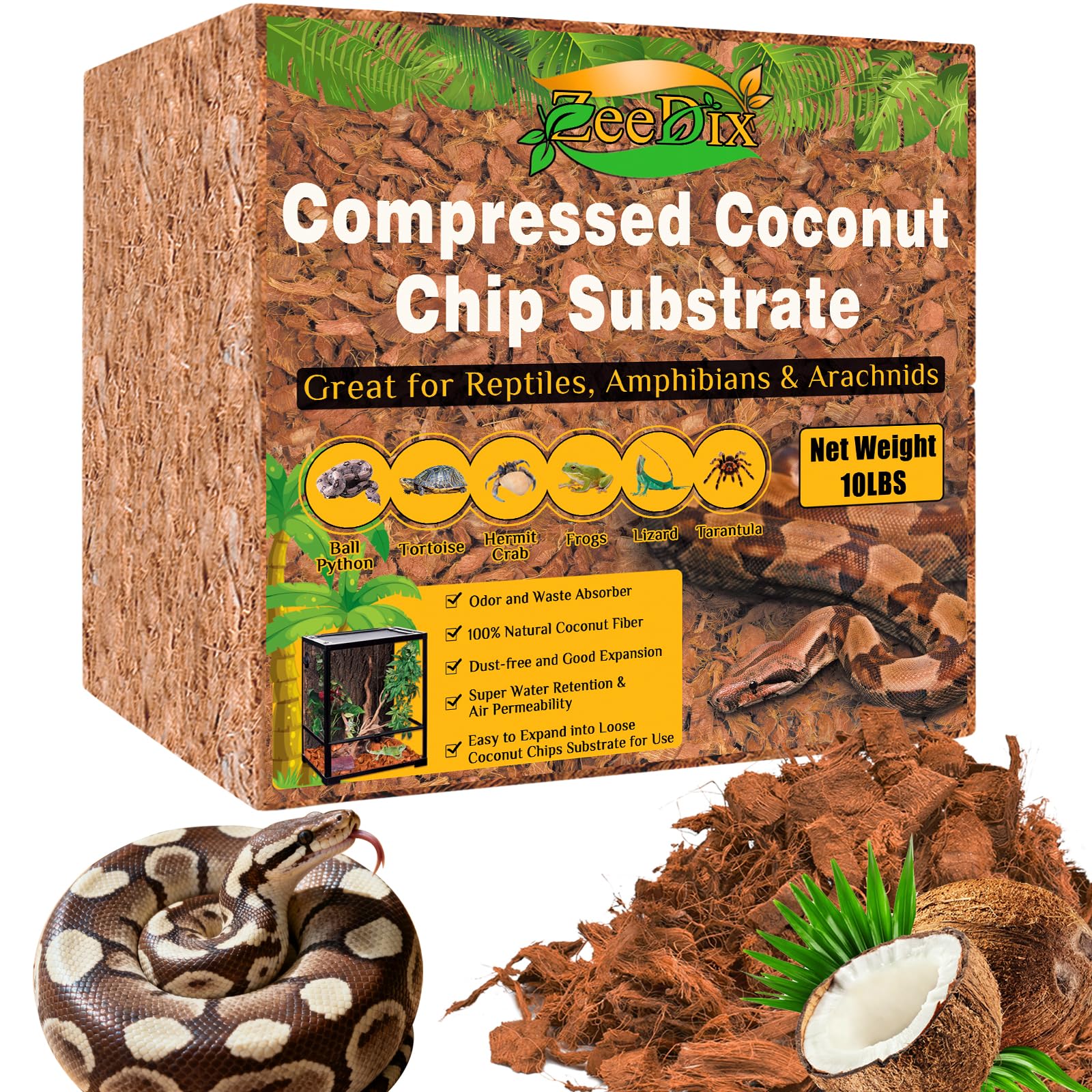
A near-identical volume competitor to the Legigo brick, with chip pieces sized for medium to large burrowing species.
At 9.27 pounds item weight, this is actually slightly heavier than the Legigo counterpart, which suggests a denser compression or slightly larger chip dimensions. The chips expand to between 10mm and 35mm each — a size that is ideal for a Russian tortoise because the pieces are heavy enough not to fly around when the tortoise digs, yet soft enough to push aside. A verified buyer reported that their ball python burrowed and explored immediately after the bedding was added, a sign that the texture feels natural and inviting to ground-dwelling reptiles.
The coconut husk material is natural and organic, and is advertised as dust-free and compostable. One thing to note: reviewers caution that this brick holds a lot of moisture if overwatered, so you need to let it dry for a day after expansion before introducing your tortoise. The brick dimensions are 11.8 x 5.12 x 11.8 inches, making it a tall, compact block that fits easily into a bucket for soaking. In terms of cost per quart, it matches the Legigo, but the slightly heavier package suggests you are getting marginally more dense husk material.
Great for windy enclosures: One owner reported that the chips “stick together really well to stay in place for windy environments,” which is useful if your tortoise enclosure is kept outdoors or near a fan.
Watch your water: Because the chips hold humidity so well, if you add too much water during expansion the substrate can stay soggy for days. Err on the side of less water at first and let it hydrate slowly.
Pick this over Legigo if: you want the slightly denser compression and the larger chip size range, which some tortoises prefer for a more structured digging experience.
Pick Legigo instead if: the higher item weight of the ZeeDix makes shipping more expensive to your location; the two products are otherwise nearly interchangeable.
4. BabiChip 12 Quart Loose Small Coconut Chip

Finely sorted coconut chips that reduce the risk of impaction for smaller reptiles and young tortoises.
This is the smallest chip size in the ReptiChip family, and it is specifically designed for species where ingestion is a concern. The item dimensions are 12 x 8 x 4 inches, and the bag weighs just 2.16 pounds — that is significantly lighter than the Halatool bricks, which weigh 8.62 pounds, The smaller pieces are less likely to cause a blockage if a baby tortoise accidentally eats some while foraging. One buyer specifically noted that the chip size is “perfect for smaller snakes,” and another said it was ideal for a 3-foot PVC enclosure.
The product is sold as a loose, ready-to-use bag — no soaking required. Despite the small chip size, owners mention that the material holds moisture well and does not mold or contaminate easily. The odor control is strong, with several reviews mentioning that the bag smells fresh and clean. For a Russian tortoise, the small chips work well as a top layer over a deeper base of larger chips, giving the tortoise both a stable burrow foundation and a soft surface to walk on. However, if your tortoise is a heavy digger, the small chips might collapse faster than medium or large chips.
Best for small enclosures: If you are setting up a 20-gallon tank for a juvenile tortoise or using a grow tent setup, one 12-quart bag provides a few inches of cover. One customer observed that “4 bags provided a few inches of cover in a 6×3 grow tent.”
The catch: The small chip size means it does not hold a deep burrow as well as medium chips. For a full-grown Russian tortoise that loves to dig, you may need to layer it with a coarser base.
Get this for: young tortoises, smaller species like Russian or Hermann’s tortoises that are still growing, or as a soft top layer in a bioactive tank.
pass on it if: your tortoise is a determined digger who needs a deep burrow that stays open — you will want the RediChip or the 36-quart ReptiChip instead.
5. RediChip 12 Quart Loose Medium Coconut Chip

The medium-chip loose substrate that strikes a strong balance between burrow stability and humidity retention.
RediChip is the same parent brand as BabiChip (ReptiChip Premium Coconut Substrate), but this version uses medium-sized chips that are chunkier and more structured. The item weight is 2.68 pounds, only slightly heavier than the BabiChip, but the chip size is roughly double. This gives a tortoise enough material to dig a tunnel that does not immediately cave in. Verified customers note the bedding “holds humidity without staying saturated,” which is exactly what a Russian tortoise needs — a damp lower layer with a dry surface. Another reviewer noted that it mixes well with orchid bark and sphagnum moss, making it a perfect base layer for a bioactive terrarium with live plants and cleanup crews.
This product is also marketed as being free of the dust and debris found in competing substrates. Because the chips are bigger, they do not compact down into a hard floor the way fine coco coir does, so your tortoise can dig without hitting a solid layer. The major drawback is the price-to-volume ratio: at for 12 quarts, it costs nearly as much per quart as the 36-quart ReptiChip, but leaves you with much less total bedding. For a single standard 40-gallon breeder tank, one bag gives you about 2 to 3 inches of depth — enough for light digging but not for a deep burrow.
Bioactive favorite: This product is designed to mix with other substrates like ReptiEarth for a bioactive base. One reviewer called it “great reptile substrate” and said their snake had “perfect sheds” on it, crediting the balance of moisture and aeration.
Small bag for the price: As a buyer put it, “Small bag for price; doesn’t fill 55-gallon tank alone.” If you are not building a bioactive setup, the Legigo bricks give you far more volume for the same money.
Reach for this if: you are setting up a bioactive enclosure where you need a reliably clean, medium-chip substrate that supports plant roots and isopod colonies.
Go with a brick instead if: your main goal is just deep, cheap burrowing substrate for a non-bioactive tank.
6. Halatool 6 Pack Coconut Fiber Tortoise Substrate
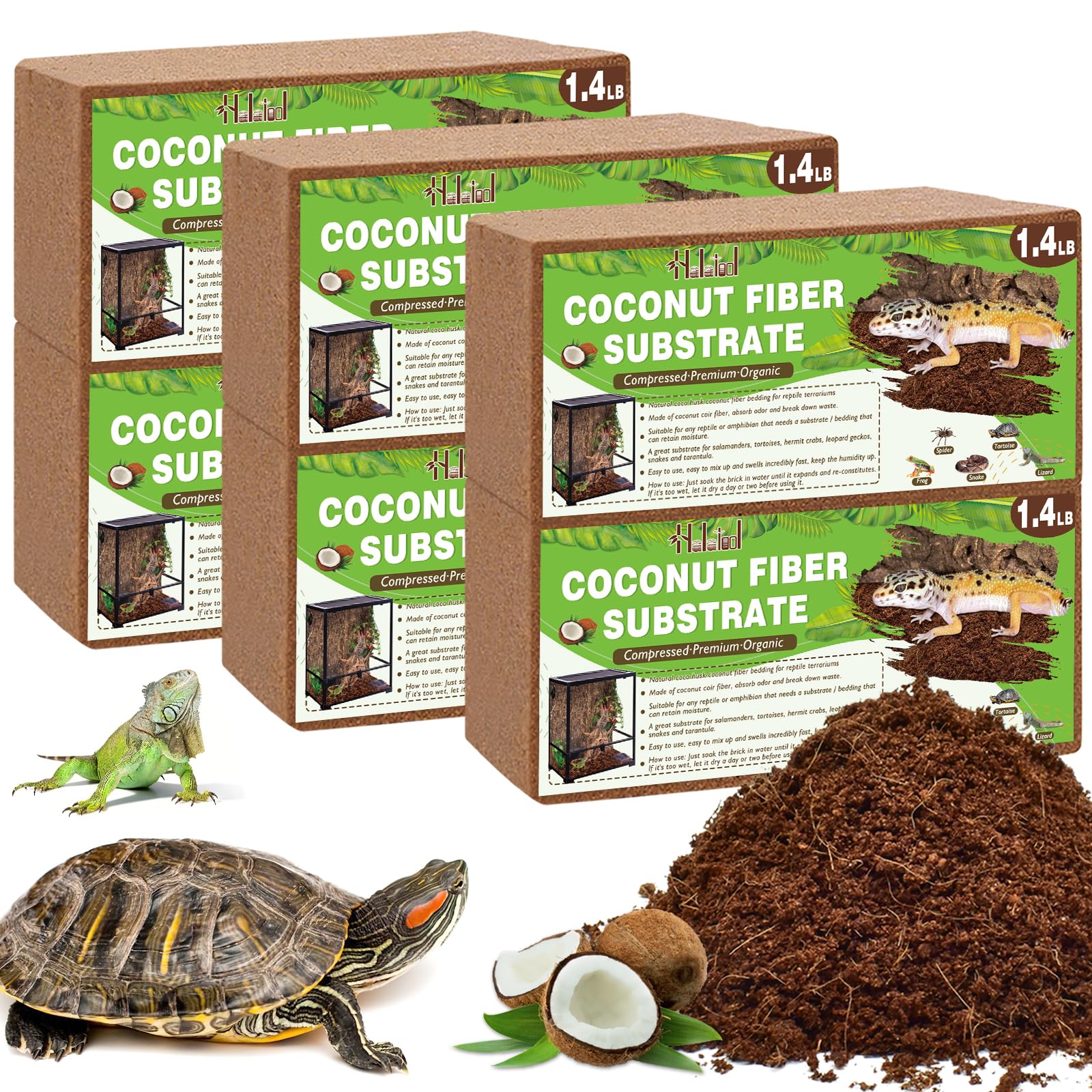
Six compressed coir bricks that turn into a huge volume of soft, moisture-holding fiber for the lowest cost per brick.
If you are willing to spend a few minutes soaking bricks, this bundle gives you the most hands-on control over the final texture of your tortoise’s substrate. Each brick is 7.87 x 3.94 x 1.97 inches and weighs about 1.4 pounds, and the entire pack comes in at 8.62 pounds., compared to 2.16 pounds for the BabiChip bag, but the expanded volume is significantly larger — enough to fill a large tortoise table. One user highlighted that the coir “expands over 10x compacted size” and that it “softens well,” making it a good option for tortoises that like to dig deep burrows.
The coir fiber is made from the husk of coconut shells and is advertised as clean, without dirt or foreign substances. It has sponge-like absorption, taking in up to 8 to 10 times its weight in water. This is great for creating a humid microclimate in one corner of the enclosure. However, because it is fine coir fiber rather than chips, it can be harder to keep a burrow from collapsing. Blending it with some larger chips, as one reviewer suggested, saves your hand muscles and gives the substrate more structure. The biggest trade-off is that fine coir can get dusty when completely dry, so you need to keep a light mist on it.
Great for mixing: Tortoise keepers who like to create custom blends will appreciate this neutral, soft base. One shopper added they blend it with “small chunks” to keep the texture varied.
Not ideal as a standalone for heavy diggers: Because it is fiber rather than chips, your tortoise’s burrow may fill back in as soon as it is dug. Layering it with a chip-based top substrate solves this.
Best for: keepers who want a huge volume of cheap, organic coir that they can customize by mixing with chips, bark, or soil.
Not for: anyone who wants a ready-to-use, pour-and-done substrate that holds a tunnel shape on its own.
7. Legigo 4 Pack Coconut Fiber Substrate
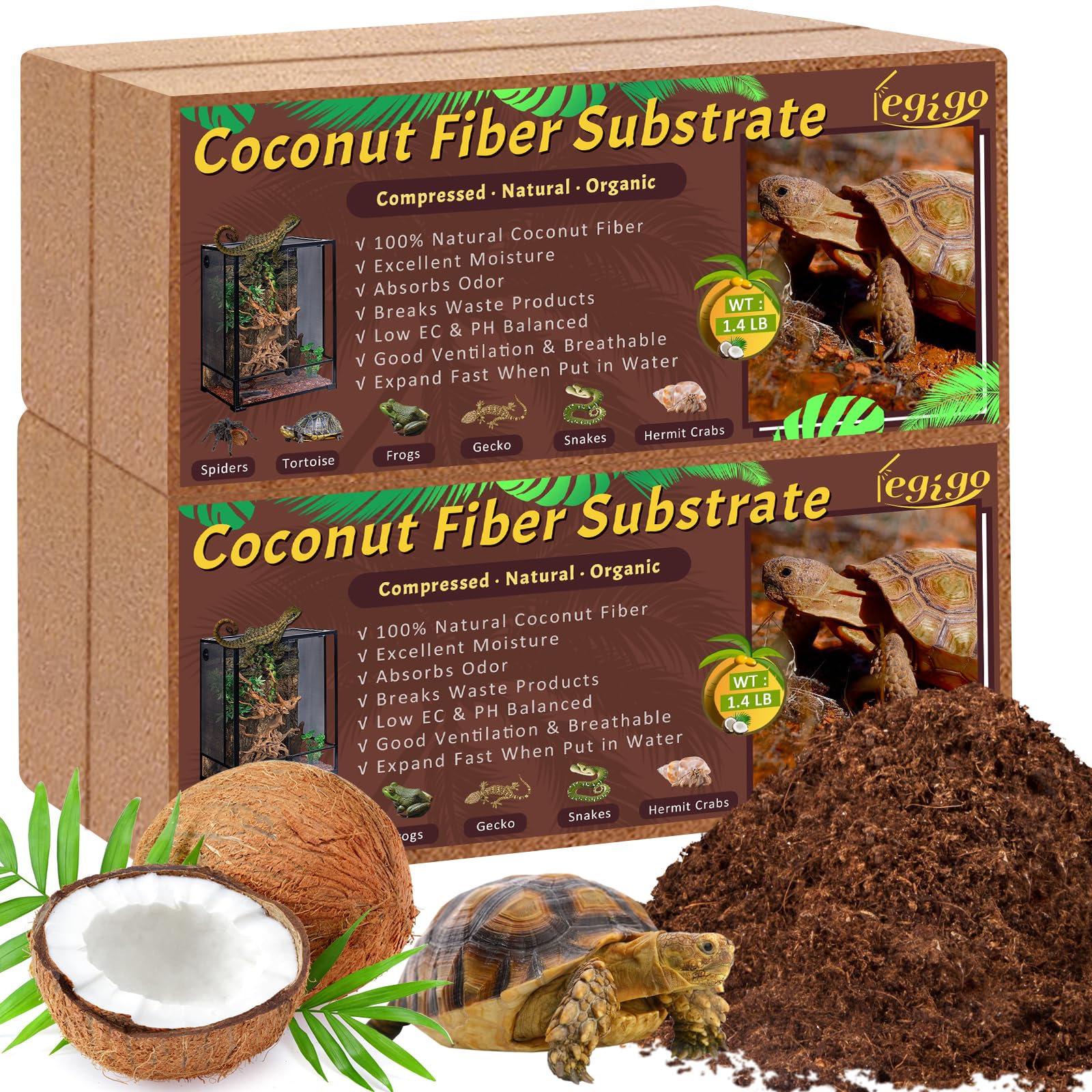
A compact four-brick starter set that gives you a simple, safe introduction to coco coir bedding.
This is the most straightforward product on the list: four small bricks of pure coconut coir, each weighing about 1.4 pounds. The item dimensions are 8.66 x 4.13 x 9.45 inches, which is 39% larger in volume than the BabiChip bag (12 x 8 x 4 inches), but the Legigo product is a set of compressed bricks and not loose substrate. The total item weight is 5.7 pounds, making it one of the lighter bundles, which is helpful if you are wary about shipping costs. The coir is marketed as odorless and able to decompose waste, keeping the cage clean and reducing unpleasant smells.
The bricks expand quickly when soaked in water, and the resulting fiber is soft and breathable. However, because this is fine coir rather than chip-based substrate, it is better suited as a component in a mixed bedding rather than the sole substrate for a tortoise that digs deep tunnels. The manufacturer suggests spraying it regularly to maintain humidity, which works well for creating a humid hide area. One thing to know: this product has fewer customer reviews than the others on this list, so there is less crowd-sourced feedback about how it holds up over months of heavy tortoise use.
Good starter kit: If you are new to tortoise keeping and want to experiment with coco coir without committing to a huge bag or a premium brand, the 4-pack gives you enough to test in a small tank.
Limited by itself: For a full-grown Russian tortoise, the fine texture means collapsed burrows. Mix in larger chips from the get-go if you want deep tunnels.
Try this if: you are setting up a quarantine tank, a small hatchling enclosure, or a humid hide box where burrow stability is not the top priority.
Upgrade if: you need a primary substrate for an adult tortoise — pick one of the chip-based products above for better digging support.
Understanding the Specs
Coconut Coir vs. Coconut Chips
Both come from the same plant, but they have different textures. Coconut coir is a fine, fibrous material that looks and feels a bit like soil. It holds a lot of moisture and is great for plants, but it does not hold a burrow shape well and can clump. Coconut chips are larger, chunkier pieces of the husk. They stay loose and breathable, let your tortoise dig without the tunnel collapsing, and drain water better. For Russian tortoises, a chip-based substrate is generally the better choice for encouraging natural burrowing behavior.
Quarts and Expansion Ratio
The “quart” number on a bag or brick tells you how much space the bedding will take up once it is fully expanded and fluffy. A compressed brick usually expands to about 8 to 10 times its dry volume. For example, a 10-pound brick of coconut chips expands to roughly 72 quarts. To give your tortoise a deep burrowing layer (at least 4 to 6 inches), you need a total expanded volume that matches the floor area of your enclosure. A 40-gallon breeder tank needs roughly 40 to 50 quarts of substrate to achieve a good depth.
FAQ
Can I use pine or cedar shavings for my Russian tortoise?
How often should I change the bedding in my tortoise enclosure?
Should I use compressed bricks or loose bagged substrate?
How deep should the bedding be for a Russian tortoise?
Is coconut coir safe if my tortoise eats some of it?
How do I keep the bedding from getting too dry or too wet?
What is the difference between BabiChip and RediChip?
Can I use these substrates for a bioactive tortoise enclosure?
Final Thoughts: The Verdict
For most people, the best bedding for russian tortoise is the ReptiChip 36 Quart Loose Coconut Chip because it combines zero preparation time, excellent burrow stability, and a very low dust level. If you want to stretch your dollar further, grab the Legigo 10LBS Coconut Chip Substrate, which expands to 72 quarts for the same price as the ReptiChip. And for keepers setting up a bioactive enclosure, the RediChip 12 Quart Loose Medium Coconut Chip offers the ideal medium chip size for plant roots and cleanup crew activity.
How We Picked
We do not accept paid placement. Every pick is matched to a real buyer and a real use-case; we do not hands-on test units.
Sources & Methodology
Specifications: manufacturer listings and product documentation. Review insights: verified customer reviews, as of July 2026. Pricing: not shown on this page (it changes often); check the current price via the retailer link.
As an Amazon Associate, Gadgets Feed earns from qualifying purchases. This does not affect which products we feature.
Related Guides
Product prices and availability are accurate as of the date/time indicated and are subject to change. Any price and availability information displayed on Amazon at the time of purchase will apply to the purchase of this product. As an Amazon Associate I earn from qualifying purchases.
CERTAIN CONTENT THAT APPEARS ON THIS SITE COMES FROM AMAZON. THIS CONTENT IS PROVIDED "AS IS" AND IS SUBJECT TO CHANGE OR REMOVAL AT ANY TIME.
Amazon and the Amazon logo are trademarks of Amazon.com, Inc. or its affiliates.