
Our readers keep the lights on and my morning glass full of iced black tea. As an Amazon Associate, I earn from qualifying purchases.
Bedwetting in the teenage years is a different beast entirely from potty-training a toddler. The social stigma, the sleepovers avoided, the embarrassment of a secret kept from friends — it grinds on a teenager’s confidence in a way that younger children don’t experience. For a deep-sleeping teen, the bladder-brain connection simply hasn’t matured enough to trigger a wake-up response during the night. An enuresis alarm that’s discreet, loud enough to pierce a heavy sleep cycle, and reliable enough to avoid false alarms from sweat is the only clinically proven first-line solution that actually retrains the brain to wake before the bladder empties.
I’m Min — the co-founder and writer behind Gadgets Feed. My approach to this guide involved cross-referencing clinical enuresis protocols with hundreds of real parent reviews to identify which alarms consistently wake a deep-sleeping teenager without causing distress or mechanical failure.
This analysis focuses on the most effective bedwetting alarm for teenager options available, ranking them by how well they balance a loud alert with a comfortable, wireless design that a teenager will actually agree to wear.
How To Choose The Best Bedwetting Alarm For Teenager
Selecting an alarm for a teenager requires a different filter than for a young child. The core mechanics of conditioning remain the same, but the hardware needs to be more discreet, more durable, and less prone to embarrassing false alarms that erode trust in the device.
Wireless vs. Wired: The Teenager Factor
A wired alarm runs a cord from a sensor in the underwear up to a receiver clipped to the pajama collar. For a teenager, this is a non-starter for comfort and discretion. A wireless system places a small transmitter in the underwear and a separate receiver on the bedside table. This eliminates the strangulation risk of a cord and makes the device feel less like a “baby” contraption. Look for a system with a wireless range of at least 30 feet so the receiver can stay with the parent if needed.
Loudness and Vibration Strength
A teenager who is a deep sleeper needs a piercing alert. An 80-decibel alarm is the baseline, but many successful models push toward the 90 dB range. The vibration mode is equally critical — a strong, buzz-like vibration on a bedside receiver can physically shake a sleeping teen awake without alerting the entire household. The best alarms let you use sound, vibration, or both simultaneously.
False Alarm Immunity from Sweat
Nothing kills a teenager’s willingness to use an alarm faster than waking up with no accident but the alarm shrieking because sweat triggered the sensor. Look for sensors with a “one-drop detection” design that is less susceptible to ambient moisture. The most reliable approach, as reported by countless parents, involves wrapping the sensor in a thin layer of toilet paper to act as a moisture buffer that only activates on actual urine.
Quick Comparison
On smaller screens, swipe sideways to see the full table.
| Model | Category | Best For | Key Spec | Amazon |
|---|---|---|---|---|
| Eclipse Wireless | Premium | Deep sleeper teens | 40ft wireless range | Amazon |
| DryEasy Pro Wireless | Mid-Range | Customizable alerts | 6 sounds + volume control | Amazon |
| Shield Max | Premium | ADHD/autistic teens | 8 tones + “fuzzy logic” AI | Amazon |
| Wet-Stop3 Kit | Mid-Range | Comprehensive bundle | 80dB + water-proof pad | Amazon |
| Wet-Stop 3 Blue | Entry-Level | Budget baseline | 6 tones + vibration | Amazon |
| TENQIU Wireless | Entry-Level | USB rechargeable | 3 working modes | Amazon |
| ReYang Wireless | Entry-Level | Magnetic charging | Magnetic USB charger | Amazon |
In‑Depth Reviews
1. Eclipse Wireless Bedwetting Alarm

This is the premium-tier pick for a reason: it’s the only model in this guide built by a New Zealand company that specializes exclusively in enuresis solutions for older children and teens. The thin, plastic-coated wireless sensor is placed directly in the underwear and is designed to be completely skin-safe, eliminating the irritation that some cheap contact sensors cause. The receiver can sit up to 40 feet (12 meters) away on the parent’s nightstand, which is crucial for teenagers who need the alarm to be loud enough to wake them without requiring the parent to be in the same room.
Reviews confirm that this alarm has solved lifelong nightly bedwetting in teens as old as 12 after six years of failed attempts with other alarms and specialists. The sensor is highly sensitive to the first drops of urine, and the alarm tone is described as “extremely loud” and distinct — a specific frequency that penetrates deep sleep better than generic buzzers. The wireless design also allows a parent to place the receiver inside the teen’s room while keeping a second unit nearby if the teen is a particularly deep sleeper who needs an adult to nudge them.
Some users report false alarms from sweat, particularly with autistic children, which can be exhausting over time. The manufacturer recommends wrapping the sensor in a thin layer of toilet paper to mitigate this. The battery is a standard lithium cell, and while the unit is lightweight at just 1.45 ounces, the sensor connector can be lost if not carefully stored. The price is the highest of any model here, but the clinical-grade engineering and proven track record with older teens justifies the investment for families who have struggled for years.
Why it’s great
- Wireless sensor with 40-foot range perfect for parent-free setup in a teen’s room.
- Proven to break the cycle for 12-year-old deep sleepers where other alarms failed.
- Plastic-coated sensor design prevents skin irritation from prolonged wear.
Good to know
- Highest price point of any option in this guide.
- Sensor can trigger false alarms from sweat; requires a toilet-paper buffer.
- The small sensor connector is easy to lose if not stored properly.
2. DryEasy Pro Wireless Bedwetting Alarm
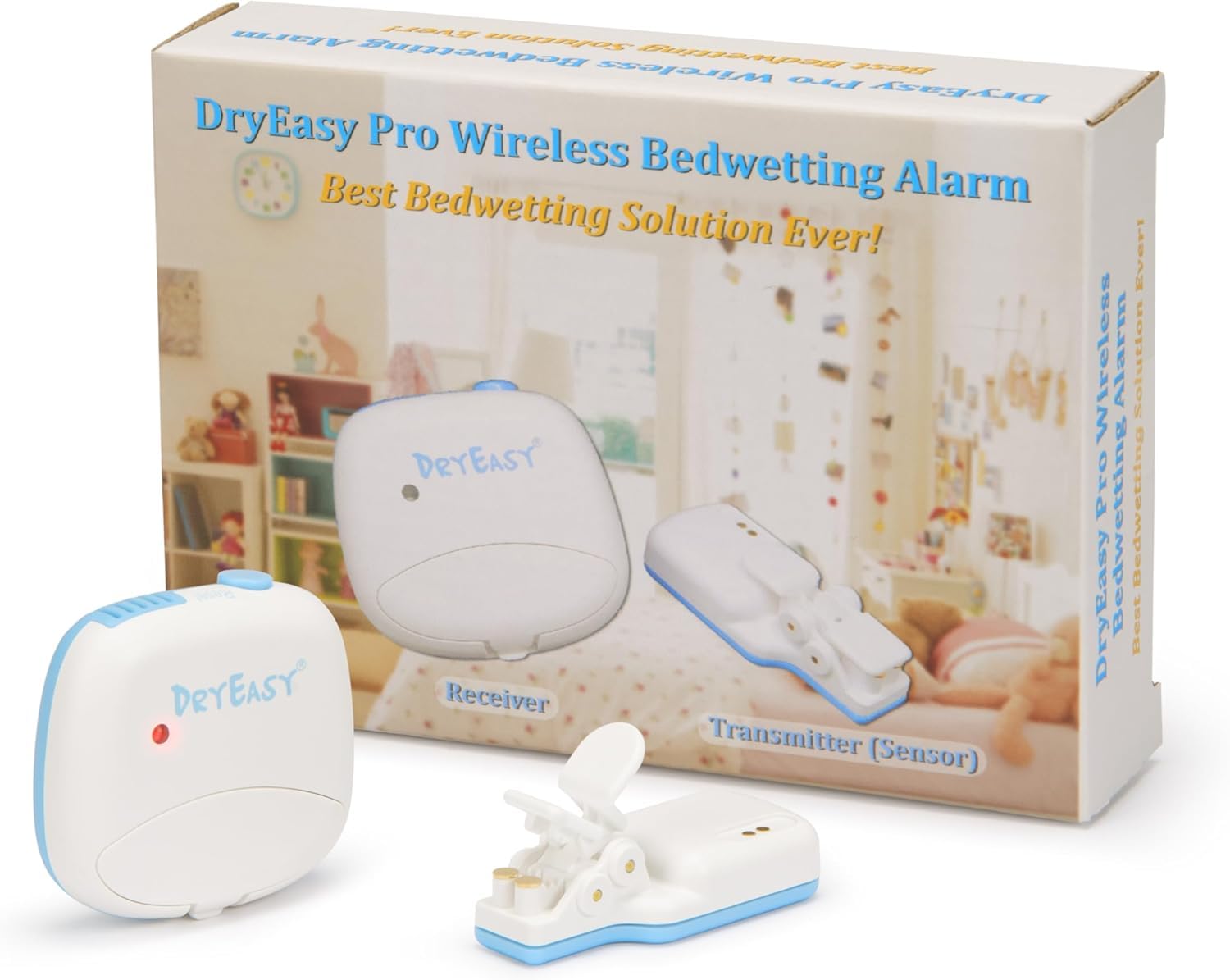
DryEasy Pro is the first choice for parents who want total control over the auditory experience of the alarm. Its wireless receiver is compact enough to sit on a bedside table or attach to a teen’s arm via a velcro pouch. The new toggle clamp on the transmitter ensures it stays secure on the underwear during restless sleep — a frequent failure point for cheaper clip-on sensors. The unit is powered by rechargeable lithium-ion batteries, and reviewers report it lasts over a month on a full charge.
What sets this alarm apart for a teenager is the volume control. Many alarms are fixed at a single, deafening volume that terrifies younger kids; the DryEasy Pro offers six levels of digital volume control. This means you can set it to a moderately loud tone for a light sleeper or max it out for a deep sleeper. It’s the only mid-range model that offers a random play mode across its six selectable sounds, which prevents the brain from habituating to a single tone — a problem that diminishes effectiveness over weeks of use.
Customer feedback indicates that it works exceptionally well with neurodivergent children, including those with ADHD and autism, achieving dry nights in as little as 10 days. However, the sensor design is a contact-style that requires direct contact with moisture; some users found it failed to trigger reliably when the sensor was not precisely positioned, leading to mornings where the child had wet the bed without the alarm ever going off. At 4.66 ounces, it’s slightly heavier than the thinnest wireless models, but the flexibility of the sound profile is unmatched in its price tier.
Why it’s great
- Six-level digital volume control prevents terrifying a teen while still being effective.
- Rechargeable battery lasts over a month, reducing ongoing costs and waste.
- Random sound mode prevents habituation for long-term conditioning success.
Good to know
- Sensor positioning is critical; poor placement leads to missed triggers.
- Small and easy to misplace; a wired unit might be easier to keep track of.
- Requires careful maintenance of the two-piece wireless connection.
3. Shield Max Bedwetting Enuresis Alarm

The Shield Max is the most technically ambitious alarm in this list, incorporating what the manufacturer calls “fuzzy logic” — an algorithm that learns the child’s bladder behavior over time to distinguish between a genuine wetting event and minor moisture from sweat. For a teenager, this is a massive quality-of-life improvement because it dramatically reduces the exhausting false alarms that plague simpler sensors. The alarm offers eight loud alert tones, a bright light, and strong vibration, all of which can be activated in sound-only, vibration-only, or combined modes.
This alarm is specifically recommended by the manufacturer for children aged 8 years and up, making it a perfect fit for a teenage user. The “One Drop Detection” technology is a unique feature: the sensor is designed to identify even the slightest moisture accumulation and alert immediately. In practice, this means the alarm catches the very first drops, which maximizes the conditioning effect because the brain learns to associate the full-bladder sensation with the alarm before a full wetting occurs. Parents of 7-year-old deep sleepers have reported the child achieving full dryness after only 4 weeks of use.
The main drawback is reliability. While the concept is excellent, multiple reviews report that the clip on the sensor breaks within days — one user improvised with a sock to hold it in place. The lack of an on/off switch forces you to remove the battery to stop the alarm if it misfires, which is annoying in the middle of the night. There are also reports of random false alarms that occur even when no wetting is present, which defeats the purpose of the “fuzzy logic” feature. If you get a fully functional unit, it’s among the best, but the quality control is inconsistent.
Why it’s great
- Fuzzy logic AI aims to eliminate false alarms from sweat, a major teen repellent.
- Eight distinct tones plus a bright light and strong vibration for multi-sensory wake-up.
- One Drop Detection sensor catches the very first moisture for optimal conditioning.
Good to know
- Sensor clip is fragile and prone to breaking within the first week of use.
- No on/off switch; requires removing the battery to silence a false alarm.
- Quality control is inconsistent; some units suffer from random false alarms.
4. Wet-Stop3 Kit with Waterproof Bed Pad

The Wet-Stop3 Kit is the only bundle in our list that combines a proven wired alarm with a full-size waterproof, washable mattress pad. For a teenager, the mattress pad is a game-changer because it means the parent doesn’t need to strip the entire bed at 2 a.m. — the pad contains the mess and dries quickly, allowing for a swift return to sleep. The alarm itself is the same core unit as the standalone Wet-Stop 3, offering six varying alarm tones plus a strong vibration alert, and it uses two standard AAA batteries.
This is a wired design, which is a trade-off. The cord runs from the sensor in the underwear up to the pajama collar, which some teens find restrictive or embarrassing. However, the wiring ensures zero signal loss and eliminates the issue of discharged batteries in the transmitter. Parents report that the 80-decibel alarm is terrifyingly loud — one reviewer noted it terrified their 7-year-old but ensured the parent heard it every time. The critical trick: the alarm only resets by simultaneously pressing a button and drying the sensor off, which prevents the teen from simply turning it off and going back to sleep.
The included “Complete Bedwetting Book” download and reward chart make this a comprehensive solution. That said, the cord is a strangulation hazard for younger children, and the sensor can unclip easily during the night for active sleepers. False alarms from sweat are common unless the sensor is wrapped in a paper towel, as with most contact sensors. For a teenager, the wired design may feel like a step backward, but the value of the included high-quality mattress pad makes this a compelling budget-friendly option.
Why it’s great
- Includes a waterproof, washable mattress pad that simplifies overnight cleanups.
- Two-step shutoff prevents the teen from disabling the alarm and returning to sleep.
- Six alarm tones and vibration provide variety to prevent habituation.
Good to know
- Wired design is less comfortable and less discreet for a teenager.
- Cord presents a strangulation risk, especially for younger users in the family.
- Sensor can unclip from active sleepers, causing false or missed alerts.
5. Wet-Stop 3 Blue Bedwetting Enuresis Alarm

The Wet-Stop 3 is the entry-level workhorse that has been a staple in the enuresis community for years. It is a simple, no-frills wired alarm that delivers a consistent 80-decibel alert. The design is straightforward: a clip-on sensor attaches to the underwear, and a wire runs up to the small alarm unit which clips to the shoulder of the pajama top. It runs on two standard AAA batteries and weighs almost nothing — the unit itself is just 2.5 inches tall and 1.5 inches wide.
What makes this a good choice for a budget-conscious parent is the proven reliability. Thousands of reviews confirm that with proper placement and consistent use, this alarm breaks the bedwetting cycle. The patented sensor is easy to clean and comes with clear instructions in six languages. The included reward chart and star stickers are obviously targeted at younger children, but for a motivated teenager, the progress tracking can still serve as a visual motivator without the “baby” stickers being used. The two-step shut-off method is identical to the kit version.
The single biggest complaint is the lack of an adjustable volume. The alarm is a fixed, loud 80 dB, which some parents describe as “traumatic” for a child as old as 7. For a teenager who is a light sleeper, this is overkill; for a deep sleeper, it’s perfect. False alarms from sweat are a consistent issue, and the wired connector creates a trip hazard. Some users report that the sensor fails to trigger when the child wets, especially if the child is wearing a pull-up rather than underwear.
Why it’s great
- Proven track record with thousands of successful dry-night outcomes.
- Two-step shut-off is a smart design that prevents the user from cheating.
- Extremely lightweight and unobtrusive despite being a wired unit.
Good to know
- Fixed 80 dB volume is deafening and can be traumatic for sensitive users.
- Wired design is less convenient and creates a tripping hazard in the bedroom.
- Sensor may fail to trigger reliably when used with pull-ups or thick underwear.
6. TENQIU Wireless Bedwetting Alarm
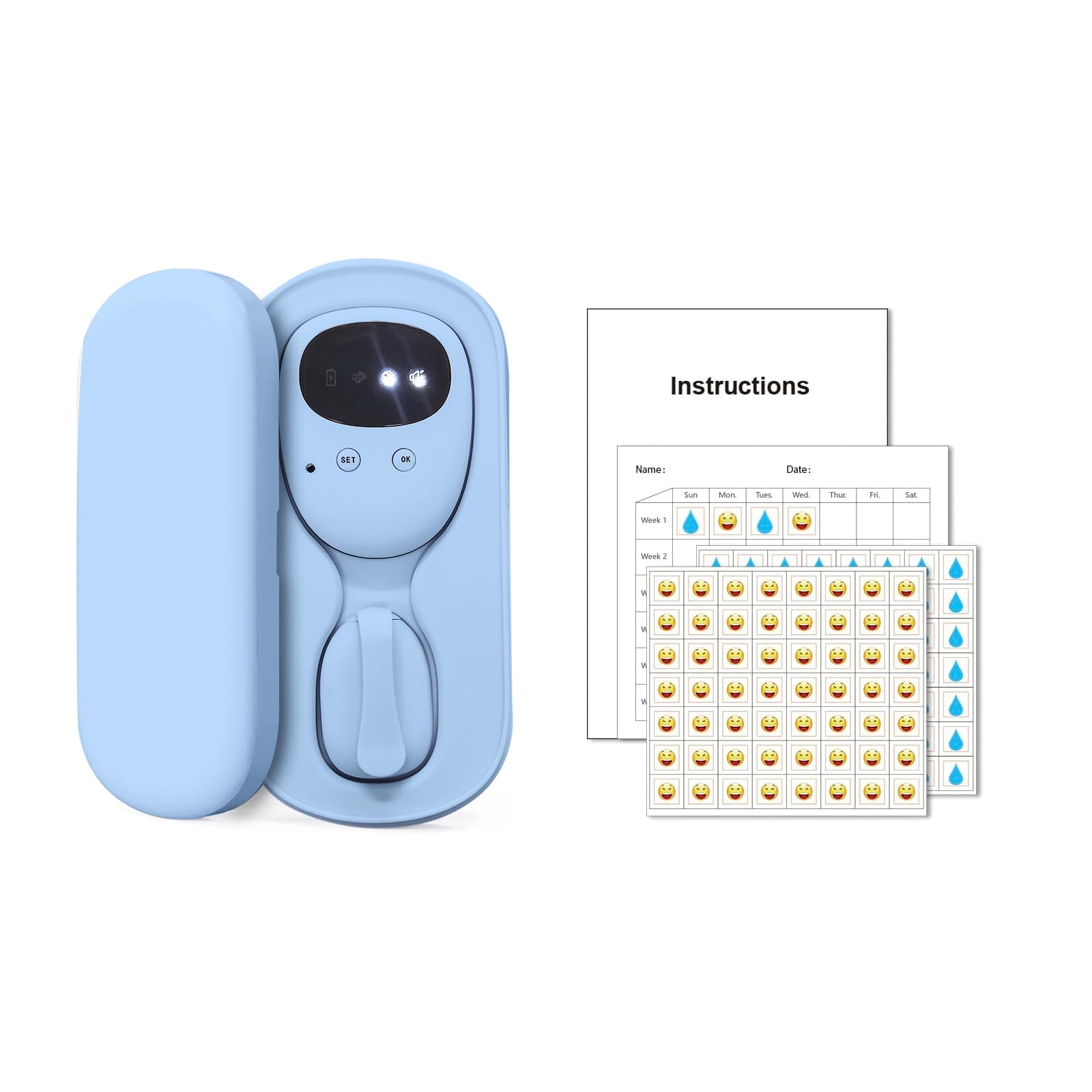
TENQIU’s wireless alarm is the newest entry in this guide, hitting the market in early 2025. It’s built around a simple promise: you get the convenience of a wireless design and the recurring-cost savings of a USB rechargeable battery, all at a budget-friendly price point. The system uses a clip-on wireless transmitter that goes in the underwear and a separate receiver unit that sits on the nightstand. It offers three working modes: sound only, vibration only, and sound plus vibration.
For a teenager, the wireless design is a clear advantage over the wired Wet-Stop. The lack of a cord means they can sleep in any position without being tethered, and the receiver can be placed across the room or even in the parent’s room if needed. The battery life is reported to last all night on a single charge, which is good, but the long-term durability of the lithium cell is a concern — one reviewer reported the unit stopped working completely just outside of the return window. The sensitivity of the moisture sensor is excellent for detecting the first drops of urine.
The biggest catch is that the alarm does not work with pull-ups or absorbent underwear because the liquid is wicked away from the sensor before it can trigger the alarm. This is a deal-breaker for many teens who still use nighttime pull-ups for security. Also, the wireless signal between the transmitter and receiver is shared when using two units in the same house, meaning both alarms will trigger at the same time if either child wets. For the price, it’s a functional wireless option, but the quality control and pull-up incompatibility limit its usefulness.
Why it’s great
- USB rechargeable design eliminates the need for buying disposable batteries.
- Affordable wireless entry point for families on a tight budget.
- Sensitive sensor catches the first drops of urine for optimal conditioning.
Good to know
- Does not work with pull-ups or absorbent garments, limiting compatibility.
- Quality control issues; some units fail shortly after the return window closes.
- Wireless signal sharing means two units in the same house trigger simultaneously.
7. ReYang Wireless Bedwetting Alarm
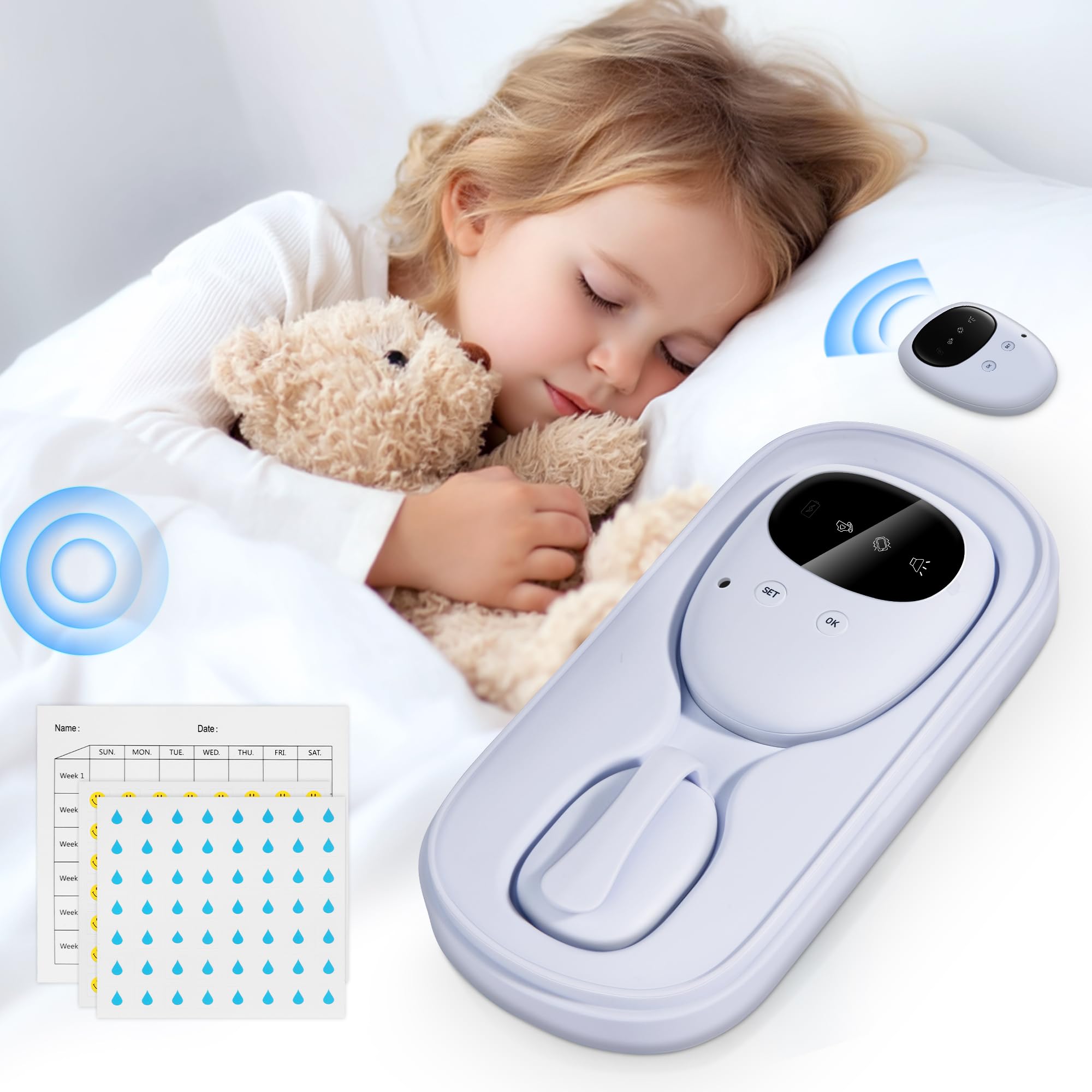
The ReYang alarm distinguishes itself with a magnetic USB charging design that stores both the transmitter and receiver in a compact charging and storage box. This is a genuinely thoughtful feature for a teenager’s bedroom — it means the whole system is contained in one box, reducing the chance that a small component gets lost under the bed. The sensor is fully waterproof and made with soft-touch materials, and the clip design is intended to stay secure on underwear even for active sleepers.
Functionally, it follows the same blueprint as other wireless alarms: it has sound, vibration, and combined modes. The receiver’s signal strength is reported to be stable across walls and rooms, maintaining performance even if the teen moves around in bed. It also includes the standard motivational materials: a reward chart and star stickers. For a younger teen who is motivated to solve the problem, the visual tracking can be a useful behavioral tool, though older teens may find the stickers patronizing.
The weakness here is longevity. Multiple reviews report that the alarm works “really well” for a couple of months and then suddenly stops functioning. The manufacturer’s product support was described as unhelpful in one case, and the return window is limited. There are also reports of units arriving dead on arrival, requiring a replacement. For the price, the magnetic charging approach is genuinely clever, but the reliability issues make it a riskier bet than established brands like Wet-Stop or Eclipse for a long-term conditioning program.
Why it’s great
- Magnetic USB charging box prevents loss of the small transmitter or receiver.
- Waterproof sensor is easy to clean and maintain hygiene after accidents.
- Stable wireless signal works across walls for flexible receiver placement.
Good to know
- Reported failure after a few months of regular use is a common complaint.
- Some units arrive defective out of the box, requiring a replacement.
- Manufacturer support is inconsistent; returns can be difficult after a short window.
FAQ
Will a bedwetting alarm work for a teenager who is a very deep sleeper?
How do I prevent false alarms from sweat ruining my teenager’s trust in the device?
Final Thoughts: The Verdict
For most users, the bedwetting alarm for teenager winner is the Eclipse Wireless because its 40-foot wireless range and proven track record with teens as old as 12 make it the most reliable option for breaking a lifelong cycle. If you want volume customization and a monthly rechargeable battery, grab the DryEasy Pro Wireless. And for a comprehensive bundle that protects the mattress and includes a proven alarm, nothing beats the Wet-Stop3 Kit.
Product prices and availability are accurate as of the date/time indicated and are subject to change. Any price and availability information displayed on Amazon at the time of purchase will apply to the purchase of this product. As an Amazon Associate I earn from qualifying purchases.
CERTAIN CONTENT THAT APPEARS ON THIS SITE COMES FROM AMAZON. THIS CONTENT IS PROVIDED "AS IS" AND IS SUBJECT TO CHANGE OR REMOVAL AT ANY TIME.
Amazon and the Amazon logo are trademarks of Amazon.com, Inc. or its affiliates.