
That rhythmic drilling sound against your wooden deck, porch, or shed isn’t just annoying — it’s a structural threat. Carpenter bees tunnel into untreated wood, laying eggs in galleries that multiply season after season, reducing the integrity of outdoor structures. An effective bee trap stops this cycle by luring the flying excavators into a one-way chamber before they can bore into your fascia boards, railings, or siding.
I’m Min — the co-founder and writer behind Gadgets Feed. I’ve parsed hundreds of hours of buyer feedback and technical spec sheets to separate the traps that actually intercept wood-boring bees from those that just collect leaves and rainwater.
Whether you’re dealing with aggressive yellow jackets around a patio or the tell-tale sawdust piles from carpenter bees, this guide distills the best hardware-based solutions available right now. This is the definitive breakdown of the best bee trap options for protecting your outdoor living spaces.
How To Choose The Best Bee Trap
Not all bee traps work the same way. A yellow jacket trap uses a pheromone lure for social wasps, while a carpenter bee trap relies on a pre-drilled hole that mimics a natural nesting tunnel. The right choice depends entirely on which species is damaging your property and whether you want to kill or relocate them.
Target Species — Carpenter Bee vs. Yellow Jacket vs. Hornet
Carpenter bees are solitary wood-borers that drill perfect ½-inch holes into untreated wood. They need a trap with a wooden block or chamber that mimics their preferred boring substrate. Yellow jackets, by contrast, are social wasps attracted to protein and sugar sources; they require a hanging bag or jar-style trap with a scent-based lure. Hornet traps sit somewhere in between, needing large entry tunnels and a strong attractant. Choose the trap design that matches the specific pest you’ve identified.
Construction Material — Wood vs. Plastic vs. Metal
Wooden traps, typically cedar or pine, naturally attract carpenter bees because the bees instinctively investigate any pre-existing hole in solid wood. Plastic traps are lighter, weather-resistant, and cheaper, but may need a separate bait attractant to draw bees inside. Metal components (stainless steel or aluminum) matter for durability in full-sun positions where plastic can warp. For permanent deck protection, a wooden or reinforced composite body holds up better through freezing winters and humid summers.
Disposal Mechanism — Catch-and-Release vs. Kill vs. Sticky
If you prefer not to kill pollinators, a catch-and-release trap with a removable chamber door allows you to relocate captured bees. Disposable bag traps are designed to be thrown away once full. Sticky traps use an adhesive board that captures bees on contact but also catches beneficial insects. Reuse is a major cost factor — traps that can be emptied, cleaned, and rebaited over multiple seasons offer better long-term value than single-use options.
Quick Comparison
On smaller screens, swipe sideways to see the full table.
| Model | Category | Best For | Key Spec | Amazon |
|---|---|---|---|---|
| Best Bee Brothers Turbo Trap 2.0 | Carpenter Bee | Professional-grade deck protection | Four-chamber funnel, 15 ft. radius | Amazon |
| RESCUE! Reusable Yellowjacket Trap | Yellow Jacket | Social wasp control | Included attractant, durable plastic | Amazon |
| Bee Warehouse Carpenter Bee Trap | Carpenter Bee | Catch and release near wood surfaces | Extra-large catch chamber, 5-15 ft range | Amazon |
| Solar LED Wasp Trap (Stingmon) | Multi-Species | Nighttime attraction via UV light | Solar panel, blue UV light, stainless steel | Amazon |
| Wasp Traps Outdoor Hanging (Stingmon 2-Pack) | Carpenter Bee | All-season coverage with included bait | Two-pack, integrated bottom, leak-resistant | Amazon |
| Wasp Traps Outdoor Hanging (Stingmon 4-Pack) | Carpenter Bee | Broad multi-zone coverage | Four-pack, multi-directional tunnels | Amazon |
| Disposable Wasp Traps (Stingmon 8-Pack) | Disposable | High-volume, temporary infestation | 8 count, funnel lock, sunny area optimized | Amazon |
In‑Depth Reviews
1. Best Bee Brothers Turbo Trap 2.0

The Turbo Trap 2.0 represents a professional-grade leap over basic plastic jars. Its internal four-chamber funnel design prevents escape more reliably than single-entry traps, and the 20% capacity increase over the original means you empty it less frequently. The effective radius of 15 feet covers a typical suburban deck or porch without needing multiple units.
Best Bee Brothers engineered the spring-loaded release door with a 9-foot pull string, letting you empty the catch chamber from the ground without touching the trap. The large viewport lets you confirm capture success before disposal. Multiple verified buyers report catching 8 or more bees per emptying cycle during peak spring emergence.
The chemical-free approach relies purely on the visual mimicry of pre-drilled holes — no lures, no sticky chemicals. This preserves honeybees and bumblebees while exclusively targeting carpenter bees. The durable plastic roof protects the funnel from rain and debris, maintaining function across multiple seasons.
Why it’s great
- Touch-free disposal via long pull string
- Large viewport for monitoring catch levels
- Roughly 20% more capacity than original model
Good to know
- Premium price point — higher initial investment
- Primarily targets carpenter bees, not yellow jackets
2. RESCUE! Reusable Yellowjacket Trap

If yellow jackets are ruining your outdoor meals, the RESCUE! trap is purpose-built for that exact problem. The specially formulated attractant targets roughly a dozen North American yellow jacket species without drawing in honeybees, a crucial distinction for anyone maintaining a pollinator garden. The two-pack provides immediate coverage for front and back yards.
The durable plastic construction holds up through multiple seasons of sun and rain, and the refill attractant cartridges (sold separately) extend usability year after year. Some users report immediate results — yellow jackets entering within hours of setup, particularly in late spring when queens are scouting. The trap kills via dehydration rather than poison, a safer mechanism around pets and children.
It’s worth noting that this trap specifically targets yellow jackets and does not attract wasps or hornets. A few users have found that the included attractant loses effectiveness over time and have switched to DIY baits like soda or fruit juice on a cotton ball. The trap is reusable, but the ongoing cost of refills is a factor to budget for.
Why it’s great
- Selectively targets yellow jackets, spares honeybees
- Reusable durable construction for multiple seasons
- Attractant is included with the two-pack
Good to know
- Does not catch wasps or hornets
- Refill attractant is an ongoing expense
3. Bee Warehouse Carpenter Bee Trap
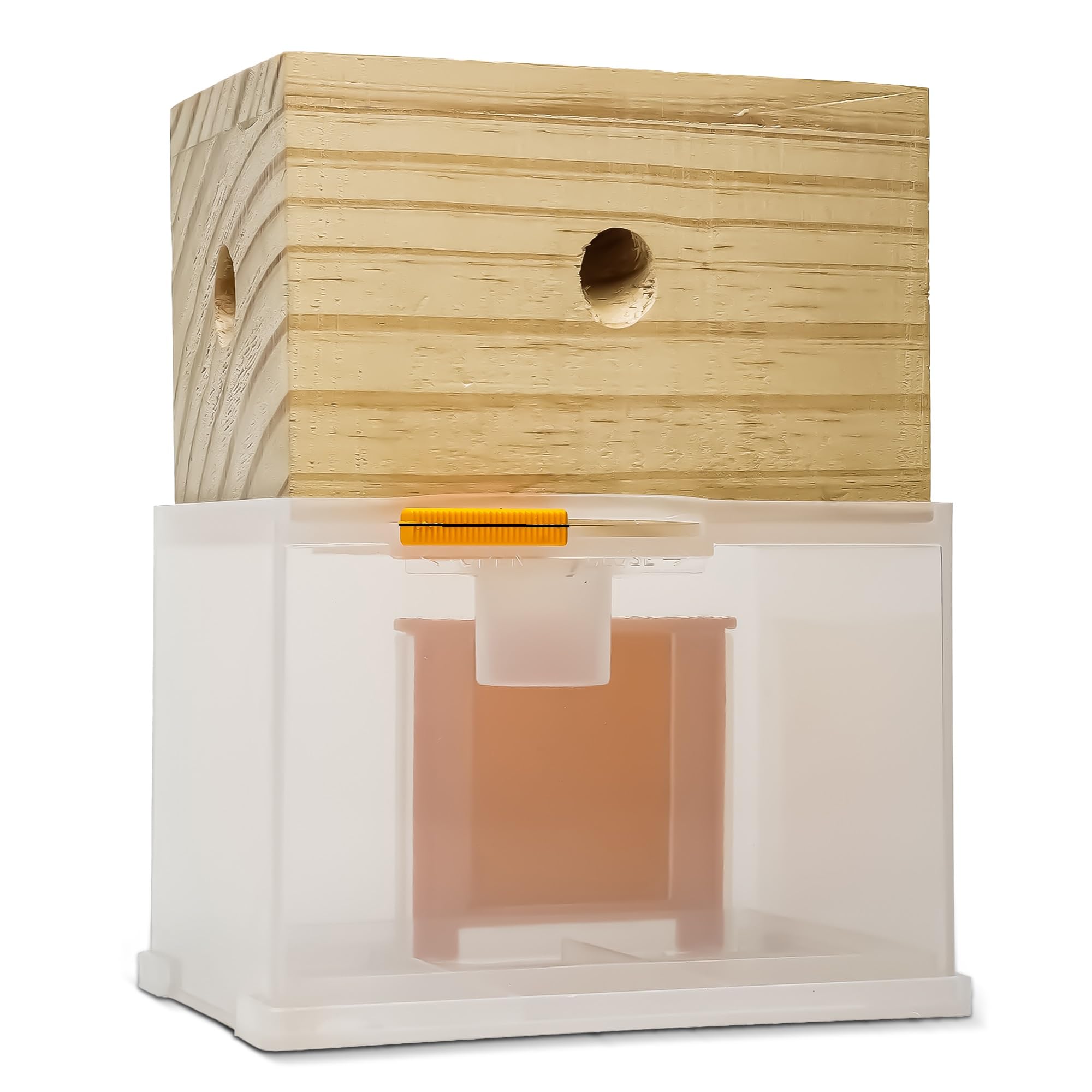
For anyone who wants to relocate rather than exterminate, the Bee Warehouse trap is the standout. The extra-large catch chamber only needs emptying once a year, which is a genuine safety advantage when traps are mounted high on siding or under eaves. The latch mechanism seals the chamber during transport, preventing escapes while you move captured bees to a remote location.
The patent-protected design (D928271) uses pre-drilled holes that specifically attract carpenter bees while ignoring bumbles, honeys, and leafcutters. No chemical lures, bait trays, or sticky potions are needed — the trap works on the same instinct that drives carpenter bees to investigate existing holes. Its effective range of 5 to 15 feet means you need strategic placement near active drilling sites.
Multiple verified users report catching several carpenter bees within the first 48 hours. The wooden construction blends into outdoor aesthetics better than bright plastic traps. The included hanging hardware and 5 bee dams simplify installation. A small minority of users struggled without a live bait bee, but the overwhelming majority found it effective without that step.
Why it’s great
- Extra-large catch chamber empties once per year
- Catch-and-release latch for safe relocation
- Only attracts carpenter bees, not other species
Good to know
- Must be placed within 5-15 feet of bee activity
- No chemical lure — relies on visual mimicry
4. Solar LED Wasp Trap (Stingmon, 2-Pack)
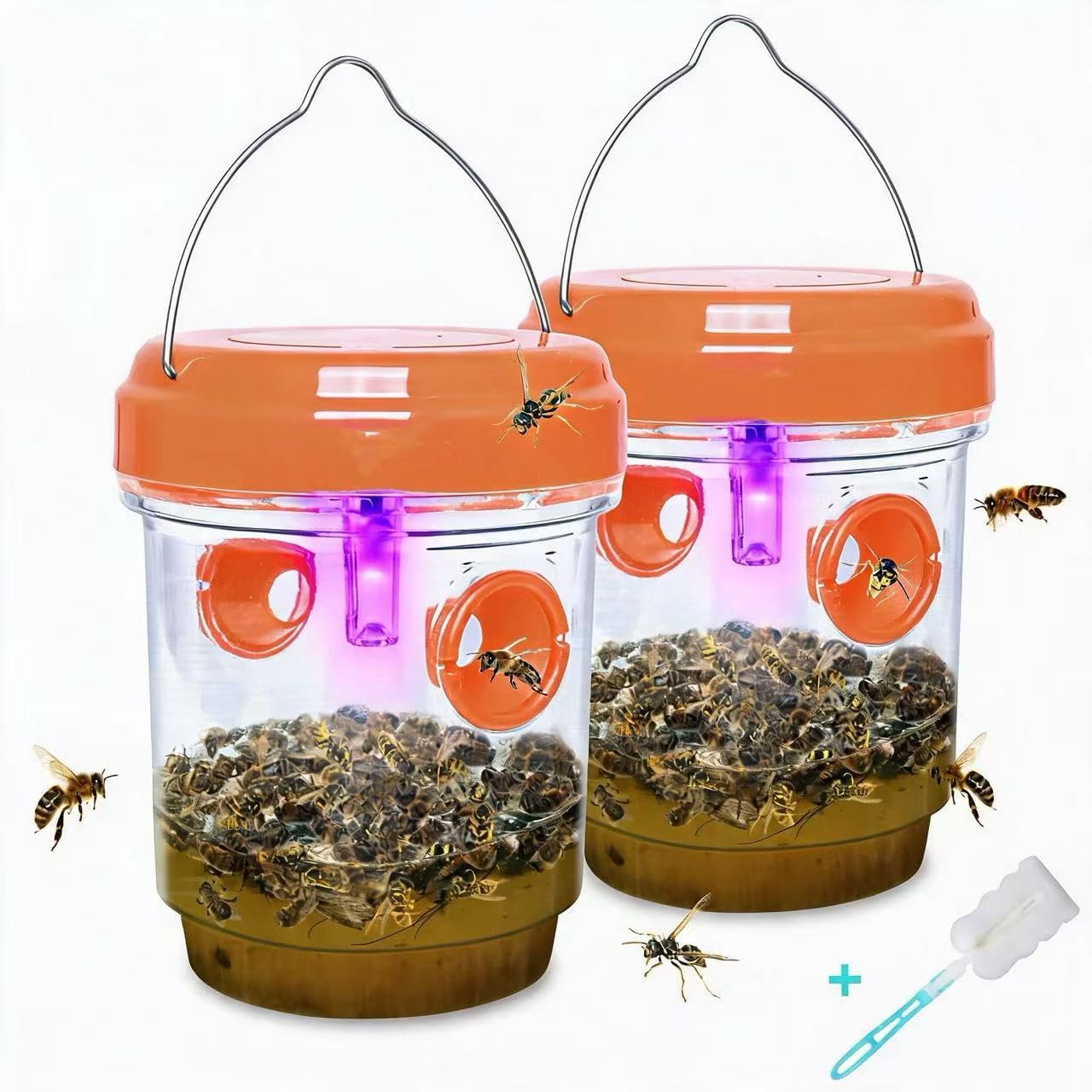
This is the only trap on the list that works actively at night. The built-in solar panel charges during the day, then powers a blue UV LED that attracts flying insects after dark. This extends trapping coverage into the evening hours when many wasps and yellow jackets are less active but nocturnal pests emerge. The dual-entry tunnel design — one larger outer, one smaller inner — creates a one-way funnel that makes escape nearly impossible.
Stingmon constructed the trap from durable ABS plastic and stainless steel, resisting rust and heat deformation better than standard plastic alone. The orange and blue color options allow you to match the trap to the species you’re targeting, as wasps and bees show different color preferences. The two-pack gives good value for covering a garden and orchard simultaneously.
Users report that adding sugar water or honey to the reservoir improves catch rates significantly. The rain-isolating design prevents the attractant from being diluted during storms. Bear in mind that the solar panel requires direct sunlight to charge effectively, so shaded placement under deep eaves reduces nighttime performance.
Why it’s great
- Solar-powered blue UV light for nighttime attraction
- Dual-entry tunnel design prevents escape
- Stainless steel and ABS durable construction
Good to know
- Requires direct sunlight to charge solar panel
- Needs added bait (sugar water or honey) for best results
5. Wasp Traps Outdoor Hanging (Stingmon, 2-Pack)
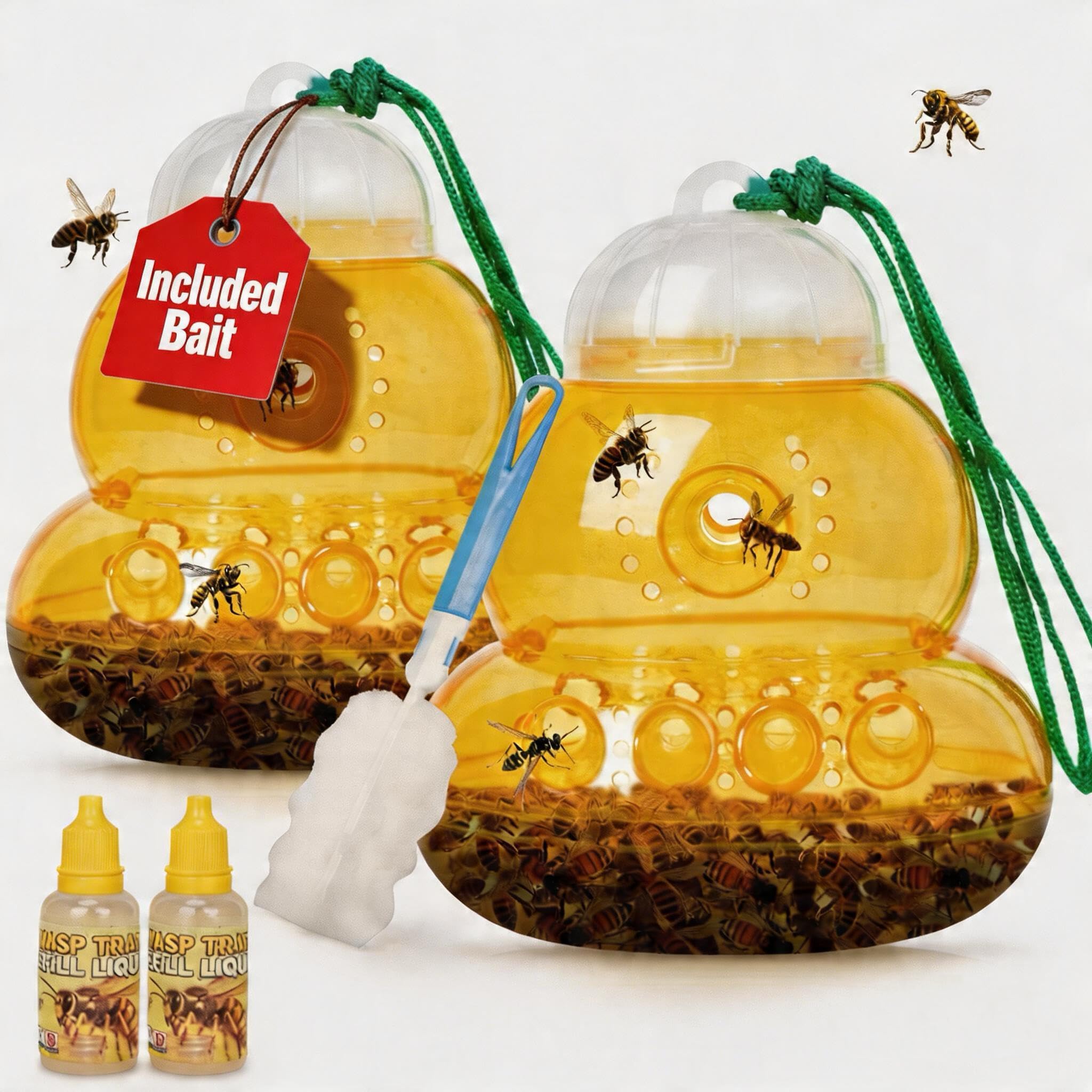
This two-pack from Stingmon includes the bait attractant refills right in the box, removing the guesswork of mixing DIY solutions. The integrated bottom design prevents the leak issues that plague cheaper single-piece traps, keeping sticky residues off your porch railings. Each trap measures 5.12 inches across, offering a stable hanging footprint that doesn’t swing excessively in wind.
The multi-directional entry tunnels allow wasps and carpenter bees to enter from four sides, increasing catch surface area compared to bottom-entry-only designs. Users have reported catching significant numbers of yellow jackets and wasps within the first week, particularly when baited with beer or fruit vinegar as recommended. The ABS plastic body is lightweight at 11.2 ounces total for both traps.
A small number of users reported that the plastic bottom deformed under extreme heat, causing the trap to leak its attractant. Hanging these traps in shaded or partially shaded positions reduces this risk. The included lanyards make installation simple, and the traps can be disassembled for cleaning and reuse in subsequent seasons.
Why it’s great
- Bait attractant refills included in the package
- Multi-directional entry tunnels increase catch area
- Leak-resistant integrated bottom design
Good to know
- Plastic bottom may warp in direct sun
- Best results when hung near areas of known bee activity
6. Wasp Traps Outdoor Hanging (Stingmon, 4-Pack)
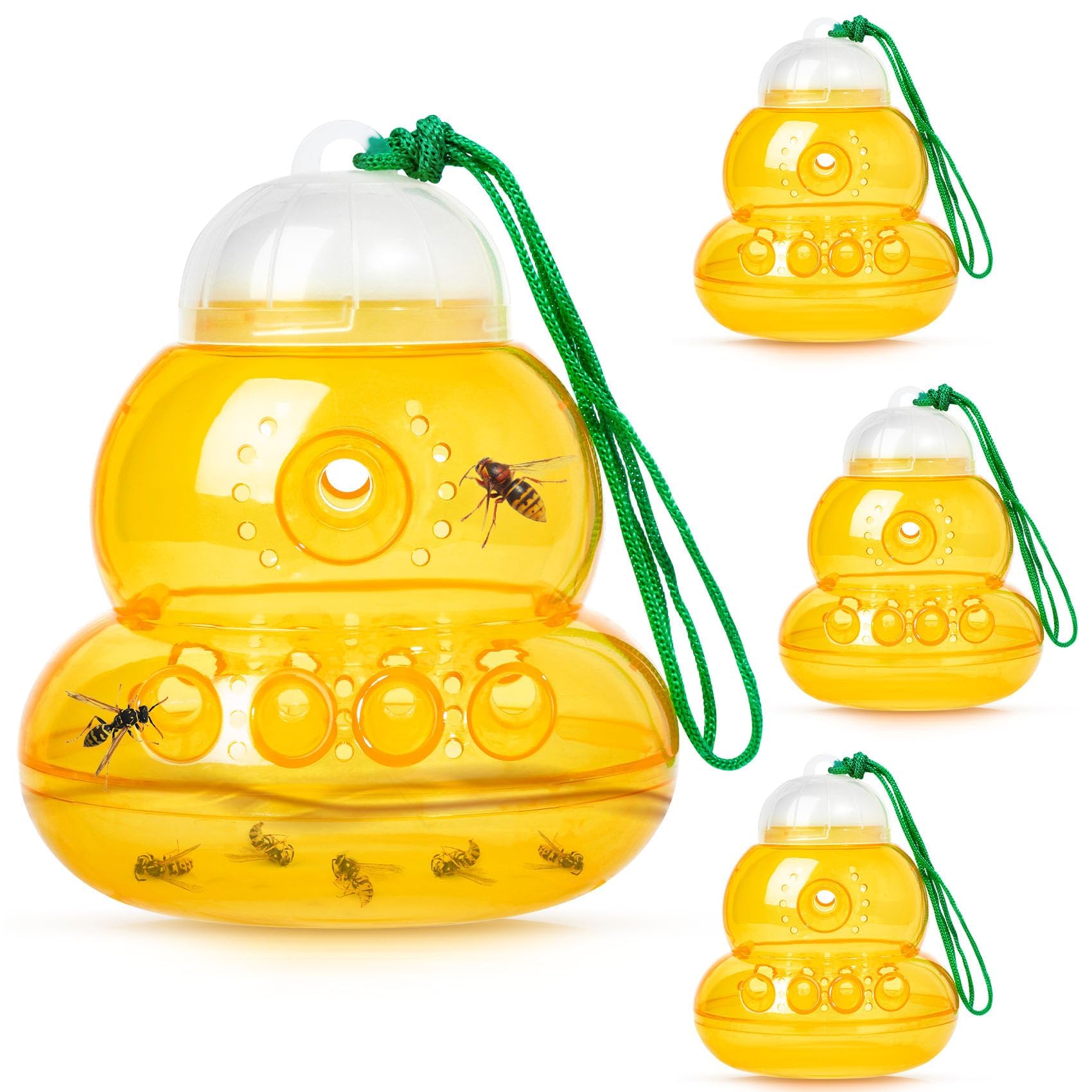
When you’re protecting a farm, large orchard, or property with multiple outbuildings, four traps provide the coverage necessary to intercept bees and wasps before they establish drill sites. The multi-tunnel design on each trap allows entry from all directions, and the integrated bottom prevents attractant leakage. Each unit uses the same food-based lure principle — beer, wine, or fruit vinegar — that keeps operation chemical-free.
At 1.45 pounds total, the four-pack is heavier than the sum of two individual traps, reflecting a slightly denser plastic formulation. The yellow color selection is deliberate — wasps are scientifically proven to be drawn to yellow wavelengths. Users consistently report visible results within 24 hours of hanging, with many noting that the traps continue catching for weeks before needing to be emptied.
The lanyard hanging system is simple and secure, and the traps can be taken down, cleaned, and stored for the off-season. A minor trade-off is that the plastic material, while sturdy, doesn’t have the same aesthetic appeal as a wooden carpenter bee trap. These are functional tools best placed out of main sight lines, such as the perimeter of a vegetable garden or the edge of a yard.
Why it’s great
- Four traps cover large properties effectively
- Multi-directional entry tunnels for maximum capture
- Food-based lures avoid chemical exposure
Good to know
- Plastic body may not blend into natural landscapes
- Best results require adding bait solution yourself
7. Disposable Wasp Traps (Stingmon, 8-Pack)
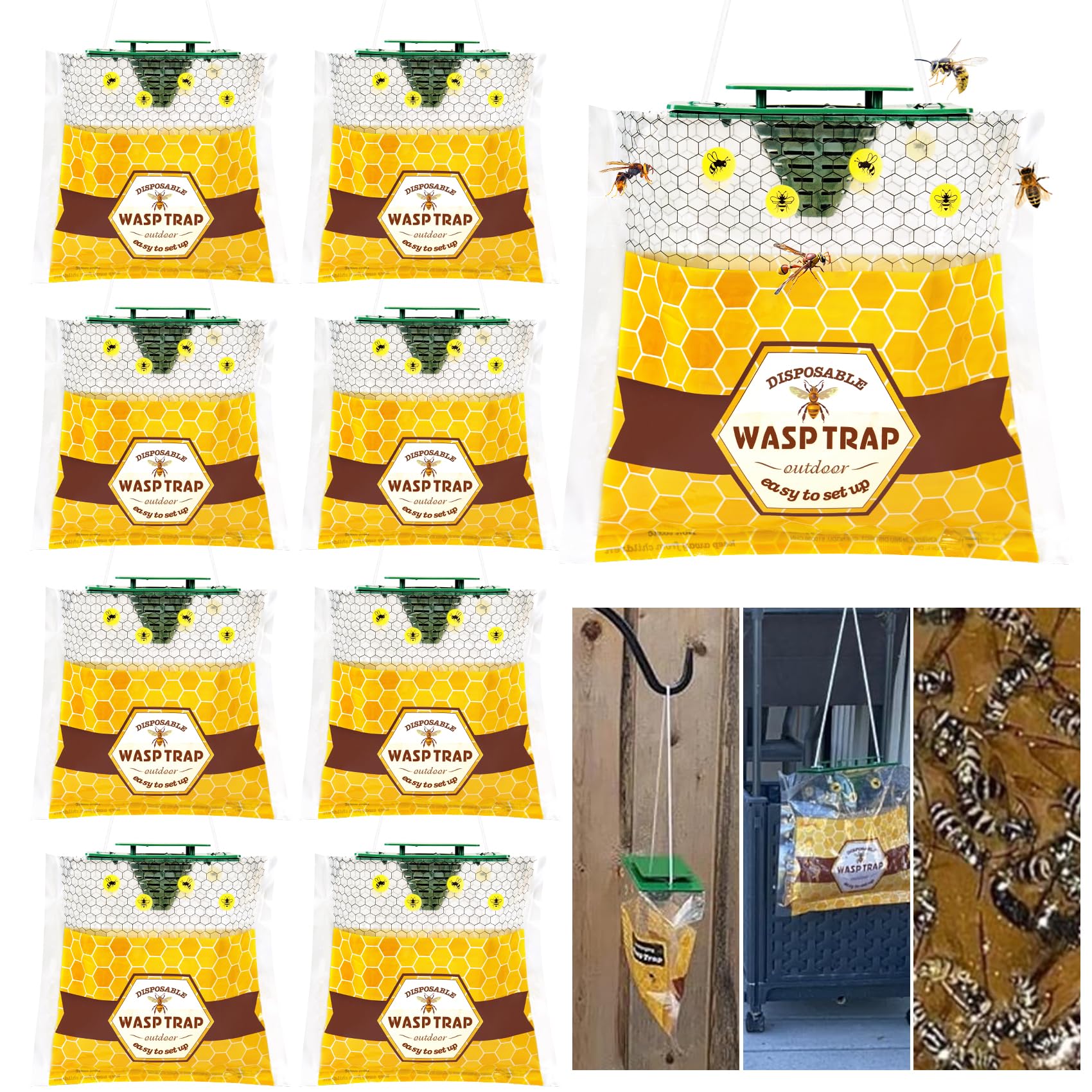
For a sudden, high-volume infestation — say, discovering a yellow jacket nest near a barn or during a summer party — this eight-pack of disposable traps offers the fastest per-dollar coverage. Each trap measures 6.7 by 5.1 inches and uses a funnel at the top that locks insects inside once they enter. The traps come with ties for immediate hanging on branches or fence lines.
The disposable design eliminates any cleanup. Once a trap is full, you simply discard the entire unit and hang a fresh one. Users recommend honey and wine for bees, beer or meat for yellow jackets, and brighter sunny positions for best results. The yellow color is scientifically proven to attract stinging insects, and the transparent body lets you monitor fill levels at a glance.
The most critical detail with disposable traps is that they do not come prefilled with bait — you must add your own attractant liquid. A few users missed this point and reported zero catches. When properly baited, the traps reliably capture wasps, hornets, and flies. The rain-protective design keeps bait from diluting. For long-term use over multiple seasons, a reusable trap is more economical.
Why it’s great
- Eight traps provide extensive coverage for large areas
- No cleaning required — dispose when full
- Rain and wind resistant for outdoor placement
Good to know
- Bait solution is not included — must be added
- Single-use design creates ongoing replacement cost
FAQ
Will a bee trap harm honeybees or other beneficial pollinators?
How often do I need to empty the trap?
What bait should I use in a reusable bee trap?
Final Thoughts: The Verdict
For most users, the best bee trap winner is the Best Bee Brothers Turbo Trap 2.0 because it combines a professional four-chamber funnel, touch-free disposal, and chemical-free operation into a durable package that targets only carpenter bees. If you’re dealing specifically with yellow jackets and want to protect honeybees, grab the RESCUE! Reusable Yellowjacket Trap. And for a budget-friendly high-volume solution to a temporary infestation, nothing beats the Stingmon Disposable Wasp Traps 8-Pack.