
The difference between a beech cutting board that lasts a decade and one that warps within months comes down to grain orientation, board thickness, and the density of the specific hardwood species. Beech wood sits right in the sweet spot — harder than most domestic hardwoods, tight-grained to resist moisture penetration, but not so hard that it destroys your knife edge on contact. That balance makes it a serious contender for anyone upgrading from bamboo or softwood blocks.
I’m Min — the co-founder and writer behind Gadgets Feed. I’ve spent hundreds of hours analyzing hardwood densities, glue-joint construction methods, and grain-pattern durability across dozens of cutting board models to identify the ones that genuinely hold up under daily knife work without developing cracks or deep cut scars.
This guide compares seven boards across grain types, thickness profiles, and build quality tiers to help you find the best beech cutting board for your actual prep habits — whether you’re rolling pasta dough, carving Sunday roasts, or dicing vegetables by the pound.
How To Choose The Best Beech Cutting Board
Beech wood’s closed grain structure gives it a natural advantage against bacterial absorption, but not every beech board is built equally. The grain direction, the adhesive used between wood strips, and the board’s finished thickness determine whether your purchase stays flat or bows after a season of use.
Grain Orientation: Edge vs. End Grain
Edge-grain boards feature wood strips running parallel to the surface, creating a smooth, uniform face that is gentle on knife edges and easier to resurface. These boards typically cost less and weigh less than end-grain alternatives. End-grain boards, where the wood fibers run perpendicular to the surface, excel at self-healing after knife cuts — the fibers part and close back — but require more regular oiling and come at a higher price point. For beech specifically, edge-grain construction hits the best balance because the wood’s density already resists deep cut scarring.
Board Thickness and Stability
Boards thinner than 1 inch tend to cup, bow, or crack as seasonal humidity changes cause differential expansion. Beech is dimensionally stable for a hardwood, but a minimum 1-inch thickness provides enough mass to resist warping. Boards at 1.5 inches or thicker add noticeable weight that prevents sliding during heavy chopping, but they also require more counter space.
Juice Management and Surface Features
A perimeter juice groove collects runoff from carving meat, while a flat, ungrooved side suits pastry rolling or vegetable prep. Reversible boards offer both options in one block. Some premium designs include a removable stainless steel drip tray that catches juices and scraps — especially useful for holiday roasts and large cuts where a simple groove overflows.
Quick Comparison
On smaller screens, swipe sideways to see the full table.
| Model | Category | Best For | Key Spec | Amazon |
|---|---|---|---|---|
| HexClad Carving & Cutting Board | Premium Carving | Large roast carving with drip tray | 2.4″ thick, reversible with hex trench | Amazon |
| Artistic Chef’s Kitchen End Grain Board | Handcrafted Artisan | Visual statement + heavy prep | 1.1” thick, walnut/ebony/beech blend | Amazon |
| HexClad XL Beechwood Board | Extra Large | High-volume prep and pastry rolling | 24″ x 18″ x 1.5″ reversible | Amazon |
| Fackelmann Beech Wood Board 40×40 cm | Compact Pasta Board | Dough kneading and pasta prep | 1.18” thick, 15.75” square beech | Amazon |
| CONSDAN Hickory Cutting Board | Heavy Duty Hickory | Bone chopping and heavy knife work | 1” thick, USA grown hickory | Amazon |
| Babilonia Walnut End Grain Board | Premium End Grain | Knife-friendly luxury charcuterie | 1” thick, 100% walnut end grain | Amazon |
| Socisen Bamboo 3-Piece Set | Value Set | Multi-size daily prep for small kitchens | 2.8” thick 5-layer bamboo | Amazon |
In‑Depth Reviews
1. HexClad Extra Large Beechwood Cutting Board

The HexClad XL delivers a full 24 by 18 inches of working surface with a 1.5-inch thickness that keeps the board planted even during aggressive chopping. The beechwood is non-aromatic, which means it won’t transfer any scent to pastry dough or cheese, and its dense grain resists deep knife scarring better than softer hardwoods like rubberwood. At 17 pounds, this board is not portable — it lives on your counter and serves as a permanent prep station.
The reversible design gives you a smooth side for dough rolling and a grooved side for meat carving. Beech’s closed pore structure makes cleaning easier than open-grain woods like walnut or oak, but the board still requires monthly mineral oil treatment to prevent surface dehydration. Owners report that the factory finish is dry out of the box and needs an initial heavy oiling before first use to achieve the rich honey tone shown in product photos.
This board suits serious home cooks who need maximum surface area without switching between multiple boards. The size is too large for standard sink rinsing, so you will need to wipe it down with a damp cloth and dry it upright. If your countertop has less than 30 inches of clear space, measure twice before buying — the footprint dominates smaller kitchens.
Why it’s great
- Monstrous 24″x18″ surface handles whole rib roasts and multiple prep ingredients at once
- Non-aromatic beechwood won’t taint pastry, cheese, or delicate herbs
- Reversible with one smooth side for dough and one grooved side for carving
Good to know
- Requires immediate and regular oiling — factory finish is dry
- At 17 lbs and 24 inches long, it is too large for most sinks and small kitchens
2. HexClad Hybrid Beechwood Carving and Cutting Board

The HexClad Hybrid board rethinks carving workflow with a dual-sided design purpose-built for large meat preparation. One side features a smooth surface for chopping vegetables and herbs, while the opposite side uses engraved hexagonal trenches that grip the meat and channel juices into a removable stainless steel tray. The tray slides out with a handle, letting you pour collected drippings directly into a gravy pot or stock without tilting the board.
At 2.4 inches thick, the beechwood construction provides enough mass to absorb impact from bone-in cuts without transferring shock to your countertop. The hexagonal pattern on the carving side is not just visual — the raised edges create friction that prevents a turkey or prime rib from sliding during slicing. Beech’s density keeps the trench edges from compressing under repeated knife pressure, unlike softer woods where the pattern flattens after a few uses.
Owners consistently praise the drip tray’s utility during holiday cooking, but note that the board’s weight (over 15 lbs) and 21.5-inch length make it a dedicated storage item rather than a daily grab-and-go board. The tray is dishwasher-safe, but the beechwood body requires hand washing and thorough drying. For cooks who carve large roasts more than once a month, the juice management alone justifies the premium position on this list.
Why it’s great
- Removable stainless steel drip tray captures carving juices for gravy without spills
- Hexagonal trench side grips meat and prevents sliding during slicing
- 2.4-inch thick beechwood absorbs heavy impact without warping
Good to know
- Very heavy — over 15 lbs and not practical to move around regularly
- The carving-side trenches collect debris and require thorough hand brushing to clean
3. Artistic Chef’s Kitchen End Grain Wooden Cutting Board
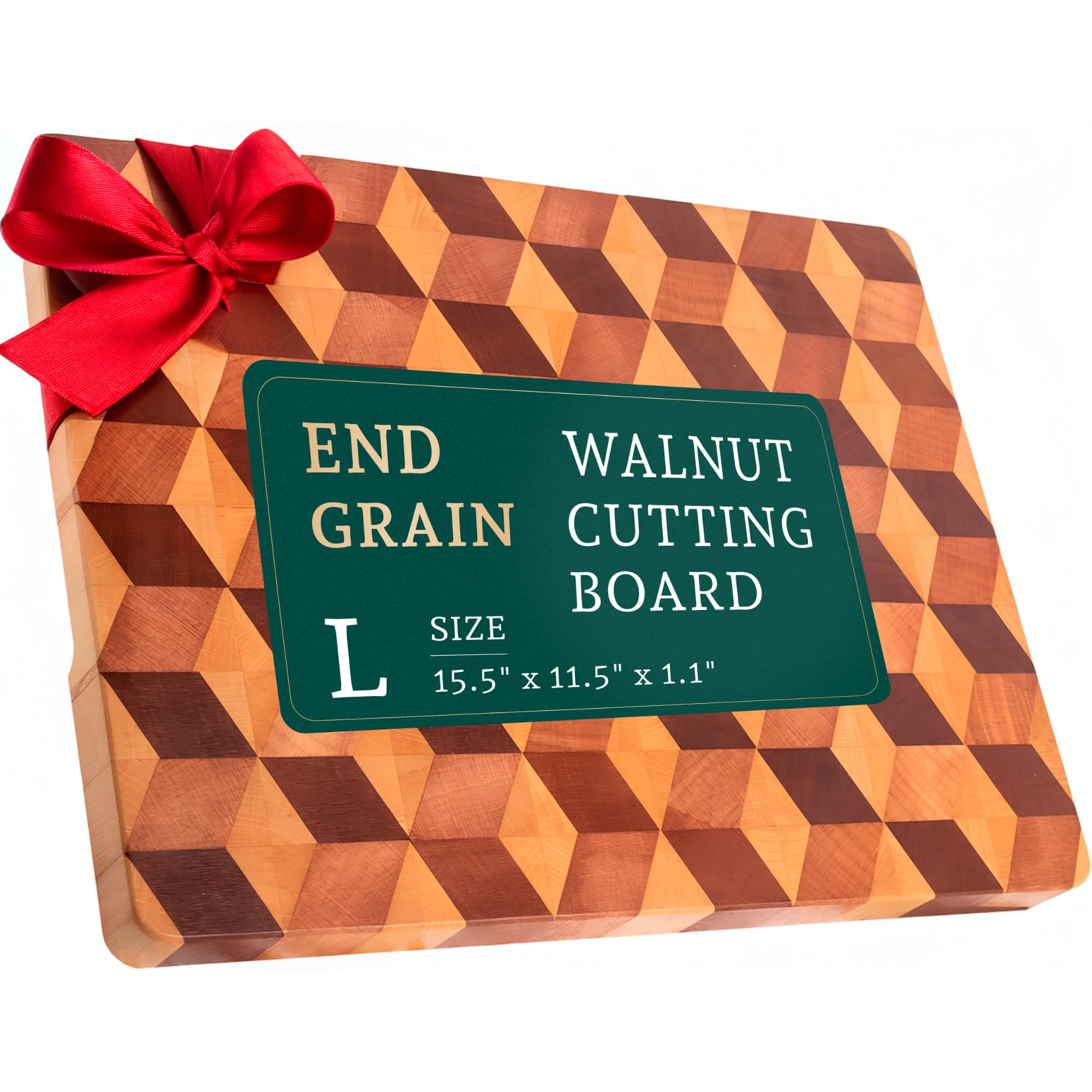
This handcrafted board combines walnut, ebony, and beech into an end-grain block that produces a striking 3D checkerboard pattern. End-grain construction means knife fibers part rather than get severed, which extends the time between sharpening sessions. The beech component in the blend contributes structural stability — beech’s dimensional consistency helps the glued assembly resist the seasonal expansion and contraction that can separate end-grain blocks made solely from softer woods.
Four rubber feet on the underside prevent the 2.55-kilogram board from sliding on granite or quartz countertops, and two side handles make it easier to lift than its weight suggests. The 15.5 by 11.5-inch surface is large enough for a full vegetable mise-en-place but compact enough to fit under most upper cabinets. Owners report that the 3D design doubles as a charcuterie presentation board, transitioning from kitchen utility to serving piece without compromising either role.
The board ships with a dry surface that requires an immediate mineral oil soak. Because end-grain exposes the wood’s open fiber ends, it absorbs oil faster and needs more frequent conditioning than edge-grain boards — every two to three weeks with heavy use. If you want the visual drama of a patterned end-grain board and prefer knife-friendly cutting over sheer surface area, this is the strongest performer in the mid-size category.
Why it’s great
- End-grain tri-wood construction is self-healing and exceptionally gentle on knife edges
- Non-slip rubber feet and side handles combine stability with easy transport
- 3D pattern doubles as a presentation charcuterie board for entertaining
Good to know
- End grain requires oiling every 2-3 weeks to prevent surface cracking
- 1.1-inch thickness is adequate but not as warp-resistant as 1.5-inch boards
4. Fackelmann Beech Wood Cutting Board 40 x 40 cm

The Fackelmann board is a square, single-purpose tool engineered for dough work — kneading, rolling pasta, shaping bread. Its 40 cm x 40 cm (15.75 inches square) format gives you a dedicated pastry surface without monopolizing counter space. The 1.18-inch thickness provides enough heft to stay in place during rolling, and the beech surface is smooth enough that well-floured dough releases without sticking.
Beech’s non-aromatic character is particularly valuable here: dough absorbs ambient odors readily, and a board that smells like garlic or onion from previous prep will transfer that scent to your pasta or pastry. The Fackelmann board avoids that problem because its closed-grain structure resists odor retention between uses. A 1.8 cm rim on one side lets you clamp the board against the counter edge for stability — a detail that matters when you are putting body weight into kneading stiff dough.
Customer reports indicate that this board is not intended for heavy chopping; the beech is not dense enough to withstand repeated knife strikes without marking. Treat it as a rolling and kneading surface only, and use a separate board for cutting. The square shape is awkward for typical cutting tasks but ideal for batch pasta production. If your kitchen workflow centers on fresh pasta, pizza, or bread, this is the most category-specific board in the lineup.
Why it’s great
- Square 15.75″ surface is perfectly sized for rolling pasta sheets and kneading dough
- Beech wood is non-aromatic and resistant to odor absorption from onions or garlic
- Edge rim allows secure clamping against counter for stable heavy rolling
Good to know
- Beech density is too low for heavy chopping — knife use will quickly scar the surface
- Some units arrived with slight warping, indicating variable quality control
5. CONSDAN Wood Cutting Board for Kitchen
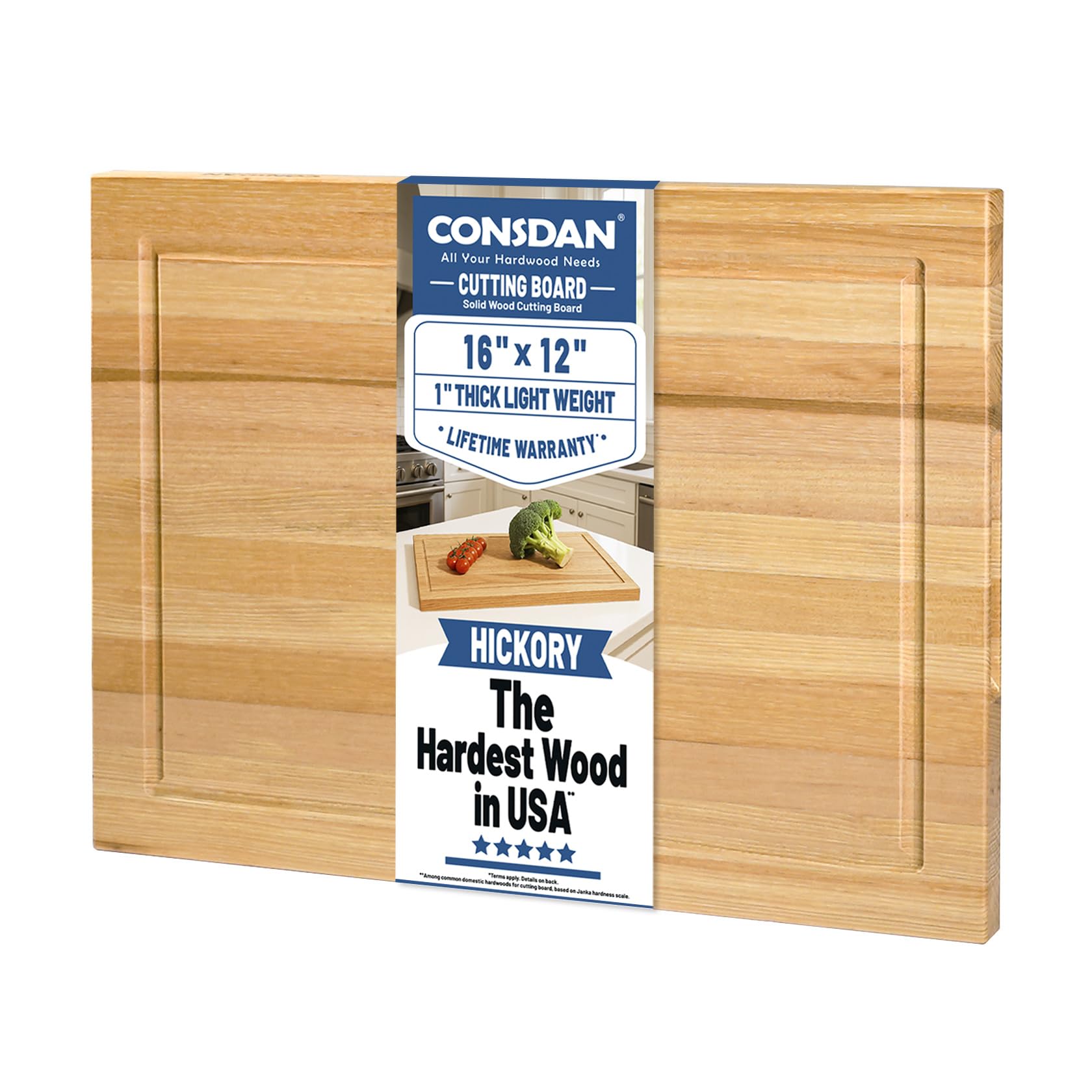
The CONSDAN board uses USA-grown hickory, a wood that registers around 1,820 lbf on the Janka hardness scale — significantly harder than beech. That hardness makes it ideal for heavy-duty tasks like splitting chicken bones or chopping through butternut squash, but it also means your knife edge will dull faster than it would on beech or walnut. The edge-grain construction is flat and stable, with a 1-inch thickness that provides adequate mass for daily prep without being too heavy to lift.
A deep perimeter juice groove runs close to the edge, giving you a wide flat cutting area in the center. The groove depth captures runoff from slicing tomatoes or carving roasted meats without overflowing. Hidden side handles let you lift the 1.77-kilogram board easily, and the reversible design means you can use the ungrooved side for dry prep like chopping herbs or cheese. The board ships pre-finished with food-safe wax oil, so it is ready for immediate use.
A small number of units arrived with cracks that developed within the first month — the company honored warranty replacements in those cases, but the reports suggest that quality control on hickory selection is not consistently tight. If you want a board that can survive bone chopping and occasional heavy impacts without splintering, the hickory construction delivers. For knife-edge preservation, stick with beech or walnut alternatives.
Why it’s great
- USA-grown hickory is significantly harder than beech — handles bone chopping safely
- Deep juice groove captures heavy runoff without overflowing onto countertops
- Hidden side handles and reversible design add everyday versatility
Good to know
- Hickory’s high hardness (1,820 Janka) will dull knife edges faster than beech
- Occasional quality issues — cracks reported, though warranty support is responsive
6. Babilonia Walnut Cutting Board
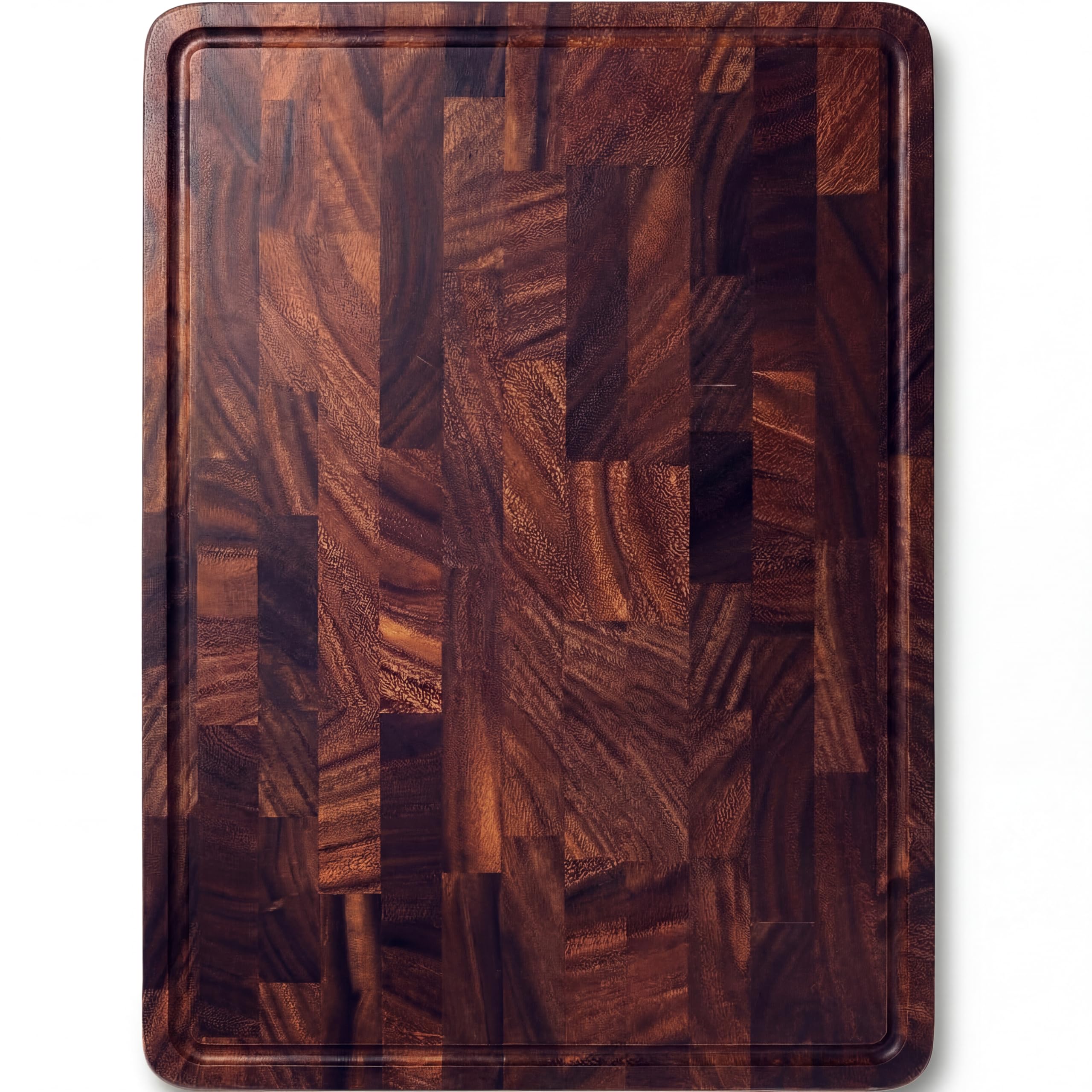
The Babilonia board shifts from beech to walnut, but its end-grain construction and 17 by 13-inch footprint make it directly comparable to the beech options above. Walnut registers around 1,010 Janka — softer than beech — which translates to superior knife-edge preservation. The end grain orientation further reduces blade wear because the fibers part rather than being cut across. This board is designed for the cook who prioritizes knife longevity over maximum hardness.
Included with the board is a sample bottle of organic mineral oil, which saves you the first-season expense of buying a separate conditioning product. The factory pre-oiling means the board arrives ready for immediate charcuterie presentation or vegetable prep. Two side cutouts serve as integrated handles, and the 2.79-kilogram weight gives the board enough mass to stay put during slicing without requiring rubber feet. Owners specifically note that the end grain does not absorb meat juices the way their previous bamboo boards did.
At 1 inch thick, this board is on the thinner side for an end-grain model. End grain requires more material to achieve the same structural stability as edge grain because the glue joints between blocks are more numerous. Expect to oil this board every two to three weeks to prevent the surface from drying and developing hairline separations. If you value knife friendliness and visual warmth over pure impact resistance, the Babilonia delivers premium performance at a mid-range investment.
Why it’s great
- End-grain walnut is extremely gentle on knife edges — fibers part rather than cut
- Comes pre-oiled with an included organic mineral oil bottle for immediate use
- Walnut’s open grain resists absorbing meat juices and odors during prep
Good to know
- 1-inch thickness is marginal for end grain — heavier users may want 1.5 inches
- Requires frequent oiling (every 2-3 weeks) to prevent end-grain cracks
7. Socisen 3 Pack Heavy Duty Bamboo Cutting Board Set

The Socisen set delivers three bamboo boards in small, medium, and large sizes for roughly the same investment as a single hardwood board. The 5-layer bamboo splicing technique creates a structure that is harder than most domestic hardwoods — bamboo’s Janka equivalent ranges between 1,380 and 1,680 lbf depending on the species and grain direction. That hardness makes bamboo very resistant to knife scars, but it also accelerates edge dulling compared to beech or walnut.
Rubber feet on each board prevent sliding on smooth countertops, and the largest board (17 by 12 inches) includes a perimeter juice groove. The multi-size approach lets you dedicate one board for raw meat, one for vegetables, and one for fruit — reducing cross-contamination risk without buying separate boards. The natural bamboo grain is visually consistent, and the set arrives packaged in a box suitable for gifting. The 2.8-inch thickness measurement refers to the combined height of the 5-layer stack, not the individual board height, which is closer to 0.75 inches per board.
Bamboo is not as dimensionally stable as beech in humid environments. Some owners report that the largest board developed a slight bow after several months of daily use, though the smaller boards remained flat. Bamboo is also harder on knife edges than beech, so if you use high-carbon steel knives, expect more frequent honing. For the cook who wants multiple dedicated prep surfaces without spending per-board premium prices, this set solves the volume problem at the cost of long-term flatness and edge preservation.
Why it’s great
- Three boards in graduated sizes cover meat, veg, and fruit prep for under
- Rubber feet and juice groove on the largest board add practical stability
- FSC-certified bamboo construction is harder than beech and resists knife scarring
Good to know
- Bamboo is harder than beech and will dull knife edges faster over time
- Individual boards are thinner than 1 inch — larger board may bow with humidity changes
FAQ
Is beech wood harder than maple for cutting boards?
How often should I oil a beech cutting board?
Can I put a beech cutting board in the dishwasher?
Final Thoughts: The Verdict
For most users, the best beech cutting board winner is the HexClad Extra Large Beechwood Board because its 1.5-inch thickness, reversible surface, and non-aromatic beech construction handle everything from kneading dough to carving a rib roast without transferring flavors. If you want a dedicated carving station with integrated juice management, grab the HexClad Hybrid Carving Board. And for the dough-focused cook who needs a compact, non-aromatic surface for pasta and bread prep, nothing beats the Fackelmann Beech Wood Board.