
The single biggest mistake new astrophotographers make is confusing a toy telescope with a tool that can actually capture a sharp image of a nebula. A “beginner” scope with a wobbly mount, plastic optics, or a poorly corrected lens will produce blurry, frustrating results that kill the hobby before it starts. The path to a great first image lies in choosing a tube with solid glass, a tracking-capable mount, and an aperture large enough to collect meaningful light.
I’m Min — the co-founder and writer behind Gadgets Feed. To build this guide, I cross-referenced real customer imagery against the technical specifications of each tube, evaluating focal ratio, chromatic aberration control, and mount stability to find the scopes that deliver actual results for someone learning the craft.
Here is the guide you need to find the best beginner astrophotography telescope that fits your budget without sacrificing the image quality you’re chasing.
How To Choose The Best Beginner Astrophotography Telescope
Picking your first astrophotography scope means balancing aperture, focal ratio, mount stability, and ease of use. A telescope that is optically great but sits on a flimsy mount will produce unusable images. The following factors are what separate a rewarding learning experience from a collection of blurry frames.
Aperture and Focal Ratio
Aperture is the diameter of the main objective lens or mirror. More aperture collects more light, allowing you to see and photograph fainter objects. For a beginner, 70mm to 150mm is the practical sweet spot. The focal ratio (f/ratio) determines how fast the telescope is and its field of view. A lower f/ratio (f/5 to f/6) is ideal for wide-field deep-sky objects like the Orion Nebula, while a higher f/ratio (f/10 to f/13) is better for planets and the moon where you need more magnification per millimeter of sensor.
Mount Type: The Backbone of Your Images
For astrophotography, the mount is arguably more important than the optical tube. You need a mount that can track the rotation of the Earth without vibration. An equatorial mount that moves on a single axis aligned with the pole is the gold standard. Some smart telescopes now handle tracking internally with Alt-Azimuth or EQ modes, which can simplify the learning curve for a beginner. Avoid cheap equatorial mounts that wobble under the weight of the telescope and camera.
Optical Design and Chromatic Aberration
Achromatic refractors use two glass elements and often suffer from chromatic aberration (purple fringing) around bright stars and planets. Extra-low dispersion (ED) glass reduces this significantly, producing sharper, more color-true images. Reflectors and Maksutov-Cassegrains eliminate false color entirely by using mirrors. For a beginner who wants to image deep-sky objects without dealing with color fringing, consider an ED refractor or a Mak.
Focuser Quality
A dual-speed (1:10 reduction ratio) focuser allows you to make coarse adjustments to get the object in frame, then fine-tune the sharpness without shaking the entire tube. This is critical for astrophotography, where even a slight defocus turns a pinpoint star into a bloated blob. Metal focusers with a rotatable body for framing your shot are a major plus.
Quick Comparison
On smaller screens, swipe sideways to see the full table.
| Model | Category | Best For | Key Spec | Amazon |
|---|---|---|---|---|
| Celestron NexStar 4SE | Premium | Automated GoTo imaging | 102mm Mak, f/13.2 | Amazon |
| DWARFLAB Dwarf 3 | Smart Scope | Portable deep-sky capture | Dual lens, 4K tracking | Amazon |
| Celestron StarSense Explorer 150AZ | Premium | Visual with phone guidance | 150mm reflector, f/5 | Amazon |
| DWARFLAB Dwarf Mini | Smart Scope | Ultra-portable all-in-one | 30mm, IMX662 sensor | Amazon |
| SVBONY SV503 70mm ED | Mid-Range | ED refractor imaging | 70mm ED, f/6.78 | Amazon |
| Gskyer 130EQ | Mid-Range | Classic equatorial setup | 130mm reflector, f/5 | Amazon |
| SVBONY MK105 Mak | Mid-Range | Planetary and lunar imaging | 105mm Mak, f/13 | Amazon |
| SVBONY SV48P 90mm | Value | Wide-field refractor work | 90mm achromat, f/5.5 | Amazon |
| FASHIONARI Smart Scope | Budget | Instant family stargazing | 80mm, 4K camera | Amazon |
In‑Depth Reviews
1. Celestron NexStar 4SE Computerized Telescope

The NexStar 4SE stands as the benchmark for a beginner who wants automated tracking from the first night. Its 4-inch Maksutov-Cassegrain optical tube delivers a long focal length of 1325mm at f/13.2, which is excellent for high-contrast planetary and lunar imaging with no chromatic aberration whatsoever. The fully computerized GoTo mount with SkyAlign technology lets you select a target from a 40,000-object database and have the scope slew to it automatically, eliminating the need to manually star-hop with a finder scope.
Users consistently report sharp views of Jupiter’s bands, Saturn’s rings, and the moon’s cratered surface at moderate magnifications. The built-in wedge allows for polar alignment, which is a rare feature at this price point and reduces field rotation during longer exposures. That said, the included 25mm eyepiece is just adequate, and many owners upgrade to a crosshair eyepiece and a better finderscope to improve alignment precision.
One clear drawback is power: the mount requires 8 AA batteries that drain quickly in cold weather, so a 12V AC adapter or external power tank is a practical necessity. The optical tube itself is heavy enough that the bundled tripod needs careful setup to avoid vibration. For a beginner planning to image planets and the moon with minimal frustration, this scope is the most capable turnkey solution in the list.
Why it’s great
- Fully automated GoTo mount with 40,000+ object database
- Mak optics eliminate chromatic aberration completely
- Built-in wedge for polar alignment and long-exposure imaging
Good to know
- AA batteries drain fast; external power strongly recommended
- Alignment procedure can be finicky without a crosshair eyepiece
2. DWARFLAB Dwarf 3 Smart Telescope
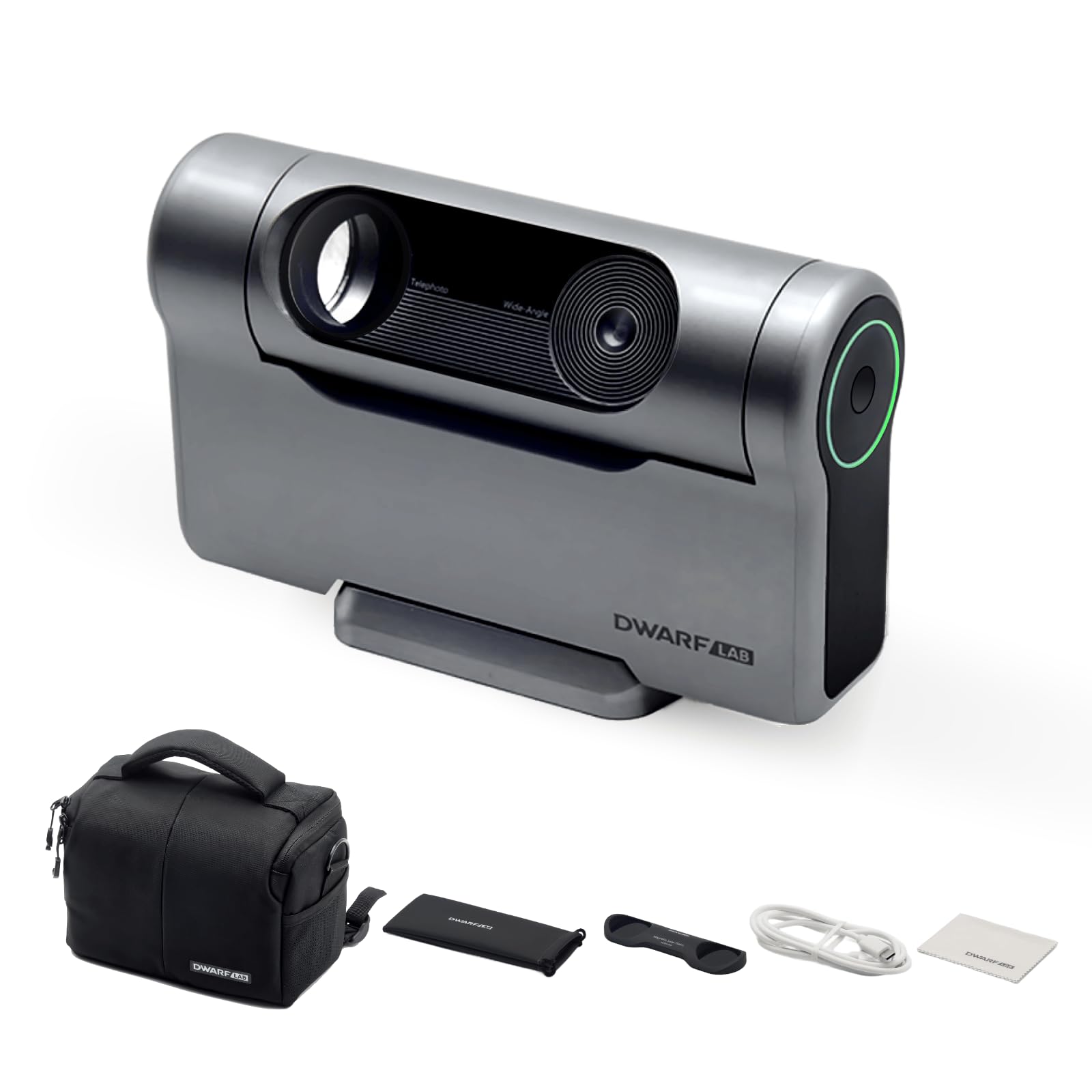
The Dwarf 3 redefines what a beginner astrophotography setup looks like by packing a dual-lens imaging system into a package that weighs just 3 pounds and fits in a backpack. Its telephoto lens is designed for deep-sky objects and wildlife, while the wide-angle lens captures the Milky Way and star trails. This smart scope handles its own tracking with Alt-Azimuth and EQ modes, and the integrated cloud processing stacks and denoises raw frames without needing a laptop.
Real user test shots show the Dwarf 3 can capture the Andromeda Galaxy, Orion Nebula, and the Milky Way core with surprising clarity, even from locations with moderate light pollution. The 4K auto-tracking means you can set it up, select a target on the app, and let it run. The dual lenses also allow daytime use, making it a versatile tool for a family that wants to do both terrestrial and celestial photography.
Because it relies on a small sensor, it is not ideal for high-resolution planetary imaging — Jupiter and Saturn will appear as small, bright dots rather than detailed disks. The app has occasional connectivity quirks, and the built-in WiFi range can be short. For a beginner who wants to see and share images of deep-sky objects on the first night without any hardware assembly, the Dwarf 3 is the most portable and beginner-friendly option available.
Why it’s great
- Ultra-portable at only 3 lbs with a carrying case included
- Dual-lens system for both deep-sky and daytime photography
- Cloud-based image processing stacks and enhances frames automatically
Good to know
- Small sensor limits planetary detail
- App connection can be unreliable initially
3. Celestron StarSense Explorer 150AZ
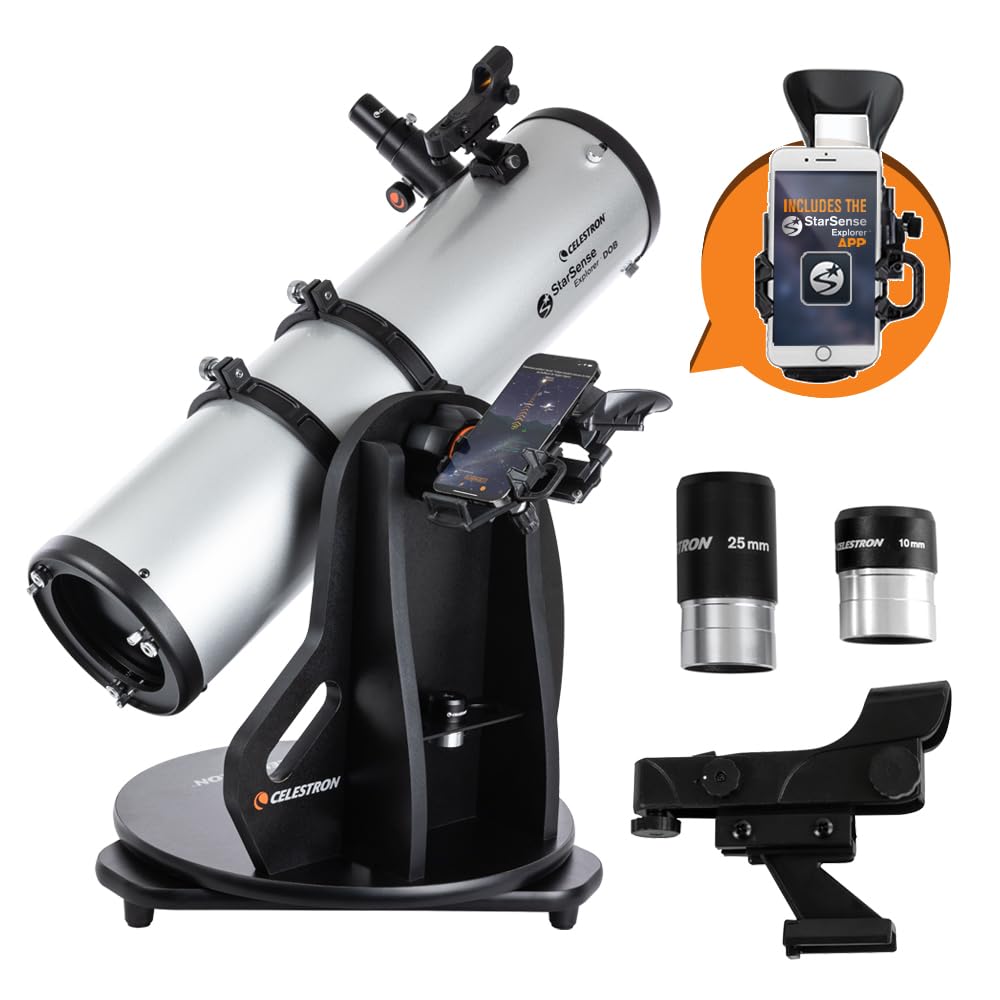
The StarSense Explorer 150AZ is a 6-inch Newtonian reflector on a tabletop Dobsonian base, designed to use your smartphone’s camera for sky recognition. You dock your phone, launch the StarSense app, and the phone analyzes star patterns to calculate where the scope is pointing — then on-screen arrows guide you to the target. This removes the usual learning curve of star-hopping and makes finding faint deep-sky objects feel like a video game.
With 150mm of aperture and a fast f/5 focal ratio, this scope collects enough light to show the Orion Nebula, Andromeda Galaxy, and globular clusters in impressive detail. The parabolic mirror means there is no spherical aberration, and high-reflectivity coatings boost contrast. For a beginner who wants to see deep-sky objects vividly with their own eyes, the views through this tube are hard to beat at this price point.
The major limitation is that the base is heavy (over 30 pounds) and made of press-board, which makes it poorly suited for transport to dark-sky sites. The manual tracking means you must nudge the scope by hand, which makes astrophotography nearly impossible without an aftermarket equatorial platform. This scope is a visual powerhouse that pairs exceptionally well with the StarSense app, but it is not a tool for long-exposure imaging without significant modification.
Why it’s great
- Large 6-inch parabolic mirror for bright, sharp deep-sky views
- StarSense app makes finding objects effortless for beginners
- Solid tabletop Dobsonian base provides stable viewing
Good to know
- Heavy press-board base is not portable for travel
- Manual tracking means it is not suitable for long-exposure astrophotography
4. DWARFLAB Dwarf Mini Smart Telescope
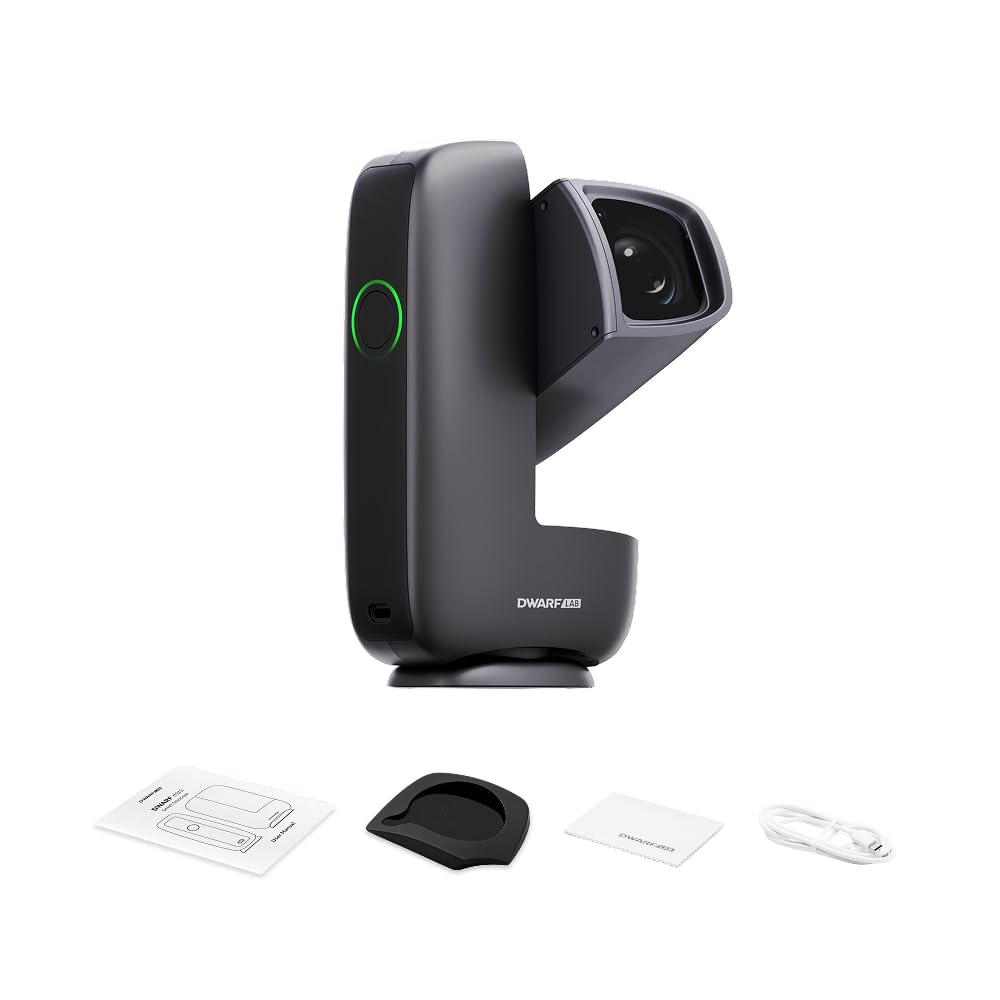
The DWARF Mini takes the smart-telescope concept and shrinks it further to just 1.85 pounds, making it the most portable dedicated astrophotography rig on this list. It uses a high-sensitivity Sony IMX662 sensor with 2.9µm pixels to capture deep-sky objects in Alt-Azimuth or EQ mode. The proprietary auto-GOTO system and built-in light pollution filter let you image from suburban backyards where sky glow would normally wash out faint galaxies.
User-submitted images show the Dwarf Mini can resolve the Pinwheel Galaxy, the Ring Nebula, and the Orion Nebula with recognizable structure, even from moderately light-polluted locations. The app-controlled setup goes from unboxing to first exposure in roughly three minutes, which is an unprecedented time-to-first-photo for a beginner. The integrated cloud processing means you can share finished images without installing any software.
Its biggest constraint is aperture — the 30mm objective lens limits its ability to gather light on very faint targets, and planetary detail is minimal because the sensor’s small field of view and short focal length do not provide enough magnification. The Dwarf Mini also requires a stable tripod (not included) and the foot adaptor for EQ mode adds a small learning curve. For a beginner who values portability and ease above all else, this scope is the lightest path to deep-sky imaging.
Why it’s great
- Weighs just 1.85 lbs for true backpack portability
- Built-in light pollution filter and cloud processing
- Auto-GOTO and app setup in under 3 minutes
Good to know
- 30mm aperture limits faint-faint deep-sky capture
- Requires an external tripod and a wedge for EQ mode
5. SVBONY SV503 Refractor Telescope 70mm ED
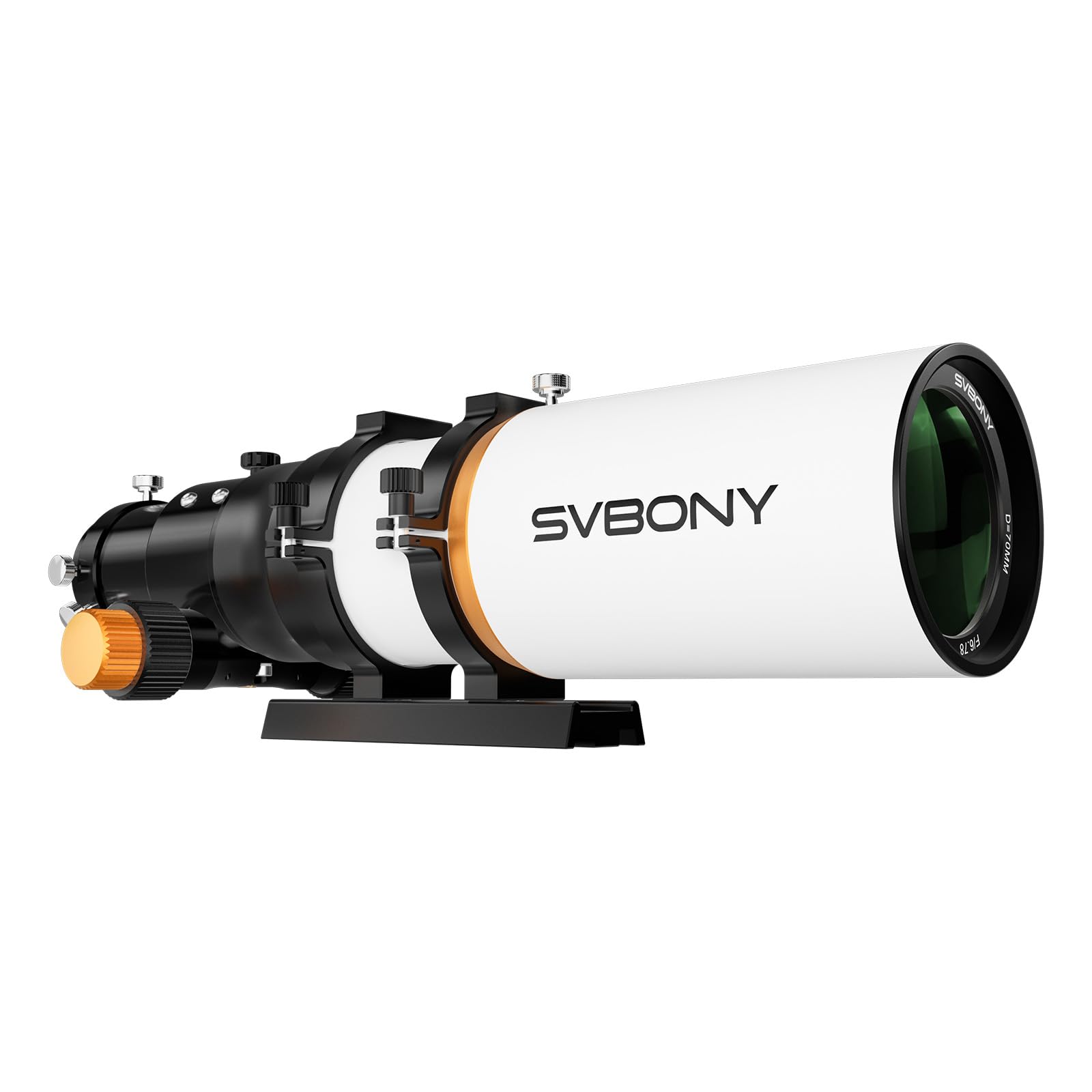
The SVBONY SV503 70mm ED is a premium entry into the world of astrophotography for a beginner who wants to grow into the hobby without replacing the optical tube. It uses extra-low dispersion (ED) glass in a doublet configuration that dramatically reduces chromatic aberration — the purple halos that plague cheap achromatic refractors are virtually gone. The built-in field flattener means stars at the edges of the frame remain pinpoints without the coma or distortion typical of fast refractors.
At 70mm aperture and f/6.78, this scope strikes a versatile balance between wide-field nebula imaging and enough resolution for lunar work. The all-metal dual-speed focuser with a 1:10 reduction ratio allows micro-adjustments for perfect sharpness, and the body is solid enough to support a mirrorless or DSLR camera without flex. Users report near-APO level color correction at a fraction of the usual cost, with sharp stars across the entire frame of a full-frame sensor.
The trade-off is that the kit does not include a mount, eyepieces, or a finder scope — you are buying just the optical tube assembly. A beginner will need to budget separately for a sturdy equatorial mount (15-20 lb capacity recommended), a camera adapter, and a guide scope for longer exposures. The lack of included accessories makes the initial investment higher than it appears on paper, but the optical quality justifies the cost for a beginner who is serious about producing clean deep-sky images.
Why it’s great
- ED glass delivers near-APO color correction with minimal fringing
- Built-in field flattener eliminates edge distortion for sharp images
- Dual-speed metal focuser provides precise micro-adjustments
Good to know
- Optical tube only — no mount, eyepieces, or finder included
- Requires a sturdy equatorial mount for long-exposure imaging
6. Gskyer 130EQ Professional Astronomical Reflector

The Gskyer 130EQ is a classic 5.1-inch Newtonian reflector on an equatorial mount, designed to introduce beginners to the concept of polar alignment and manual tracking. With a 650mm focal length at f/5, it is fast enough to capture deep-sky objects in shorter exposures, and the included 3 eyepieces plus a 3X Barlow lens give a good range of magnification for lunar and planetary viewing.
Customer feedback consistently praises the optical quality for the price — the moon’s craters appear crisp, and Jupiter’s cloud bands and four Galilean moons are clearly visible with the included 10mm eyepiece. The wireless Bluetooth remote is a thoughtful inclusion for taking smartphone photos through the eyepiece without shaking the scope. The equatorial mount, when properly polar-aligned, allows you to track objects by turning only one knob.
The mount is the weak point — it is not sturdy enough for heavy cameras or long-exposure astrophotography, and the gears can slip under the weight of the tube. The 30-pound total weight also makes it cumbersome to move. The Gskyer 130EQ is a capable visual telescope that teaches the fundamentals of equatorial tracking, but a beginner aiming to capture deep-sky images will soon outgrow its mount limitations.
Why it’s great
- 130mm aperture collects enough light for bright deep-sky views
- Equatorial mount teaches polar alignment and manual tracking
- Includes Bluetooth remote for shake-free smartphone photos
Good to know
- Equatorial mount is not sturdy enough for long-exposure imaging
- Heavy at 30 lbs, making transport inconvenient
7. SVBONY MK105 Maksutov-Cassegrain

The SVBONY MK105 is a 105mm Maksutov-Cassegrain optical tube that eliminates chromatic aberration entirely because it uses mirrors instead of lenses for image formation. With a focal length of 1365mm at f/13, it is optimized for high-magnification planetary and lunar imaging, delivering crisp, high-contrast views of Saturn’s rings, Jupiter’s Great Red Spot, and the moon’s Alpine Valley.
The multi-layer aluminum and high-reflectivity coatings on the mirrors achieve 99.99% reflectivity, which significantly improves contrast compared to uncoated surfaces. The dual dovetail slots allow you to attach guide scopes or finders without needing extra hardware. Owners report that when paired with a focal reducer, it becomes a viable tool for small deep-sky objects like the Ring Nebula, compressing the focal ratio to around f/7.7 for faster exposures.
As an optical tube only, the MK105 does not include a finder scope, eyepieces, or a mount — you must supply those separately. The narrow field of view (1.32 degrees) makes finding targets challenging for a beginner without a motorized mount with GoTo capability. It is a specialized instrument for planetary work that rewards a beginner willing to invest in a solid mount and learn precise alignment.
Why it’s great
- Zero chromatic aberration due to pure reflective optics
- High-contrast planetary and lunar images at 300x magnification
- Dual dovetail slots for accessories and guide scopes
Good to know
- Optical tube only — no mount, eyepieces, or finder included
- Narrow field of view makes target acquisition challenging manually
8. SVBONY SV48P Telescope 90mm
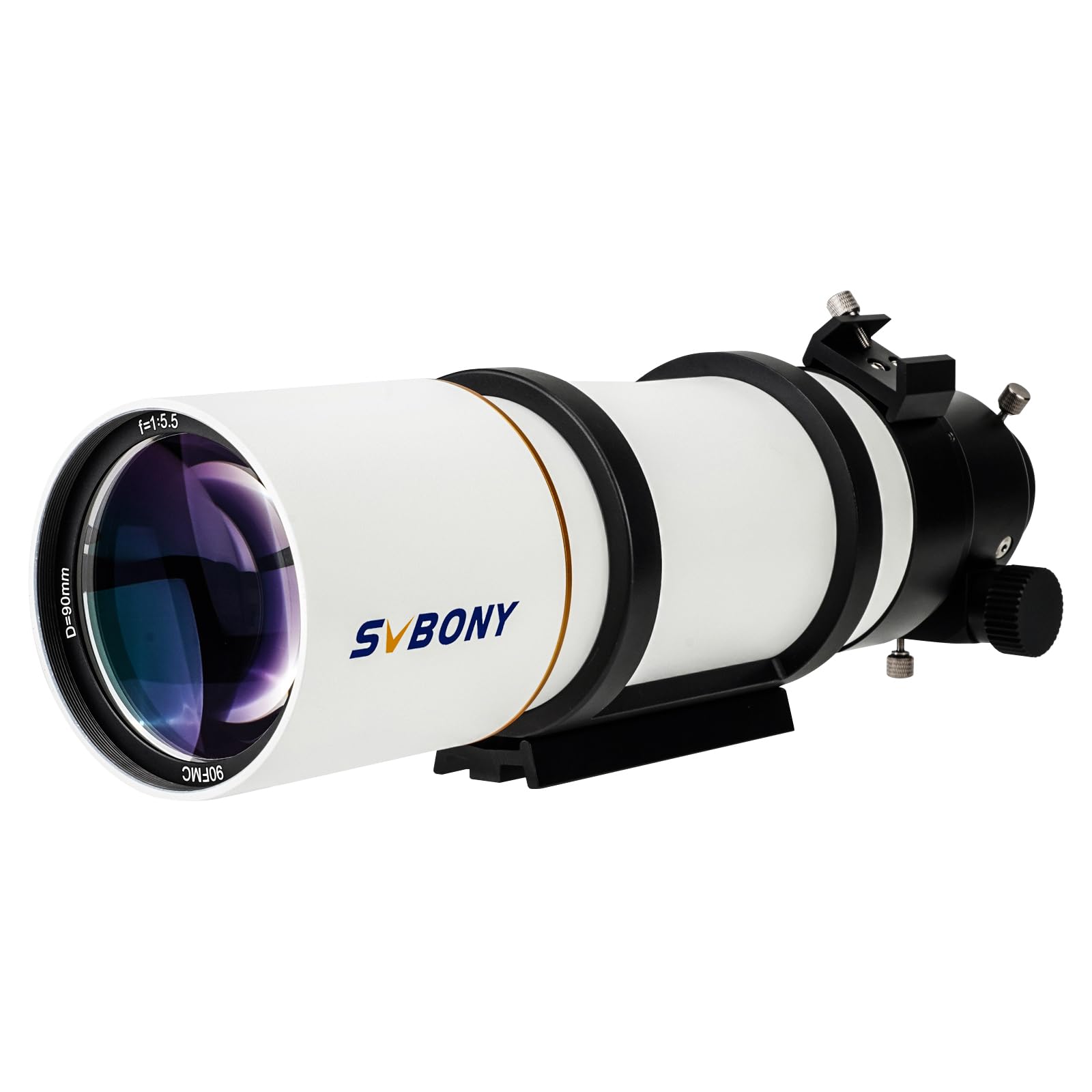
The SVBONY SV48P is a 90mm achromatic refractor with a fast f/5.5 focal ratio, designed to provide wide-field views of the Milky Way, large nebulae, and the moon at a very accessible price. The standout feature is its 2-inch dual-speed focuser with a 1:10 reduction ratio — a rarity at this budget — which allows precise fine-tuning of focus without shaking the image. The fully multi-coated green lenses maximize light transmission, and the metal focuser interface guarantees optical axis parallelism.
Customer reviews highlight that this scope splits close double stars well and shows crisp lunar detail. The 500mm focal length makes it easy to frame large targets like the Andromeda Galaxy and the Pleiades. The tube body can be rotated 360 degrees for photographic composition, which is useful for framing your shots on an equatorial mount. For a beginner on a tight budget, the SV48P is one of the few telescopes that combines a usable aperture with a serious focuser mechanism.
The main issue is chromatic aberration — as an achromatic doublet, it shows purple fringing on bright stars and planets. This can be mitigated with a Moon & Skyglow filter or software processing, but it cannot be eliminated. The optical tube is relatively heavy for its size, requiring a stable mount to avoid vibrations. For a beginner who wants to try wide-field astrophotography without committing to a premium ED scope, the SV48P offers the best value focuser and aperture combination in the budget tier.
Why it’s great
- Dual-speed 2-inch focuser with 1:10 micro-adjustment
- 90mm aperture at f/5.5 for bright, wide-field images
- Rotatable body for flexible photographic composition
Good to know
- Achromatic lens shows purple fringing on bright objects
- Requires a stable mount for best results
9. FASHIONARI Smart Telescope with 4K Camera
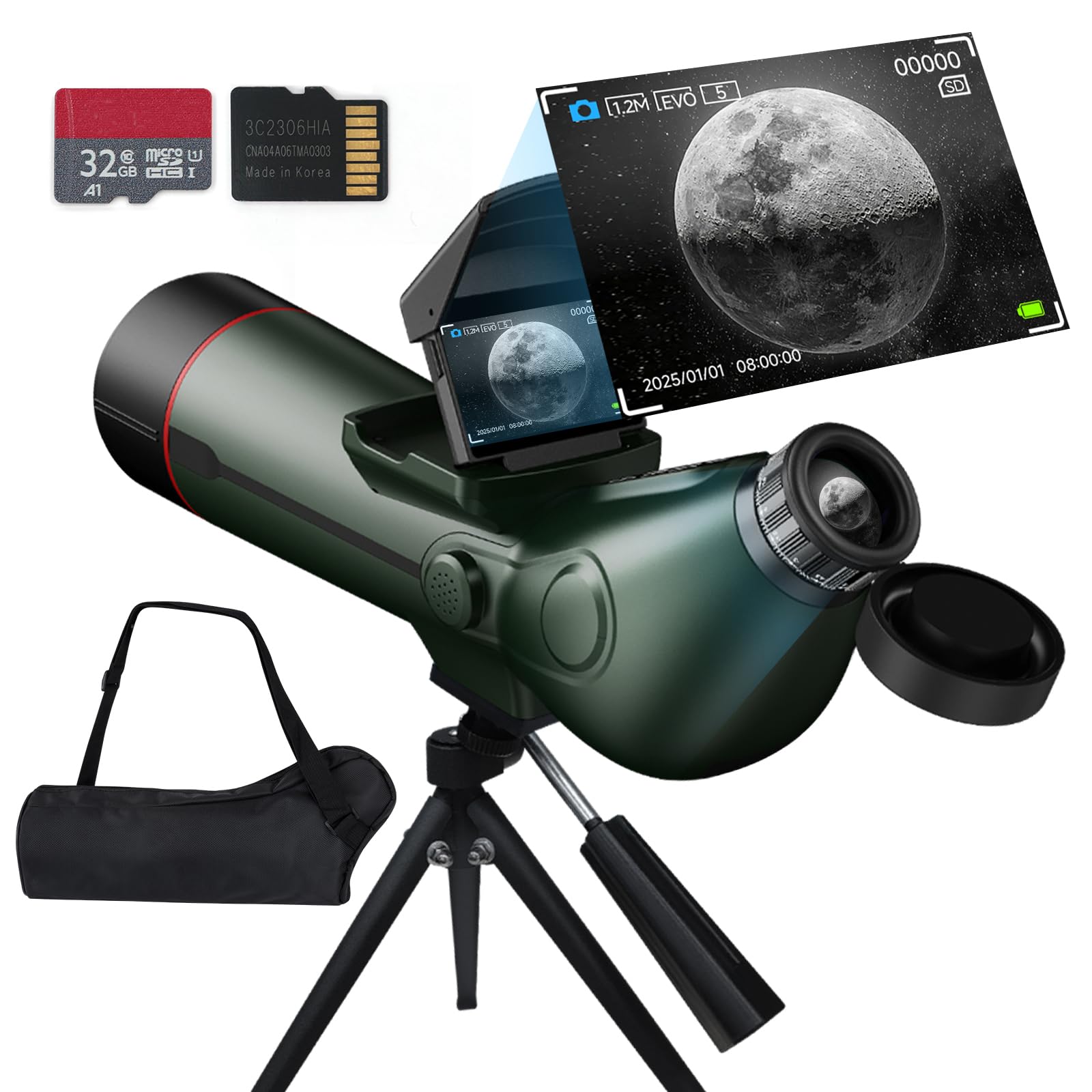
The FASHIONARI Smart Telescope is purpose-built for families and kids who want to see the moon, planets, and wildlife without dealing with eyepieces, finderscopes, or equatorial mounts. It features a built-in 4K camera and a dual-screen system — a foldable external display for group viewing and an eyepiece with diopter adjustment for individual observation. The auto-focus system and one-touch photo/video capture mean you can start taking pictures immediately with no manual alignment.
With an 80mm aperture and 300mm focal length (f/8.89), this scope provides bright views of the moon’s features and the larger planets. The built-in 4500mAh battery offers up to 6 hours of operation, and the auto-power-off function preserves charge when not in use. For a family camping trip or an evening of backyard stargazing with children, the immediate feedback of seeing the image on a screen is genuinely engaging.
The optical quality is limited — the achromatic lens shows significant chromatic aberration, and the maximum usable magnification is much lower than the advertised 350X. The mount is a basic photo tripod that provides manual panning, not tracking, so long-exposure astrophotography is not possible. The FASHIONARI is not a tool for serious image capture, but it is the most accessible way to introduce a young beginner to the night sky with instant visual results.
Why it’s great
- Built-in 4K camera and dual screens for instant group viewing
- Auto focus and one-touch image capture for zero learning curve
- Long 6-hour battery life for extended outdoor sessions
Good to know
- Optical quality is limited with significant chromatic aberration
- Basic tripod mount cannot track objects for long exposures
FAQ
Can I use any telescope for astrophotography or do I need a specific type?
What is the most important purchase for a beginner astrophotographer after the telescope?
How much chromatic aberration is acceptable in a beginner scope?
Do I need a computer or a laptop to use a smart telescope?
Final Thoughts: The Verdict
For most users, the best beginner astrophotography telescope winner is the Celestron NexStar 4SE because it combines a fully automated GoTo mount with the high-contrast, zero-chromatic-aberration optics of a Maksutov-Cassegrain, giving beginners a manageable learning curve for planetary and lunar imaging. If you want a portable deep-sky system that fits in a backpack, grab the DWARFLAB Dwarf 3 for its dual-lens versatility and cloud-based processing. And for a beginner who prioritizes minimal setup time and family-friendly screen-based viewing, nothing beats the DWARFLAB Dwarf Mini for sheer ease of use and portability.