
Stepping into filmmaking is about capturing a story, not just recording a moment. The right camera for a beginner is the one that removes technical barriers between you and your creative vision, offering manual controls when you are ready, but refusing to compromise on image quality or audio capture.
I’m Min — the co-founder and writer behind Gadgets Feed. I’ve spent countless hours analyzing sensor performance, gimbal stabilization, and codec support across dozens of models to find the gear that genuinely helps a new filmmaker grow without breaking the bank.
This guide dissects the options to help you find the absolute best beginner camera for filmmaking that matches your shooting style and budget.
How To Choose The Best Beginner Camera For Filmmaking
Not every camera that shoots video is built for filmmaking. The distinction lies in manual control, dynamic range, and the ability to grade your footage in post. Here is what matters most when you are starting out.
Sensor Size and Dynamic Range
A larger sensor (APS-C or Micro Four Thirds) gathers more light, giving you natural background blur and better performance in low-light scenes. Dynamic range, measured in stops, tells you how much detail the camera retains in shadows and highlights. Entry-level cameras offer between 11 and 13 stops; more means your footage tolerates heavy color grading in DaVinci Resolve or Premiere Pro without falling apart.
Stabilization: Gimbal, IBIS, or Both
Handheld shots are a staple of narrative filmmaking and vlogging alike. In-body image stabilization (IBIS) keeps your shots smooth on mirrorless bodies, while a built-in gimbal (like the DJI Pocket 3 or Xtra Muse) physically moves the sensor to cancel out shake. For action sequences or POV work, an action camera with electronic stabilization works well, but mechanical stabilization always produces a more cinematic glide.
Codecs and Color Profiles
The file format your camera records in determines how much flexibility you have in editing. Look for support at least one flat or log profile (S-Log, D-Log M, or Blackmagic RAW) which preserves highlight and shadow data. ProRes and RAW codecs deliver the highest quality but require faster memory cards and larger storage budgets. Beginners should prioritize cameras that shoot 4K without heavy cropping or overheating.
Quick Comparison
On smaller screens, swipe sideways to see the full table.
| Model | Category | Best For | Key Spec | Amazon |
|---|---|---|---|---|
| Blackmagic Pocket Cinema Camera 4K | Cinema Camera | Narrative & doc work | 4/3″ sensor, 13 stops DR, Blackmagic RAW | Amazon |
| DJI Osmo Pocket 3 Creator Combo | Gimbal Camera | Vlogging & smooth handheld | 1″ CMOS, 4K/120fps, 3‑axis mechanical gimbal | Amazon |
| Sony Alpha ZV-E10 | Mirrorless | Vlogging & interchangeable lenses | 24.2MP APS-C, 4K 6K oversampled | Amazon |
| Sony ILCE6100KB Alpha 6100 | Mirrorless | Hybrid photo/video | 24.2MP APS-C, 4K oversampled, 0.02s AF | Amazon |
| Insta360 X5 Starter Bundle | 360° Action Cam | Action & invisible selfie stick reframing | Dual 1/1.28″ sensors, 8K, FlowState stabilization | Amazon |
| Canon EOS Rebel T7 DSLR Kit | DSLR | Budget intro to interchangeable lenses | 24.1MP APS-C, 1080p Full HD, f/1.8 prime included | Amazon |
| Canon EOS R100 Kit | Mirrorless | Entry mirrorless for RF mount | 24.1MP APS-C, 4K up to 24fps, DIGIC 8 | Amazon |
| Sony ZV-1F | Point & Shoot | Ultra-wide selfie vlogging | 1″ sensor, 20mm ultra‑wide f/2 lens | Amazon |
| DJI Osmo Nano Standard Combo (128GB) | POV Camera | Compact POV vlogging & sports | 1/1.3″ sensor, 4K/60fps, 143° FOV, 128GB built-in | Amazon |
| Xtra Muse Vlogging Camera | Gimbal Camera | Budget pocket gimbal alternative | 1″ CMOS, 4K/120fps, 3‑axis built‑in gimbal | Amazon |
| GoPro Hero Black Compact | Action Camera | Underwater & action POV | 4K30, HyperSmooth stabilization, waterproof 33ft | Amazon |
In‑Depth Reviews
1. Blackmagic Design Pocket Cinema Camera 4K

The Blackmagic Pocket Cinema Camera 4K is the gold standard for entry-level filmmaking because it treats you like a filmmaker from day one. Its 4/3″ sensor delivers 13 stops of dynamic range, allowing you to recover shadow and highlight detail in DaVinci Resolve. The dual native ISO up to 25,600 keeps noise low even when shooting candlelit scenes, and the Micro Four Thirds mount opens up a vast ecosystem of affordable vintage and modern glass.
Recording options are unmatched for this tier. You can shoot Blackmagic RAW at 4K DCI (4096 x 2160) or Apple ProRes, giving you codec flexibility that mirrorless cameras at twice the price cannot match. The 5-inch touchscreen makes manual focus, framing, and exposure adjustments intuitive without an external monitor, and the mini XLR input with phantom power means your audio gear grows with you.
The catch is that this camera demands external stabilization — there is no IBIS or built-in gimbal. Battery life is roughly 30 minutes per LP-E6 pack, so a rig with a V-mount battery plate quickly becomes necessary. It also lacks continuous autofocus, so you must pull focus manually or invest in a follow focus system. If you are ready to learn real cinematography, this is the most powerful learning tool available at this price point.
Why it’s great
- ProRes and Blackmagic RAW codecs produce studio-grade color depth
- 13 stops of dynamic range hold up under heavy grading
- Mini XLR input with phantom power for professional microphones
Good to know
- No mechanical or electronic stabilization — must rig on a gimbal or tripod
- Battery lasts only about 30 minutes during recording
- No continuous autofocus; manual focus only
2. DJI Osmo Pocket 3 Creator Combo

The DJI Osmo Pocket 3 redefines what a pocket camera can do for filmmakers. Its 1-inch CMOS sensor shoots 4K at 120fps in 10-bit D-Log M color, giving you nearly one billion colors and a flat profile ready for grading. The 3-axis mechanical gimbal delivers gimbal-smooth footage without any post-processing, making it a complete handheld rig that fits in your jacket pocket.
The 2-inch rotating touchscreen flips between horizontal and vertical orientation, which is a game-changer for creators who publish to both YouTube and TikTok. ActiveTrack 6.0 locks onto your face or any moving subject, keeping you centered while you walk, dance, or pan dramatically. The Creator Combo bundles a DJI Mic 2 transmitter for crystal-clear wireless audio, plus a battery handle that extends runtime to roughly 166 minutes.
The trade-off is that the Pocket 3 is a fixed-lens system — you cannot swap glass. Its low-light performance, while solid for a 1-inch sensor, trails APS-C or MFT cameras with fast primes. The gimbal head is also more fragile than a solid-body camera, so a protective case is essential during travel. For vloggers, travel filmmakers, and anyone who needs cinematic stabilization out of the box, this is the most capable pocket rig you can buy.
Why it’s great
- Integrated 3-axis mechanical gimbal eliminates the need for a separate stabilizer
- 4K/120fps with 10-bit D-Log M for flexible color grading
- Rotating touchscreen makes switching between landscape and portrait effortless
Good to know
- Fixed lens — no option to change focal length or upgrade glass
- Gimbal is delicate; needs careful handling and a protective case
- Low-light performance is good but not on par with larger sensor cameras
3. Sony Alpha ZV-E10

The Sony ZV-E10 packs a 24.2MP APS-C sensor with 4K oversampled from 6K, delivering sharp, detailed footage with natural background separation. Its BIONZ X processor enables lightning-fast real-time Eye AF for both humans and animals, which is a godsend when you are filming talking-head segments or run-and-gun content alone. The front-facing flip screen makes framing yourself easy, and the Product Showcase mode instantly racks focus from your face to an object held to the lens.
For filmmakers, the ZV-E10 supports S-Log2 and S-Log3 gamma curves, giving you 14 stops of dynamic range to shape in post. Its full pixel readout without pixel binning means 4K is rendered with genuine detail, not the softness that plagued earlier cameras. The included 16-50mm power zoom lens is versatile for walkaround shooting, and the E-mount system now offers dozens of affordable third-party lenses.
The downsides are real. The ZV-E10 lacks in-body image stabilization — you will need to rely on a tripod, gimbal, or OSS lenses. The battery lasts about 25 minutes when recording 4K, so you must carry spares or use USB-C power delivery. And the rolling shutter effect is severe when panning quickly, which limits its use for action filmmaking. For a first interchangeable-lens vlogging rig, though, the combination of sensor performance and autofocus is tough to beat.
Why it’s great
- Sharp 4K from 6K oversampling with full pixel readout
- S-Log2 and S-Log3 profiles for professional color grading
- Real-time Eye AF locks onto faces and animals with exceptional speed
Good to know
- No IBIS — shaky footage unless using stabilized lenses or a gimbal
- Poor battery life; around 25 minutes of 4K recording
- Severe rolling shutter during fast pans
4. Sony ILCE6100KB Alpha 6100

The Sony Alpha 6100 is a step up from the ZV-E10 in burst photography and AF speed, reaching 11fps with AF/AE tracking. Its 24.2MP APS-C Exmor sensor uses a front-end LSI to process data faster, keeping the camera responsive even in demanding lighting conditions. The 425 phase-detection AF points cover 84% of the sensor area, and the Real-time Eye AF works for video, ensuring sharp eyes in your narrative shots.
Video quality mirrors the ZV-E10: 4K oversampled from 6K with full pixel readout, S-Log and HLG support, and a 180-degree tiltable touchscreen. The built-in flash gives you an emergency fill light for stills, and the hot shoe accepts Sony’s ECM-B1M shotgun mic for clean audio without cables. For a hybrid shooter, the Alpha 6100 handles stills and video with equal confidence.
Its limitations overlap with the ZV-E10 — no IBIS, short battery life, and cropped 4K at 30p (1.1x crop). The menu system also predates Sony’s newer touch interface, making it less intuitive for total beginners. If you want Sony’s best autofocus and a longer battery life than the ZV-E10 (roughly 40 minutes), it is a solid upgrade.
Why it’s great
- Blazing fast 0.02-second autofocus with 425 phase-detection points
- 4K oversampled from 6K with full pixel readout and no binning
- Real-time Eye AF for video locks onto subjects in motion
Good to know
- No IBIS — footage requires a gimbal for smooth handheld shots
- Battery life is better than ZV-E10 but still short for a day of filming
- Older menu system may feel clunky for beginners
5. Insta360 X5 Starter Bundle

The Insta360 X5 introduces 8K 360° video on dual 1/1.28-inch sensors, letting you shoot first and frame later using the app’s AI-assisted reframing. The invisible selfie stick effect creates cinematic third-person shots without any visible support—useful for B-roll, action sequences, and dynamic travel montages. FlowState stabilization combines with 360° Horizon Lock, keeping your footage perfectly level even during 360-degree spins.
The camera is waterproof to 49 feet without a housing, so you can film underwater scenes that a standard mirrorless setup would need a bulky dive case to match. Battery life reaches 208 minutes, and fast charging pushes it to 80% in just 20 minutes. The Wind Guard on the 4-mic array significantly reduces wind interference, making audio usable straight out of the camera for narration.
For narrative filmmaking, the 360° form factor introduces a unique workflow — reframing in post requires editing software or the Insta360 app, which adds time to your process. The image quality is great for action and 360° capture, but a traditional wide-angle camera still provides more resolution per frame for color-graded scenes. If your filmmaking relies on action, POV, or immersive 360° storytelling, this is a specialty tool that delivers results no other camera can.
Why it’s great
- 8K 360° video with invisible selfie stick effect for unique POV shots
- FlowState stabilization with 360° Horizon Lock — no gimbal needed
- Waterproof to 49ft for underwater action sequences
Good to know
- 360° reframing requires extra post-production editing time
- Standard 4K footage does not match the per-frame resolution of dedicated cinema cameras
- Heating can occur during extended 8K recording sessions
6. Canon EOS Rebel T7 DSLR Kit
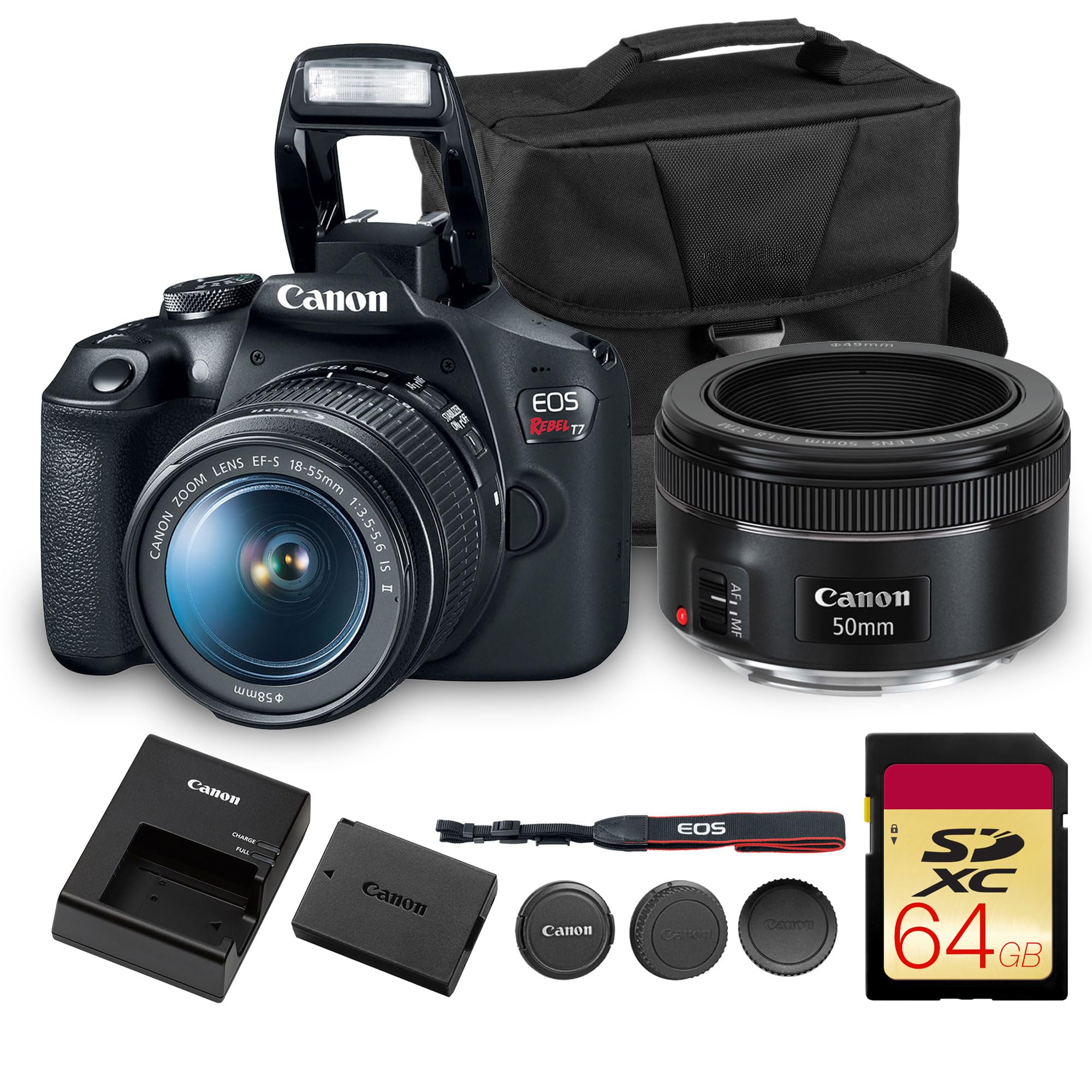
The Canon Rebel T7 is the classic first camera for reason — its 24.1MP APS-C sensor produces vibrant, sharp stills, and Full HD 1080p at 30fps is enough for non-4K projects. The bundle includes an EF 50mm f/1.8 STM lens, which is arguably the best value prime lens for learning depth of field, low-light shooting, and manual focus. The 9-point autofocus system is basic but works for static subjects.
As a filmmaking entry point, the T7 gives you manual exposure control, a hot shoe for external mics, and Canon’s intuitive menu system. The Wi-Fi and Bluetooth connectivity let you transfer clips to your phone for quick social uploads. For the price, you get a complete kit with a bag, 64GB card, two lenses, and a body that can grow with you for a year or two.
The major limitation is 1080p only — no 4K whatsoever. The contrast-detection autofocus in live view is slow and hunts during video recording, so manual focusing is the reliable approach. The plastic body feels lightweight but less durable than magnesium-alloy mirrorless bodies. If you cannot stretch your budget to a 4K-capable camera, the T7 teaches the fundamentals of exposure and composition effectively.
Why it’s great
- Includes EF 50mm f/1.8 prime lens for shallow depth of field and low-light
- Full kit with bag and 64GB card — everything you need out of the box
- Intuitive Canon menu system ideal for absolute beginners
Good to know
- 1080p only; no 4K video recording capability
- Contrast-detect autofocus hunts and slows dramatically in live view
- Plastic build feels less premium and less durable than mirrorless options
7. Canon EOS R100 Kit

The Canon EOS R100 is the smallest and lightest body in the EOS R series, making it an attractive entry point for those who want to invest in Canon’s RF ecosystem. Its 24.1MP APS-C sensor and DIGIC 8 processor deliver 4K video at 24fps, plus Full HD at up to 120fps for slow-motion effects. Dual Pixel CMOS AF covers 143 zones with face and eye detect for both humans and animals.
The RF-S 18-45mm kit lens provides optical image stabilization at up to 4 stops, which helps reduce handheld shake without a gimbal. The compact size makes it easy to bring to sets, travel shoots, and everyday practice. The Bluetooth and Wi-Fi let you transfer files to your phone for quick social media stories.
The 4K video is limited to 24fps — not ideal for action or smooth motion sequences. The articulating screen is fixed tilt-only (not fully articulating), making self-framing less flexible. The battery is small (LP-E17), so you will want at least one spare. For a first mirrorless camera that lets you grow into the RF system, the R100 is a capable but limited choice.
Why it’s great
- Dual Pixel CMOS AF with face and eye detection ensures sharp focus
- RF-S 18-45mm kit lens includes 4-stop optical stabilization
- Lightest and smallest body in Canon’s RF mirrorless lineup
Good to know
- 4K video capped at 24fps; limited for action or smooth pans
- Screen is tilt-only, not fully articulating for self-framing
- LP-E17 battery requires spares for a full day of filming
8. Sony ZV-1F

The Sony ZV-1F was designed specifically for vloggers and beginner content creators. Its 20mm ultra-wide lens captures a wide field of view from arm’s length, which means you do not need a selfie stick to keep your face in the frame. The 1-inch sensor with an f/2 lens delivers decent depth of field and better low-light performance than smartphone sensors.
Side-articulating touchscreen makes recording yourself easy, and the directional 3-capsule mic with the included windscreen captures clear audio even outdoors. The Product Showcase mode automatically racks focus to objects held in front of the lens, making it a go-to camera for unboxings, reviews, and cooking tutorials.
The trade-offs are fixed lens (20mm only) and digital stabilization only — walking shots can look wobbly compared to optically stabilized or gimbal-based alternatives. Battery life is roughly 45 minutes of continuous recording, and the lack of a viewfinder makes outdoor framing difficult in bright sunlight. It is a highly specific tool for face-forward vlogging, not versatile filmmaking.
Why it’s great
- 20mm ultra-wide lens fits group shots and selfies at arm’s length
- Directional 3-capsule mic with windscreen for clear on-camera audio
- Product Showcase mode racks focus to objects instantly
Good to know
- Fixed lens — no optical zoom or lens interchangeability
- Electronic stabilization only; walking shots are shaky
- Battery life is short at roughly 45 minutes of recording
9. DJI Osmo Nano Standard Combo (128GB)
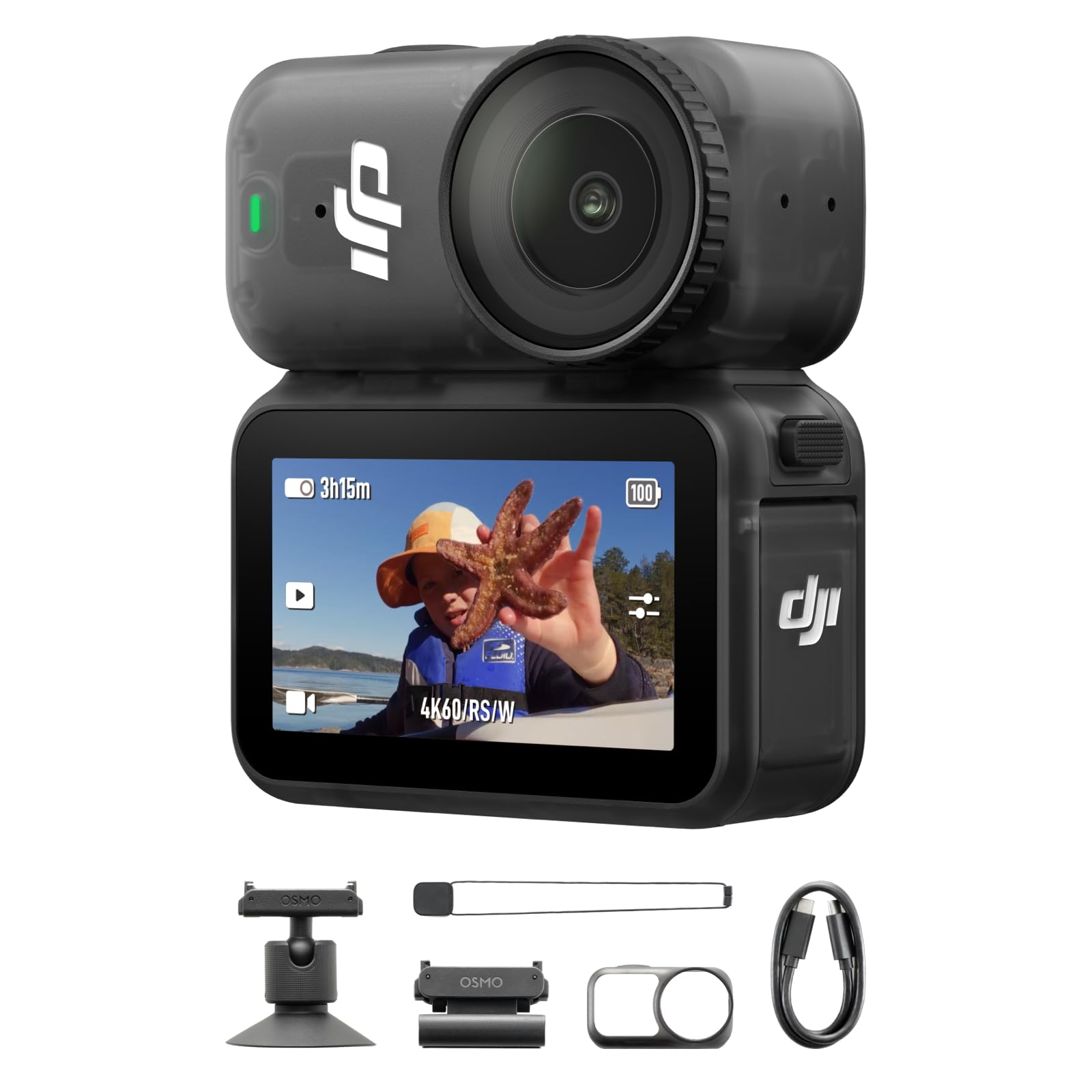
The DJI Osmo Nano is a magnetic POV camera designed for creators who need ultra-portable 4K capture with a 143° field of view. Its 1/1.3-inch sensor shoots 4K at 60fps in 10-bit D-Log M color, giving you the same log-encoded workflow as larger DJI cameras. The magnetic mounting system attaches to any ferrous surface, so you can place it on a car hood, bike frame, or fridge without a tripod.
The 200-minute battery life with the Vision Dock is twice what many action cameras offer, and 128GB of built-in storage means you never need to buy a microSD card. The camera connects directly to two DJI microphones via OsmoAudio, delivering high-quality synchronized audio without wires. It is also waterproof to 10m, making it viable for snorkeling and poolside filming.
The lack of a built-in screen makes framing difficult for planned narrative shots; the DJI Mimo app is your viewfinder, which adds a step. Action cameras like this excel at unscripted POV captures but lack the manual controls and lens flexibility of dedicated cinema cameras. For a true pocket-sized action cam that shoots log, it is uniquely positioned.
Why it’s great
- 128GB built-in storage and 200-minute battery life with the dock
- Magnetic mounting system enables creative POV placements
- 10-bit D-Log M color for professional post-grading
Good to know
- No built-in screen — must use smartphone app for framing
- Fixed ultra-wide FOV lacks zoom or lens interchangeability
- Heating during high-resolution recording can trigger auto-stop
10. Xtra Muse Vlogging Camera

The Xtra Muse offers a compelling alternative to the DJI Pocket 3 at a budget-friendly price. It couples a 1-inch CMOS sensor with a built-in 3-axis gimbal, so you get smooth stabilized footage without an external gimbal. The 2-inch touchscreen rotates for horizontal and vertical shooting, and Face/Object tracking ensures you remain in focus and centered while moving.
The camera records 4K at 120fps in 10-bit X-Log color, which provides over one billion colors and a flat log profile for grading. The bundle includes a handle with a 1/4-inch tripod thread, carrying bag, and wrist strap — everything is ready to shoot out of the box. Autofocus is fast and reliable, locking onto subjects quickly even in modest lighting.
The image quality is very close to the Pocket 3 for a lower entry point, but the stabilization algorithm is not quite as advanced in fast shake scenarios. The battery lasts roughly 161 minutes, which is decent, but the camera can get warm during extended 4K/120fps recording. Some users report that DJI Pocket 3 accessories fit, which is a bonus for expanding your rig.
Why it’s great
- Built-in 3-axis gimbal provides excellent stabilization without extra gear
- 1-inch CMOS with 4K/120fps and 10-bit X-Log for color grading
- Compact and portable with rotating touchscreen for vertical content
Good to know
- Gimbal stabilization is slightly less refined than DJI Pocket 3
- Can heat up during prolonged 4K/120fps recording sessions
- Accessory ecosystem is less mature than DJI’s
11. GoPro Hero Black Compact

The GoPro Hero is the most straightforward entry point for action filmmaking. It shoots 4K UHD at 30fps and 2.7K60 for 2x slow-motion playback, and HyperSmooth stabilization smooths out the bumps of mountain biking, skiing, or running. The camera is waterproof to 33 feet without any housing, so you can film underwater scenes with no additional gear.
The compact 3-ounce body clips to helmets, handlebars, or the included 50-in-1 accessory bundle. Voice control in 11 languages means you can start and stop recording hands-free, which is critical when you are mid-action. The bundle also includes a 64GB microSD card, so you can start shooting immediately.
The Hero lacks a removable battery (the battery is internal), so you cannot swap packs on long shoots — you must use a power bank via USB-C. The app connectivity on older iPhones has been reported as finicky, and screen size is tiny for framing. For a pure action POV camera that is rugged and simple, the Hero delivers consistent results.
Why it’s great
- HyperSmooth electronic stabilization produces steady action footage
- Waterproof to 33 feet without additional housing
- Compact at 3 ounces with voice control for hands-free operation
Good to know
- Non-removable battery limits filming time to about 1 hour at highest quality
- Small screen makes composition and playback difficult
- App compatibility issues reported with older iPhones
FAQ
Do I need a cinema camera or can I start with a mirrorless?
Which accessory is most important for a beginner filmmaker?
Final Thoughts: The Verdict
For most users, the best beginner camera for filmmaking winner is the Blackmagic Pocket Cinema Camera 4K because it gives you the most cinematic image quality, 13 stops of dynamic range, and pro-level codecs for the price. If you want built-in stabilization and pocketable portability for run-and-gun content, grab the DJI Osmo Pocket 3 Creator Combo. And for budget-conscious creators who need interchangeable lenses and excellent autofocus, nothing beats the Sony Alpha ZV-E10.