
Our readers keep the lights on and my morning glass full of iced black tea. As an Amazon Associate, I earn from qualifying purchases.
Specs are compiled from manufacturer listings and verified buyer reviews and can change over time — please confirm the key details on the product page before buying.
For most teenagers, the right starter camera is one that gets carried everywhere and survives being carried everywhere. A camera that lives in a drawer teaches nobody anything, no matter how good its sensor is. So the real question is not which camera has the biggest number on the box — it is which one your teenager will actually grab on the way out the door, and which one makes photos that look noticeably better than the phone already in their pocket.
I’m Min — the founder and writer behind Gadgets Feed. This guide is built by comparing the manufacturers’ published specifications and the patterns across verified customer reviews, so you get each pick’s real strengths and trade-offs instead of marketing spin.
Some teen-friendly cameras win on zoom, some win on size, and some win because they come with everything needed to start shooting the same day. The trick is matching the camera to how your teenager actually shoots. That is exactly what this breakdown of the beginner camera for teenager shortlist is built to settle quickly.
Our Picks at a Glance

How To Choose The Best Beginner Camera For Teenager
Teen photographers are hard on gear in a specific way: cameras get shoved in backpacks, taken to concerts, dropped on sidewalks, and forgotten in hot cars. Durability and portability matter more here than in almost any other camera category. Here is what actually separates a camera your teenager will keep using from one that ends up in a junk drawer by month three.
Optical Zoom Versus Digital Zoom
Optical zoom is real glass magnification — the lens itself moves to bring distant subjects closer without losing image detail. Digital zoom is just software cropping: the camera shoots the scene, then enlarges the center and throws away the rest. A compact with 4X or 5X optical zoom will produce sharper concert and sports shots than a camera advertising 16X or 20X digital zoom, even though the digital number sounds bigger. Encourage your teenager to ignore digital-zoom specs and hunt for optical-zoom numbers.
The Sensor Size Trap
More megapixels does not mean better photos. A 16MP camera with a larger sensor will often beat a 64MP camera with a tiny sensor in indoor and evening light, because each pixel collects more light. For teenagers shooting mostly indoors, at parties, or after sunset, sensor size matters more than resolution. It is the single spec most beginners overlook.
Battery Strategy For A Teenager
Rechargeable lithium-ion batteries are the easier long-term choice — but they need charging routines. Cameras running on standard AA batteries (like the KODAK FZ45) are convenient because your teenager can grab fresh batteries anywhere. Either way, look for a kit that ships with a spare battery or two, and make sure a memory card is included. Nothing kills a new photographer’s momentum faster than a camera with no card on day one.
Quick Comparison
Every row below uses the same three comparison columns — resolution, zoom type, and what the camera genuinely does best — so you can scan the trade-offs at a glance. Use this table after you’ve read the reviews for the picks that sound interesting.
| Model | Best For | Resolution | Zoom | Included Storage | Amazon |
|---|---|---|---|---|---|
| Canon EOS Rebel T7 DSLR Kit★ Best Overall | Learning real photography | 24.1MP APS-C CMOS | EF-S 18-55mm lens (interchangeable) | Sold separately | Amazon |
| FACLAM 4K WiFi 64MP 16X ZoomBest Value | Selfies and vlogging | 64MP | 16X digital | 32GB SD card included | Amazon |
| AUREAPIX 8K 96MP Vlogging CameraTop Performer | YouTube and content creation | 96MP | 20X digital | 32GB SD card included | Amazon |
| KODAK PIXPRO FZ45 | Budget-friendly everyday shooting | 16MP CMOS | 4X optical (27-108mm) | Sold separately | Amazon |
| Gavonde 8K Dual-Lens Touchscreen | Young content creators | 64MP | 16X digital, dual lens | 32GB TF card included | Amazon |
| Saneen 8K 64MP Dual Lens | First vlogging camera | 64MP | 16X digital, dual lens | 32GB TF card included | Amazon |
| Yatao 6K WiFi Flip Screen Camera | All-in-one vlogging bundle | 64MP effective | 16X zoom, dual lens | 64GB card included | Amazon |
| KODAK PIXPRO FZ55 Bundle | Travel and grab-and-go | 16MP | 5X optical (28mm wide angle) | 32GB SD card + case + reader | Amazon |
| Panasonic LUMIX ZS99 | Long-zoom travel and concerts | — | 30X optical (24-720mm) | Sold separately | Amazon |
In‑Depth Reviews
1. Canon EOS Rebel T7 DSLR Camera EF-S 18-55mm f/3.5-5.6 is II Lens Kit
Our pick — over 4.5★ from 5,000+ verified ratings; the strongest balance of quality and price.
The real camera that teaches real photography, with a proper sensor and a lens that can be swapped out later.
If your teenager has outgrown phone photos and wants to actually learn the craft, this is the camera the whole category is measured against — 4.6 stars across 5,000+ ratings, and a crowd that skews toward students and first-time DSLR owners. The defining number is a 24.1 Megapixel CMOS (APS-C) sensor. In plain terms, APS-C means the light-capturing chip inside is much larger than the tiny sensor in a point-and-shoot, so indoor shots and evening shots come out cleaner and with less noise. The 24.1MP APS-C sensor holds detail when you crop or print large.
The lens is what sets this apart from every fixed-lens camera on this list. The EF-S 18-55mm f/3.5-5.6 IS II has an image stabilizer (which counteracts hand shake) and it comes off — you can add a telephoto later for wildlife or a wider lens for landscapes. A 9-point autofocus system handles the focusing, and there is a real optical viewfinder (a glass eyepiece you look through, not a screen) with roughly 95% coverage. Wi-Fi and NFC are on board, so photos hop to a phone over the air. Video runs at 1080p.
Here is the honest caveat a buyer deserves. This is a DSLR, so it is bigger and heavier than the pocket compacts in this roundup, and your teenager will need to actually want to learn exposure, modes, and lens swaps to get the most from it. There is no memory card in the box, so budget for an SD card separately. And the built-in Feature Guide does a lot of the teaching, but the first week still involves some reading. That is the trade-off for getting the most photographic growth per dollar in this category.
Beginner Canon DSLR
- 24.1MP APS-C sensor delivers noticeably better daylight and low-light images than a phone or compact
- Interchangeable EF-S lens mount means your teenager can grow into new lenses later
- Optical viewfinder and 9-point autofocus make framing feel intentional, not guesswork
- Wi-Fi and NFC let photos reach a phone without pulling the card
No 4K video
- No memory card included — add an SD card to the order
- Heavier and bigger than any compact here; not a pocket camera
- Built-in kit lens is not long enough for distant subjects without a separate telephoto
- Requires a teenager willing to learn settings — not a pure point-and-shoot
First camera pick: the teenager who has asked about photography and wants to actually learn it, not just snap photos.
Phone beats it: they want something they can slide into a jacket pocket and forget about — the compacts below win that fight.
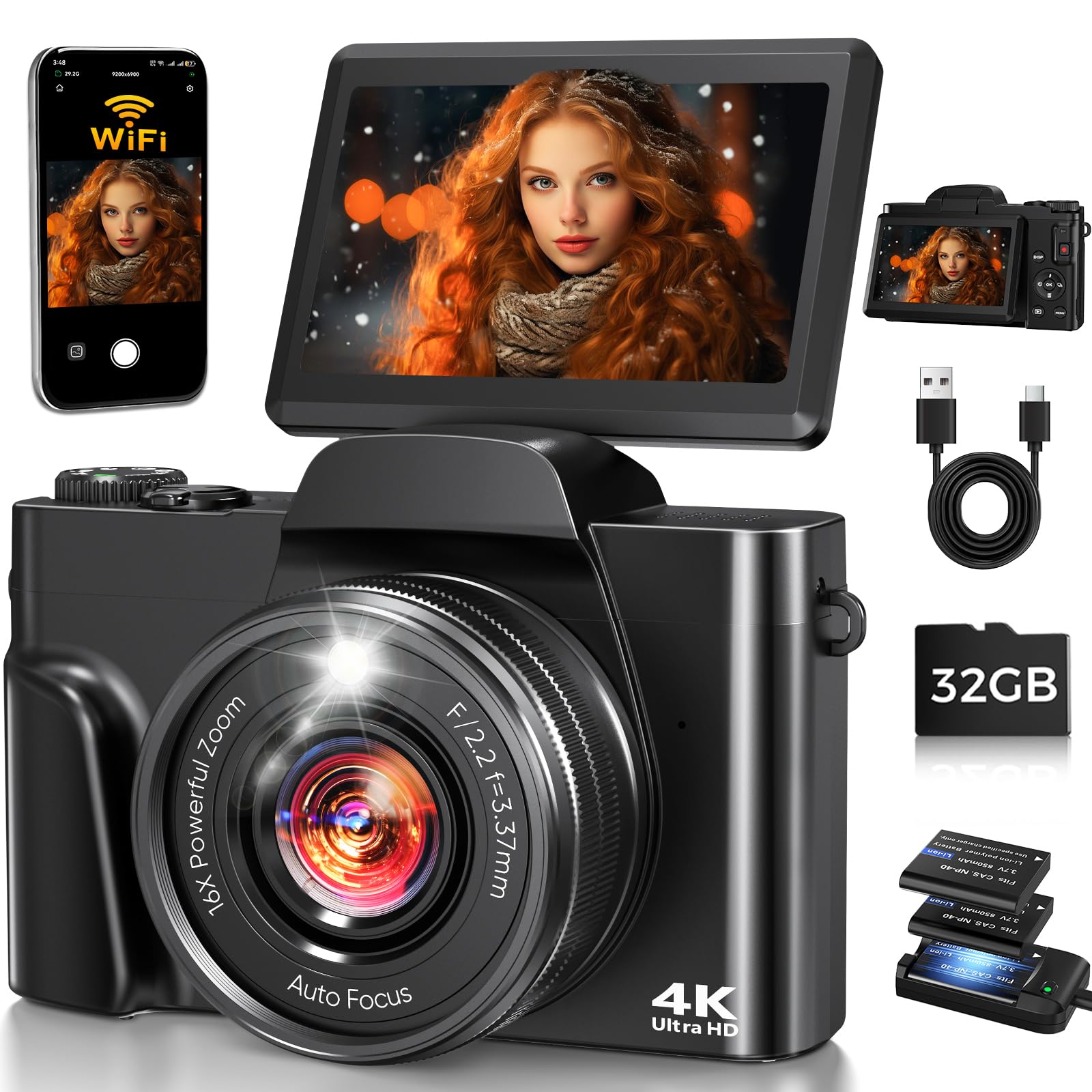
2. FACLAM 4K Digital Camera WiFi 180° Flip Screen Autofocus 64MP 16X Zoom, Black
Flip the screen, film yourself, and hand the memory card to a friend — the selfie-first starter kit.
This is the camera to buy when the teenager in question already makes TikTok or YouTube content on a phone and wants a step up. A 180° flip screen (a display that rotates all the way around to face forward) makes framing a selfie or a solo video genuinely work, and the top dial offers one-button mode switching between Photo, Video, Slow Motion, and Filters — no menus to wade through. The rear screen and body are compact enough to slip into a purse or backpack, which is exactly what keeps teens actually shooting.
Autofocus here uses Phase Detection, which is the quicker focusing method that locks onto moving subjects rather than hunting for focus. The resolution is 64MP — 50% more pixels than the Panasonic LUMIX ZS99’s sibling compact cameras in this bracket, though the real-world benefit shows up in cropping rather than in every shot. Video runs at 4K UHD, and the 16X digital zoom pulls distant subjects closer (accepting some softening at max zoom). Buyers report the whole bundle arrives ready to shoot from the start: “Ships with two batteries and a 32GB card, so it shoots the day it arrives.” That immediacy matters for a gift.
The catch is worth knowing upfront. The 16X zoom is digital, not optical, so images soften at full reach. And while the flip screen is a huge quality-of-life win for solo filming, it means one more hinge that eventually wears — treat it gently. For the price tier, though, this is among the most complete starter kits in this roundup: camera, two batteries, charger, 32GB card, bag, strap, and cleaning cloth all in one box.
Flip screen selfies: the 180° flip screen and one-button mode dial — these are the two features that turn a phone-content kid into someone who wants to use a real camera.
Small sensor limits: every zoom on this camera is digital, so the 16X is a framing tool, not a way to shoot wildlife across a field. Plan accordingly.
Vlog on budget: your teenager makes selfie videos or vlogs and wants a camera that treats them as the star of the frame.
Low light weak: they want a photographic tool for distant or sports subjects, where optical zoom matters more than a flip screen.
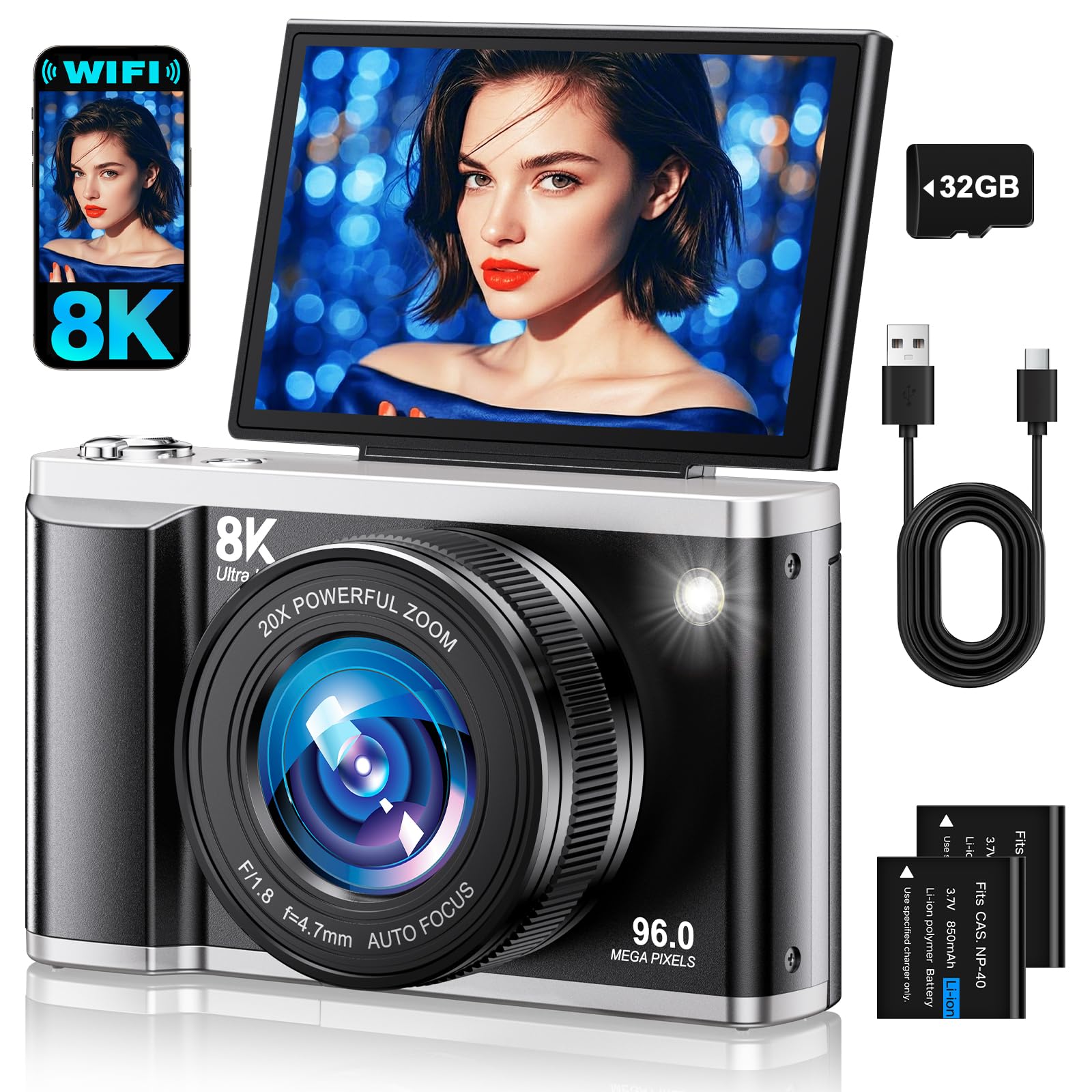
3. AUREAPIX 8K Digital Camera 96MP Autofocus Vlogging Camera (3.5″ Flip Screen, 20X Zoom)
The spec sheet monster of the starter class — 96MP stills, 8K video, and a webcam mode a teenager will actually use.
If your teenager has been comparing cameras by their numbers, this is the one that wins the comparison and then has to live up to it. The headline figure is 96MP — a 50% higher pixel count than the FACLAM above at 64MP. In practice, that means more room to crop a photo after the fact without losing detail, though it does not automatically mean better low-light results. Autofocus here is Face Detection (the camera identifies and locks on faces), and the fixed lens carries a fast f/1.8 aperture — the wider the aperture number, the more light reaches the sensor, and f/1.8 is bright enough for indoor and evening shooting without a flash.
Video rises to 8K Ultra HD, which is above what most phone screens and social apps currently display, but genuinely useful for future-proofing and for re-cropping vertical video later. A 3.5″ 180° flip screen handles selfies, and the camera doubles as a webcam when plugged into a computer — handy for online school, streaming, or Zoom calls. The 20X digital zoom offers 25% more magnification than the FACLAM’s 16X zoom, useful for framing but with the usual softening at maximum reach. The kit ships with two high-capacity batteries, a 32GB card, wrist strap, camera bag, and cleaning cloth.
The honest limit: 96MP and 8K are impressive on the label, but this is still a fixed-lens compact with a digital zoom. It is a creator camera for self-framing, not a replacement for the Canon’s growing lens system. Buyers who lean content-first will love it; buyers who want to learn manual photography will outgrow it in a year. The HDR mode (High Dynamic Range, which blends multiple exposures to hold detail in both bright and dark areas) helps with tricky light, which is a real quality boost for outdoor shots.
Print large photos: the teen creator who wants maximum resolution and video specs in one compact, ready-to-shoot package.
Video shaky: the goal is learning photography, where interchangeable lenses beat stacked spec numbers every time.
4. KODAK PIXPRO FZ45 16MP Compact Digital Camera, 4X Optical Zoom, AA, Black

An old-fashioned, unfussy camera with real optical zoom — the one you hand a teenager without a lecture.
There is something quietly smart about this camera: it runs on two standard AA alkaline batteries. That means no charger to lose, no cable to forget on a trip — your teenager walks into any store and comes out with fresh power. The 16MP CMOS sensor is modest by modern spec-sheet standards, but a real CMOS sensor in this body is doing more for image quality than any digital-zoom gimmick. And crucially, this camera has 4X optical zoom — actual glass movement — with a 27mm wide-angle lens that is genuinely useful for group shots and landscapes.
Full HD video at 1080p covers travel clips and family moments. The 2.7″ LCD screen is small but clear and gets the job done for framing and reviewing. Cards are Class 10 SD, SDHC, or SDXC up to 512GB, so storage is cheap and easy. Buyers describe it as “the best camera I’ve ever owned” for cute Instagram photos — that is the energy this camera is aiming for, and it delivers.
Now the honest part that buyers need to hear. There are two battery-related quirks: the included AA alkalines are not rechargeable, and users who switch to rechargeable AAs without checking compatibility can hit low-battery warnings sooner than expected. The USB cable is for file transfer only — it does not charge the camera. And like any budget compact, it works best with lithium batteries if rechargeable power is the goal. Size the caveat properly: this is a small, cheap, cheerful camera that does its job well, and buying a fresh pack of AA lithiums solves most of what people complain about.
Pocket zoom Kodak: real optical zoom, a wide 27mm lens, and AA-battery convenience at a level no other camera in this roundup touches.
Tiny image sensor: buy AA lithiums rather than rechargeable AAs — the camera’s battery indicator reads rechargeables optimistically and warns early.
Travel light: you want a genuinely easy first camera and the freedom of battery-swap power while traveling.
Manual control missing: your teenager expects modern conveniences like Wi-Fi transfer or a touchscreen — you will want one of the models above instead.
5. Gavonde 8K Digital Camera, 64MP WiFi with 4″ Touchscreen, Dual Lens, 3000mAh Battery

A dual-lens video camera with a big touchscreen, a 3000mAh battery, and a hot shoe for later upgrades.
Two features stand out on this camera, and they solve different problems. The first is a 4-inch touchscreen — large by compact-camera standards, which makes menu navigation feel phone-like rather than fussy. The second is a 3000mAh lithium-ion battery, one of the largest in this roundup, which means fewer charging interruptions during a day out. Combine those with a dual-lens setup (front and rear) that switches with a single button, and you have a camera built for solo content: your teenager can flip to the front lens for a selfie or monologue, then flip to the rear for the surroundings, without moving the camera.
Video is 8K, stills are 64MP, and the camera transmits files over built-in Wi-Fi to a phone for editing. When connected to a computer via Type-C, it doubles as a webcam. There is a 3.5mm microphone jack for adding an external mic — a real advantage for anyone planning to talk on camera, since onboard mics sound like onboard mics. There is also a hot shoe (a mounting bracket on top) for lights or accessories, plus a standard 1/4-inch tripod mount. The package includes a 32GB card, lens hood, neck strap, and battery.
Honest note: this camera is aimed at young content creators and kids specifically — the review pages are dominated by family buyers describing it as an ideal gift. Its photo quality is best in bright light; the 16X zoom is digital and softens at full reach. It is not the camera for learning manual photography, and there is no optical viewfinder. If your teenager’s goal is Instagram and TikTok videos, this camera is a strong fit. If they want to learn photography proper, the Canon above is the better path.
Casual shooting: young video creators who want a big touchscreen, a long-lasting battery, and a mic jack in one camera.
Pro needs more: this is an entry-level creative tool — no viewfinder, digital zoom only, and best performance in good light.
6. Saneen 8K 64MP Dual Lens Vlogging Camera with 32GB Card (Black)
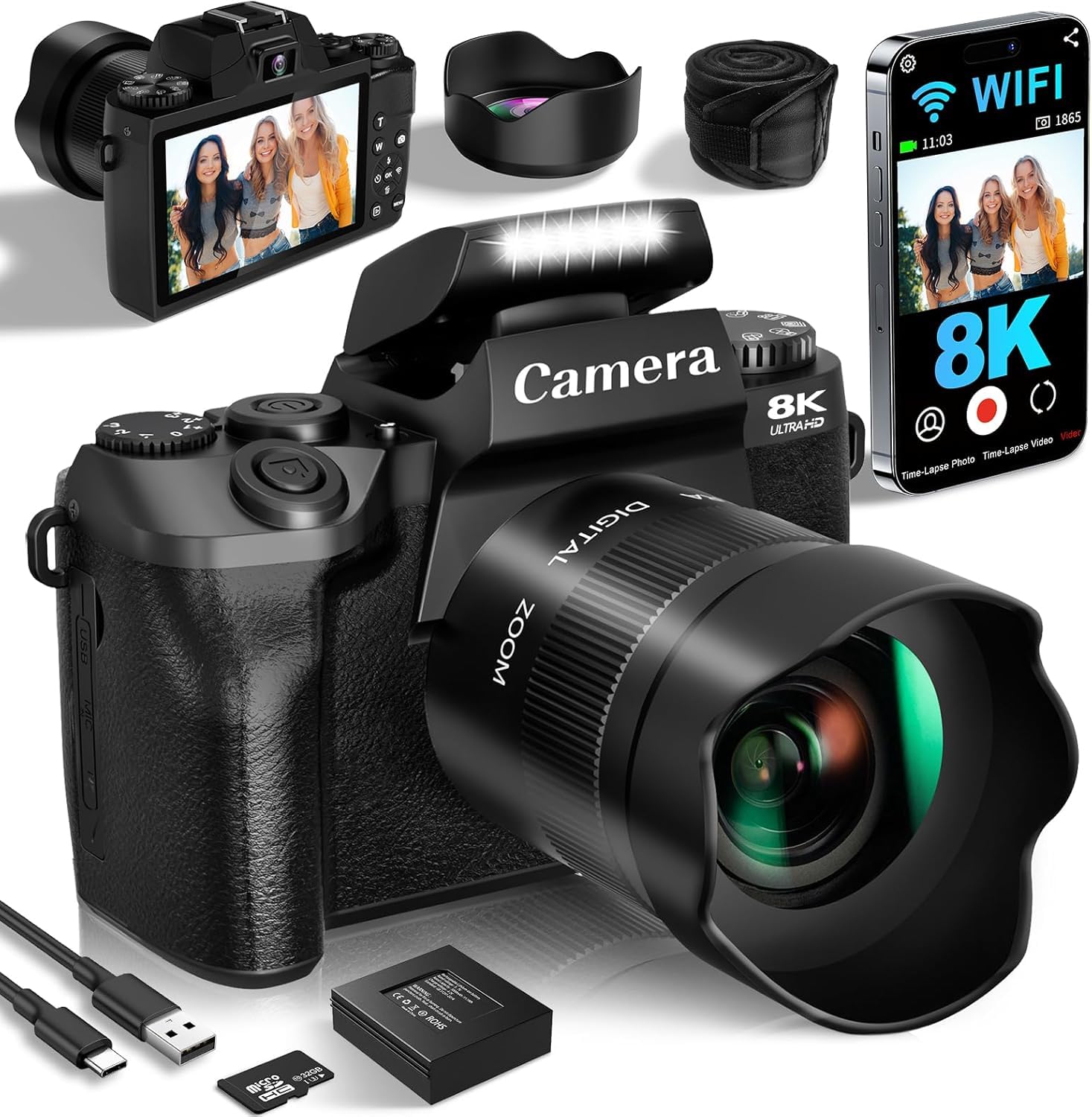
A dual-lens touchscreen camera that comes in a gift-ready box with a stacked spec sheet for a modest outlay.
What sets this Saneen apart is the mode dial — eight shooting modes including Smart Auto, Portrait, Scenery, Slow Motion, and Time-Lapse, all selectable with a physical twist rather than a menu dive. For a teenager whose instinct is to just point and shoot, that dial is worth more than any spec sheet. The 4.0-inch IPS touchscreen is the biggest display in this roundup, so reviewing shots feels natural. Dual front and rear lenses switch on the fly for selfies versus scenes, and video runs at 8K with 64MP stills.
The 3000mAh lithium-ion battery is another standout — matching the Gavonde’s capacity, and enough for a full day of shooting without hunting for a charger. Wi-Fi transfer via the HDV CAM app (iOS and Android) sends files to a phone. The built-in flash with an LED fill light handles low light, and the hot shoe lets you attach an external flash or mic later. The kit ships with a 32GB TF card, lens hood, Type-C cable, and battery — all in a box designed to be gift-wrapped. Especially telling: the handful of buyer reviews available consistently describe the camera as looking far more expensive than it costs. That is a gift-friendly quality.
The caveat to flag: this model has a modest review history compared to the flagship picks in this roundup, so the long-term reliability picture is less proven. It is also a fixed-lens, digital-zoom camera — Its 16X digital zoom softens images at maximum reach, per the manufacturer’s own notes. Treat it as a first serious camera for a teenager or a thoughtful gift buy, not as a long-term photographic workhorse.
Starter kit: you want a gift-ready kit that feels premium in the box and lets your teenager create content immediately.
Audio mediocre: you want a camera with years of owner history behind its reliability — the flagship picks above have more track record.
7. Yatao 6K WiFi Flip Screen Digital Camera with Mic and Fill Light

The only camera here that ships with a microphone and a fill light — an entire starter vlogging studio in one box.
If you want a bundle that leaves nothing left to buy, this is the one. The Yatao arrives with a 64GB card, two batteries with charging stand, an external microphone, a bi-color fill light, and a lens hood. Those last two accessories are genuinely rare in the starter-camera category, and they solve the two most common complaints from beginner creators: dim lighting and quiet, thin audio. The mic and the fill light transform what a teenager can produce right from the start, and their absence is what forces most buyers of other models to shop for accessories a week after delivery.
Video is 6K Ultra HD with the option to shoot at 2K or 4K for smaller files. Stills run at 64MP effective resolution. The dual-lens system includes a wide-angle lens for landscapes and a macro lens for close-ups, plus 16X zoom. The flip screen handles selfies and framing. Wi-Fi transfer and USB-C webcam mode cover sharing and streaming. For content-first teenagers, the accessory package alone justifies the price tier — no other pick here solves audio and lighting in one purchase.
The honest downsides to flag: the largest concentration of buyer criticism targets the video output specifically — some report the 6K footage does not look dramatically sharper than 1080p and that the frame rate skips on some clips. The body is plastic rather than metal, which is fine for the price but worth knowing. Battery life on continuous 4K video is on the shorter side, so a second spare is smart. If your teenager is set on smooth cinema-grade video, this camera will disappoint them. For selfie vlogs, travel clips, and YouTube channel starters, the total package is a genuinely strong value.
Talking head videos: you want to hand your teenager a complete YouTube kit — camera, mic, light, card, and spare batteries — in one purchase.
Stills soft: your teenager expects cinema-quality 6K footage; some owners mention frame drops that pull the video quality closer to 1080p.
8. KODAK PIXPRO FZ55 16MP Digital Camera Bundle (5X Optical Zoom, 28mm, 32GB Card and Case)
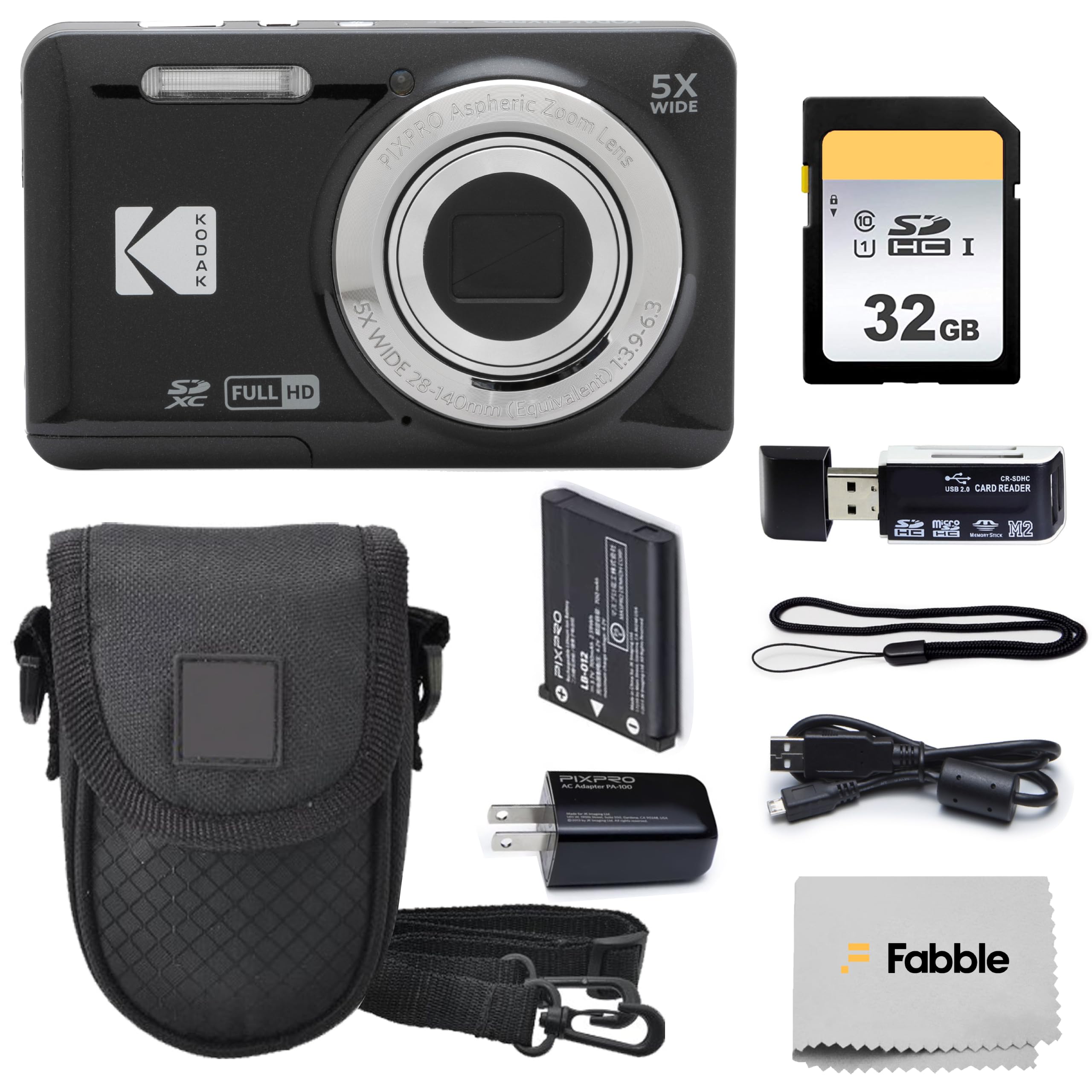
A slim, ready-to-go travel point-and-shoot with real optical zoom, a bundled case, and next-day-usable parts.
Where this camera shines is portability. The FZ55 fits in a jacket pocket, comes with a protective case and a card reader, and runs off a rechargeable lithium-ion battery that only needs charging about once a week with light use — the review pages make a note of exactly that kind of ease. The 5X optical zoom (28mm wide-angle) gives genuine glass magnification for framing distant subjects, and the 16MP sensor captures everyday, travel, and school-event photos cleanly. Full HD video runs at 1080p.
Autofocus relies on Contrast Detection with 179 autofocus points, which is a lot of focus points for a compact and helps with quick lock-on. The 2.7″ LCD screen is small but serviceable. The bundle adds the essentials: 32GB SD card, protective camera case, and a high-speed USB card reader. Compare that with the KODAK FZ45 above, which needs a memory card bought separately — the FZ55’s out-of-box completeness is the reason it sits higher in the lineup for a gift purchase.
The fair warning: the tiny LCD makes it harder to check focus on the spot, and one reviewer flagged a few motion-blurred shots on moving vehicles (trains, buses) where the slower contrast-detection autofocus struggles to keep up. The included card reader is also Windows-compatible only — Apple users will need their own solution. Buy a spare battery and you sidestep the only complaint pattern worth noting. For a teenager who wants a pocketable camera with genuine zoom and no fuss, this is one of the safest picks in the roundup.
Family snapshots: a teenager who wants a genuinely pocketable camera with real optical zoom and doesn’t want to unpack a dozen accessories.
No viewfinder: a spare lithium battery and an Apple-compatible card reader if you’re on macOS — the bundled reader is Windows-only.
9. Panasonic LUMIX ZS99 Point and Shoot Camera with 30x Optical Zoom (24-720mm)

The pocket zoom champion — a LEICA lens reaching 720mm, for concerts, travel, and every shot that needs reach.
If your teenager’s biggest frustration is never being close enough to the action, this is the camera that ends it. The 24-720mm LEICA lens reaches 30X optical zoom — real glass magnification, not cropping. The FACLAM, by contrast, tops out at 16X digital. For a concert, a football match, or photographing wildlife from a hiking trail, having 30X of genuine optical reach is a categorically different capability than any digital-zoom camera can offer. Teenagers who shoot live events will notice the difference immediately.
Video runs at 4K 30p, with high-speed 120fps slow-motion (frames per second, where higher numbers mean smoother slow-mo playback) for creative clips. The 1,840k-dot tiltable touchscreen lets you frame shots from awkward angles — a concert crowd above you, a pet at floor level. Battery charges over universal USB Type-C, which means one cable for phone, tablet, and camera. Wireless is Bluetooth v5.0 with a dedicated Send Image button for transferring to a smartphone via the Panasonic Image App. Autofocus uses Hybrid technology with 121 autofocus points, and image stabilization is 5-Axis HYBRID O.I.S.+ — a big deal for hand-held shots at long zoom, where any shake is magnified.
Honest framing: this is the most expensive pick on the list, and it earns that position by delivering a genuinely unique capability — a 30X optical LEICA lens — that no other camera in this roundup can match. The trade-offs buyers mention most: low-light performance is limited by the smaller sensor, and a small minority of users report the tiltable screen’s hinge becoming flimsy over time. This camera also makes the most sense for a teenager who has already outgrown their phone camera and knows they want the reach. It is a serious tool, and priced accordingly.
Wildlife zoom: the teenager who goes to concerts, games, or travels and wants real zoom instead of a phone’s digital crop.
Pocket bulge: this is the premium pick, and the small sensor limits it in very low light — it is a zoom specialist, not an all-rounder.
Understanding the Specs
Here is what the two most misunderstood numbers on any starter camera actually mean, and how to use them when comparing picks.
Megapixels and Sensor Size
Megapixels measure how many individual light-collecting dots make up a photo — 16MP means roughly sixteen million of them. That sounds like it should be the most important number, but it is not. A camera with a larger sensor captures more light per pixel, which is what actually makes photos look clean in indoor lighting, at parties, or after sunset. For most teenagers, a 16MP camera with a good sensor will outshoot a phone or a 96MP compact in low light. Resolution matters most for cropping — pulling a smaller frame out of a bigger photo, like making a portrait from a group shot without it turning grainy.
Optical Zoom Versus Digital Zoom
Optical zoom is the real thing: the glass inside the lens physically moves, so distant subjects fill more of the frame without losing sharpness. Digital zoom is software cropping — the camera takes the shot, then magnifies the center and enlarges it, which throws away detail. A camera with 4X or 5X optical zoom will generally outshoot a camera advertising 16X or 20X digital zoom for distant subjects, because those big numbers are sometimes pure digital crop. When comparing cameras, always ask which type the zoom is. It is the single most important distinction in the compact camera category.
FAQ
Is a DSLR like the Canon EOS Rebel T7 too advanced for a teenager just starting out?
Do I need to buy a memory card separately for a beginner camera?
Which camera in this list has real optical zoom rather than digital zoom?
How many batteries should I plan on buying for a starter camera?
Is 8K video on a beginner camera real or just marketing?
Do beginner cameras like these work with iPhones to transfer photos wirelessly?
Which cameras in this list include a 180° flip screen for selfies and vlogging?
How long does the battery typically last on a beginner camera during video recording?
Can a teenager use these cameras as a webcam for online classes or streaming?
Which is a better first camera for a teenager — a point-and-shoot or a DSLR like the Canon Rebel T7?
Final Thoughts: The Verdict
For most teenagers getting their first real camera, the winner is the Canon EOS Rebel T7 DSLR Kit — a real 24.1MP APS-C sensor and an interchangeable 18-55mm lens give your teenager the most photographic growth, and the crowd of 5,000+ owners who rate it 4.6 stars confirms it holds up as a long-term learning tool rather than a passing phase. The trade-off is size and weight, and no memory card in the box.
If your teenager is content-first — vlogging, selfies, Instagram reels — grab the FACLAM 4K with the 180° flip screen, which ships with two batteries and a 32GB card so the camera starts working the same day it arrives. If the priority is reach — concerts, wildlife, games — the Panasonic LUMIX ZS99 is the only camera here with genuine 30X optical LEICA zoom, and its premium position reflects that unique capability.
And if you want the simplest, most complete ready-to-go option — a gift-ready kit with everything a young creator needs — the Yatao 6K bundle includes a microphone, fill light, two batteries, and a 64GB card in one box, which is what makes it the easiest no-follow-up-purchase pick in this roundup. Whichever pick you land on, the deciding factor is which one your teenager will actually pick up and shoot with tomorrow — and every camera on this list is worth buying for the right teenager.
How We Picked
We do not accept paid placement. Every pick is matched to a real buyer and a real use-case; we do not hands-on test units.
Sources & Methodology
Specifications: manufacturer listings and product documentation. Review insights: verified customer reviews, as of September 2026. Pricing: not shown on this page (it changes often); check the current price via the retailer link.
As an Amazon Associate, Gadgets Feed earns from qualifying purchases. This does not affect which products we feature.