
Our readers keep the lights on and my morning glass full of iced black tea. As an Amazon Associate, I earn from qualifying purchases.
Specs are compiled from manufacturer listings and verified buyer reviews and can change over time — please confirm the key details on the product page before buying.
Buying your first interchangeable-lens camera can feel like standing at the edge of a deep technical canyon. One wrong spec — a sensor format you do not need or a lens mount that locks you in — and you are either out of cash or stuck with gear that does not match what you actually want to shoot.
I’m Min — the founder and writer behind Gadgets Feed. This guide is built by comparing the manufacturers’ published specifications and the patterns across verified customer reviews, so you get each pick’s real strengths and trade-offs instead of marketing spin.
Whether you dream of sharp portraits, vlogging, or capturing everyday life in rich detail, this roundup of the best beginner camera kit options focuses on the three specs that matter most for a smooth start: sensor size, lens versatility, and autofocus capability.
Our Picks at a Glance

How To Choose The Best Beginner Camera Kit
A beginner camera kit is more than just a camera body and a lens boxed together. The right kit pairs a versatile zoom lens, a sensor that handles bright and dim light, and responsive autofocus. Here are the three filters to run every kit through before you click buy.
Sensor Size: The Foundation of Image Quality
A larger sensor collects more light, delivering better low-light performance, more background blur, and richer colors. Most beginner kits use an APS-C sensor — a good middle ground that is a fair bit larger than a smartphone sensor but keeps the camera body and lenses reasonably sized and affordable. A few kits step up to a full-frame sensor, which is significantly larger and delivers the best image quality, but comes with bigger lenses and a higher upfront cost. For your first kit, APS-C is perfectly capable; full-frame is worth considering only if you want the absolute best stills now and have room in your budget.
Lens Reach: What the Kit Lens Actually Covers
The lens included in the kit determines what you can photograph right from the start. A standard zoom like an 18-55mm is great for everyday snapshots, portraits, and group photos, but it falls short for distant subjects like wildlife or sports. A two-lens kit that adds a 50-250mm telephoto zoom gives you reach for faraway scenes without changing anything else. Pay attention to the aperture range too — a wider maximum aperture (smaller f-number like f/3.5) lets in more light, which helps in dim conditions and gives you more background blur. A good kit lens covers wide landscapes to moderate telephoto, letting you learn your preferred focal lengths before buying additional glass.
Autofocus System: How Fast It Locks On
A slow autofocus system is the fastest way to miss a shot. Autofocus points are the tiny sensors on the imaging chip that detect contrast or phase differences to lock focus. More points mean the camera can track a moving subject across more of the frame. For casual portraits and stationary subjects, 9 to 50 points work fine. For kids, pets, or any action, look for at least 150 autofocus points with subject-tracking capability. Mirrorless cameras often deliver faster and more accurate autofocus because they read focus data directly off the image sensor, while DSLRs use a separate phase-detection sensor. Eye-detection and animal-detection modes, common on newer bodies, make it much easier to keep a sharp focus on faces and eyes.
Quick Comparison
| Model | Best For | Sensor Type | Zoom Range (Kit) | Autofocus Points | Amazon |
|---|---|---|---|---|---|
| Canon EOS RP Full-Frame Kit★ Best Overall | Highest image quality | 26.2MP Full-Frame | 24-105mm | Phase Detection | Amazon |
| Canon EOS R10 KitAlso Great | Speedy action & vlogging | 24.2MP APS-C | 18-45mm | 153 | Amazon |
| FUJIFILM X-T30 III KitBest Style | Color & classic style | APS-C | 13-33mm | 425 | Amazon |
| Nikon Z50 II Two-Lens Kit | Complete range in one box | 20.9MP DX (APS-C) | 16-50mm + 50-250mm | 231 | Amazon |
| Sony ZV-E10 Deluxe Bundle | Vlogging & content creation | 24.2MP APS-C | 16-50mm | 425 | Amazon |
| Nikon Z50 Two-Lens Bundle | Two-zoom value bundle | 20.9MP APS-C | 16-50mm + 50-250mm | 209 | Amazon |
| Canon Rebel T7 Bundle | Budget-friendly all-in-one | 24.1MP APS-C | 18-55mm | 9 | Amazon |
| Canon EOS 2000D / Rebel T7 Kit | Entry-level bundle | 24.1MP APS-C | 18-55mm + telephoto | 9 | Amazon |
In‑Depth Reviews
1. Canon EOS RP Full-Frame Mirrorless Camera + RF24-105mm Lens F4-7.1
Our pick — over 4.5★ from 800+ verified ratings; the strongest balance of quality and price.
The EOS RP gets you into full-frame territory for the price of a high-end APS-C kit.
Full-frame sensors (sensors that match the size of a frame of 35mm film) are the gold standard for image quality — they capture significantly more light than APS-C sensors, which translates to cleaner shadows, smoother color, and more pronounced background blur. The 26.2MP full-frame CMOS sensor in this Canon delivers exactly that. The bundled RF24-105mm F4-7.1 IS STM lens is a versatile walk-around zoom covering wide-angle to portrait telephoto, with up to 5 stops of optical image stabilization (a system that counteracts hand shake to let you shoot at slower shutter speeds).
One of the neatest tricks here is the macro capability. The lens can focus as close as 0.66 feet in autofocus mode, giving you a maximum magnification of 0.4x, and in Center Focus Macro mode it focuses as close as 0.43 feet for a 0.5x magnification — so you can photograph small objects like flowers or jewelry in impressive detail. The Dual Pixel AF (Canon’s phase-detection autofocus that covers a large portion of the frame) is fast for stills and smooth for video. The camera also doubles as a high-quality webcam using the EOS Utility software or a clean HDMI output. The 14 Bit depth ensures plenty of editing latitude, matching the FUJIFILM X-T30 III. The trade-off is that the built-in flash is only a hotshoe mount (no pop-up flash), so you will need an external flash for dark indoor shots. Also, the 4K video is 2160p but does come with a crop factor, meaning a narrower field of view than you might expect.
One owner reported the “lightweight” feel relative to other full-frame cameras, making it easier to pack for travel. The aspect ratio options include 1.50:1, 16:9, and 4:3, giving you flexibility for print and screen.
The strong points
- Full-frame 26.2MP sensor for superior low-light and background blur
- 24-105mm lens with up to 5 stops of stabilization
- Close-focus macro mode at 0.43 ft with 0.5x magnification
- Can be used as a high-quality webcam via USB or HDMI
The catch
- No pop-up flash — external flash required for low-light indoor shooting
- 4K video has a crop factor that narrows the field of view
- F4-7.1 aperture on the kit lens is slower than F3.5 options on APS-C kits
Go for it if: You want the best image quality and low-light performance possible in a beginner kit and plan to grow into photography seriously.
skip it if: You need a built-in flash for after-dark family shots or want uncropped 4K video for vlogging.
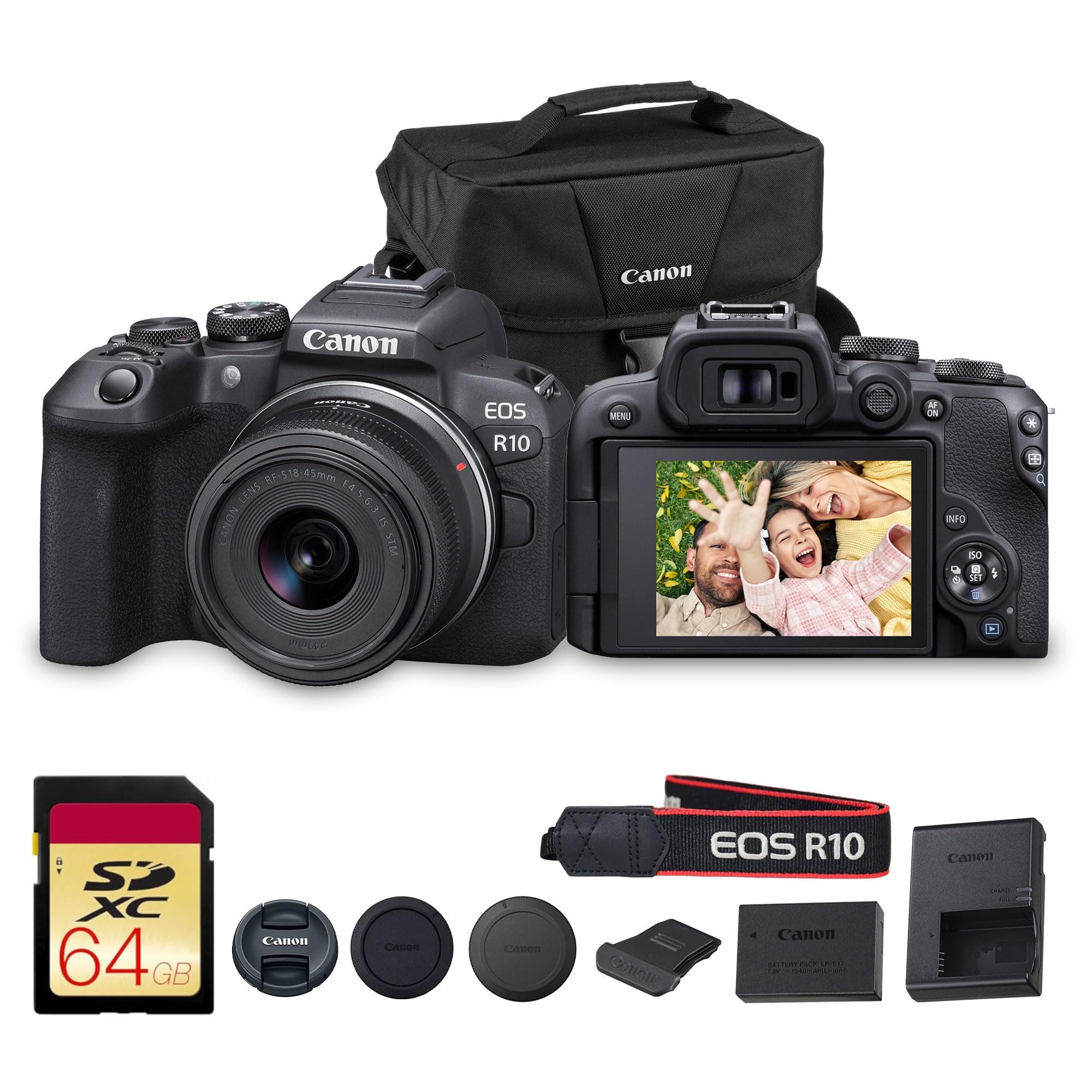
2. Canon EOS R10 Mirrorless Camera Kit with RF-S 18-45mm Lens
The R10 gives beginners professional-grade speed without overwhelming them with menus.
This mirrorless kit leads the list because it nails the balance between performance and simplicity. The 24.2MP APS-C sensor paired with the DIGIC X processor delivers sharp, vibrant photos across the ISO range of 100–32,000 (the measure of the sensor’s sensitivity to light, so higher numbers work better in dim conditions). The included RF-S 18-45mm IS STM lens covers wide landscapes and standard portraits, and its image stabilization (a system inside the lens that counters hand shake) helps keep handheld shots blur-free.
What really sets the R10 apart from the Canon EOS Rebel T7 kit below is its autofocus speed. With 153 autofocus points and Canon’s Dual Pixel CMOS AF II (a technology that reads focus across nearly the entire frame), it can track people, pets, and vehicles reliably. You can shoot continuous bursts at 15fps with the mechanical shutter or 23fps with the electronic shutter — a huge step up from the Rebel T7’s 3fps burst rate, which buyers report matters when trying to capture a child’s first soccer goal or a dog catching a frisbee. The vari-angle touchscreen also flips out to face you, making vlogging or self-portraits comfortable. Just know there is no built-in flash — you will need a hotshoe-mounted flash for indoor night shots.
One reviewer noted that the 4K/60p video (ultra high-definition video at 60 frames per second for smooth slow motion) looks crisp straight out of camera, and the Wi-Fi and Bluetooth let you send images to your phone quickly. The body weighs under 430g (about 15 ounces), so it is genuinely easy to carry every day.
What stands out
- Fast 15fps burst and 23fps electronic shutter for action
- Reliable Dual Pixel CMOS AF II with 153 autofocus points
- Oversampled 4K/30p and 4K/60p video with a flip-out screen
- Lightweight design under 430g
One trade-off
- No built-in flash — requires an external flash for dark indoor scenes
- Bit depth of 10 Bit (less color gradation than the 14 Bit on the FUJIFILM X-T30 III, which matters for heavy photo editing)
Reach for it if: You want a fast, future-proof mirrorless kit that handles action, vlogging, and everyday photography without feeling like a learning curve.
Look elsewhere if: You frequently shoot in very low light and need a built-in flash, or you plan to do heavy post-processing where 14 Bit color depth is critical.
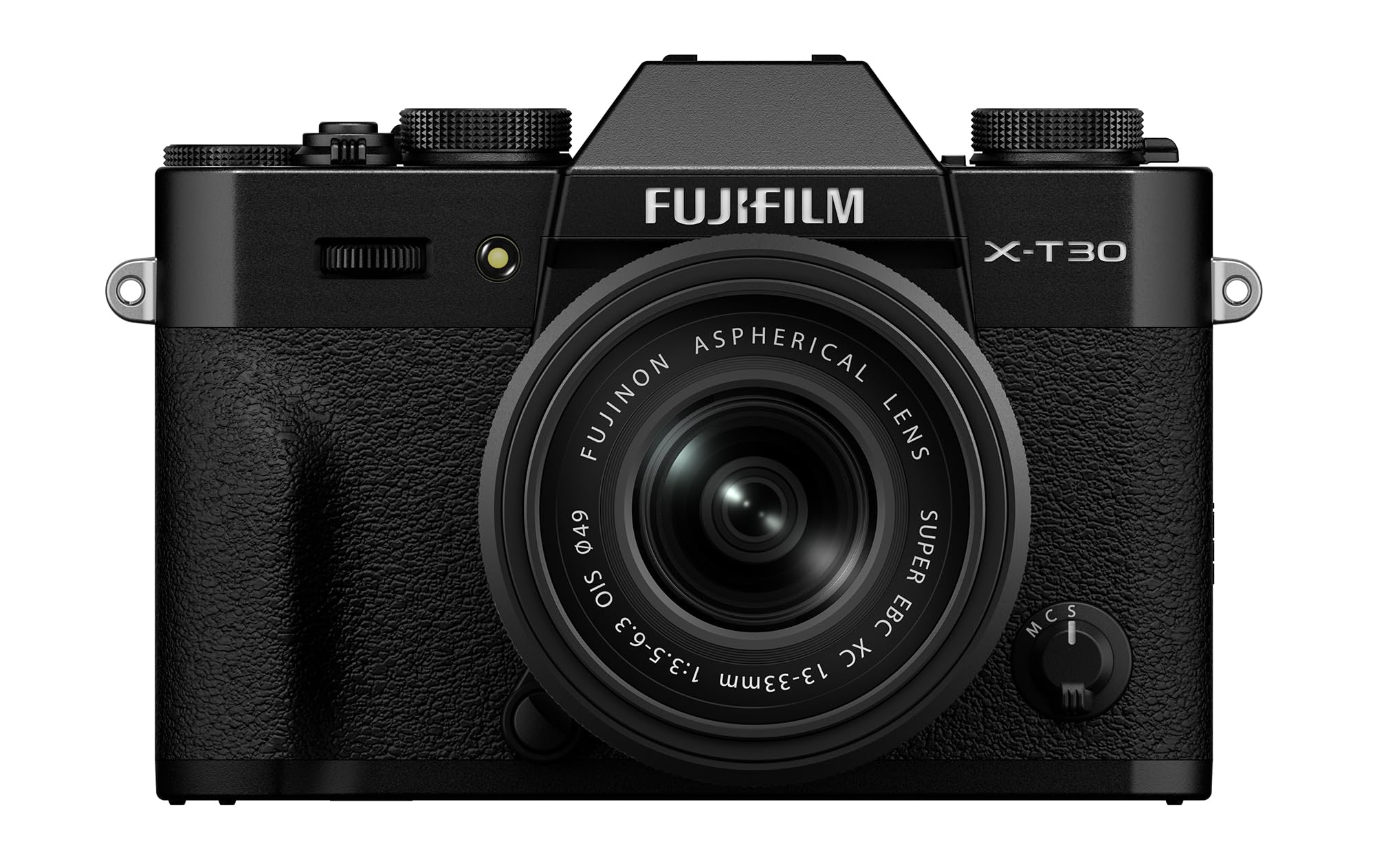
3. FUJIFILM X-T30 III Mirrorless Camera Body with XC13-33mm Lens Kit
The X-T30 III serves up gorgeous JPEGs straight from the camera using Fujifilm’s legendary film recipes.
If you love the look of classic analog photos but want modern autofocus, this is your kit. The body uses an APS-C sensor with a 14 Bit depth (the amount of color information each pixel captures, giving you smoother transitions between shades than the 10 Bit on the Canon R10). That extra color data matters when you edit RAW files. But the real star is the 20 built-in Film Simulations — presets that emulate famous Fujifilm film stocks like PROVIA, Velvia, and Classic Chrome — so you get striking colors right out of the camera with zero editing.
The autofocus is a strong point here too. With 425 phase-detection autofocus points (versus the 9 points on the Canon Rebel T7), the camera tracks subjects confidently. AI-powered subject detection automatically locks onto faces, eyes, animals, and vehicles. The included XC13-33mm f/3.5-6.3 OIS lens (OIS stands for Optical Image Stabilization — built into the lens to reduce blur from shaky hands) provides a versatile wide-to-portrait range. Owners mention that the Auto mode is genuinely useful for beginners, letting the camera handle exposure while you focus on composition. The compact body is beautifully built with retro dials that make adjusting settings feel tactile and fun. The trade-off is that the kit lens does not reach very far — 33mm on the long end is close to a “normal” view, so distant subjects will appear small.
One buyer mentioned that the 14 Bit files give them “so much latitude to recover shadows and highlights,” but beginners who just want great JPEGs may never even open a RAW editor. The camera also shoots 4K video at up to 30fps with no crop, making it a capable hybrid shooter for stills and clips.
Why it stands out
- 20 Film Simulations for gorgeous unedited JPEGs
- 425 autofocus points with AI subject detection
- 14 Bit color depth for rich edits
- Beautiful retro design in a compact, portable body
One limitation
- The 13-33mm kit lens is fairly short on the telephoto end
- Auto focus point count is excellent, but the system can hesitate in very low contrast scenes
Best suited for: Photographers who want distinctive color and character straight out of camera without hours of editing.
Pass on it if: You need a long zoom range for wildlife or sports right from the start — you will need to invest in a separate telephoto lens.
4. Nikon Z50 II with Two Lenses

The Z50 II covers everything from wide landscapes to faraway wildlife with two lenses in one box.
This is the kit that gives you the most physical range right from the start. It includes both the NIKKOR Z DX 16-50mm f/3.5-6.3 VR lens (great for everyday walk-around shooting) and the NIKKOR Z DX 50-250mm f/4.5-6.3 VR lens (for pulling in distant subjects like birds, sports, or mountain peaks). Both lenses have Vibration Reduction (VR), which is Nikon’s term for image stabilization, to help keep handheld shots sharp. The 20.9-megapixel DX sensor (Nikon’s name for its APS-C format) is several times larger than a typical smartphone sensor, so you get noticeably better detail and low-light performance.
The Z50 II brings 31 built-in Picture Control presets — color and contrast recipes you can apply in real time as you shoot. You can also download custom presets from the Nikon Imaging Cloud. Autofocus uses 231 points with hybrid phase-detection and contrast-detection, and it can automatically track people, dogs, cats, birds, and vehicles. Dedicated bird and airplane modes improve accuracy for those specific subjects. For video, you get 4K UHD at 60fps for smooth slow-motion clips, and Full HD 120fps for even more dramatic slo-mo. The vari-angle 3.2-inch touchscreen tilts to face you, making vlogging practical. One customer observed that the 4K/60p footage “looks incredible straight from the camera” and that the built-in flash works well for indoor snapshots. The only area where it trails the Canon R10 is continuous shooting speed — the Z50 II is not rated at 15fps in this spec set, so it is less ideal for fast action sequences.
Buyers consistently praise the compact design for travel, and the 14 Bit depth gives you the same generous editing headroom as the FUJIFILM and Canon RP. The SnapBridge app simplifies wireless photo sharing to your phone. The inclusion of two VR lenses at this price point makes it the most complete kit for immediate versatility.
What you get
- Two-lens kit covering 16mm wide to 250mm telephoto
- 31 Picture Control presets plus downloadable Cloud presets
- 4K/60p video with 120fps slo-mo in Full HD
- Built-in flash for indoor night shots
The limitation
- Burst shooting speed is lower than the Canon R10’s 15fps
- 20.9MP is slightly fewer pixels than the 24.1-26.2MP competitors
Pick this if: You want one purchase that covers wide landscapes and distant zoom without spending more on a second lens.
pass on it if: Burst shooting for fast sports is your priority — the Canon R10 has a higher frame rate.
5. Sony ZV-E10 Mirrorless Camera Deluxe Bundle

The ZV-E10 was built from the ground up for vloggers who need reliable autofocus and clean audio.
This camera’s design centers on video creation. The 24.2MP APS-C Exmor CMOS sensor (CMOS is the type of sensor architecture — most modern cameras use it) captures UHD 4K at 30fps and Full HD at 120fps for slow-motion clips. The 3-inch side flip-out touchscreen lets you see yourself while recording, which is essential for solo vloggers. The real party piece is the directional 3-capsule microphone with a supplied windscreen — that is a built-in mic with three separate capsules that can focus on sound coming from the direction the camera points, and the fuzzy windscreen muffles outdoor wind noise. The camera also has headphone and microphone ports so you can monitor audio while recording.
Autofocus is a 425-point Fast Hybrid AF system (it combines phase-detection and contrast-detection for reliable tracking), with Real-Time Eye AF (a mode that keeps a person’s eye in focus as they move) and real-time tracking. That is the same number of autofocus points as the FUJIFILM X-T30 III, making it very sticky on faces and subjects. The bundled Sony E PZ 16-50mm f/3.5-5.6 OSS lens (OSS is Sony’s optical image stabilization) has a power zoom mechanism — a motor inside the lens that zooms smoothly, which is useful for controlled video movements. The bundle also throws in a SanDisk 64GB Extreme PRO UHS-I card (speed class V30, meaning it guarantees a minimum write speed of 30 MB/s, suitable for 4K video) and Movavi video editing software. One buyer feedback repeated across reviews is that the side flip screen avoids the hotshoe blockage issue that top-flip screens cause when using an external mic. The trade-off is that the F3.5-5.6 aperture on the kit lens is not exceptionally fast for low light, and the 16-50mm range is standard, not telephoto.
Buyers also note that the Background Defocus button (a one-press switch that blurs the background for a more professional look) is easy to use while holding the camera. The camera supports 14 Bit depth for stills.
Built for video
- 425-point Fast Hybrid AF with Real-Time Eye AF
- Directional 3-capsule mic with supplied windscreen
- Side flip-out touchscreen avoids mic blockage
- Power zoom lens for smooth zooming in video
Consider this
- Kit lens has an F3.5-5.6 aperture, which is not ideal for very low light
- Zoom range (16-50mm) is relatively modest
Best for: Vloggers and content creators who prioritize reliable autofocus, clean audio, and a flippable screen for self-recording.
Look elsewhere if: You primarily shoot stills and prefer a wider zoom range — a two-lens kit like the Nikon Z50 II may suit you better.
6. Nikon Z50 Two-Lens Bundle
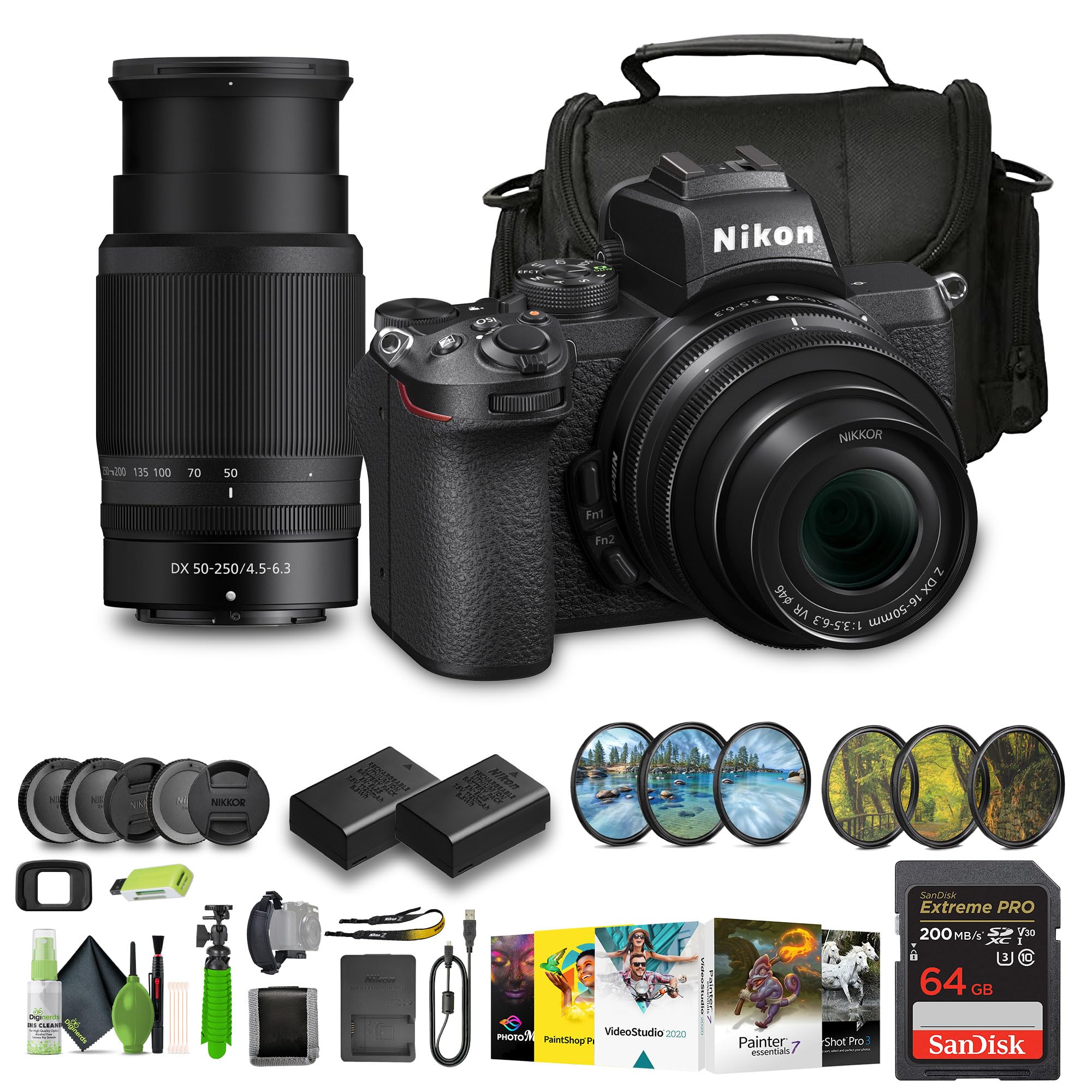
The original Z50 two-lens bundle delivers strong image quality and a complete zoom range in a weather-sealed body.
This bundle pairs the Nikon Z50 body with both the NIKKOR Z DX 16-50mm and 50-250mm VR lenses, giving you coverage from wide-angle to telephoto in one box. The 20.9MP APS-C sensor is backed by the EXPEED 6 processor (the image processing engine that handles noise reduction and color rendering), which delivers clean images up to ISO 51200 — a high sensitivity that means you can shoot in very dim conditions without a flash. The body is built from magnesium alloy and has weather sealing (gaskets at seams that resist dust and light rain), so it is tougher than most plastic-bodied cameras in this category. The 209-point hybrid autofocus system includes eye detection for humans and animals, and it shoots at up to 11fps continuous.
The bundle adds useful extras: an EN-EL25 replacement battery, a 64GB Extreme PRO SD card, a UV lens filter, a flexible tripod, and photo editing software. The 3.2-inch flip-down touchscreen LCD is convenient for high-angle shots, though note that it flips downward rather than to the side, which can be blocked by a tripod plate when you try to tilt it. Customers note that the ergonomics are comfortable for long shooting sessions and that the 16-50mm lens is impressively compact when retracted. The 50-250mm lens reaches far enough for wildlife at the zoo or kids on a sports field. The trade-off compared to the newer Z50 II is that it lacks the 31 Picture Control presets and dedicated bird/airplane autofocus modes of the newer model. The 14 Bit depth, same as the FUJIFILM and Canon RP, gives solid editing headroom.
One user highlighted that the “image quality rivals cameras twice the price,” citing the good dynamic range (the camera’s ability to capture detail in both bright highlights and dark shadows in the same shot).
Why it works
- Two-lens kit (16-50mm and 50-250mm) for complete coverage
- Weather-sealed magnesium alloy body for durable outdoor use
- ISO up to 51200 for extreme low-light shooting
- Comes with replacement battery, SD card, tripod, and software
What to note
- Flip-down screen can be obstructed by a tripod head
- Lacks the Z50 II’s newer autofocus modes and color presets
Choose it for: A durable, complete two-lens setup at a strong value point, especially if you shoot outdoors in varying conditions.
Consider the Z50 II instead if: You want the very latest autofocus tracking modes and built-in color recipe presets.
7. Canon EOS Rebel T7 DSLR Camera Bundle with EF-S 18-55mm
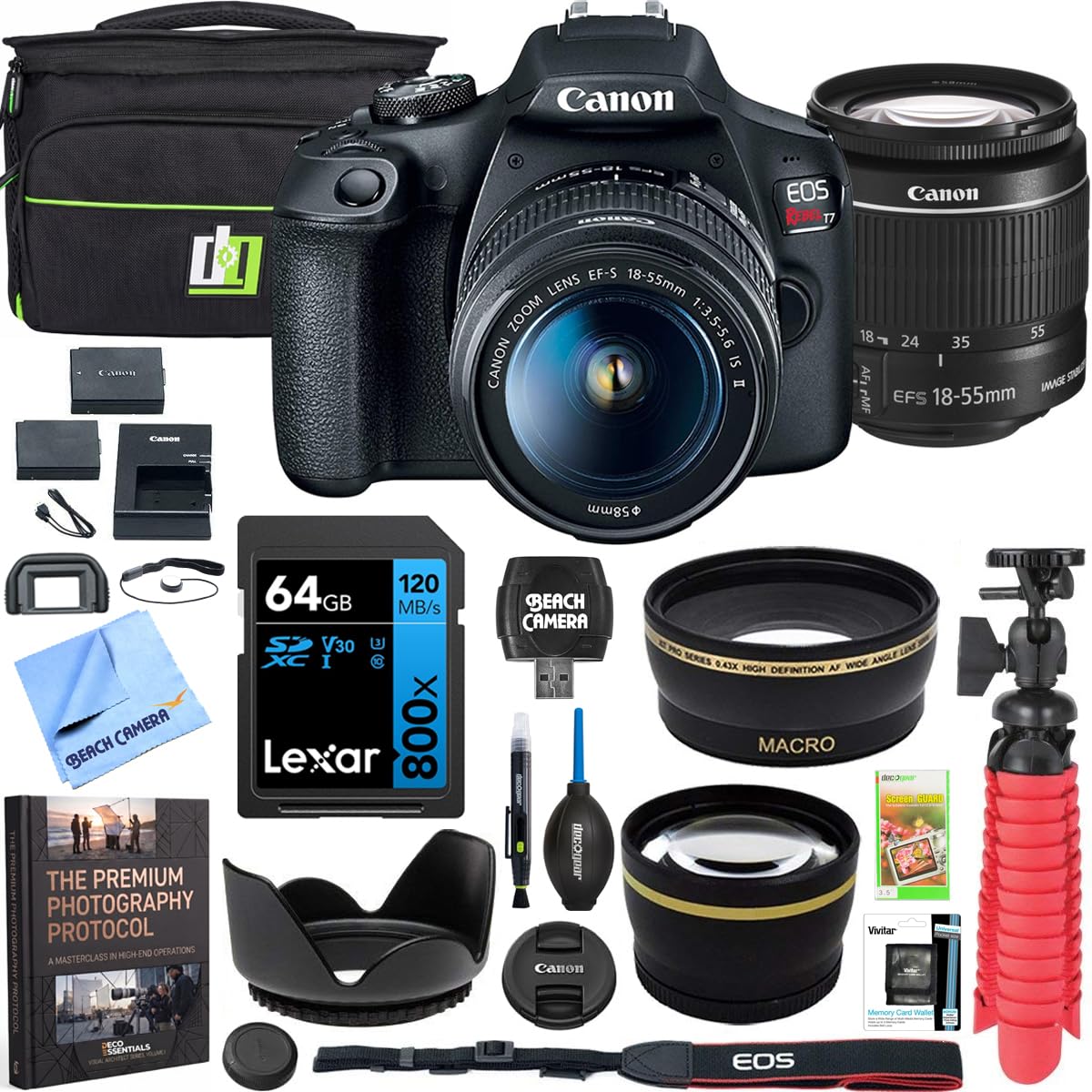
The Rebel T7 bundle packs everything a new photographer needs to start shooting immediately — camera, bag, tripod, and memory card included.
This is the entry-level DSLR bundle for anyone who wants a dedicated camera without any guesswork about what accessories to buy. The 24.1MP APS-C CMOS sensor delivers image quality that easily outpaces a smartphone, and the bundled EF-S 18-55mm f/3.5-5.6 IS II lens (IS stands for Image Stabilization) covers the standard zoom range. The bundle rounds out with a Deco Gear camera bag, a 58mm wide-angle and telephoto lens set, a replacement battery, a 12-inch tabletop tripod, a lens cleaning kit, a 64GB Lexar 800x SDXC memory card, and even an ebook guide. The 9-point autofocus system is basic by modern standards — at 9 points versus the 425 points on the FUJIFILM X-T30 III — so keep that in mind if you plan to shoot fast-moving kids or pets. The burst rate is 3fps, which is also slower than the Canon R10’s 15fps.
What you get is a proven, straightforward DSLR (Digital Single-Lens Reflex — it uses a mirror to direct light from the lens to an optical viewfinder) that runs on AA or LP-E10 batteries. The built-in flash pops up for indoor fill light. The aspect ratio options include 16:9, 3:2, and 4:3. The camera has built-in Wi-Fi with NFC (Near Field Communication — tap your phone to the camera to pair quickly) for transferring photos to your phone. The kit lens has a versatile aperture range of F3.5 at the wide end to F22 when stopped down, giving you control over depth of field. Buyers consistently say this bundle is “everything you need” for getting started, though the 9-point AF system and 3fps burst mean it is best suited for stationary subjects and slower-paced photography like portraits, landscapes, and still life.
Complete package
- Full bundle includes bag, tripod, extra battery, 64GB card, and cleaning kit
- 24.1MP APS-C sensor for image quality above smartphones
- Built-in flash for indoor lighting
- Simple DSLR operation with onboard guidance for beginners
Limitations
- 9 autofocus points (47.2x less than 425-point systems) limit moving subject tracking
- Slow 3fps burst shooting
Ideal for: Absolute beginners on a budget who want a complete starter kit with all accessories included, shooting mostly still subjects.
Move up if: You plan to shoot sports, pets, or any fast-moving action — the 9-point AF and 3fps will frustrate you.
8. Canon EOS 2000D / Rebel T7 DSLR Camera w/EF-S 18-55mm f/3.5-5.6 Lens Kit (Renewed)

This renewed kit packs the same 24.1MP sensor and 18-55mm lens as the new Rebel T7, with more memory and lenses for less.
This is a renewed (refurbished) version of the Canon EOS 2000D, also known as the Rebel T7, that includes the EF-S 18-55mm f/3.5-5.6 lens plus a second telephoto lens and a wide-angle adapter. The camera itself has the same 24.1MP APS-C CMOS sensor and DIGIC 4+ processor as the new Rebel T7 bundle above, so image quality is identical. The kit adds a 128GB memory card, a flash, a tripod, a filter kit, and a carrying case. The 9 autofocus points (the same as the Canon Rebel T7 bundle above, versus the FUJIFILM X-T30 III’s 425 points) and 3fps burst shooting are on par with the standard Rebel T7 performance — functional for slow to moderate shooting, but not action cameras.
Full HD 1080p video recording at 30fps is standard for this generation of DSLR. The camera features built-in Wi-Fi with NFC for easy pairing with a smartphone. The aspect ratio is fixed to 3:2, while the other bundles offer 16:9 and 4:3 as well. The optical zoom multiplier is listed at 3.0x. Note that this is an international model, so it does not include a manufacturer’s warranty in some regions. The hammerhead flash is included. Because it is a renewed unit, condition varies — reviewers point out being happy with the value, but some note that the battery is not included, so you will need to purchase that separately. One shopper added that the bundle “provided everything I needed to experiment with different types of photography,” specifically calling out the telephoto and wide-angle adapters for adding versatility without the cost of dedicated lenses.
Value highlights
- Renewed price offers the core Rebel T7 camera and lens at a lower cost
- Includes 128GB card, telephoto and wide-angle lenses, flash, and tripod
- 24.1MP APS-C sensor matches the image quality of new Rebel T7 bundles
Important notes
- Battery is not included — must be purchased separately
- International model with no manufacturer’s warranty in some regions
- 9-point autofocus and 3fps burst are dated for moving subjects
Reach for this if: Your budget is tight and you want the most accessories possible for the lowest entry price, accepting that it is renewed.
Pass on it if: You prefer a new camera with a full manufacturer’s warranty and a battery included.
Understanding the Specs
APS-C vs Full-Frame Sensor
The sensor is the heart of the camera — it captures light and turns it into your image. An APS-C sensor is roughly the size of a postage stamp and is the most common sensor in beginner camera kits. It balances image quality, lens size, and cost very well. A full-frame sensor is physically much larger (about the same size as a 35mm film frame) and captures significantly more light. This gives you cleaner shadows, better low-light performance, and an easier time creating that soft, blurry background (called bokeh). However, full-frame lenses tend to be larger and more expensive. For a beginner, APS-C is a perfect starting point. Full-frame is for the buyer who wants the absolute best image quality achievable and is ready for the higher lens costs that come with it.
Kit Lens Zoom Range and Aperture
A standard zoom like 18-55mm covers wide-angle shots (landscapes, group photos) at 18mm and moderate telephoto (portraits) at 55mm. A two-lens kit that adds a 50-250mm lens gives you significant reach for sports, wildlife, and compressed perspective shots. The aperture, written as f/3.5-5.6, tells you how wide the lens can open. A smaller f-number (f/3.5) lets in more light, which helps in dim conditions and creates more background blur. A larger f-number (f/5.6) lets in less light. Shoot with it for a few months to learn which focal length you prefer before buying additional glass.
FAQ
What is the difference between APS-C and full-frame in a beginner kit?
Should I get a kit with one lens or two lenses?
How many autofocus points do I really need as a beginner?
Is a mirrorless camera better for beginners than a DSLR?
Can I use a beginner camera kit for vlogging?
What does the f-number on the kit lens mean for my photos?
How important is image stabilization in a beginner kit?
Can I upgrade the lens later if I start with a kit lens?
What is the difference between mechanical shutter and electronic shutter?
Does a higher megapixel count always mean better photos?
What is bit depth and why does it matter for editing?
Final Thoughts: The Verdict
For most buyers, the best beginner camera kit winner is the Canon EOS R10 Kit because it combines a modern mirrorless body with fast autofocus, 15fps burst shooting, 4K video, and an intuitive touchscreen interface — all at a price that leaves room for a future lens upgrade. If you want the most lens versatility in a single purchase, grab the Nikon Z50 II Two-Lens Kit and get wide-angle to telephoto coverage from the start. And for the absolute best image quality with that full-frame look, the standout is the Canon EOS RP Full-Frame Kit.
How We Picked
We do not accept paid placement. Every pick is matched to a real buyer and a real use-case; we do not hands-on test units.
Sources & Methodology
Specifications: manufacturer listings and product documentation. Review insights: verified customer reviews, as of July 2026. Pricing: not shown on this page (it changes often); check the current price via the retailer link.
As an Amazon Associate, Gadgets Feed earns from qualifying purchases. This does not affect which products we feature.