
The moment you decide to move beyond your smartphone camera, the sheer number of interchangeable lenses, sensor sizes, and confusing acronyms can feel like a brick wall. Beginner cameras are supposed to make this transition easy, but the market is flooded with models that either overcomplicate the basics or cut so many corners that your photos look worse than what your phone can produce. The real trick is finding a camera that teaches you core concepts like aperture and shutter speed without punishing you with a sluggish interface or poor low-light performance.
I’m Min — the co-founder and writer behind Gadgets Feed. My deep dive into the beginner camera market involved analyzing hundreds of technical spec sheets, cross-referencing user experience reports, and understanding exactly which autofocus systems and kit lenses deliver the most consistent results for someone learning the craft.
This guide cuts through the noise to deliver the most reliable, well-researched advice for finding the best beginner cameras that actually help you grow as a photographer without breaking the bank.
How To Choose The Best Beginner Cameras
Selecting your first real camera is less about buying the most expensive body and more about matching the system to your learning style and the subjects you love to shoot. You need a camera that rewards practice, not one that hides its best features behind a deep menu.
Sensor Size & Image Quality
The sensor is the heart of the camera. An APS-C sensor (found in most entry-level DSLRs and mirrorless models) offers a great balance of image quality, low-light performance, and lens affordability. Micro Four Thirds sensors are smaller, making the entire kit lighter, but they can struggle more in dim conditions. Full-frame sensors, like the one in the Sony a7 III, deliver the best dynamic range and depth of field, but they come at a premium price and often require more expensive glass. For a beginner, a modern APS-C sensor is the sweet spot.
Autofocus System
For a beginner, a reliable autofocus (AF) system eliminates frustration and keeps you shooting. Phase-detection AF points, especially those covering a wide area of the frame, allow the camera to lock onto moving subjects like pets or kids quickly. Look for models with dedicated Eye or Face Detection AF, as this technology dramatically increases your hit rate for portraits and vlogging, ensuring your subject is sharp without you having to fiddle with focus points mid-shoot.
Lens Ecosystem & Kit Lens Quality
The camera body is only part of the equation. The lens you attach directly impacts the sharpness, aperture, and creative possibilities of your images. A good kit lens, like a stabilized 18-55mm or a versatile 12-60mm, gives you enough range to experiment with wide-angle and portrait-length shots. More importantly, consider the system behind the camera — Canon’s EF-S/RF-S and Sony’s E-mount have vast and affordable third-party lens options, ensuring you can grow your kit without going broke.
Quick Comparison
On smaller screens, swipe sideways to see the full table.
| Model | Category | Best For | Key Spec | Amazon |
|---|---|---|---|---|
| Sony a7 III | Mirrorless | Full-Frame Upgrade Path | 693-point phase-detection AF | Amazon |
| Sony ZV-E10 | Mirrorless | Vlogging & Streaming | 425-point hybrid AF | Amazon |
| Panasonic Lumix G85 | Mirrorless | Steady Video on a Budget | 5-axis In-Body Stabilization | Amazon |
| Canon EOS R100 | Mirrorless | Lightweight RF System Entry | 143-zone Dual Pixel CMOS AF | Amazon |
| Canon EOS Rebel T7 | DSLR | Classic DSLR Experience | 9-point AF system | Amazon |
| Canon EOS 2000D (Rebel T7) | DSLR | Value DSLR Kit | 9-point AF with center cross-type | Amazon |
| Panasonic Lumix FZ80D | Bridge | Superzoom Range | 60x optical zoom (20-1200mm) | Amazon |
| Insta360 X5 | 360 Camera | Immersive Action Shots | Dual 1/1.28-inch sensors | Amazon |
| Xtra Muse Pocket Gimbal | Pocket Camera | Ultra-Stable Vlogging | 3-axis gimbal stabilization | Amazon |
| DJI Osmo 360 Essential | 360 Camera | Invisible Selfie Stick Shots | 1-inch 360° sensor | Amazon |
| Nikon D3200 | DSLR | Entry-Level Budget DSLR | 24.2 MP DX-format sensor | Amazon |
In‑Depth Reviews
1. Sony a7 III Full-Frame Mirrorless

The Sony a7 III sits at a fascinating intersection for the beginner market: it is a professional-grade full-frame camera that is simple enough for a novice to grow into for years. The 24.2MP back-illuminated sensor delivers an outstanding 15-stop dynamic range, meaning you can recover shadows and highlights in post-processing with very little noise. This gives a new photographer considerable creative latitude to fix exposure mistakes without the image falling apart.
Its 693-point phase-detection AF system covers 93% of the frame, making it incredibly forgiving for beginners who haven’t mastered focus-and-recompose techniques. You can set the camera to Eye AF for portraits and trust it to track a moving subject across the frame at up to 10 fps. The battery life is excellent for a mirrorless body, allowing for extended shooting sessions without worrying about finding a power outlet mid-afternoon.
The trade-off is that the full-frame lens ecosystem is more expensive, and the kit 28-70mm lens is decent but not optically exceptional. Beginners planning to buy into this system should budget for a prime lens like a 50mm f/1.8 to truly understand what the sensor can do. The menu system is also famously dense, though once configured, the physical dials and controls are intuitive enough for daily use.
Why it’s great
- Exceptional 15-stop dynamic range for editing latitude
- Industry-leading 693-point phase-detection AF with real-time Eye Tracking
- Silent mechanical shutter up to 10 fps with continuous AF
Good to know
- Full-frame lenses are significantly more expensive than APS-C glass
- Complex menu system can be intimidating for a first-time camera owner
- Kit lens is optically average; a prime upgrade is almost necessary
2. Sony Alpha ZV-E10
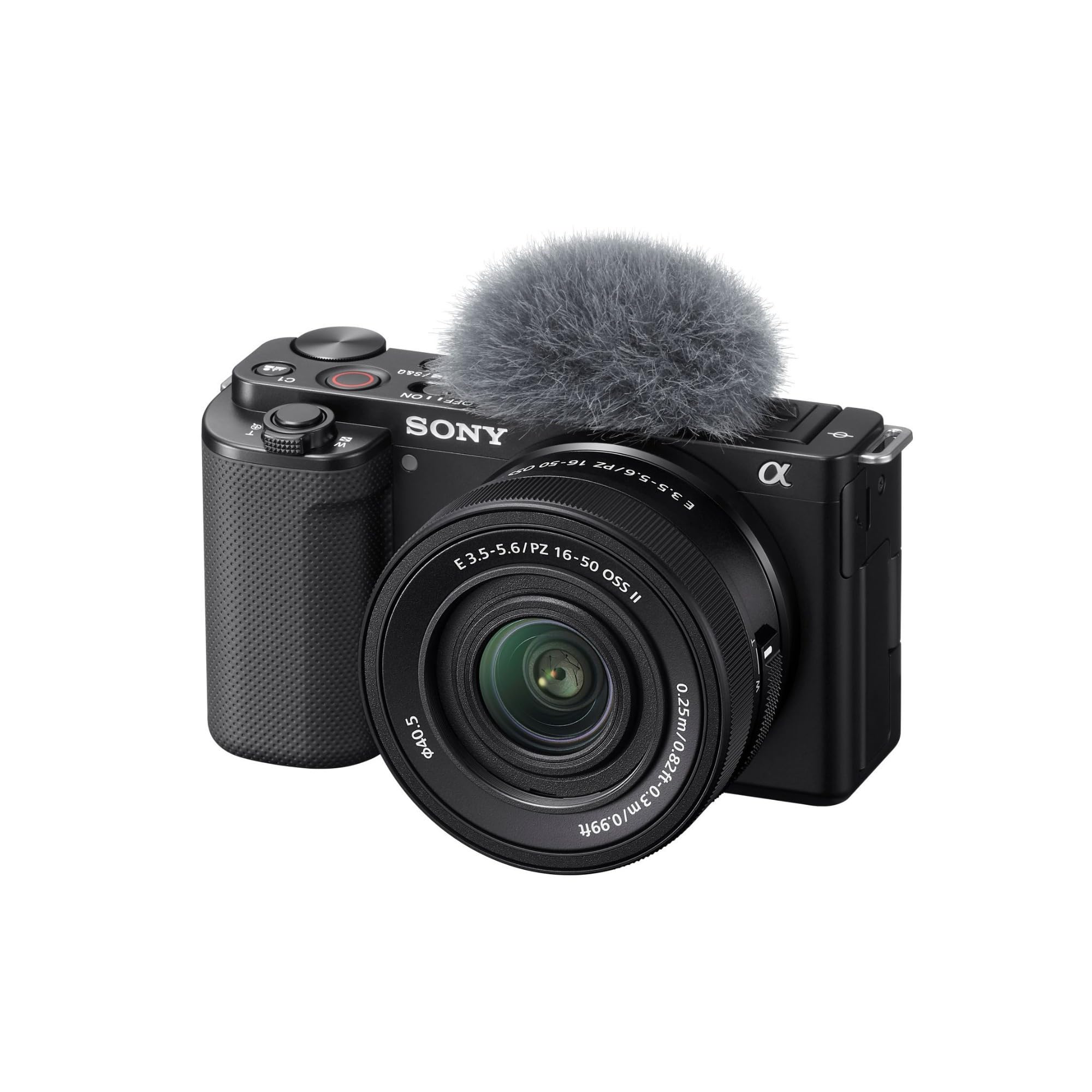
Designed from the ground up for content creators, the Sony ZV-E10 takes the excellent 24.2MP APS-C sensor from the a6000 series and wraps it in a body that prioritizes video features and ease of use. The oversized 425-point hybrid AF system provides incredibly sticky tracking for faces and objects, which is a lifesaver for a beginner vlogger who needs to stay in focus while moving around. The Product Showcase Setting is a brilliant touch that instantly transitions focus from your face to an object held up to the lens.
The Background Defocus button is a physical switch that mimics the shallow depth-of-field look new creators often desire, effectively teaching the user about aperture control without having to dive into manual mode. The inclusion of a directional 3-capsule mic and a windscreen in the box means the audio quality is immediately usable, removing one of the biggest hurdles for beginner video. The 4K video is oversampled from a 6K readout, providing excellent detail and sharpness.
The primary downside is the lack of in-body image stabilization (IBIS), relying instead on the OSS in the kit lens. This means handheld walking shots can be noticeably shaky. The battery life is average for a mirrorless camera, so vloggers should invest in a spare. The menu, while improved, is still the traditional Sony deep-menu structure, which might require some time to learn.
Why it’s great
- Excellent 4K video quality oversampled from a 6K readout
- Product Showcase Setting and Background Defocus button for easy creative control
- Built-in directional microphone with windscreen for better starter audio
Good to know
- No in-body stabilization; relies on lens-based stabilization
- Average battery life requires planning for longer shoots
- Menu system can feel complex for a beginner despite the dedicated buttons
3. Panasonic Lumix G85

The Panasonic Lumix G85 is a masterclass in value engineering for the beginner. It packs a 16MP Micro Four Thirds sensor with no low-pass filter, resulting in surprisingly sharp images that rival many 20MP+ sensors in good light. The real star here is the 5-axis in-body image stabilization (IBIS) that works in tandem with the lens OIS, allowing you to capture usable handheld shots at shutter speeds that would be impossible on a non-stabilized camera. This is a massive confidence booster for a beginner.
The build quality is exceptionally high for its price point, featuring a magnesium-alloy front panel and weather-sealing on the kit lens, making it a rugged companion for travel or outdoor learning. The 4K video output is clean, and the 4K Photo mode lets you extract 8MP stills from a video burst, a useful feature for capturing fast action. The Live Viewfinder is a crisp OLED panel that provides accurate previews of your exposure.
The 16MP sensor is its limiting factor; it won’t handle extreme cropping or heavy low-light pushing as well as larger APS-C sensors. The contrast-detect AF system, while reliable in good light, can hunt and lag noticeably in dim environments during video recording. The battery life is also relatively poor, so carrying a spare is recommended for a full day of shooting.
Why it’s great
- Outstanding 5-axis dual image stabilization for sharp handheld shots
- Weather-sealed magnesium-alloy build is durable for travel
- Excellent value for a body with advanced video and photo features
Good to know
- 16MP sensor limits heavy cropping and low-light performance
- Contrast-detect AF hunts in low light for video
- Below-average battery life for full-day shoots
4. Canon EOS R100

The Canon EOS R100 represents the most affordable entry point into Canon’s modern RF mirrorless system, offering a 24.1MP APS-C sensor paired with Canon’s reliable DIGIC 8 processor. Its primary appeal is size; it is the smallest and lightest EOS R body, making it an unobtrusive camera for learning on the go. The Dual Pixel CMOS AF covers a wide 143-zone area and includes human, animal, and vehicle detection, a surprisingly advanced AF system for this price tier.
The kit RF-S 18-45mm lens is incredibly compact, collapsing to roughly the size of a pancake lens, which makes the entire kit pocketable in a large jacket. The image quality from the 24MP sensor is solid, with good color science straight out of the camera that many new users find appealing and shareable without heavy editing. The user interface is clean and beginner-friendly, with a guided mode that explains different settings.
The 4K video is limited to 24 fps, which can be frustrating for PAL-region users or anyone wanting smooth 30/60fps. The buffer is small, limiting burst depth, and the LCD is a fixed screen, making vlogging or overhead shots awkward. It also lacks a traditional hotshoe for flash triggers, limiting expansion for those interested in off-camera lighting.
Why it’s great
- Smallest and lightest EOS R body for excellent portability
- Dual Pixel CMOS AF with subject detection for easy focusing
- Clean, beginner-friendly UI with guided shooting modes
Good to know
- 4K video is capped at 24 fps
- Small buffer limits continuous shooting bursts
- Fixed LCD screen hinders vlogging and high/low-angle shots
5. Canon EOS Rebel T7
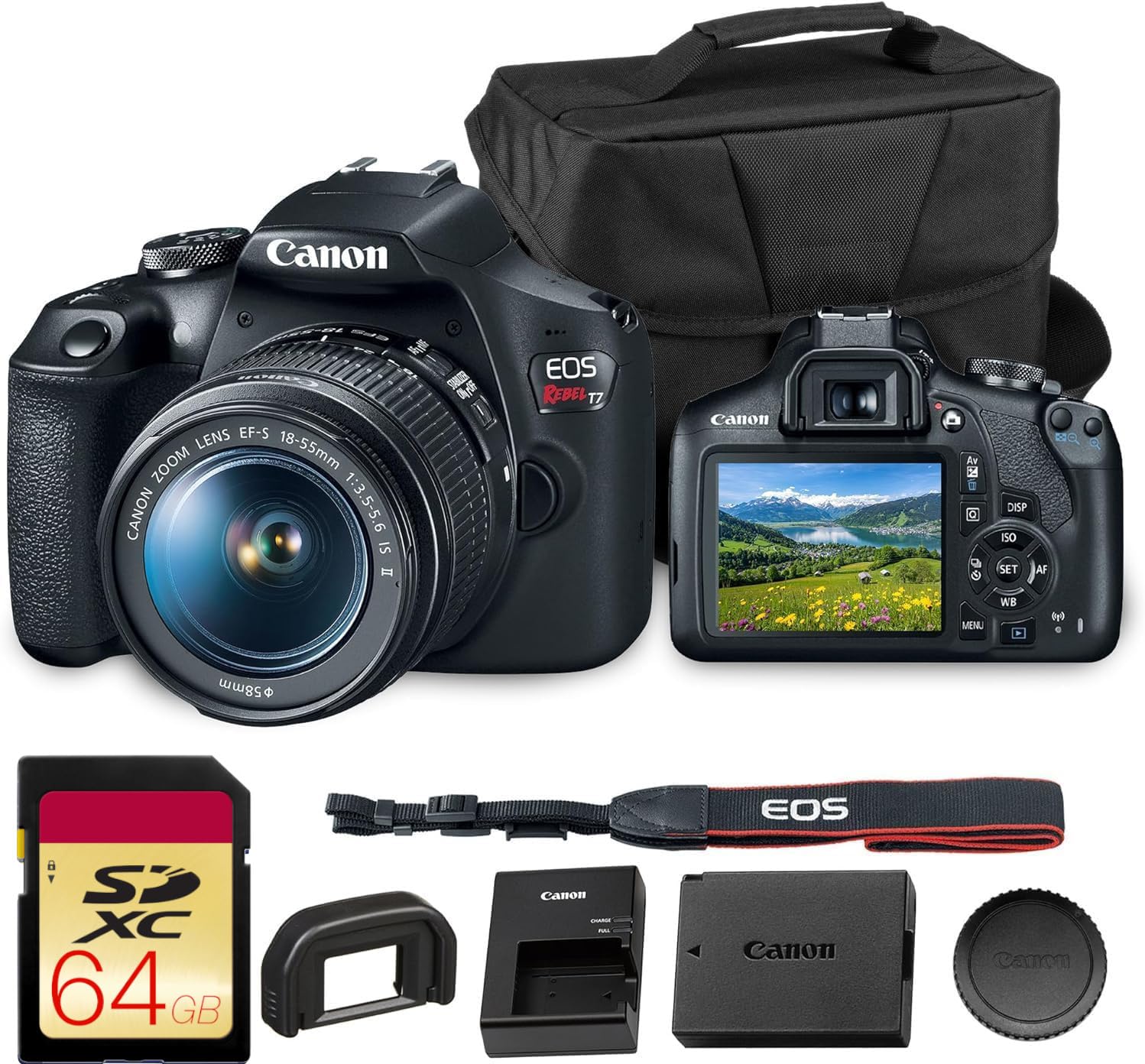
The Canon EOS Rebel T7 (also known as the 2000D in some markets) remains a staple of the beginner market for a reason: it offers a pure, classic DSLR experience that forces you to learn the fundamentals without breaking the bank. The 24.1MP APS-C sensor paired with the DIGIC 4+ processor produces vibrant, sharp JPEGs right out of the camera, with Canon’s renowned color science that is particularly flattering for skin tones. The optical viewfinder provides a real-time, lag-free view of the world.
The included 18-55mm kit lens is optically decent and provides a standard zoom range to learn composition. The built-in Wi-Fi and NFC allow for easy image transfer to a smartphone for social sharing, a necessary modern convenience. The battery life is excellent for a beginner, often lasting several days of casual shooting on a single charge, as the optical viewfinder uses no power. The kit bundle typically includes a bag and memory card, providing everything a new user needs to start immediately.
The 9-point AF system is very basic by modern standards; it feels limiting when trying to track moving subjects, and you will quickly outgrow it. The 3 fps continuous shooting is slow for action or sports. The LCD is a low-resolution 920k-dot panel that looks dated, and the video is limited to 1080p at 30fps. This camera is best for a user who prioritizes still photography over video.
Why it’s great
- Classic DSLR design teaches fundamental photography skills
- Excellent battery life for all-day shooting
- Great JPEG color science and image quality for the price
Good to know
- 9-point AF system is very basic and slow
- Slow 3 fps burst rate for action shots
- Low-resolution LCD and 1080p video only
6. Canon EOS 2000D (Rebel T7) Kit

This specific listing for the Canon EOS 2000D (Rebel T7) arrives as a comprehensive kit that includes everything a person needs to begin their photography journey immediately: the camera body, 18-55mm lens, a padded case, a 32GB memory card, and various accessories. The camera itself is the same T7 platform, featuring a 24.1MP APS-C sensor and a DIGIC 4+ processor that produces great still images. This bundle removes the friction of buying separate components.
The inclusion of Wi-Fi and NFC is a key feature for beginners, enabling easy image sharing and remote control via the Canon Camera Connect app. The Scene Intelligent Auto mode is smart enough to handle most everyday situations, allowing a new user to start capturing good photos instantly while they learn the more advanced manual modes. The optical viewfinder provides a bright and clear view of the scene.
The accessories in this kit, such as the case and tripod, are basic and will likely need to be replaced as the user becomes more serious. The 9-point AF system and 3 fps burst rate are severely dated and make this camera unsuitable for any fast-paced photography. It also uses a smaller LP-E10 battery which provides fewer shots per charge compared to higher-end DSLRs.
Why it’s great
- Complete all-in-one kit for immediate out-of-box use
- Built-in Wi-Fi and NFC for easy sharing
- Simple Scene Intelligent Auto mode for instant great photos
Good to know
- Included accessories are entry-level quality
- 9-point AF is very restrictive for moving subjects
- Smaller battery capacity limits shooting time
7. Panasonic Lumix FZ80D

The Panasonic Lumix FZ80D is a bridge camera that serves a very specific market: the beginner who wants to photograph distant subjects like wildlife, birds, or sports without investing in expensive telephoto lenses. Its headline feature is the built-in 60x optical zoom lens, equivalent to a 20-1200mm range, which brings faraway objects into sharp view. The included POWER O.I.S. (Optical Image Stabilizer) is essential for keeping those telephoto shots steady.
The camera features a 4K Photo mode and Post Focus capability, which allows you to change the focus point after the image is taken, a neat trick for macro subjects. The electronic viewfinder has a high 2,360K-dot resolution, making it usable in bright sunlight. It also records 4K video, adding versatility. This is a single, non-interchangeable lens system, which simplifies the decision-making for a beginner.
The 1/2.3-inch sensor is tiny compared to APS-C or MFT sensors, resulting in noisy, grainy images, especially in anything less than bright daylight. The image quality is smartphone-competitive at best, and significantly worse in low light. The autofocus can be slow and hunt at the extreme telephoto end. This camera is a specialist tool for reach, not a general-purpose camera that produces great all-around images.
Why it’s great
- Incredible 60x zoom range (20-1200mm) built-in
- Power O.I.S. stabilization helps manage long telephoto shots
- 4K Photo and Post Focus features add creative flexibility
Good to know
- Small sensor produces grainy images in low light
- Image quality is not significantly better than a high-end smartphone
- Autofocus can struggle at the long end of the zoom
8. Insta360 X5 Essentials Bundle

The Insta360 X5 redefines what a beginner can do by capturing everything around it in 360 degrees. The dual 1/1.28-inch sensors allow for 8K 360° video and 72MP stills, providing incredibly immersive footage. For a beginner, the real magic is in the software: you can shoot without worrying about framing, then use the app to reframe and choose the perfect angle later, a process called “shoot now, frame later.” This removes the immediate pressure of composition.
The “Invisible Selfie Stick” effect creates stunning third-person drone-like shots, making it incredibly easy to capture unique perspectives of travel or action sports. FlowState Stabilization ensures the footage is perfectly smooth, and the 360° Horizon Lock keeps the horizon level even when the camera rotates fully. The camera is waterproof to 15 meters without a case, and the battery offers up to 208 minutes of runtime with fast charging to 80% in 20 minutes.
There is a significant learning curve for the editing process, as 360 video requires a different workflow. The file sizes are enormous, requiring fast memory cards and ample storage. The image quality in low light, while improved, is still not on par with a dedicated APS-C camera. The “Essentials Bundle” name indicates this is a specific kit; ensure it has the accessories you need.
Why it’s great
- Shoot-now-frame-later workflow eliminates composition anxiety
- Incredible invisible selfie stick effect for unique third-person shots
- FlowState Stabilization for perfectly smooth action footage
Good to know
- Steep learning curve for editing 360-degree footage
- Low-light performance still lags behind traditional cameras
- Large file sizes require fast microSD cards and storage
9. Xtra Muse Pocket Gimbal Camera

The Xtra Muse is a dedicated pocket vlogging camera that directly competes with the DJI Pocket 3, offering a 1-inch CMOS sensor that captures 4K video at 120fps. Its primary differentiator is the integrated 3-axis gimbal stabilizer, which provides professional-level smoothness for walking, running, or dynamic vlogging without the need for external stabilization rigs. This makes it an incredibly turnkey solution for a beginner looking to create high-quality video content immediately.
The camera features a 2-inch touchscreen that is responsive and intuitive, and the face/object tracking works reliably to keep the subject centered even when they move. The compact design makes it highly portable, easily slipping into a pocket. The included bundle comes with a carrying bag and a handle with a 1/4″ thread, providing a solid out-of-box experience. The 10-bit X-Log color mode allows for more advanced color grading in post.
Battery life is rated at around 161 minutes, which is decent but not spectacular. The camera is an all-in-one unit, meaning you cannot upgrade the lens or sensor. Some users have noted that while the 4K/120fps footage is impressive, the image quality in very low light is only average compared to larger-sensor cameras. The brand is less established than DJI or Sony, so long-term support and accessories may be a consideration.
Why it’s great
- Integrated 3-axis gimbal for insanely smooth walking shots
- Compact, pocketable design ideal for vlogging
- 10-bit X-Log color for advanced color grading
Good to know
- Average low-light performance for the 1-inch sensor class
- Non-expandable system; what you buy is what you have
- Less brand recognition may affect accessories and support
10. DJI Osmo 360 Essential Combo
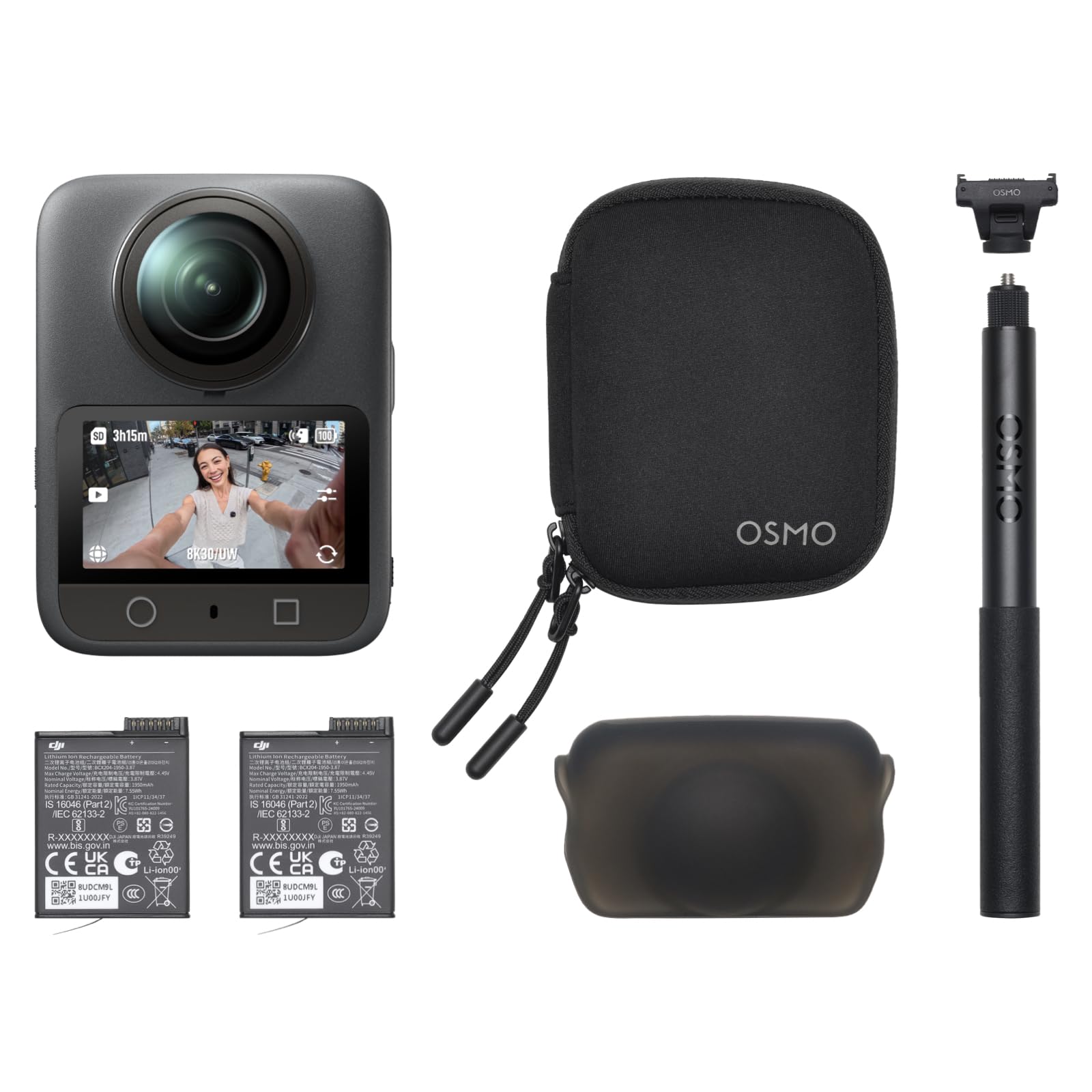
The DJI Osmo 360 leverages a groundbreaking 1-inch 360° imaging sensor, which significantly improves low-light performance compared to the smaller sensors typically found in 360 cameras. This produces sharper, more vibrant 8K 360° video, making it a strong choice for a beginner who wants to capture immersive travel and outdoor adventure footage. The included 1.2m invisible selfie stick enables the classic third-person effect, making solo footage look like it was shot by a dedicated cameraman.
The software ecosystem, accessible via the DJI Mimo app, includes automatic reframing tools, Pano Dewarp, and Pro Color Grading, making the post-processing learning curve much gentler than other 360 cameras. The camera has built-in 105GB of storage, eliminating the immediate need for a memory card. Audio capture is a highlight, with a 4-mic array and OsmoAudio compatibility for wireless DJI mics.
There is still an editing learning curve inherent to 360 footage for a true beginner. The camera is more of an action camera form factor and lacks a viewfinder, which some photographers new to the genre may find disorienting. The Essential Combo includes the selfie stick and an extra battery, which is good value, but you should confirm the accessories fit your specific use case.
Why it’s great
- Superior 1-inch sensor for improved low-light 360 video
- Built-in 105GB storage for immediate use
- Excellent audio capture with 4-mic array and OsmoAudio
Good to know
- Learning curve for editing 360 content remains
- Battery life (100 min) is shorter than competitors
- No traditional viewfinder; requires app or screen for framing
11. Nikon D3200 (Renewed)
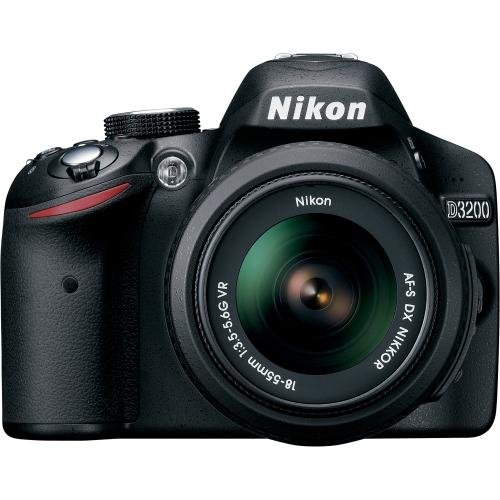
The Nikon D3200, even as a renewed model, remains a formidable entry point for the budget-conscious beginner. Its 24.2MP DX-format CMOS sensor, paired with the EXPEED III processor, delivers image quality that is still competitive with many modern entry-level cameras in good light. The 11-point autofocus system, while not sophisticated, is fast and reliable for casual shooting. This is a pure, no-nonsense DSLR that teaches the trade-offs of aperture, shutter speed, and ISO.
The kit 18-55mm f/3.5-5.6 VR (Vibration Reduction) lens is optically sharp and provides stabilization, a huge help for handheld photography. The camera has a Guide Mode that walks the user through different shooting scenarios, acting as a built-in photography tutor. It captures 1080p video at 30fps, which is fine for basic video needs. The battery life is excellent, and the camera is compatible with a huge range of affordable Nikon F-mount lenses.
As a renewed product, the condition can vary; some units show cosmetic wear, and the included battery may be a third-party unit. The 11-point AF system and 3 fps burst rate are very dated. There is no Wi-Fi, so transferring photos requires a cable or an external card reader. The 3-inch 920k-dot LCD is low-resolution by modern standards.
Why it’s great
- Excellent 24.2MP image quality for a very low entry cost
- Guide Mode helps teach photography fundamentals
- Vast, affordable Nikon F-mount lens ecosystem
Good to know
- Renewed condition may show cosmetic wear
- 11-point AF and 3 fps burst are very dated
- No Wi-Fi connectivity for quick photo sharing
FAQ
Should a beginner buy a DSLR or a mirrorless camera in 2024?
Is a full-frame camera too much for a beginner?
Final Thoughts: The Verdict
For most users, the best beginner cameras winner is the Sony a7 III because it offers unbeatable image quality and autofocus performance that allows a beginner to grow into a professional without needing a new body. If you want a camera purpose-built for vlogging, grab the Sony ZV-E10. And for a classic, budget-friendly learning experience, nothing beats the value of the Canon EOS Rebel T7 kit.