
Our readers keep the lights on and my morning glass full of iced black tea. As an Amazon Associate, I earn from qualifying purchases.
Specs are compiled from manufacturer listings and verified buyer reviews and can change over time — please confirm the key details on the product page before buying.
Buying your first camera drone is more about avoiding a flyaway or a crash than it is about raw specs. This guide cuts through the jargon to help you pick the model that will actually get you flying safely on day one, whether your budget is entry-level or premium. We are focusing on what matters for a beginner: ease of setup, automated safety features that bring the drone home, and a camera that gives you footage worth keeping.
I’m Min — the founder and writer behind Gadgets Feed. This guide is built by comparing the manufacturers’ published specifications and the patterns across verified customer reviews, so you get each pick’s real strengths and trade-offs instead of marketing spin.
We’ve matched each pick to real-world flying conditions so you know exactly which mini quad suits your skill level and shooting style. This is your practical starting point for finding the best beginner drone with camera that won’t frustrate you after the first charge.
Our Picks at a Glance

How To Choose The Best Beginner Drone With Camera
For a first-time pilot, the learning curve is steep, and a drone that is too aggressive or lacks safety nets can end up in a tree. Focus on features that forgive mistakes rather than specs that sound impressive on the box but offer little real-world value to a novice. Your priority is a drone that hovers steadily and can bring itself back home when you lose your bearings.
The 249g Rule: Registration and Portability
The sub-249g weight class is the golden zone for beginners. Drones under this weight, like several on this list, do not require FAA registration or a Remote ID, which simplifies the pre-flight process considerably. This weight limit also means the drone is compact and light enough to toss in a backpack, making it more likely you will actually take it on trips. The trade-off is that lighter drones feel the wind more, so you will need to be conservative when the breeze picks up.
GPS and Return-to-Home: Your Safety Net
Look for a drone with a GPS module. This allows the drone to lock onto a specific location in the sky and hold its position, which is crucial for capturing stable footage. More importantly, GPS powers Return-to-Home (RTH) — a feature that automatically flies the drone back to its takeoff point when the battery is low or the signal is lost. For a beginner, this single feature is the difference between a fun afternoon and a very expensive walk into the woods.
Stabilization: Gimbal vs. EIS
The camera’s stabilization system determines whether your footage looks like a professional reel or a shaky home movie. A mechanical 3-axis gimbal physically moves the camera to counteract the drone’s movements, offering the smoothest results. Some budget drones use Electronic Image Stabilization (EIS), which crops the image and stabilizes it digitally. For the best quality, a physical gimbal is superior, but you will pay more for it.
Flight Time vs. Battery Packs
Manufacturers advertise a maximum flight time, but you will rarely hit that number in real-world conditions. A more reliable metric is how many batteries come in the box, since each one gives you a full flight cycle. A drone with a 30-minute max flight time but only one battery will frustrate you quickly. Look for “Fly More” kits or combos that include two or three batteries, which often offer 60 to 90 minutes of total air time.
Quick Comparison
| Model | Best For | Camera | Flight Time (Total) | Obstacle Sensing | Amazon |
|---|---|---|---|---|---|
| DJI Neo 2★ Best Overall | Gesture control & tracking | 4K (12MP) | 3 Batteries | Omnidirectional | Amazon |
| Specta MiniBudget 4K | Budget 4K value | 4K/30fps | 31 Mins (1 Battery) | None | Amazon |
| Potensic ATOM LTLongest Airtime | Ultra-long airtime | 2.5K (3.68MP) | 80 Mins (2 Batteries) | None | Amazon |
| Potensic ATOM SE | Proven budget all-rounder | 4K/30fps (12MP) | 62 Mins (2 Batteries) | None | Amazon |
| Skyrover S1 | Smooth 4K/60fps video | 4K/60fps (48MP) | 40 Mins (1 Battery) | Forward | Amazon |
| Bwine F7GIM | Flight time & range | 4K/30fps (18MP) | 70 Mins (2 Batteries) | None | Amazon |
| Ruko | Gift-ready GPS bundle | 4K/30fps (48MP) | 96 Mins (3 Batteries) | None | Amazon |
| Skyrover X1 | Advanced safety & night shots | 4K/60fps (48MP) | 96 Mins (3 Batteries) | 360° | Amazon |
| Bwine F7MINI | Built-in screen controller | 4K/30fps (48MP) | 96 Mins (3 Batteries) | None | Amazon |
In-Depth Reviews
1. DJI Neo 2 Fly More Combo With RC-N3 Remote Controller
Our pick — 4.5★ from 750+ verified ratings; the strongest balance of quality and price.
Omnidirectional obstacle sensing and gesture controls make this the most forgiving drone for first-time pilots.
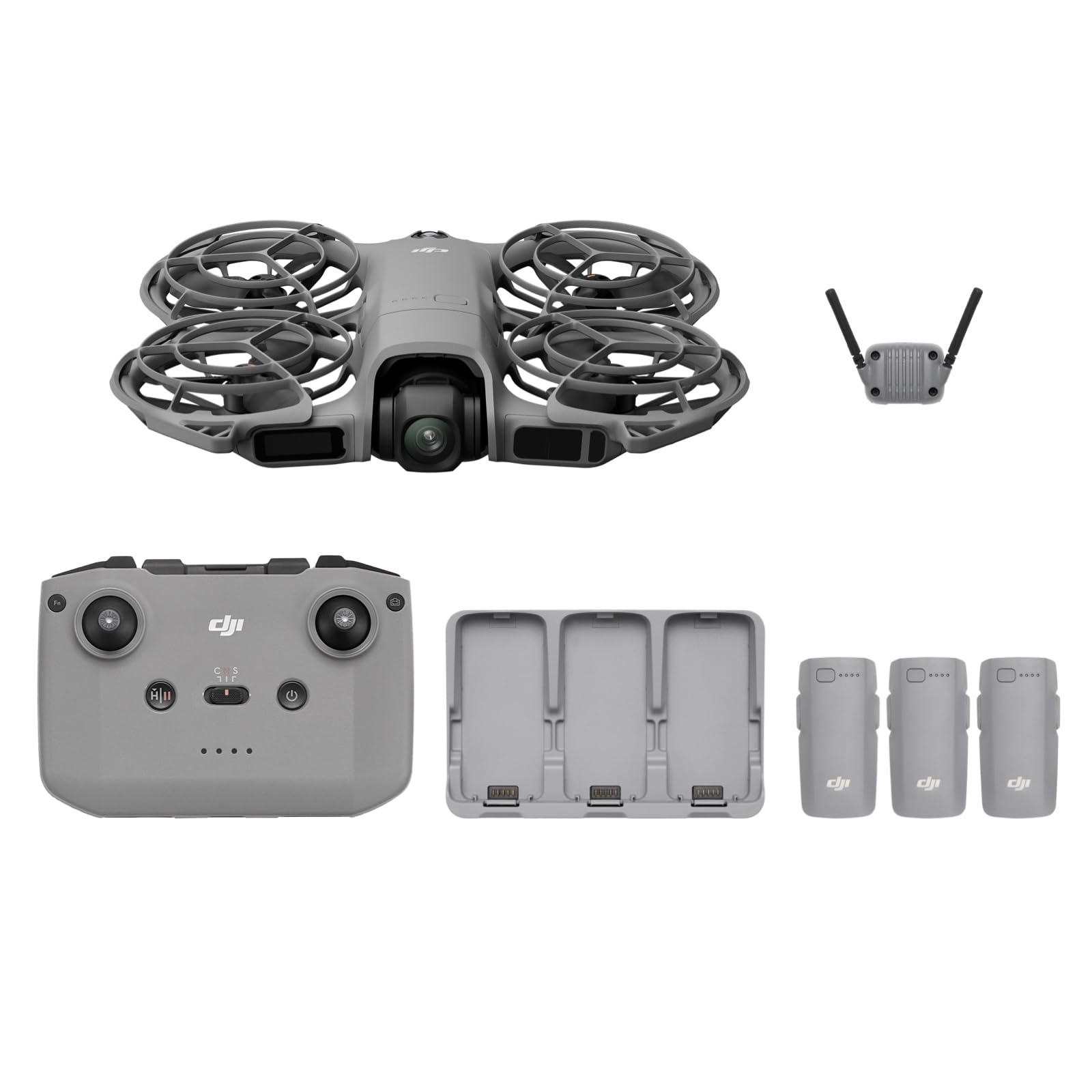
This is the drone that lets you fly without touching the controller. The DJI Neo 2 shines with palm takeoff and landing, plus gesture control that lets you command it with a wave of your hand — perfect for solo travelers who want a selfie without fumbling with apps. At just 151g and C0 certified, it is lighter than many rivals yet packs in omnidirectional obstacle sensing, so the drone sees threats from all sides and stops before it collides with them.
You get about 17 minutes per battery, which buyers report is the main limitation — so the Fly More Combo matters: it adds three batteries, a charging hub, and a digital transceiver (a device that sends video to your phone), turning a short flight into a full afternoon session. ActiveTrack (a feature that locks the camera on a moving subject) keeps your subject in frame automatically, and the two-axis camera stabilizer (a motorized mount that steadies the lens) keeps the horizon level even when you are not gentle with the sticks. The crowd favorite here — 4.5 stars across 700+ owners — consistently praises the crisp 4K video and how intuitive the controls feel for a first-time pilot.
One thing to know: the DJI Fly app is no longer on Google Play, so you will need to grab it from the official DJI website. That small friction aside, the combo is the most complete beginner package on this list, with propeller guards and spare parts included to survive the inevitable bumps.
Forgiving by Design
- Omnidirectional obstacle sensing stops it before collisions
- Palm takeoff and gesture control for hands-free flying
- Three batteries and a charging hub in the Fly More kit
- 151g weight means no registration hassle
The Two Trade-offs
- Battery life is the recurring gripe — roughly 17 minutes per pack
- Low-light video quality is weak; keep it for daytime
Choose the Neo 2 if: you want the most forgiving, accident-resistant drone that prioritizes safety sensors and easy gesture control over raw specs.
Look elsewhere if: you need single-battery flights longer than 17 minutes or plan to shoot much at dusk, since low light is its known weak spot.
2. Specta Mini Drone with Camera 4K
A 4K gimbal drone that undercuts the big names without gutting the specs.
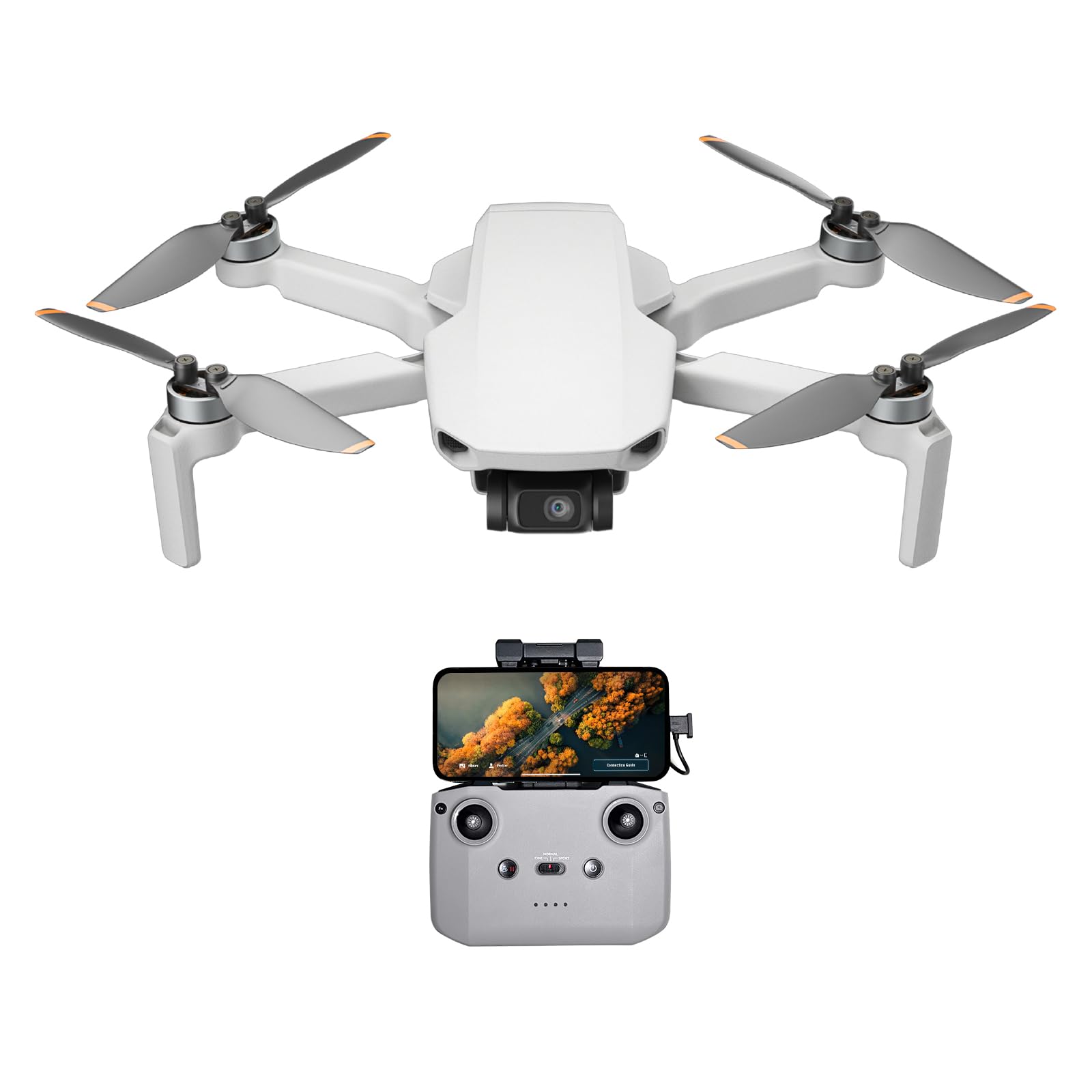
If you want cinematic 4K footage without paying flagship money, the Specta Mini delivers a real 3-axis gimbal — not just electronic smoothing — to keep shots steady. Owners mention the actual fly time per battery lands around 22-24 minutes, which is respectable for the class. The 32800ft (10km) transmission claim is optimistic; most owners find the connection starts to drop around.8 miles, which is still plenty for a beginner exploring a park.
Its calling card is the one-button takeoff and landing paired with GPS Return-to-Home, so you never have to manually wrestle it back to the ground. At under 249g, it skips FAA registration entirely, and the level 5 wind resistance means it holds its position even in a fresh breeze. Some customers note the companion app has been pulled from app stores, leaving phone pairing a challenge — check the app situation before committing.
The value equation is tough to top: it performs like the DJI Mini 4K at a fraction of the price. Yes, the proprietary batteries are expensive to replace, but for a first drone that gives you gimbal-stabilized 4K (a camera mount that keeps the lens steady) and a generous flight window, the Specta is a smart entry point.
Value Verdict: You get gimbal-stabilized 4K, GPS return, and a 22-24 minute real flight time for a budget price. The main risk is the app availability, so verify that first.
Reach for this if: you are on a budget but refuse to give up a mechanical 3-axis gimbal for smooth 4K shots.
Look elsewhere if: you want established, guaranteed app support and a wide ecosystem of affordable spare parts.
3. Potensic ATOM LT GPS Drone Expansion Kit
Two 3000mAh batteries deliver a real 80 minutes of total flight time, the longest in this lineup.
The Potensic ATOM LT solves the beginner’s biggest frustration: not enough air time. With two 3000mAh batteries, it promises a max flight time of 80 minutes — 40 minutes per battery — which reviewers point out is accurate and refreshing. The brushless motors and level 5 wind resistance keep it stable in breezy conditions, and the 2.5K EIS camera with a Sony sensor and 118° field of view captures smooth, vibrant footage even for a budget tier.
The PixSync 2.0 transmission system provides a stable HD feed up to 4km (13,123ft), and it supports four satellite positioning systems (GPS, GLONASS, Galileo, Beidou) for high-precision Auto Return Home. Beginners get a dedicated Beginner mode that limits distance and speed while you learn, and more advanced pilots can open up Follow Me, Waypoint Fly, and Circle Fly. The catch is battery charging — it can take about an hour and 45 minutes via a phone cable, so a fast charger is recommended.
The camera resolution tops out at 2560×1440, which is below the 4K standard, so if you are chasing maximum detail, look toward the ATOM SE instead. But for a first drone where flight time and safety matter more than pixel-peeping, the LT’s endurance is its superpower.
Endurance First: The 80-minute total flight time across two batteries is the headline, making it ideal for long practice sessions. The 2.5K camera is the honest trade-off for that airtime.
Grab this if: practicing and flying duration matter more to you than 4K resolution.
Consider a 4K model if: you want photos and video in the highest resolution possible, since this tops out at 2.5K.
4. Potensic ATOM SE GPS Drone with 4K EIS Camera

Thousands of verified owner reviews confirm reliable GPS return and honest 62-minute battery life.
With thousands of owners behind it, the Potensic ATOM SE is the most battle-tested beginner 4K drone here. It pairs a 1/3″ CMOS Sony sensor shooting 12MP photos and 4K/30fps video with a 118° FOV — no gimbal, but the ShakeVanish EIS keeps footage smooth. The SurgeFly control system includes a Beginner Mode that limits speed and distance, plus Video, Normal, and Sport modes, with Sport hitting a max speed of 16 m/s in 2.8 seconds for when you are ready to push.
The two 2500mAh batteries deliver a total 62 minutes of flight time (31 minutes each), and the PixSync 2.0 transmission maintains a stable feed up to 4km (13,123ft). Buyers confirm the GPS Auto Return works flawlessly on low power or signal loss, and the drone hovers well even in wind. At 248g, it is right at the registration-free limit and folds down to fit a jacket pocket. The realistic range is more like 1,200-1,500 ft with obstructions, not the full 4km, so plan flights accordingly.
The ATOM SE is the safe, proven recommendation for a first drone. It delivers sharp day footage, reliable GPS behaviors, and a battery system that outlasts most rivals. The camera does drop in quality at night, and there is no optical zoom — but those are reasonable concessions at this price point.
Why Thousands Bought It
- 4K/30fps video with a 118° field of view for wide shots
- 62 minutes total flight time across two batteries
- Beginner Mode and three flight modes to grow into
- GPS Auto Return that shoppers say works perfectly every time
Set Your Expectations
- Real-world transmission range is closer to 1,500 ft than the claimed 4km
- Night video quality drops off noticeably
Best for: the new pilot who wants a proven, reliable 4K drone with honest battery life and GPS safety nets.
Not for: long-range explorers who need the full 4km transmission in built-up areas, or night shooters who expect clean low-light footage.
5. Skyrover S1 Mini Drone with Camera
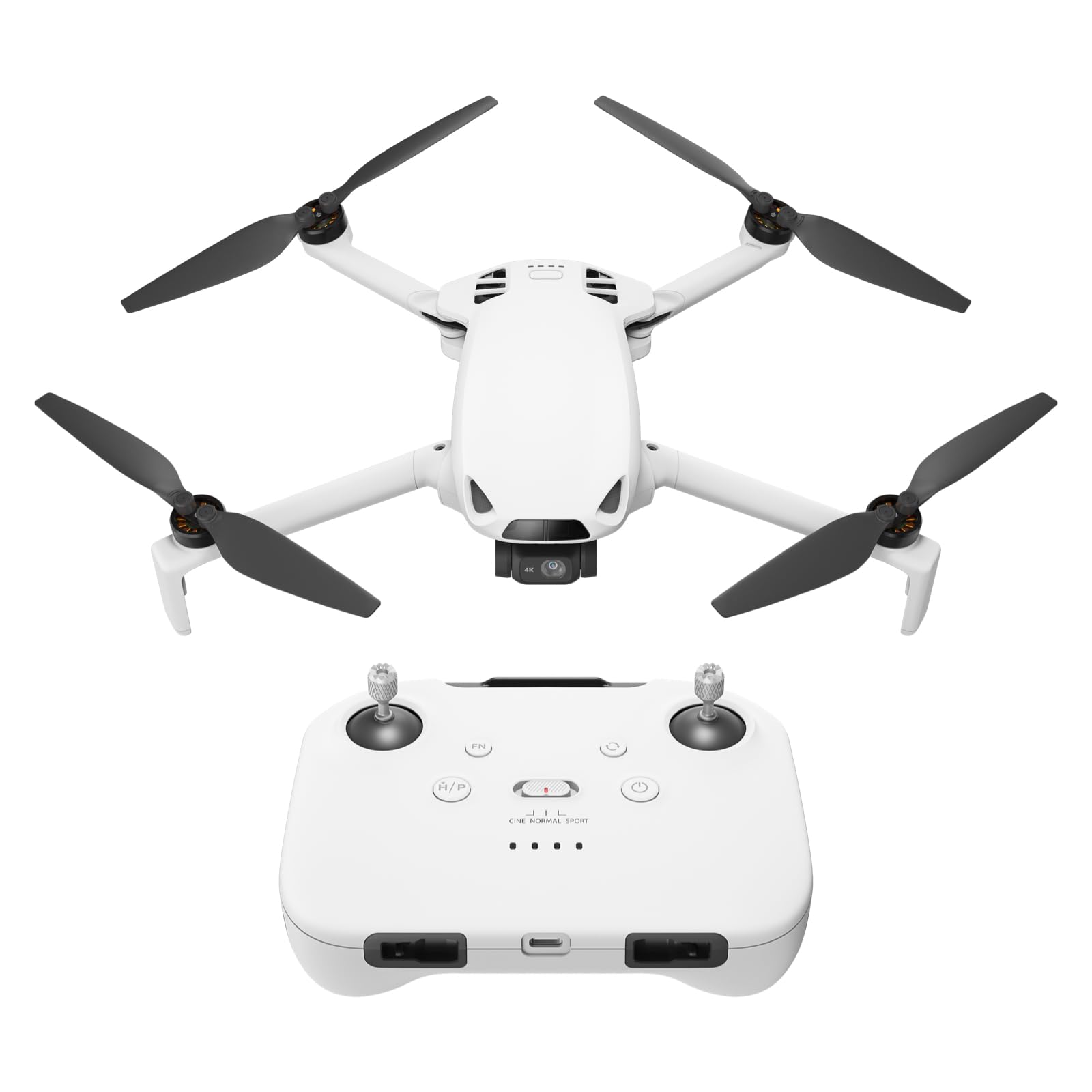
A mechanical 3-axis gimbal and 4K/60fps capture deliver the smoothest video in this price class.
The Skyrover S1 is for the beginner who cares about video quality from day one. It captures 4K/60fps video and 8K/48MP photos using a 1/2″ CMOS sensor, with a true mechanical 3-axis gimbal keeping the frame steady even when you are flying fast or in breezy conditions. The 40-minute flight time per battery is among the best single-pack figures here, and the 39,000ft (7.45 mile) video transmission claim is backed by owners who tested it to about 2 miles without issue.
Forward obstacle avoidance and Smart Return-to-Home give new pilots a safety cushion, while Auto Track keeps a subject centered in the frame as you fly. Content creators will love the 2.7K vertical video mode with intelligent cropping, tune for TikTok, Instagram Reels, and YouTube Shorts — a feature most rivals lack. The time-lapse mode automatically shoots and stitches smooth footage of sunsets, clouds, or city traffic with one tap.
The honest caveat is the startup process — some buyers report it takes 15-20 minutes to get the drone and app linked and ready for the first flight each session. And for 4K/60fps footage, you will need a fast 32GB+ microSD card. Once in the air, the performance rivals drones that cost significantly more.
Creator’s Choice: The 4K/60fps video, 3-axis gimbal, and vertical shooting mode make it the best social-media-ready drone here. The startup hiccup is the price you pay for those specs.
Pick this if: you want 60fps smoothness and 8K photos, and you plan to post vertical footage to social media.
Pass if: you want a grab-and-go drone that launches in under a minute, since its startup routine can be slow.
6. Bwine F7GIM 4K Video 6K Photo Drone
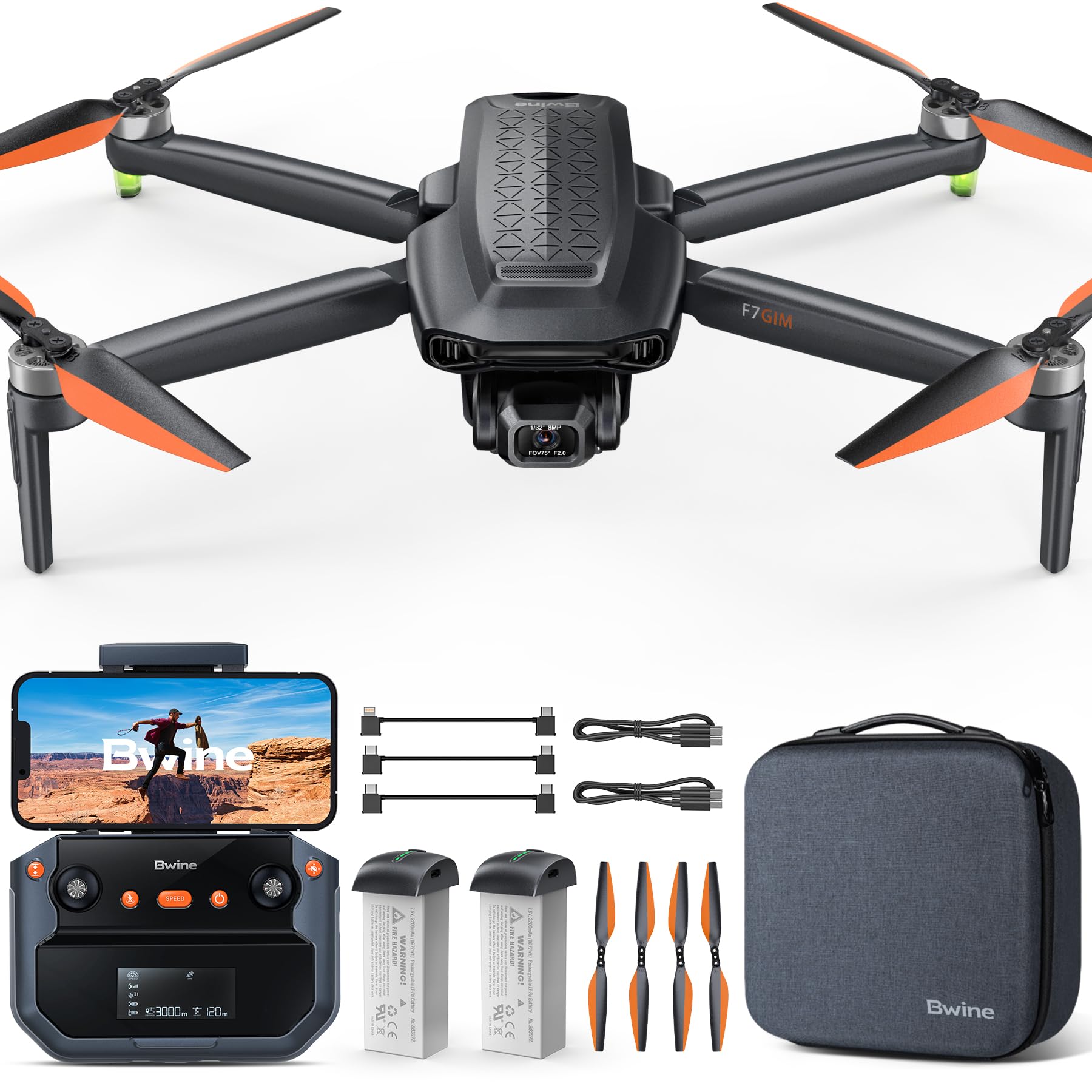
A 70-minute flight time and 10,000ft transmission range make it ideal for open-field exploration.
The Bwine F7GIM stands out for its 70-minute total flight time — two batteries at 35 minutes each — and a 10,000ft real-time transmission range. It captures 6K photos and 4K/30fps video with an 18MP camera and a 3-axis brushless gimbal that keeps things steady in strong winds. The TOF and GPS sensors raise low-altitude stability, making it forgiving for beginners while offering pro-level modes like follow, orbit, cruise control, and waypoint planning.
The built-in FAA-compliant Remote ID module is a bonus, and the bundle includes a military-grade shockproof carrying case, spare propellers, and a full maintenance kit. Owners mention it handles 10mph winds with ease and the GPS follow functions work reliably. The 5X digital zoom extends your reach, and Night Mode 2.0 is available for lower-light scenes.
The trade-offs are real: the remote’s screen is hard to see in direct sunlight, photos lean grainy in some conditions, and you must calibrate the compass before each flight. The proprietary batteries also swell if stored fully charged — keep them at 50-60% when not in use. For long-distance field work, the range and battery make it a compelling pick.
Field Specialist: The 70-minute flight time and 10,000ft range make it ideal for farmland, large parks, and long inspection flights. It demands more pre-flight care than simpler drones.
Reach for this if: you need maximum range and flight endurance for outdoor exploration and inspections.
Think twice if: you want a simple, instant-launch drone — the compass calibration ritual and careful battery storage add ownership duties.
7. Ruko Drone with Camera for Adults
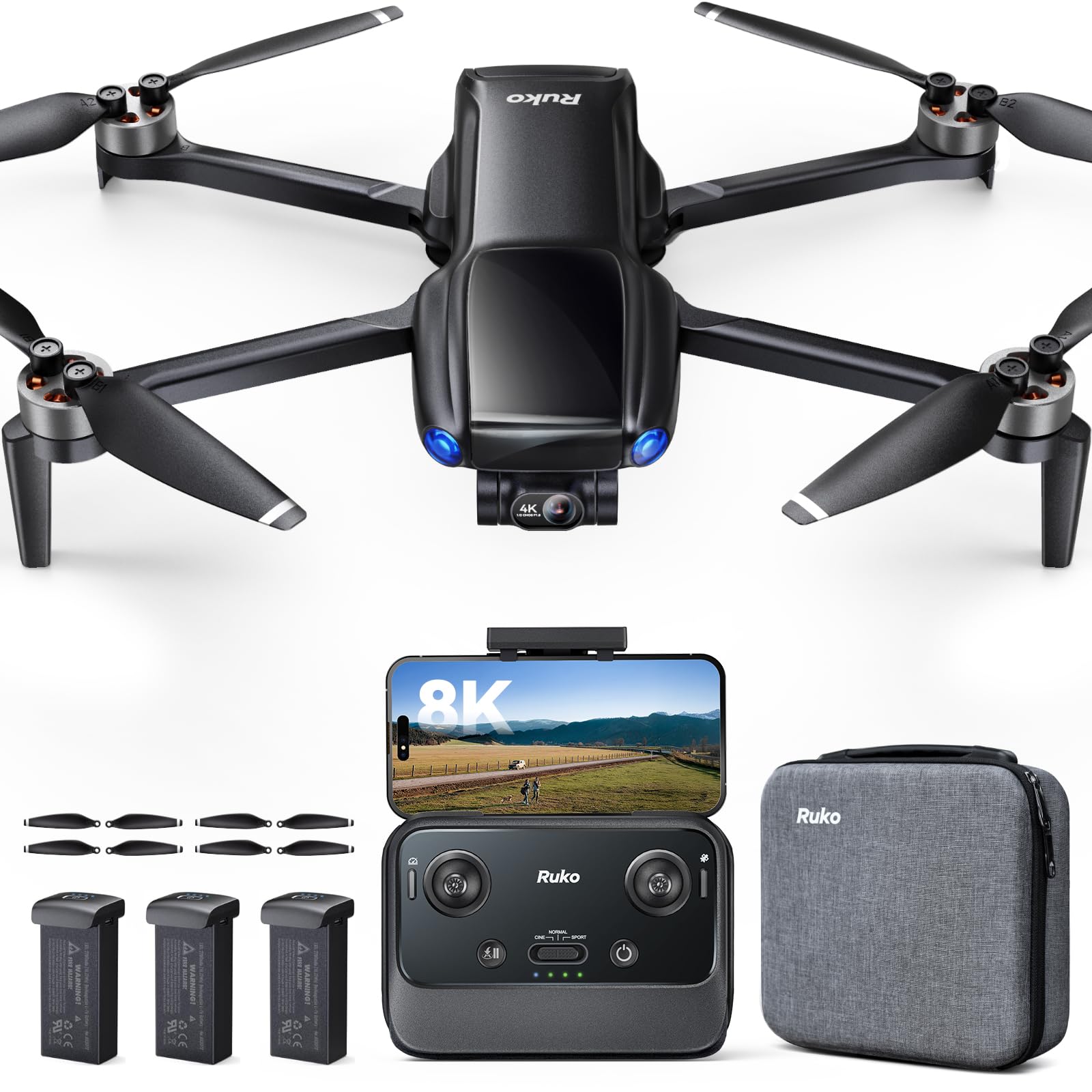
Three batteries, a carrying case, and full accessories make this the most complete ready-to-fly bundle.
The Ruko is the drone you hand someone who appreciates getting everything in one elegant package. It delivers up to 96 minutes of flight time across three batteries (32 minutes each), a 1/2″ 48MP CMOS sensor for 8K photos and 4K/30fps video, and a 3-axis brushless gimbal with EIS for smooth footage. The 20,000ft (6km) transmission range via the R2 digital system keeps you connected for far-reaching exploration.
For safety, it uses quadruple positioning — TOF, optical flow, barometer, and GPS — for rock-steady hovering, plus one-tap takeoff and Auto Return Home on low power or signal loss. Owners praise how easy it is for non-tech users, with a beginner mode and tutorial built in. The carrying case, three smart batteries, spare propellers, and full accessory kit make it a genuinely complete bundle.
The drone weighs 248g, under the registration threshold, and customers note it handles 10-16MPH winds with manageable drift. A few note that third-party landing gear and guards need to be removed for storage. Ruko’s 24/7 customer service and generous support are frequently highlighted as a major reason to buy.
Complete Package: Three batteries, a case, and full accessories make this the lowest-friction gift option. The customer service reputation is among the strongest in this list.
Choose this if: you want a ready-to-fly bundle with three batteries and a case, backed by responsive 24/7 support.
skip it if: you plan to use third-party accessories frequently, since some require removal for the included case to close.
8. SKYROVER X1 Drone with Camera Combo

360° obstacle avoidance and a large f/1.7 sensor bring pro-level safety and low-light performance.
If your budget stretches, the SKYROVER X1 is the drone you buy when you want the most advanced safety and imaging in a sub-249g frame. It captures 4K/60fps HDR video and 48MP photos with a large 1/1.32″ CMOS sensor and an f/1.7 aperture — a spec that lets in more light for genuinely better dusk and night shots. The AI Night Mode builds on that sensor to capture city lights and sunset scenes with usable detail.
The 360° obstacle avoidance is the standout safety feature, sensing threats from every direction and pulling up in time to save the drone — owners credit it with saving their aircraft on multiple occasions. The SkyBridge transmission reaches up to 9.32 miles (50,000ft), and the three batteries deliver a total of 96 minutes of flight time (32 minutes each). Vertical shooting, AI Auto Track, and Smart Spotlight make social-ready content easy.
The 4K/100fps slow-motion mode and timelapse capture add creative options most beginners won’t outgrow for years. Real-world flight time is closer to 25-30 minutes per battery, and the lighter build feels less substantial than a DJI. Accessories are harder to source than for bigger brands, and the controller gimbal can develop a jiggle over time — but the performance-to-price ratio is exceptional.
Pro-Grade Features
- 4K/60fps HDR video and 48MP photos with an f/1.7 aperture for low light
- 360° obstacle avoidance that owners say has saved the drone twice
- 96-minute total flight time across three batteries
- 9.32-mile transmission range with 1080p/60fps live view
Reality Check
- Real flight time lands around 25-30 minutes per battery, below the 32-minute claim
- Obstacle avoidance can miss very thin branches, so don’t rely on it entirely
- Accessories are harder to find than for DJI or Potensic
Step up to this if: you want 360° safety sensing and a large-sensor camera for night footage, all in a registration-free 249g frame.
Stick with a simpler model if: you want to keep costs down and don’t plan to shoot at dusk or need slow-motion video.
9. Bwine F7MINI 4K Video 8K Photo Drone
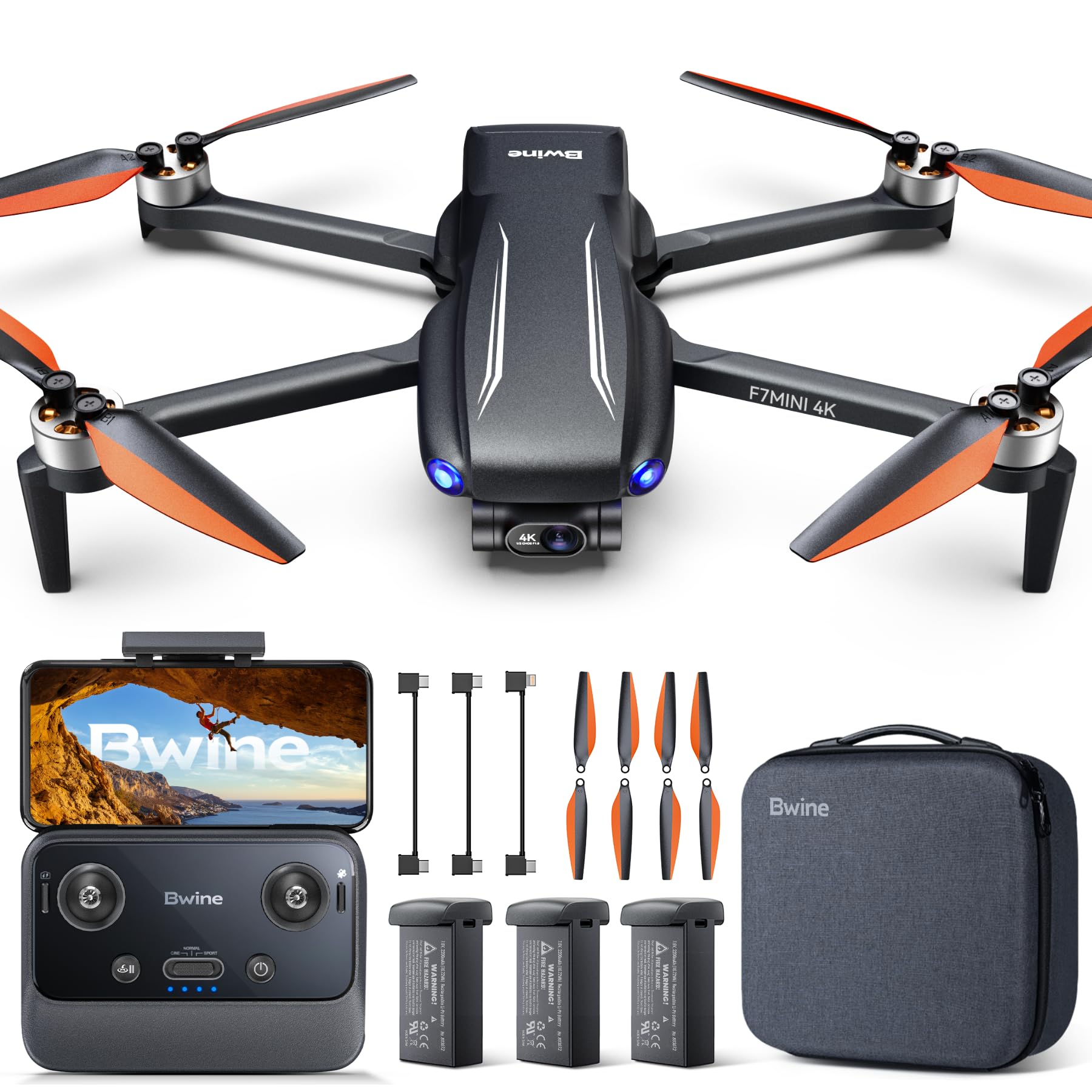
A built-in 5.5″ touchscreen controller keeps your phone free and the live feed easy to see.
The Bwine F7MINI is the only drone here whose remote controller has a built-in screen — a 5.5″ touchscreen that means you never have to clip in your phone. That is a huge convenience for beginners who want to see the live feed without draining their phone battery or worrying about cable compatibility. It captures 8K photos and 4K/30fps video with a 48MP 1/2″ CMOS sensor and an F1.8 aperture, stabilized by a 3-axis gimbal.
The three high-density batteries deliver 96 minutes of total flight time (32 minutes each) and support PD 3.0 fast charging. The 1503 brushless motor hits a 31mph top speed while maintaining level-5 wind resistance, so it stays steady even on blustery days. Smart RTH, a dynamic home point, and a 120dB locator buzzer help you recover the drone if it goes down or gets lost.
Intelligent GPS modes include auto cruise, 0.5m accurate follow, orbit, and waypoint, plus optical flow positioning for stable indoor flight when GPS isn’t available. The F7MINI is the most beginner-friendly premium option if you value the standalone controller, though reviewers point out the media transfer from controller to phone can be slow — about 10 minutes for a video and a few photos.
Phone-Free Flying: The 5.5″ touchscreen controller is the defining feature, keeping your phone free and the feed easy to see. It is a premium convenience worth the cost for many.
Buy this if: you want the built-in screen controller, three-battery endurance, and strong wind resistance in a registration-free package.
Consider a cheaper model if: you are happy using your phone as the screen and want to save your budget for extra accessories.
Understanding the Specs
Obstacle Avoidance
This is the drone’s collision-detection system, using sensors (like cameras or ToF, which measures distance by bouncing light) to spot objects in its path. It can stop the drone or fly around the object automatically. For a beginner, this is your crash insurance — it won’t prevent every accident, but it turns a careless moment into a close call instead of a wreck. 360° systems cover all directions, while forward-only systems only protect the front.
Transmission Range
This is how far the drone can fly from the remote before losing the live video feed and control signal. The numbers look impressive on the box — 4km, 10km, even 9.32 miles. In the real world, buildings, trees, and hills reduce that dramatically. Most shoppers say reliable range of 1,500 to 3,200 feet in typical suburban conditions. Plan your flights assuming half the advertised range, and you will never be caught off guard.
FAQ
Do I need FAA registration for a beginner drone under 249g?
What is the difference between a 3-axis gimbal and EIS?
How long does a beginner drone battery actually last?
Is the DJI Fly app still available for the Neo 2?
How far can a beginner drone realistically fly before losing signal?
Can I fly a mini drone in the wind?
What does Return-to-Home (RTH) actually do?
Is a 4K camera necessary on a beginner drone?
How do I choose between the Potensic ATOM LT and ATOM SE?
What is the best beginner drone for low-light or night flying?
Final Thoughts: The Verdict
For most new pilots, the beginner drone with camera winner is the DJI Neo 2 Fly More Combo because its omnidirectional obstacle sensing and gesture controls take the fear out of your first flights. If you want the longest total airtime, grab the Potensic ATOM LT with its 80-minute battery endurance. And for the smoothest video specs with a 3-axis gimbal, the Skyrover S1 is the one to reach for.
How We Picked
We do not accept paid placement. Every pick is matched to a real buyer and a real use-case; we do not hands-on test units.
Sources & Methodology
Specifications: manufacturer listings and product documentation. Review insights: verified customer reviews, as of August 2026. Pricing: not shown on this page (it changes often); check the current price via the retailer link.
As an Amazon Associate, Gadgets Feed earns from qualifying purchases. This does not affect which products we feature.