
Our readers keep the lights on and my morning glass full of iced black tea. As an Amazon Associate, I earn from qualifying purchases.
Specs are compiled from manufacturer listings and verified buyer reviews and can change over time — please confirm the key details on the product page before buying.
Your first electric skateboard should feel safe, not scary. The best beginner boards cap their top speed around 15 mph, keep the motor gentle, and focus on smooth braking over raw power. The M8 below is the crowd favorite for that exact reason, with a 4.4-star rating across a solid base of owners.
I’m Min — the founder and writer behind Gadgets Feed. This guide is built by comparing the manufacturers’ published specifications and the patterns across verified customer reviews, so you get each pick’s real strengths and trade-offs instead of marketing spin.
Whether you are a teen testing the waters or an adult commuting a few miles, this beginner electric skateboard guide cuts through the noise to find the board that matches your weight, your roads, and your confidence level.
Our Picks at a Glance


How To Choose The Best Beginner Electric Skateboard
Forget the marketing hype about ludicrous speeds. A beginner board needs to be forgiving — gentle acceleration, predictable brakes, and a deck that doesn’t feel like a balance beam. You are learning muscle memory, not chasing records.
Match the Motor to Your Weight
The single biggest mistake new riders make is ignoring the weight limit. A single 350W motor that feels zippy for a 120-pound teen can feel sluggish for a 200-pound adult. Check the board’s load capacity against your body weight, and remember that a heavier rider loses acceleration and hill-climbing ability no matter how strong the spec sheet looks.
Look for a Remote with Real Speed Modes
Your remote is your lifeline. A good beginner remote has multiple speed modes so you can start slow and ramp up as your balance improves. The brake should be smooth and progressive, not a sudden jolt that pitches you forward.
Consider the Deck and the Surface You Ride
Short decks under 28 inches are easy to carry and maneuver but feel twitchier at speed. Longer decks are more stable. If your roads are rough, you want larger, shock-absorbing wheels rather than hard, small ones that transmit every crack straight to your feet.
Quick Comparison
| Model | Best For | Top Speed | Range | Motor | Amazon |
|---|---|---|---|---|---|
| M8 DNASKATE★ Best Overall | Overall beginners | 15 mph | 9 miles | 400W hub | Amazon |
| EBOSSOM ES6 SEBest For Teens | Younger teens | 10 mph | 6-8 miles | 350W hub | Amazon |
| MEEPO Campus V3 | Light riders | 15.5 mph | 8-10 miles | Single hub | Amazon |
| ASKATE A1 | Longer commutes | 15.5 mph | 17 miles | 350W hub | Amazon |
| UDITER S3 Pixel | Tech enthusiasts | 18 mph | 12 miles | 600W hub | Amazon |
In‑Depth Reviews
1. M8 Electric Skateboard with Remote
Our pick — over 4★ from 100+ verified ratings; the strongest balance of quality and price.
The forgiving 28-inch cruiser that makes flat-ground confidence feel easy.
The M8 earns the top spot by nailing the beginner formula: a 400W brushless hub-motor (the motor built into the wheel itself) that tops out at a manageable 15 mph, paired with a 28-inch deck that has a practical kicktail — the little upturned lip at the back — so you can pop the nose up and steer with your foot. On flat asphalt, owners consistently report cruising at 15 to 18 mph with a full advertised range after the battery’s break-in period. It outruns the EBOSSOM below by a solid margin: 15 mph versus 10 mph top speed, and a 9-mile range versus 6-8 miles.
The ride experience is where this board wins people over — quality is the thing everyone raves about, with the value-for-money angle running close behind. The LCD remote shows your speed and gear, and you get 4 speed modes so you can start gentle and graduate to faster as your balance builds. It also supports a max 14° climbing angle. The practical limit, echoed across reports, is hills: this is a flat-road board, so expect to push it up steeper inclines. Heavier riders around the 200-pound mark report consistent speed on flat ground, though one 120-pound owner found the acceleration snappy across all four gears.
Durability shows up as a genuine strength rather than a promise, with riders logging over 100 miles and reporting the battery still strong — one owner charged the remote exactly once in that whole span. The grip tape and bearings will wear with hard use, which is normal for any board. A 6-month warranty covers you from the day it arrives.
What Wins Riders Over
- 400W hub-motor is reliable and low-maintenance
- LCD remote with 4 speed modes for gradual learning
- 11.5-pound weight makes it easy to carry
- Independent battery monitoring with UL testing
Where It Falls Short
- Struggles on hills; flat roads are its home
- Grip tape wears down with heavy use
- Plastic remote feels less premium
Reach for this if: you want the proven all-rounder that balances speed, range, and build quality for a first board.
Look elsewhere if: your commute involves steep hills or you weigh well over 200 pounds and need extra torque.
2. EBOSSOM ES6 SE
The mellow 10-mph starter board parents can actually feel good about.
If your rider is on the younger side — think 7 to 12 years old — the EBOSSOM is built around one idea: keep it slow enough to stay safe. Its 350W brushless motor tops out at a gentle 10 mph across 4 speed modes, and its 8-ply maple deck is reinforced to support up to 220 lbs, though a recommended 160 lbs keeps the battery performing at its best. The 27-inch deck and wide 9.1-inch stance give young riders a stable platform — notably wider than the M8’s 8-inch deck, which translates to more forgiving balance for wobbly first-timers.
What owners consistently highlight is the battery and speed — both get the most mentions, and in this case those are two things beginners actually care about. Grandparents report kids taking to it immediately, and the charge holds for a long time between rides. The wireless remote pairs easily and lets riders switch modes on the fly, which is exactly what a nervous parent wants to see. It also carries a UL2272 test report and an FCC report, giving you documented safety certification beyond just marketing language.
The honest trade-off: this is a straight-line cruiser, not a hill climber. Owners note the motor isn’t the strongest, but it’s plenty for coasting on flat paths and getting good speed on straightaways. The remote feels a bit flimsy in the hand, though it functions well. For a first taste of electric riding without the fear factor, this hits the mark.
Who It’s For: young teens and lighter adults who want a safe, slow, confidence-building first board on flat ground. The top speed of 10 mph is low enough that a 7-year-old can manage it, yet still fast enough to feel like real electric riding.
The Fit Note: heavier riders near the 220-pound max will noticeably cut into range and hill ability, so treat the 160-pound recommendation as the realistic balance, not the advertised ceiling.
3. MEEPO Campus V3 Series

A tiny 26.7-inch commuter that slips into a backpack and glides to 15.5 mph.
The MEEPO Campus is the pocket rocket of this list — a compact 26.7-inch deck that the brand explicitly positions for 12-to-18-year-old beginners. Its 4-speed M5 remote reaches a top speed of 15.5 mph in Pro mode, with a 7-ply maple deck that’s FSC certified (meaning the wood comes from responsibly managed forests). The battery charges in about 3 hours, which is on the slower side, but you get 8-10 miles of range in return. Owners love the smooth ride and the brake system, praising how easy it is to swap speeds and how portable the tiny deck makes it.
The thing everyone calls out is how compact it is — “it’s tiny” comes up again and again — but that size comes with a critical asterisk. The board is rated to support up to 150 lbs, and MEEPO is upfront that riders over that weight will see reduced speed performance. One 220-pound owner used it as a reliable commuter but noted noticeably reduced acceleration. Another rider who logged 33 miles found the real-world range closer to 6 miles on flat ground and recommended it for riders under 135 lbs. Speed modes 3 and 4 add minimal gain, hovering around 11-12 mph while draining the battery faster.
Here’s the honest read: this is a genuinely fun, well-built little board for lighter riders, but the feedback is genuinely split. The battery life and durability reviews are mixed — some buyers report long charge retention while others describe unexpected shutdowns. Treat this as a board for smaller teens and lighter adults who value portability over raw power, and keep expectations realistic about hill climbs and top-end speed.
The Compact Advantage
- Smooth, progressive brake system
- Easy speed changes via M5 remote
- FSC-certified 7-ply maple deck
- UL2272 certified battery protections
The Weight Reality
- 150-lb limit cuts speed for heavier riders
- Real-world range dips to ~6 miles
- Speed modes 3-4 barely increase pace
Who It Beats: anyone under 135 lbs wanting the most portable, easy-to-carry electric board that still hits a fun 15.5 mph.
Who It Doesn’t: heavier riders, hill commuters, or anyone expecting the full advertised range on every ride.
4. ASKATE A1
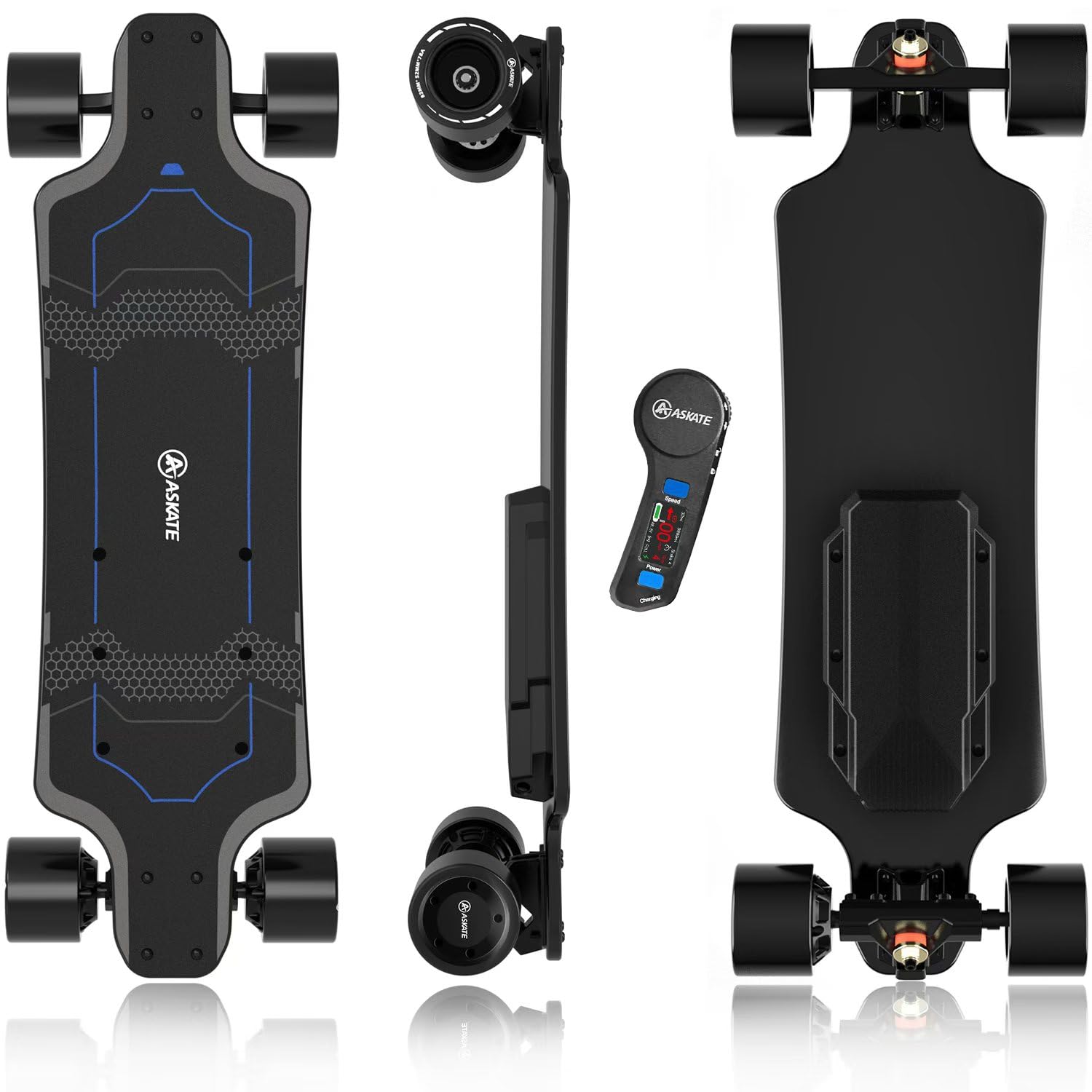
The 31.5-inch range king that turns a school commute into a daily joyride.
If range anxiety is your biggest fear, the ASKATE A1 answers it directly: up to 17 miles per charge, which is nearly double the M8’s 9-mile range and far beyond what most beginners will ride in a day. That’s the standout metric here, but it’s far from the only draw. The 31.5-inch deck is longer than the others on this list, which translates to a more stable, settled ride at speed — a real comfort factor for new riders finding their feet. It also carries up to 264 lbs, giving heavier beginners a legitimate option that lighter boards can’t offer.
Quality and beginner suitability are what owners highlight most, with a 12-year-old’s daily school commute being the classic success story. The MR remote with its high-definition LED screen lets you monitor battery level, check instant speed, and log mileage — a genuinely useful learning tool. It offers four speed and brake modes, and the single 350W motor hits a top speed of 25 KPH (about 15.5 mph). Owners mention it can climb hills, just not quickly — enough to get you to the top without drama. One rider even put the remote through a washing machine cycle by accident and it kept working, a small but telling durability vote.
The honest warts: battery life and durability feedback is genuinely mixed. The battery takes a long time to fully charge — around 3.5 hours — and while some customers note it’s still going strong, others describe quality issues over time. A heavier rider found the board couldn’t carry them up small hills without significant momentum. And one alarming report describes the remote occasionally flickering signal with the board, leading to brake failure. That’s a rare anecdote, but for a safety-critical system, it’s worth knowing about.
The Verdict: the best pick if you need serious per-charge range and a weight capacity that actually accommodates adult riders. The 17-mile reach and 264-lb limit set it apart from every other board here.
The Caution: treat the occasional remote-signal report seriously — test the brake response fully in a safe open area before you trust it on busy streets.
5. UDITER S3 Pixel Rider
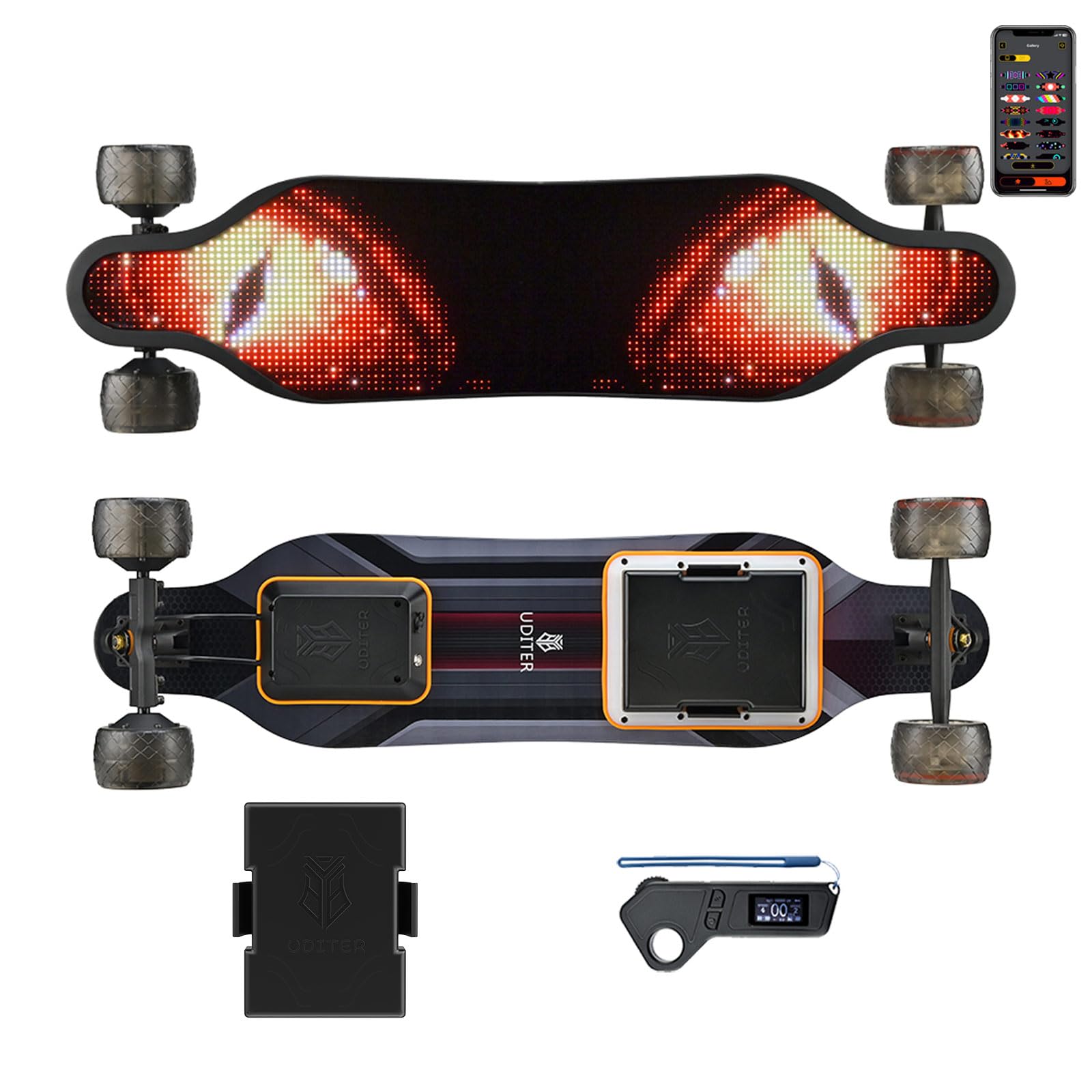
A 600W full-deck LED showpiece that’s as much about looks as it is about the ride.
The Pixel Rider is the wildcard of this list — not because it’s hard to ride, but because it’s a different species of beginner board entirely. Its headline feature is the full-deck LED display, which runs custom visuals you upload through an app: images, animations, even text. It’s the kind of board that turns heads at night and makes the rider the center of attention. But the tech showpiece sits on serious hardware: a 600W motor system that hits 18 mph and handles slopes up to 30°, with a 12-mile range on ideal conditions. That makes it the most powerful board here, doubling the EBOSSOM’s motor output.
The swappable battery is the genuinely useful a neat extra — a 42V 5.2Ah removable pack that swaps in seconds, so you can ride back-to-back sessions without ever waiting at a charger. The 37.6-inch deck is the longest and widest here at 9.7 inches, built from a 13-layer construction of FSC-certified Canadian maple and fiberglass that supports up to 330 lbs. Instead of abrasive sandpaper grip, it uses a transparent silicone surface that provides traction without shredding your hands. Owners at 217 lbs describe it as very fast and powerful, with the customizable LEDs being the favorite feature.
The battery earns praise for pumping out full power until completely dead. But there are recurring reports of the LED screen failing — one unit’s screen died within a day from the start, and another stopped working after three months. The brake system has a reported wobble, and the heavy 10 kg weight makes it harder to carry than the others. This is a board for tech lovers who accept some tinkering risk in exchange for the coolest deck on the street.
What Makes It Special
- Full-deck LED display with custom visuals via app
- 600W motor hits 18 mph and climbs 30° slopes
- Swappable battery extends rides infinitely
- 330-lb capacity suits heavy riders
What To Watch
- LED screen reliability is a recurring complaint
- Brake wobble reported by some owners
- Heavy 10 kg weight makes carrying a workout
- Sudden throttle can catch new riders off guard
Reach for this if: you want the most powerful, flashiest board on the block and don’t mind troubleshooting the occasional screen glitch.
Look elsewhere if: you want a low-maintenance, dependable first board — the M8 above offers that reliability for a fraction of the price.
Understanding the Specs
Hub Motor vs. Belt Motor
Most beginner boards use a hub motor, which sits inside the wheel itself. That design means fewer moving parts, less maintenance, and you can still push the board like a regular skateboard if the battery dies. Belt motors deliver more torque for hills but add complexity and noise. For a first board, hub is almost always the right call.
UL 2272 Certification
This is the safety standard for electric skateboards, covering the battery, charging system, and electrical components against fire and shock risks. A board that carries a UL2272 test report has been independently checked for electrical safety, which matters when you’re charging a lithium battery overnight in your home.
Deck Length and Rider Weight
Shorter decks under 28 inches are easier to carry and maneuver but less stable at speed. Longer decks above 31 inches ride smoother but weigh more. Every board has a load capacity — buy one that clears your body weight by a comfortable margin, because heavier riders lose acceleration, top speed, and hill-climbing power no matter the spec sheet.
Speed Modes and Braking
Beginner boards typically offer 3 to 4 speed modes, letting you start slow and increase the ceiling as your balance improves. The brake is the more critical feature — a smooth, progressive brake slows you down predictably, while an abrupt one can pitch you off. Test your brake in an empty parking lot before you ride near traffic.
FAQ
How fast should a beginner electric skateboard go?
What does the weight limit actually mean for me?
Will an electric skateboard carry me up hills?
How long does the battery take to charge?
How far can I actually ride on one charge?
Is a hub motor or belt motor better for my first board?
What does UL2272 certification mean?
Can kids ride these boards safely?
How long does an electric skateboard last?
Final Thoughts: The Verdict
For most people, the beginner electric skateboard winner is the M8 because it pairs a 400W hub motor with a 9-mile range in a way that owners consistently praise for quality and value. If you want a board your young teen can learn on without fear, the EBOSSOM caps at a reassuring 10 mph. And if your commute demands range, the ASKATE A1 stretches up to 17 miles — nearly double the M8 — for riders up to 264 lbs.
How We Picked
We do not accept paid placement. Every pick is matched to a real buyer and a real use-case; we do not hands-on test units.
Sources & Methodology
Specifications: manufacturer listings and product documentation. Review insights: verified customer reviews, as of August 2026. Pricing: not shown on this page (it changes often); check the current price via the retailer link.
As an Amazon Associate, Gadgets Feed earns from qualifying purchases. This does not affect which products we feature.