
The single most common reason a beginner-friendly telescope ends up collecting dust in a closet isn’t the price tag — it’s the frustration of a 45-minute assembly that requires a hex key and a physics degree to get a blurry, wobbling image of the moon. The small details separate scopes that deliver that first “wow” Saturn ring moment from gear that kills the hobby before it starts. This guide focuses exclusively on the optics, mounts, and accessories packed into kits that respect your time and patience.
I’m Min — the co-founder and writer behind Gadgets Feed. I’ve spent hundreds of hours analyzing the optical specifications, mount stability, and accessory bundles in this price range to separate the truly beginner-friendly telescopes from the kits that overpromise and underdeliver on image clarity and setup speed.
These recommendations boil down to which scopes consistently give new stargazers clear, sharp views of the moon’s craters and Jupiter’s moons the very first night, making this the definitive list of the best beginner friendly telescope options available right now.
How To Choose The Best Beginner Friendly Telescope
The best entry-level scope isn’t the one with the highest magnification number on the box — it’s the one that gets used regularly. That means prioritizing setup speed, mount stability, and aperture size over exaggerated zoom claims. Here are the three factors that matter most.
Aperture: The Light-Gathering Engine
The aperture — the diameter of the main lens or mirror — is the single most important spec on any telescope. A larger aperture captures more light, which translates directly to brighter, sharper, more detailed images. In this guide, you’ll see options ranging from 80mm refractors to a 150mm reflector. An 80mm scope shows the moon’s craters, Jupiter’s four largest moons, and Saturn’s rings as a distinct shape. A 150mm scope reveals finer banding on Jupiter and subtle cloud structure on Saturn, but requires more setup effort.
Mount Type: Stability Is Not Optional
For a beginner, the mount often makes or breaks the experience. Altazimuth (AZ) mounts are the simplest — they move left-right and up-down, and are intuitive to use. Equatorial (EQ) mounts require polar alignment to follow the night sky’s rotation but become essential if you ever want to attempt long-exposure astrophotography. Computerized GoTo mounts handle object-finding automatically but add battery dependency and a steeper learning curve. Every product reviewed here is assessed for how stable it keeps the view when you’re trying to focus at high power.
Accessory Bundle: Quality Over Quantity
A kit stuffed with cheap plastic eyepieces, flimsy Barlow lenses, and an unusable finder scope creates frustration, not fun. The best beginner kits include two decent eyepieces (a low-power 20-25mm for wide views and a medium-power 10mm for planetary detail), a functional red-dot or optical finder scope, a moon filter to cut glare, and a smartphone adapter that actually holds alignment. Avoid packages that advertise “300x magnification” using a 3x Barlow on a weak eyepiece — the image will be too dim and blurry to enjoy.
Quick Comparison
On smaller screens, swipe sideways to see the full table.
| Model | Category | Best For | Key Spec | Amazon |
|---|---|---|---|---|
| MEEZAA 150EQ | Reflector | Deep-sky & upgrader path | 150mm aperture, 650mm f/4.3 | Amazon |
| Hawkko 90/900 | Refractor | Planetary detail on a budget | 90mm aperture, 900mm f/10 | Amazon |
| Celestron StarSense LT 80AZ | Refractor | Easiest object-location | 80mm aperture, app-guided | Amazon |
| Koolpte 90/700 | Refractor | Value kit with slow-mo mount | 90mm aperture, 700mm f/7.8 | Amazon |
| MEEZAA 90/800 | Refractor | Stable stainless steel tripod | 90mm aperture, 800mm f/8.9 | Amazon |
| Celticbird 80/900 | Refractor | Long focal length planets | 80mm aperture, 900mm f/11.25 | Amazon |
| Gskyer 80/400 | Refractor | Wide-field & daytime use | 80mm aperture, 400mm f/5 | Amazon |
| Celestron 114LCM | Reflector | Family & GoTo convenience | 114mm aperture, motorized | Amazon |
| HUGERSTAR 80/600 | Refractor | Quick & budget-friendly | 80mm aperture, 600mm f/7.5 | Amazon |
In‑Depth Reviews
1. MEEZAA 150EQ Newtonian Reflector Telescope
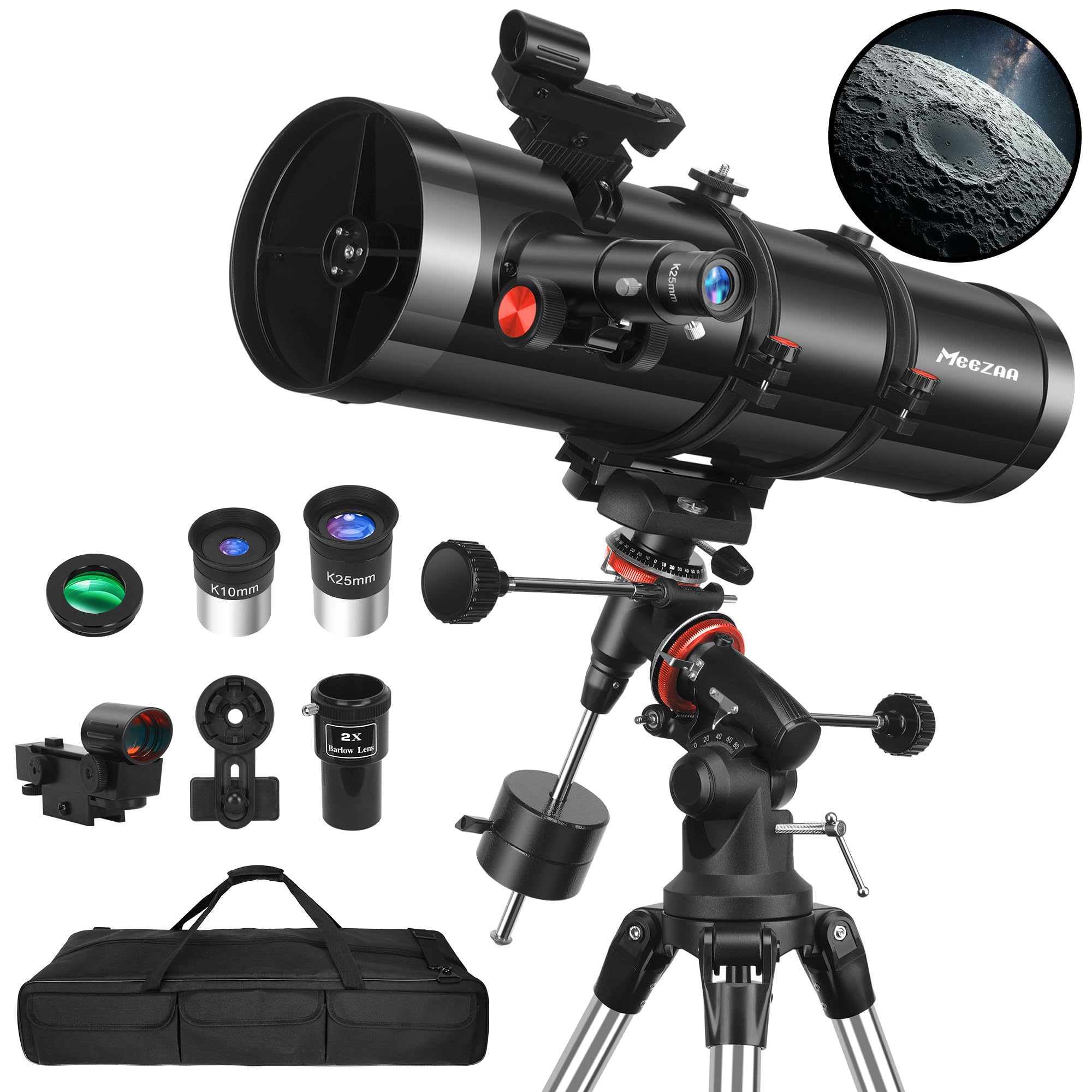
The MEEZAA 150EQ is the only reflector telescope in this guide with a 150mm (6-inch) aperture, giving it roughly 3.5 times the light-gathering area of an 80mm refractor. That extra light translates directly to visibly brighter views of deep-sky objects like the Orion Nebula, star clusters, and faint galaxies that smaller scopes cannot resolve. The 650mm focal length at f/4.3 produces a fast optical system, ideal for wide-field observations and entry-level astrophotography.
The German Equatorial mount is a genuine step up from the basic altazimuth mounts found on most beginner kits. It features slow-motion control knobs for precise manual tracking and graduated setting circles to help learn celestial coordinate navigation. The stainless steel tripod is heavy-duty and includes an accessory tray, keeping eyepieces organized during a session. Assembly requires more attention than a simple AZ mount, but the included color instructions and no-tools setup keep the learning curve manageable.
Reviewers consistently note the excellent clarity on the Moon, Jupiter’s cloud bands, and Saturn’s rings at 130x magnification. The 26x to 130x magnification range using the included 25mm and 10mm Kellner eyepieces plus 2x Barlow lens covers the most useful powers for a beginner. The phone adapter works for casual captures, though the equatorial mount’s slow-motion controls make tracking easier than on any AZ mount in this list.
Why it’s great
- 150mm aperture reveals deep-sky objects invisible to smaller scopes
- Equatorial mount with slow-motion controls teaches proper tracking technique
- Sturdy stainless steel tripod eliminates most vibration at high power
Good to know
- Heavier and larger than refractors — not a grab-and-go option
- Requires understanding polar alignment to fully utilize EQ mount
- Entry-level eyepieces are functional but benefit from future upgrades
2. Hawkko 90mm Aperture 900mm Refractor Telescope

The Hawkko 90/900 refractor delivers a long focal ratio of f/10, which inherently minimizes chromatic aberration — the purple fringing that plagues cheaper short-tube refractors. This design choice pays off when observing planets: Saturn’s rings appear crisp, Jupiter’s equatorial bands show visible structure, and the Moon’s craters resolve with sharp contrast. The 90mm aperture is a meaningful step up from 80mm, gathering roughly 26% more light for brighter deep-sky views.
The AZ mount on this model is fitted with a stainless steel tripod that adjusts from 28 to 46 inches, accommodating both seated and standing viewing positions. The mount rotates smoothly through 360 degrees, and the included slow-motion rod allows fine adjustments without jarring the image. Setup is a genuine 15-minute process with no tools required, which aligns with the needs of a true beginner.
User feedback overwhelmingly praises the “wow” factor of the first lunar view, with detailed crater rims and mountain ridges visible even in the 25mm eyepiece. The full multi-coating (FMC) on the objective lens is cited as a key differentiator, improving light transmission by approximately 73% over uncoated glass. The carrying bag, accessory tray, and smartphone adapter round out a kit where nothing feels like cheap filler.
Why it’s great
- Long 900mm f/10 focal length delivers excellent planetary contrast with minimal color fringing
- FMC optics improve light transmission significantly over basic coatings
- Stable stainless steel tripod with smooth AZ mount and slow-motion rod
Good to know
- No motorized tracking — objects drift out of field at high power
- Long tube feels front-heavy on the mount without counterweights
- Basic Kellner eyepieces are decent but not premium
3. Celestron StarSense Explorer LT 80AZ

Celestron’s StarSense Explorer LT 80AZ solves the single biggest hurdle for a new astronomer: finding objects in the night sky. The patented StarSense technology uses your smartphone’s camera and the free app to analyze star patterns overhead and calculate exactly where the telescope is pointing. You simply dock your phone, follow the on-screen arrows, and when the bullseye turns green, the target is in your eyepiece. No star-hopping experience required.
Optically, the 80mm f/5 refractor delivers sharp, bright views of the Moon’s craters, Jupiter’s four Galilean moons, Saturn’s rings, and bright deep-sky objects like the Orion Nebula and Andromeda Galaxy. The fully coated glass optics control reflections well, and the erect-image diagonal makes daytime terrestrial viewing comfortable. The manual altazimuth mount includes an altitude slow-motion adjustment with a sliding rod for fine-tuning once you’re on target.
Customer reviews highlight how the app turns the telescope into a family-friendly experience. One user noted a 15-year-old assembled the scope alone and was seeing Saturn’s rings within 30 minutes of unboxing. The pre-assembled mount and tripod accelerate setup. Celestron backs this with a 2-year US warranty and California-based support. The 25mm and 10mm eyepieces plus 2x Barlow lens offer 16x, 40x, and 80x magnification — appropriate for a short-focal-length refractor.
Why it’s great
- StarSense app eliminates the learning curve of finding celestial objects manually
- Lightweight and portable at under 10 pounds fully assembled
- Celestron’s 2-year warranty and US-based support add peace of mind
Good to know
- Requires a charged smartphone with the app installed to function fully
- 80mm aperture limits deep-sky views compared to 90mm or 150mm options
- Short 400mm focal length shows field curvature at the edges with some eyepieces
4. Koolpte 90mm Aperture 700mm Refractor Telescope
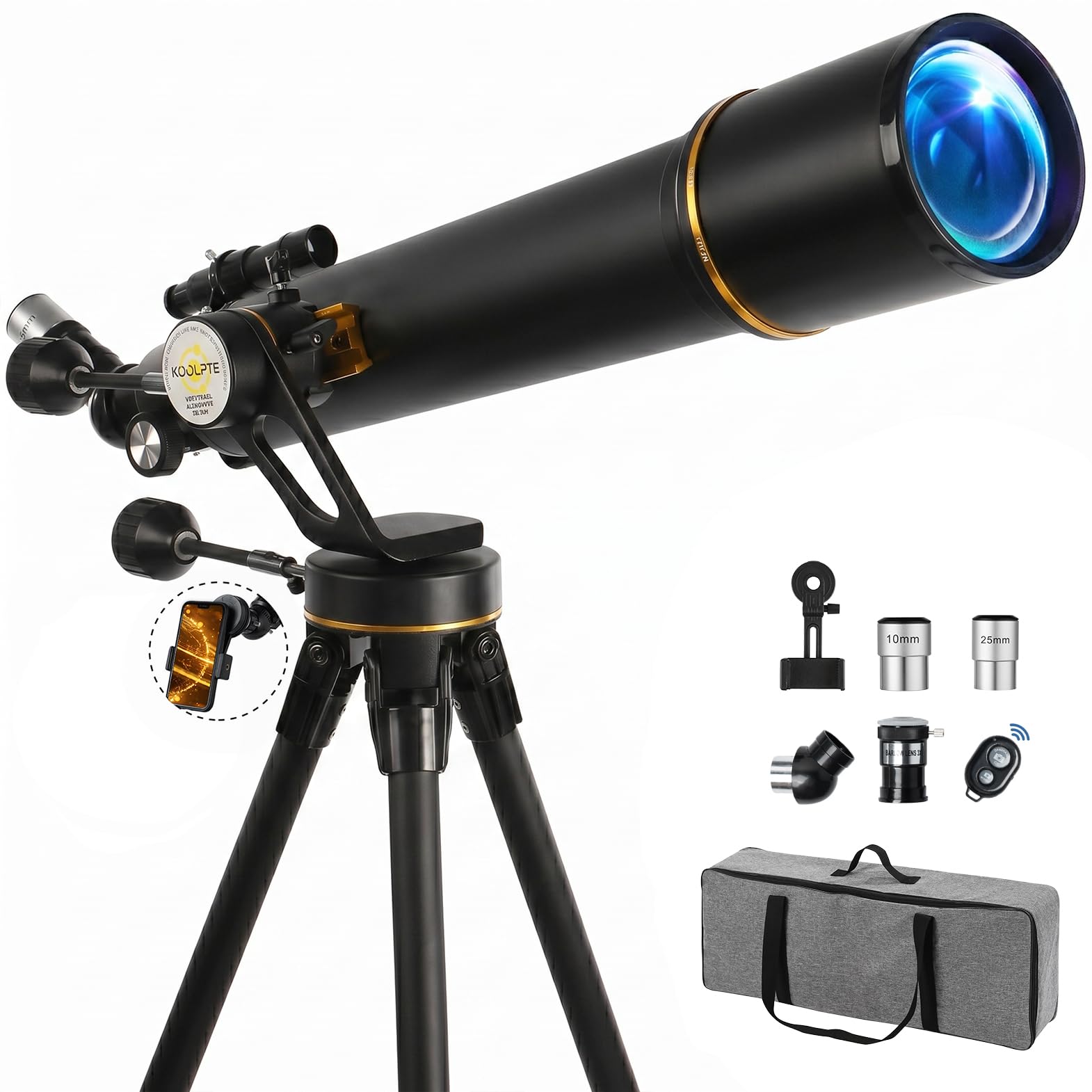
The Koolpte 90/700 brings a 90mm aperture into a budget-friendly position that most 80mm scopes occupy, and backs it with the exclusive Vertisteel AZ Slow-Motion Mount. The mount’s “Follow and Stop” design prevents the overshooting and backlash typical of cheaper geared altazimuth mounts, keeping the object centered in the eyepiece while you swap between the 25mm and 10mm Kellner eyepieces. The 700mm focal length at f/7.8 offers a good balance between manageable tube length and solid planetary performance.
The fully multi-coated (FMC) objective delivers the 99% light transmission claimed in the spec sheet, translating to bright, high-contrast lunar views where the crater walls and central peaks are sharply defined. The included 3x Barlow lens pushes magnification from 28x to a practical maximum of 210x, though atmospheric conditions on most nights limit useful power to around 180x on this aperture. The wireless remote and phone adapter for astrophotography are thoughtful additions.
Setup clocks in under 10 minutes based on multiple user reports, with no tools required. The carrying bag fits everything including the adjustable tripod. One area of concern from reviewers is the tripod’s stiffness when adjusting leg angles, and a single report of an internal component coming loose after extended use. Most users, however, report crystal-clear images and smooth mechanical operation well beyond what the price point suggests.
Why it’s great
- 90mm aperture at a price point usually reserved for 80mm kits
- Vertisteel AZ mount with slow-motion controls reduces image jitter
- Includes wireless remote and phone adapter for casual imaging
Good to know
- Taller users above 6 feet may find low zenith viewing angles uncomfortable
- A very small number of units have reported internal lens shift after repeated use
- Basic Kellner eyepieces are functional but will be the first upgrade path
5. MEEZAA 90mm Aperture 800mm Refractor Telescope

MEEZAA’s 90/800 refractor distinguishes itself from the mid-range pack with a stainless steel tripod that offers noticeably better vibration damping than the aluminum legs found on most competing kits in this segment. The 800mm focal length at f/8.88 delivers a long-tube design that minimizes false color, and the 90mm aperture gathers enough light to make Jupiter’s Equatorial Bands and the Cassini Division in Saturn’s rings visible on steady nights.
The altazimuth mount is straightforward to operate, and the included 10mm and 25mm Kellner eyepieces with a 3x Barlow lens provide 32x, 80x, and 240x magnification. In practical terms, 240x is above what most nights of average atmospheric seeing will support on a 90mm aperture, but the 80x to 120x range produced by the 10mm eyepiece alone delivers crisp, bright planetary details. The straight-through finder scope requires a bit of neck bending but aligns accurately once calibrated.
Build quality is a recurring theme in user reviews, with mentions of all-metal tube construction and minimal chromatic aberration even at medium powers. The 10-minute setup claim from the manual is corroborated by most buyers. The carry bag is well-padded and accommodates the full assembly. The phone adapter works reliably for quick smartphone captures of the Moon and bright planets, though deep-sky astrophotography is beyond this scope’s intended use case.
Why it’s great
- Stainless steel tripod absorbs vibration better than budget aluminum legs
- 90mm aperture and 800mm focal length balance portability and planetary power
- Metal tube construction indicates higher build quality than plastic-bodied rivals
Good to know
- 240x maximum magnification is often limited by atmospheric conditions
- Straight-through finder is less ergonomic than a red-dot finder for beginners
- No slow-motion controls on the AZ mount — fine adjustments require nudging
6. Celticbird 80mm Aperture 900mm Refractor Telescope

With a focal ratio of f/11.25, the Celticbird 80/900 has the longest focal ratio of any refractor in this guide. This design choice virtually eliminates chromatic aberration, making it arguably the best “out of the box” planetary performer among the 80mm options. On a clear night, the view of Saturn through the 10mm eyepiece (90x) shows a cleanly separated ring system, and Jupiter reveals two distinct equatorial cloud bands plus the dance of its four Galilean moons.
The altazimuth mount and adjustable aluminum tripod (20 to 45 inches) provide a stable platform, though at maximum extension, the tripod becomes susceptible to wind vibration. The 5×24 finder scope is an optical finder that offers a brighter image than a red-dot unit, making it easier to locate the Moon and bright planets in light-polluted backyards. The phone adapter is well-reviewed for aligning and capturing passable lunar photos.
Multiple reviewers confirm the 5-minute setup and takedown time, and the included carry bag is large enough to store all components for grab-and-go travel. The upgraded wide-angle eyepieces (20mm and 10mm) are a real improvement over the budget plossls found in many kits. The Celticbird’s 3-year satisfaction service adds a safety net for beginners worried about defects. Some users noted a small amount of dust inside the objective lens on arrival, which did not affect image quality in most cases.
Why it’s great
- Very long f/11.25 focal ratio produces near-zero false color on planets
- Upgraded wide-angle eyepieces offer wider field than stock Kellners
- Quick 5-minute setup with no tools and a full-size carry bag
Good to know
- 80mm aperture limits light-gathering for deep-sky objects
- Long 900mm tube can feel heavy on the basic aluminum tripod
- A few units have arrived with minor dust on internal lens surfaces
7. Gskyer 80mm Aperture 400mm Refractor Telescope

The Gskyer 80/400 is a short-tube refractor with a fast f/5 focal ratio, making it uniquely suited for wide-field sweeping of star clusters, the Milky Way, and daytime terrestrial observation. The 400mm focal length produces a 2.6-degree true field of view with the included 25mm eyepiece — more than double the field width of the long-tube 80/900 refractors. This makes it excellent for families who want to use the scope for both astronomical and nature viewing.
The optical tube includes fully coated glass and an erect-image diagonal, eliminating the upside-down image typical of astronomical scopes when used during the day. The 3x Barlow lens and three eyepieces (16x, 40x, and 80x native magnification) give a wide zoom range, but pushing past 80x on the 10mm eyepiece reveals the limitations of the short focal length — Jupiter appears small but the rings of Saturn are still recognizable. The 6×30 finder scope is larger than typical beginner finders, aiding object location.
The adjustable aluminum tripod is full-size but lighter than the stainless steel models in this guide. It provides adequate stability for low and medium power but will vibrate at the highest magnifications in a breeze. The 1-year care warranty is shorter than some competitors, but the Gskyer’s massive installed base and positive reviewer sentiment — noting “shocking” moon crater clarity and successful views of Mars, Saturn, and star clusters — confirm its value for the buyer prioritizing versatility over maximum planetary magnification.
Why it’s great
- Fast f/5 optics provide wide fields ideal for star clusters and Milky Way sweeps
- Erect-image diagonal works for daytime birding and landscape viewing
- Compact tube is easy to pack and transport for camping trips
Good to know
- Short 400mm focal length shows small planets even at maximum magnification
- More chromatic aberration than longer f/10+ designs on bright objects
- Aluminum tripod is less stable than stainless steel options at high power
8. Celestron 114LCM Computerized Newtonian Telescope
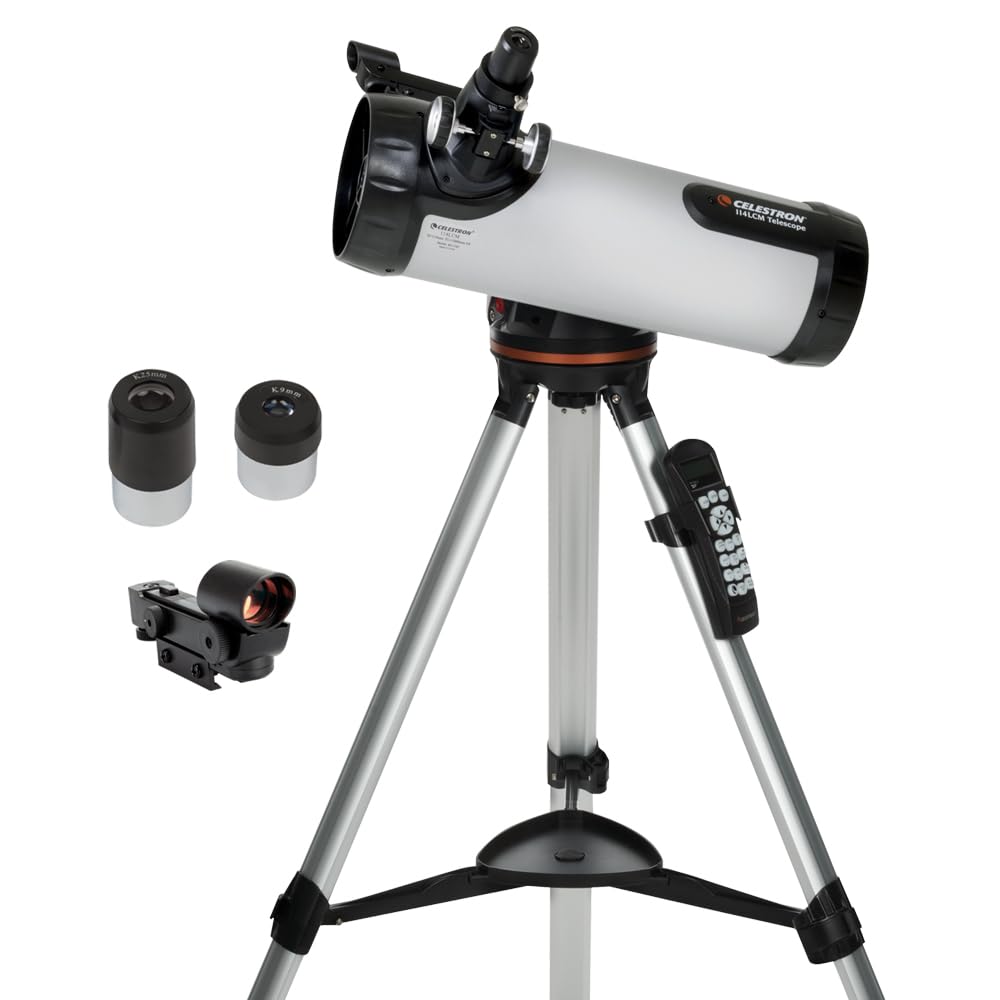
The Celestron 114LCM is a computerized Newtonian reflector that automates the sky-searching process entirely. With its GoTo mount, the telescope automatically slews to and tracks any of 4,000 pre-programmed celestial objects at the push of a button. The included NexStar+ hand controller makes navigation through the database simple, and the Sky Tour feature generates a curated list of the best visible objects for your exact time and location without requiring any map-reading skills.
The 114mm aperture (about 4.5 inches) gathers significantly more light than any 80mm or 90mm refractor, allowing it to reveal fainter deep-sky objects like globular clusters and brighter nebulae under dark skies. The 1000mm focal length operates at approximately f/8.8, giving good planetary contrast. With the 25mm eyepiece, you get 40x magnification for wide views, and the 9mm eyepiece provides 111x for detailed lunar and planetary work. The StarPointer red dot finder aids initial alignment of the mount.
Setup is genuinely fast — at least one reviewer noted a 5-minute assembly from box to first target. The motorized altazimuth mount compensates for Earth’s rotation, keeping objects centered without manual adjustments. User feedback is mixed on the optical quality of the Bird-Jones design, which incorporates a corrector lens in the focuser to shorten the tube length. This design can be difficult to collimate accurately, and some users report blurry images at higher magnifications until collimation is refined. The 2-year Celestron warranty is a solid safety net.
Why it’s great
- Computerized GoTo mount finds and tracks 4,000 objects automatically
- 114mm aperture gathers more light than all refractors in this guide
- Motorized tracking eliminates the need for constant manual adjustment
Good to know
- Bird-Jones optical design is tricky to collimate for optimal sharpness
- Runs on 8 AA batteries — rechargeable pack is a recommended upgrade
- Low-quality eyepieces and finder are common first upgrade suggestions
9. HUGERSTAR 80mm Aperture 600mm Refractor Telescope
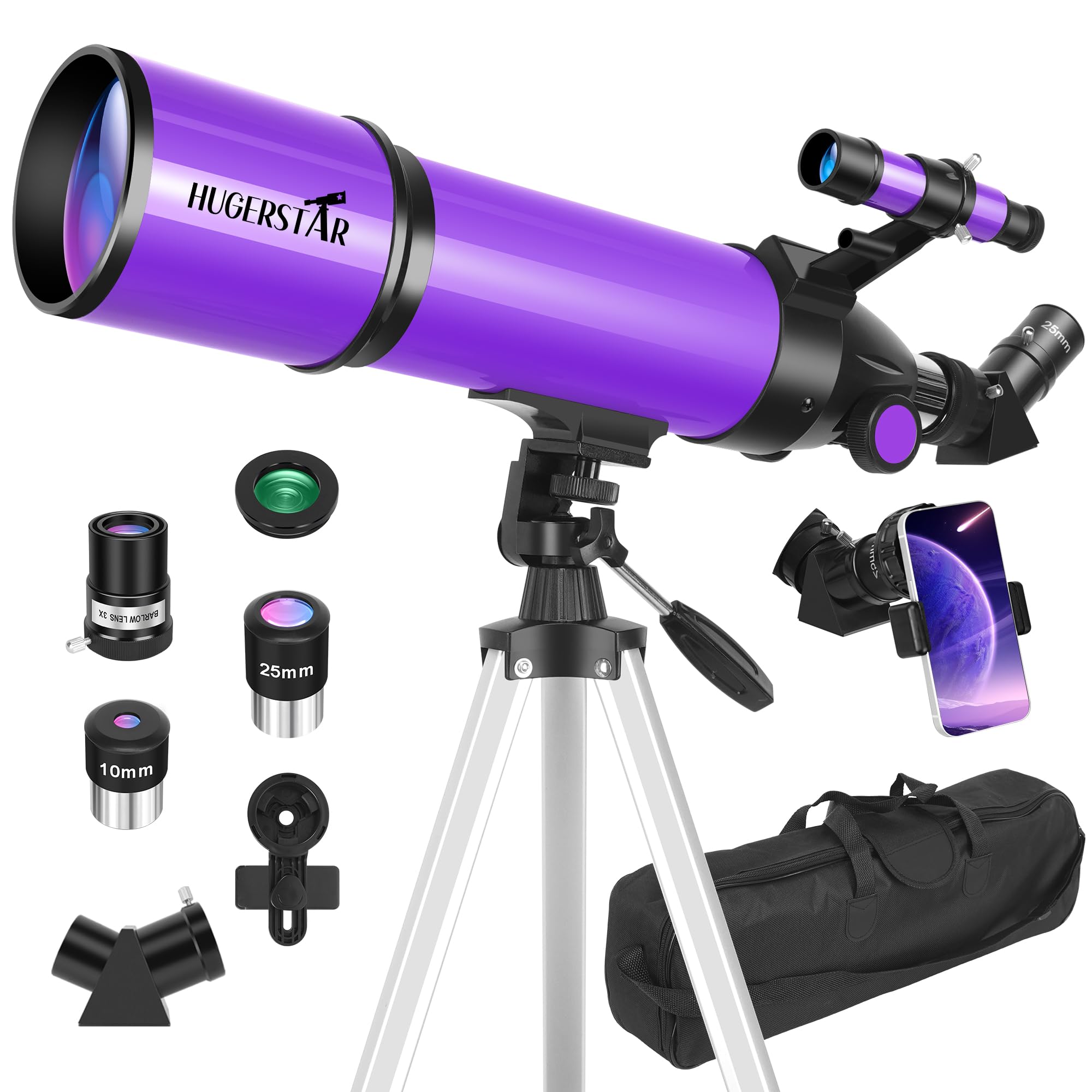
The HUGERSTAR 80/600 is the most budget-friendly entry point in this guide, but it does not compromise on the fundamentals. The 80mm aperture is the baseline size needed to see Jupiter’s moons as distinct dots and Saturn’s rings as an elongated oval rather than a single point. The 600mm focal length at f/7.5 is a versatile middle ground — short enough for a reasonably compact tube but long enough to keep chromatic aberration manageable at medium magnifications.
The fully multi-coated optics deliver noticeably brighter views than single-coated or uncoated lenses found on ultra-budget toys. The included 25mm and 10mm Kellner eyepieces plus a 3x Barlow lens produce magnifications of 24x, 60x, and 180x. The 180x maximum is optimistic for a 80mm aperture on most nights, but the 60x view through the 10mm eyepiece renders the Moon’s craters with impressive detail. The 5×24 finder scope is functional for initial targeting, though its straight-through design requires bending down to look through.
Setup is genuinely straightforward — the majority of users confirm assembly in 10 minutes with no tools, and the included carry bag keeps everything organized. The aluminum tripod adjusts from 21 to 44 inches and includes an accessory tray. The smartphone adapter is basic but functional for capturing that first lunar photo to share. The main caveat is the mount: at this price point, the altazimuth mount lacks slow-motion controls, so objects will drift out of the field of view and require gentle manual nudging to re-center.
Why it’s great
- Functional 80mm aperture with multi-coated optics at the lowest entry price
- 10-minute no-tool assembly — fastest setup in the budget tier
- Includes moon filter, phone adapter, and carry bag in a complete bundle
Good to know
- No slow-motion controls on the AZ mount — objects drift with Earth’s rotation
- Basic Kellner eyepieces are adequate but not sharp at edge of field
- Aluminum tripod is lightweight but transmits vibration in windy conditions
FAQ
Do I need to collimate a beginner friendly telescope?
Can I see Saturn’s rings with an 80mm telescope?
What magnification do I actually need for a beginner friendly telescope?
Final Thoughts: The Verdict
For most users, the best beginner friendly telescope winner is the MEEZAA 150EQ because its 150mm aperture offers a genuine step into deep-sky observation while the equatorial mount teaches proper tracking technique — a path that grows with you rather than being outgrown in six months. If you want smartphone-guided object location that removes all frustration from finding targets, grab the Celestron StarSense Explorer LT 80AZ. And for the highest planetary contrast in a completely maintenance-free package, nothing beats the Hawkko 90/900.