
Our readers keep the lights on and my morning glass full of iced black tea. As an Amazon Associate, I earn from qualifying purchases.
Specs are compiled from manufacturer listings and verified buyer reviews and can change over time — please confirm the key details on the product page before buying.
Picking your first ham radio can feel like decoding a foreign language — between frequency ranges, power outputs, and which accessories you actually need, it is easy to grab the wrong one and end up frustrated. The good news is that the market is full of capable handhelds built specifically to get a new licensee on the air without emptying your wallet. This guide cuts through the alphabet soup to show you exactly which radios deliver real performance for the money and which spec actually matters when you key up for the first time.
I’m Min — the founder and writer behind Gadgets Feed. This guide is built by comparing the manufacturers’ published specifications and the patterns across verified customer reviews, so you get each pick’s real strengths and trade-offs instead of marketing spin.
You want a first ham radio that survives a drop, lasts a full weekend on one charge, and lets you program it without a computer science degree — and that is the standard I used to find the best beginner handheld ham radio for your first call.
Our Picks at a Glance
How To Choose The Best Beginner Handheld Ham Radio
When you are just starting out, three specs separate a radio you will enjoy from one you will toss in a drawer. Channel count, battery life, and how you program it matter far more than vendor buzzwords. A radio with 128 channels is perfectly fine for a handful of local repeaters, but a 999-channel radio lets you load every frequency in your region plus weather alerts without deleting anything. Battery life is the second dealbreaker — a 24-hour battery is fine for a day trip, but a 48-hour battery keeps you connected all weekend without a charger. Third, look for USB-C charging so you can top off from a power bank or car adapter, and either CHIRP software support or a smartphone app so you are not punching in frequencies by hand.
Power Output and Range
Most beginner handhelds offer between 5W and 10W of transmit power. A 5W radio can easily hit a local repeater 3-5 miles away in open terrain, while a 10W radio can stretch that to 10 miles under good conditions. Do not obsess over the maximum number on the box — your antenna choice and elevation matter just as much. What you want is a radio that gives you at least a low/medium/high power toggle so you save battery when you are talking to someone nearby.
Programming Method
Manually entering frequencies using the keypad is tedious and error-prone for a beginner. The best entry-level radios support CHIRP — a free, open-source programming tool that lets you manage all your frequencies on a computer and upload them in seconds. Some newer models even allow programming via a smartphone Bluetooth app. If you want to actually get on the air on day one rather than spending an afternoon with a manual, prioritize a radio that works with CHIRP or an app.
Quick Comparison
| Model | Best For | Channels | Battery Life | Max Range | Amazon |
|---|---|---|---|---|---|
| BAOFENG UV-5R 2-Pack★ Best Overall | Budget-Friendly Starter Kit | 128 | 24 Hours | 5 km | $29.98$32.47PrimeAmazon |
| BAOFENG 5RM 1-PackAlso Great | Best Value 10W Power | 999 | 48 Hours | 10 km | $25.99Amazon |
| Retevis RA79 | Easiest Beginner Menu System | 200 | 10 Hours | — | $28.49$29.99Amazon |
In‑Depth Reviews
1. BAOFENG UV-5R 2-Pack (128 Channels)
Our pick — over 4.5★ from 450+ verified ratings; the strongest balance of quality and price.
The entry-level radio that has launched more ham licenses than any other model on earth.
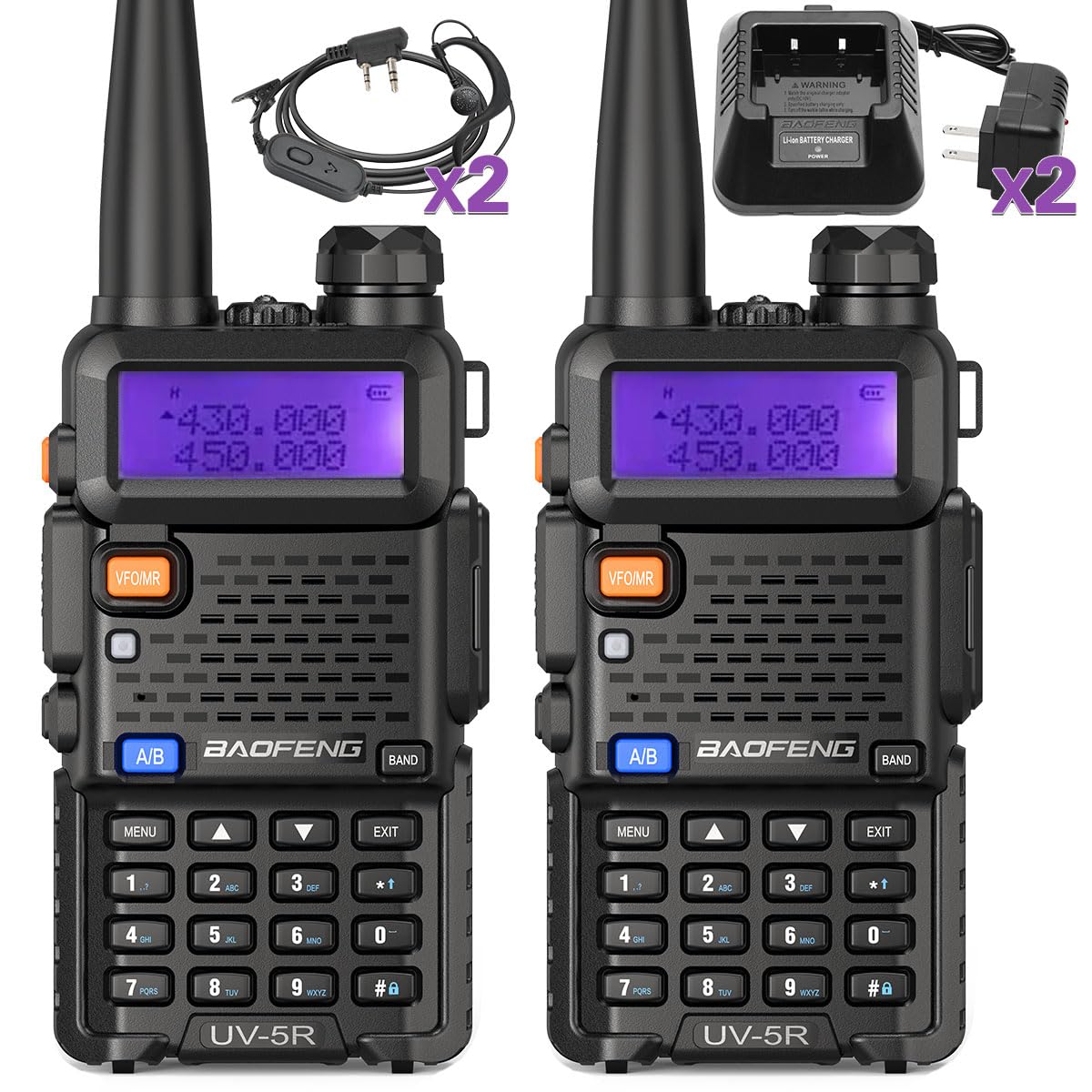
The UV-5R is the Toyota Corolla of ham radio — it is not the flashiest or the most powerful, but it works and it is cheap enough that you are not afraid to learn on it. This two-pack gets you two radios, two 1800mAh batteries, two chargers, belt clips, earpieces, and slings. Owners mention the “batteries hold charge long” and that the kit is “better value than buying separately.” With 128 channels and a 5-kilometer claimed range,, it is enough to monitor your local repeaters and talk to a partner during a hike. The 24-hour battery life is solid for a day of intermittent use., and the manual programming (while a bit tedious) teaches you the basics of frequency entry that you will use on every radio going forward.
That said, the UV-5R is the oldest design here. It lacks USB-C charging (you get a cradle charger), has only 128 channels compared to the 999 on the newer 5RM and UV-5R Mini, and its 5W output compared to the 10W output of the higher-powered models. One reviewer noted they “survived drops” and now hand them to friends to test interest — it is a durable learning tool. For a true beginner who wants to spend the minimum to see if the hobby sticks, this two-pack is the lowest-risk option. Just be aware that the 5RM single-unit (Pick 1) offers 999 channels versus the UV-5R’s 128 channels, and a 10 km talking range versus the UV-5R’s 5 km range for not much more money.
Why it is still popular
- Lowest-cost entry to a complete two-radio system
- Tons of online tutorials, YouTube videos, and community support
- Includes earpieces, belt clips, and slings in the box
Where it shows its age
- 128 channels and 5W output are entry-level even for this category
- No USB-C charging — uses a dedicated cradle only
- Manual programming is slow compared to CHIRP or app-based models
Great for the absolute minimum budget: the UV-5R 2-pack is the cheapest way to get two radios in your hands.
Upgrade soon: if you stick with the hobby, the 128-channel limit and lack of USB-C will push you toward a newer model within a few months.
2. BAOFENG 5RM Ham Radio 10W (1-Pack)
The radio that squeezes 10W out of a compact body so a beginner can hit the local repeater on the first try.
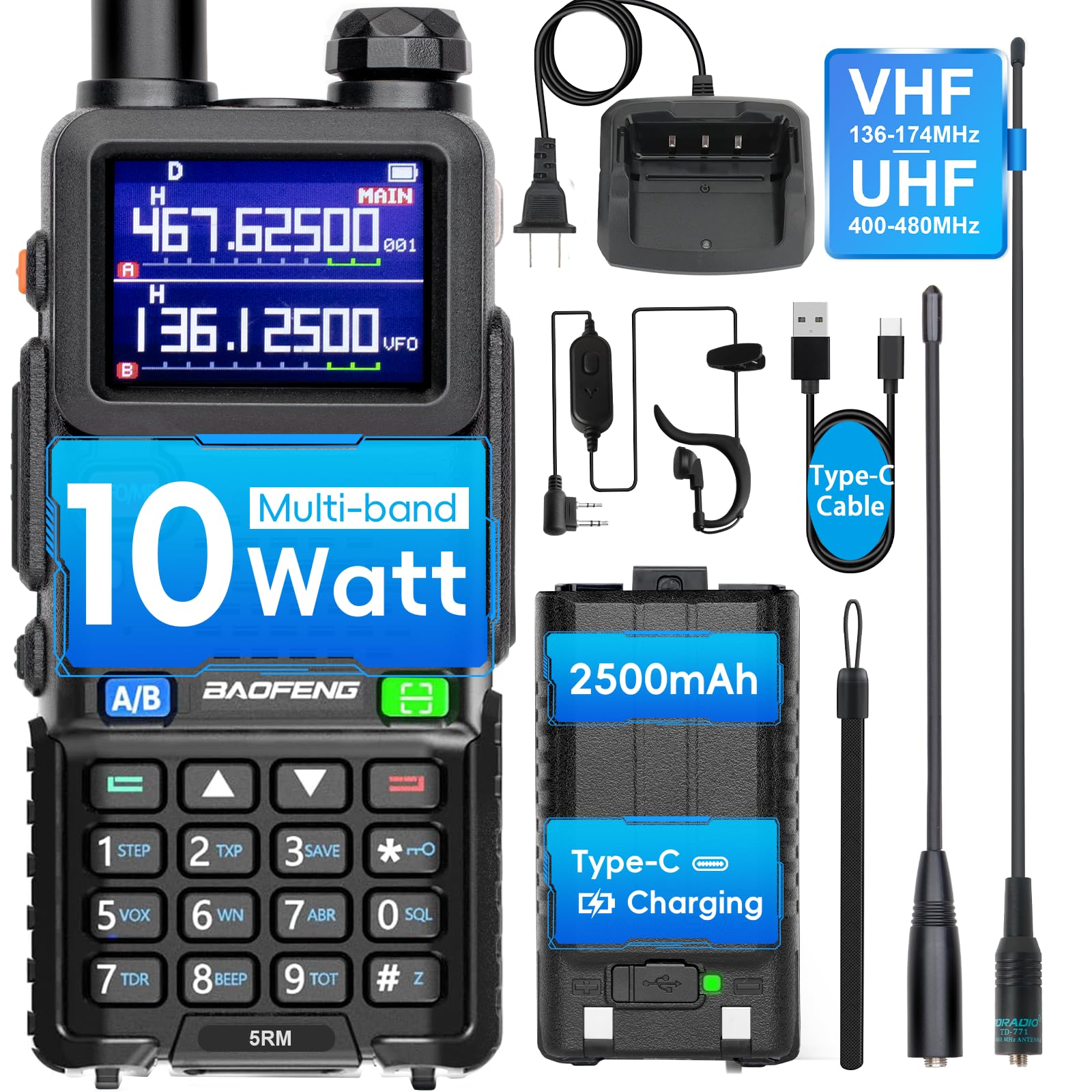
Your first priority as a new ham is simply getting heard, and this radio’s 10W of transmit power makes that noticeably easier than the standard 5W radios around it. The 2500mAh battery delivers a claimed 48 hours of talk time, and buyers confirm it easily lasts a full weekend of casual use. The 1.77-inch color screen is bright enough to read your channel name at a glance, though a few owners mention the red-on-blue menu gets tough to read under direct sunlight.
The biggest time-saver here is USB-C charging: you can top up from the same cable you use for your phone, and it takes about 3 hours to a full charge via USB-C. With 999 channels onboard, you have room to load every repeater in your state plus all ten NOAA weather frequencies. It also includes a 15.12-inch 771 antenna for better reach and a 6.1-inch stubby antenna for pocket carry, so you are not stuck buying extras right away. Compared to the classic UV-5R, which holds only 128 channels and maxes at 5 km range, the 5RM gives you 999 channels versus the UV-5R’s 128 channels, and an advertised talking range of 10 km versus 5 km — a massive upgrade for just a few dollars more.
Why it works for a beginner
- 10W output gives better repeater reach than the 5W UV-5R crowd
- 999 channels and 48-hour battery beat the category average handily
- USB-C charging from any power bank or laptop cable
The trade-offs
- Color screen is difficult to read in bright daylight
- Single-unit pack; you will need a second radio for a family or group
- Airband AM reception is decent but not studio-clear per some reviews
Reach for this if: you want the strongest transmit power for your first dollar and a battery that lasts an entire camping trip without recharging.
Look elsewhere if: you absolutely need two radios in one box for a partner or child — this is a solo unit.
3. BAOFENG UV-5RM Plus 10W
A tiny body that programs from your phone so you never touch a manual frequency entry.
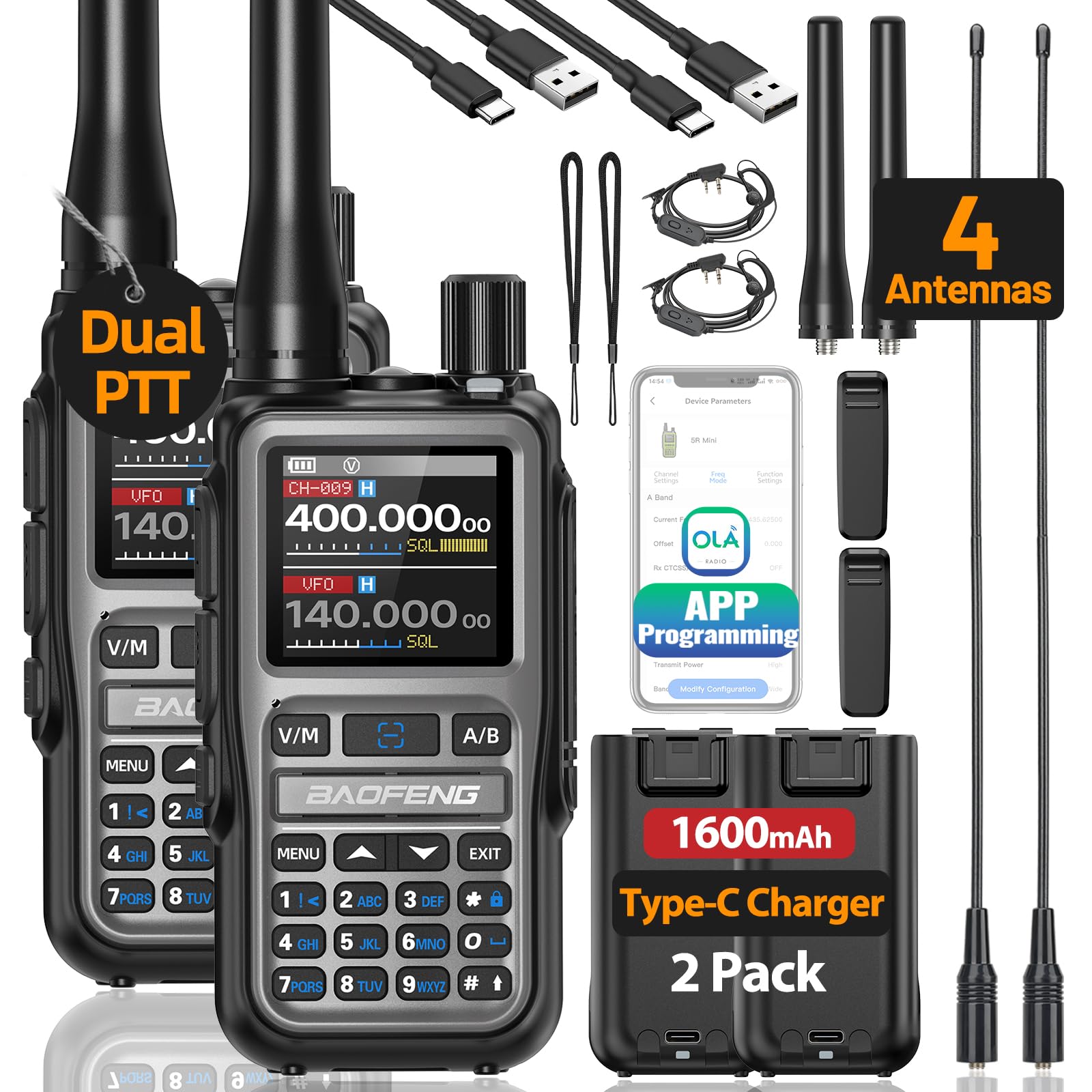
If you dislike wrestling with tiny keypads, this radio is your shortcut. The UV-5R Mini pairs with a free smartphone app (OLA Radio) via Bluetooth to let you load frequencies in seconds — no computer, no programming cable, no manual. It is also physically smaller than the standard UV-5R, which makes it pocket-friendly for hiking or tossing in a go-bag. The two-pack includes both a short 9cm antenna and a long 38cm 771 antenna, so you can swap for better range when you need it. Buyers report the stock antenna reaches about 2-3 miles in suburban conditions, which is solid for a 5W radio.
As with any compact radio, the smaller screen and buttons take some getting used to — a few owners note the font is tiny for channel names. The 999-channel memory mirrors the larger models, and the USB-C charging port on the back of the battery means you can charge from a car or power bank without a cradle. The built-in FM/AM and NOAA reception mean you can listen to weather and music even when you are not transmitting. Just remember this is a 5W radio, not the 10W of the 5RM series, so your maximum range will be shorter in challenging terrain.
What makes it special
- Smartphone app programming eliminates the need for a computer or cable
- Truly compact form factor fits any pocket
- Comes as a two-pack with two antennas each
Compromises
- 5W output is weaker than the 10W options in this guide
- Small screen and buttons can be hard to read/use
- No customizable channel groups per some experienced users
Take this if: you want the most portable radio you can program from your phone, and you primarily talk within 2-5 miles.
skip it if: you need the longest possible reach — the 10W 5RM series is the better call for distance.
