
Our readers keep the lights on and my morning glass full of iced black tea. As an Amazon Associate, I earn from qualifying purchases.
Specs are compiled from manufacturer listings and verified buyer reviews and can change over time — please confirm the key details on the product page before buying.
You grab a beginner multimeter when a light stops working, a car battery acts dead, or an appliance goes silent. Most entry-level meters omit auto-ranging or overload you with irrelevant specs. This guide highlights meters that make your first electrical test safe, simple, and accurate.
I’m Min — the founder and writer behind Gadgets Feed. This guide is built by comparing the manufacturers’ published specifications and the patterns across verified customer reviews, so you get each pick’s real strengths and trade-offs instead of marketing spin.
To diagnose a dead outlet, test a fuse, or check a car battery, the best beginner multimeter gives you trustworthy voltage and continuity readings without needing a degree in electrical engineering.
Quick Picks
- AstroAI Digital Multimeter and Analyzer TRMS 6000 Counts — Best Overall
- Klein Tools MM420 Digital Multimeter, Auto-Ranging TRMS — Tough as Nails
- INNOVA 3320 Auto-Ranging Digital Multimeter — Car and Battery Pro
- Crenova 890Z Digital Multimeter, 6000 Counts TRMS — Feature Monster
- Extech MN35 Digital Mini Multimeter — Compact Carry
- Gardner Bender GMT-318 Analog Multimeter, 6 Function, 14 Range — Analog Survivor
How To Choose The Best Beginner Multimeter
Picking your first multimeter can feel overwhelming due to the many dial positions and acronyms. Focus on these three things to find the right tool.
Auto-Ranging vs. Manual Ranging
Auto-ranging means the meter picks the correct measurement scale for you — you just touch the probes and read the number. Manual ranging makes you guess the range first (like picking “200V” vs “20V”), and if you guess wrong on voltage, you risk damaging the meter or getting a useless reading. Auto-ranging is a massive time saver for a beginner. Most digital meters here offer it.
Safety First: Fuses and Input Impedance
A decent beginner multimeter should have fuse protection on the current inputs. Without fuses, a mistake — like plugging into the amp jack while measuring a wall outlet — can cause a dangerous spark. A higher input impedance (like the 10 MegOhm on the INNOVA 3320) protects sensitive car electronics and prevents the meter from loading down the circuit it is testing.
Display Counts: What “6000 Counts” Actually Means
The “counts” rating tells you the maximum number the display can show. A 6000-count meter can show readings up to 6000 (like 600.0V), while a 2000-count meter tops out at 1999. Higher counts give you more precision without fiddling with the range setting. For typical household and automotive work, 6000 counts is the balance.
Quick Comparison
| Model | Best For | Display Counts | Auto-Ranging | Max Voltage | Amazon |
|---|---|---|---|---|---|
| AstroAI Digital Multimeter & Analyzer | Mid-range all-rounder | 6000 | Yes | 1000V DC | $34.99$38.99PrimeAmazon |
| Klein Tools MM420 | Durable pro-level build | — | Yes | 600V AC/DC | $62.00$64.98Amazon |
| INNOVA 3320 | Automotive & battery | — | Yes | — | Amazon |
| Crenova 890Z | Best value / feature-packed | 6000 | Yes | — | Amazon |
| Extech MN35 | Compact pocket meter | — | Yes | — | Amazon |
| Gardner Bender GMT-318 | Budget analog backup | Analog | No (Manual) | 500V | $24.04Amazon |
In-Depth Reviews
1. AstroAI Digital Multimeter and Analyzer TRMS 6000 Counts

The 6000-count TRMS meter delivers trusted readings for automotive and household jobs without the complexity.
You get a fast, accurate tool because this meter uses auto-ranging (it picks the correct measurement range for you) and True RMS (a method that gives you the right reading even on noisy signals from modern electronics). It measures AC/DC current, AC/DC voltage up to 1000V DC, capacitance up to 20,000µF, frequency, duty cycle, resistance, diodes, continuity, and temperature. Buyers report it handles nearly every scenario a beginner or intermediate user will face.
Owners mention fast and precise readings for voltage, resistance, and automotive or household issues. At 7.48 x 3.54 x 1.38 inches, it is compact enough for a tool bag but has a clear backlit display. The double ceramic fuse protection (F400mA/600V and F10A/600V explosion-proof tubes) provides a safety net — if you accidentally probe the wrong port, the fuse blows instead of the meter. The AstroAI packs a feature set that punches well above its tier, especially compared to the basic Extech MN35 which lacks auto-ranging entirely.
The trade-off: the temperature probe on some units arrived non-functional, according to a few reports. For metrology-grade precision work, buyers recommend a higher-end lab meter.
Why It Wins
- Auto-ranging and True RMS for accurate readings every time
- Measures capacitance up to 20,000µF — rare at this price
- Double ceramic fuse protection for safety
- Included temperature measurement via thermocouple
The Caveats
- Temperature probe on some units arrived non-functional, per buyers
- Instructions contain an error for current clamp use
Reach for this if: you want one versatile meter for car repairs, home wiring checks, and hobby electronics — it does nearly everything a beginner needs.
Look elsewhere if: you need certified calibration-grade accuracy for lab work, or an unreliable thermocouple would be a deal-breaker.
2. Klein Tools MM420 Digital Multimeter, Auto-Ranging TRMS
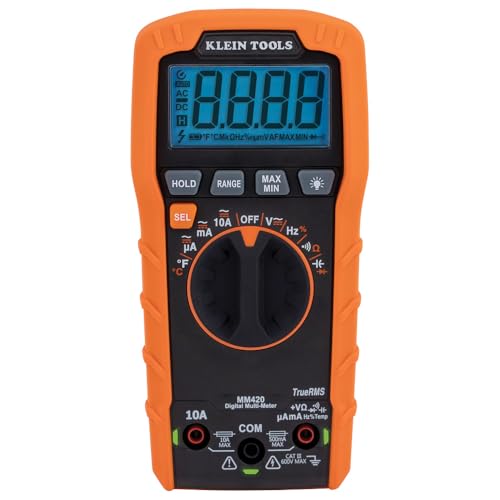
The contractor-grade meter survives a 6.6-foot drop and still gives a precise reading — tougher than the AstroAI.
Klein Tools is a name electricians trust. The MM420 measures AC/DC voltage up to 600V, 10A AC/DC current, and 50 MOhms resistance, plus temperature (with included thermocouple), capacitance, frequency, duty cycle, and diode test. The auto-ranging and True RMS ensure accurate measurements. The Lead-Alert LEDs on the meter body light up to show if your test leads are in the correct jacks — a big safety plus for a first-time user.
The durability stands out. It is built to withstand a 6.6-foot (2-meter) drop, which is more than double what most budget meters can handle. The backlit LCD is large and clear, and test lead holders on the back plus a kickstand make hands-free operation easy. One reviewer noted the meter read 13.85V on a 13.8V power supply, showing excellent out-of-the-box accuracy. Compared to the budget Extech MN35, the Klein MM420 offers a far more rugged build and safety-minded Lead-Alert feature, though it costs more.
Its main limitation: max voltage is 600V, lower than the AstroAI’s 1000V DC, so it is less suited for high-voltage industrial panels. The optional magnetic hanger (Cat. Nos. 69445 or 69417) is sold separately.
Built to Last
- Survives a 6.6-foot drop — the toughest meter here
- Lead-Alert LEDs prevent dangerous misconnections
- Includes thermocouple for temperature measurement
- Large backlit display with clear readings
Small Drawbacks
- Max voltage is 600V, not 1000V like the AstroAI
- Magnetic hanger is an extra purchase
Best for: the DIYer or homeowner who needs a meter that can survive a fall off a ladder or workbench — the MM420 is built like a tank.
Not for: budget-first buyers wanting the lowest price, or anyone measuring circuits above 600V.
3. INNOVA 3320 Auto-Ranging Digital Multimeter

The UL-certified auto-ranger shines brightest when testing car batteries and fuses — easier than the AstroAI for automotive use.
The INNOVA 3320 is designed with automotive work at its core. It has a 10 MegOhm input impedance, which means it draws almost no power from the circuit it tests — safe for sensitive car electronics like an ECU (the car’s main computer). Auto-ranging selects the right scale automatically, and the large display has color-coded LEDs for quick battery status — green, yellow, or red — so you do not need to interpret a raw voltage number.
Customers note it is nearly identical in accuracy to a Fluke 179 on DCV, ACV, and resistance tests, which is high praise at this price. The battery test function applies a 10mA load (a small current draw) to give a real reading of battery health under load. One owner reported that after five years of use, it remained accurate except for ACV readings below 50V. The meter cannot measure AC current above 200mA, so it is not for heavy appliance diagnostics.
Why an Auto Guy Loves It
- 10 MegOhm impedance protects sensitive car ECUs
- Battery load test with instant color-coded result
- UL certified for safety
- Near-identical readings to premium Fluke meters, per reviewers
The Catch
- Cannot measure AC current above 200mA
- Range switch can loosen over years of use
- Accuracy can drift on ACV below 50V
Grab it for: the DIY mechanic or homeowner who primarily tests car batteries, fuses, and 12V circuits — the INNOVA battery tester is genuinely useful.
Pass if: you need to measure AC current on appliances, or want a meter for precision electronics repair with stable low-voltage AC readings.
4. Crenova 890Z Digital Multimeter, 6000 Counts TRMS

The value-packed 6000-count meter also measures temperature, transistors, and detects voltage without touching wires — more features than the AstroAI for less money.
The Crenova 890Z is a serious contender for most features per dollar. It measures AC/DC current, AC/DC voltage, resistance, frequency, capacitance, continuity, diode, transistor hFE (a transistor’s current gain), and temperature. The 6000-count TRMS (True RMS) display gives accurate readings on both clean and distorted AC signals. It also has Non-Contact Voltage (NCV) detection — hold the meter near a wire and it beeps if it detects live AC voltage, a safety feature for identifying hot wires without contact.
Reviewers point out it is accurate, auto-ranging, and includes extras like a K-type thermocouple (for temperature), two pairs of test leads (one with alligator clips), and a semi-hard carrying case. One buyer mentioned the backlight works in dim areas, and the built-in flashlight helps illuminate dark spots under a hood. The downside: auto-ranging cannot be disabled, which some find inconvenient for repeated measurements.
Loaded for the Price
- 6000-count TRMS for high precision
- Non-Contact Voltage (NCV) detection for safety
- Measures temperature, transistors, capacitance
- Includes a hard case and alligator clip leads
One Quirk
- Cannot disable auto-ranging — a small annoyance for repeat measurements
- Backlight described as “dim” by some users
Pick this if: you want the maximum feature set for your money — temperature probes, a case, and NCV detection that pricier meters sometimes skip.
skip it if: you need to manually lock a range for repetitive testing, or prefer a simpler meter without extras you may not use.
5. Extech MN35 Digital Mini Multimeter

The pocket-friendly meter fits a shirt pocket and still reads within 0.01% of a Fluke on a car battery — far smaller than the Crenova 890Z.
The Extech MN35 is a true grab-and-go meter. At 2.3 x 1.3 x 5.8 inches, it is the most compact autoranging meter here. It measures AC/DC voltage, AC/DC current, resistance, diode test, and continuity — eight essential functions for basic home and auto troubleshooting. The protective rubber holster has a built-in stand, and the large LCD is easy to read despite the small size.
Buyers call it the “best in price range” and report accuracy within 0.01% vs a Fluke on a car battery. It includes a 9V battery in the box. The downsides: it is actually manual-ranging according to multiple reviews (not auto-ranging as advertised), and the continuity buzzer is weak and glitchy for some users. The test leads are lower quality — one owner reported they failed after a year, needing replacement with Keysight probes. Compared to the Crenova 890Z, the Extech is far smaller but lacks TRMS precision and NCV safety.
Grab and Go
- Very compact — fits in a shirt pocket
- Accurate within 0.01% of a Fluke on DC voltage, per buyers
- Includes a 9V battery and protective holster
- Large LCD display for its size
On the Flip Side
- Manual-ranging, not the auto-ranging advertised
- Weak continuity alarm and cheap test leads
- No auto-off feature — you may drain the battery
Ideal for: the electrician or field tech who needs a backup meter that disappears into a pocket — the Extech MN35 is supremely portable.
Not for: beginners expecting full auto-ranging from the start, or anyone relying on a loud continuity beep for tracing wires.
6. Gardner Bender GMT-318 Analog Multimeter, 6 Function, 14 Range
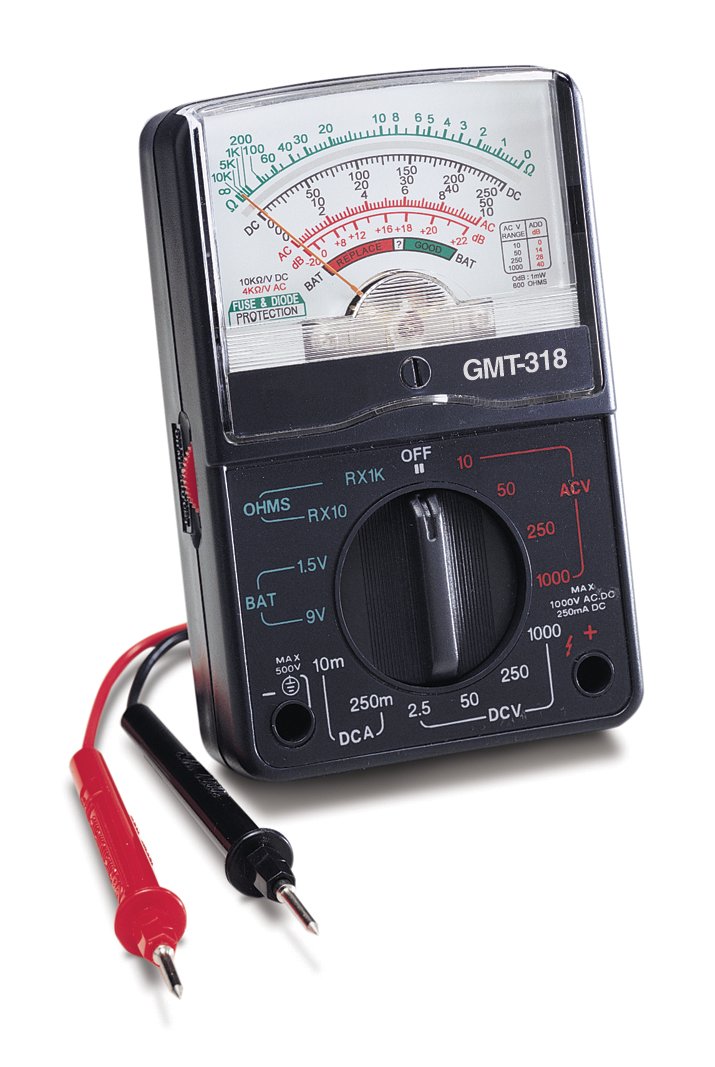
The classic analog needle never lies — no digital aliasing, just a simple swinging pointer for watching signals change.
The Gardner Bender GMT-318 is a deliberate choice. It uses a moving needle instead of a digital display, giving a continuous visual sweep — great for watching a voltage rise slowly or testing potentiometers (variable resistors) where you want smooth motion, not jumping digits. It has 6 functions and 14 ranges, covering AC/DC voltage up to 500V, resistance, and decibels. The color-coded analog display is easy to read, and the 15-position rotary dial is straightforward.
At 1.25 x 2.75 x 4.25 inches, it is the most compact meter here — compared to the AstroAI at 7.48 x 3.54 x 1.38 inches. Buyers describe it as a “compact budget analog multimeter for home voltage/continuity testing.” One customer observed proper internal wiring and a fuse, unlike some ultra-cheap analogs, and that the manual has a small error. The battery compartment is tight — some report it cannot fit a rechargeable AA battery without modification. It is not a precision tool, but for simple voltage checks and continuity tests needing quick visual confirmation, it is a solid cheap backup.
Analog Advantages
- No digital aliasing — the needle shows true signal movement
- Very compact: 1.25 x 2.75 x 4.25 inches
- Color-coded display is simple to read
- Fuse overload protection included
Analog Limitations
- Manual ranging only — you must guess the range first
- Tight battery compartment, incompatible with rechargeable AAs
- Not suitable for precision electronics work
Best for: the budget buyer who just needs to confirm a wall outlet has power or a wire is unbroken — it is a cheap, honest tool for basic checks.
Forget it if: you want a precise digital number for automotive sensors, or hate manual-ranging and want the convenience of auto-ranging.
Understanding the Specs
Auto-Ranging vs. Manual Ranging
Auto-ranging means the meter figures out the correct measurement scale (like 20V vs 200V) by itself. Just touch the probes and read the number. Manual ranging requires you to turn the dial to a specific range — pick too low a range and the display says “OL” (overload); pick too high and you lose precision. Auto-ranging removes a major source of confusion for a beginner.
True RMS (True Root Mean Square)
This is how the meter calculates AC voltage and current. A basic meter assumes the AC signal is a perfect sine wave (like a clean wall outlet). True RMS meters measure the actual heating value of the wave, even if it is distorted by modern electronics like LED drivers, dimmers, or variable-speed motors. Without True RMS, you can get readings 30-40% off on those circuits.
FAQ
What does “6000 counts” mean on a multimeter?
Can I use a beginner multimeter to test a car battery?
What is the difference between an analog and a digital multimeter?
Do I need True RMS for home use?
What does the continuity test do?
How do I stay safe when using a multimeter?
Can I measure the current draw of an appliance with a beginner multimeter?
What is a diode test and why would I use it?
How long do multimeter batteries last?
Final Thoughts: The Verdict
For the majority of shoppers, the best beginner multimeter winner is the AstroAI Digital Multimeter and Analyzer because it gives you 6000-count TRMS accuracy, auto-ranging, and double ceramic fuse safety at a price that leaves room for a coffee. If you want a tough meter that survives a drop, grab the Klein Tools MM420. For the pure budget-first beginner who just needs to test a car battery, the Crenova 890Z packs an absurd amount of features for the money.
How We Picked
We do not accept paid placement. Every pick is matched to a real buyer and a real use-case; we do not hands-on test units.
Sources & Methodology
Specifications: manufacturer listings and product documentation. Review insights: verified customer reviews, as of July 2026. Pricing: not shown on this page (it changes often); check the current price via the retailer link.
As an Amazon Associate, Gadgets Feed earns from qualifying purchases. This does not affect which products we feature.
Product prices and availability are accurate as of the date/time indicated and are subject to change. Any price and availability information displayed on Amazon at the time of purchase will apply to the purchase of this product. As an Amazon Associate I earn from qualifying purchases.
CERTAIN CONTENT THAT APPEARS ON THIS SITE COMES FROM AMAZON. THIS CONTENT IS PROVIDED "AS IS" AND IS SUBJECT TO CHANGE OR REMOVAL AT ANY TIME.
Amazon and the Amazon logo are trademarks of Amazon.com, Inc. or its affiliates.