
Stepping into electronics troubleshooting or hobbyist projects without a reliable oscilloscope is like debugging code without a console — you’re flying blind. A good entry-level oscilloscope reveals signal integrity issues, glitches, and timing errors that a standard multimeter simply cannot detect, transforming your diagnostic capability overnight.
I’m Min — the co-founder and writer behind Gadgets Feed. I specialize in dissecting the technical specifications of test and measurement gear to help newcomers avoid overpaying for unnecessary bandwidth or underbuying on features like sampling rate and memory depth.
This buying guide breaks down everything from bandwidth and sampling rate to memory depth and probe quality so you can confidently select the right best beginner oscilloscope for your projects and education.
How To Choose The Best Beginner Oscilloscope
Selecting your first oscilloscope involves balancing core specifications against your budget and intended use — whether you’re diagnosing automotive sensors, checking PWM signals on a Raspberry Pi, or validating power supply ripple. Beginners often fall into the trap of chasing the highest bandwidth figure without considering sampling rate, memory depth, or probe quality, which are equally critical for accurate measurements.
Bandwidth — The Frequency Ceiling
Bandwidth, measured in MHz, defines the highest frequency sine wave the oscilloscope can accurately display with less than 3 dB of attenuation. A practical rule of thumb is to choose a scope with at least five times the bandwidth of the fastest signal you plan to measure. For typical microcontroller projects with clock speeds around 16 MHz, a 50 MHz oscilloscope is sufficient, while automotive CAN bus or higher-speed digital circuits may require 100 MHz or more.
Sampling Rate — Capturing Details
Sampling rate, expressed in MSa/s (mega-samples per second) or GSa/s (giga-samples per second), determines how many data points the oscilloscope takes each second. A higher sampling rate yields a more detailed and accurate waveform reconstruction. For meaningful measurements on digital signals with fast rise times, aim for a scope with at least 250 MSa/s real-time sampling; bench-grade models at 1 GSa/s provide substantially better fidelity for capturing transient events.
Memory Depth — Storing the Waveform
Memory depth, measured in Kpts (kilo-points) or Mpts (mega-points), dictates how long the scope can record at a given sampling rate. Deeper memory lets you capture longer time windows without reducing the sampling rate, which is essential for decoding serial protocols or viewing low-frequency signal behavior over extended periods. Entry-level handheld scopes often offer 1 Kpts to 128 Kpts, while mid-range bench scopes provide 8 Mpts or more for comprehensive captures.
Channels — Single vs Dual vs Four
More channels allow you to simultaneously compare multiple signals — for example, observing SPI bus lines (MOSI, MISO, SCLK, and CS) requires four channels. Beginners typically start fine with two channels for basic signal injection and measurement, but upgrading to four channels early can prevent the need to buy a second scope later when debugging more complex digital interfaces.
Quick Comparison
On smaller screens, swipe sideways to see the full table.
| Model | Category | Best For | Key Spec | Amazon |
|---|---|---|---|---|
| Rigol DHO804 | Premium | Power ripple & embedded debug | 70 MHz, 4-ch, 12-bit, 1.25 GSa/s | Amazon |
| Siglent SDS1104X-E | Premium | Serial decoding & advanced use | 100 MHz, 4-ch, 1 GSa/s | Amazon |
| Rigol DS1054Z | Mid-Range | Education & general debugging | 50 MHz, 4-ch, 1 GSa/s, 24 Mpts | Amazon |
| Hantek DSO2D15 | Mid-Range | Lab work & signal generation | 150 MHz, 2-ch, 1 GSa/s, AWG | Amazon |
| FNIRSI 1014D | Mid-Range | Hobbyist bench work | 100 MHz, 2-ch, 1 GSa/s, DDS | Amazon |
| HANMATEK HO52 | Mid-Range | Portable field use | 50 MHz, 2-ch, 250 MSa/s | Amazon |
| FNIRSI 2C53T | Budget-Friendly | Compact 3-in-1 diagnostics | 50 MHz, 2-ch, 250 MSa/s, DDS | Amazon |
| IMARS HO-3S | Budget-Friendly | Automotive & general use | 70 MHz, 2-ch, 200 MSa/s | Amazon |
| ZOYI ZT-703 | Budget-Friendly | On-the-go troubleshooting | 50 MHz, 2-ch, 280 MSa/s | Amazon |
In‑Depth Reviews
1. RIGOL Digital Oscilloscope DHO804

The Rigol DHO804 is arguably the best value proposition in the current oscilloscope market for the serious entry-level user, offering a 70 MHz bandwidth combined with four analog channels and a remarkable 12-bit vertical resolution that provides 16 times the voltage detail of standard 8-bit scopes — crucial for seeing low-amplitude power ripple that an 8-bit scope would mask as noise.
Its 1.25 GSa/s sampling rate and 25 Mpts memory depth, paired with an UltraAcquire capture rate of 1,000,000 wfms/s, mean this scope can reliably catch glitches and intermittent events even on high-speed digital buses. The addition of a responsive 7-inch 1024×600 touch screen, HDMI output, and LAN-based web control via SCPI commands makes it a powerful tool for both bench work and remote monitoring in educational settings.
The DHO804 runs a clean Android-based UI with intuitive menus and auto-measurements, though some users note occasional lock-ups resolvable with a factory reset. The USB-C power input is convenient but a bit recessed for certain cables. Despite minor quirks, it delivers professional-grade features at a price that undercuts any comparable 4-channel, 12-bit offering on the market.
Why it’s great
- 12-bit resolution reveals fine voltage details other scopes miss
- Touch screen and web remote control for easy operation
- Four channels and 70 MHz handle most embedded projects
Good to know
- Occasional software lock-up requiring factory reset
- Included 70 MHz probes may limit absolute accuracy
2. Siglent Technologies SDS1104X-E
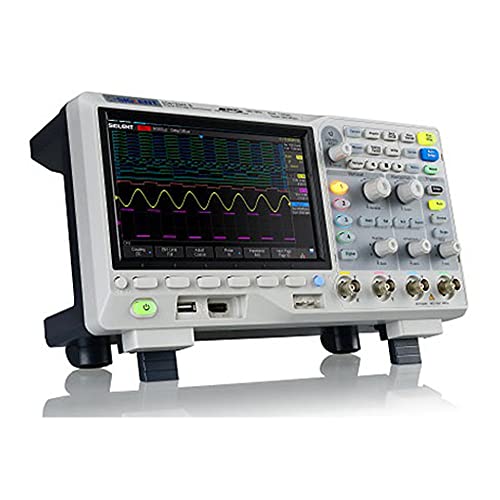
The Siglent SDS1104X-E delivers 100 MHz bandwidth across four analog channels with a 1 GSa/s sampling rate (full rate on two channels) and a deep memory architecture that rivals much more expensive scopes, making it an excellent choice for hobbyists who need serious serial decoding capabilities for I2C, SPI, UART, CAN, and LIN protocols without moving to professional pricing tiers.
The user interface is notably more responsive than competitors in this bracket, with 14 horizontal divisions for better time-domain visibility and a clean menu system that avoids overlaying measured traces. The built-in LAN web server lets you control the scope from a browser, and an optional USB WiFi dongle enables wireless operation — a convenience for collaborative debugging sessions in a lab environment.
While the included passive probes are adequate, their 1X/10X switch is easy to accidentally bump during probing, which can skew your measurements if not checked. The 16-channel MSO add-on option exists but is poorly integrated compared to native digital input solutions. For pure analog work and serial debugging, however, the SDS1104X-E remains a top-tier recommendation for its price-to-performance ratio.
Why it’s great
- Included standard serial decoders for five protocols
- Responsive UI with 14-division display and LAN control
- 100 MHz bandwidth covers high-speed digital signals
Good to know
- Probe 1X/10X switch is easy to bump inadvertently
- MSO add-on is poorly integrated compared to native solutions
3. Rigol Digital Oscilloscope DS1054Z
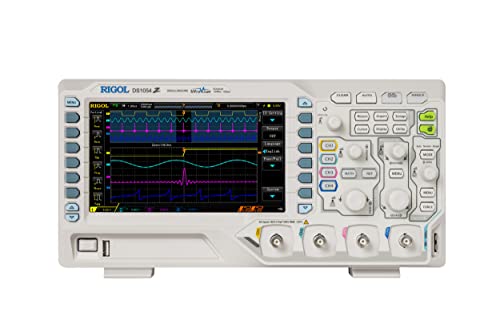
The Rigol DS1054Z has long been the gold standard for budget-conscious electronics learners, offering a 50 MHz bandwidth, four analog channels, and a 1 GSa/s sampling rate with a huge 24 Mpts memory depth that enables exceptionally long captures for protocol analysis. Its UltraVision technology provides a 30,000 wfms/s capture rate and an intensity-graded display that helps reveal rare glitches in real time.
A standout feature of the DS1054Z is its community-developed hack that unlocks the full 100 MHz bandwidth and premium serial decoding options (I2C, SPI, RS232) for free — though this voids the warranty, it effectively transforms a mid-range scope into a significantly more capable instrument. The 7-inch 800×480 display is clear and functional, and the four color-coded channels with dedicated probes simplify multi-signal comparisons during debugging sessions.
Drawbacks include a somewhat noisy internal fan, mushy rotary encoder knobs that lack tactile precision, and occasional triggering sluggishness on very low-amplitude signals. The included passive probes are adequate but not premium — upgrading them later can improve measurement accuracy. Despite these minor compromises, the DS1054Z remains the most recommended starter scope in online electronics communities for good reason.
Why it’s great
- Community hack unlocks 100 MHz bandwidth and decoders
- 24 Mpts memory depth for long captures
- Four channels at an entry-level price point
Good to know
- Noisy fan may be distracting in quiet labs
- Mushy encoders and occasional trigger lag
4. Hantek DSO2D15

The Hantek DSO2D15 brings professional-level bandwidth to the entry-level price bracket with 150 MHz dual-channel performance, a 1 GSa/s sampling rate, and an integrated arbitrary waveform generator that outputs sine, square, triangle, and custom waveforms up to 25 MHz — a complete signal injection and measurement solution in one compact bench unit.
Build quality is surprisingly robust for the price tier, with a sturdy chassis, stable signal trace even at higher frequencies, and a 10:1 probe that performs well for general-purpose use. The DSO2D15 supports 14 trigger types, including serial protocol triggers for I2C, SPI, UART, CAN, and LIN, making it useful for intermediate-level embedded debugging and automotive diagnostics straight out of the box.
On the downside, finding the full service manual for the DSO2D15 specifically can be frustrating — the DSO2D20 manual is compatible but not perfectly matched. The auto-set function is somewhat limited, requiring manual adjustment for proper waveform display. Firmware updates (v3205) have resolved prior stability issues, but early units occasionally lock up and need a quick power cycle to recover.
Why it’s great
- 150 MHz bandwidth for higher-speed signals
- Built-in 25 MHz arbitrary waveform generator
- Sturdy build with stable trace at high frequencies
Good to know
- Service manual is not specific to the DSO2D15 model
- Auto-set function requires occasional manual tweaking
5. FNIRSI 1014D
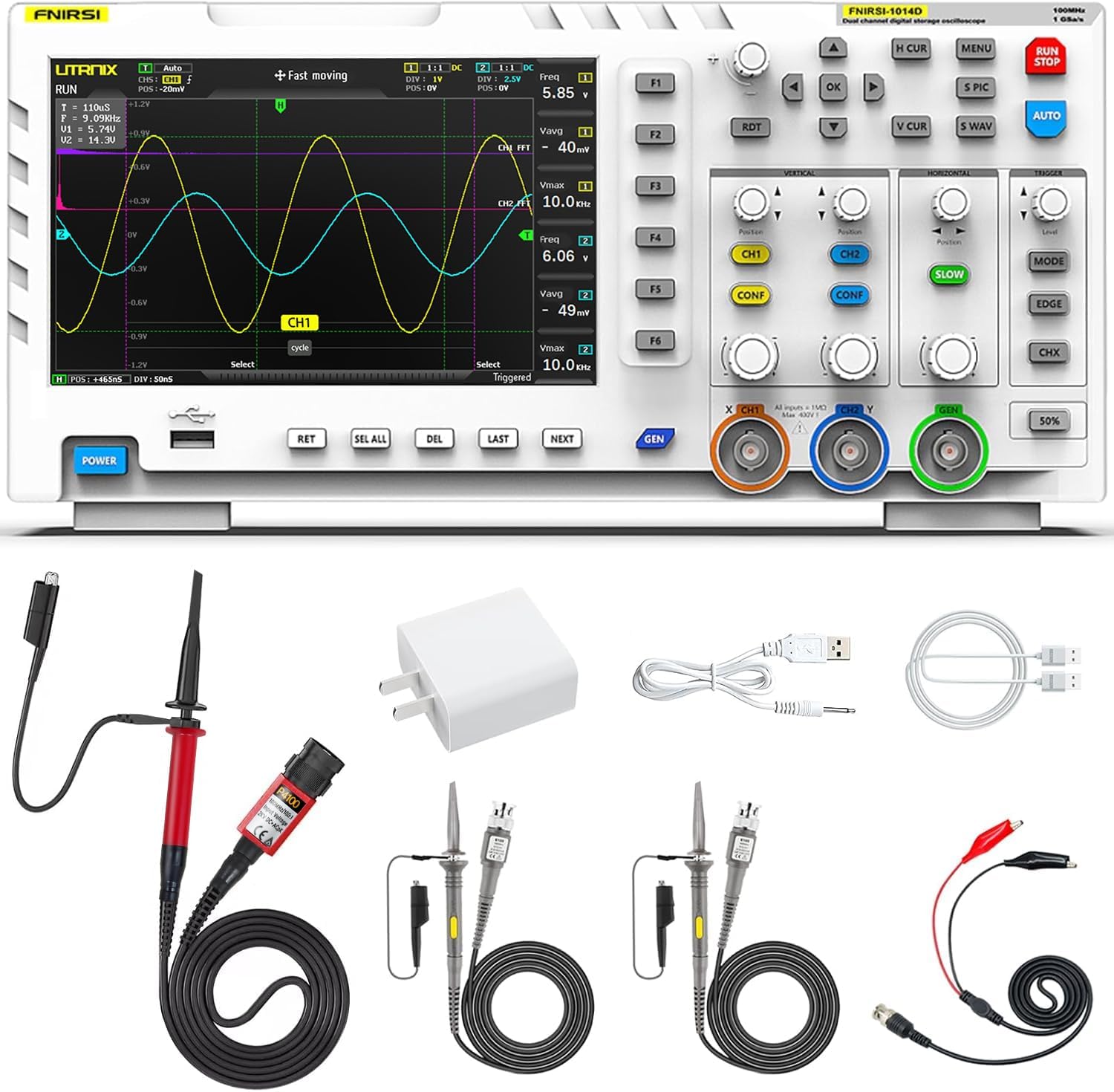
The FNIRSI 1014D offers an impressive specification sheet for hobbyists: a 100 MHz analog bandwidth with a 1 GSa/s real-time sampling rate across two channels, combined with a built-in DDS signal generator that supports 14 waveform types including sine, square, and triangle waves. The 7-inch 800×480 LCD provides a large viewing area for waveform analysis without taking up excessive bench space.
A one-button AUTO function automates triggering and scaling to help beginners get stable waveforms quickly, while Lissajous pattern display and FFT viewing allow for basic frequency-domain comparisons and harmonic content estimation. The unit includes a 100X high-voltage probe and built-in 1 GB storage for saving waveform screenshots and CSV data for later analysis on a PC via USB connection.
Quality control appears inconsistent — some units arrive with defective screens or jammed buttons, and the included USB power adapter can introduce noise into measurements that disappears when using a clean iPad charger. Voltage accuracy tends to drift beyond 30 MHz, and the signal generator output is fixed at approximately 2V peak-to-peak without fine amplitude adjustment for millivolt-level work. For pure hobbyist use, however, the feature set is hard to beat at this price level.
Why it’s great
- Large 7-inch display for easy waveform viewing
- 100 MHz bandwidth with 1 GSa/s sampling rate
- Built-in DDS signal generator with 14 waveforms
Good to know
- Inconsistent quality control on initial units
- Included USB power supply injects noise into signals
6. HANMATEK HO52

The HANMATEK HO52 is a handheld 2-in-1 oscilloscope and multimeter that prioritizes portability and floating-ground safety, featuring a 50 MHz dual-channel scope with 250 MSa/s real-time sampling and a 4.5-digit true RMS multimeter capable of measuring up to 1000V DC and 750V AC with independent inputs for each mode.
A key advantage of the HO52 is its electrical isolation — the floating input design allows you to safely measure signals referenced to different ground potentials without the risk of short-circuiting your measurement setup, making it an excellent choice for working on live mains-powered circuits or automotive systems. The unit captures up to 8K points of record length and includes XY mode for Lissajous patterns, along with cursor measurement and six automatic measurement types.
The button-based navigation system has a learning curve compared to analog knob controls, and the capacitor measurement readout displays values in mF instead of µF (the numerical value is correct, but the unit label is misleading). Battery life reaches approximately five hours on a full charge, and the Type-C port supports both charging and data transfer for saving waveform screenshots and CSV captures to a computer. The build quality is solid for a field instrument, though it won’t replace a full bench scope for precision work.
Why it’s great
- Floating input for safe mains measurements
- Integrated 4.5-digit true RMS multimeter
- Compact design with ~5 hour battery life
Good to know
- Button interface less intuitive than analog knobs
- Capacitance readout shows mF instead of µF unit label
7. FNIRSI 2C53T Upgraded
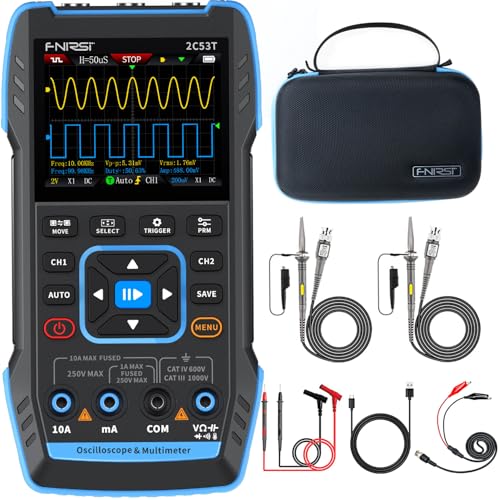
The FNIRSI 2C53T is the upgraded version of the popular 2C23T, combining a 50 MHz dual-channel oscilloscope, a 4.5-digit 19999-count multimeter, and a DDS signal generator capable of outputting 13 waveform types up to 50 kHz — all in a compact handheld form factor that fits in a jacket pocket. The FPGA+MCU+ADC hardware architecture provides stable performance with a 250 MSa/s sampling rate and 1 Kpts record depth.
The oscilloscope mode adds math operations, cursor measurement, persistence mode, and XY mode in this revision, along with a one-click save function that stores waveform images to internal memory for later export via Type-C to a PC. The 2.8-inch color LCD is bright and readable, and the built-in 3000 mAh battery provides up to six hours of continuous use — excellent for field work where a wall outlet isn’t accessible.
Initial setup can be confusing because the UI defaults to Chinese — switching to English requires navigating to System Settings on the first boot. The multimeter auto-ranging mode is somewhat slow compared to dedicated DMMs, and the included probes are functional but not high-end. For a portable 3-in-1 tool at this price point, however, the 2C53T offers remarkable versatility for general diagnostics and learning.
Why it’s great
- Three tools in one compact handheld package
- 6-hour battery life from 3000 mAh cell
- Added math, persistence, and XY modes in upgrade
Good to know
- UI defaults to Chinese on first boot
- Multimeter auto-ranging is slower than dedicated meters
8. IMARS Dual Channel Handheld Oscilloscope HO-3S
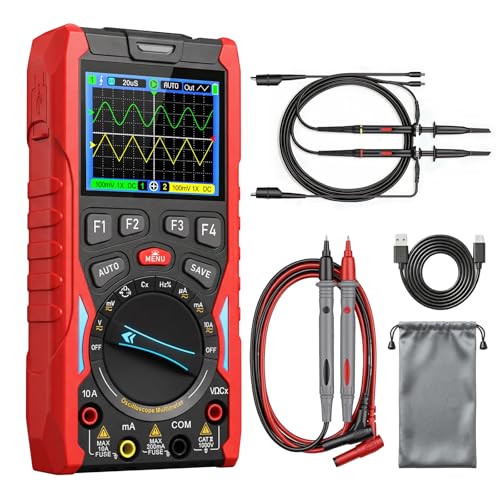
The IMARS HO-3S packs a 70 MHz dual-channel oscilloscope, a 20000-count true RMS multimeter, and a signal generator into a single handheld unit powered by a replaceable 18650 lithium battery — giving you up to four hours of continuous use with Type-C fast charging. The 2.4-inch color TFT display offers 8-level adjustable backlighting and a one-key flashlight for low-light work environments.
Data management is a strong suit here: the HO-3S stores up to 1000 sets of multimeter readings and 200 oscilloscope waveform records with one-touch save and recall, allowing you to document field measurements without needing a separate laptop. Safety features include dual fuse protection (200mA/250V resettable plus 10A/125V single-use) and an overvoltage alarm that alerts you at 24V DC/AC with both audible and visual warnings.
Accuracy on the DMM side is surprisingly good — one user reported readings comparable to their Fluke DVM on common household and automotive voltages. The scope controls, however, have a steeper learning curve, and a printed cheat card is recommended for quick reference until the menu layout becomes familiar. The plastic housing feels durable but lacks a carrying case, so careful handling is advised.
Why it’s great
- Replaceable 18650 battery for extended field use
- Stores 1000 multimeter and 200 waveform records
- Dual fuse protection and overvoltage alarm
Good to know
- Scope controls require a learning curve
- No included carrying case for transport
9. ZOYI ZT-703S

The ZOYI ZT-703S is the most affordable fully integrated 3-in-1 option in this roundup, combining a dual-channel oscilloscope with 50 MHz bandwidth (30 MHz in normal mode, 50 MHz in high-speed mode), a 25000-count multimeter, and a signal generator that outputs sine, square, and triangle waves — all powered by a replaceable Li-ion battery and charged via a standard Type-C port.
The oscilloscope features an AUTO recognition function that simplifies waveform capture for beginners unfamiliar with manual trigger and timebase adjustments, though recognition time varies with waveform complexity and amplitude. The multimeter mode handles resistance, capacitance, continuity, diode testing, and AC/DC current up to 10A with a resolution that rivals basic Fluke meters in the same category, making it a capable standalone DMM when needed.
Reviewers consistently praise the build quality and display readability, with many noting it feels more expensive than its price suggests. The learning curve for button navigation is moderate — expect to spend some time with the manual before feeling comfortable. It’s not a replacement for a professional bench scope, but for occasional troubleshooting, automotive diagnostics, and educational use, the ZT-703S delivers exceptional value in a pocket-sized package.
Why it’s great
- Exceptional value for a 3-in-1 instrument
- Replaceable battery and Type-C charging
- AUTO waveform recognition for beginners
Good to know
- Button layout requires manual reference initially
- Not suitable for very precise measurements
FAQ
Do I need a 4-channel oscilloscope as a beginner?
What is the difference between 8-bit and 12-bit vertical resolution?
Can I use an oscilloscope to measure mains voltage safely?
Final Thoughts: The Verdict
For most users, the best beginner oscilloscope winner is the Rigol DHO804 because its 12-bit resolution, touch screen interface, and four-channel capability at a mid-range price provide the best balance of learning value and advanced features. If you need deep serial decoding and a responsive UI, grab the Siglent SDS1104X-E. And for pure portability with integrated multimeter capabilities, nothing beats the HANMATEK HO52 for field work and floating measurements.