
Our readers keep the lights on and my morning glass full of iced black tea. As an Amazon Associate, I earn from qualifying purchases.
Specs are compiled from manufacturer listings and verified buyer reviews and can change over time — please confirm the key details on the product page before buying.
Your first wheel has one job: keep the turntable steady while your hands are covered in slip (the wet, slippery clay mixture). A wheel that wobbles turns every cylinder into a fight. A wheel that stalls when you press down on the clay teaches you nothing but frustration. Every pick below spins a real potter’s turntable, comes with a foot pedal so you control speed without your hands, and fits a beginner’s workbench rather than a production studio.
I’m Min — the founder and writer behind Gadgets Feed. This guide is built by comparing the manufacturers’ published specifications and the patterns across verified customer reviews, so you get each pick’s real strengths and trade-offs instead of marketing spin.
You will see 350W and 450W motors, 8-inch to 14-inch turntables, and speed ranges that start at 60 rpm and climb past 300 rpm. Weight matters more than you think here — a 25-pound machine and a 46.8-pound machine behave very differently when you lean into a lump of clay. The list below is a practical beginner pottery wheel shortlist built around steady rotation, usable slow speeds, and tools that actually arrive in the box.
Our Picks at a Glance


How To Choose The Best Beginner Pottery Wheel
A beginner wheel has to do three jobs well: hold clay steady, spin slowly enough to learn on, and survive water splashing over it every session. Everything else — tool counts, LCD panels, apron colors — is a bonus you can live without. Get those three right and you will keep throwing past the first month.
Start With Clay Capacity, Not Top Speed
The number that decides whether you can throw a real vase is how much clay the motor can carry. One wheel here handles 11 lbs of clay, another handles 17.6 lbs, and the Alldeer states a 15kg load. A tiny lump of clay for a mug is well inside every wheel on this list, so a higher clay capacity is really a promise about how it behaves when you push toward a taller, heavier form.
Top speed is the least useful figure for a beginner. Every machine here reaches at least 300 rpm, and most of your early work happens far below that, while you are centering a lump with wet hands. What matters is whether the wheel holds a slow, even crawl under pressure rather than stuttering.
Turntable Size Sets Your Ambition
An 8-inch turntable is fine for mugs, small bowls, and hand-building practice. An 11-inch or larger wheel gives your knuckles somewhere to sit while you pull a wall, which is why most classes put beginners on a wider head. If you plan to throw plates or wide bowls within a year, lean toward 11 inches or more.
Foot Pedal, Reversible Spin, and a Basin You Can Lift Out
A foot pedal frees both hands for the clay, which is the whole reason potters use one. A forward-and-reverse switch helps left-handed throwers and makes centering feel less one-sided. A detachable basin lets you carry the slop to the sink in one trip instead of sponging out a fixed tray.
Weight Is Stability You Can Feel
A light machine is easy to store but easy to nudge. A heavier body sits still when you lean in. If you plan to work at a kitchen table, weigh that trade-off before you buy, and keep a stable, level surface underneath.
Quick Comparison
| Model | Best For | Turntable | Motor | Speed Range | Amazon |
|---|---|---|---|---|---|
| VEVOR 11in 350W Ceramic Wheel Forming Machine★ Best Overall | First wheel with a full tool kit | 11 in | 350W | 60–300 rpm | Amazon |
| VEVOR 11in 450W with LCD Touch ScreenBiggest Clay Load | Bigger clay loads on a budget | 11 in / 28 cm | 450W | 60–300 rpm | Amazon |
| VIVOHOME 11Inch Electric Throwing WheelBest for Bat Swaps | Bat pin holes and clean swap-outs | 11 in / 28 cm | 450W | 0–300 rpm | Amazon |
| Alldeer 11 inch Pottery Wheel | Serious hobbyists ready to grow | 11 in | 350W | — | Amazon |
| Huanyu 10″ Pottery Wheel Machine | Quiet home sessions up to 320 rpm | 10 in | 350W | 60–320 rpm | Amazon |
| NATIONAL GEOGRAPHIC Hobby Pottery Wheel Kit | Clay, tools, and lessons in one box | 8 in | Variable speed | Variable | Amazon |
| 110V 9.8 inch Electric Pottery Wheel | Hands-free pedal work on a small head | 9.8 in / 25 cm | 350W | Up to 300 rpm | Amazon |
| 450W 14″ Electric Pottery Wheel with LCD Panel | Big-format throwing at home | 35 cm | 450W | Adjustable | Amazon |
In‑Depth Reviews
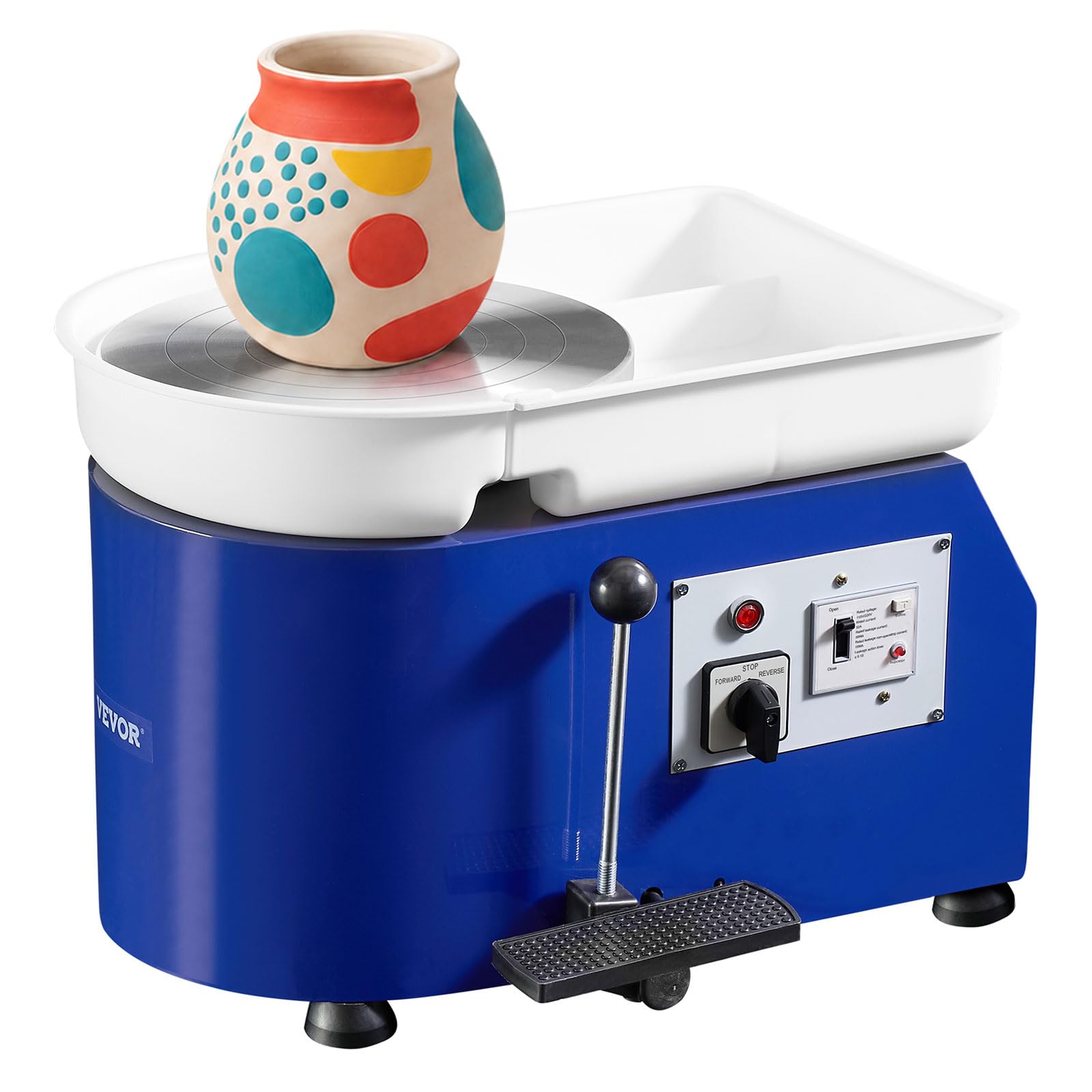
1. VEVOR Pottery Wheel 11inch 350W Ceramic Wheel Forming Machine Accessory Kit
Our pick — 4.5+★ from 250+ verified ratings; the strongest balance of quality and price.
The crowd favorite for a reason — a wide 11-inch head and a full toolset at the price of a bare machine.
An 11-inch turntable with 350W behind it is the combination most beginners want, because the head is wide enough for your fingers to steady a tall cylinder and the motor can carry 11 lbs of clay without complaint. The brushless motor runs at a stated 60dB, roughly the volume of a normal conversation, so a late-evening session in a spare room will not carry through the house. Speed runs from 60 to 300 rpm, and you can reverse the direction for left-handed throwing or a mirrored pull.
Buyers report that it simply does the job. They praise functionality most, then overall build quality, and the value stands out: you get an 8-piece stainless steel toolset, an 8-piece wooden set, and a waterproof apron in the same box. Amazon’s own rating sits at 4.5+ stars across 200+ ratings, which is a strong showing for hobby equipment.
The honest catch is slow-speed control. The summary on this listing flags that customers find it hard to run at very slow speeds, and a few note the wheel can feel a touch unsteady early on. Separately, the bat pin fittings draw the only consistently negative comments in the block. None of that stops you making pots, but if you plan to spend your first month almost exclusively at a crawl while you learn to center, budget time to get used to the pedal’s low end. For scale, this machine weighs 28 pounds.
What earns it the top spot
- 11-inch turntable gives your hands room while you pull a wall
- Handles 11 lbs of clay, so taller forms stay possible
- 8 stainless steel tools, 8 wooden tools, and an apron included
- 60dB brushless motor keeps the noise down at home
Where it asks for patience
- Crawling speeds take practice to dial in cleanly
- Bat pin fittings are the weakest spot in the kit
- At 28 pounds it is not a drop-in-the-cupboard machine
Pick this if: you want one box that gets you throwing tonight — wheel, tools, apron, done.
Think twice if: your entire first month will be painstaking slow-speed centering, where the low end needs coaxing.
2. VEVOR 11in Pottery Wheel for Adults Beginners, 450W Ceramic Wheel Forming Machine With LCD Touch Screen
Same 11-inch head as the top pick, but the motor carries 17.6 lbs of clay instead of 11.
That jump in clay capacity is the whole story here. Sixty percent more clay than the 350W VEVOR above means the 450W motor holds its speed when you push toward a wide bowl or a taller vase, instead of asking you to lighten the lump. The 11-inch turntable is unchanged, so you are buying headroom in the motor rather than a bigger working surface.
The LCD touch screen is the feature you will either love or ignore. It shows your speed and direction and lets you switch between the push lever and the foot pedal without hunting. Quiet operation stays at the same 60-300 rpm range, and the removable ABS basin lifts out for cleaning. The 23-piece sculpting toolset, 8-piece repair set, and waterproof apron round out a kit that genuinely covers a first year.
Where this one gets real is wheel balance. The listing summary is blunt that several buyers hit a badly wobbling wheel, and build quality lands as mixed rather than raved about. That is worth knowing before you commit: a stable turntable is the one thing you cannot work around, so check it spins true the moment it arrives and make use of the return window if it does not. Functionality still anchors the positive side, and the value read is strong for the wattage.
Power per pound: 450W driving an 11-inch head with 17.6 lbs of clay behind it is a lot of throwing room for a beginner-priced machine.
The balance question: wheel wobble is the documented risk — verify it on day one, not on day thirty.
Reach for it if: your clay ambitions run to bigger bowls and taller forms sooner than most beginners.
Look elsewhere if: you would rather not gamble on turntable balance when a steadier wheel exists on this list.
3. VIVOHOME 11Inch 28CM Electric Pottery Throwing Wheel with Bat Pin Holes
Bat pin holes turn a beginner wheel into a wheel you can actually run like a studio.
Most entry machines make you lift the whole pot off the head by hand, which is where rims get squeezed. This one drills bat pin holes into the aluminum alloy wheel so a bat drops on, locks, and lifts off clean. For anyone who wants to throw a set of matching mugs, that single detail changes the workflow more than any motor figure. The 11-inch (28cm) head is wide enough to sit your knuckles against while pulling.
The 450W motor drives a 0-300 rpm range from the foot pedal, and the knob flips between forward and reverse in one move. Noise stays under 60dB. The removable MDF bat has smooth edges and the detachable ABS bowl lifts away for cleaning and storage. You also get 8 stainless steel shaping tools and 8 wooden ones plus a waterproof apron, so the second half of the job — the trimming and cleanup — is covered too.
At 25.3 pounds this is the lighter of the two 11-inch machines that belong side by side in this list, and the compact 13.8-inch footprint tucks against a wall. The spray-finished body and four reinforced bottom pads keep it planted without scratching your floor. Nothing here is a performance compromise; the trade is simply that you pay a step more for the bat-pin machining than you do for a plain head of the same size.
Made for: the beginner who already knows they want repeatable results and matching pieces, not one-off pots.
Worth a pass if: you only ever throw single pieces and would never use a bat in your first year.
4. Alldeer 11 inch Pottery Wheel for Adults, Professional Pottery Kit
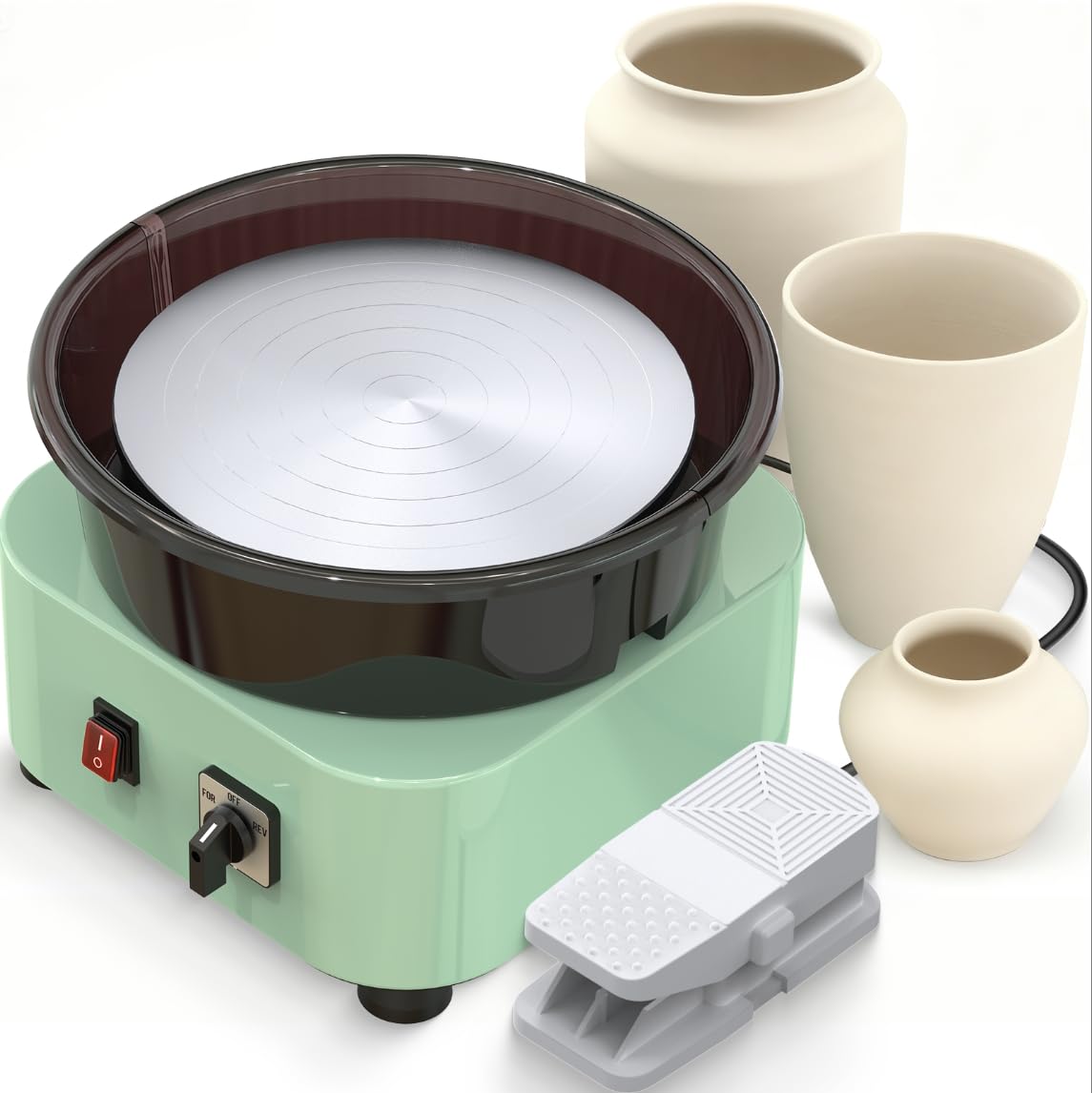
The one that shows up with nineteen tools and stays centered through the deep pulls.
Alldeer pitches this at beginners and backs it with a number that is hard to argue with: a 350W brushless motor rated to carry 15kg of clay and throw pieces up to 18 inches tall without slowing. The wheel is aluminum, which is what keeps the head true when you lean on a heavy lump. A foot pedal runs the speed so both hands stay in the clay.
Nineteen tools ship in the box — stainless steel trimmers and ergonomic wood tools — and the detachable 11-inch splash tray pulls out in seconds so cleaning is a short job instead of an evening. The sealed design keeps clay dust inside the tray rather than across your table. At 21 pounds this is the lightest full-size machine here, which makes it easier to move between a bench and a shelf.
What people enjoy about this wheel is the point of it — hobby pottery, kids included, with everything you need in one box. The included accessories are the second most appreciated part of the package. The catch is quality and durability, which come back mixed: some find it sturdy, others say the motor is weaker under load than the wattage suggests. Nothing here stops you learning; it just means an 18-inch throw is an aspiration, not a promise.
What buyers warm to
- 19 tools means no second trip for trimmers or ribs
- Aluminum head stays centered under a heavy pull
- 11-inch splash tray lifts out in seconds
- 21 pounds is manageable to shift and store
Keep in mind
- Motor strength under a big load is contested
- Quality and durability feedback splits both ways
- Hobby-first build, not a production machine
Fits best for: the hobbyist who wants tools, a clean tray, and a centered wheel on day one.
skip it if: you intend to throw genuinely large pieces where motor strength is the deciding factor.
5. Huanyu Pottery Wheel Machine 10″ with Foot Pedal

Ten inches of aluminum and a top end that reaches 320 rpm — the highest ceiling on this list.
The 60-320 rpm range on a stepless 350W motor gives you a little more headroom than the 300 rpm machines around it. It runs under 60dB, so the machine is quiet in a shared house. The push-button switch is waterproof, which matters when your hands are dripping, and one button flips the direction for reverse throwing.
The aluminum alloy turntable is scratch-resistant and wear-resistant, and the body has thick non-slip pads so it holds its place on a bench. The detachable ABS basin lifts off for cleaning and is built to resist falling, abrasion, and deformation. At 32.5 pounds, this is the heaviest of the 10-to-11-inch group, and that weight is working for you when you lean into a centering push.
The value read here is the strongest single takeaway — buyers rate this wheel well on money spent, and the long-run durability and beginner suitability both come up as solid. Wheel size and stability also draw steady approval. It is a heavier, more static machine than the compact options, so it suits a dedicated corner over a kitchen table you pack away.
Speed and silence: 320 rpm at under 60dB is the widest, quietest envelope in this group, so fine shaping does not drag.
Where it sits still: 32.5 pounds and non-slip pads mean fewer mid-pull nudges — but it is not a wheel you tuck away after each session.
Right choice when: you have a permanent spot and want a heavy, quiet, slightly faster wheel to grow into.
Not for you if: the wheel needs to live in a cupboard between sessions.
6. NATIONAL GEOGRAPHIC Hobby Pottery Wheel Kit – 8″ Variable Speed Pottery Wheel

Clay, tools, lessons, and an articulating arm — the one-box route for total newcomers.
Most wheels sell you the machine and stop. This kit arrives with 3 lbs of air dry clay, 5 wooden sculpting tools, a cut-off tool, and a sponge, so nothing stands between you and a first pot. The 8-inch wheel is the smallest here, which suits mugs and small bowls, and it spins in two directions for right- and left-handed throwers. A powerful variable-speed motor is the drive behind it.
The articulating arm tool is the differentiator — an attachment built to help center, open, and shape clay, which lowers the skill floor for a first-timer. Detailed instructions and links to video lessons plus a learning guide come with it, so you are not guessing at hand positions from scratch. The motor is rated at 60 decibels, genuinely quiet for a shared room, and at 11.34 pounds this is by far the lightest machine on the list — easy to put on a table and take down again.
The honest part is reliability. Some of these wheels run beautifully for a day and then fail, and durability draws real complaints about units giving out after only a couple of uses. A handful find the wheel awkward to work with. Beginners still rate it well as a beginner’s tool, and the fun factor comes through, but treat this as a low-stakes way to try pottery rather than a wheel you pass years of practice through.
Choose this if: you want to try pottery with clay, tools, and instruction included before committing to a serious machine.
Steer clear if: you are looking for a wheel that will reliably last through years of regular practice.
7. 110V 9.8 inch Electric Pottery Wheel Machine with Foot Pedal, 350W

A compact 9.8-inch head with a pedal that lets both hands stay on the clay.
This one keeps the footprint small on purpose. At 23.6 x 19.7 x 16.5 inches it takes noticeably less bench space than the 11-inch VIVOHOME, whose 13.8 x 13.8 x 20.5-inch body is taller and more upright. The 25cm (9.8-inch) turntable sits in between an 8-inch hobby head and a full 11-inch wheel — enough for mugs, small bowls, and first cylinders with hands that have not found their grip yet.
The brushed motor is rated to 300 rpm and runs at about 60dB. The independent foot pedal carries speed so you can work hands-free, and the ABS basin detaches for cleaning. The body is stainless steel and plastic with a good mud-blocking design that keeps clay out of the seams. An earth-leakage protection device sits in the supply, which is the sort of safety check that matters when water is the core ingredient.
The single trade-off is that this is the least-reviewed machine in the group, sitting at 4.0+ stars, so there is less buyer history to lean on than the VEVOR machines carry. Nothing in the build says it is a compromise — stainless steel, low noise, and a hands-free pedal are all real features. It just asks you to go in with modest expectations on long-term feedback.
What it does well: a 25cm head, a hands-free pedal, and a stainless steel body make it a tidy starter for tight benches.
The thinner record: fewer ratings than the leading picks, so don’t expect the same volume of real-world experience behind it.
Best fit: a small workbench where space is scarce but you want pedal control and a stainless body.
Less ideal if: you want a large body of buyer feedback to lean on before your first purchase.
8. 450W 14″ Electric Pottery Wheel with LCD Panel, Adjustable Speed Foot Pedal
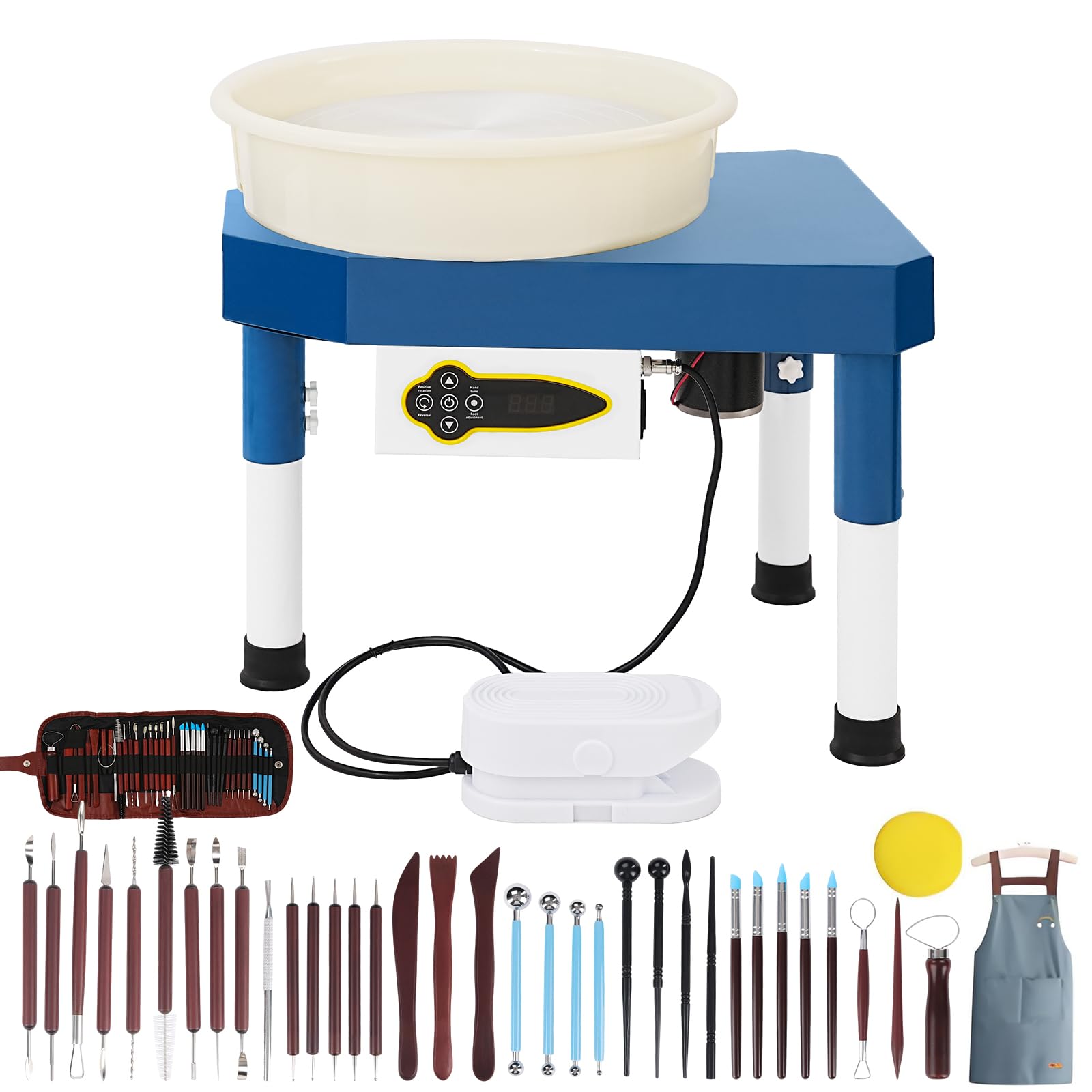
A 35cm aluminum head on a steel body — the biggest working surface here, and the heaviest.
The 35cm turntable is the widest on this list, noticeably bigger than an 11-inch head, which means room for plates and wide bowls that the smaller wheels ask you to skip. The 450W motor drives it through a belt-drive turbine that holds under 60dB at any speed, so the extra size does not arrive as extra noise. The aluminum head is bright, wear-resistant, and scratch-resistant, and the steel-plate body is built for a fixed spot rather than a shelf.
An LCD panel sits on the front and shows which step of the throw you are on and what speed each form wants, so you can record settings and repeat them next session. You can switch between the independent foot pedal and the speed button beside the screen, and flip clockwise to counterclockwise freely. The detachable ABS basin lifts out for cleanup, and an earth-leakage plug covers the safety side.
Here is the thing to weigh: 46.8 pounds is the heaviest machine on the list by a wide margin, and it is also the least-reviewed at 4.0+ stars. That weight buys you stability when you lean into a big lump, but it is not a wheel you move between rooms. As the newest machine in the group, it simply has less track record behind it than the established picks.
Why it stands out
- 35cm head is the widest working surface in the group
- LCD panel logs speed and step for repeatable throws
- Belt-drive motor stays under 60dB at any speed
- Steel body and aluminum head are built to sit still
What to weigh first
- 46.8 pounds is heavy to move anywhere
- 4.0+ stars with a smaller pool of buyer history
- Bigger head is overkill if you throw small forms
This one wins for: a fixed home studio where big plates and wide bowls are the goal, from the very first session.
Not the one for: a spare-room thrower who wants a light wheel and a long buyer track record.
Understanding the Specs
Motor Wattage and Clay Capacity
Wattage is the muscle rating — 350W and 450W are the two figures you will see on beginner wheels. Clay capacity is the practical result of that muscle: one wheel here states 11 lbs of clay, another 17.6 lbs, and a third claims a 15kg load. A bigger capacity means the motor holds speed under a taller, heavier lump rather than stalling. For first-year work — mugs, bowls, small cylinders — every wheel on this list has more than enough.
Speed Range and Slow-Speed Control
Speed is measured in rpm, or rotations per minute of the turntable. A range like 60-300 rpm means the wheel can crawl at 60 rpm while you center a lump and spin at 300 rpm when you shape a thin wall. The low end is where beginners live, so a wheel that stutters at 60 rpm will feel harder than one that glides. A foot pedal drives the speed so both hands stay free.
Turntable Diameter
The head diameter sets how big a piece you can comfortably throw. An 8-inch head suits mugs and small bowls, a 9.8-inch or 10-inch head gives a little more room, and 11 inches and up lets your fingers sit steady against a taller wall. A 35cm head is the widest here and opens up plates and wide bowls. Match the diameter to the shapes you genuinely want to make, not the biggest number on the page.
Noise, Weight, and Cleanup
A quiet wheel runs in the region of 60dB, close to a conversation, which matters if pottery happens in a shared or small space. Weight tells you how stable the machine sits — a 46.8-pound body barely moves, an 11.34-pound body travels easily. A detachable ABS basin lets you carry the slop to the sink in one trip, and bat pin holes let you swap a bat without lifting the pot by hand.
FAQ
How much clay can a beginner pottery wheel actually handle?
What turntable size should a beginner start with?
Is a foot pedal really necessary on a beginner wheel?
Why does a wheel wobble, and can I fix it?
How loud is a pottery wheel when I use it at home?
Do I need to bolt the wheel down, or is weight enough?
Can a left-handed person use these wheels?
What is the difference between an 11-inch and a 14-inch turntable?
Are the included tools and clay enough to start?
How do I clean a beginner pottery wheel after a session?
Final Thoughts: The Verdict
For most people starting out, the VEVOR 11-inch 350W Ceramic Wheel Forming Machine is the pick to beat. Its wide 11-inch head gives you room to center clay, and its quiet 350W motor (350 watts of power) carries 11 lbs of clay. A full toolset and apron arrive with the wheel. If bigger clay loads are the goal, the VEVOR 450W with the LCD touch screen carries 17.6 lbs and gives you power headroom. And if you want a real studio workflow from day one, the VIVOHOME with its bat pin holes (holes that hold a bat, a flat disc you lift off with the pot) is the one to grab. Start with the strongest kit you can afford — the slow speeds come with practice.
How We Picked
We do not accept paid placement. Every pick is matched to a real buyer and a real use-case; we do not hands-on test units.
Sources & Methodology
Specifications: manufacturer listings and product documentation. Review insights: verified customer reviews, as of November 2026. Pricing: not shown on this page (it changes often); check the current price via the retailer link.
As an Amazon Associate, Gadgets Feed earns from qualifying purchases. This does not affect which products we feature.