
The moment your first RC airplane lifts off the ground, a new world opens. But for every beginner who soars, another nose-dives into the grass within seconds — frustrated, stripped of confidence, and wondering if they bought the wrong plane. The difference between a thrilling first flight and a splintered fuselage comes down to one factor: choosing a trainer designed to forgive your mistakes. A proper beginner RC airplane prioritizes stability over speed, gyro assistance over raw power, and durability over weight savings. Without those three pillars, you are set up for failure from the start.
I’m Rikta — the co-founder and writer behind Gadgets Feed. I’ve spent years analyzing the technical specifications of entry-level RC aircraft, comparing flight controller chipsets, motor-gear ratios, and wing-loading numbers so you don’t have to learn the hard way. (And Homer 🐱 supervised every test flight from the safety of the windowsill, tail twitching at each landing.)
This guide walks you through the seven most capable models for first-time pilots, with detailed breakdowns of their stabilization systems, battery configurations, and structural foam types. Whether you plan to fly in a backyard, at a local park, or on a dedicated RC field, the right beginner rc airplane is the one that keeps you flying after the first inevitable bump.
How To Choose The Best Beginner RC Airplane
Selecting your first RC plane is a balance between crash forgiveness, control assistance, and growth potential. The wrong choice can turn a hobby into a repair project. Focus on these four factors before clicking buy.
6-Axis Gyro Stabilizer
This electronic system constantly corrects the plane’s attitude against wind gusts and pilot over-correction. A 6-axis gyro is what separates a “flyable” plane from a “fly-by-wire” trainer. Without it, a beginner’s natural twitch on the joystick sends the plane into a spiral. With it, the aircraft self-levels the moment you release the sticks, giving you time to think. Every plane on this list includes one, but the calibration quality varies across brands.
3-Mode Flight Control: Beginner, Intermediate, Expert
The best trainers offer three presets that adjust the gyro’s intervention level. In Beginner mode, the plane limits bank angle and automatically recovers from dives. Intermediate mode reduces assistance but still provides stability. Expert mode hands full control to the pilot. This phased learning approach lets you build muscle memory without buying a new aircraft as your skills develop. If a plane only has one mode, you will outgrow it in weeks.
Propeller Saver Technology
Propellers are the most fragile part of any RC airplane. A “prop saver” is a flexible mounting system that allows the propeller to pop off upon impact rather than shatter. Models with traditional rigid mounts break blades on every rough landing, creating a recurring expense and downtime. The best beginner airframes also use EPP (expanded polypropylene) foam, which bends and bounces rather than cracks.
Quick Comparison
On smaller screens, swipe sideways to see the full table.
| Model | Category | Best For | Key Spec | Amazon |
|---|---|---|---|---|
| HobbyZone AeroScout S 2 1.1m | Premium Trainer | First-time pilots wanting a dedicated trainer | 1.1m wingspan, SAFE Technology | Amazon |
| E-flite UMX Turbo Timber Evolution | Compact Premium | Small field flying and STOL performance | UMX size, 2S/3S compatible | Amazon |
| volantexrc Trainer Sport Cub 500mm | High-End Mini | Learning with a dedicated Sport Cub airframe | 500mm wingspan, 3 flight modes | Amazon |
| volantexrc P51D Mustang 500mm | Mid-Range Warbird | Scale looks and 20-minute flight times | 500mm wingspan, Xpilot gyro | Amazon |
| LEAMBE P51 Mustang 4CH | Mid-Range Value | Budget-conscious beginners wanting 3 modes | 14-inch fuselage, 656ft range | Amazon |
| DEERC F-16 Style X-62A Vista | Value Jet | High-speed jet experience on a budget | 4400KV brushless motor, 4-ch | Amazon |
| ANBURI P51 3CH Fighter | Entry-Level | Absolute beginners wanting ultra-simplicity | 3-channel, dual 20-min batteries | Amazon |
In‑Depth Reviews
1. HobbyZone AeroScout S 2 1.1m

The HobbyZone AeroScout S 2 is the gold standard for true beginner training, purpose-built around Horizon Hobby’s exclusive SAFE technology. This system uses an envelope-protection algorithm that prevents the aircraft from exceeding a safe bank angle and automatically returns to level flight when you release the sticks — a lifesaver for the first half-dozen flights. The 1.1-meter wingspan provides excellent visibility at altitude and stable slow-flight characteristics, while the rear-mounted pusher propeller protects the blades from ground strikes during belly landings. It includes a Spektrum DXS transmitter with industry-leading DSMX 2.4GHz technology for interference-free control.
The airframe arrives nearly ready to fly with the brushless motor, Spektrum AR631 receiver, and Avian 30A Smart ESC pre-installed. You supply your own 3S LiPo battery and charger, which adds a small upfront investment but gives you full control over battery quality. The three-mode flight system — Beginner, Intermediate, and Experienced — lets you progress from self-leveling assistance to full aerobatic control (loops, rolls, inverted flight) on the same airframe. Experienced pilots report 15-20 minute flight times on a 2200mAh pack and a top speed of around 50 mph in Expert mode.
The most important consideration is the plane’s weight: at over 3.4 kilograms with battery, the AeroScout crosses the FAA registration threshold (250 grams), so you will need to register with the FAA and likely install a Remote ID module. This is a minor paperwork step for a plane that will survive high-speed impacts into fences and trees thanks to its durable foam construction. The basic DXS transmitter lacks an LCD screen, so you will need to connect it to a computer or purchase a programming cable for binding adjustments. For a dedicated trainer that grows with you for years, this is the benchmark.
Why it’s great
- SAFE envelope protection prevents common beginner crashes
- Rear-mounted pusher prop avoids ground strikes
- Three flight modes on a single airframe
Good to know
- Requires separate LiPo battery and charger
- Exceeds FAA weight limit — needs registration
- Basic DXS transmitter lacks screen feedback
2. E-flite UMX Turbo Timber Evolution

The E-flite UMX Turbo Timber Evolution packs serious capability into an ultra-micro (UMX) airframe, making it the best option for pilots who fly in smaller spaces like soccer fields or schoolyards. Its STOL (Short Takeoff and Landing) design, combined with functional LED navigation and landing lights, allows you to operate from paved and grass surfaces with ease. The brushed-outrunner motor spins a scale propeller and delivers strong thrust on both 2S and 3S LiPo packs — a 3S 300mAh battery yields aerobatic performance with extended vertical authority, while 2S keeps things docile for initial training.
The factory-installed Spektrum receiver includes optional-use SAFE Select, which you can assign to a transmitter switch for on-demand self-leveling. This is a critical feature: you can fly in full manual mode for skill-building, then flip SAFE on during a stressful landing approach. The foam airframe is lightweight, so even a 3S pack keeps the all-up weight under 250 grams, avoiding the need for FAA registration. The box itself doubles as a carrying and storage case, protecting the airframe during transport. Flight times hover around 5 minutes on 3S 300mAh, which is short but typical for UMX-class aircraft.
The main downside is reliability: multiple user reports describe servo failures (aileron and elevator freezing mid-flight) that resulted in crashes. This appears to be a quality-control inconsistency with the linear servos, not a design flaw in every unit. Additionally, the UMX Timber is sensitive to wind above 5-7 mph due to its low wing loading, limiting its comfortable flying envelope. You will also need a Spektrum-compatible transmitter since this is a BNF (Bind-N-Fly) model — no transmitter is included. For pilots who already own a Spektrum radio, this is the most capable small-field trainer available.
Why it’s great
- STOL capability for small-field operations
- 2S and 3S battery flexibility
- Under 250g — no FAA registration needed
Good to know
- Requires separate Spektrum transmitter
- Reported servo reliability issues
- Short flight times on 3S packs
3. volantexrc Trainer Sport Cub 500mm

The volantexrc Trainer Sport Cub is a purpose-built 500mm trainer that emphasizes crash forgiveness through its Xpilot 6-axis gyro stabilizer and prop saver technology. The prop saver is the standout feature: upon impact, the propeller pops off the motor shaft rather than snapping, allowing you to snap it back on and resume flying within seconds. The airframe uses durable EPP foam that has survived over 50 crashes in user testing, with only a cracked nose after repeated hard nose-ins — fixable with foam-safe glue. The 2.4GHz transmitter provides a 656-foot control range with strong anti-interference capability.
The three flight modes are clearly distinct: Beginner mode limits bank angle to approximately 30 degrees and auto-recovers from dives, Intermediate mode allows sharper turns while maintaining gyro assistance, and Expert mode hands over full aileron, elevator, rudder, and throttle control. The Sport Cub’s high-wing design provides inherent pitch stability, and the large squishy wheels make ground takeoffs easy even on short grass. Flight times reach 15-20 minutes on the included 2S LiPo battery, and the gearbox-driven motor system improves low-end torque for steady climbs.
The biggest frustration is propeller availability: the specialized 4-blade propellers are difficult to find on Amazon, and EXHOBBY’s direct-from-China replacement process has caused shipping delays for some users. While the prop saver reduces breakage, a hard crash can still launch the prop into tall grass where it is easily lost. The included charging cable is also flimsy, so upgrading to a proper balance charger improves battery longevity. For a mini trainer that teaches 4-channel control with a safety net, the Sport Cub delivers exceptional value.
Why it’s great
- Propeller saver prevents blade breakage
- Three distinct flight modes for phased learning
- Durable EPP foam survives repeated crashes
Good to know
- Replacement propellers hard to source
- Included charger is low-quality
- Tail wheel has weak connection
4. volantexrc P51D Mustang 500mm

The volantexrc P51D Mustang offers the same 3-mode Xpilot gyro system and 500mm airframe as the Sport Cub, but wrapped in a low-wing WWII fighter aesthetic that looks far more aggressive in the air. The gearbox-driven motor system provides up to 20 minutes of flight time on the included 2S LiPo pack, which is generous for this size class. The 4-blade propeller delivers scale authenticity at the cost of some efficiency, but the plane still achieves approximately 25 mph in level flight — fast enough for responsive circuits without overwhelming a beginner. The one-button aerobatic function lets you perform rolls and loops by pressing a switch on the transmitter.
The three flight modes operate identically to the Sport Cub, but the low-wing design makes this plane slightly less stable in wind. Beginner mode still provides strong gyro assistance, but the Mustang will feel more twitchy in gusts above 5 mph. The included transmitter is the same 2.4GHz unit with a 656-foot range, and everything arrives ready to fly — just charge the battery, snap on the wing, and launch with a hand toss or ground roll. The red paint scheme stands out well against blue sky and green trees, making orientation easy even at distance.
The low-wing configuration also means ground handling is more challenging: the landing gear is springy but the plane will nose over on grass if you land with any nose-down attitude. The motor box can shift inward after a hard frontal impact, requiring careful re-gluing. Some users note that the inverted elevator authority is weak in Expert mode, limiting sustained inverted flight. This is not a plane for absolute raw beginners — it is best for pilots who have logged at least 5-10 flights on a high-wing trainer and want to transition to a warbird airframe with ongoing gyro support.
Why it’s great
- Scale P-51 Mustang appearance with warbird details
- 20-minute flight times from included battery
- One-button aerobatic function for instant fun
Good to know
- More wind-sensitive than high-wing trainers
- Motor box shifts forward after crashes
- Requires prior trainer experience for best results
5. LEAMBE P51 Mustang 4CH
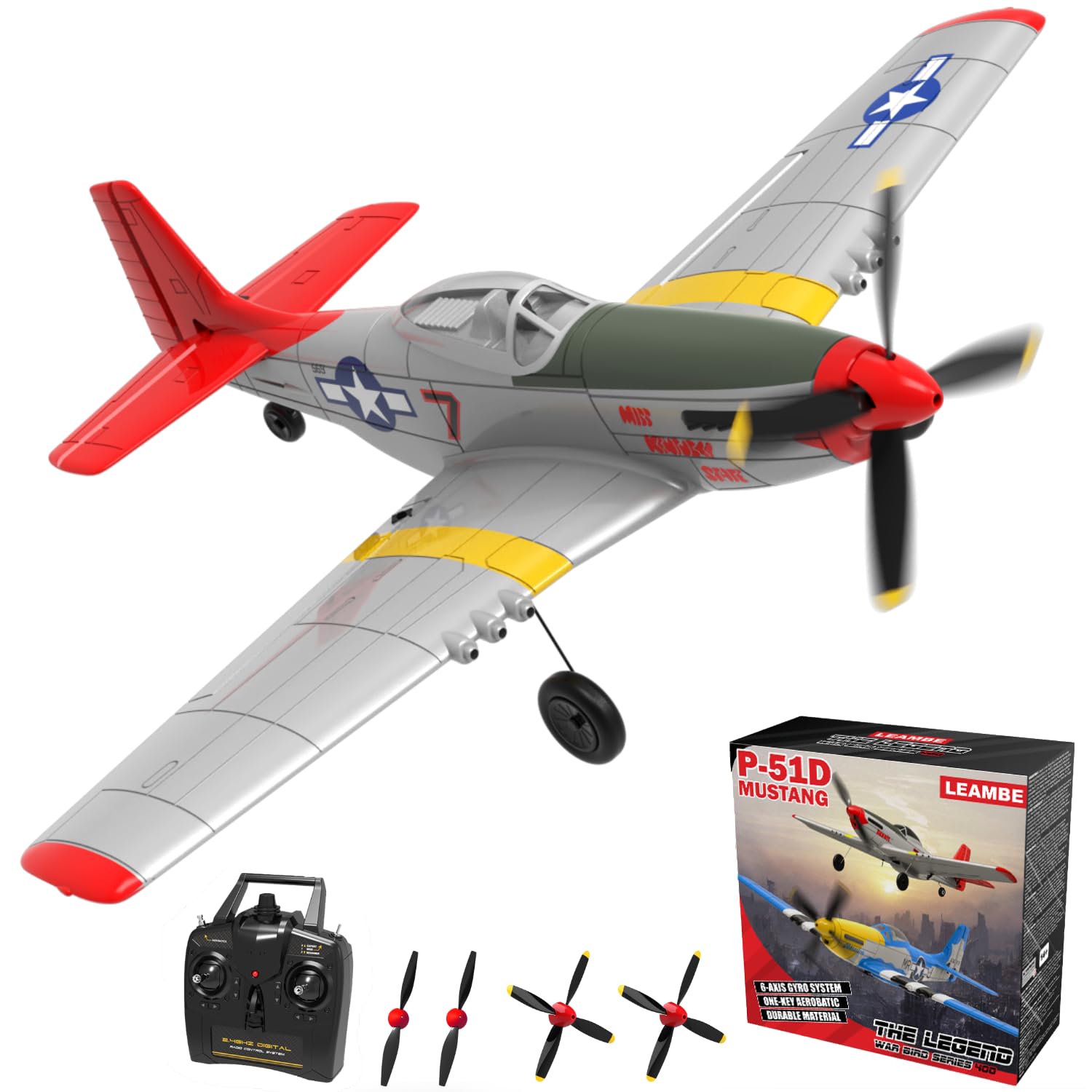
The LEAMBE P51 Mustang 4CH delivers the full 3-mode flight experience (Beginner, Intermediate, Expert) paired with a propeller saver at a price that undercuts the volantexrc models. The Xpilot stabilization system provides noticeably strong self-leveling in Beginner mode — users describe it as “practically flying itself” during the first few flights. The 8mm coreless motor pulls the 14-inch fuselage and 15-inch wingspan through the air with enough authority for smooth climbs and banked turns. The 2.4GHz control range reaches 656 feet, giving you plenty of room for wide circuits.
The propeller saver works reliably: several user reports describe crashes into trees and hard nose-ins where the prop popped off cleanly and snapped back on without damage. The bright white paint scheme with red accents shows up well against most backgrounds, though some users note that the sky can wash it out on overcast days. The included transmitter requires AA batteries (not included), and the plane arrives with a USB charger and single LiPo pack that delivers approximately 12 minutes of mixed-throttle flying. The small battery compartment requires careful battery insertion to avoid pinching wires.
Durability is a mixed bag: while the EPP foam survives impacts well, the landing gear is fragile and tends to bend or detach after grass landings. Several users managed to break the propeller even with the saver system during extreme crashes, and the replacement prop situation is unclear. The instruction manual is rudimentary, so beginners may need to watch online setup videos to understand dual-rate and trim adjustments. For the price, this is a capable 4-channel trainer with the safety net of three flight modes, but expect to budget for a spare propeller and some glue.
Why it’s great
- Lowest-cost 4-channel with 3-mode gyro system
- Propeller saver effectively prevents blade breakage
- Lightweight foam survives moderate impacts
Good to know
- Landing gear bends easily on grass landings
- Battery compartment is very tight
- Manual lacks clear setup instructions
6. DEERC F-16 Style X-62A Vista
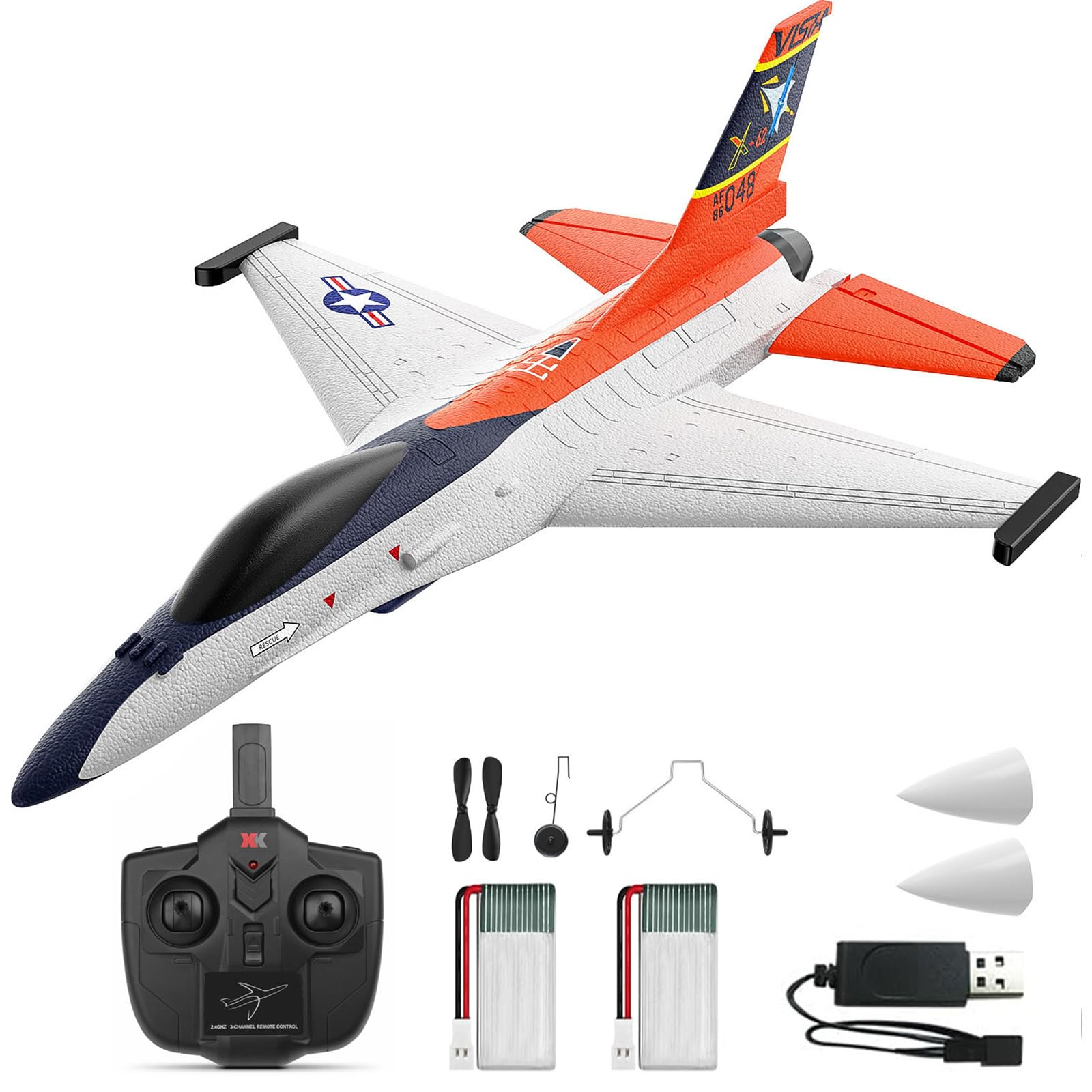
The DEERC X-62A Vista brings a brushless 4400KV motor to the budget category, delivering instant throttle response and sustained torque through high-G maneuvers that brushed motors cannot match. The 4-channel control system includes a 6-axis gyro stabilizer with dual takeoff modes (standard and hover assist), which is rare at this price tier. The “hover mode” is especially useful for beginners: it holds the plane at a near-vertical attitude during launch, preventing the most common first-flight mistake of stalling immediately after the toss. LED lights on the wingtips and fuselage improve orientation during low-light flying.
The airframe is modeled after the F-16 with scale paintwork and jet-inspired lines, though the EPP foam construction feels slightly less dense than the volantexrc models. The dual 400mAh LiPo batteries provide a combined flight time of 20+ minutes, and the 2.4GHz transmitter includes a low-battery alert that flashes the LED when voltage drops. The included landing gear and rear tail wing require minor snap-on assembly, but no tools are needed and the process takes under 60 seconds. The brushless motor produces a satisfying high-pitched whine during full-throttle passes.
The foam quality is the main concern: multiple user reports describe cracked wings and battery compartment lids coming off during the first flight, suggesting inconsistent manufacturing. The plane is also relatively heavy for its size, and without the gyro’s hover mode, it falls from the sky at low speed — it simply does not glide. This means every landing requires power management right up to the flare, a skill that takes practice. The hover mode is essential for both takeoff and landing, so beginners should not attempt manual launches until they have built confidence over several battery cycles.
Why it’s great
- Affordable brushless motor for instant power
- Hover assist mode prevents launch and landing stalls
- Dual batteries for extended 20+ minute flying
Good to know
- Foam quality is inconsistent across units
- Does not glide — requires power on approach
- Delicate rubber nose cone wears quickly
7. ANBURI P51 3CH Fighter
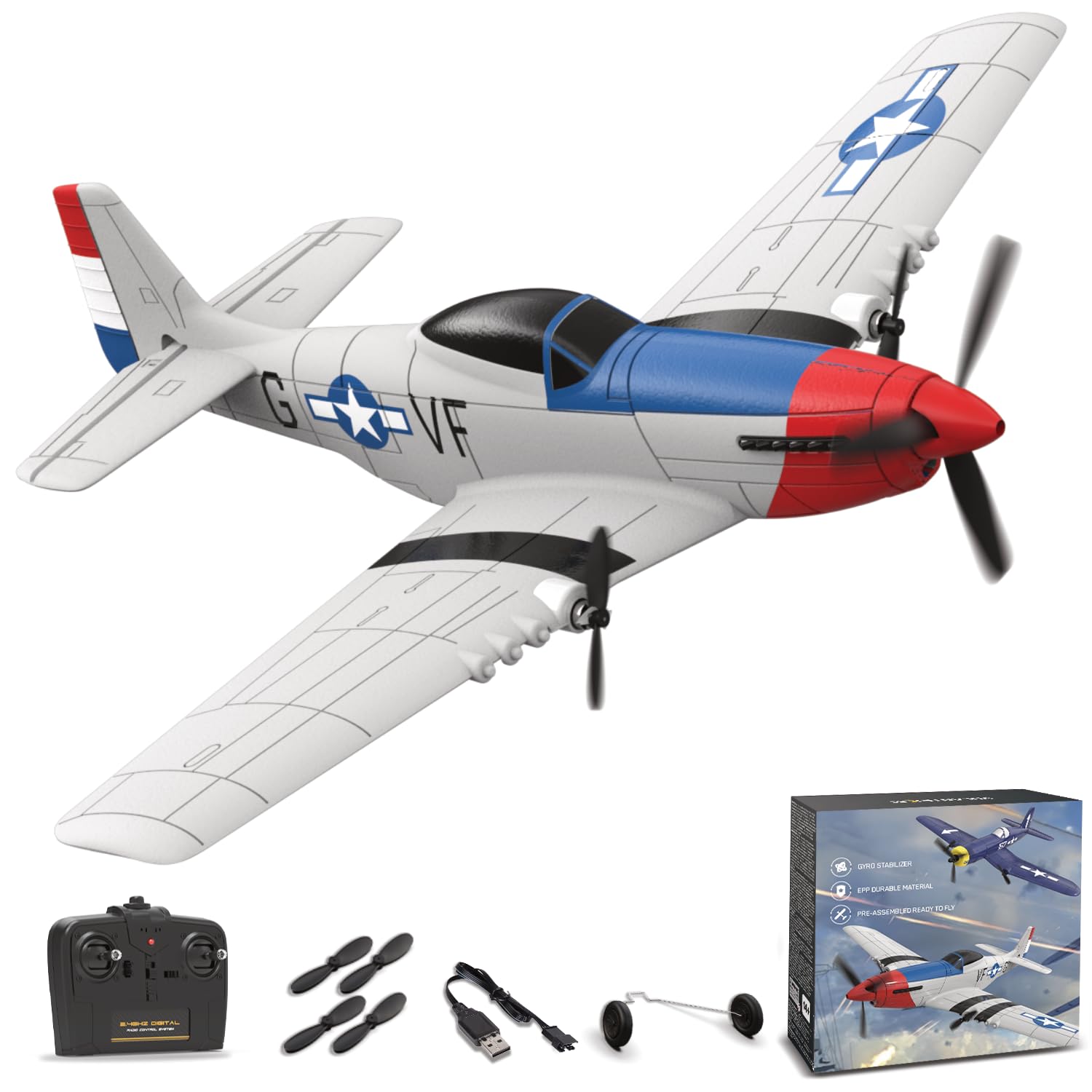
The ANBURI P51 3CH Fighter is the simplest entry point on this list, using a 3-channel control scheme (throttle, rudder, elevator) that eliminates the aileron complexity of 4-channel planes. This makes it ideal for young pilots or adults who just want to experience hands-on flight without learning multi-axis coordination. The 6-axis gyro stabilizer provides strong self-leveling, and the dual built-in motors give it surprising climb authority for a lightweight EPP airframe. The package includes two batteries for approximately 20 minutes of total flight time, which is generous at this tier.
The assembly is genuinely tool-free: snap on the tail section, attach the propeller, and install the landing gear — done in under two minutes. The 2.4GHz remote controls four directions (up, down, left, right) via the rudder and elevator, and includes a trick button that triggers pre-programmed rolls and flips. The foam construction is durable enough for moderate impacts, though the propeller is exposed without a saver mechanism, so replacements are a realistic need. The plane’s lightweight design (under 0.5 kg) keeps it below any regulatory threshold.
Quality control is the biggest gamble: several user reports describe units where the tail stopped responding mid-flight, batteries died within a week, or a motor broke off after two hours of cumulative use. These failures appear to be batch-specific and not universal, but the variance is high enough that you may receive a plane that works perfectly or one that fails within minutes. The 3-channel limitation also means you cannot practice aileron rolls in manual mode — the trick button handles that. For a sub- experiment to see if RC flying is for you, this plane works, but do not expect the longevity or support of the premium options.
Why it’s great
- Simplest 3-channel learning curve available
- Tool-free assembly in under two minutes
- Dual batteries for extended flight time
Good to know
- Inconsistent quality control across units
- No propeller saver — blades break on impact
- 3-channel limits future skill progression
FAQ
Can a complete beginner fly a 4-channel RC plane without crashing?
What is the difference between EPP and EPS foam in RC airplanes?
How much wind can a beginner RC airplane handle safely?
Final Thoughts: The Verdict
For most users, the beginner rc airplane winner is the HobbyZone AeroScout S 2 1.1m because its SAFE envelope protection offers the most forgiving learning curve available, plus a 1.1-meter airframe that cuts through wind better than any micro trainer. If you want a compact plane that fits in a backpack and flies at your local soccer field, grab the volantexrc Trainer Sport Cub 500mm with its excellent prop saver and three-mode Xpilot gyro. And for the best value on a 4-channel starter with room to grow, the LEAMBE P51 Mustang 4CH delivers the essential features — gyro stabilization, three flight modes, and a propeller saver — at a price that leaves room in your budget for a spare battery and some foam-safe glue.