
Our readers keep the lights on and my morning glass full of iced black tea. As an Amazon Associate, I earn from qualifying purchases.
Specs are compiled from manufacturer listings and verified buyer reviews and can change over time — please confirm the key details on the product page before buying.
If you want to actually see Saturn’s rings or Jupiter’s cloud bands, the number that decides it is aperture — the width of the telescope’s main lens in millimeters. A 70mm scope will show you the Moon beautifully and Saturn as a small ringed disc. An 80mm or 90mm scope gathers noticeably more light, so those same planets look brighter and hold more detail. That one spec matters far more than magnification numbers printed on the box, because magnification is just focal length divided by eyepiece size, and you can always add more with a Barlow lens later.
I’m Min — the founder and writer behind Gadgets Feed. This guide is built by comparing the manufacturers’ published specifications and the patterns across verified customer reviews, so you get each pick’s real strengths and trade-offs instead of marketing spin.
The picks below run from a 70mm refractor with a huge owner base to 90mm scopes with stainless steel tripods, and every one of them has put real planets in real eyepieces. This guide sorts the nine strongest options for a beginner telescope to see planets.
Our Picks at a Glance


How To Choose The Best Beginner Telescope To See Planets
Planets are the hardest easy target in the sky. The Moon forgives a weak scope because it is enormous and blindingly bright. Saturn and Jupiter do not — they are small, and you need enough light-gathering and enough steady mounting to pull detail out of them. Here is what actually moves the needle.
Aperture First, Magnification Second
Aperture is the diameter of the front lens, measured in millimeters, and it controls how much light the scope collects. More light means a brighter planet and finer detail at the same magnification. A 90mm scope pulls in more light than a 70mm one, so Jupiter’s cloud bands and Saturn’s rings hold up better. Magnification is adjustable — you change it by swapping eyepieces or adding a Barlow lens — but aperture is fixed the day you buy. Buy the aperture you can afford and adjust the rest later.
Focal Length Sets Your Magnification Math
Focal length is the distance light travels inside the tube before it reaches your eye, written in millimeters. Divide focal length by eyepiece size to get your magnification. A 900mm scope with a 10mm eyepiece gives you a much closer look than a 400mm scope with the same eyepiece. Long focal length also means a narrower field of view, which is good for planets but makes finding them harder at first.
Mount Type Decides How Much You Fuss
An alt-azimuth mount moves up-down and side-to-side, like a camera tripod head — intuitive for beginners learning the sky. A Dobsonian is a simple rocker box that does the same job without a tripod. Neither one tracks the planet for you as the Earth rotates, so expect to nudge the scope every so often. A stable mount matters more than a fancy one; a shaky tripod turns a sharp planet into a blurry smear.
Get a Finder and a Barlow in the Box
A finderscope is the small sighting tube on top that lets you aim the scope without squinting down the main tube. A Barlow lens is a magnifier you insert before the eyepiece that multiplies your power. Both are far cheaper bundled in than bought separately later, so check the included accessory list before you commit.
Quick Comparison
| Model | Best For | Aperture | Focal Length | Included Eyepieces | Amazon |
|---|---|---|---|---|---|
| Celestron AstroMaster 70AZ★ Best Overall | First scope with the biggest owner base | 70mm | 900mm | 20mm and 10mm | Amazon |
| SOLOMARK 80mmAZ 900mmBest for Travel | Travel and packing light | 80mm | 900mm | 10mm and 20mm | Amazon |
| SOLOMARK 80mm Aperture 900mmBest for Small Spaces | Apartment and small-space storage | 80mm | 900mm | 10mm and 20mm | Amazon |
| Celestron FirstScope Moon | Desk-side Moon and bright planet sessions | 75mm | 300mm (12″) | 4mm and 20mm | Amazon |
| MEEZAA 80mm Aperture 500mm | Families and first-night success | 80mm | 500mm | 25mm and 10mm | Amazon |
| Celticbird 80mm Aperture 600mm | Backpack camping and road trips | 80mm | 600mm | 20mm and 9mm | Amazon |
| Gskyer 80mm AZ 400mm | Daytime spotting and night sky in one | 80mm | 400mm | 16X, 40X, 80X | Amazon |
| MEEZAA 90mm Aperture 800mm | Brightest planet views in the group | 90mm | 800mm | 10mm and 25mm | Amazon |
| Dianfan 90mm Aperture 800mm | Steady mount for high zoom on planets | 90mm | 800mm | 10mm and 25mm | Amazon |
In‑Depth Reviews
1. Celestron AstroMaster 70AZ Refractor Telescope for Moon & Planet Viewing
Our pick — over 4★ from 3,500+ verified ratings; the strongest balance of quality and price.
The 70mm entry point with the deepest track record for putting Saturn’s rings in a beginner’s eyepiece.
If you want the safest possible first telescope — the one thousands of people bought before you and can tell you exactly what it shows — this is the pick. It is a 70mm achromatic refractor with a 900mm focal length, and that combination is what lets it push usable magnification high enough to resolve the rings of Saturn and the cloud bands on Jupiter. The alt-azimuth mount moves the way your hand expects, and the supplied panhandle lets you nudge the tube up, down, and sideways without losing your target. Setup is quick because the tripod and mount arrive preassembled — you attach the optical tube to the mount and you are three minutes from your first look.
You get a full set of accessories, not just the tube. The kit includes a 20mm and a 10mm eyepiece, an erect-image 90° diagonal (a prism that turns the image right-side-up for land viewing), and a StarPointer red dot finderscope (a small sight that projects a red dot on the sky so you can aim roughly before looking through the main tube). You also get a free download of astronomy software. The fully coated optics and the Dawes Limit of 1.66 arc_sec — a measure of the finest detail the lens can theoretically resolve — put it right where a starter scope should be. The exit pupil diameter is 1.56 millimeters, which is the size of the bright circle of light that hits your eye.
Buyers bring up value more than any other aspect, with enjoyment and beginner-friendliness close behind. The clearest sky report is also the most specific: “Good for beginners: sees Saturn’s rings, Jupiter + 4 moons, cloud bands, Orion Nebula, Andromeda (hazy), lunar craters.” That is a real catalogue of planetary targets, not a marketing promise. The honest catch is the tripod. Owners describe the mount as sticky at high magnification and the legs as prone to a little flex, so the planet will bounce while you are framing it. It settles down if you observe on solid ground and swap in an upgrade eyepiece later — but if you want rock-steady tracking right from the start, the 90mm Dianfan further down the list is built differently.
Where it earns its place
- 900mm focal length and a 70mm aperture put Saturn’s rings and Jupiter’s moons within reach for a true beginner.
- Arrives preassembled — optical tube to mount, and you are observing.
- Two eyepieces, an erect-image diagonal, and a red dot finderscope all ship in the box.
- Fully coated optics with a 1.56 millimeters exit pupil keep the view bright and comfortable.
What to know before you buy
- The tripod flexes enough that high-magnification views wobble while you are nudging the mount.
- 70mm caps what you can pull out of faint deep-sky objects — it is a planet and Moon scope first.
- One owner flatly found the included eyepieces limiting on anything past the Moon.
Buy it if: you want the most-proven beginner setup and planets are your priority over faint nebulae.
Look at the 90mm picks instead if: you plan to spend most nights on high magnification, where the lighter tripod shows its flex.
2. Telescopes for Adults & Beginner Astronomy, 80mmAZ 900mm Focus Length
A packable 80mm tube that turns a campsite into an observatory in under a minute of unpacking.
Here is the jump in real terms: this SOLOMARK pairs an 80mm aperture with a 900mm focal length, and that wider front lens captures more light than the 70mm Celestron above. The exit pupil diameter tells you how bright the view feels — 0.89 millimeters here versus the AstroMaster’s 1.56 millimeters, the trade-off of a longer tube with a wider objective. The field of view is 1.35 degrees, a narrow, planet-friendly window. Everything — the scope, the tripod, the eyepieces, the diagonal — packs into the included carrying bag, and that bag is the whole point of this pick.
The included accessories cover the basics well: a 5×24 finderscope with a crosshair for aiming, an erect image diagonal so the view is upright, and a phone adapter for snapping what you see. Two wide-angle eyepieces give you 45X and 90X magnification. The tripod is a full-size adjustable aluminum model with a rough-adjustment gimbal marked with altitude and azimuth scales, which makes pointing more deliberate than the panhandle style.
Owners consistently single out build quality first, then clarity — those two dominate the feedback. The beginner-priced performance story is best summed up by a parent whose eight-year-old used a phone app to star-hop and then looked through this scope: “Beginner-friendly, unbeatable price. 8yo used SkyView Lite app; clearly saw Saturn’s rings.” Size draws mixed notes, which is fair — this is a full-length tube that measures 36 inches deep by 10 inches wide by 60 inches tall at full extension, versus the Celestron’s 27 by 32 by 51 inches, so it will not disappear into a corner. For a scope that folds into its own bag, though, that is a manageable footprint.
The travel case does the heavy lifting: a full 80mm refractor that repacks into one bag is rare at this tier, and it is why this one earns a spot over more stationary rivals.
Weigh the size: if you have a dedicated dark corner and never move the scope, the taller tube is more storage than advantage.
Reach for this if: your stargazing happens away from home and you need one bag for everything.
Pass on it if: you have no porch or patio and want the smallest possible footprint indoors.
3. Telescope for Adults High Powered, 80mm Aperture 900mm Professional Refractor
A full-size 80mm refractor trimmed down to a shape that tucks behind a door.
The thing that sets this SOLOMARK apart from the other 80mm in the list is its folded-down shape. At 40 inches deep, 10 inches wide, and 60 inches tall, it is the same family of instrument, but it weighs 10 pounds and comes with a built-in smartphone adapter and a carrying bag for everything. The optics are the same 80mm aperture and 900mm focal length, with a field of view of 0.63 degrees — a tight, high-contrast window ideal for picking out a planet against a dark sky. The finderscope is a 5X24 model.
Owners describe the ground-viewing performance in unusually careful terms: usable from 200 meters out to 40 miles with no color fringing and a clean focus, which usually signals decent glass for the money. On the sky, the reports lean toward crisp lunar detail and clear looks at Jupiter and Saturn. Ease of use and portability both get steady praise, and the design is called out as looking nicer than the price suggests. The honest note is the mount. Getting the tube onto the tripod takes some effort, and the star pointer can feel awkward to use — one owner swapped it for a red dot finder. There is also one owner who struggled to clip a large iPhone into the phone adapter, so if phone photography is your main goal, expect a fiddly first attempt.
The storage win: a genuinely compact package with a bag for the tube and accessories, which makes it a realistic option for an apartment with no spare closet.
The mount is the friction point: attaching the tube takes effort and the pointer is not intuitive, so budget your first evening for setup rather than observing.
Suits you if: space is tight and you want a real 80mm refractor that still disappears when not in use.
Not for you if: you want to point and shoot with zero mount wrangling on your first night.
4. Celestron FirstScope Signature Series Moon Tabletop Dobsonian Telescope

No tripod, no setup ritual — set it on a table and swing it at the Moon.
This one breaks the pattern. Instead of a tripod, it uses a Dobsonian mount — a simple rocker base you sit the optical tube on so it swivels the way you swivel your head. The focal length is 300mm, which is short, and the exit pupil diameter is a generous 3.17 millimeters, meaning the view arrives as a wide, bright circle that is easy to find things in. The field of view is 1.3 degrees, wide enough to make aiming easy. It ships with a 4mm and a 20mm eyepiece, and the tube carries a custom Moon map wrap designed with Robert Reeves, with matching names on the base so you can learn lunar features as you look.
That short focal length is the whole character of the scope. It is unbeatable for a quick look when you do not want to drag out a full tripod, and owners describe it as well-made far beyond its price, with one calling it a real value that shows “a lot of stuff you never saw before.” It focuses down to roughly 15 feet, so it doubles as a daytime spotter for birds or distant treelines, just with an inverted image. Saturn’s rings do show up as a small ringed shape. The catch is finding things. Because it has no finderscope and a wide field, lining it up on a specific planet takes patience, and swapping to the 4mm eyepiece nudges the tube off target. Add a red dot sight and it becomes a dramatically faster instrument. Visibility gets mixed feedback for exactly that reason — great on the Moon, harder on pinpoint planets.
Why it’s the quick-look king
- Dobsonian base means zero tripod assembly — set it down and point.
- A 300mm focal length with a 3.17 millimeters exit pupil gives a wide, bright, easy-to-aim view.
- Moon map wrap and matching base labels turn each session into a lesson.
- Compact 9 by 9 by 18 inch footprint stores almost anywhere.
What you’ll have to work around
- No finderscope, so locating a specific planet takes trial and error.
- Short focal length limits how tight you can zoom on Jupiter’s bands.
- Swapping eyepieces can shift the tube off your target.
Grab it for: fast Moon sessions, kids’ first looks, and a scope you keep set up on a shelf.
skip it if: planet hunting is your main goal and you want a finderscope doing the aiming for you.
5. MEEZAA Telescope for Adults & Kids, 80mm Aperture 500mm Refractor
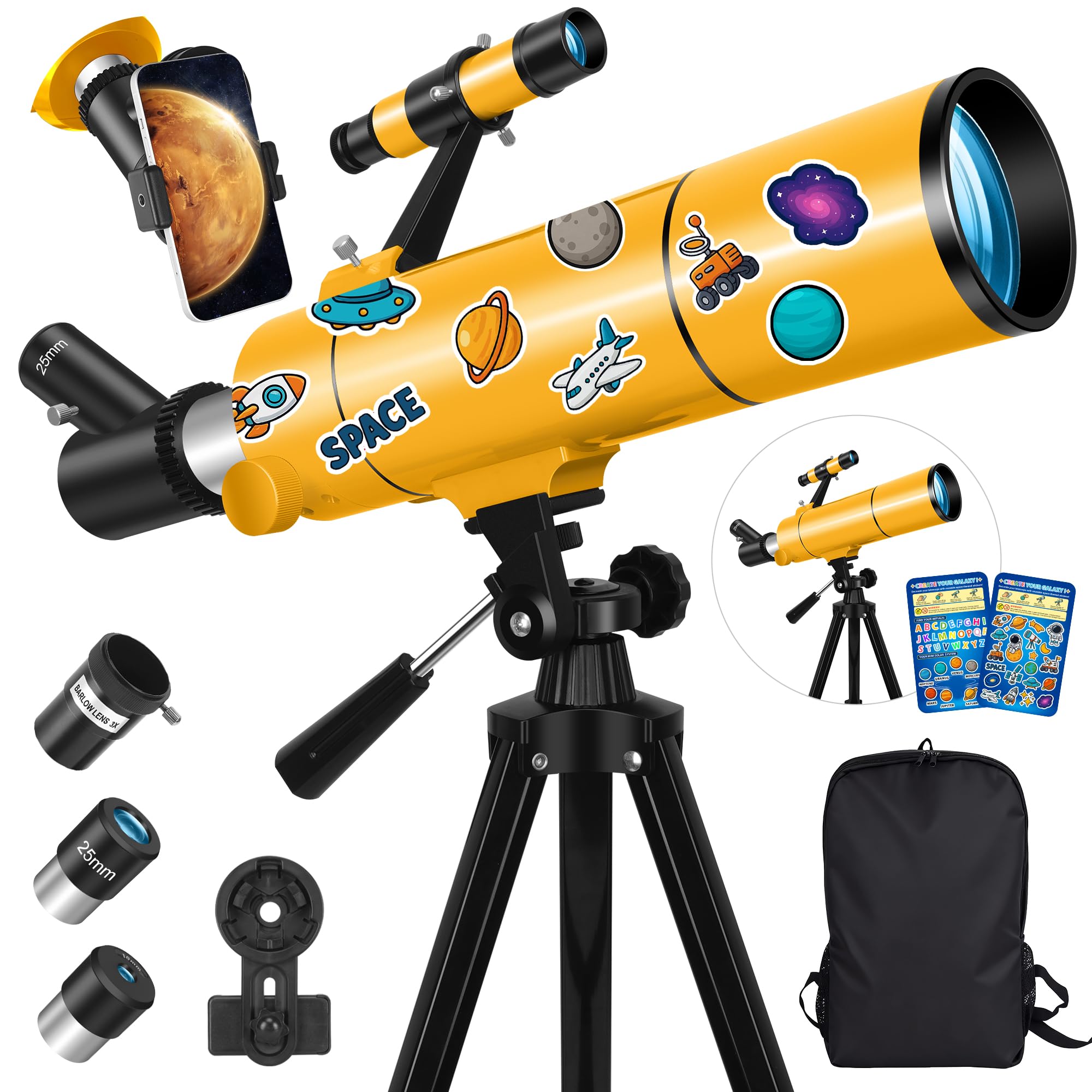
The all-in-one family kit — scope, tripod, Barlow, phone adapter, and a backpack that holds it all.
what separates it is the kit completeness and the finishing touches. Blank space stickers let kids decorate the bright yellow tube, which sounds minor until you watch a child claim ownership of the scope. Everything packs into a waterproof backpack. The kit includes a lens pouch, an accessory tray, and lens caps. Build quality and image quality are the two things owners praise most, with portability not far behind. The clearest endorsement comes from a spouse: “This telescope and its accessories were a birthday gift for my husband. He loves it! He finds it easy to use.”
The size of this tube makes it a car-trip scope rather than a hand-carry scope — it measures 17.51 inches deep, 11.81 inches wide, and 5.9 inches tall, so it fits in a backpack but is not a pocket item. Sturdiness draws mixed reviews, which is the trade-off for the low weight: the tripod is called sturdy by some and a touch flimsy by others. For lunar and bright-planet work that difference rarely shows up; for very high magnification it can. If you plan to push the zoom hard, the 90mm scopes at the top of this list have heavier stainless steel mounts.
Why the family angle is real: the adjustable tripod, the stickers, and the Barlow that reaches 150X make this a scope multiple people can actually share in one night.
The known trade-off: the lightweight tripod is the part owners disagree about most, so plan on a stable surface for the highest powers.
Buy it for: a first scope that has to work for a child, an adult, and a grab-and-go camping weekend.
Choose differently if: you want maximum magnification stability and do not care about the extras or the kid-friendly touches.
6. Celticbird Telescope for Adults High Powered, 80mm Aperture 600mm AZ Mount Refractor

A backpack scope with a moon filter, a compass stand, and enough light-gathering for Jupiter.
Celticbird’s kit is the most complete of the 80mm group on paper. It is an 80mm aperture refractor with a 600mm focal length at f/6.7, which puts you in the balance between the short 500mm MEEZAA and the longer 900mm SOLOMARK. The 600mm focal length gives you enough reach for planets while keeping the tube short enough to pack. The exit pupil diameter is 1.21 millimeters and the field of view is a generous 3.4 degrees. Included are a backpack, an adjustable aluminum tripod that ranges from 17.7 to 52 inches, a 5×24 finderscope, a phone adapter, and — unusually — a moon filter that transmits only 13 percent of incoming light, which cuts the glare on a full Moon so craters stay readable instead of washing out.
The tripod stand carries a compass and a bubble level, and the mount has azimuth and altitude markings printed on it, so you can point deliberately rather than by feel. Setup runs about 15 minutes on the first night. The claimed magnification is 30X with the 20mm eyepiece and 66X with the 9mm. Owners describe the sharpness on the Moon as excellent and the scope as light enough to carry around easily. The recurring honest note is the mount. It wobbles during fine adjustments, which is normal for a lightweight portable head, and one owner felt the setup and view quality did not match the description. It is a solid budget kit if you accept that the mount is the weak link in the chain.
The accessory value is the story: a moon filter, a compass-and-level tripod, a backpack, and a phone adapter in one kit is hard to match at this tier.
Set expectations on the mount: it wobbles under fine adjustment, so lock the head down and nudge gently.
Best for: campers and road-trippers who want a filter-equipped 600mm refractor in a backpack.
Think twice if: you want a rock-solid head for high-power planet tracking and will not tolerate a little sway.
7. Gskyer Telescope, 80mm AZ Space Astronomical Refractor Telescope for Kids

The shortest tube here — a daylight spotter that still finds the Moon and bright planets at night.
Gskyer goes the opposite direction from the 900mm scopes. This is an 80mm aperture with a short 400mm focal length, and the combination keeps the whole instrument light and portable. The exit pupil diameter is a very generous 5 millimeters — the widest in this list — so the image arrives as a big, bright circle that is easy to look through and easy to aim. It ships with three eyepieces giving 16X, 40X, and 80X, plus a 3X Barlow lens that multiplies each one. There is a 6×30 finder scope, an erect-image diagonal that corrects the view for daytime use, and an adjustable full-size tripod.
The short focal length is the defining trade-off. It does not have the reach of a 900mm or 800mm tube, so planets appear as small bright discs rather than detailed banded globes. What it does have is versatility. Owners call it a great first scope that kids love, easy to set up, and good for both day and night use. The eyepiece ecosystem is a nice touch — standard 1.25-inch threaded eyepieces mean you can upgrade glass later without changing the tube. Setup runs about 15 minutes. The honest caveats are the finder and the tripod. The sight scope bracket needs rotating to sit properly, and the leg screws should not be overtightened. Image quality gets mixed feedback for the same reason the focal length is short — some nights it looks sharp, others less so, and it takes patience to dial in focus at high power.
Why the short tube wins
- A 5 millimeters exit pupil makes the view bright, wide, and forgiving for beginners.
- Threaded 1.25-inch eyepieces mean you can upgrade optics later.
- Three eyepieces and a 3X Barlow give you 16X through 240X of range.
- Adjustable tripod with a tray handles day spotting and night sky sessions.
Where it asks patience
- 400mm focal length keeps planets small — this is a Moon and bright-planet scope, not a high-detail instrument.
- The finder bracket needs a rotation fix before it will hold the sight scope firmly.
- Leg screws can work loose if overtightened.
Pick this if: you want one scope that does daytime spotting and beginner night-sky work without being bulky.
Choose the 800mm MEEZAA if: you want planets to fill more of the eyepiece instead of showing as small bright discs.
8. MEEZAA Telescope for Adults High Powered, 90mm Aperture 800mm Refractor

A 90mm objective that pulls in more planetary light than anything else in this lineup.
If you have looked at the 80mm options and decided you want more glass, this is where you land. The 90mm aperture here is the largest in the article, and it beats the 70mm Celestron above on pure light-gathering — 90mm versus 70mm is a genuine step up rather than a rounding difference. The focal length is 800mm at f/8.88, and with a 10mm and 25mm eyepiece plus a 3X Barlow lens you get a magnification range of 32X to 240X. The field of view is 15.63 arc_minute, a tight window that suits planets. The exit pupil diameter is 0.38 millimeters, small and dim, so the view is narrow and demands a steady mount — which is exactly what it has.
The stainless steel tripod adjusts from 28 to 46 inches and holds steadier than the lighter aluminum legs on the budget picks. Owners describe the lunar views as exceptionally clear, with crater detail and Jupiter’s bands both showing up well, and the sturdiness of the tripod comes in for steady praise. The carry bag and the accessory tray are both mentioned as useful rather than throwaway. One important note for anyone buying this for a young child: assembly involves heavy parts and loose screws, so it needs an adult in the room — the manufacturer claims most users finish in 10 minutes, but a child on their own should not be the plan.
Two consistent quirks worth knowing about. The finder scope shows an inverted image, which is normal for this style of scope, and the phone adapter can shift slightly under the weight of a phone, which nudges your alignment. Adjustability gets mixed feedback for those reasons. Neither one affects the optical view through the eyepiece, which is the part owners keep coming back to. Compared with the 80mm MEEZAA up the list, this one trades portability for a bigger objective and a heavier mount — the exact trade-off you want if planet detail is the goal and the scope mostly stays home.
The aperture payoff: 90mm versus 70mm is a visible difference on Jupiter’s cloud bands and Saturn’s rings, and the stainless tripod keeps that extra detail steady.
The honest quirks: an inverted finder view is standard for the design, and the phone adapter shifts under a phone’s weight — check your alignment after you mount it.
This is your pick if: planets are the priority and you want the brightest views and the steadiest tripod in the group.
Look elsewhere if: you need something light to carry or you have a small child assembling it alone.
9. Dianfan Telescope, 90mm Aperture 800mm, with Stainless Steel Tripod & Phone Adapter

The 90mm scope built for holding a shaking planet dead still at high zoom.
Dianfan matches the 90mm aperture and 800mm focal length of the MEEZAA above, but its personality is different — this one is about steadiness at high magnification. The Dawes Limit is 1.29 arc_sec, and the exit pupil diameter is 0.26 millimeters, the tightest in the group, which means the view is narrow and unforgiving of any wobble. That is exactly why the stainless steel tripod matters so much here. The kit ships with two eyepieces and a 3× Barlow lens for 32×–240× magnification, along with a 45° zenith mirror that keeps images upright and correctly oriented for terrestrial viewing. A phone adapter and a carrying bag round it out.
Buyers report the tripod stays steady even at higher magnifications, which is the single biggest win for planet viewing — a still image is what lets you actually see Saturn’s ring gap instead of a smeared blob. Assembly runs about 15 minutes, and the smooth focusing helps you lock onto targets quickly. That is a useful reality check for anyone chasing the highest number on the box.
The honest caveat is consistency. There is at least one report of the tripod feeling unstable and the phone adapter struggling to hold a phone securely, alongside praise for near-vibration-free viewing from other owners. That split is common in this tier, and it usually depends on how solid the surface is under the legs and how carefully you tighten the head. Set it up on level, firm ground and re-tighten after the first session, and it behaves. The lightweight design and included bag make it easy to move between a backyard and a travel spot, and the age range is listed as 3+ for supervised family use.
Where it earns the premium tier: the tight 0.26 millimeters exit pupil demands a stable mount, and the stainless steel tripod delivers it — that is the point of paying up.
A fair caution: the phone adapter and lowest-stability reports suggest tightening everything down before you trust a high-power session.
Ideal for: a serious beginner who wants the steadiest 90mm view and does not mind a bit of setup care.
Not the one for: someone who wants the widest, brightest, most forgiving eyepiece feel — the 90mm MEEZAA and the 70mm Celestron are more forgiving.
Understanding the Specs
Aperture and Why 90mm Beats 70mm on Planets
Aperture is the width of the front lens in millimeters, and it sets how much light the telescope collects. On planets, more aperture means a brighter image at the same magnification, so Jupiter’s cloud bands and Saturn’s ring detail survive where a smaller scope would wash them out. Compare the 90mm picks here against the 70mm Celestron and you are looking at a real difference in how much detail you can tease out, not a marketing bump. Bigger aperture also means the scope handles higher magnification more gracefully. That is why the moon filter, the eyepieces, and the mount all matter — but the aperture is the ceiling you cannot raise later.
Focal Length, Magnification, and the Barlow
Focal length is how far light travels inside the tube, in millimeters. Divide it by your eyepiece size to get magnification — a 900mm scope with a 20mm eyepiece gives you 45X. A Barlow lens is a magnifier that sits between the eyepiece and the tube and multiplies that number, often tripling it. The catch is that magnification only helps if the image is sharp and steady. Too much magnification on a shaky mount or under wobbly air just magnifies the blur. The eyepieces that ship in the box define your baseline, and the finder scope is what lets you aim the tube in the first place.
FAQ
What aperture do I need to see Saturn’s rings?
Is 70mm or 90mm better for a beginner telescope?
Do I need a Barlow lens to see planets?
Can a beginner telescope see Jupiter’s moons?
How steady does a tripod need to be for planet viewing?
Is a tabletop telescope like the Celestron FirstScope good for planets?
What is the difference between a refractor and a Dobsonian telescope?
Can I attach my phone to these telescopes to photograph planets?
Do I need a moon filter with a beginner telescope?
How long does it take to set up a beginner telescope?
Can a beginner telescope be used during the day?
Final Thoughts: The Verdict
For a first scope you will actually keep using, the beginner telescope to see planets that makes the most sense is the Celestron AstroMaster 70AZ — a 70mm achromatic refractor with a 900mm focal length, preassembled mount, and the deepest owner track record in this category. Customers note seeing Saturn’s rings, Jupiter plus 4 moons, and the Orion Nebula with it, which is a remarkable result for a first instrument. If you want the brightest planet views and a stainless steel tripod under them, the MEEZAA 90mm 800mm steps up to a 90mm aperture and 32X–240X magnification. And if steadiness at high zoom is the goal, the Dianfan 90mm 800mm brings the tightest exit pupil here paired with a stainless tripod built to hold it still. Whichever you choose, aperture in millimeters is the number to lock in first — everything else you can adjust later.
How We Picked
We do not accept paid placement. Every pick is matched to a real buyer and a real use-case; we do not hands-on test units.
Sources & Methodology
Specifications: manufacturer listings and product documentation. Review insights: verified customer reviews, as of September 2026. Pricing: not shown on this page (it changes often); check the current price via the retailer link.
As an Amazon Associate, Gadgets Feed earns from qualifying purchases. This does not affect which products we feature.