
Our readers keep the lights on and my morning glass full of iced black tea. As an Amazon Associate, I earn from qualifying purchases.
Specs are compiled from manufacturer listings and verified buyer reviews and can change over time — please confirm the key details on the product page before buying.
The hardest part of wakesurfing is not the wave — it is the first three seconds, when a board that is too small, too tippy, or too fast dumps you face-first while everyone in the boat watches. A beginner wakesurf board fixes that by being wide, buoyant, and forgiving, so you pop up on the first pull instead of the tenth. The four boards below cover the whole beginner spectrum: adult learners, big riders, kids, and first-timers who just want to stand up and stay up.
I’m Min — the founder and writer behind Gadgets Feed. This guide is built by comparing the manufacturers’ published specifications and the patterns across verified customer reviews, so you get each pick’s real strengths and trade-offs instead of marketing spin.
Every board here is chosen for stability and easy get-ups, and each one has a clearly different rider in mind. The Hyperlite Broadcast takes the top spot because it is the one board here that beginners and advancing riders can share. If you want the full picture of what makes a first board work, this breakdown of the best beginner wakesurf board options walks you through it pick by pick.
Our Picks at a Glance

How To Choose The Best Beginner Wakesurf Board
Getting up on a wakesurf board is mostly a gear problem, not a balance problem. A board that floats you easily and tracks straight gives you the half-second you need to stand up. A board that is too small or too loose makes every attempt a swim. Here is what actually decides whether a first board works for you.
Match the board to your weight, not your height
Buoyancy is what holds you on top of the water, and buoyancy follows the board’s surface area and volume. A heavier rider needs a longer, wider board to float without dragging. Bigger riders do fine on a full-length board like a 67-inch deck, while lighter riders can size down for quicker turns. If you are between sizes, size up for learning — a longer board is easier to get up on and easier to stay behind the wave.
Fins decide how forgiving the board feels
Fins are the small fins under the tail that keep the board tracking in a straight line instead of spinning out. More fin surface equals more grip and stability, which is exactly what a beginner wants. Many boards here use removable fins, so you can start with all of them in for maximum hold, then pull one out later when you want the board to turn more freely.
Look at the rail shape and tail design
The rail is the edge of the board, and a rounded rail is more forgiving than a sharp one because it releases water gradually instead of catching. A mid-tail shape — a tail that narrows toward the back — gives you a traditional surf feel with manageable carving. For a first board, forgiving beats aggressive every time.
Check the traction pad and kick tail
The traction pad is the grippy surface where your feet land, usually made of EVA foam. A molded kick tail is a raised lip at the back that stops your rear foot from sliding off when you push. Good grip means you spend less energy just staying on the board and more energy learning to steer.
Quick Comparison
| Model | Best For | Length | Width | Weight | Amazon |
|---|---|---|---|---|---|
| Hyperlite Broadcast Wakesurfer★ Best Overall | Beginners who will keep riding | 5 ft 4″ | — | 5 kg | Amazon |
| RIDE Wakesurf Board | Heavier adult riders | 67″ | 23″ | 5 pounds | Amazon |
| Airhead Wakesurf Board | First-timers on a budget | 63″ | 20.5″ | 4.49 kg | Amazon |
| Hyperlite Gromcast Wakesurfer | Kids and young riders | 3 ft 9″ | — | — | Amazon |
In‑Depth Reviews
1. Hyperlite Broadcast Wakesurfer – Wakesurf Board Endorsed By Shaun Murray
Our pick — 4.5★ from 60+ verified ratings; the strongest balance of quality and price.
The one board a whole family can fight over — forgiving enough to learn on, lively enough to stay interesting.
The Broadcast is the rare first board that does not become a shelf decoration in year two. Its Biolite 3 Core — a proprietary foam core wrapped in layered fiberglass — bonds the top and bottom laminates together for a deck that stays responsive instead of going soft. Fiberglass laminates overlap around the rail so the edges resist separating the way older woven-glass boards can. That construction is the reason this board is built to survive seasons of learners dragging themselves up on it.
Beginners get up fast here. The rolled edge profile is a rounded rail shape, and rounded rails release water gently instead of catching and dumping you. The mid-tail profile narrows toward the back like a traditional surfboard tail, so carving and turning come easily once you are up. Included fins add grip and control on the water, and riders who want a looser feel can pull fins out for more challenge — they swap out easily, and the board travels light at 5 kg (about 11 pounds).
Where it stands against the rest of this list: at 5 ft 4″ it is more compact than the 67-inch RIDE and the 63-inch Airhead, and that shorter deck is what makes it quicker underfoot for a growing rider. The honest catch is weight. Riders coming off carbon competition boards notice this one feels heavier in the hand, and it is not the featherweight in this group — the Airhead comes in lighter at 4.49 kg. For learning and cruising, that extra heft buys you durability. There is also a construction risk worth knowing about: one buyer reports a fin fell off in the lake within 20 minutes of use. Check your fin screws before your first set, and treat this as a board to inspect rather than a board to worry about.
What sells it
- Biolite 3 Core foam wrapped in layered fiberglass for a deck that stays responsive over time
- Rolled edge rail is forgiving for learners and still fun for intermediate riders
- Removable fins let you dial grip up for learning and loosen it later for carving
- Weighs 5 kg, so it moves between the boat and the rack without a fight
What to weigh first
- Heavier in the hand than carbon competition boards, as riders who came from those decks point out
- A fin has been known to work loose early — check the hardware before your first run
- The 5 ft 4″ length leaves less float for the heaviest adult riders than a full 67-inch deck
Buy this if: you want one board that gets a beginner up on the first try and still has room to grow into carving and tricks.
Look elsewhere if: you are a big adult rider chasing maximum float or a weight-obsessed rider who counts grams.
2. RIDE WAKESURF BOARD
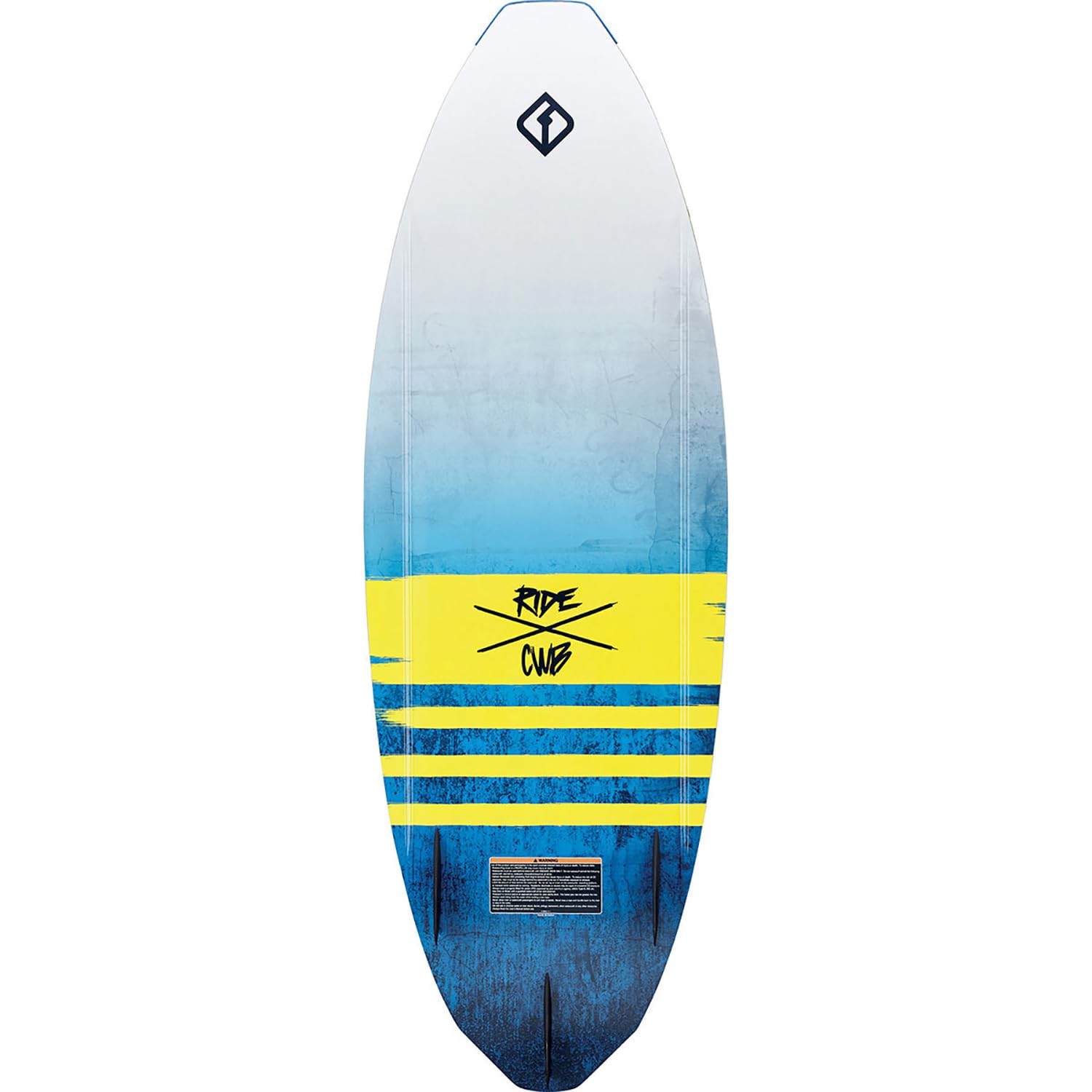
A full 67 inches of deck for riders who have been told they are too big to surf.
If you are a large adult, most beginner boards feel like standing on a dinner plate. The RIDE answers that with sheer surface area — 67″L x 23″W — and the reviews back it up. One 6’6″, 280 lb buyer reports it “works fine.” That is the whole pitch: a wide, long deck that floats heavy riders without dragging, plus a three-fin tail setup (three 1.75-inch fins) that keeps the board tracking straight while you figure out your balance. The surf-style shape and compression-molded build give predictable turns rather than twitchy ones.
The traction story here is the CNC diamond-cut EVA pad with a kick tail — a machine-cut grippy surface with a raised rear lip to hold your back foot in place. That matters when you are pushing hard to hold the wave. Three fins under the tail add directional stability, and the double edge rail helps the board release water cleanly on turns. A towrope comes in the box, which is one less thing to buy before your first outing.
Size is what owners talk about most, and the board’s handling earns steady praise too. It is genuinely beginner-friendly: riders who have never been up before get up on the first pull. The board is also fast enough to keep pace with the wave, which friends ranging from around 130 to 220 pounds have managed with success. One quirk worth planning around is that it can be hard for lighter, less experienced riders to hold back — it wants to run. The included rope draws mixed feelings; it works, but on a long boat it can feel short, so if you run a big boat, plan to extend or swap the line.
The size advantage: at 67″ x 23″ this is the biggest deck on the list, giving heavier riders the float that smaller boards cannot. Compared with the 63-inch Airhead, the RIDE offers more length and width for riders who need it most.
The one to plan for: that same size makes it a handful for lighter riders to slow down. If you are small and new, expect the board to lead and your calves to work.
Who it fits: bigger adults and mixed-weight crews who need one wide, stable deck that floats everyone from teens to linebackers.
The trade-off to own: smaller riders will find it takes real effort to hold back, and a long boat may outrun the included rope.
3. Airhead Wakesurf Boards, EVA Traction Pads, Adjustable Foot Straps

The board that teaches first-timers without asking them to learn a whole new sport first.
The Airhead is built around one idea: make getting up easy. Its classic shape is forgiving by design, and the compression-molded fiberglass deck with dual hook grooves grabs the wake so the board stays planted. A pin-shaped 2.5-inch rocker — the curve along the bottom of the board — keeps it fast without making it twitchy. The EVA pad with a molded kick tail gives you grip and a foot stop, so you are not sliding around while you find your balance.
Three profiled fins sit in recessed fin boxes, which keeps the mounting low-profile and out of the way. That fin setup is what delivers the handling owners keep coming back to, and the board’s beginner-friendly character is the other half of the story. Riders describe it as easy to control with a smooth ride, and one reviewer at about 180 lbs says “the board fits me nicely” — the mid-weight audience this board is dialed in for. It is also thinner than a lot of wake decks, which means it slides into standard board racks that thicker boards will not fit.
Here is the honest catch, and it is a big one to understand before you buy. The board often ships without its fins, or riders pull them for a looser feel — the reviews are split on the fin situation, and it is the most-discussed point by a wide margin. If you remove the fins to gain maneuverability, you lose tracking, so beginners should decide up front whether they want maximum hold or maximum freedom. Buyers who run it finless love the looseness; buyers who expect fins in the box are the ones who end up frustrated. Set your expectation correctly and this board delivers.
Why learners love it: the forgiving shape and the 63″ x 20.5″ footprint build confidence fast, and the deck has held up over seasons of teaching new riders.
Where it needs a decision: sort your fin setup before you hit the water. Go finned for stability, finless for freedom — but decide, because the board will not do it for you.
Reach for this if: you want a stable, rack-friendly deck that gets first-timers standing up and does not punish you for being new.
Sort first if: you expect fins pre-installed and ready to ride — check the box and mount them, or commit to surfing finless.
4. Hyperlite Gromcast Wakesurfer – Kids Wakesurf Board Shaped by Scott Bouchard

A short, light deck scaled to small riders so kids are not fighting an adult board.
Most kids fail at wakesurfing because they are handed a board built for a grown-up. The Gromcast flips that. At 3 ft 9″ it is purpose-built for young riders, and its light weight makes it easy for a child to handle both on the boat and in the water. Where the 5 ft 4″ Broadcast gives adults room, this shorter deck gives kids a platform they can actually control. The design brief is simple: stability and balance first, so young riders can stay upright long enough to build skills and confidence.
Underneath, it runs the same Biolite 3 Core construction as the adult Broadcast — a foam core mixture encased in layered fiberglass that bonds the top and bottom laminates for a durable, responsive deck. Layered fiberglass overlapping around the rail resists the separation that older style boards run into. There is also a bold graphic treatment, which matters more than adults admit: kids who like the look of their board are kids who want to ride it.
Weight and length are the two numbers that matter for this buyer, and both work in the board’s favor. It is light enough for kids to carry and short enough for them to stand up on without the deck running away from them. The construction quality and the textured surface both come up as positives through the reviews, and the surface offers grip that young riders find comfortable rather than harsh. Compared with the adult-focused Airhead at 63 inches, the Gromcast’s 3 ft 9″ deck is dramatically shorter — which is exactly what a child needs and exactly why a grown-up should not buy this one.
Built for small riders: the 3 ft 9″ length and light weight let kids get up and surf on their own, and the stability-focused shape keeps them upright while they learn.
Adults should skip: this board is sized for children, not grown-ups — a full-size rider will sink it and lose interest fast.
The right call when: you are outfitting a son or daughter who is ready to surf but not ready for an adult-sized deck.
The wrong call when: an adult will be using the board — go with the Broadcast or the RIDE instead.
Understanding the Specs
Board Length and Width
Length and width are the two numbers that decide how much weight a board floats and how stable it feels underfoot. Wider decks are more forgiving for learning because they give you more surface to land on. A full-size deck like 67″ x 23″ carries heavier riders easily, while a compact 3 ft 9″ board is scaled for kids. For beginners, size up: a longer, wider deck floats you higher and gives you more surface to land on.
Core Construction and Durability
The core is the foam inside the board, and it is what makes a deck responsive instead of dead. The Biolite 3 Core mixed with layered fiberglass bonds the top and bottom laminates together so the board holds its shape over seasons of use. Compression-molded fiberglass serves a similar purpose — it presses the layers together for a stiffer, more durable shell. Look for boards where the fiberglass overlaps around the rail, since that is where separating boards tend to fail first.
Fins and Rail Shape
Fins sit under the tail and keep the board tracking straight instead of spinning out. More fin surface equals more hold and stability, which is what a beginner wants. Removable fins let you learn with full grip and then pull some out when you want the board to turn more freely. The rail — the edge of the board — matters too: a rounded, forgiving rail releases water gradually, while a sharp one catches and can dump you. Beginners should favor rounded rails and a full fin setup.
Traction Pad and Kick Tail
The traction pad is the grippy EVA surface where your feet land. A textured top keeps your feet planted, and a molded kick tail — a raised lip at the back — stops your rear foot from sliding off when you push. Boards with a CNC-machined pad have a detailed grip pattern that sheds water and holds firm.
FAQ
What size wakesurf board should a beginner ride?
Do I need fins on a beginner wakesurf board?
How much weight can a beginner wakesurf board hold?
Is a bigger wakesurf board easier to learn on?
What is a kick tail on a wakesurf board?
Can adults use a kids wakesurf board?
How do I keep the fins from coming loose?
What is the difference between a wakesurf board and a wakeboard?
Does board weight matter for a beginner?
Final Thoughts: The Verdict
The board that wins this list is the Hyperlite Broadcast — 4.5 stars across 60+ owners, and the pick that gets a beginner up on the first pull, then keeps them interested long after. Its Biolite 3 Core and layered fiberglass construction are what separate it from a board you outgrow in a season. If you are a bigger adult who needs maximum float, the RIDE Wakesurf Board and its 67-inch deck handles riders up to 280 pounds. If you have kids ready to learn, the Hyperlite Gromcast is the one sized for them, and the Airhead is the budget-friendly way to get a whole family standing up on the water.
How We Picked
We do not accept paid placement. Every pick is matched to a real buyer and a real use-case; we do not hands-on test units.
Sources & Methodology
Specifications: manufacturer listings and product documentation. Review insights: verified customer reviews, as of September 2026. Pricing: not shown on this page (it changes often); check the current price via the retailer link.
As an Amazon Associate, Gadgets Feed earns from qualifying purchases. This does not affect which products we feature.