
Getting a classroom of young students to self-regulate without constant verbal redirection is one of the toughest parts of any teaching day. A visual behavior chart turns that daily struggle into a concrete, predictable system where every child can see exactly where they stand and what it takes to improve. The right chart cuts down on interruptions, gives kids ownership of their choices, and frees you to actually teach.
I’m Min — the co-founder and writer behind Gadgets Feed. I’ve spent years analyzing how classroom management tools are engineered, from pocket depth and grommet durability to the readability of color-coded tiers, so you don’t have to guess what actually holds up.
This guide breaks down the top options to help you find the best behavior chart for classroom management, covering everything from stoplight designs to customizable clip systems that fit any grade level or teaching style.
How To Choose The Best Behavior Chart For Classroom
A classroom behavior chart works best when its design matches your daily routine and the maturity level of your students. Before you buy, consider the system style, material durability, and how many children it needs to serve at once.
System Style: Stoplight vs. Clip Chart vs. Pocket Grid
Stoplight charts use three or four color-coded tiers (green, yellow, red) and work well for younger students in Pre-K through 1st grade who understand traffic-light logic. Clip charts, often with seven pockets or more, let you move a clothespin up or down throughout the day, giving older kids in grades 2–6 a more nuanced feedback loop. Pocket grids with 30–40 individual slots are ideal for tracking multiple behaviors, chores, or daily routines in a single glance.
Materials and Build Quality
The best behavior charts use heavy-duty oxford fabric or reinforced nylon with double-stitched seams. Look for reinforced grommets at the top — two is the minimum, and they should be metal, not plastic. A chart that measures at least 19 inches wide and 32 inches tall gives you room to read names and move clips without crowding. Cheaper vinyl charts can tear at the pocket corners within a few months of daily use.
Customizability and Included Components
Check whether the chart comes with preprinted behavior cards or blank dry-erase cards you can write on with a marker. Some sets include 14 double-sided cards (one side preprinted, one side blank) so you can adapt the chart for chores, reading logs, or special-ed goals. The number of clothespins or student sticks matters too — a set with 40 clips gives you room for a full class plus a few extras. A bottom storage pocket for markers and spare pins is a practical addition you’ll appreciate by week two.
Quick Comparison
On smaller screens, swipe sideways to see the full table.
| Model | Category | Best For | Key Spec | Amazon |
|---|---|---|---|---|
| Really Good Stuff EZ-Tuck Clip-N-Track | Premium Clip Chart | K–6 structured tracking | 33⅜” height, magnetic & grommet mount | Amazon |
| AUVCAS Behavior Chart with Clips & Pockets | Mid-Range Clip Chart | Customizable homeschool & classroom | 42.75” x 9.75”, 40 clips included | Amazon |
| Panelee Stoplight Behavior Pocket Chart | Stoplight Pocket Chart | Pre-K and early elementary | 26” x 19.75”, 43 pieces total | Amazon |
| Carson Dellosa Stoplight Behavior Pocket Chart | Stoplight Pocket Chart | Homeschool & small classrooms | 30 dry-erase student sticks | Amazon |
| AUVCAS Student Behavior Clip Chart (Sunshine) | Mid-Range Clip Chart | Classroom with daily clip moves | 42.75” x 9.75”, 14 double-sided cards | Amazon |
| Learning Resources Junior Organization Station | Multi-Purpose Pocket Chart | Daily routines & center rotation | 32.5” x 12.1”, 32 pockets | Amazon |
| Pacon Behavioral Pocket Chart | Basic Pocket Chart | Chore tracking & mood meters | 18.5” x 21”, 35 clear pockets | Amazon |
In‑Depth Reviews
1. Really Good Stuff Classroom Behavior EZ-Tuck Clip-N-Track
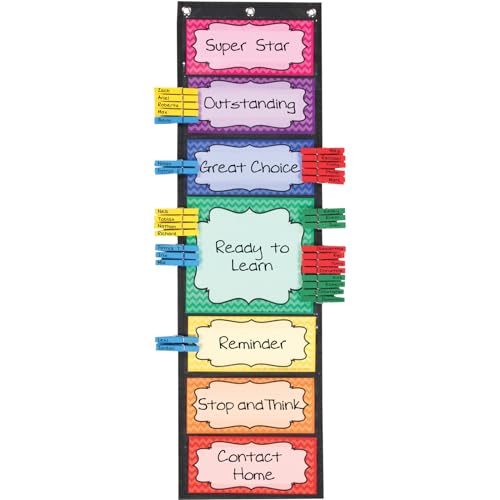
The Really Good Stuff EZ-Tuck Clip-N-Track is built like a piece of classroom furniture — the nylon fabric is dense, the stitching is reinforced, and the chart includes both grommets and sewn-in magnetic strips so you can hang it on a whiteboard or a wall without extra hardware. At 33⅜ inches tall with seven visible behavior tiers, it gives older elementary students a clear ladder to climb without feeling like a babyish stoplight.
The set comes with six double-sided dry-erase cards and one larger card, all coated with Write Again wipe-off laminate that survives daily use. Thirty-two clothespins are included, which is enough for a typical class, and the colors vary so you can assign each student a unique pin. Teachers report that the visual accountability reduces time-outs because students self-correct when they see their clip move down.
A bottom storage pocket keeps the extra cards and dry-erase markers organized. The only trade-off is the premium build cost — this is an investment for a teacher who wants a chart that survives multiple school years without fraying at the edges.
Why it’s great
- Dual mounting (magnetic strips + grommets) offers flexible placement
- Write Again wipe-off laminate cards are truly durable and reusable
- Seven-tier system gives nuanced feedback for K–6 students
Good to know
- Higher price point than most clip charts
- Clothespin colors are random, so you may need to label them
2. AUVCAS Behavior Chart for Classroom Management with Clips & Pockets

This AUVCAS chart hits a sweet spot between size and customization. At 42.75 inches long, it spans a wide section of wall space and gives you seven clear pockets to display behavior tiers. The set includes 40 upgraded wooden clothespins — wider than standard pins — making them easier for small hands to grasp and move without breaking.
Fourteen double-sided cards come included: one side printed with color-coded behavior levels, the other side blank so you can write your own categories like “Chores,” “Reading Log,” or “Homework.” A bottom storage pocket holds markers and spare pins, preventing the clutter that usually ends up on your desk. The material is a heavy-duty oxford fabric that resists tearing, and two reinforced grommets make hanging simple.
Teachers and homeschool parents alike praise the flexibility — you can switch from a behavior chart to a reward chart to a job chart without buying a separate product. The only minor complaint is that the clothespins, while sturdy, could use a few more green pins for the top tier since that’s where most students aim to stay.
Why it’s great
- Extra-long design fits wide wall spaces and displays 7 tiers clearly
- Blank card backs let you customize for behavior, chores, or goals
- 40 oversized clothespins are easy for young children to operate
Good to know
- Hanging hooks are not included
- Some users wish for more green clothespins in the pack
3. Panelee Classroom Behavior Stoplight Pocket Chart

The Panelee chart uses a classic stoplight system with three color-coded pockets — green (good), yellow (warning), and red (consequence) — plus two header pockets at the top for the class name or the day’s theme. It’s made from heavy-duty oxford fabric with sturdy stitching, so it holds up to daily stuffing and un-stuffing of student sticks without tearing at the seams.
You get 40 boy-and-girl-shaped white cutouts (blank on both sides) plus two larger name tag cutouts. The cutouts measure 3.9 inches tall — big enough for a student’s name to be read from across the room. Each light section has two nylon pockets, giving you six total pockets to manage where each child’s stick sits. The resource guide on the back includes tips for using the chart as a teaching tool rather than just a punishment system.
Teachers of Pre-K and kindergarten love that the stoplight layout is instantly intuitive — no explanation needed beyond “stay on green.” The 26-by-19.75-inch size is compact enough to fit on a small wall or door but visible from a reading circle. The only drawback is that the white cutouts can get bent over time if stored loosely in a drawer.
Why it’s great
- Stoplight system is immediately understood by young learners
- Oxford fabric construction resists tearing from daily use
- 40 student cutouts plus name tags cover a full class roster
Good to know
- Cutouts are paper-based and can crease if not stored carefully
- Not ideal for teachers who prefer a 5–7 tier nuanced system
4. Carson Dellosa Stoplight Behavior Pocket Chart

Carson Dellosa has been making classroom supplies for over 40 years, and this stoplight chart shows why teachers keep coming back. The chart body is a mix of nylon and vinyl — the nylon pockets are where you manage the student sticks, and the three clear vinyl pockets sit over the red, yellow, and green lights so you can slide in a behavior card or a visual cue.
Thirty write-on/wipe-away student sticks are included, each dry-erase so you can reuse them year after year without ordering refills. The chart measures 26 by 19.75 inches and has two reinforced grommets at the top for hanging. The resource guide includes tips for transitioning students back to green after a warning, which helps make the system restorative rather than purely punitive.
A standout feature is the relative anonymity — because the sticks only show a student’s name when you’re close to the chart, kids don’t feel publicly shamed when their stick moves to yellow. Parents and homeschoolers also appreciate that the chart works well with photos or small wooden figures clipped to the pockets for non-readers.
Why it’s great
- Dry-erase student sticks are reusable for multiple school years
- Clear vinyl pockets let you insert custom behavior visuals
- Relative anonymity reduces public embarrassment for students
Good to know
- 30 sticks may not be enough for larger classes
- Vinyl can cloud or crack over several years of use
5. AUVCAS Student Behavior Clip Chart (Sunshine)

This Sunshine version from AUVCAS is structurally identical to the earlier clip chart but with a different color palette — warmer yellows and oranges that feel less formal and more encouraging for younger kids. The chart measures the same 42.75 by 9.75 inches and comes with 14 double-sided cards (one side preprinted with a positive-behavior hierarchy, the other side blank for your own wording).
The set includes 40 upgraded colored clothespins that are sturdier than the standard wooden pins found in cheaper charts. A bottom storage pocket keeps markers, spare pins, and extra cards organized. The two reinforced grommets at the top are metal, not plastic, so they won’t crack when you move the chart between rooms. Teachers note that the foldable design makes it easy to store over summer break without taking up closet space.
Some educators have used this chart as a reward system rather than a behavior tracker — moving clips up only, never down — and the blank card backs make that switch seamless. The main limitation is that the included cards are printed on cardstock, so laminating them is recommended for year-round durability.
Why it’s great
- Warm color scheme feels encouraging for young students
- 40 clips and 14 double-sided cards offer plenty of customization
- Foldable design stores flat for easy off-season storage
Good to know
- Cards are cardstock and will last longer if laminated
- Hanging hooks are not included in the package
6. Learning Resources Junior Organization Station Pocket Chart

Learning Resources designed this chart as a multi-purpose organizer rather than a pure behavior tracker. It has 32 clear pockets that can hold word cards, job assignments, behavior visuals, stickers, or incentive pieces. The chart measures 32.5 by 12.1 inches — shorter than the clip charts but wider, making it a good fit for a wall space near a circle-time rug.
The soft blue and pastel color scheme blends into classroom decor without screaming “discipline tool.” Teachers use it for calendar routines, weather check-ins, attendance tracking, and center rotations as much as for behavior management. The chart comes with magnets sewn into the top, but several users note the magnets are weak and recommend adding mini magnet clips for extra hold on a whiteboard.
A practical consideration: the 32 pockets measure approximately 2.75 by 5 inches, so standard 3-by-5-inch index cards require a slight trim to fit. The chart itself is made from durable vinyl with reinforced stitching, and the grommets at the top give you a backup hanging option. If you need a dedicated behavior-only chart, this isn’t it — but if you want a single chart that handles behavior plus daily routines, it’s a smart space-saving choice.
Why it’s great
- 32 pockets support behavior, calendar, jobs, and routines in one chart
- Pastel colors integrate easily into classroom decor
- Shorter height works well for young children at circle time
Good to know
- Pockets are slightly smaller than standard 3×5 cards
- Sewn-in magnets are weak and may need supplemental clips
7. Pacon Behavioral Pocket Chart

The Pacon Behavioral Pocket Chart is the no-frills option that focuses on maximizing pocket count for the lowest investment. With 35 clear pockets in a 18.5-by-21-inch blue vinyl body, it gives you a grid that can track a whole class across multiple behaviors or a single behavior across several weeks. The vinyl material is lightweight but sturdy enough for wall hanging via the top grommets.
Homeschool parents have found creative uses for this chart — as a chore tracker with laminated cards for each task, a mood meter where kids show how they feel each morning, or a reading log where each pocket holds a book title. The clear pockets make it easy to swap paper inserts without removing the chart from the wall. Several users recommend laminating any paper cards you insert, because the vinyl itself holds up fine but thin paper can tear when pushed into the pocket repeatedly.
The biggest drawback is durability under heavy use — after several months of daily pulling by enthusiastic children, the vinyl can start to tear at the top corners. For a low-traffic homeschool environment or a classroom that rotates charts seasonally, this is a perfectly functional budget pick. For a high-traffic kindergarten room with 25 kids moving cards daily, you’ll likely want a fabric chart with reinforced stitching.
Why it’s great
- 35 pockets offer maximum tracking capacity at a budget-friendly price
- Clear pockets are ideal for photo cards or laminated inserts
- Versatile design works as a chore chart, mood meter, or reading log
Good to know
- Vinyl material can tear at corners under daily heavy use
- No pre-printed behavior cards or clothespins are included
FAQ
What is the difference between a stoplight chart and a clip chart for classroom behavior?
How many student slots do I need for a full classroom behavior chart?
Can I use a classroom behavior chart for homeschooling one or two children?
Final Thoughts: The Verdict
For most users, the best behavior chart for classroom winner is the Really Good Stuff EZ-Tuck Clip-N-Track because it combines premium nylon construction, dual mounting options, and a seven-tier system that works from kindergarten through 6th grade without feeling babyish. If you want the best balance of customization and size, grab the AUVCAS Behavior Chart with Clips & Pockets. And for a simple stoplight system that younger students instantly understand, nothing beats the Panelee Stoplight Pocket Chart.