
Our readers keep the lights on and my morning glass full of iced black tea. As an Amazon Associate, I earn from qualifying purchases.
Specs are compiled from manufacturer listings and verified buyer reviews and can change over time — please confirm the key details on the product page before buying.
A behavior traffic light chart turns the daily struggle of managing a child’s conduct into a simple, visual game—green means go, yellow is a warning, and red means stop and think. The best behavior traffic light chart gives kids a clear, hands-on way to see where they stand, so you spend less time nagging and more time teaching.
I’m Min — the founder and writer behind Gadgets Feed. This guide is built by comparing the manufacturers’ published specifications and the patterns across verified customer reviews, so you get each pick’s real strengths and trade-offs instead of marketing spin.
Whether you manage a full classroom or a single child at home, these charts have proven track records. You are about to find the behavior traffic light chart that fits your exact situation—built from what real buyers actually say works.
Our Picks at a Glance


How To Choose The Best Behavior Traffic Light Chart
Every behavior chart promises to make your day easier. But the wrong one just becomes another thing to manage. Here is what actually matters when you pick one.
Pockets vs. Magnets vs. Clips
A pocket chart lets you slide name cards or paper cutouts between color zones. It is best for classrooms where you have many students and you want a large, wall-mounted display. A magnetic chart sticks to the fridge and works well for one or two kids at home—it takes up less space and the kids can move their own magnet. A clip chart uses clothespins that kids physically pinch and move, which some toddlers find tricky but others love for the hands-on feel.
Class Size and Number of Slots
If you have a class of 25, you need a chart that comes with 30 name sticks or cutouts from the start. If you are a parent with two kids, you might prefer a smaller chart that fits on a cabinet door. The number of name tags or pockets directly sets the limit on how many children the chart can track—check this number before you buy.
Customizability
The best charts let you write your own behavior categories or goals. Some come with blank cards or blank magnets where you can write specific tasks like “brush teeth” or “homework done.” This makes the chart useful as the child grows and the goals change. A pre-printed chart with rigid categories can feel stale after a few weeks.
Durability and Material
A classroom chart gets touched dozens of times a day. Look for heavy-duty Oxford cloth or thick laminated paper. Grommets (the metal rings at the top) let you hang the chart on a wall hook. Foldable designs store flat during summer break. A chart that is too flimsy will be torn within a month.
Quick Comparison
| Model | Best For | Name Slots | Size | Material | Amazon |
|---|---|---|---|---|---|
| AUVCAS Clip & Pocket Chart★ Best Overall | Larger classrooms & homeschool | 40 clips | 42.75″ x 9.75″ | Heavy-duty fabric | Amazon |
| Carson Dellosa Pocket ChartTop Performer | Standard classroom, veteran teachers | 30 student sticks | 26″ x 19.75″ | Nylon & Vinyl | Amazon |
| ZKOO Pocket ChartFlexible Pick | Preschool & Pre-K classrooms | 30 cards | 25.7″ x 19″ | Oxford cloth & PVC | Amazon |
| Generic Thermometer Chart | Up to 6 kids, small spaces | 1-6 name tags | 11″ x 8.5″ | Laminated paper | Amazon |
| Amonev Magnetic Chart | Fridge use, toddlers & special needs | 1-2 (magnetic pieces) | Small | Plastic magnets | Amazon |
| Hadley Designs Magnetic Chart | Single-child homes, star reward system | 4 icon magnets | 8″ x 10″ | Magnetic sheet | Amazon |
| Panelee Pocket Chart | Budget classroom, large groups | 80 boy/girl cutouts | 26″ x 19.75″ | Heavy-duty Oxford fabric | Amazon |
| LIKARTO Magnetic Chart | Home, siblings, habit building | 2 children | 16.5″ x 12.5″ | Magnetic board & magnets | Amazon |
In‑Depth Reviews
1. AUVCAS Behavior Chart with Clips & Pockets
Our pick — over 4.5★ from 650+ verified ratings; the strongest balance of quality and price.
The heavy-duty chart that survived a 3-year-old’s best efforts to tear it apart.
This pick leads the pack because it solves the two biggest classroom problems at once: giving kids instant visual feedback and lasting long enough to earn its spot on the wall. It measures a wide 42.75 inches across by 9.75 inches tall, giving you room for 40 clips across 7 clear pockets. Unlike the ZKOO chart which uses 30 person-shaped dry-erase cards, this one uses physical clips that kids pinch and move themselves—a hands-on motion that makes the consequence or reward feel real.
You get a heavy-duty fabric chart with 2 reinforced grommets for hanging, and it folds flat for summer storage. A veteran teacher who returned to the classroom in 2024 with a challenging group of 1st graders reported that this chart “revolutionized classroom” behavior—students got motivated to move their clips up, and the teacher rewarded them with 1-3 Skittles daily. At 12.7 ounces, it is about 17% heavier than the ZKOO chart, which matches the more substantial fabric feel. Buyers consistently say the quality holds up and the classroom compatibility is excellent—9 different owners specifically mention how well it fits into a school setting.
One family using it at home with a 3-year-old noted the clips were a bit stiff for tiny fingers and switched to a different clip option, so very young toddlers may need help. But the build quality is high enough that the child “hasn’t managed to tear it up,” which is about as strong a real-world durability test as you can get.
Why Teachers and Parents Love It
- 40 clips handle large classes or multiple home kids.
- Heavy-duty fabric with grommets for lasting wall display.
- 14 double-sided customizable cards for your own behavior goals.
- Folds flat for easy off-season storage.
A Fair Trade-Off
- Clips can be stiff for a 3-year-old’s fine motor skills.
- At 42.75 inches wide, it needs a good amount of wall space.
Reach for this if: you have a class of 20+ students or multiple kids at home and you want a chart that can survive years of daily use.
Look elsewhere if: your child is a toddler who cannot yet pinch open a standard clothespin, or your wall space is limited.
2. Carson Dellosa Stoplight Behavior Pocket Chart
The classroom veteran that has been on walls since 2008 for a reason.
Carson Dellosa has been making teacher supplies for over four decades, and this pocket chart reflects that experience. It measures 26 inches by 19.75 inches—a slightly more compact footprint than the Panelee chart of the same dimensions—but the construction uses nylon and vinyl rather than Oxford cloth. The system uses 30 write-on/wipe-away student sticks that slide into clear pockets over the red, yellow, and green lights, plus 6 nylon pockets (two per light) to manage the sticks themselves.
Quality is the single most-mentioned aspect in the reviews, with 10 separate buyers praising the build. Durability follows closely at 6 mentions, which makes sense for a product that has been on the market since 2008 and is still going strong. One teacher noted that the children can operate the chart without assistance, and the design is actually more anonymous than a card chart because names are less easily read from across the room. The reinforced grommets at the top make hanging straightforward, and the chart comes with a resource guide to help you set up your behavior management system.
At 9.6 ounces, it is noticeably lighter than the AUVCAS pick but also has a slightly smaller scope—no clips, no storage pocket for markers. It is a clean, focused behavior management tool that assumes you already know your system and just need the physical chart to execute it. The resource guide helps new teachers get started, but the real value is in the straightforward, no-gimmick design that just works.
What Makes It a Classroom Staple
- Nylon and vinyl construction is durable for daily handling.
- 30 student sticks with write-on/wipe-away surface for reusability.
- Reinforced grommets for easy wall mounting.
- More anonymous than card charts, reducing peer pressure.
The Only Downside
- No included storage pocket for markers or extra supplies.
- At 26 inches wide, smaller than the full-class AUVCAS chart.
Ideal for: experienced teachers who want a reliable, durable pocket chart that their students can operate independently.
Pass if: you need storage pockets for markers or want the extra width of a 42-inch chart for a large class.
3. ZKOO Classroom Behavior Chart, Multi Pockets 25″ x 19″
The colorful chart that turns behavior tracking into a DIY sticker system.
ZKOO brings a fresh approach with three DIY behavior pockets that you can label however you want—red light, green light, and yellow light, or any variation you need for your classroom. The chart measures 25.7 by 19 inches, a touch smaller than the Carson Dellosa but more colorful, as multiple buyers noted. It comes with 30 person-shaped dry-erase writable cards, so students can see their own name or a little figure move between zones.
Parents and teachers alike reported it works well for Pre-K and preschool settings, where the bright colors naturally catch attention. One buyer paired it with matching stickers—whatever color the child ended the day on, the same color sticker went home in the planner. That kind of parent-teacher communication loop is where a behavior chart really earns its keep. The set includes a red erasable pen and a black erasable pen, plus 3 square cards and 2 rectangle cards for additional labeling. At 10.9 ounces and a package dimension of 14.02 x 9.13 x 1.42 inches (about 13% larger a box than the AUVCAS chart), it is light enough to move between rooms.
The quality material is thick Oxford cloth with PVC and cardboard reinforcement, and the stitching is described as exquisite and durable. The downside is that dry-erase markers can smudge over time, and the person-shaped cards are smaller than standard index cards, so writing many names small is a bit fiddly.
What Shines Here
- Three DIY pockets for custom behavior categories.
- 30 person-shaped dry-erase cards for student identification.
- Comes with two erasable pens.
- Bright, colorful design that Pre-K kids respond to.
Where It Falters
- Small card size makes writing names a chore for older classes.
- Dry-erase markers can smudge with frequent handling.
Best for: preschool and Pre-K teachers who want a colorful, customizable system that pairs with a sticker home-report routine.
Skip if: you need a large chart for older students who require more legible name spacing.
4. Panelee Classroom Behavior Chart Stoplight Behavior Pocket Chart

The chart that brings 80 boy and girl cutouts to the table—plenty for any class size.
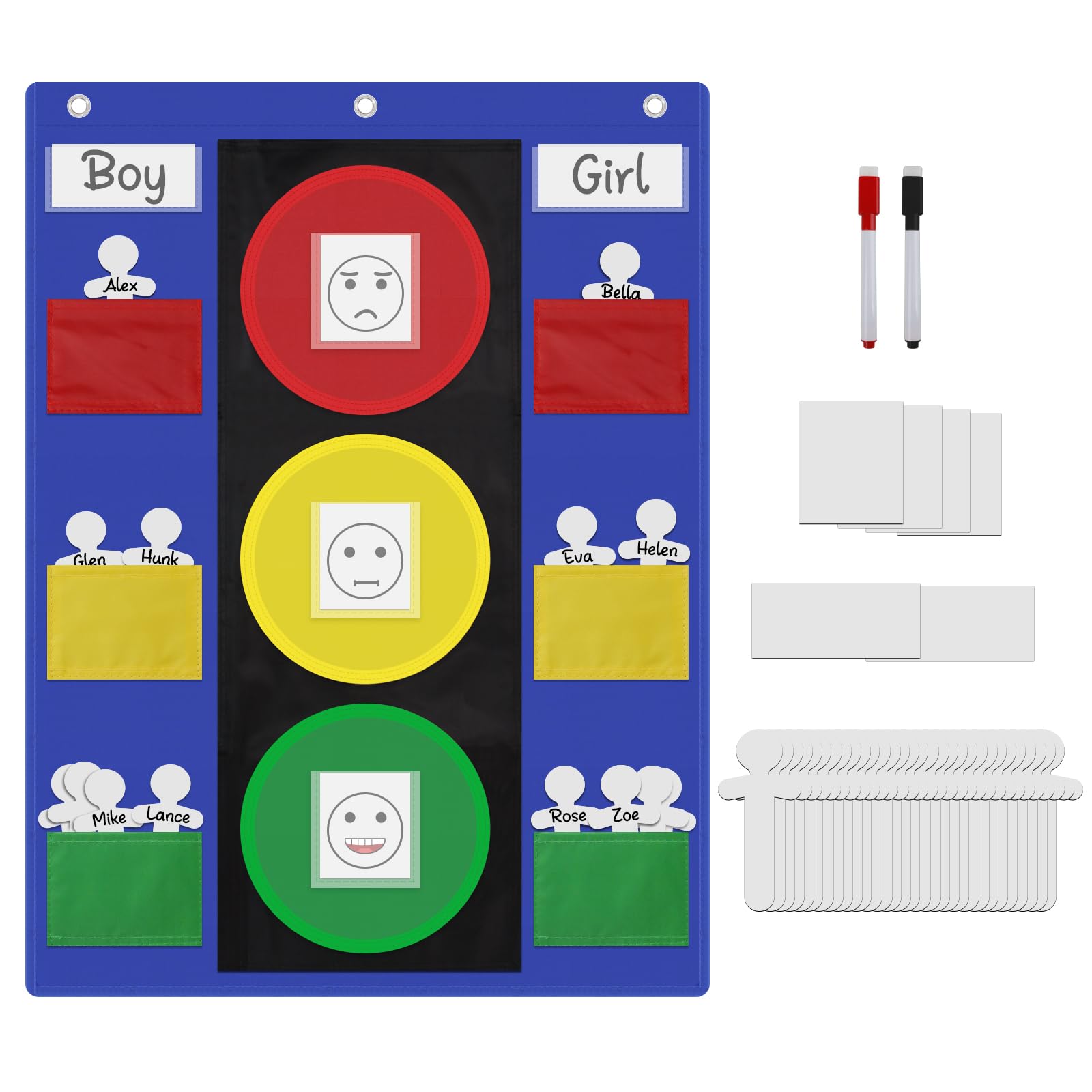
Panelee takes a different approach from the other pocket charts. Instead of 30 name sticks, it comes with 80 boy-and-girl-shaped white cutouts plus 4 white name tag cutouts. That is an enormous supply for a single classroom, meaning you will never run out even if a few get lost or damaged. The chart itself measures 26 by 19.75 inches with 2 header pockets at the top and 6 pockets (two per light) to manage the cutouts and name tags.
The material is heavy-duty Oxford fabric with sturdy stitching, which buyers confirm is “not easy to tear or break.” The set includes three emoticons in different colors (red, yellow, green) that fit into the pockets to mark each behavior zone. One especially memorable review came from a non-teacher who bought the chart to manage behavior between roommates and even their cat—proof of how universally appealing the stoplight system can be. For actual classroom use, a first-grade teacher reported the chart works great and that the kids are “terrified of it,” which is a strong endorsement for a behavior management tool. At 1.09 pounds (about 17.4 ounces), it is the heaviest chart on this list, reflecting the generous supply of 86 total pieces.
The only real trade-off is that the cutouts are plain white paper shapes—you have to write the names yourself and they are not laminated on both sides, so they may wear out faster than the Carson Dellosa vinyl sticks. But the sheer quantity makes replacements painless.
Why It Stands Out
- 86 pieces total—the highest count on this list.
- Heavy-duty Oxford fabric with reinforced stitching.
- Includes 3 colorful emoticons for zone identification.
- Works for both classrooms and non-traditional settings.
The Catch
- Plain paper cutouts may wear out faster than laminated or vinyl alternatives.
- At 1.09 pounds, noticeably heavier than comparable charts.
Grab this for: a large classroom where you need enough cutouts for every student plus spares, and you do not mind replacing paper shapes occasionally.
Choose something else if: you want a more durable, laminated name system that lasts multiple school years.
5. Hadley Designs Magnetic Reward Chart For Kids at Home

The fridge-friendly chart that turns good behavior into a star-filled game.
If your classroom is actually your kitchen, this chart was made for you. Hadley Designs built a magnetic sheet that measures 8 by 10 inches—small enough to live on the refrigerator door without dominating the space. It comes with 4 icon shape magnets (1×1 inch each) and 4 star charts (4×7 inches each) where you write your child’s name and track their rewards. The system is simple: good behavior moves the icon up the chart, poor behavior moves it down, and if the child ends the day at the top, they fill in a star.
The magnetic aspect is the headline here. 6 separate mentions from buyers confirm the magnets stick well to the fridge and are easy to use. One parent reported that the visual chart improved communication with their teen daughter, actually reducing arguments and fostering self-awareness. The chart works for ages 2 through 7 according to the manufacturer, and you write your child’s name with a dry erase or liquid chalk marker. At 7.8 ounces, it is featherlight and stores easily in a drawer. The catch mentioned by a few buyers is that the included marker may arrive dried out, so have a spare dry-erase marker handy.
Unlike the pocket charts above, this one is designed for a single child or two children at most. The 4 icon magnets technically let you track up to four kids, but the star chart side is tune for one. If you have two children, you use two of the four star charts and two icon magnets.
What Wins Parents Over
- Fully magnetic—sticks to fridges or metal surfaces.
- Compact 8×10 size fits small spaces.
- Includes star reward charts for long-term motivation.
- Visually cute, which keeps kids engaged.
Small Gripe
- Included marker sometimes arrives dried out.
- Designed for 1-2 kids, not a full classroom.
Perfect for: a parent who wants a simple, magnetic, fridge-based reward system for one or two young kids at home.
Not for: teachers managing a full classroom or anyone who wants a large wall-mounted display.
6. LIKARTO Magnetic Reward Chart with 280 Magnets

The overachiever that packs 280 magnets to build a complete daily habit system.
LIKARTO is a different beast from the other charts on this list. It is not a stoplight per se—it is a magnetic task and reward board that uses the same green/yellow/red logic but expands it into a full habit-tracking system. The board measures 16.5 by 12.5 inches and comes with 280 magnets: 60 task magnets, 9 blank magnets for your own routines, 180 star magnets, and 30 bonus magnets. That is enough to run a chore chart, a behavior chart, and a reward chart all on one surface.
The system is Montessori-inspired, teaching through visual cues rather than force. The colorful symbols let even pre-literate children follow their daily tasks. It works for one or two children, with parents reporting their 4-year-olds independently track before-school chores and get excited about choosing their weekly reward. The board is designed to pair with the LIKARTO 2-in-1 schedule, creating a morning-to-evening system. One reviewer noted that the magnets come on a punch-out sheet with a wide variety of options, including blanks, and that the quality held up over months of use. At 3.87 pounds, this is the heaviest item on the list by a wide margin—the magnets and board are substantial.
The trade-off is that this is not a pure behavior traffic light chart. If you want the simple red-yellow-green visual of a stoplight, this one requires you to set up that system yourself using the blank and task magnets. It is better suited to parents who want a comprehensive responsibility and reward framework rather than a quick behavior check-in tool.
The Magnet Advantage
- 280 magnets cover tasks, rewards, and blank customization.
- Montessori-inspired visual system works for pre-readers.
- Designed for siblings (supports 2 children with ease).
- Pairs with LIKARTO schedule for full-day structure.
Consider Before Buying
- Not a simple stoplight chart—requires setup.
- At 3.87 pounds, much heavier and more involved than other picks.
Ideal for: parents who want a full daily habit and reward system for one or two children, using a magnet-based visual tracker that evolves as the child grows.
Too much if: you just want a quick red-yellow-green behavior chart to hang on a wall with no setup.
7. Generic Behavior Chart for Multiple Kids with Custom Names

The custom-name chart that lets you personalize up to 6 kids on a single laminated sheet.
This chart strips away the fabric and pockets and goes back to basics: a laminated paper sheet with 5 behavior sections (Amazing in purple, Great Job in blue, Good Day in green, Warning in yellow, Lose a Privilege in red) and velcro name tags that you move up and down. At 11 by 8.5 inches, it is the smallest chart on the list after the Hadley Designs magnetic option, but it supports up to 6 children with custom name tags.
The personalization process is the standout feature. You click “Customize and add to cart,” choose your velcro style (2, 4, or 6 tags), and type in the names. The first tag is free. This means the chart arrives ready to use with the kids’ actual names, no writing or stickering required. Buyers report that the system works beautifully for motivating 6-year-old twins, with the visual warning system helping them think and problem-solve independently. One parent called it a “standout for behavior.” The laminated surface is durable enough for daily handling as long as no one intentionally damages it.
The size is a double-edged sword. It is compact enough to sit on a countertop or clip to a binder, but at 11 x 8.5 inches, it is small for a group of 6 kids—the name tags and velcro positions are close together. For 1-3 kids, the size is fine. For a full classroom, the AUVCAS or Panelee charts give you much more room to spread out.
Why It Works
- Custom printed with your children’s names on arrival.
- Supports 1 to 6 kids in a compact format.
- Laminated paper is surprisingly durable.
- Promotes independence—kids move their own names.
Space Constraint
- Small 11 x 8.5 size feels crowded with 4+ name tags.
- Laminated paper can be intentionally torn by a determined child.
Best suited for: a parent with 1-3 children who wants a simple, personalized, portable chart that requires zero setup.
Pass on this if: you need a large wall chart for a classroom of 20+ students or want a fabric-based system with pockets.
8. Amonev Behaviour Chart Magnetic Warning Chart

The small magnetic chart designed in Britain that helps special needs children and toddlers self-regulate.
Amonev takes a specialized approach with a magnetic chart that is particularly popular for children with autism or special needs. All the pieces are magnetic, so the entire chart lives on your fridge or a metal surface. The format is a simple stoplight: green means good, yellow is a warning, and red means stop. The child can move their own magnet piece or you can do it together, making it a collaborative self-awareness tool rather than a punitive one.
Multiple owners mention that their 4-year-olds and Pre-K children respond well to the system. One parent specifically bought it to help her child maintain the same expectations between school and home, and found it “has helped immensely.” The chart is made from plastic and described as “great size as well, doesn’t take up too much space on the fridge.” It weighs 0.23 kilograms (about 8.1 ounces), making it comparable to the Hadley Designs chart in weight and portability. The educational objective is concentration and self-awareness, and the theme is self-awareness and personal growth.
The main issue reported is that the red face magnet and the time-out magnet have weaker magnets than the rest of the set. Some owners found that these pieces fell off the fridge more easily. One buyer mentioned that unless you have magnets all over your living space, there was no good place to put the chart besides the fridge, and the fridge was not always a great visual location for their setup. For families who want a fridge-based chart and do not plan to move it frequently, this is a minor issue.
What Is Special Here
- All pieces are magnetic, easy for small hands to move.
- Compact size fits on most refrigerator doors.
- Popular for children with autism, ADHD, or special needs.
- Made in Britain with a focus on self-awareness.
Known Weakness
- Red and time-out magnets have weaker magnetism.
- Fridge placement may not be the best visual spot for all homes.
Reach for this if: you want a simple, magnetic, low-fuss stoplight chart for a child with special needs, and your fridge is a convenient and central location.
skip it if: you need a chart for multiple children or want a fabric-based classroom system with pockets and grommets.
Understanding the Specs
Name Capacity: How Many Kids Fit on One Chart
This is the first number you should check. A chart for 30 students (like the Carson Dellosa) will not work for a classroom of 40, and a chart for 6 kids (like the Generic thermometer chart) will be crowded with 2. Look at the product’s included name tags, clips, or cutouts—that is your hard limit. A chart with 80 paper cutouts like the Panelee gives you flexibility to lose a few without running out, but you will be writing names by hand on each one.
Material: Nylon vs. Oxford Cloth vs. Laminated Paper vs. Magnet
Each material serves a different use case. Nylon (Carson Dellosa) is lightweight and wipeable but can rip if snagged. Heavy-duty Oxford cloth (AUVCAS, Panelee, ZKOO) is the most durable for daily classroom handling and survives folding and storage. Laminated paper (Generic thermometer chart) is fine for home use with gentle handling but will not survive a year in a classroom. Magnetic sheets (Hadley Designs, LIKARTO, Amonev) stick to the fridge and are best for home where you want to move the chart rather than hang it permanently.
Customization: Pre-Printed vs. Write-Your-Own
A chart with pre-printed behavior categories is ready to use from the start but cannot adapt as your goals change. Blank cards or blank magnets let you write specific tasks like “make your bed” or “no hitting.” The AUVCAS chart includes 14 double-sided customizable cards with one blank side for DIY themes. The ZKOO chart has 3 DIY pockets. The LIKARTO chart includes 9 blank magnets for your own routines. If you are a teacher who uses the same system year after year, pre-printed is fine. If your child’s needs evolve monthly, get customization.
Mounting: Grommets, Velcro, or Magnets
A wall-mounted chart needs reinforced grommets (metal rings) so it hangs straight and can hold a bit of weight. The AUVCAS, Carson Dellosa, Panelee, and ZKOO charts all use grommets. A fridge chart uses magnets covering the entire back or piece-specific magnets. The Generic thermometer chart uses velcro name tags that stick to a laminated sheet—this sheet can be hung with tape or pinned to a corkboard. Think about where your chart will live before you buy.
FAQ
How do behavior traffic light charts actually work for a child with ADHD or autism?
Can I use a behavior traffic light chart for more than one child at a time?
How do I make a behavior chart last a full school year?
What is the difference between a clip chart and a pocket chart?
Can I mount a behavior chart without damaging my wall?
How do I teach my toddler to use a behavior chart without frustration?
What if my child refuses to participate in a behavior chart system?
Can I use a behavior traffic light chart at daycare or co-op?
How do I clean a behavior pocket chart?
Will a behavior traffic light chart work for a teenager?
Final Thoughts: The Verdict
If you want one dependable pick, the behavior traffic light chart winner is the AUVCAS Clip and Pocket Chart because it combines the highest rating with a heavy-duty build, 40 clips for large groups, and a foldable design that survives summer breaks. If you want a classroom-grade pocket chart from a brand teachers trust, grab the Carson Dellosa Stoplight Chart. And for a comprehensive magnet-based habit and reward system at home, the LIKARTO 280-Magnet Chart is the one to reach for—it turns behavior tracking into a daily habit-building game.
How We Picked
We do not accept paid placement. Every pick is matched to a real buyer and a real use-case; we do not hands-on test units.
Sources & Methodology
Specifications: manufacturer listings and product documentation. Review insights: verified customer reviews, as of July 2026. Pricing: not shown on this page (it changes often); check the current price via the retailer link.
As an Amazon Associate, Gadgets Feed earns from qualifying purchases. This does not affect which products we feature.