
Separating a rough edge from a finished surface is the difference between a project that looks handcrafted and one that looks hand-destroyed. A static belt and spinning disc combo sander is the workhorse that bridges that gap, but choosing the wrong one means burning through belts, fighting vibration, and squinting at wavy surfaces that a quality machine would flatten in seconds.
I’m Min — the co-founder and writer behind Gadgets Feed. After cross-referencing motor amperage, belt speed, direct-drive efficiency, and cast-iron build quality across nine distinct models, the meaningful differences that separate a lifetime tool from a frustrating paperweight are clear.
The right machine delivers repeatable accuracy without the vibration that fatigues your hands and blurs your work. This guide breaks down the specs and real-world performance of the most compelling options so you can confidently select the best belt and disc sander for your shop.
How To Choose The Best Belt And Disc Sander
Selecting a combination sander depends on matching the motor’s continuous power, the belt’s surface feet per minute, and the rigidity of the worktable to your specific projects. Beginners often overvalue disc size while ignoring the motor’s ability to maintain speed under load, which is the single most important predictor of usable performance.
Motor Power and Drive System
Amp rating alone doesn’t tell the full story. An induction motor, typically rated between 4.5 and 5 amps (roughly 3/4 to 1 HP), delivers consistent torque without overheating during extended use. Direct-drive designs eliminate the belts and pulleys that sap efficiency and require adjustment, giving you roughly 25 percent more usable power from the same motor rating.
Belt Speed and Disc RPM
Belt speed, measured in surface feet per minute (SFPM or FPM), determines how aggressively the abrasive removes material. Higher FPM (around 1900 to 2300) strips stock quickly but can burn thin edges if you’re not careful. Slower speeds offer more control for detail work. Disc RPM usually falls between 3200 and 3600 RPM, and a larger disc surface at the same RPM cuts faster because the outer edge travels more feet per minute than the inner portion.
Build Quality and Worktable
Cast-iron or cast-aluminum worktables resist flex under pressure, keeping your workpiece flat against the abrasive. Stamped steel tables are lighter but can deflect, introducing a subtle rock that ruins precision. A miter gauge slot that matches standard accessories and a belt that tilts from 0 to 90 degrees add versatility without compromising stability.
Quick Comparison
On smaller screens, swipe sideways to see the full table.
| Model | Category | Best For | Key Spec | Amazon |
|---|---|---|---|---|
| Woodskil 4.3A | Mid-Range | DIY and home projects | 3570 RPM disc / 1732 FPM belt | Amazon |
| Woodskil 4.5A Upgraded | Mid-Range | Lightweight benchtop use | 3590 RPM disc / 1900 FPM belt | Amazon |
| BUCKTOOL BD4603 | Mid-Range | Quiet, maintenance-free operation | Direct-drive 3/4 HP motor | Amazon |
| Rikon 50-112 | Premium | Vibration-free precision sanding | Cast iron base at 38.5 lbs | Amazon |
| VEVOR 8-Inch Combo | Mid-Range | Knife making and metalwork | 8-inch disc / 3450 RPM | Amazon |
| SKIL BB9504-00 | Premium | Hobbyist with consistent power needs | 4.5A induction motor | Amazon |
| BUCKTOOL Pro BD4801-M | Premium | Heavy metalworking and fabrication | 1 HP direct-drive motor | Amazon |
| PALMGREN 9681063 | Premium | Professional knife making | 8-inch disc / rugged build | Amazon |
| Scheppach BTS800 | Premium | Precision woodworking | 370W motor / cast iron body | Amazon |
In‑Depth Reviews
1. Woodskil 4.3A Belt Sander (4×36 Belt / 6-Inch Disc)

The Woodskil delivers a 3/4 HP motor pushing 3570 RPM on the disc and 1732 FPM on the 4×36-inch belt, which is sufficient for shaping wood, smoothing plastic, and deburring metal edges in a home shop. The belt tilts from 0 to 90 degrees for vertical or horizontal sanding, and the worktable adjusts 0 to 45 degrees with a miter gauge for bevel work.
Double dust exhaust ports separate debris from the belt and disc sides, which helps keep the work surface visible. The multi-wedge belt drive mechanism extends belt life by reducing slippage, and the transparent PC guard lets you monitor belt condition without stopping the machine. At 25 pounds, it’s light enough to move between benches but stable enough that four bolts lock it down securely.
Customer feedback highlights its compact footprint and ability to handle wood, metal, and plastic without bogging down on medium-pressure passes. The belt tension adjustment device prevents the belt from drifting off the rollers during extended use, a common annoyance on cheaper combos. A two-year warranty backs the unit.
Why it’s great
- Strong 3/4 HP motor with 3570 RPM disc speed for efficient material removal
- Dual dust exhaust ports keep both belt and disc sides clear
- Belt tilts 0-90 degrees for versatile vertical or horizontal sanding
Good to know
- Belt drive system requires periodic tension adjustment
- Some users note the worktable needs careful alignment out of the box
2. Woodskil 4.5-Amp Upgraded Belt & Disc Sander
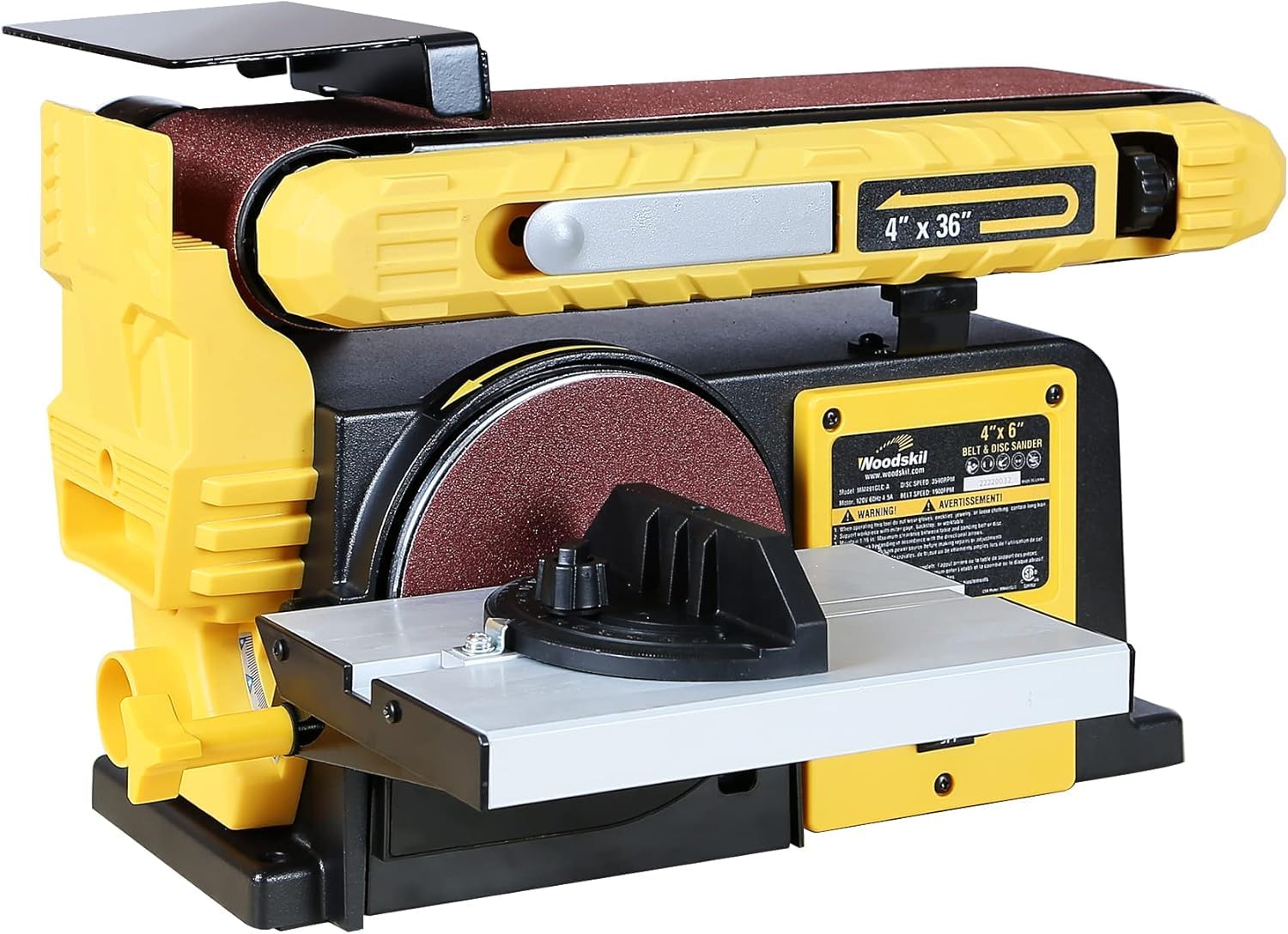
The upgraded Woodskil model bumps the disc speed to 3590 RPM and the belt to 1900 FPM, giving a slight edge in material removal rate over the standard 4.3A version while retaining the same 3/4 HP direct-drive architecture. The sanding belt worktable tilts from 0 to 90 degrees, and the disc worktable adjusts 0 to 45 degrees for compound-angle beveling.
At 39.6 pounds, this version is significantly heavier than the base model, which translates to lower vibration transfer to the benchtop during aggressive passes. Belt replacement is handled by loosening the dust exhaust screw and pulling the tension lever, a simpler process than the multi-wedge system on the cheaper unit. The miter gauge improves accuracy on repeatable crosscuts.
Buyers consistently report that it runs smoothly straight out of the box with easy belt tracking adjustment and a solid build that outperforms its price tier. Several reviewers note it’s roughly half the weight of older Ryobi models while delivering comparable power concentration. A minor trade-off is that dust collection isn’t assisted, so a shop vacuum connection is necessary for fine dust control.
Why it’s great
- Higher 1900 FPM belt speed removes material faster than the base model
- Heavier 39.6-pound build dampens vibration for smoother finishes
- Easy belt replacement with a lever-driven tension release
Good to know
- Dust collection port lacks active suction assistance
- Some users find the belt slightly harder to replace than on other models
3. BUCKTOOL BD4603 5.0A Belt Disc Sander

The BUCKTOOL BD4603 uses a direct-drive configuration that connects the motor shaft directly to the disc and belt drums, eliminating the transmission belts that sap power and require tuning. The fully enclosed 3/4 HP induction motor runs quietly while delivering 3200 RPM at the disc, and the company claims 25 percent greater efficiency than traditional belt-driven designs.
Two cast-aluminum worktables provide a rigid surface for both the belt and disc sides, and the belt tilts 0 to 90 degrees for vertical sanding. The driven drum on the belt side allows sanding curved workpieces without snagging. A quick-release mechanism lets you swap sanding belts without tools, and the tracking control keeps the belt centered during operation.
Users upgrading from weaker 2.4A sanders praise the noticeable power bump and the quiet hum of the induction motor. The cast-aluminum base with rubber feet reduces vibration, though the included dust ports are smaller than standard shop-vac hoses, requiring an adapter for effective collection. Overall, it’s a maintenance-free choice that avoids the most common failure point on combo sanders: broken drive belts.
Why it’s great
- Direct-drive motor eliminates belt maintenance and power loss
- Twin cast-aluminum worktables resist flex under pressure
- Quiet induction motor suitable for shared workshop spaces
Good to know
- Dust ports require an adapter for standard 2.5-inch vacuum hoses
- No safety cover for the disc, per some user reports
4. Rikon 50-112 4×36 Belt / 6-Inch Disc Sander
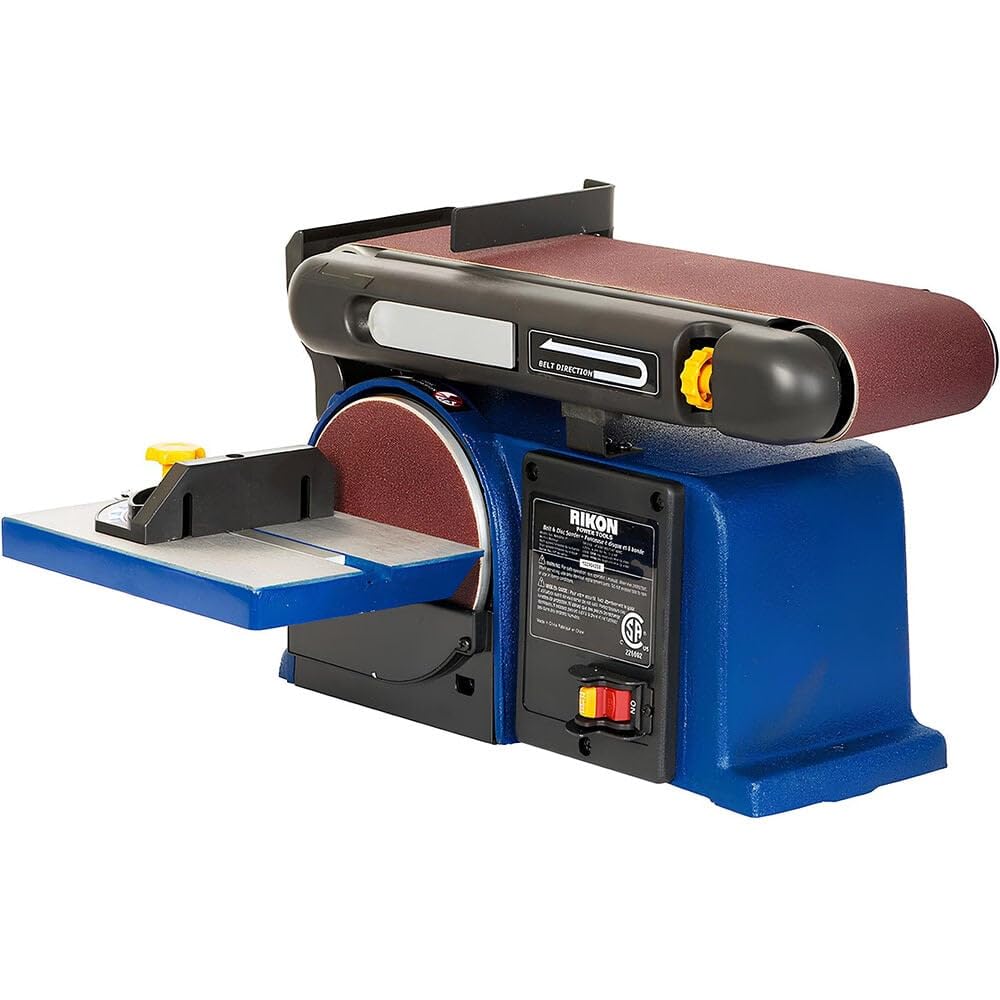
The Rikon 50-112 distinguishes itself with cast-iron and steel construction that brings the unit to 38.5 pounds, providing vibration-free operation that stamped-steel machines can’t match. The belt runs at 1900 SFPM, and the disc spins at 3450 RPM directly driven for increased torque consistency. Setup takes about 10 minutes out of the box.
The belt tilts for vertical or horizontal sanding, and the miter gauge handles crosscuts on both the belt and disc sides. The heavy base keeps the sander planted without bolting it down for most operations, though securing it is recommended for aggressive passes. Rikon backs the unit with a five-year warranty, reflecting confidence in the motor and bearings.
Experienced woodworkers note that the belt tracking adjustments are responsive and hold their position between grit changes, and the machine runs noticeably quieter than typical combo sanders in the same class. Some owners report motor failure after several years of heavy use, but the overall consensus is that the cast-iron build quality at this price point is rare. For a home shop that demands flat, repeatable results, this is a long-term investment.
Why it’s great
- 38.5-pound cast-iron base eliminates vibration for smooth finishes
- Direct-drive disc at 3450 RPM delivers consistent torque
- Five-year warranty far exceeds industry standard
Good to know
- Some units arrive with motor issues requiring replacement
- Belt tensioning requires a few minutes of careful adjustment
5. VEVOR Professional 4×36 Belt / 8-Inch Disc Sander

The VEVOR combo is one of the few in this class to offer an 8-inch disc alongside the standard 4×36-inch belt, giving you more sanding real estate on the rotating surface. The 5-amp fully enclosed induction motor delivers 3450 RPM on the disc and 2160 RPM on the belt, which translates to aggressive stock removal when you lean into it.
Cast-aluminum worktables on both sides tilt 0 to 45 degrees, and the belt tilts 0 to 90 degrees for vertical sanding. The steel plate base with non-slip rubber pads keeps the machine stable during heavy passes. A dust collection port connects to a shop vacuum, though some users note the port design doesn’t funnel debris as efficiently as dedicated dust systems.
Knife makers and metalworkers specifically praise this model for bevel grinding and deburring because the 8-inch disc provides a larger surface area for drawing consistent angles. The disc uses a hook-and-loop backing for quick paper changes. A minority of units have shipped with a slightly warped disc, but replacement discs are inexpensive and the motor’s power makes the trade-off acceptable at this level.
Why it’s great
- Larger 8-inch disc offers more sanding surface than standard 6-inch models
- Powerful 5-amp induction motor maintains speed under load
- Non-slip rubber base pads reduce vibration transfer
Good to know
- Disc flatness can vary; some units need a replacement disc
- Dust collection port design is less effective than competitors
6. SKIL 4.5 Amp Belt and Disc Combination Sander (BB9504-00)

SKIL brings decades of power-tool experience to the BB9504-00, pairing a 4.5-amp induction motor with a belt angle adjustment that spans 0 to 90 degrees and a beveling tabletop that tilts 0 to 45 degrees. The miter gauge guides workpieces for accurate crosscuts on both the belt and disc. Assembly is straightforward, and pre-drilled holes in the base make mounting quick.
The dust port accepts standard 2.5-inch vacuum hoses, which is a welcome departure from proprietary sizing on other brands. A quick-tension release lever allows you to swap between sandpaper grits in seconds without tools. The motor maintains constant speed even when pressing firmly into the belt, a reliability mark that sets it apart from look-alike combos that share its visual design.
Users who directly compared this to identical-looking machines from other brands (specifically Wen) found the SKIL version had tighter table tolerances and a motor that didn’t bog under pressure. The three-year limited warranty adds peace of mind. A safety note: both the belt and disc run concurrently, so loose clothing near the disc side requires attention.
Why it’s great
- Standard 2.5-inch dust port fits most shop vacs without adapters
- Motor maintains constant speed under heavy load
- Tool-free belt tension lever for quick grit changes
Good to know
- Belt and disc run simultaneously with no option to run separately
- Tables require careful alignment check after assembly
7. BUCKTOOL Pro 1HP Belt Sander (4×36 Belt / 8-Inch Disc, BD4801-M)

The BUCKTOOL Pro series steps up to a full 1 HP direct-drive motor, giving it the grunt to shape high-carbon steel, grind knife bevels, and remove material on metal stock without stalling. The 8-inch disc uses a hook-and-loop backing for quick sanding-paper swaps, and the aluminum dust outlet on the belt side resists melting from hot metal debris.
The belt tilts 0 to 90 degrees, and the disc worktable adjusts 0 to 45 degrees, both using a metal miter gauge for repeatable angles. The switch box is mounted on top of the machine for easy access, and the cast-aluminum base with rubber feet dampens vibration. Belt tension is adjustable, and the tracking control keeps the belt centered during high-speed operation.
Metalworkers and knife makers report that this sander handles continuous use without bogging, and the extra 1/4 HP over standard 3/4 HP models makes a noticeable difference in how much pressure you can apply before the motor labors. The unit is heavy at 36.3 pounds and takes up significant bench space. Instructions are minimal, and some assembly guesswork is required, but the build quality and raw power justify the premium.
Why it’s great
- Full 1 HP direct-drive motor handles metalworking without stalling
- Hook-and-loop disc backing enables fast paper changes
- Aluminum belt-side dust outlet resists melting from hot debris
Good to know
- Assembly instructions are poor, requiring trial and error
- Large footprint consumes significant bench space
8. PALMGREN 9681063 4×36 Belt / 8-Inch Disc Finishing Machine
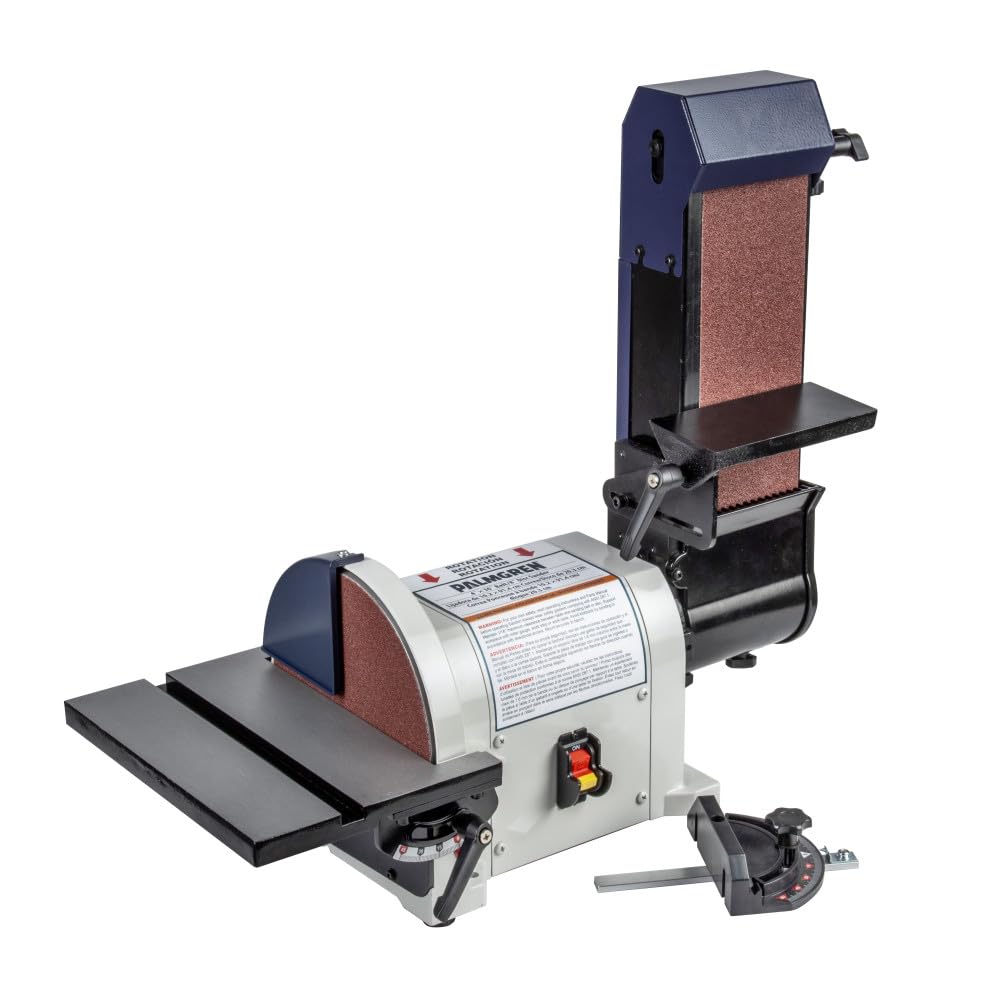
The PALMGREN 9681063 is an industrial-grade finishing machine that tips the scales at 175 pounds, dwarfing every other unit in this roundup. The cast-iron construction absorbs virtually all vibration, allowing for passes that produce near-mirror finishes without chatter marks. It runs a 4×36-inch belt and an 8-inch disc, but the belt can also accommodate 1-inch and 2-inch belts for specialized knife-making work.
The motor doesn’t bog under pressure, and the belt tracking holds steady even after hours of continuous use. Knife makers will need to add a ceramic glass platen to the belt side for perfectly flat bevels, as the factory platen isn’t dead flat out of the box. Changing belts requires removing the disc-side worktable, and the plastic disc table bolts can strip if overtightened.
Users who own this machine alongside cheaper alternatives report that the PALMGREN outlasts competing units by years and handles workloads that would burn up a standard home-shop sander. It’s overkill for casual DIY work, but if your shop involves daily knife making, fabrication, or metal finishing, the build quality justifies the investment. A 12-month warranty is shorter than expected for this class.
Why it’s great
- 175-pound cast-iron frame eliminates vibration for industrial-grade finishes
- Compatible with 1-inch, 2-inch, and 4-inch belts for versatile grinding
- Motor doesn’t bog under heavy, continuous use
Good to know
- Factory platen is not perfectly flat; upgrade to ceramic glass for knife work
- Belt changes require removing the disc-side worktable
9. Scheppach BTS800 Belt and Disc Sander

The Scheppach BTS800 is a German-engineered benchtop unit with a cast-iron body that delivers the solid, quiet operation expected from European woodworking tools. The 370W motor drives the belt and disc combo with a smooth, consistent torque curve suited for precision fretboard work, curves, and small-part finishing rather than aggressive stock removal.
Belt changes are quick via two side screws and a removable tray, a design that avoids the tension-lever mechanisms on budget machines. The disc table is larger than average, providing better support for wider workpieces. Dust extraction is effective when connected to a proper vac, though the included dust port doesn’t have a standard adapter, and the miter gauge is loose out of the box with about 1 degree of play.
Woodworkers praise the compact footprint and near-silent operation, which makes it suitable for indoor shops where noise is a constraint. The unit is heavy for its size, contributing to stability during use. Price is notably higher than the performance-adjusted competition, and the absence of a standard dust-port adapter is a frustration at this price point. For skilled DIYers who prioritize precision over power, this machine delivers consistent results.
Why it’s great
- Cast-iron body provides stable, vibration-free operation
- Compact footprint with a larger-than-average disc table
- Quick belt changes using side screws and a removable tray
Good to know
- Dust port lacks a standard adapter for common vacuum hoses
- Miter gauge has about 1 degree of play for non-square cuts
FAQ
What belt grit should I start with on a new combination sander?
Can I use a belt and disc sander for metal without damaging the machine?
How do I prevent the belt from drifting off the rollers?
Is a 5-amp motor enough for cabinet-making and frequent use?
Final Thoughts: The Verdict
For most users, the best belt and disc sander winner is the Woodskil 4.3A because its 3570 RPM disc speed, dual dust ports, and 0-to-90-degree belt tilt deliver the best balance of power and versatility for home-shop projects. If you want direct-drive maintenance-free operation and quieter running, grab the BUCKTOOL BD4603. And for heavy metalworking and knife making where 1 HP makes the difference between stalling and cutting, nothing beats the BUCKTOOL Pro BD4801-M.