
Our readers keep the lights on and my morning glass full of iced black tea. As an Amazon Associate, I earn from qualifying purchases.
Specs are compiled from manufacturer listings and verified buyer reviews and can change over time — please confirm the key details on the product page before buying.
You lean into a belt disc sander to remove stock fast, but if the motor bogs down the moment you push, you are fighting the tool instead of the workpiece. The difference between a sander you enjoy and one you avoid depends on motor torque, table stability, and ease of grit changes. This guide names the model that keeps its speed under load so you can stop guessing and start sanding.
I’m Min — the founder and writer behind Gadgets Feed. This guide is built by comparing the manufacturers’ published specifications and the patterns across verified customer reviews, so you get each pick’s real strengths and trade-offs instead of marketing spin.
We look at motor amps and RPM (revolutions per minute — how fast the disc spins), belt and disc dimensions, table adjustability, dust collection, and build weight to find the real-world winner for your shop — these are the facts that decide whether the belt disc sander you buy will be a reliable partner or a regret.
Quick Picks
- JET 2″ x 42″ Belt and 8″ Disc Sander (J-41002) — Pro Grade
- BUCKTOOL Pro 1HP Bench Belt Sander BD4801-M — Metal Master
- VEVOR Professional 4 x 36 in. Belt Sander with 8″ Disc Sander — Large Disc Value
- BUCKTOOL 5.0A Belt Disc Sander BD4603 — Quiet Power
- SKIL 4.5 Amp Belt and Disc Combination Benchtop Sander (BB9504-00) — Best Overall
- Woodskil 4.5-Amp Belt & Disc Sander Combo — Lightweight Simple
- Scheppach Set Belt and disc Sander BTS800 — European Craft
How To Choose The Best Belt Disc Sander
Picking the right combo sander is about matching motor torque to your most-used material. If you force a 2.5-amp motor through thick hardwood, it will stall and frustrate you. Below are the three factors that separate a weekend-warrior tool from a shop-grade workhorse.
Motor Amperage and Power Delivery
The amperage rating — typically between 4.5 and 6.2 amps for benchtop models — tells you how much sustained torque the motor can produce without overheating. A 5-amp motor provides noticeably more resistance against heavy pressure than a 4.5-amp unit, meaning you can remove material faster without the belt or disc slowing down. Direct-drive designs (where the motor shaft drives the belt drum or disc directly) also eliminate the power loss and belt-replacement hassle of traditional belt-driven setups.
Work Table Quality and Adjustability
The work tables are where you fight alignment drift. Look for cast aluminum or cast iron tables that stay flat and resist vibration. The miter gauge (a guide that holds your workpiece at a set angle) should lock securely at common angles (0°, 45°) without slop. If the belt table can tilt from horizontal to vertical (0–90°) and the disc table tilts 0–45°, you gain the flexibility to sand end-grain, bevels, and curved pieces without rigging a jig.
Dust Collection and Footprint
A sander produces fine dust that lingers in the air and coats your shop. The dust port diameter matters — a standard 2.5-inch port connects directly to most shop vacs, while smaller or non-standard ports force you to buy adapters. Also consider the machine’s footprint and weight: a 25-pound unit is easy to move but may walk across the bench, while a 60-pound cast-iron beast stays planted but needs a permanent spot.
Quick Comparison
| Model | Best For | Motor Power | Belt Size | Disc Size | Amazon |
|---|---|---|---|---|---|
| JET 2″x42″ / 8″ Disc | Pro Metalwork & Knife Making | 6.2 Amps | 2 x 42 in | 8 in | $736.99Amazon |
| BUCKTOOL Pro BD4801-M | Metalworking & Fabrication | 5 Amps / 1HP | 4 x 36 in | 8 in | $239.00$262.20PrimeAmazon |
| VEVOR Belt & Disc | Versatile Wood & Soft Metal | 5 Amps | 4 x 36 in | 8 in | $162.99Amazon |
| BUCKTOOL 5.0A BD4603 | Small Shop All-Rounder | 5 Amps | 4 x 36 in | 6 in | $153.00$161.98PrimeAmazon |
| SKIL BB9504-00 | Hobbyist Value & Ease of Use | 4.5 Amps | 4 x 36 in | 6 in | $123.49$199.00Amazon |
| Woodskil 4.5-Amp | Budget Benchtop & Light Duty | 4.5 Amps | 4 x 36 in | 6 in | $129.00$135.99PrimeAmazon |
| Scheppach BTS800 | European Precision Woodworking | 370W Induction | 4 x 36 in | 8 in | $426.45Amazon |
In‑Depth Reviews
1. JET 2″ x 42″ Belt and 8″ Disc Sander (J-41002)
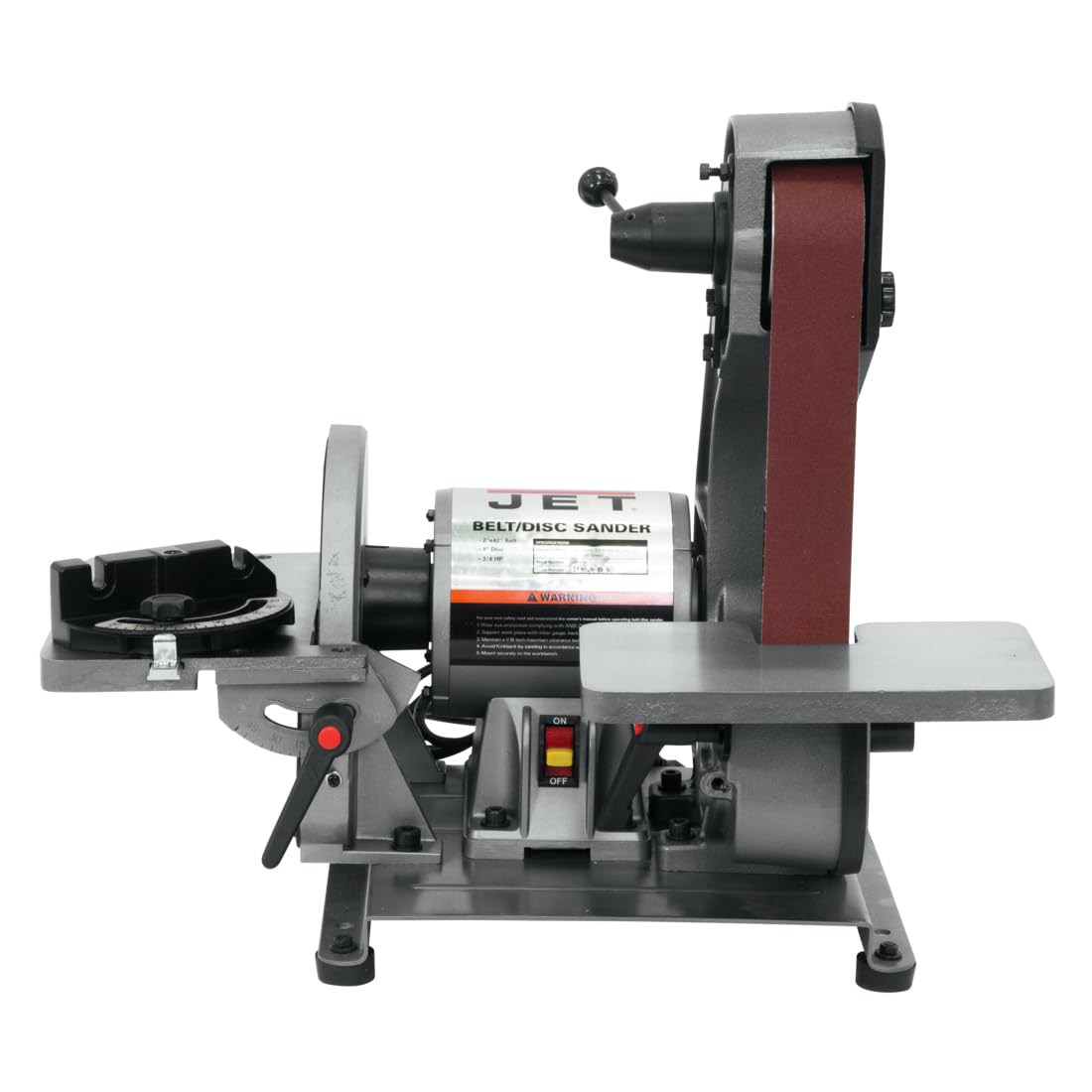
The cast-iron monster that doesn’t flinch when you push hard into the belt.
This is the heaviest machine on the list at 60 pounds, and it earns every ounce. The 6.2-amp motor is the highest amperage here, meaning you can lean into a piece of high-carbon steel or thick hardwood without hearing the motor struggle. Buyers report they “could not slow it down no matter what material” they worked with — a confidence you simply don’t get from lighter 4.5-amp models. The 2 x 42-inch belt is narrower than the standard 4 x 36, but that narrower belt gives you better control for knife bevels and small workpieces, and the removable platen (a flat metal backing plate) lets you grind outside curves on the belt.
The cast-iron construction extends to the base and work tables, so vibration is minimal even at full speed. The deluxe miter gauge locks at 0° and 45° left and right. It also handles a 6.2-amp, 115-volt motor which is 11% more amperage than the 5-amp VEVOR or BUCKTOOL models — a real gap when grinding thick material for extended periods. One owner mentioned the sanding disc plate had runout issues initially, but Jet support sent a replacement plate quickly, backing up the two-year warranty.
Belt changes require removing the work table — some owners modified this with a grinder cut to make swaps faster. The dust shroud works well when connected to a vacuum, but you’ll want a decent dust-extraction system because the JET removes metal quickly and produces fine particles. If you’re setting up a professional shop or do serious knife work, this is the one that will still be running a decade from now.
Shop-floor beast: The 6.2-amp motor and 60-pound cast-iron build make this the most powerful and stable option for metalworking and heavy use.
True catch: The price point is the highest here, and you’ll need to modify the table or invest time in belt changes if you swap grits often.
Who it fits: Professional fabricators, knife makers, and anyone who needs a sander that won’t bog down under heavy pressure and will outlast everything else in the shop.
skip it if: You have a tight budget or need a lightweight machine you can move between benches.
2. BUCKTOOL Pro 1HP Bench Belt Sander BD4801-M

A dedicated metalworking machine with a 1HP direct-drive motor that laughs at high-carbon steel.
This BUCKTOOL Pro is built specifically for metal polishing and knife fabrication, and it shows in every detail. The 1HP direct-drive motor spins the 4 x 36-inch belt and 8-inch disc at 3450 RPM, and the maker claims direct drive is 25% more efficient than traditional belt-driven designs — meaning more power reaches the sanding surface without mechanical loss. The disc uses a hook-and-loop backing for easy abrasive changes, and the aluminum belt-dust outlet prevents the melting that can happen with plastic ports when grinding hot metal.
Buyers confirm that the motor handles high-carbon steel without bogging down, which is the same pain that weaker 4.5-amp models like the Woodskil struggle with under load. At 16.5 kilograms (about 36 pounds) with dimensions of 23.23 x 14.17 x 20.05 inches, it takes up roughly the same footprint as the standard BUCKTOOL BD4603 but delivers noticeably more torque. The belt tension is adjustable, and the switch box positioned on top makes it easy to turn off quickly in a shop environment.
One limitation is that the switch is on top, which some users find takes up space on the work surface. Also, the plastic dust guard on the disc has been reported to be a weak point — one reviewer noted it “caught fire” during heavy grinding, so metalworkers should monitor it. The cast aluminum base with rubber feet keeps vibration low, and the 0–90° belt tilt gives you vertical sanding for edge work. For the price, it delivers professional-grade power for metal without jumping to the JET price bracket.
What the Pro Gets
- 1HP direct-drive motor with real torque for metals
- 8-inch disc with hook-and-loop paper for quick swaps
- Versatile 0–90° belt tilt and 0–45° disc table tilt
What to Watch
- Plastic dust guard may need metal replacement for heavy use
- Setup instructions are poor; expect to assemble by intuition
Grab this for: Metalworkers, knife makers, and machinists who need a powerful 1HP direct-drive machine at a mid-premium price without jumping to pro pricing.
Look elsewhere if: You primarily do light woodworking and don’t need the extra torque or the 8-inch disc size.
3. VEVOR Professional 4 x 36 in. Belt Sander with 8″ Disc Sander

An 8-inch disc at a mid-range price that punches above its weight with a 5-amp motor.
The VEVOR combo gives you a larger 8-inch disc than most competitors at this mid-range price point — most similarly priced sanders stop at a 6-inch disc. The 5-amp fully enclosed induction motor runs at 3450 RPM on the disc and 2160 FPM (feet per minute — belt speed) on the belt, providing consistent power for woodworking and soft metals like aluminum and copper. The 5-amp motor is 11% more amperage than the 4.5-amp SKIL and Woodskil models, meaning it resists bog-down noticeably better when you lean into hardwood.
Buyers describe it as a “Type 2 direct-drive 8″ disk sander” that works great with hardwood. The belt tilts 0–90° for horizontal and vertical sanding, and the cast aluminum worktable adjusts 0–45° with a miter gauge for bevel work. The steel plate base with non-slip rubber pads keeps it stable. One owner reported an initial warped disc but the replacement was flat and worked perfectly — a reminder to inspect on arrival.
The real trade-off here is dust collection. Buyers repeatedly note that the dust port does not accept a standard vacuum hose without an adapter. The port design is poor. You will need to buy a separate adapter or improvise a connection. For the money, you get the largest disc size in the mid-range tier, but you sacrifice dust-management convenience.
The Big Disc Advantage
- 8-inch disc is larger than most sub- models
- 5-amp induction motor runs quietly and resists stall
- Cast aluminum worktable with 0–45° tilt
The Dust Hassle
- Dust port does not fit standard 2.5-inch vacuum hose without adapter
- Some units arrive with disc runout issues (check and return if needed)
Best for: Woodworkers who want the larger 8-inch disc surface for sanding wide boards and don’t mind rigging a dust adapter.
Skip if: You need plug-and-play dust collection or prefer a smaller footprint.
4. BUCKTOOL 5.0A Belt Disc Sander BD4603

A direct-drive 5-amp workhorse that stays quiet on the bench and fits tight spaces.
The BUCKTOOL BD4603 uses a direct-drive design — the motor shaft connects right to the belt drum and disc, so there is no separate drive belt to adjust or replace over time. The 5-amp motor delivers 3200 RPM on the disc, which is 12% slower than the Woodskil’s 3590 RPM, but buyers consistently report the motor feels powerful and quiet. One owner called it a “Powerful 5A motor, quiet, small footprint” — a rare combo in this category. The 5-amp motor is 11% more amperage than the 4.5-amp SKIL motor, giving you more sustained torque for thicker material without the motor struggling.
It comes with two cast aluminum worktables — one for the belt and one for the disc — and both can be adjusted with the included miter gauge. The belt tilts 0–90°, and the disc table tilts 0–45°. The cast aluminum base with rubber feet does a good job damping vibration. Like the VEVOR, the dust ports are non-standard sizes — the adapter only fits the disc port, and the belt port is located on the side rather than at the end as pictured. No safety cover comes on the disc, so be mindful of fingers.
At 23.82 x 11.61 x 20.47 inches, it has a 32% larger footprint than the Woodskil sander (18.11 x 14.17 x 13 inches), meaning it takes up more bench space but also offers a more stable base for heavier work. The direct-drive design is the standout feature — less maintenance and more consistent power delivery over years of use compared to belt-driven rivals.
Maintenance-free win: Direct drive means no belt tension to adjust and no replacement belts — set it up once and forget it.
The catch: Dust ports are non-standard and may require a Y-fitting hose purchase for proper shop-vac connection.
Reach for this if: You want a quiet, low-maintenance 5-amp sander for a small shop that fits in a tight corner and runs reliably over years.
Look elsewhere if: You need a standard 2.5-inch dust port or the absolute fastest RPM on the market.
5. SKIL 4.5 Amp Belt and Disc Combination Benchtop Sander (BB9504-00)

The sander that proved to one reviewer it won’t bog down like the Wen they returned — solid tables and real torque.
The SKIL BB9504-00 sits at the balance of value and performance for the home hobbyist. While the 4.5-amp motor is 11% less amperage than the 5-amp VEVOR and BUCKTOOL models, one buyer specifically compared it to a Wen sander they returned and noted the SKIL did not bog down: “I had to apply quite a bit of effort to bog down the sander with the piece wood I was sanding to have the slightest noticeable slow down of the motor.” That is a real-world test that matters — the Wen version of the same-body sander was unusable due to easy stalling, while the SKIL motor holds its speed. The 4.5-amp induction motor delivers consistent sanding without the variable-speed complexity that most hobbyists don’t need.
The work tables are the other differentiator. The same buyer noted that with the Wen, “the tables could not be attached to the sander securely enough to provide a safe experience,” but the SKIL tables “were easily secured and felt comfortable.” The miter gauge guides crosscuts, the belt adjusts 0–90°, and the disc table tilts 0–45° for bevel work. The quick tension release lever makes grit changes simple. At 25.57 pounds, it is heavy enough to stay put during use but portable enough to move between benches.
The dust port accepts standard 2.5-inch vacuum hoses, which is a major plus — plug it into your shop vac and you are done. Both belts run concurrently, so be careful with loose clothing near the disc while focusing on the belt. The 3-year limited warranty when registered adds confidence. For the price, you get better table stability and more usable torque than the similarly-priced Woodskil, making this the best all-around pick for most hobbyists.
Why It Works
- Work tables secure firmly — no dangerous wobble like cheaper clones
- Motor maintains speed under pressure; does not bog down easily
- Standard 2.5-inch dust port connects directly to most shop vacs
Small Trade-offs
- Motor speed is constant, not variable — no slow-speed option
- Both belt and disc run simultaneously; watch for loose items near the disc
Best for: Home woodworkers who want a reliable, easy-to-assemble sander with secure tables and real stall-resistance without spending over.
Not for: Metalworkers who need the extra torque of a 5-amp or 1HP motor for grinding steel.
6. Woodskil 4.5-Amp Belt & Disc Sander Combo
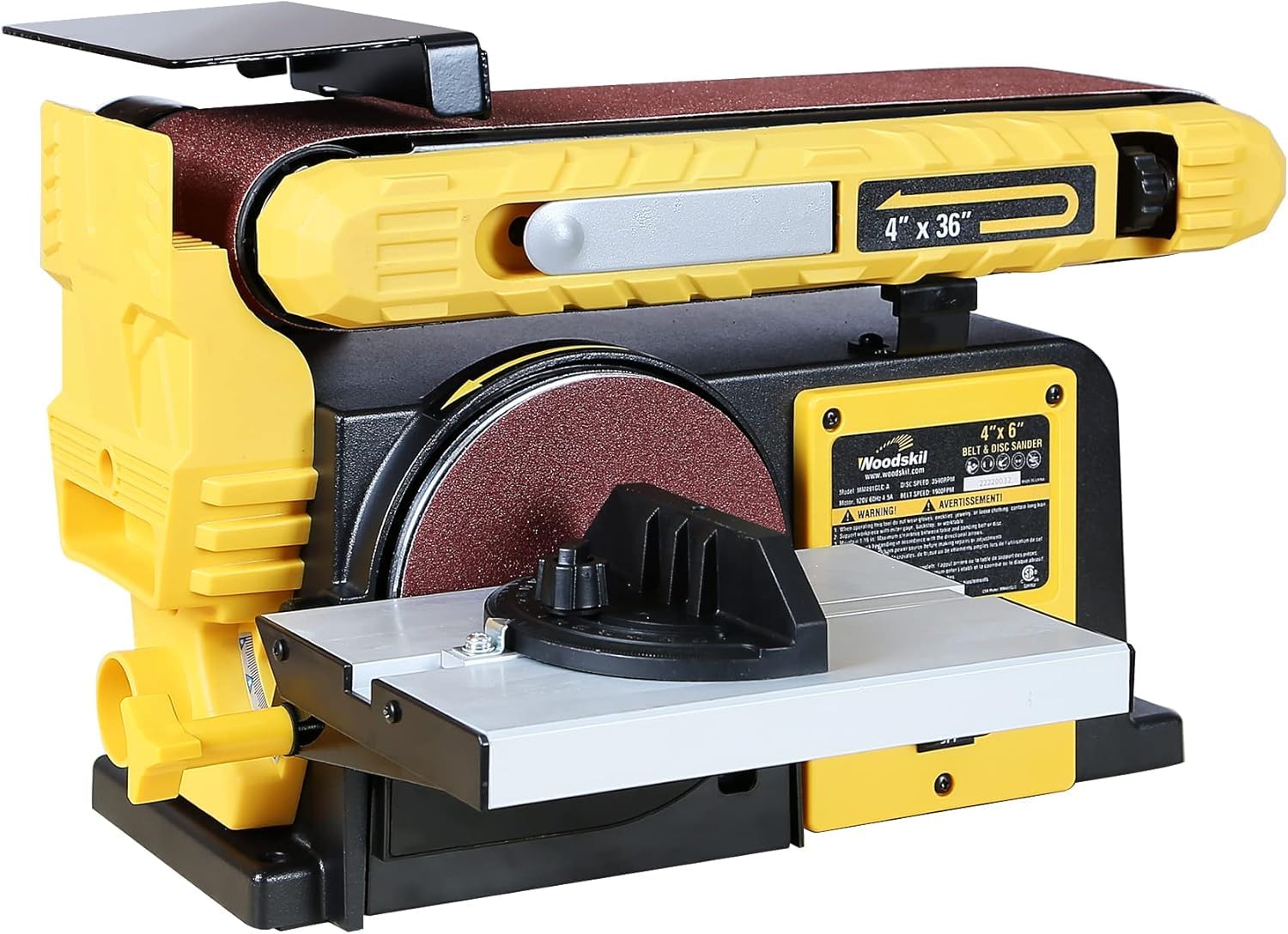
The budget bench buddy that buyers call “extremely lightweight — half the weight of old Ryobi” — but needs bolting down.
The Woodskil combo is the lightest and most compact option here at 18.11 x 14.17 x 13 inches and only about 18 kilograms (39.6 pounds) in shipping weight. It spins the 4 x 36-inch belt at 1900 FPM and the 6-inch disc at 3590 RPM — the highest disc speed in the list, spinning 12% faster than the BUCKTOOL BD4603’s 3200 RPM. That extra speed helps remove material quickly on softer woods. The 3/4HP motor is driven directly, and owners mention it is “extremely lightweight (half the weight of old Ryobi)” — a real advantage if you move tools often.
The belt table tilts 0–90° for horizontal and vertical sanding, and the disc table tilts 0–45° with a miter gauge for bevel work. Belt replacement is straightforward: loosen the screw, pull the tension lever, and swap the belt. At this price point, it delivers solid functionality without fuss. One buyer mentioned it is “a little under powered but for the price, you can’t beat it” — a fair assessment given the 4.5-amp motor is 11% less amperage than the 5-amp BUCKTOOL and VEVOR models.
Dust collection is mediocre — one buyer flatly stated “dust collection is mediocre (no assistance)” — so plan to wear a mask and clean up after sessions. The light weight means it may walk across the bench during aggressive sanding; most owners recommend bolting it down for stability. If your budget is tight and you mostly work with softwood, this is the entry point that gets the job done while staying affordable.
Speed advantage: At 3590 RPM, the disc spins faster than any other sander here — great for quick material removal on small workpieces.
Honest limit: The 4.5-amp motor is adequate for light work but will stall under heavy pressure; dust collection is weak.
Ideal for: Casual woodworkers and DIYers on a tight budget who need a compact, lightweight sander for occasional projects and don’t mind bolting it down.
Pass on it if: You frequently sand hardwood or need reliable dust extraction without extra effort.
7. Scheppach Set Belt and disc Sander BTS800

A solid cast-iron German machine that a user said “is not a toy — it’s a heavy tool with moving parts” — treat it with respect.
The Scheppach BTS800 is different from the rest — it uses a 370-watt induction motor (roughly 0.5 HP) in a solid cast-iron body that provides exceptional mass and stability. Buyers consistently praise its quiet, vibration-free operation: one German reviewer noted it is “absolutely laufruhig” (runs smoothly) and quieter than other machines. The cast-iron construction allows high bearing pressure for precise sanding without the machine walking. The belt measures 715 mm (approximately 28 inches) long and 150 mm wide, giving you about 4 x 28 inches of belt surface — slightly shorter than the standard 4 x 36 but with the same 150 mm (6-inch) width.
The 8-inch disc uses a Velcro (hook-and-loop) backing for easy abrasive changes. The belt tilts horizontally and vertically, and the swivel support table adjusts for angled work. Belt changes on this machine are notably easier than on many competitors — one owner reported that replacing the belt is “immediate and idiot-proof” compared to other sanders. The dust collection port fits standard vacuum hoses, though one buyer wished there was an adapter included in the box. The machine weighs enough to stay planted, so no bolting required in most cases.
The trade-off is that the wattage (370W) is lower than the amp-based motors on the US-market sanders. This machine is designed for precision woodworking on wood and wood-like materials, not for aggressive metal grinding. The miter gauge was noted by one buyer to be 1 degree out of true, so check alignment with a square before critical cuts. If you appreciate European engineering and quiet operation for fine woodworking, this is a satisfying tool that one customer observed they hope will last them another 30 years.
German Engineering
- Cast-iron body absorbs vibration and stays planted
- Exceptionally quiet and smooth running motor
- Easiest belt-change system of any model in this list
Considerations
- 370W motor is less powerful than US 5-amp models for heavy work
- Some units may have miter gauge alignment that needs adjustment
- No vacuum adapter included in the box
Perfect for: European woodworkers and precision-minded hobbyists who prioritize quiet operation, smoothness, and cast-iron stability over raw power.
Not for: Metalworkers or anyone who needs a 5-amp motor to grind steel or remove heavy material quickly.
Understanding the Specs
Motor Amperage vs. Horsepower
Amperage (A) tells you the sustained electrical current the motor draws. A 5-amp motor typically delivers more torque than a 4.5-amp motor, meaning it resists stalling when you push hard. Horsepower (HP) is the mechanical output — 3/4 HP and 1 HP are common here. Induction motors (fully enclosed) run cooler and quieter than universal motors, making them ideal for benchtop tools that run for long sessions.
Direct-Drive vs. Belt-Driven
In a direct-drive design, the motor shaft connects directly to the belt drum or disc. This eliminates the need for a separate drive belt, which means no belt tension adjustments and no belt replacements over time. It also transfers power more efficiently — the maker of the BUCKTOOL claims 25% more efficient than traditional designs. Belt-driven designs are cheaper to manufacture but lose some power through the belt and require periodic tensioning.
RPM and FPM: Speed vs. Torque
RPM (revolutions per minute) measures how fast the disc spins. Higher RPM removes material faster but can burn the workpiece if you push too hard. FPM (feet per minute) measures the belt speed. A typical 4 x 36 belt runs around 1900–2100 FPM. Balancing speed with torque is key — a high RPM disc on a 3/4 HP motor may stall under pressure, while the same RPM on a 1 HP motor maintains speed.
Work Table Material and Adjustability
Cast aluminum and cast iron work tables resist vibration and stay flat over years of use. The belt table should tilt 0–90° for horizontal and vertical sanding. The disc table should tilt 0–45° for bevels. A quality miter gauge locks at common angles without slop. Cheaper stamped steel tables bend under pressure and cause unsafe work conditions.
FAQ
Will a 4.5-amp motor bog down on hardwood?
What is the difference between direct-drive and belt-driven sanders?
How do I know if a combination sander will fit on my workbench?
Which sander has the largest disc for wide sanding?
Can I use these sanders for knife making and metalwork?
Why is dust collection different on every model?
How often do I need to replace sanding belts and discs?
What does the miter gauge do?
Are heavier sanders always better?
Is belt speed (FPM) or disc speed (RPM) more important?
Final Thoughts: The Verdict
If you want one dependable pick, the belt disc sander winner is the SKIL BB9504-00 because it delivers real stall-resistance, secure work tables, and a standard dust port at a price that makes sense for hobbyists. If you need the larger 8-inch disc for wide boards and don’t mind rigging dust collection, grab the VEVOR. And for serious metalwork or knife making where the motor must never stall, the standout is the JET.
How We Picked
We do not accept paid placement. Every pick is matched to a real buyer and a real use-case; we do not hands-on test units.
Sources & Methodology
Specifications: manufacturer listings and product documentation. Review insights: verified customer reviews, as of July 2026. Pricing: not shown on this page (it changes often); check the current price via the retailer link.
As an Amazon Associate, Gadgets Feed earns from qualifying purchases. This does not affect which products we feature.
Product prices and availability are accurate as of the date/time indicated and are subject to change. Any price and availability information displayed on Amazon at the time of purchase will apply to the purchase of this product. As an Amazon Associate I earn from qualifying purchases.
CERTAIN CONTENT THAT APPEARS ON THIS SITE COMES FROM AMAZON. THIS CONTENT IS PROVIDED "AS IS" AND IS SUBJECT TO CHANGE OR REMOVAL AT ANY TIME.
Amazon and the Amazon logo are trademarks of Amazon.com, Inc. or its affiliates.