
Our readers keep the lights on and my morning glass full of iced black tea. As an Amazon Associate, I earn from qualifying purchases.
Specs are compiled from manufacturer listings and verified buyer reviews and can change over time — please confirm the key details on the product page before buying.
If you have ever crouched beside a rear wheel wondering whether that belt is too tight or too loose, the answer is a gauge — not a thumb press. A belt that is too tight chews up bearings and pulleys. A belt that is too loose skips teeth, slips, and wears fast. A deflection gauge gives you one clear reading in pounds, so a belt check takes five minutes instead of guesswork. Below you get nine real tools sorted by job, with the numbers and the trade-offs spelled out.
I’m Min — the founder and writer behind Gadgets Feed. This guide is built by comparing the manufacturers’ published specifications and the patterns across verified customer reviews, so you get each pick’s real strengths and trade-offs instead of marketing spin.
The category splits fast once you look at what each tool actually measures — deflection force in pounds, belt span in inches, or raw tension pressure. The OTC 4748 is the pick most people should reach for, and it stays our belt tension gauge leader for Harley-style secondary drive belts.
Our Picks at a Glance


How To Choose The Best Belt Tension Gauge
The hardest part of shopping for one of these is that two gauges that look similar can measure completely different things. One presses down on the belt and tells you how many pounds it took. Another clamps across the belt span and tells you a tension number on a scale. Buy the wrong type and you will be holding a tool that cannot answer the question your service manual asks.
Match the gauge to what your manual measures
Before anything else, find the spec in your service manual. Harley secondary drive belts are typically called out as a deflection force in pounds — the OTC 4748 is built around a 10-pound specification. Automotive V-belts and ribbed belts usually get a tension range instead, which is where gauges like the Gates 91132 and the Browning 1302546 come in. If your manual says inches of span, you want a ruler-style checker, not a pressure pad.
Check the belt type and width it accepts
A gauge that does not fit your belt is money spent on nothing. The Gates 91132 handles belts up to eight ribs in width and is not built for timing belts. The Browning 1302546 covers V-belt drives from 3L through 8V and adjusts for 10″ to 170″ of belt span. Motorcycle secondary belts want a different shape entirely — a narrow, flat pad like the Motion Pro or the OTC 4748. Read the compatibility line twice.
Weigh accuracy against the price you pay
Every gauge here reads something, but they do not all read the same thing equally well. Owners consistently flag accuracy as the place these gauges differ — some read dead-on from the start, others drift. The OTC 6673 is built from aluminum with precision castings for repeatable readings, while the small plastic-body gauges are fine for a home garage but less suited to a busy shop. Spend the money on the gauge for your daily driver or bike, where a misread tension ruins a bearing, not on a lawn mower.
Think about clearance under the hood
A long gauge body can be a real problem in a cramped engine bay. The Gates 7401-0076 measures 8 x 8 x 11 inches overall, while the Gates Carbon Drive Krikit is 5.5 x 1.25 x 1.25 inches — a huge difference when you are reaching behind a pulley. A compact body like the 5.5-inch Krikit wins when you are reaching behind a pulley. A larger body gives you a better lever and a clearer read when you have room to swing it.
Quick Comparison
| Model | Best For | Belt Type | Measuring Range | Weight | Amazon |
|---|---|---|---|---|---|
| OTC 4748★ Best Overall | Harley secondary drive belts | Motorcycle secondary drive | 10 lb specification | — | Amazon |
| Motion Pro 08-0350Budget Cruiser Pick | Flat belt cruisers | Flat belt | Built-in scale | 1.6 ounces | Amazon |
| Continental 9001 KrikitCompact Bike Gauge | Budget bike-drive check | Belt drive (electric gauge) | — | 1.28 ounces | Amazon |
| Gates 91132 Krikit | Tight engine bays | V-ribbed, up to 8 ribs | 100–320 lb / 50–150 kg | — | Amazon |
| Dayco 93866 | Ribbed belt servicing | Ribbed belts | — | 1 pound | Amazon |
| Gates 7401-0076 | Small V and synchronous belts | Small V-belts, synchronous belts | 30 lb max deflection | — | Amazon |
| Gates Carbon Drive Krikit | Gates Carbon Drive systems | Gates Carbon Drive belt | Full-circumference check | 1.6 ounces | Amazon |
| Browning 1302546 | All V-belt drives | 3L, 4L, 5L, A–C, 3V, 5V, 8V | 10″–170″ span, 35 lb tension | Steel body | Amazon |
| OTC 6673 | Shop-grade universal use | Automotive, motorcycle, industrial | — | 1.4 pounds | Amazon |
In‑Depth Reviews
1. OTC 4748 Belt Tension Gauge for Motorcycle Secondary Drive Belts
Our pick — 4.5+★ from 950+ verified ratings; the strongest balance of quality and price.
The narrow paddle that takes the guesswork out of Harley belt tension, with little fuss.
If you ride a Harley with a secondary drive belt, this is the tool built for that exact job. It is designed to work on secondary drive belts with a 10-pound specification — the number your service manual wants you to hit. The body is 7.8 x 2.9 x 0.85 inches, so it tucks into a saddlebag or a small toolbox divider. For most riders, that combination is the whole story: it fits the belt, it reads the spec, and it is done.
What makes it the top pick is simple usability. Buyers report it is easy to use and easy to read, and the tool lets you set accurate belt tension after a belt replacement, an adjustment, or wheel service. It costs less than the name-brand gauge it mimics, which is why riders buy it instead.
The catch is accuracy at the margins. Some owners say it reads dead-on, while others find it less precise than they want. Fit shows up as the recurring grumble — a small group of riders report the belt barely fits the gauge depending on their setup. Neither is a reason to skip it, but if you need a shop-grade repeatable read, look at the OTC 6673 below. Sized against the Dayco at 1 x 1.5 x 5 inches, this OTC body is a much larger 7.8 x 2.9 x 0.85 inches, which gives you a better grip and a clearer read.
What riders keep coming back for
- Built around the 10-pound secondary drive spec so you can stop guessing.
- Functionality is the standout trait in the reviews — it just works on the belt.
- Easy to read, so a five-minute adjustment stays a five-minute adjustment.
- Budget-friendly against the name-brand equivalent it mimics.
Where it asks you to be careful
- Accuracy gets mixed reports — some find it dead-on, others want more precision.
- Fit is the recurring note; a few find the belt barely fits depending on the pulley setup.
- Secondary-drive use only — not a cross-category gauge.
Reach for this if: you run a Harley-style secondary drive belt and want the spec, the fit, and the read in one tool.
Look elsewhere if: you need shop-grade repeatability or a gauge for ribbed automotive belts — that is a different tool entirely.
2. Motion Pro 08-0350 Belt Tension Gauge
A featherweight flat-belt gauge with a scale on the face and a price that stings less.
Motion Pro built this one for flat belts, and it names Harley-Davidson motorcycles as the compatible device. At 1.6 ounces, it hangs off a hook in the garage without dragging anything down, and it slides into a jacket pocket for the ride. The scale on the face is the whole point: you press, you read, you know. That is why riders on Victory Vegas models name it specifically as the tool that took the guesswork out of drive belt adjustment.
Value is what the reviews keep circling back to. It is the trait owners praise most for this gauge, and belt adjustment is a close second — the tool does the one job it claims. Design gets a quiet nod too, with the shape clearly what buyers were hunting for. Against the OTC 4748 above, this one is the cheaper route to the same outcome if you are on a flat belt and want a pocket-sized read.
Durability is where the reports split. Some owners say it lasts a lifetime, while others report the printed scale stickers peel with use. Take that at face value: it is a simple mechanical tool, and the printed scale is its wear point. If you want a gauge that sits on a shelf or in a rider’s vest and still works in five years, treat the labels gently.
The scale does the work: a flat-belt gauge with a visible reference scale, 1.6 ounces in the hand, and Harley-Davidson listed as the compatible device.
Best fit: flat-belt cruiser riders who want a light, low-cost gauge that reads off the face.
Think twice if: you plan to toss it around a shop bench — the printed stickers are the part that ages.
3. Continental 9001 Krikit Tension Gauge
A tiny electromechanical pressure gauge that costs little and does the bike-drive check.
Tiny is the right word. The Continental 9001 weighs 1.28 ounces and measures 5.1 x 1.4 x 0.9 inches, so it disappears into a glovebox or a seat bag. It is an electromechanical gauge — a pressure pad on a spring-loaded arm — which means you press it against the belt and the reading comes off the mechanism, not a digital screen. That is about as simple as belt tension gets.
The reviews single out bike drives. Owners mention it works well, and it earns specific praise for Gates Carbon Belt bike drives. Functionality is the trait that comes up most, and value is the clear second — described as a great inexpensive tool. Against the OTC 4748, this one is the narrower, lighter gauge, and the 1.28-ounce body makes it the lighter of the two by the numbers you can feel.
Accuracy is honestly mixed. Several owners find it accurate enough for their needs, while others want more. That is a normal split for a small pressure-pad tool, and it is fair to say this one is at its best as a home check rather than a shop reference. The upside is that a small tool like this can stay in the bag for a mid-ride tension check without adding weight.
Built to disappear in a pocket: at 1.28 ounces and 5.1 x 1.4 x 0.9 inches, it is the kind of gauge you can carry and forget.
Pick it for: a light, low-cost electromechanical gauge that lives in the bike bag for a quick belt-drive read.
skip it if: you need documented shop-grade accuracy — the reports on precision are mixed, not unanimous.
4. Gates 91132 Krikit V-Ribbed Belt Tension Gauge

The bright-green Krikit that reads 100 to 320 pounds without asking for room.
This is the tool that handles ribbed serpentine belts, and it does it with a numbered range. It is calibrated to measure tension from 100 to 320 lb., and 50 to 150 kg., and it accepts belts up to eight ribs in width. The bright green pressure pad and indicator arm make the read obvious even in a dim engine bay. Note the limit: it is not for timing belts.
Quality is the thing owners talk about most, and functionality is right behind it. Both numbers are high, which tells you this is a tool that gets used hard and still holds up. Ease of use is the next most-praised trait, and that makes sense — push the pad against the belt, watch the indicator arm, read the number. It works well in confined areas, which is exactly where a serpentine belt usually lives. Against the Dayco 93866, which is another ribbed-belt option at 1 x 1.5 x 5 inches, the Gates body is the one owners describe as a first-rate tool for tight clearance work.
Accuracy and indicator movement are the two spots where reports split. Some find it highly accurate and repeatable, others say it does not give consistent readings. On a very loose belt, the arm can be hard to pin down. Either way, treat the pad as a precision surface and keep it clean.
Why mechanics reach for this
- Reads a real range — 100 to 320 lb., and 50 to 150 kg. — so it covers most ribbed belts.
- Handles belts up to eight ribs wide, which covers the common serpentine sizes.
- Bright green pad and indicator arm make the reading easy to see in a dark bay.
- Works well in confined areas, the place ribbed belts actually live.
Fine print worth knowing
- Not for use on timing belts — that is a different measuring job entirely.
- Accuracy reports are mixed; some find it dead-on and others find it inconsistent.
- Indicator movement is the other split, so repeatability is not guaranteed unit to unit.
Right choice for: anyone servicing a ribbed serpentine belt in a crowded engine bay who wants a visible range on the tool.
Not the tool for: timing belts, or anyone who needs a single unquestioned repeatable number every time.
5. DAYCO PRODUCTS Belt Tension Gauge for Ribbed Belts

A compact ribbed-belt gauge for buyers who already know the Dayco name.
At 1 x 1.5 x 5 inches and 1 pound, the Dayco 93866 is a small, machined tool built for ribbed belts. The exterior is finished rather than molded, which is a clue that this is aimed at the person who has a drawer of Dayco parts already. The model number is 93866 — the same number Gates lists as one of the parts its own 91132 replaces, which tells you this is the standard shape the industry has settled on for ribbed-belt checking.
The detail that stands out is the size contrast. Put it next to the OTC 4748 at 7.8 x 2.9 x 0.85 inches and you get a genuinely different tool — the Dayco is far narrower and shorter, which is what you want when the pulley is tucked behind a radiator hose. This listing also carries far less owner feedback than the Gates, so treat the specs as the reliable part and the review picture as thin.
One honest note: the listing is spare on detail. There is no published tension range and no stated belt width, so if your manual calls out a specific pound figure or a rib count above the common sizes, confirm before you buy.
The compact answer: a 1 x 1.5 x 5 inch ribbed-belt gauge that fits where a full-size tool will not, at 1 pound in the hand.
Go with it when: you want a compact, machined ribbed-belt gauge and you already trust the Dayco parts line.
Hesitate if: you need a published tension range or a deep review trail — the listing gives you neither.
6. Gates 7401-0076 Pencil Type Tension Tester, 30 lbs Deflection Force

A pencil-style tester that presses the belt and stops at a stated 30 pounds.
The Gates 7401-0076 is a single-barrel tension tester built for small V-belts and synchronous belts. Its maximum deflection force is 30 lb., which is the number that matters: you press the barrel until you hit that force, and the reading tells you how far the belt moved. It is made for vehicles and industrial machinery with those small belts, and it is listed as coming from the United States. If you have a synchronous belt and a manual that calls out deflection force, this is the shape the manual means.
The size is the trade-off you need to know up front. Item dimensions are 8 x 8 x 11 inches overall, against the Gates Carbon Drive Krikit at 5.5 x 1.25 x 1.25 inches — the difference is dramatic when you have to reach behind a pulley. A big body gives you a long lever and a firm press. It also gives you a tool that wants a full hand of clearance.
This one is a straightforward spec tool rather than a crowd favorite, and its buyer is the person with a small V-belt and a manual that says “deflection.” If your belt is bigger or your clearance is smaller, look at the Gates 91132 or the compact Carbon Drive meter instead.
Force, measured by press: a 30 lb. deflection ceiling on a single-barrel tester, aimed at small V-belts and synchronous belts.
For the manual-follower: small V-belt and synchronous-belt owners who need a stated 30 lb. deflection check.
Not ideal if: elbow room is tight — the 8 x 8 x 11 inch body needs a real swing.
7. Gates Carbon Drive Belt Tension Meter, Krikit – 74010073
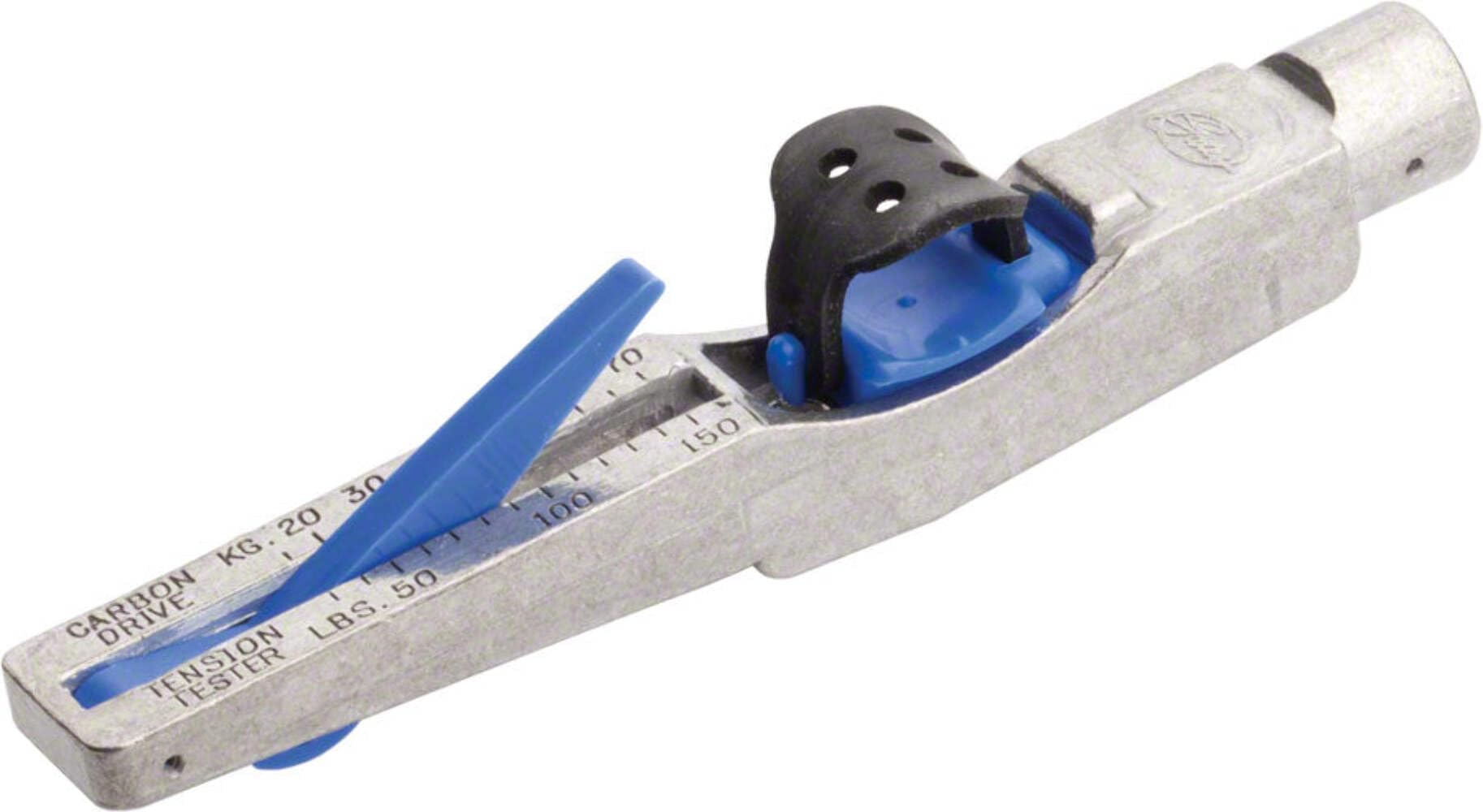
The Carbon Drive specialist that checks the belt all the way around, not just one spot.
This gauge is built for one belt family: Gates Carbon Drive systems. That matters, because the tool includes a gauge that lets you check tension multiple times around the belt circumference. A bike belt can read differently at one spot than another, and this meter is the one that catches that. It detects low tension that causes tooth jump and skipping, and excess tension that wears bearings and the drive system.
The metal body is 5.5 x 1.25 x 1.25 inches and 1.6 ounces. Against the Continental 9001 at 1.28 ounces, this Gates is listed at the heavier figure — a small difference that tells you the body has real metal in it. That is the right build for a tool you hold against a moving system. It carries a limited warranty and calls itself Carbon Drive specific, and that narrowness is exactly what makes it work.
The thing to be honest about is compatibility. It is not a universal gauge. If you do not run a Gates Carbon Drive belt, this tool will not help you. For the rider who does, though, it is purpose-built, and it does a job the general pressure-pad tools do not.
Purpose-built for one belt: a metal 5.5 x 1.25 x 1.25 inch meter that checks tension at multiple points around a Gates Carbon Drive belt.
Match made for: Gates Carbon Drive owners who want a full-circumference tension read on a metal tool.
Wrong drawer for: anybody with a conventional ribbed, flat, or secondary drive belt — this one is nailed to its own belt family.
8. Browning 1302546 Belt Tension Checker, Steel
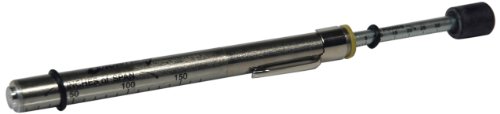
The steel checker that covers nearly every V-belt and reaches spans up to 170 inches.
If you work on more than one machine, this is the range answer. It indicates tension on all V-belt drives — 3L, 4L, 5L, A, B, C, AX, BX, CX, 3V, 5V, and 8V. It is adjustable for 10″ to 170″ of belt span and up to 35 pounds of tension. The body is steel and the design is compact and spring loaded, with instructions included. That combination means one tool can follow you from a garden tractor to an industrial drive.
Functionality is the trait that carries it. It does the job the maker promises, and the broad belt-type list is what buyers are paying for. Against the Gates 91132, which tops out on ribbed belts and carries a fixed pound range, the Browning’s adjustable 10″ to 170″ span makes it the more flexible of the two. If you service a mix of machine sizes, that flexibility is the whole reason to pick it.
The one trade-off noted is durability. The printed plastic adhesive labels wear out with extended use, so if this is going to live in a toolbox and get knocked around, expect the scale to be the first thing to fade. The steel body holds up; the printed face is the part that ages.
One tool, many belts: steel body, spring-loaded, adjustable from 10″ to 170″ of span and up to 35 pounds of tension.
Buy it for: multi-machine work, where its 10″ to 170″ span and full V-belt coverage replace several single-job gauges.
Consider skipping if: it will sit in a jostling toolbox — the printed labels wear with use, even when the steel does not.
9. OTC 6673 Universal Belt Tension Gauge

An aluminum universal gauge built for the shop that needs repeatable readings daily.
This is the premium tool in this list, and it reads like one. The OTC 6673 is made from aluminum with precision castings and careful assembly, built to hold accuracy over the life of the tool. It is aimed at a wide range of automotive, motorcycle, and industrial belts, which keeps it useful across an entire shop. It weighs 1.4 pounds, and the body measures 9.1 x 5.4 x 2.3 inches. If you are setting tension on a fleet, this is the one you keep on the cart.
The real endorsement is on the belt. Customers note it takes the guesswork out of adjusting belts and call it the most accurate gauge they have used. Belt tension is the most-praised trait by count, with accuracy right behind it — the two things that actually matter when a loose belt means a ruined bearing. The sturdy aluminum body backs that up, and buyers who need the tension dead-on keep coming back to this one.
The honest catches are portability and fit. Some owners find it very handy, while others report it is hard to get into tight spaces — a fair trade for a big aluminum body. And fit is the loudest negative: several owners note the belt barely fits to make the test depending on the application. Value gets mixed reports here, which is normal for the highest-priced tool in a list. If you have a cramped bay, the compact Gates Krikit above is the better size.
Why the shop keeps it close
- Aluminum body with precision castings, built to hold accuracy over the tool’s life.
- Belt tension and accuracy are the two most-praised traits in the reviews.
- Covers automotive, motorcycle, and industrial belts — one tool for a mixed fleet.
- Hefty 1.4-pound build that feels like a shop tool, not a gadget.
The real-world snags
- Portability splits — some find it handy, others find it hard to get into tight spaces.
- Fit is the loudest complaint; the belt can barely fit on some applications.
- Value reports are mixed, as you would expect for the top of the price range.
Made for: the working shop or the serious multi-vehicle home mechanic who needs repeatable accuracy and does not care about bulk.
Better off elsewhere if: you are working in a cramped engine bay — the compact gauges are built for that kind of clearance.
Understanding the Specs
Deflection Force in Pounds
Deflection force is how hard you press the belt to push it a set distance — the tool stops at a stated pound figure, and that number is your target. A gauge listed at 30 lbs, like the Gates 7401-0076, is telling you the maximum press it will read. A tool built around a 10-pound specification, like the OTC 4748, is aimed at a specific belt. Match the number to your service manual, or you are measuring the wrong thing correctly.
Belt Span and Belt Type
Belt span is the length between the two pulleys — the Browning 1302546 adjusts from 10″ to 170″ to cover a wide range of machinery. Belt type is the other half: a ribbed serpentine, a flat bike belt, a V-belt with a letter size, and a Gates Carbon Drive belt all want different tools. A gauge for ribbed belts tops out at eight ribs on the Gates 91132. A flat-belt gauge names Harley-Davidson as its device. Confirm both before you commit.
FAQ
Will the OTC 4748 work on my Harley secondary drive belt?
What is the difference between a Krikit gauge and a deflection tester?
Can I use these gauges on a Gates Carbon Drive bike belt?
How often should I check belt tension?
Does the Gates 91132 work on timing belts?
Why do some gauges read a range instead of one number?
Are these gauges hard to use in a tight engine bay?
What does the sticker on a belt gauge actually do?
Will one gauge cover my car and my motorcycle belts?
Is an aluminum gauge worth it over a plastic one?
Final Thoughts: The Verdict
The belt tension gauge that solves the most problems for the most people is the OTC 4748. It is built for the 10-pound secondary drive spec, it fits a Harley belt the way the manual intends, and it is priced below the branded equivalent it mimics. If your belt is ribbed and lives in a crowded engine bay, the Gates 91132 Krikit covers 100 to 320 lb. and eight ribs, and it works where a big tool cannot reach. And if you want the tool a working shop keeps on the cart, the OTC 6673 is the aluminum, precision-cast option that owners call the most accurate for the job. One nudge before you decide: the crowd has already done the sorting — the OTC 4748 sits at 4.5+ stars across 900+ ratings, and that is a lot of riders who stopped guessing.
How We Picked
We do not accept paid placement. Every pick is matched to a real buyer and a real use-case; we do not hands-on test units.
Sources & Methodology
Specifications: manufacturer listings and product documentation. Review insights: verified customer reviews, as of November 2026. Pricing: not shown on this page (it changes often); check the current price via the retailer link.
As an Amazon Associate, Gadgets Feed earns from qualifying purchases. This does not affect which products we feature.