
A stationary bench belt sander transforms how you shape, smooth, and finish wood and metal. The right machine delivers consistent material removal at a fixed angle, freeing both hands to control the workpiece with precision. The wrong choice wanders off-track, stalls under pressure, or shakes your entire workstation apart.
I’m Min — the co-founder and writer behind Gadgets Feed. I’ve spent countless hours cross-referencing motor specs, belt dimensions, and real-world user feedback across dozens of models to separate the workshop workhorses from the frustrating mistakes.
Whether you are outfitting a home garage, a cabinet shop, or a metal fabrication bench, choosing the right stationary sander determines your finish quality and project speed. This guide ranks the top contenders to help you identify your ideal best bench belt sander.
How To Choose The Best Bench Belt Sander
A bench belt sander is a long-term investment in your shop’s capability. You need to prioritize motor architecture, belt dimensions, and build stability over flashy features. Beginners often overpay for extra disc diameter while ignoring the critical factor of belt tracking control.
Motor Type: Direct-Drive vs. Belt-Driven
Direct-drive motors connect the belt drum directly to the motor shaft, eliminating pulleys and tension belts. This design delivers higher torque efficiency and requires zero belt tension adjustments over the life of the machine. Belt-driven sanders use a separate motor pulley and a drive belt — they are cheaper to manufacture but introduce friction loss, require periodic belt replacement, and tend to lose power under sustained load. For consistent performance, direct-drive is the superior architecture.
Belt Size & Application Fit
Belt dimensions dictate the type of work you can efficiently handle. The 1×30-inch format suits detail work, small parts, and knife sharpening. The 4×36-inch standard is the all-rounder for furniture refinishing, cabinet door edges, and general wood shaping. The 4×24-inch size favors heavy material removal and professional floor-level work. Larger belts dissipate heat better and last longer during aggressive sanding sessions, but they also demand a more powerful motor — look for at least 3/4 HP in the 4×36 category and 1 HP for continuous metalworking.
Belt Tracking Adjustment
Tracking controls where the belt rides on the drums. A poorly designed tracking mechanism lets the belt drift sideways, causing edge fraying, uneven sanding, and premature belt failure. Reliable tracking systems use a threaded knob or lever that micro-adjusts the front drum angle. Machines with manual belt tension levers (as opposed to spring-loaded auto-tension) give you more control for fine-tuning the belt path. Before buying, check user reviews for any mention of “belt wanders” or “tracking won’t hold” — this is a hard dealbreaker in a stationary sander.
Quick Comparison
On smaller screens, swipe sideways to see the full table.
| Model | Category | Best For | Key Spec | Amazon |
|---|---|---|---|---|
| Bucktool BD4801-M | Premium | Metalworking & Heavy-Duty | 1 HP Direct-Drive | Amazon |
| Bucktool BD4603A | Mid-Range | All-Round Woodworking | 5.0A Direct-Drive | Amazon |
| Woodskil 4×36 | Mid-Range | Home DIY Projects | 3/4 HP Motor | Amazon |
| Bucktool MM493C | Entry-Level | Compact Hobby Use | 1/3 HP Direct-Drive | Amazon |
| Scheppach BTS800 | Premium | Professional Precision | 370W Cast Iron Base | Amazon |
| Makita 9924DB | Premium | Professional Woodworking | 7.8A Motor | Amazon |
| Makita 9404 | Premium | Floor & Large Surface Work | 8.8A Variable Speed | Amazon |
In‑Depth Reviews
1. BUCKTOOL Pro BD4801-M 1HP Belt Disc Sander

The BD4801-M is built specifically for metalworking. Its 1 HP direct-drive motor delivers consistent torque at 3450 RPM, handling high-carbon steel knife bevels and thick aluminum stock without stalling. The 8-inch disc uses hook-and-loop backing for rapid paper swaps, and the dedicated knife grinding accessory mounts directly to the belt platen when you need precise edge work.
Construction is exceptionally rigid. The cast aluminum base with rubber feet absorbs vibration effectively during extended sessions, and the belt work table tilts from 0 to 90 degrees, giving you vertical sanding capability for long stock. The removable dust port expands your work area when polishing longer materials — a thoughtful detail for fabrication environments.
Setup requires some patience because the printed instructions are sparse, but the machine itself rewards the effort with smooth tracking and quiet operation. Owners report years of reliable service with basic maintenance. If your shop regularly sees metal parts, this model justifies its position at the top of the list.
Why it’s great
- 1 HP direct-drive handles aggressive metal stock removal without bogging
- 8-inch disc with hook-and-loop backing enables fast paper changes
- Sturdy cast aluminum base minimizes vibration during heavy work
Good to know
- Assembly instructions are poorly written; you may need to reverse-engineer steps
- Footprint is larger than typical 4×36 machines, requiring dedicated bench space
2. Bucktool BD4603A Belt Disc Sander

The BD4603A marks a major upgrade over Bucktool’s smaller units, replacing the 1×30 belt with a full 4×36-inch format paired with a 6-inch disc. The 5.0 amp direct-drive motor delivers 25 percent more efficiency than traditional belt-driven designs, translating to quieter operation and no drive belt to replace over time. Users consistently note that the motor maintains speed under load — a critical advantage for jointing edges on hardwood boards.
Versatility is a strong suit here. The belt tilts from 0 to 90 degrees for horizontal or vertical sanding, while the cast aluminum workbenches on both belt and disc sides provide stable workpiece support. The miter gauge allows repeatable angled cuts on the disc, and the quick belt replacement design paired with the tracking control knob makes maintenance straightforward.
The one consistent pain point involves the dust ports. The disc port accepts the supplied adapter, but the belt-side port is a non-standard size that resists standard shop vac hoses. Owners recommend picking up a universal hose adapter or using a Y-fitting hose splitter to get proper chip evacuation on both sides.
Why it’s great
- Maintenance-free direct-drive eliminates belt tension adjustments
- Full 4×36 belt handles everything from small trim to cabinet panels
- Dual cast aluminum workbenches add stability for precision work
Good to know
- Belt-side dust port uses a non-standard size; plan for an adapter
- No safety cover is included for the disc side
3. Woodskil 4.3A Belt Sander

Woodskil enters the 4×36 arena with a 3/4 HP motor that spins the belt at 3570 RPM and delivers 1732 surface feet per minute. The 4.3 amp rating gives it enough grunt for furniture refinishing, cabinet edge smoothing, and light metal deburring. The 6-inch disc handles smaller curves and detail work that the belt can’t reach.
The belt assembly can tilt from 0 to 90 degrees, and the work table adjusts 0–45 degrees with the included miter gauge, giving you flexibility for bevel sanding. Woodskil added two dust exhaust ports — one for the belt, one for the disc — which helps keep the workspace clearer than single-port designs. The multi-wedge belt drive mechanism is designed to extend belt life by reducing slippage.
Feedback from users who sand custom insoles and craft parts confirms that the machine runs reliably over extended periods. The only caution is that the motor’s power curve favors wood rather than continuous heavy metalwork — it will handle occasional metal but isn’t built for daily fabrication. For the home DIYer who needs a versatile 2-in-1 machine at a reasonable investment, this sander delivers consistent results.
Why it’s great
- Dual dust exhaust ports keep both belt and disc areas clear
- Belt tilts 0-90 degrees for flexible positioning
- Long belt life from multi-wedge drive mechanism
Good to know
- Power is adequate for wood but not designed for daily heavy metalwork
- Setup instructions require careful attention to belt tension adjustment
4. Bucktool 1×30 Bench Belt Sander

Bucktool’s MM493C crams impressive build quality into a 1×30-inch footprint. The 1/3 HP direct-drive motor spins at 3590 RPM and produces noticeably less noise than belt-driven competitors at this size. Users who upgraded from cheaper oscillating spindle sanders report that the solid metal enclosure eliminates the rattling and vibration that plague many entry-level benchtop units.
The one-button belt cover release is a genuine time-saver — you push, the cover pops open, and you swap belts in seconds without hunting for a screwdriver. The 5-inch disc is useful for smaller parts, and the disc work table adjusts from 0 to 45 degrees for bevel sanding. Owners using the machine for knife blade profiling and model-making note that the tracking control is precise and holds position even after hours of use.
The small belt size means you cannot flatten large panels or tackle heavy stock removal — this machine excels at detail work, touch-ups, and small-part finishing. If your shop has limited bench space and your projects rarely exceed hand-sized parts, this compact direct-drive sander will outperform anything in its size class.
Why it’s great
- One-button belt cover enables the fastest belt changes in this category
- Direct-drive motor runs quieter and smoother than belt-driven alternatives
- Metal construction feels substantially more durable than plastic-base models
Good to know
- 1×30 belt size limits you to small parts, knife work, and touch-up sanding
- Disc table is relatively small for larger curved workpieces
5. Scheppach BTS800 Belt and Disc Sander

The Scheppach BTS800 brings European engineering to the benchtop sander category. Its cast iron chassis and 715mm sanding belt length provide a level of stability and vibration damping that stamped steel or aluminum frames cannot match. The machine runs quietly enough for extended sessions without hearing protection fatigue, and the belt change mechanism is exceptionally fast — loosen two side screws, remove the tray, swap the belt, and retighten.
Disc changes are equally efficient thanks to the Velcro-style backing that accepts stick-on sanding discs. The disc platen is generous in size, making it suitable for shaping external curves on guitar fretboards, model parts, and furniture components. Owners who upgraded from 30-year-old sanders report immediate improvement in both finish quality and noise level.
The largest drawback is dust extraction. Despite a well-built chassis, the dust collection system underperforms even when connected to a powerful shop vac like a CamVac. You will need to wear a mask and plan for airborne debris. Additionally, the miter gauge has some play and may be off by one degree — you will want to verify angles with a dedicated square before making precision cuts.
Why it’s great
- Cast iron construction provides superior vibration absorption and long-term durability
- Quick belt and disc change system minimizes downtime between grits
- Quiet operation suitable for residential workshops without disturbing neighbors
Good to know
- Dust extraction is weak even with a high-performance shop vac
- Miter gauge has slight play and may not hit accurate angles out of the box
6. Makita 9924DB 3×24 Inch Belt Sander

The Makita 9924DB has earned legendary status among professional woodworkers. Its 7.8 amp motor drives a 3×24-inch belt with enough torque to flatten a bowed oak tabletop or strip 500 square feet of hardwood flooring without complaining. The extended base allows flush sanding right up to walls and into corners — a feature that saves hours of hand sanding on floor refinishing jobs.
Belt tracking on this model is the gold standard for portable belt sanders. The auto-tracking system requires zero adjustment during normal use, and the easy-release belt lever lets you swap grits in seconds. The dust collection port at the rear accepts a standard shop vac hose, and the ball-bearing construction supports tool life measured in decades rather than years — several owners report 20 to 25 years of service from a single unit.
The 3×24 belt width is narrower than the 4-inch standard, which makes it ideal for edge work and sanding between floorboards but slightly slower for large flat surfaces. The 9924DB also lacks variable speed, so you are locked into one belt speed. If you need belt speed control for heat-sensitive finishes, the Makita 9404 with its variable speed dial may be a better fit.
Why it’s great
- Auto-tracking belt system never needs manual adjustment during use
- Flush sanding base reaches walls and corners without extra tools
- Ball-bearing construction and Japanese manufacturing deliver multi-decade reliability
Good to know
- Fixed belt speed limits control on heat-sensitive finishes
- 3-inch belt width is slower than 4-inch models on large flat surfaces
7. Makita 9404 4×24 Inch Belt Sander
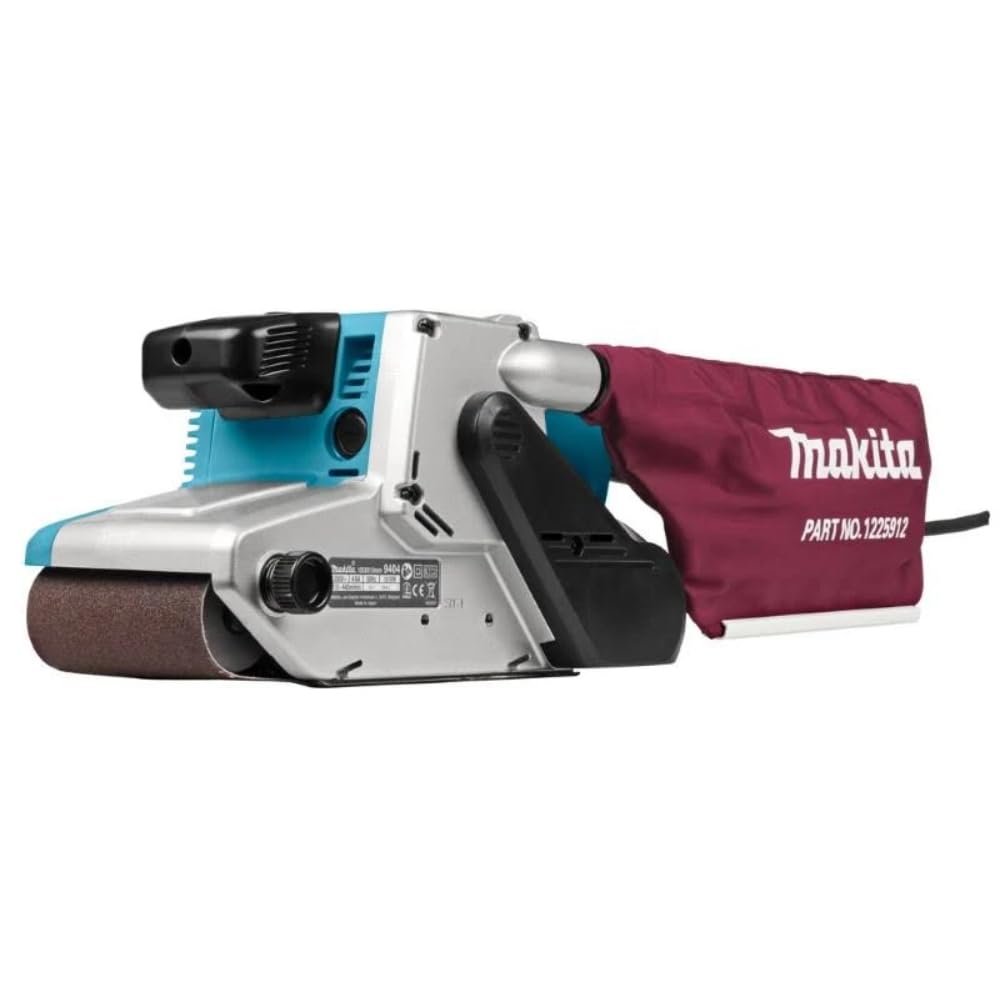
The Makita 9404 combines a 4-inch-wide belt with an 8.8 amp motor and variable speed control, giving you the power to remove material quickly and the finesse to dial back speed when working near glue lines or delicate veneers. The low-noise design hits 84 decibels — noticeably quieter than comparable sanders — which makes a measurable difference during all-day floor refinishing marathons.
The 16.4-foot power cord eliminates the need for an extension cord in most residential rooms, and the ergonomic grip layout lets you control the machine comfortably when mounted upside down in a bench stand. The dust collection port accepts a shop vac hose directly, and when used with a vacuum, the dust pickup is excellent — nearly zero airborne fines escape during operation.
Weight distribution is well-balanced at 10.3 pounds. The machine is heavy enough to stay planted on the work surface without requiring excessive downward force, but light enough to maneuver one-handed for edge work. The auto-tracking system holds the belt centered throughout the speed range, and belt changes are tool-free. For woodworkers who need both a portable floor sander and a bench-mounted unit, the 9404’s variable speed and 4-inch width make it the most versatile portable option on this list.
Why it’s great
- Variable speed dial gives control from gentle finishing to aggressive stock removal
- 8.8 amp motor with 4-inch belt width handles large area jobs efficiently
- Low 84 dB noise level is exceptional for a full-size belt sander
Good to know
- Belt speed at the lowest setting may bog down with coarse 36-grit belts
- Dust bag is adequate but a shop vac is strongly recommended for best results
FAQ
What belt grit should I start with on a bench belt sander for wood shaping?
Can I use a 4×36 bench belt sander for metal knife making?
Why does my bench belt sander vibrate excessively and how do I fix it?
Final Thoughts: The Verdict
For most users, the best bench belt sander winner is the Bucktool BD4603A because its 5.0 amp direct-drive motor delivers mid-range power without the maintenance headaches of belt-driven alternatives. If you do heavy metalworking and need 1 HP reliability, grab the Bucktool BD4801-M. And for professional woodworking on large surfaces where variable speed and flush sanding matter, nothing beats the Makita 9404.