
Walking into a workshop with a project that needs perfectly flat edges or a smooth, uniform contour can turn frustrating fast when your sanding setup involves clamping a hand-held belt sander to a workbench. A dedicated, stable platform changes everything, turning hours of tedious work into precise, repeatable results in minutes.
I’m Min — the co-founder and writer behind Gadgets Feed. I analyze motor amperage, belt speed ratings, and table stability specs across dozens of models to separate the hobby-grade units from the true shop performers in the bench sander category.
This guide cuts through the marketing claims to compare nine models on the metrics that actually matter for your projects, helping you find the best bench sander for your specific workshop needs.
How To Choose The Best Bench Sander
A bench sander is a long-term investment in your shop’s precision, and choosing the wrong one means fighting vibration, struggling with underpowered motors, or dealing with poor belt tracking. Focus on these three factors to pick the model that fits your work.
Motor Power and Drive System
The motor’s amperage and the drive mechanism define how much material you can remove per pass and how consistently the machine maintains speed under load. A 3.5-amp motor suits light shaping and knife sharpening, while a 5-amp or 1HP motor powers through hardwood and metal grinding without stalling. Direct-drive designs eliminate belts and pulleys that wear out, delivering quieter, more efficient power transfer at the cost of higher initial price.
Belt Speed and Surface Feet Per Minute (SFPM)
SFPM measures how fast the abrasive moves past your workpiece. A belt running at 1900 to 2160 FPM is standard for woodworking, removing material quickly. Variable-speed models, found on premium units, let you dial down to around 1900 SFPM for heat-sensitive metals or plastics and crank up for aggressive stock removal. Fixed-speed sanders are simpler but less adaptable.
Dust Collection and Table Stability
A clean shop is a safer shop. Look for dual dust exhaust ports — one for the belt, one for the disc — that accept standard 2.5-inch vacuum hoses. Cast iron bases absorb vibration better than stamped steel or aluminum, keeping the work surface steady for accurate sanding. The work table’s tilt adjustment should lock firmly at any angle without requiring tools between every adjustment.
Quick Comparison
On smaller screens, swipe sideways to see the full table.
| Model | Category | Best For | Key Spec | Amazon |
|---|---|---|---|---|
| Bucktool Pro BD4801-M | Premium | Heavy metalworking & knife making | 1HP direct-drive motor | Amazon |
| Skil BB9504-00 | Premium | Reliable mid-range performance | 4.5A induction motor | Amazon |
| VEVOR BD4083 | Premium | Versatile 8″ disc tasks | 5A induction motor | Amazon |
| Rikon 50-161VS | Mid-Range | Precision shaping & variable speed | Variable speed 1909-3248 SFPM | Amazon |
| Bucktool BD4603 | Mid-Range | Maintenance-free operation | 5A direct-drive motor | Amazon |
| KFMK 2×42 Combo | Mid-Range | Knife making & sharpening | 3.5A variable-speed motor | Amazon |
| WEN 6502T | Mid-Range | Hobbyist woodworking | Cast iron base | Amazon |
| Woodskil Upgraded Model | Budget | Budget-minded DIY projects | 3/4HP motor, 3590 RPM | Amazon |
| Woodskil 4.3A | Budget | Entry-level home use | Double dust exhaust ports | Amazon |
In‑Depth Reviews
1. Bucktool Pro BD4801-M

The Bucktool Pro BD4801-M is the most powerful unit in this lineup, featuring a 1HP direct-drive induction motor that delivers 5 amps of consistent torque. This machine does not bog down on high-carbon steel, making it the definitive choice for knife makers and metal fabricators who need aggressive material removal without stalling. The 4×36 inch belt and 8 inch disc work in tandem, and the cast aluminum base with rubber feet effectively dampens vibration even under heavy grinding pressure.
Belt tension is adjustable, and the tracking control keeps the abrasive running true without constant fiddling. A top-mounted switch box improves accessibility, and the removable dust port allows polishing of long workpieces without obstruction. The hook-and-loop disc backing makes swaps quick, while the knife grinding accessory integrates neatly onto the belt plate.
Setup requires careful attention because the included instructions are minimal, and some owners report needing to square the work table out of the box. The belt arm includes a small platen for knife notches, though the table lacks angle markings for repeatable adjustments. At this power level, the plastic dust guard is a weak point that can melt under sustained heavy use, so monitoring heat buildup is advised.
Why it’s great
- Powerful 1HP motor handles steel without bogging
- Direct-drive design for quiet, efficient operation
- Versatile belt and disc combo with adjustable angles
Good to know
- Instructions are poor and lack a setup video
- Work table may need truing during assembly
2. Skil BB9504-00

The Skil BB9504-00 delivers the most balanced combination of power, build quality, and price in the 4×36 belt and 6 inch disc category. Its 4.5 amp induction motor runs at a constant speed that does not drop significantly under load, a noticeable upgrade over cheaper models that slow down when pressing into hardwood. Assembly takes minutes thanks to clear instructions, and the quick tension release lever makes grit changes as simple as pulling a lever and swapping belts.
The miter gauge guides crosscuts accurately, and the belt tilts from 0 to 90 degrees for edge sanding or contour work. The dust port accepts standard 2.5-inch vacuum hoses, keeping the workspace cleaner than most competitors at this tier. The base has pre-drilled holes for benchtop mounting, and the unit’s 25.6-pound weight keeps it planted during operation.
One quirk to note is that both the belt and disc run simultaneously with no individual shutoff switch, so you need to stay mindful of the spinning disc when accessing the belt area from the side. The 12-month warranty can be extended to 36 months through Skil’s registration, adding peace of mind for the price.
Why it’s great
- Constant-speed motor resists bogging under pressure
- Tool-free belt changes with quick tension lever
- Clean dust port compatibility with standard hoses
Good to know
- Belt and disc run simultaneously without separate controls
3. VEVOR BD4083

The VEVOR BD4083 stands out by offering an 8-inch disc alongside the standard 4×36 belt, giving you a larger sanding surface for wider pieces or more comfortable palm support. The 5-amp fully enclosed induction motor spins the disc at 3450 RPM and the belt at 2160 FPM, delivering smooth, quiet power that handles hardwood and soft metals without complaint. The cast aluminum worktable tilts from 0 to 45 degrees and locks securely, while the belt can be positioned vertically or horizontally via a simple adjustment.
The steel plate base with non-slip rubber pads keeps vibration to a minimum, a welcome feature for extended sessions. Dual dust collection ports help maintain visibility, though some owners note the ports are smaller than standard shop vac fittings, requiring an adapter for a tight seal. The unit includes a sanding belt, a disc, and all necessary indexing hardware.
Occasional quality-control issues surface with early production runs, including a disc that arrived slightly warped (VEVOR replaced it promptly under warranty). The plastic disc guard can crack if screws are overtightened, so gentle hand-tightening is recommended. At 3450 RPM, the disc speed is fixed, which limits its usefulness for heat-sensitive materials compared to variable-speed rivals.
Why it’s great
- Large 8″ disc provides a bigger sanding surface
- 5A motor runs quietly with stable speed
- Versatile belt tilt from horizontal to vertical
Good to know
- Dust ports may need an adapter for standard hoses
- Plastic disc guard is fragile if overtightened
4. Rikon 50-161VS

The Rikon 50-161VS is the only model in this lineup with a true variable-speed dial, letting you adjust the belt from 1909 to 3248 SFPM and the disc from 2000 to 3400 RPM. This control is invaluable for fine craft work, knife sharpening, and shaping heat-sensitive materials where a fixed high speed would burn the edge. The 3/4HP, 4-amp motor delivers smooth torque, and the belt tracking knobs allow precise centering adjustments without tools.
The removable platens on the belt let you access the contact wheel for sanding curved objects, a feature that makes this sander particularly useful for jewelry, doll furniture, and small tool repair. The disc table measures 8 inches by 5.3 inches, and the belt table is 5.75 inches in diameter. Both tables tilt to 45 degrees, and the included miter gauge fits the 5/8-inch slot.
The 1-inch belt width limits this unit to light-duty work — it cannot handle wide panels or aggressive stock removal like the 4-inch belt models. The fence on the disc side is plastic and lacks a keyed guide rail for precise repeatable cuts. Owners report the machine is quiet and well-made, but it is best suited for detailed sanding rather than volume production.
Why it’s great
- Variable-speed dial for heat-sensitive materials
- Removable platens for curved surface sanding
- Quiet, smooth operation with minimal vibration
Good to know
- 1-inch belt limits use to light-duty projects
- Plastic disc fence lacks a keyed guide rail
5. Bucktool BD4603

The Bucktool BD4603 introduces a direct-drive design that eliminates belt tension adjustments entirely — the motor shaft drives the belt and disc directly, reducing maintenance and improving efficiency by 25% over traditional pulley systems. The 5-amp, 3/4HP induction motor runs quietly and provides consistent power for wood and light metal sanding. The cast aluminum base with rubber feet minimizes vibration, and the dual cast aluminum worktables offer stable support for both the belt and disc operations.
Multi-angle sanding is straightforward: the belt tilts from 0 to 90 degrees, and the driven drum accommodates curved workpieces for contour sanding. The quick-release belt replacement works without tools, and the tracking control keeps the belt centered during use. A miter gauge is included for angled crosscuts on the disc side.
The dust ports on the belt and disc have different diameters, and the included adapter only fits the disc port. The belt’s dust port is located on the side of the unit rather than the end as pictured in some marketing shots, which can complicate hose routing under a bench. The disc lacks a safety cover, so operators need to be mindful of exposed abrasive when not in active use.
Why it’s great
- Maintenance-free direct-drive design
- Quiet 5A motor with stable power delivery
- Tool-free belt changes and reliable tracking
Good to know
- Dust port sizes differ between belt and disc
- No safety cover for the disc
6. KFMK 2×42 Combo

The KFMK 2×42 Combo targets knife makers and metalworkers who prefer the longer belt format for profiling blade bevels. The 2-inch by 42-inch belt runs on a variable-speed SCR controller, allowing you to dial in the right speed for grinding heat-treated steel without drawing the temper. The 6-inch disc complements the belt for fine shaping and cleanup. A large worktable on the belt side measures 6.75 by 9 inches, providing a stable platform for bevel grinding.
The motor is rated at 3.5 amps and runs quietly, though some disassembly reveals the actual output may be closer to 1/3 HP rather than the advertised 1/2 HP. The belt tilts vertically and horizontally, and the disc table angles to 45 degrees. The included accessories — tool rest, miter gauge, combination wrench, and hex keys — cover most setup needs out of the box.
Experienced knife makers note that this sander requires modification to perform like a dedicated 2×42 grinder. The plastic guards and aluminum table interfere with aggressive 36-grit belts, and the platen’s coating wears through quickly under heavy contact. The tracking knob is small, and the tensioner handle can obstruct work access. This is a hobby-grade unit best for beginners or light sharpening, not professional-volume production.
Why it’s great
- 2×42 belt format ideal for knife bevel grinding
- Variable-speed SCR controller prevents heat buildup
- Large worktables provide good support
Good to know
- Actual motor power may be less than advertised
- Requires modifications for aggressive knife making
7. WEN 6502T

The WEN 6502T has been a staple in hobby workshops for years, earning a reputation for solid value with its cast iron base that effectively absorbs vibration — a feature rarely found at its tier. The 4.3-amp motor spins the belt and disc at 3600 RPM, providing enough power for woodworking, light metal sanding, and plastic shaping. The 4×36 belt and 6-inch disc combination handles the majority of tasks a home hobbyist encounters.
The tension release lever makes grit changes simple and tool-free, taking about 30 seconds with an Allen key. The belt tilts from 0 to 90 degrees for vertical or horizontal sanding, and the work table with miter gauge tilts to 45 degrees for bevel cuts. Owners consistently praise the WEN for being sturdier than Harbor Freight alternatives and nearly as robust as units costing significantly more.
The fence design is higher than ideal for some operations, and the disc deck can shift out of alignment with regular use, requiring occasional re-truing. The included miter gauge feels cheap and the dust collection in flat belt mode is poor — chips tend to accumulate on the table instead of getting sucked away. The upper pulley retaining bolt is reverse-threaded and can loosen over time; adding thread locker during assembly prevents frustration.
Why it’s great
- Cast iron base reduces vibration significantly
- Tool-free belt changes with tension lever
- Proven reliability for years of hobby use
Good to know
- Disc deck may need periodic alignment
- Dust collection is weak in flat belt mode
8. Woodskil Upgraded Model
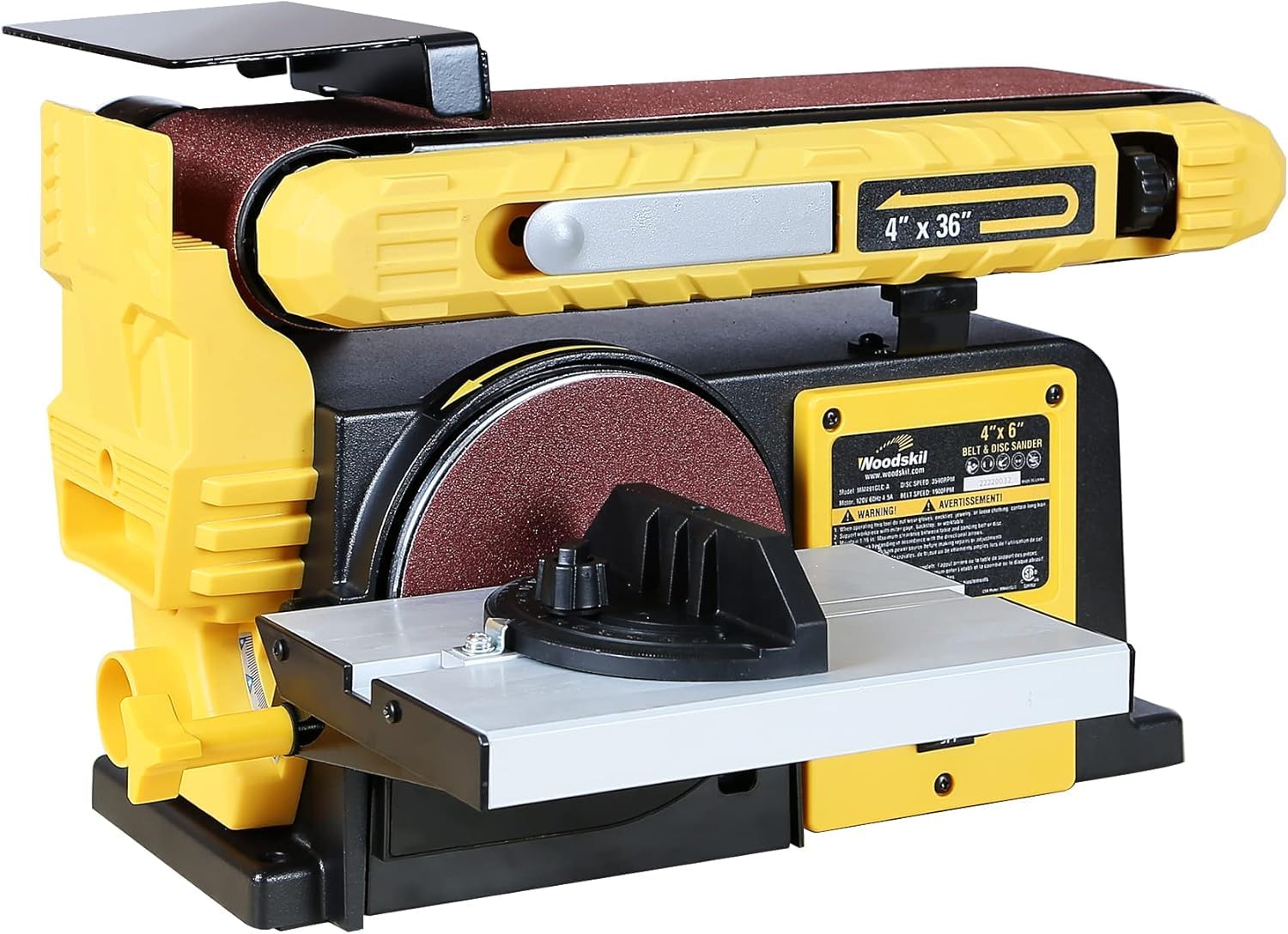
The Woodskil Upgraded Model brings a 4.5-amp, 3/4HP motor to the budget category, delivering 3590 RPM disc speed and 1900 FPM belt speed that competes with mid-range units on raw power. The direct-drive layout simplifies the internal mechanism, and the 18-kilogram weight adds stability during operation. The belt tilts from 0 to 90 degrees, and the work table with miter gauge angles to 45 degrees for bevel grinding.
Belt replacement is straightforward: loosen the screw on the dust exhaust, pull the tension lever, swap the belt, and adjust tracking with the knob. The upgraded appearance design is a minor aesthetic touch, but the real value is the power-to-price ratio. Owners report it handles continuous use for insoles, woodworking, and light metal shaping without overheating or stalling.
The dust collection is mediocre — the ports lack the suction to keep up with heavy sanding, especially in belt mode. Some users note the belt is slightly harder to replace than on Skil or Wen equivalents due to the tension mechanism design. The motor feels adequate for moderate workloads but bogs down if too much pressure is applied, so letting the abrasive do the work is essential for consistent results.
Why it’s great
- Strong 4.5A motor for the price point
- Simple belt tracking and replacement system
- Heavy build improves stability during use
Good to know
- Dust collection performance is below average
- Belt replacement takes more effort than premium models
9. Woodskil 4.3A

The Woodskil 4.3A is the entry point for this comparison, offering a 3/4HP motor that delivers 3570 RPM and 1732 FPM for basic sanding tasks. What sets it apart from other budget units is the double dust exhaust port design — one port dedicated to the belt and one for the disc — which improves dust control significantly compared to single-port competitors. The steel base provides a solid foundation, and the included two pieces of sandpaper get you started immediately.
The belt adjusts from 0 to 90 degrees for vertical or horizontal positioning, and the work table tilts 0 to 45 degrees with a miter gauge for angled cuts. The multi-wedge belt drive mechanism extends belt life, and the transparent PC guard lets you inspect belt condition without stopping the machine. Owners consistently rate this unit highly for home DIY projects involving wood, metal, and plastic.
Motor power is adequate for light work but becomes noticeable under sustained pressure on hardwood — the 4.3-amp rating is at the lower end of the spectrum. The belt tracking adjustment is less precise than on premium models, occasionally requiring re-tuning during a session. Some users note the miter gauge feels flimsy compared to the rest of the unit, though it functions adequately for basic crosscuts.
Why it’s great
- Dual dust exhaust ports for better cleanliness
- Steel base and adjustable belt angle
- Comes with sandpaper and 2-year warranty
Good to know
- Motor bogs down under heavy pressure on hardwood
- Belt tracking needs occasional re-adjustment
FAQ
What is the best grit for a bench sander on hardwood?
Can a bench sander replace a handheld belt sander?
Why does my bench sander belt keep drifting off center?
Final Thoughts: The Verdict
For most users, the best bench sander winner is the Skil BB9504-00 because it delivers the strongest balance of 4.5-amp power, build quality, and tool-free belt changes at a price that fits both serious hobbyists and light commercial use. If you need heavy-duty metalworking performance, grab the Bucktool Pro BD4801-M for its 1HP motor and 8-inch disc. And for knife making or variable-speed control, nothing beats the Rikon 50-161VS.