
Our readers keep the lights on and my morning glass full of iced black tea. As an Amazon Associate, I earn from qualifying purchases.
Specs are compiled from manufacturer listings and verified buyer reviews and can change over time — please confirm the key details on the product page before buying.
Getting a factory-sharp crease in a metal sheet without a messy, rounded edge is tough. You need a brake that clamps flat, bends straight, and holds rigid across its whole width — or you waste material. This guide matches eight bending brake machines to real workshop needs, from portable job-site models to heavy benchtop units, so you know exactly which one is worth bolting down.
I’m Min — the founder and writer behind Gadgets Feed. This guide is built by comparing the manufacturers’ published specifications and the patterns across verified customer reviews, so you get each pick’s real strengths and trade-offs instead of marketing spin.
A good brake machine bends steel and aluminum up to its rated gauge (thickness) without the frame bowing. This roundup of the best bending brake machine options stacks capacity, build quality, and real buyer feedback side by side.
Our Picks at a Glance

How To Choose The Best Bending Brake Machine
Buying a brake means matching the machine’s capacity — width, thickness, and angle — to the metal you actually work with. A 48-inch brake for 6-inch gutter pieces wastes bench space, while a 12-inch brake is too short for roofing panels. Focus on three things: the gauge (a number where a lower number means thicker metal) of steel you bend most often, the maximum width you need, and if you need removable fingers for box shapes.
Capacity — Gauge and Width
The gauge rating tells you the thickest material the brake can crease without the frame bowing (bending in the middle). A 20-gauge mild steel rating at full width is very different from bending a narrow 2-inch strip of 18-gauge steel. Check both the width and thickness together. Most mid-range brakes handle 20-gauge steel across 24 to 48 inches, while compact press-style brakes can bend quarter-inch aluminum in a 4-inch opening.
Box and Pan vs. Standard Brake
A box-and-pan brake (sometimes called a finger brake) has a segmented clamping leaf — the top bar that holds the metal — that you can remove piece by piece. This lets you form boxes, pans, and trays with three or four sides, which a solid-apron brake (one solid clamping bar) cannot do. If you build ductwork, enclosures, or corner pieces, the removable fingers are worth the extra cost. A standard brake is fine for straight-line bends like flashing, siding, and simple brackets.
Portability vs. Stability
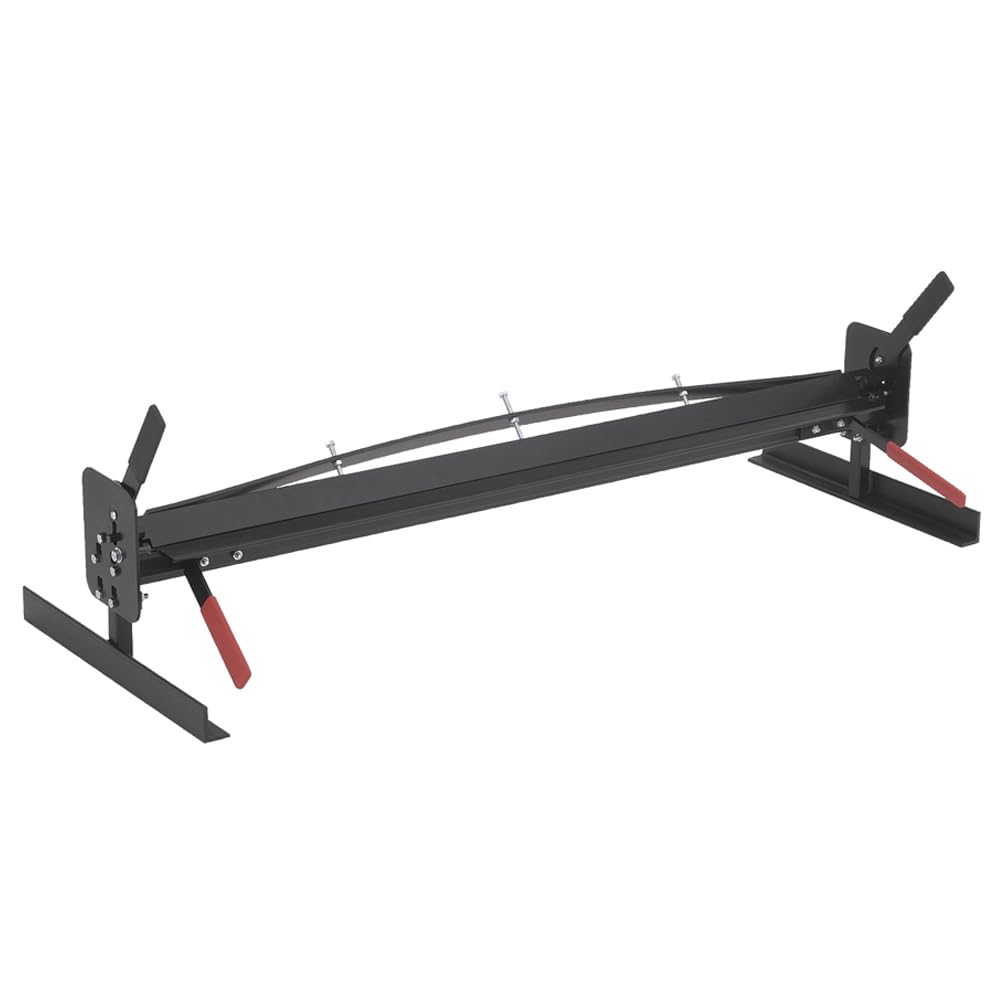
A 60-pound brake is portable enough to load into a van for job-site work but may need bolting or clamping to stay rigid under a long bend. A 300-pound industrial brake like the Van Mark sits in one spot and delivers consistent creases across its full width every time. Your decision depends on whether the brake travels or lives on a dedicated bench.
Quick Comparison
| Model | Best For | Width | Max Bend Angle | Material Capacity | Amazon |
|---|---|---|---|---|---|
| Malco MB48A★ Best Overall | Portable job-site work | 48 in | 135° | 22 ga steel | Amazon |
| KAKA FB-4Shop Press King | Thick steel bends | 4 in | 90° | 3/16″ steel / 3/8″ aluminum | Amazon |
| VEVOR 48-InchValue Box & Pan | Budget box-and-pan | 48 in | 130° | 20 ga steel / 14 ga aluminum | Amazon |
| KASTFORCE KF5002 | HVAC and ductwork | 28 in | 135° | 18 ga steel / 16 ga aluminum | Amazon |
| KASTFORCE KF5006 | Box and pan work | 24 in | 135° | 20 ga steel | Amazon |
| KAKA W-2418 | Versatile mid-size | 24 in | 135° | 18 ga steel | Amazon |
| Eastwood 12 in | Precision small parts | 12 in | 135° | 20 ga steel / 16 ga aluminum | Amazon |
| Van Mark TM10 | Pro contracting / high volume | 10 ft | — | — | Amazon |
In‑Depth Reviews
1. Malco MB48A Portable Mini Brake
Our pick — over 4★ from 250+ verified ratings; the strongest balance of quality and price.
You get crisp, sharp folds on site without a dedicated bench — the Malco MB48A bends 22-gauge steel (thin flashing metal) into 1/8-inch folds, all from a 58-pound portable package.
You get a full 48-inch bending width in a portable 58-pound package that fits in a service van. The 135-degree max bending angle beats the 90-degree limit you find on many compact brakes — at 135 degrees versus 90 degrees so you can make flashing, drip edges, and trim on site. Buyers report it “bends 24-gauge steel and makes 1/8″ bends, unlike cheaper brakes limited to 3/4″ and 90°,” which means you can put tight hems in standing-seam metalwork without a second tool.
The Malco is also made in the United States, with a limited warranty and customer service that reviewer feedback mentions as responsive. At 58 pounds, it is noticeably lighter than the VEVOR box-and-pan brake (61.7 pounds), but its solid-apron design (one-piece clamping bar) means you cannot form box shapes — it is strictly a straight-line brake for roofers and siding contractors.
What Makes It a Pro Tool
- 135° max bending angle gives you acute folds and return flanges
- Compact enough to carry on the truck (58 x 8.1 x 8.3 inches)
- Made in USA with strong manufacturer support
Where It Limits You
- Solid apron (a one-piece clamping bar) cannot form box pans or trays
- At 58 pounds, still heavy enough to need a secure mount in the van
Reach for this if: you bend flashing and gutter metal on jobsites and need a portable brake that makes very tight (1/8″) folds.
Look elsewhere for: box-and-pan work — the fixed apron means no removable fingers for enclosures or duct transitions.
2. KAKA INDUSTRIAL FB-4 Manual Steel Bending Brake
The small press that bends thick steel — 3/16-inch steel and 3/8-inch aluminum — where wide brakes cannot go.
While a typical 48-inch brake struggles with anything over 14-gauge, the FB-4 is a different breed — a 2.5-ton press-style bender (it uses a punch-and-die action to crease metal) limited to a 4-inch width but capable of 3/16-inch steel and 3/8-inch aluminum. One reviewer noted the Brake “bent 3/8 inch steel and quarter inch aluminum without problems,” which is well beyond what any 18-gauge-rated wide brake can touch. At 19 pounds and just 16 x 6 x 7 inches, this machine is lighter than the VEVOR 48-inch brake (61.7 pounds) and fits in a tool drawer.
The trade-off is that the KAKA locks you into 90-degree bends only, compared to the 135-degree range on the Malco or KASTFORCE models. It is a dedicated corner bender for brackets, motor mounts, and ornamental iron, not a versatile angle changer. A reviewer flagged that “cannot make multiple bends very close to each other,” so plan your bend sequence before clamping.
Raw Bending Power
- 2.5-ton pressing force handles 3/8″ aluminum and 3/16″ mild steel
- Bench-top mountable and very compact (only 19 lbs)
- Durable steel frame that owners expect to last for years
Angle Limitation
- Fixed 90-degree bend only — no acute or obtuse angles
- Narrow 4-inch width limits you to small parts
The right tool for: fabbing steel brackets, car project motor mounts, and thick aluminum parts in a compact space.
Not for: roof flashing, wide panels, or any bend needing more than a 90-degree crease.
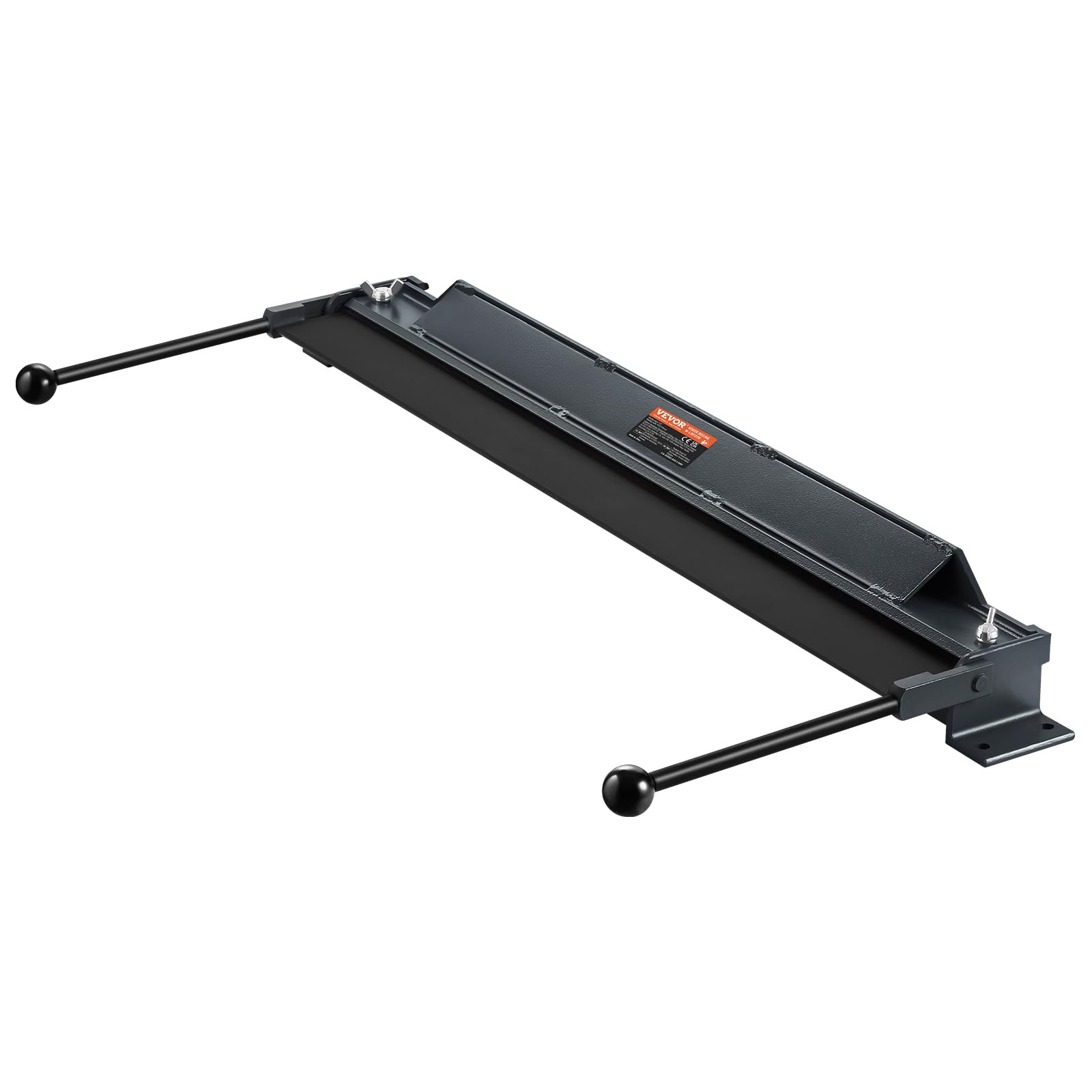
3. VEVOR 48-Inch Box and Pan Brake
A wide, budget-friendly finger brake that bends 20-gauge steel across four feet — but you will likely need to replace the wing-nut clamps for reliable use.
The VEVOR gives you a box-and-pan design at a price point where you normally only get a solid-apron brake. That means you can remove the segmented fingers (the individual clamping pieces) to form trays and enclosures with up to 1.5-inch box depth (the height of the box sides). At 54.7 x 17.7 x 6.1 inches, its footprint is larger than the KAKA FB-4 (16 x 6 x 7 inches), but the capacity is still limited to 20-gauge low carbon steel and 14-gauge aluminum. One buyer summed it up: “Heavy metal bender, good value at.”
Owners mention two common pain points: the included wing nuts are slow to tighten and can slip under load, and the center clamping bar (the bar that holds the metal flat) may need an extra clamp for thin 24-gauge sheet steel. Owners suggest swapping the hardware for hex bolts and T-handle wrenches. Upgraded with a 0.31-inch thick blade and reinforced rib design, the frame is rigid enough to deliver clean edges on aluminum and steel, as multiple buyers confirm.
Why It Stands Out
- Box-and-pan fingers let you make enclosures and brake-formed boxes
- Wide 48-inch capacity for full-length flashing and panels
- Reinforced Q235 steel frame resists bowing at this price level
What Needs Upgrading
- Wing nut clamps are slow and require pliers or replacement
- Not suited for daily production use — thumbscrews (the tightening knobs) wear quickly
Pick this if: you need a wide, low-cost brake for occasional box work and are comfortable making minor hardware upgrades.
Avoid if: you bend metal daily — the clamping system is too slow for production pace.
4. KASTFORCE KF5002 Steel Bending Brake (28 Inch)

The 28-inch mid-size handles 18-gauge steel (the thickness used for furnace ducts and structural brackets) with a 135-degree range — ideal for ductwork bends.
If you are making duct transitions, filter racks, or shutters, the KF5002 hits the balance: 28 inches is wide enough for residential HVAC panels but short enough to keep the frame rigid. With a 1.2mm (18-gauge) mild steel capacity and 1.5mm (16-gauge) aluminum rating, it is one step thicker than the entry-level VEVOR and the KF5006. Buyers confirm it: “Only tested on.063 (1/16) aluminum and handled with ease.” The adjustable angle from 0 to 135 degrees means you can set acute folds for return flanges, not just standard 90-degree corners.
The 44-pound weight places it between the lighter KAKA hand press and the heavy 60+ pound box-and-pan brakes, making it reasonably portable for a 28-inch machine. Some units arrive with minor cosmetic damage or improperly threaded handles, but buyers who work through the setup find the steel frame and extra support on the angle iron produce consistent, non-slip bends that look professional.
Great Bend Angles
- 0–135° adjustable range for acute and obtuse folds
- Heavier 18-gauge steel capacity than most budget brakes
- Extra angle-iron support (a steel bracket) prevents flex and material slip
Minor Inconveniences
- Some units arrive with broken knobs or thread issues
- Lift spring could be stronger, per owner feedback
Best for: HVAC professionals and DIYers who need a solid 28-inch brake for ductwork and mid-gauge steel.
skip it if: you need more than 28 inches of width or prefer a zero-modification experience right out of the crate.
5. KASTFORCE KF5006 Box and Pan Brake (24 Inch)

A dedicated box-forming brake with five removable fingers (individual clamping segments) and a 1.5-inch max box depth for small enclosures — perfect for electrical boxes and vent covers.
The KF5006 is essentially a smaller sibling of the VEVOR box-and-pan brake, but with a narrower 24-inch width and a much better finish from the start. The five fingers come off individually, letting you form boxes up to 1.5 inches deep without the solid apron blocking you. This matters if you make electrical junction boxes, vent covers, or small fabricated pans where three bends on one piece are routine. A buyer who used it for stainless steel screen vents said “I had no problem making all the bends and they look professional.”
At 68.1 pounds, the KF5006 is actually heavier than the 24-inch KAKA W-2418 (57 pounds) because the cast-iron-style finger assembly adds weight. The 0–135 degree range matches the KF5002, so acute folds are possible, but capacity is limited to 20-gauge mild steel (1.0mm) — noticeably thinner than the 18-gauge rated KF5002. That means it works best on thinner brake metal and small fabrication rather than structural brackets.
Box-Building Advantage
- Five removable fingers let you form three-sided boxes and pans
- Arrives in good condition with minimal adjustments needed
- Handles thin stainless steel screens and decorative metal well
Capacity Ceiling
- Limited to 20-gauge mild steel — no thick material bends
- Heavier than some 24-inch solid-apron brakes (68.1 lbs)
Reach for it when: you need to form shallow boxes and pans from thin sheet metal and want removable fingers without paying premium prices.
Pass on it if: your primary work is heavy 18-gauge or thicker steel — the KF5002 handles that better.
6. KAKA INDUSTRIAL W-2418 Sheet Metal Brake (24 Inch)
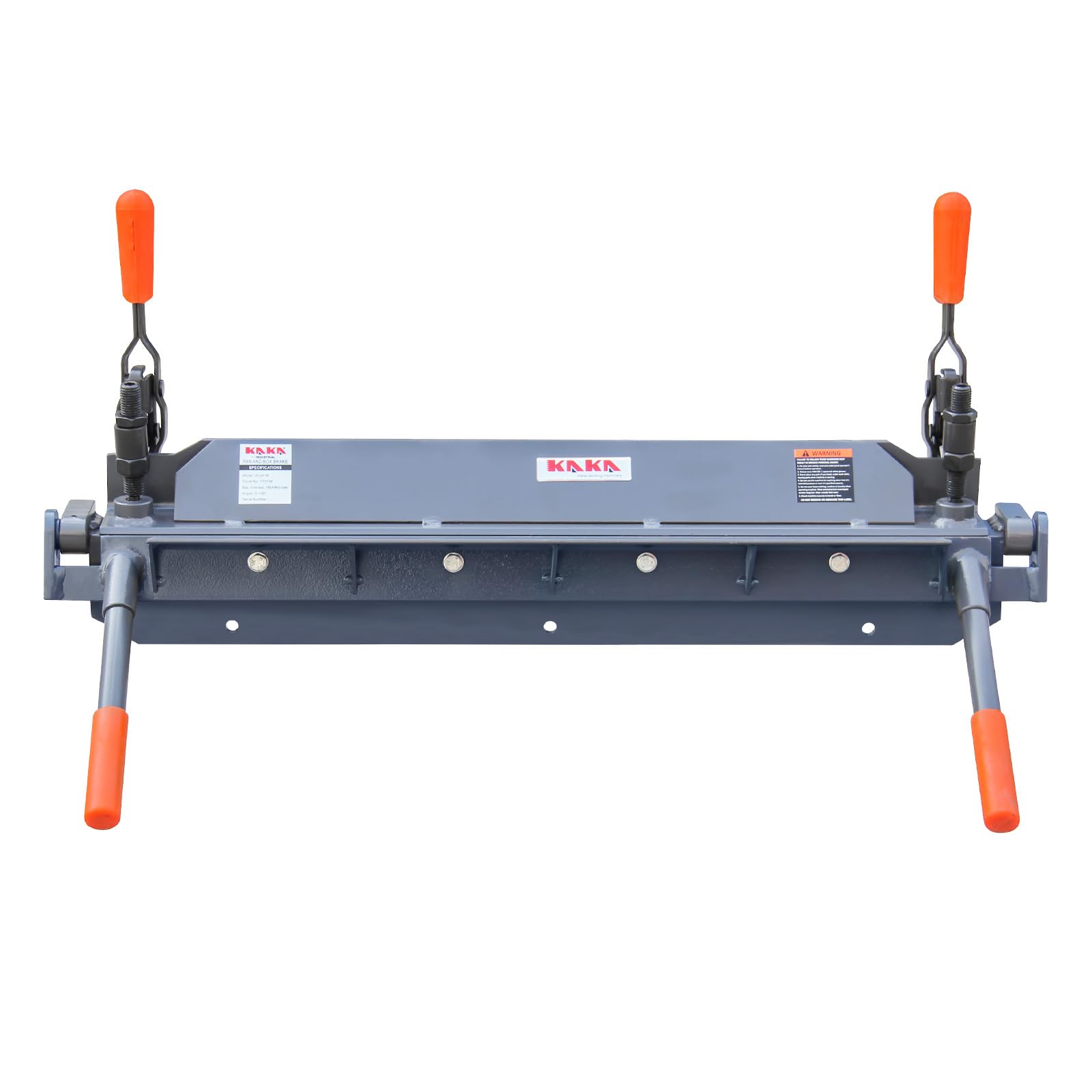
An 18-gauge, 24-inch solid-apron brake with adjustable angles — but customers note frame flex that makes sharp creases hard to get.
The W-2418 offers the same 24-inch width as the KASTFORCE KF5006 but in a solid-apron design, so it handles straight bends only — no box forming. The 0–135 degree adjustable clamping plate (the part that holds the metal) gives you flexibility for acute folds, unlike the fixed 90-degree KAKA FB-4 press. With 18-gauge mild steel capacity, it is on paper stronger than the 20-gauge KF5006. The included body weighs 57 pounds and features ergonomic 8-inch handles and a cam clamp (a lever-style clamp) for quick material locking.
However, reviewer feedback reveals a significant problem: the frame flexes under load, producing rounded bends instead of sharp creases on thin sheet metal even. One buyer described it as “worse than bending in a vise.” Multiple owners had to add reinforcement at stress points or weld the handles permanently because set screws (the screws that hold a part in place) failed. The KAKA W-2418 works for light-duty hobby projects but is not reliable for precision fabrication without modification, contrasting sharply with the Eastwood or higher-end brakes.
Decent Core Specs
- 18-gauge steel capacity across 24 inches
- Adjustable 0–135° for varied bend angles
- Cam clamp design helps with quick material locking
Flex Problems
- Frame bows during bending, causing rounded creases
- Requires modifications (welding, extra bracing) for acceptable results
OK for: light DIY siding or hobby work where a perfectly sharp 90-degree crease is not critical.
Not for: anyone needing crisp, repeatable bends for professional fabrication — the flex is a dealbreaker.
7. Eastwood 12 Inch Box and Pan Sheet Metal Brake
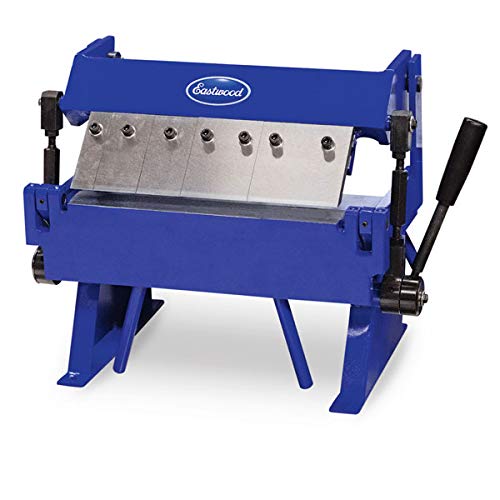
A pro-quality finger brake that fits on a small bench and bends 20-gauge steel with zero flex — it weighs 66 pounds in a 12-inch package.
Eastwood’s 12-inch box-and-pan brake is the most rigid compact brake in this list, with a 5.0-star rating and a frame that owners describe as “nice solid bender.” Despite its small 16.5 x 10.75 x 14.25 inch footprint, it weighs 66 pounds — about the same as the 48-inch VEVOR — meaning the steel is thicker and the structure does not wobble. It handles 20-gauge mild steel across the full 12 inches, and one buyer mentioned it bends 18-gauge in narrower 2-4 inch strips without issue.
The five adjustable fingers let you form boxes and pans with up to 135-degree bends, matching the KASTFORCE models but in a much stronger chassis. The caveat is the price — this is a premium piece of equipment for a modest 12-inch width, so you pay for precision rather than capacity. Eastwood backs it with a 1-year limited warranty and lifetime tech support, which is better than the no-frills support on most imports in this category.
Build Quality
- Very rigid steel frame — 66 lbs for a 12-inch brake
- Box-and-pan fingers for forming enclosures and brackets
- Backed by Eastwood’s support and 1-year warranty
Limited Width
- Only 12 inches wide — too narrow for full roofing panels
- Price is high compared to the 24-inch KASTFORCE models
Choose this for: precision small-parts work in a home shop where build quality matters more than maximum width.
pass on it if: you need to bend material wider than 12 inches — the VEVOR (48 inches) or KF5002 (28 inches) gives you more width than the Eastwood’s 12 inches.
8. Van Mark Mark II Trimmaster TM10 Bending Brake

A 10-foot industrial brake that weighs 312 pounds and does not flex — for contractors who bend long siding and fascia all day.
At 10 feet of bending width and 312 pounds, the Van Mark TM10 is not a garage toy — it is a contractor-grade machine designed for continuous high-volume trims, soffits, fascia, and siding. The Power Lock mechanism (a lever system) lets you secure long sheets quickly without fighting wing nuts or cam clamps, and the 312-pound mass means zero frame flex even at full width. One buyer who bought it three times said it is “very efficient,” and another noted it was “well worth the money” for the growing number of jobs they ran through it.
The TM10 is a solid-apron brake, so box forming and short tight bends are not its strengths. It is purpose-built for straight-line architectural metalwork: long, clean creases in thin-gauge aluminum and steel coil stock. At this price tier, you are paying for production speed, durability across thousands of cycles, and a frame that stays square for years. It is firmly in the professional contractor category, not the small-shop or DIY space.
class-leading Capacity
- 10-foot bending width handles full siding and fascia lengths
- Massive 312-pound steel frame eliminates flex completely
- Power Lock speeds up production clamping compared to manual brakes
Not for Small Shops
- Requires permanent installation space and a lot of it
- No box-and-pan fingers — straight bends only
For pro contractors only: if you bend flashing, trim, and siding coils daily and need zero downtime, the TM10 earns its cost.
Not for: the home shop, the budget buyer, or anyone who needs box-forming capability.
Understanding the Specs
Gauge & Thickness Rating
Gauge numbers are counterintuitive — the lower the number, the thicker the steel. A 22-gauge brake handles thin flashing, while 18-gauge handles structural brackets and heavier sheet. Always check the width at which the gauge is rated: a brake that bends 20-gauge across 24 inches may not bend the same material across its full 48-inch capacity without flex (the frame bending in the middle).
Bend Angle & Box Depth
Most brakes are rated 0–135 degrees, letting you make acute folds (less than 90°) for return flanges or wider obtuse angles. Box depth matters only on finger brakes — it tells you how tall the sides of a tray or pan can be before the fingers hit the back frame. A 1.5-inch max box depth is fine for small electrical enclosures but too shallow for deep duct transitions.
FAQ
What size bending brake machine do I need for residential roof flashing?
Can a box and pan brake bend the same thickness as a solid-apron brake?
Why does my brake produce rounded bends instead of sharp creases?
How do I mount a portable bending brake to my workbench?
Will a 22-gauge brake bend 18-gauge steel if I use a narrower strip?
What is the difference between a press brake and a box and pan brake?
Can I bend stainless steel with a manual bending brake?
How often should I lubricate a sheet metal brake?
Final Thoughts: The Verdict
If you want one dependable pick, the best bending brake machine overall is the Malco MB48A because it combines a portable 48-inch width with 135-degree bends and a proven track record among professional roofers and siding contractors. If you need a compact press for thick steel brackets and motor mounts, grab the KAKA FB-4. And for the precision small-shop fabricator who wants zero flex and box-forming capability, the Eastwood 12-inch brake is worth every pound of its 66-lb frame.
How We Picked
We do not accept paid placement. Every pick is matched to a real buyer and a real use-case; we do not hands-on test units.
Sources & Methodology
Specifications: manufacturer listings and product documentation. Review insights: verified customer reviews, as of July 2026. Pricing: not shown on this page (it changes often); check the current price via the retailer link.
As an Amazon Associate, Gadgets Feed earns from qualifying purchases. This does not affect which products we feature.