
Our readers keep the lights on and my morning glass full of iced black tea. As an Amazon Associate, I earn from qualifying purchases.
Specs are compiled from manufacturer listings and verified buyer reviews and can change over time — please confirm the key details on the product page before buying.
Most bermuda seed bags fail you at germination (whether the seed actually sprouts), and that is the real bet on a Florida lawn. The short answer: the Outsidepride Oasis 5 lb bag is the safest pick for a sunny, high-traffic yard, and the Pennington 5 lb bag is the forgiving choice if you want the widest spread of cold-tolerant varieties working in your favor. Everything below is sorted by what actually matters in Florida heat, humidity and sandy soil.
I’m Min — the founder and writer behind Gadgets Feed. This guide is built by comparing the manufacturers’ published specifications and the patterns across verified customer reviews, so you get each pick’s real strengths and trade-offs instead of marketing spin.
The trick to a Florida lawn is matching a bermuda’s seed coating and spread rate to your sandy soil before you open the bag. Read on for a clear shortlist of the best bermuda grass seed for florida lawns, ranked by how they actually behave in sun and sand.
Quick Picks
- Outsidepride Oasis Bermuda Grass Seed – 5 lbs — Best Overall
- Outsidepride Maya (Blackjack II) Bermuda Grass — Top Performer
- PanAm Bermudagrass Lawn Seed Blend – 25 lb — Big-Area Pick
- Pennington Bermudagrass Southern Grass Seeds — Cold-Tolerant Pick
- Hancock Seed Co. Common Bermuda Grass Seed — Pasture Pick
- X-Seed Moisture Boost Plus Bermuda Grass Seed — Budget Starter
How To Choose The Best Bermuda Grass Seed For Florida
A Florida lawn is a harsh test for any seed. You get intense sun, weeks of humidity, and soil that is often sandy and drains fast — so the seed has to germinate quickly before the top inch dries out. That fast-drying top inch drives most of what follows.
Match the coating to how you water
A coated seed (one wrapped in a moisture-holding jacket) buys you slack on watering. The X-Seed bag uses a Moisture Boost Plus coating, which is built to hold water around the seed while it sprouts. If you can water twice a day for the first couple of weeks, an unhulled seed like the Hancock bag works too — it just asks more of your hose and your schedule.
Read the coverage number twice
Bags quote two rates: a heavier one for bare ground and a lighter one for overseeding an existing lawn. The X-Seed bag covers 1,000 sq. ft. for a new lawn and up to 2,000 sq. ft. for overseeding. Buy to the new-lawn number if you are starting from dirt, or you will run short halfway across the yard.
Time it to soil temperature, not the calendar
Bermuda will not budge in cold dirt. Hancock states 65°F or higher at planting, and Outsidepride’s Oasis asks for soil above 65°F too. In Florida that usually means spring into early summer, when the ground has warmed and there is still growing time before any cold snap.
Expect dormancy, not death
Pennington notes its bermuda goes dormant and turns brown out of season in winter months. That is normal dormancy for a warm-season grass, not a lost lawn.
Quick Comparison
| Model | Best For | Bag Weight | Coverage | Seed Treatment | Amazon |
|---|---|---|---|---|---|
| Outsidepride Oasis Bermuda Grass Seed | High-traffic sunny lawns | 5 pounds | 2–3 lb per 1,000 sq. ft. | Hybrid blend of three bermudas | Amazon |
| Outsidepride Maya (Blackjack II) Bermuda Grass Seed | Fine-textured show lawn | 5 pounds | — | Coated seed | Amazon |
| PanAm Bermudagrass Lawn Seed Blend | Large properties and fairways | 25 pounds | — | Yellow Jacket coating | Amazon |
| Pennington Bermudagrass Southern Grass Seeds | Cold-tolerant spreading lawn | 5 pounds | — | Improved cold-tolerant varieties | Amazon |
| Hancock Seed Co. Common Bermuda Grass Seed | Pasture and erosion control | 5 pounds | — | Coated and unhulled | Amazon |
| X-Seed Moisture Boost Plus Bermuda Grass Seed | Budget-friendly sandy-soil lawns | 3 pounds | 1,000 sq. ft. new / 2,000 overseed | Moisture Boost Plus coating | Amazon |
In‑Depth Reviews
1. Outsidepride Oasis Bermuda Grass Seed – 5 lbs

Three bermudas in one bag, engineered to crowd out weeds before they get a foothold.
If your Florida yard takes a beating — kids, a dog, a mower that turns hard in July — this is the bag to start with. Oasis is not a single grass but a blend of three top-performing bermuda varieties, so the lawn carries several sets of survival traits instead of one. The pitch is aggressive spreading: the grass fills in fast and crowds out weeds, which is what cuts your herbicide habit down.
The numbers that matter here are the spread rate and the planting depth. Outsidepride specifies 2-3 pounds per 1,000 square feet, and seed covered no deeper than 1/4 inch — deeper than that and a fine seed simply runs out of energy before it reaches light. Keep the surface moist for 1-2 weeks or until established. That is the honest workload of this bag: daily attention early, then it stands on its own drought and heat resistance.
Where it gets shaky is consistency. Germination is the loudest theme in the feedback on this bag, and it splits both ways — some lawns come up thick, some come up patchy. The blend is GMO free and rated for little to no watering once mature, which suits a Florida yard you cannot babysit forever. Just do not expect a uniform carpet from a single pass; plan to touch up thin spots. For the coverage math, note this 5-pounder holds more ground than the 3-pound X-Seed bag, which is a meaningfully bigger fill for a full lawn.
Where Oasis Pulls Ahead
- Three-variety blend gives the lawn more than one way to survive heat and dry spells
- Fast, aggressive spread that crowds weeds out and lowers herbicide needs
- Clear spread rate of 2-3 lb per 1,000 sq. ft. and a 1/4-inch depth limit to follow
- GMO free and rated for little to no watering once it is up
The Patchy Truth
- Germination is uneven — some areas fill in, others stay bare and need reseeding
- Demands moist surface for 1-2 weeks, so a dry spring hurts your odds
- Fine-textured turf is less forgiving of a rushed, uneven spread
Right call for: a sunny, high-use lawn where weed suppression and heat survival matter more than a flawless first month.
Think twice if: you want one even carpet from one pass — budget time to overseed the thin patches.
2. Outsidepride Maya (Blackjack II) Bermuda Grass Seed – 5 lbs

The show-lawn bermuda, built for a tight carpet rather than a quick patch job.
Maya, also sold as Blackjack II, is aimed at the homeowner who wants the lawn to look cut-and-rolled. It grows fine-textured, carpet-like dark green turf, the kind the maker pitches for golf courses, parks and sports fields as well as home yards. If curb appeal is the goal and you are willing to mow low, this is the pick on the list tuned for texture.
Mowing height is the number to lock in: 0.5 to 2 inches. That low cut is what produces the dense, fine-bladed look, and it is also the maintenance promise you are signing up for. The seed is coated to spread easily and hold moisture, which helps germination rates and makes an even pass with a spreader more achievable. It is listed as GMO free and rated for little to no watering, and it is built for southern lawns including Florida, Texas and California.
Here is the catch, and it is a real one: germination on this bag is the most-discussed topic in the feedback, and it swings hard — lush results for some lawns, nothing at all for others. Value is the second-most raised concern, which tells you buyers who get a thin stand feel the sting. The upside is real, though: this is the finer-textured, more polished look on the shortlist. Compared with the Oasis blend, Maya leans on texture and appearance while Oasis leans on weed-crowding aggression.
Texture is the draw: fine-bladed, dark green, carpet-like turf is exactly what a low mow at 0.5 to 2 inches delivers — this is the aesthetic pick of the group.
Plan for a gamble: germination results split sharply between lawns, so buy enough to overseed bare spots and treat the first pass as a start, not a finish.
Pick it when: you mow low and want a tight, dark, fine-bladed lawn more than a bulletproof one.
Pass if: you need near-certain germination from a single bag and cannot afford a second round.
3. PanAm Bermudagrass Lawn Seed Blend – 25 lb
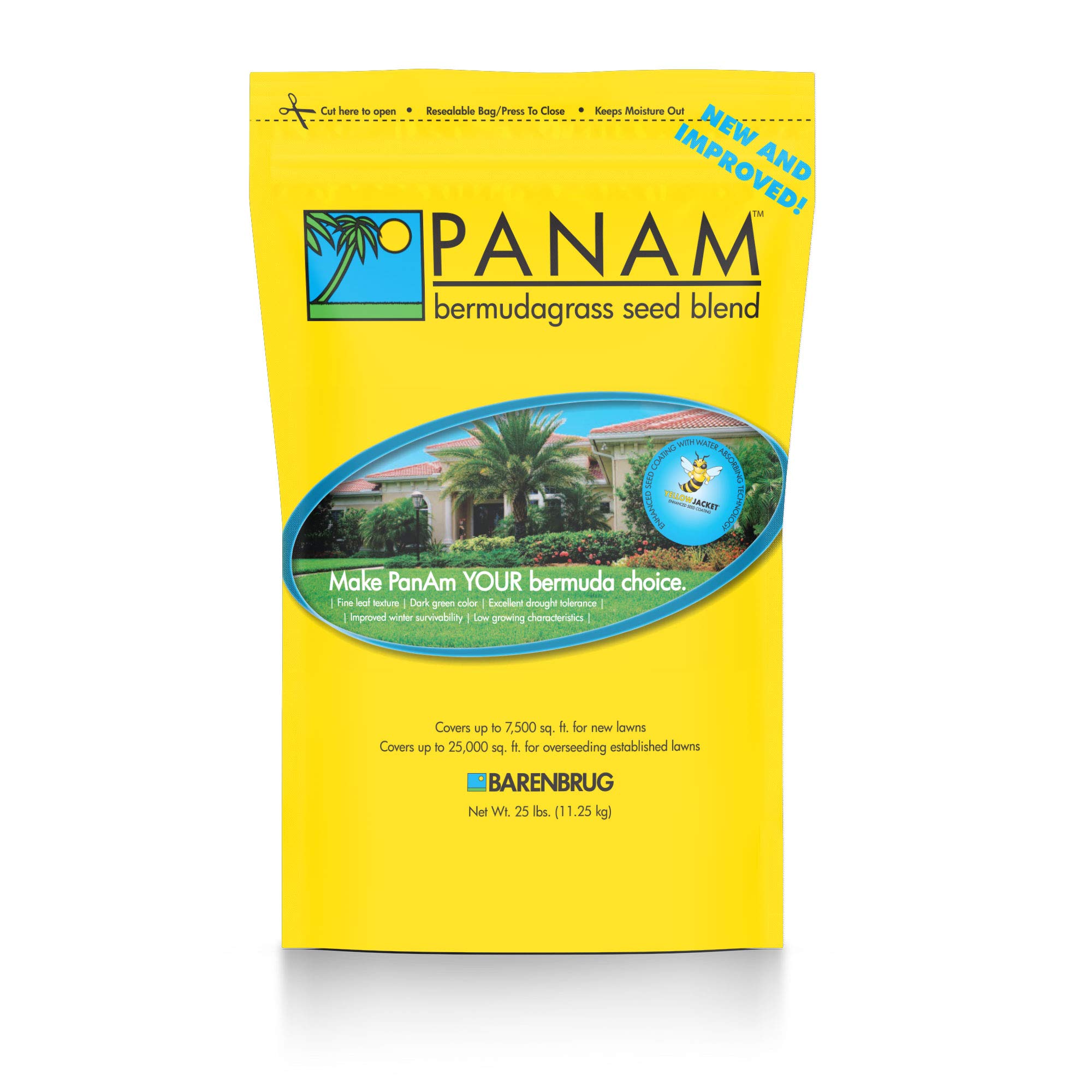
A 25-pound bag for the yard where a 5-pounder would not even get you started.
PanAm wins on size: at 25 pounds it is five times the bag of most picks here, so it is the one to reach for on a large property, a long driveway border, or a fairway-scale project. It works equally well for upgrading an existing common bermuda or building a new low-maintenance turf area, and it is aimed at a medium-dark green look with a sturdy, filled-out appearance.
The coating is the technical hook. Yellow Jacket is a seed coating the maker says delivers a “SuperCharged” germination for rapid establishment, and it also improves handling while you seed. The blend is pitched for excellent tolerance to heat, drought and even frost, and for standing up to heavy foot traffic with quick recovery. It also greens up earlier in the spring, which is the difference between a bare yard in March and a lawn you can actually enjoy.
The honest caveat is thin evidence: this bag has the smallest feedback base of the group, so you are buying largely on the maker’s stated tolerances rather than a wide field of owner results. If you are planting a large area and need a coating built for even spreading, the case holds up. If you want a heavily proven bag for a small yard, one of the 5-pounders makes more sense — you would be buying far more seed than you need here.
Made for: large lawns, pastures or commercial turf where 25 pounds of coated seed is the right scale.
Not for: a small suburban yard, where the bag size outruns your project.
4. Pennington Bermudagrass Southern Grass Seeds – 5 lb

Improved cold-tolerant varieties in a blend that spreads hard and clips less.
North Florida gets the odd cold snap that a pure tropical bermuda hates, and this bag is built with that in mind. Pennington’s blend packs improved cold-tolerant varieties, which gives the lawn a better shot through a chilly winter than a single heat-only strain. The grass spreads aggressively on its own once it takes hold, so a thin first season can still fill out.
Two spec lines matter for daily life. The seed is formulated to be low-growing and to produce fewer grass clippings, which means less bagging and fewer trips to the curb. It also grows a deep root system that makes it extremely wear-resistant turf — the right trait for a family lawn with a dog path worn into it. Expect an expected plant height of about 3 inches, and plan for summer planting.
What owners consistently describe is faster than average: germination within 7 to 10 days and vibrant color, with dry locations getting a specific nod. Appearance and soil suitability are the two things people praise most. Where it wobbles is consistency — germination and overall quality draw mixed reports, and a slice of buyers end the season disappointed. Be honest with yourself about watering during that first week and the odds swing in your favor. One more thing worth knowing: warm-season bermuda goes dormant and brown in winter months, so plan for a seasonal look rather than year-round green.
What Makes It Easy To Live With
- Improved cold-tolerant varieties suit North Florida winters better than a heat-only bermuda
- Low-growing blend produces fewer clippings and less bagging
- Deep root system gives it strong wear resistance under foot traffic
- Germination commonly reported in 7 to 10 days with vibrant color
What To Expect Going In
- Germination and quality reviews are mixed — results vary lawn to lawn
- Turns brown and dormant through the winter months
- Needs steady moisture while it establishes, so a dry stretch costs you
Best match: a family lawn in North or Central Florida that needs cold tolerance and less clippings.
Look elsewhere if: you want a single-season fill and cannot water consistently for the first week.
5. Hancock Seed Co. Common Bermuda Grass Seed – 5 lb

Common bermuda built for ground cover, grazing and holding a slope in place.
This bag is not chasing a perfect front lawn — it is chasing coverage that survives. Hancock’s common bermuda is aimed at pastures, livestock grazing areas, cattle forage and erosion control as much as home lawns. Once it is established it takes heavy foot and livestock traffic and recovers well, and it adapts to a wide range of soils including lower-fertility ground. For a Florida property with a rough back acre, that is the useful promise.
Planting discipline is spelled out plainly: put it down in spring or summer when soil sits at 65°F or higher, with enough growing time left before the first frost. Keep the soil damp through germination and establishment, then switch to deep, infrequent watering to push roots down. The seed is coated and unhulled, rated for full sun at 6-8+ hours of direct light daily. Drought tolerance once mature is the headline — after establishment it asks for low to moderate water.
Set your expectations honestly, because the feedback here is the roughest on the list: poor germination is the recurring theme, and some plantings show no growth at all. That does not make it a bad bag — it makes it a specific one. This is the right buy for pasture, slope stabilization or a rough area where you will water and wait, and the wrong buy if you expect a manicured front lawn from a casual scattering. Match it to ground cover and it does its job.
Built for rough ground: erosion control, grazing and lower-fertility soil are where this common bermuda earns its keep, with 6-8+ hours of full sun and low water once mature.
Germination is the risk: results are the least consistent of this group, so treat it as a pasture and slope tool rather than a show-lawn seed.
Reach for it if: you are covering a pasture, a slope or a rough back lot and can water through establishment.
skip it if: the goal is a fine front lawn — choose a textured variety instead.
6. X-Seed Moisture Boost Plus Bermuda Grass Seed – 3 lbs
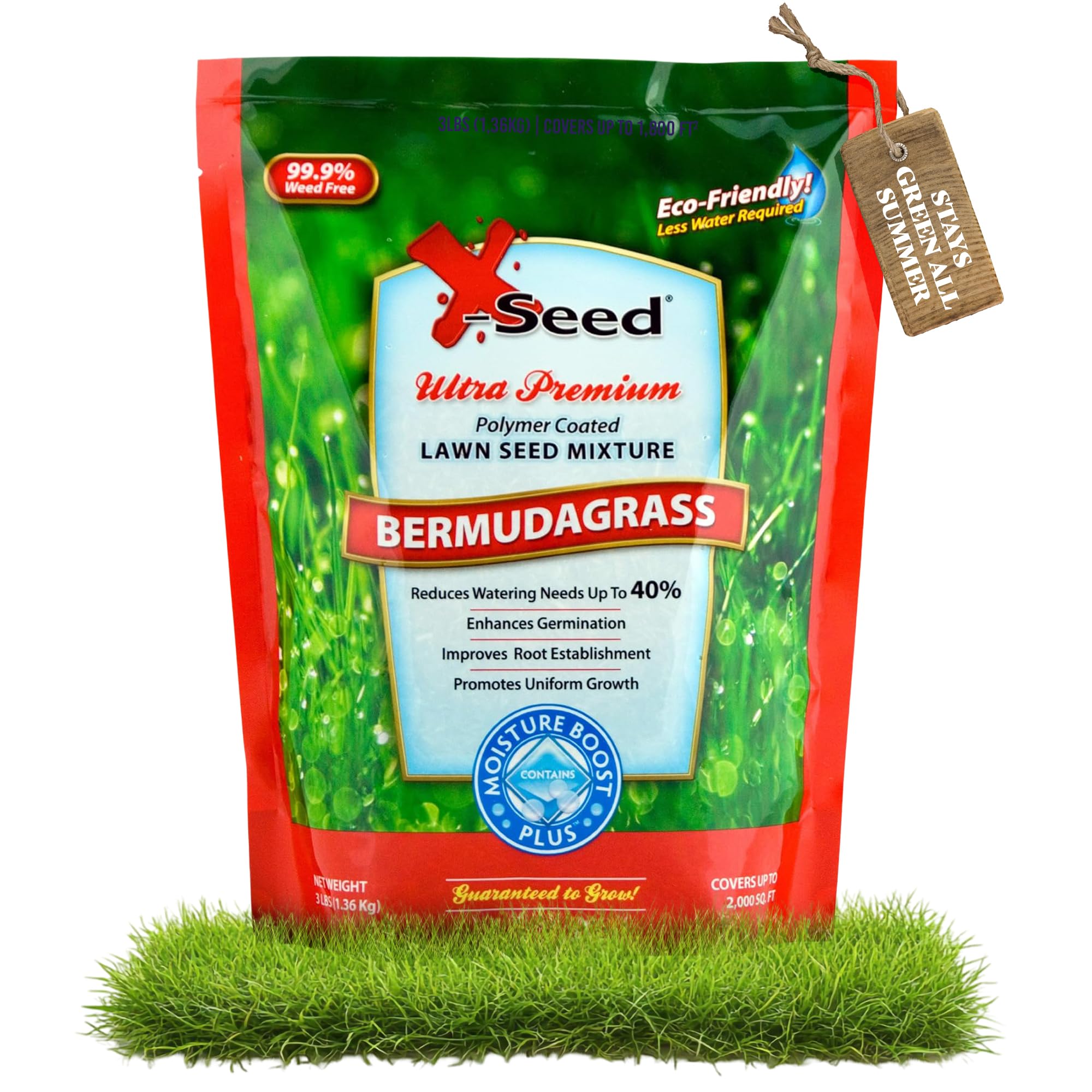
The smallest bag here, and the one tuned hardest for fast-drying sandy soil.
Florida yards are frequently sandy, and this bag is the one that names it directly — sandy soil is the listed soil type, with full sun and moderate watering as the stated needs. Each seed carries a Moisture Boost Plus coating designed to hold water around the seed and improve germination, which is exactly the help a fast-draining yard needs. It is the value entry point on this list, and the lightest at 3 pounds.
Check the coverage math twice: one bag covers 1,000 square feet for a new lawn, or up to 2,000 square feet when overseeding an existing lawn. Compare that with the 5-pound Oasis and Maya bags, which carry more seed for a bigger project. If your patch is small or you are filling in bare spots on an established lawn, the lighter bag is the smarter buy; if you are starting from dirt across a full yard, you will want more weight in the bag.
What the feedback tells you is that growth is genuinely a coin flip by area: some lawns report good early results while others say it never came up in many spots. It is billed as heat and drought tolerant and as using less water than other grasses, and the coating is the reason a sandy yard has a fighting chance. Just set your expectations to patchy and plan a second pass. For a first-time Florida seeding job on a modest patch, the low entry cost and sandy-soil focus make it a reasonable place to start.
Good starting point: a small lawn or an overseed job on sandy Florida soil where you want to try bermuda without committing to a big bag.
Know the limit: at 3 pounds it tops out at 1,000 square feet for a new lawn, so a large bare yard will need a second bag.
Understanding the Specs
Seed Coating (Moisture Retention)
A coating is a jacket around each seed that holds water close while it sprouts. The X-Seed bag uses a Moisture Boost Plus coating and the PanAm blend uses a Yellow Jacket coating, both aimed at faster, more even germination. In Florida’s fast-draining soil, that jacket is the difference between a seed that gets a chance and one that dries out on day two.
Coverage Area and Spread Rate
Coverage is quoted two ways: a heavier rate for bare ground and a lighter rate for overseeding. The X-Seed bag covers 1,000 sq. ft. new or up to 2,000 sq. ft. overseeded; Outsidepride’s Oasis states 2-3 lb per 1,000 sq. ft. Always buy to the new-lawn number or you will run short mid-yard.
Soil Temperature at Planting
Bermuda will not germinate in cold dirt. Hancock names 65°F or higher, and Outsidepride’s Oasis asks for soil above 65°F. That is why spring into early summer is the window — warm ground, plus time to establish before any frost.
Dormancy and Winter Color
Warm-season bermuda goes dormant and brown in winter months, as Pennington states on its label. Brown grass in January is normal dormancy, not a failed lawn, so expect a seasonal color shift.
FAQ
What soil temperature do I need before planting bermuda seed in Florida?
How much area does a bag of bermuda seed actually cover?
Will bermuda grass seed grow in sandy Florida soil?
How long does bermuda seed take to germinate?
Why did my bermuda seed not come up at all?
Does bermuda grass turn brown in a Florida winter?
What is the difference between coated and unhulled bermuda seed?
How low should I mow a fine-textured bermuda lawn?
Can I overseed an existing Florida lawn instead of starting over?
Final Thoughts: The Verdict
For a sunny Florida yard that takes real traffic, the Outsidepride Oasis Bermuda Grass Seed is the pick to beat — a three-variety blend built to crowd out weeds and shrug off heat and dry spells. If you want the finer, darker carpet look and you mow low, grab the Outsidepride Maya (Blackjack II). And for a cold-tolerant, low-clipping family lawn in North or Central Florida, the Pennington Bermudagrass is the one to reach for. Whichever you choose, plant into soil at 65°F or warmer and keep the surface moist through that first week — that is where nearly every Florida bermuda lawn is won or lost.
How We Picked
We do not accept paid placement. Every pick is matched to a real buyer and a real use-case; we do not hands-on test units.
Sources & Methodology
Specifications: manufacturer listings and product documentation. Review insights: verified customer reviews, as of November 2026. Pricing: not shown on this page (it changes often); check the current price via the retailer link.
As an Amazon Associate, Gadgets Feed earns from qualifying purchases. This does not affect which products we feature.