
Our readers keep the lights on and my morning glass full of iced black tea. As an Amazon Associate, I earn from qualifying purchases.
Specs are compiled from manufacturer listings and verified buyer reviews and can change over time — please confirm the key details on the product page before buying.
Staring at your phone for directions on a group ride is awkward, and relying on guesswork for your distance and pace is just frustrating. A dedicated bike computer solves both problems instantly, giving you clear turn-by-turn navigation and precise ride data right on your handlebars. This guide breaks down the seven best models for every budget and riding style, from simple speed-and-distance trackers to advanced training computers.
I’m Min — the founder and writer behind Gadgets Feed. This guide is built by comparing the manufacturers’ published specifications and the patterns across verified customer reviews, so you get each pick’s real strengths and trade-offs instead of marketing spin.
After looking at the data, my pick for the best bicycle computers delivers a large 2.6-inch screen you can actually read in bright sun and a 40-hour battery that lasts through multi-day tours without needing a charge.
Quick Picks
- iGPSPORT BSC100S GPS Bike Computer — Best Overall
- Garmin Edge 540 — Training Powerhouse
- Magene C606 V2 — Premium Screen
- Magene C506 GPS Bike Computer — Smart Navigator
- Beeline Velo 2 — Navigation Specialist
- XOSS G+ GPS Bike Computer — Budget Sensor Hub
- COOSPO BC26 Cycling Computer — Entry-Level Star
How To Choose The Best Bicycle Computers
Picking the right bike computer depends on matching a few key specs to the way you actually ride. Here are the three most important things to look at before you buy.
Screen Size and Readability
Larger screens let you see multiple data fields — speed, distance, time, and a map — at a single glance. A 2.6-inch display like the one on the iGPSPORT BSC100S is much easier to read while you are pedaling than a 1.8-inch screen. Also look for “sunlight-readable” or “anti-glare” descriptions; a screen that washes out in direct sun is useless on a bright afternoon ride.
Battery Life and Charging
If you ride long distances or over multiple days, battery life becomes your top concern. A computer that lasts 40 hours on a charge (the iGPSPORT BSC100S) will handle a week of commuting or a weekend bikepacking trip. Models with 11 to 25 hours are enough for most daily riders but require charging more often. USB-C charging is a nice bonus because it is faster and the cable is easier to replace than an old micro-USB cord.
Sensor Compatibility and Navigation
Think about what extra gear you want to pair. If you plan to add a heart rate monitor, cadence sensor, or speed sensor, choose a computer that supports ANT+ or Bluetooth — the XOSS G+ and COOSPO BC26 both do. For turn-by-turn directions, you need a model with built-in maps like the Magene C506 or Beeline Velo 2. Simpler computers only record a breadcrumb trail of where you have been, which works fine if you stick to familiar roads.
Quick Comparison
On smaller screens, swipe sideways to see the full table.
| Model | Best For | Screen Size | Battery Life | Weight | Amazon |
|---|---|---|---|---|---|
| iGPSPORT BSC100S | Battery life and big screen | 2.6 in | 40 hrs | 67 g | $37.95$39.99PrimeAmazon |
| Garmin Edge 540 | Advanced training features | 2.3 in | 26 hrs | — | $324.48$349.99Amazon |
| Magene C606 V2 | Color touchscreen and navigation | 2.8 in | 25 hrs | — | $159.99Amazon |
| Magene C506 | Smart navigation and sensor support | 2.4 in | 24 hrs | 76 g | $99.99Amazon |
| Beeline Velo 2 | Simple turn-by-turn navigation | — | 11 hrs | — | $99.99Amazon |
| XOSS G+ | Budget with sensor support | 1.8 in | 25 hrs | 101 g | $29.90Amazon |
| COOSPO BC26 | Entry-level simplicity | 2.3 in | 25 hrs | 54 g | $27.74$36.99PrimeAmazon |
In‑Depth Reviews
1. iGPSPORT BSC100S GPS Bike Computer
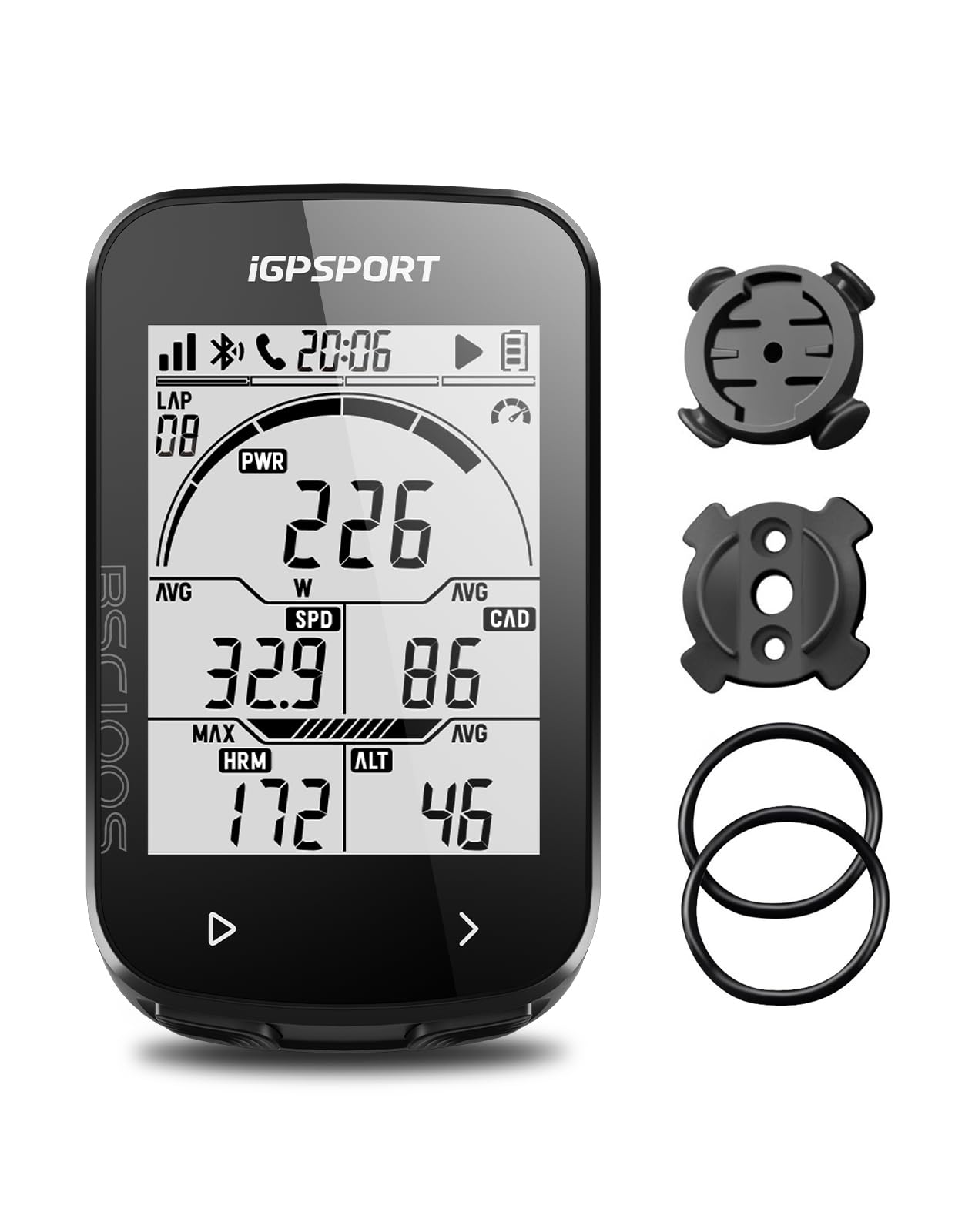
The only computer that outlasts a three-day tour on a single charge.
If you hate charging devices mid-trip, the 40-hour battery life on the iGPSPORT BSC100S is the biggest reason to pick it. That is nearly double the 25 hours you get from the XOSS G+, and it means you can ride for four 10-hour days without finding a USB port. The 2.6-inch LCD screen is 44% larger than the XOSS G+’s 1.8-inch display, so glancing down to check your speed or distance is easy even in bright sun — the anti-glare coating keeps it readable.
The BSC100S uses ANT+ (a wireless protocol) and Bluetooth 5.0 dual protocols to connect with speed sensors, cadence sensors (which track your pedaling rate), heart rate straps, and even smart watches. You get over 40 data fields including grade (the steepness of the hill), temperature, and calories. The iGPSPORT app lets you upload to Strava and Komoot easily. Buyers report the GPS lock is fast and the unit is waterproof at IPX7 (it can survive submersion in up to 1 meter of water for 30 minutes), but a few owners note the battery seems to drain quicker than the 40-hour claim, and the included rubber-band mount takes some trial and error.
The catch: there is no real-time turn-by-turn navigation — you get a breadcrumb trail of your route, not spoken directions. For riders who stick to planned courses on familiar roads, that is minor, but if you rely on GPS navigation to find your way around, look at the Magene C606 or Beeline Velo 2 below.
The long-haul wins
- 40-hour battery leads the group
- 2.6-inch screen is the largest here
- ANT+ and Bluetooth dual protocol
- USB-C charging port
The trade-offs
- No turn-by-turn map navigation
- Battery life inconsistent per some buyers
- Rubber mount can be confusing
Reach for this if: multi-day touring or long weekend rides where battery anxiety is your biggest worry.
Look elsewhere if: you need a GPS that gives you spoken or visual turn-by-turn directions to a new address.
2. Garmin Edge 540

A button-operated coach that suggests your next workout based on your recovery.
The Garmin Edge 540 is built for cyclists who treat riding like a sport, not just transportation. Its Target Adaptive Coaching generates daily suggested workouts based on your training load and event, and you can view them directly on the screen — no phone needed. Battery life hits up to 26 hours in demanding use and up to 42 hours in battery saver mode, which is competitive with the iGPSPORT BSC100S but adds features the iGPSPORT does not have.
Multi-band GNSS (a global navigation satellite system that uses multiple signals from the same satellite for better accuracy) gives you enhanced positioning accuracy in challenging environments like dense forests or between tall buildings. The ClimbPro ascent planner shows remaining ascent and grade (steepness) on every ride without needing a course. Buyers rave about the hill-climbing feature and the power guide, which recommends wattage targets throughout a course when paired with a compatible power meter. One reviewer noted the solar model held a full charge after 74 miles. The catch: the setup has a steep learning curve and the manual is a daunting 84 pages online.
what separates it
- Personalized daily workout suggestions
- 42-hour battery in saver mode
- Multi-band GNSS for better GPS lock
- ClimbPro on any ride
The price of power
- Steep learning curve
- Pricey compared to similar mid-range units
- Limited customization without phone app
Ideal for: serious road cyclists and triathletes who train with power meters and heart rate monitors.
Less ideal for: casual commuters or anyone who just wants a simple speed-and-distance readout.
3. Magene C606 V2
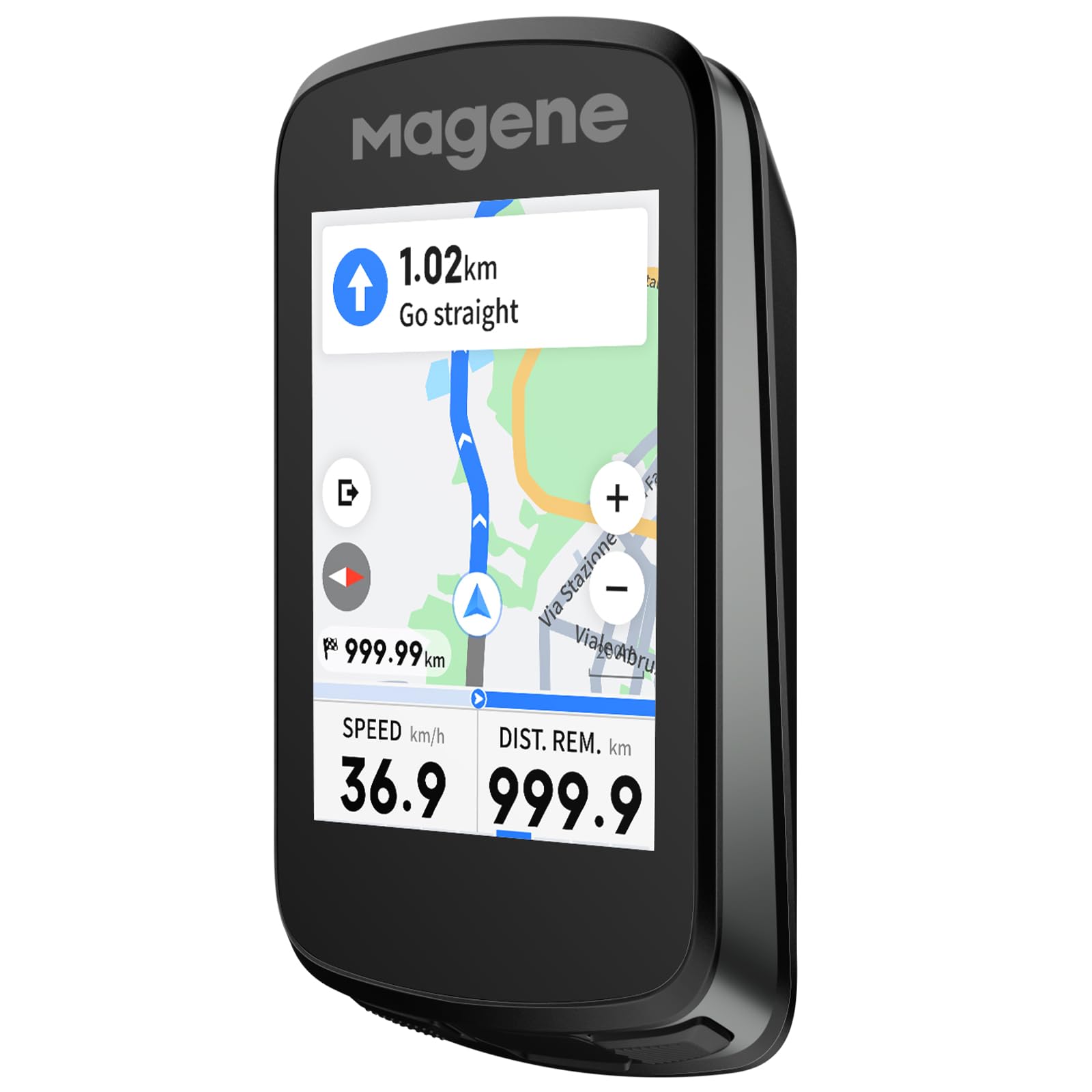
A vibrant 2.8-inch touchscreen that shows you every climb profile ahead.
For riders who want a big, responsive color display without stepping up to Garmin pricing, the Magene C606 V2 is a serious contender. Its 2.8-inch TFT (thin-film transistor) touchscreen is the largest in this lineup and delivers rich color for maps, charts, and live segments. The Multi-Scenario ClimbPro feature handles full route planning and mid-ride detection, showing real-time gradient (steepness), remaining distance, and elevation gain — the same kind of data that used to require a unit.
Battery life is listed at 25 hours (down from the 40-hour iGPSPORT but still strong for a color touchscreen). The C606 V2 connects via ANT+, Bluetooth, and Wi-Fi, and one reviewer says it contains a Garmin 840 contender thanks to its premium feel and amazing screen. It also supports wireless smart camera control for DJI Action and Insta360 cameras, a unique touch for vloggers. One buyer mentioned the screen is slightly dim in bright sunlight and the radar lacks color-coded speed differentiation, but the touchscreen works reliably even in the rain.
The standout features
- 2.8-inch color touchscreen
- Multi-scenario ClimbPro
- Wireless camera control
- Wi-Fi and Bluetooth dual sync
Minor gripes
- Screen can be dim in direct sun
- Battery is less than 40-hour competitors
- Map download process is unintuitive
Perfect for: riders who want a modern color interface with climb profiles and radar support without spending Garmin money.
Not a fit if: you need the absolute longest battery life on the market.
4. Magene C506 GPS Bike Computer
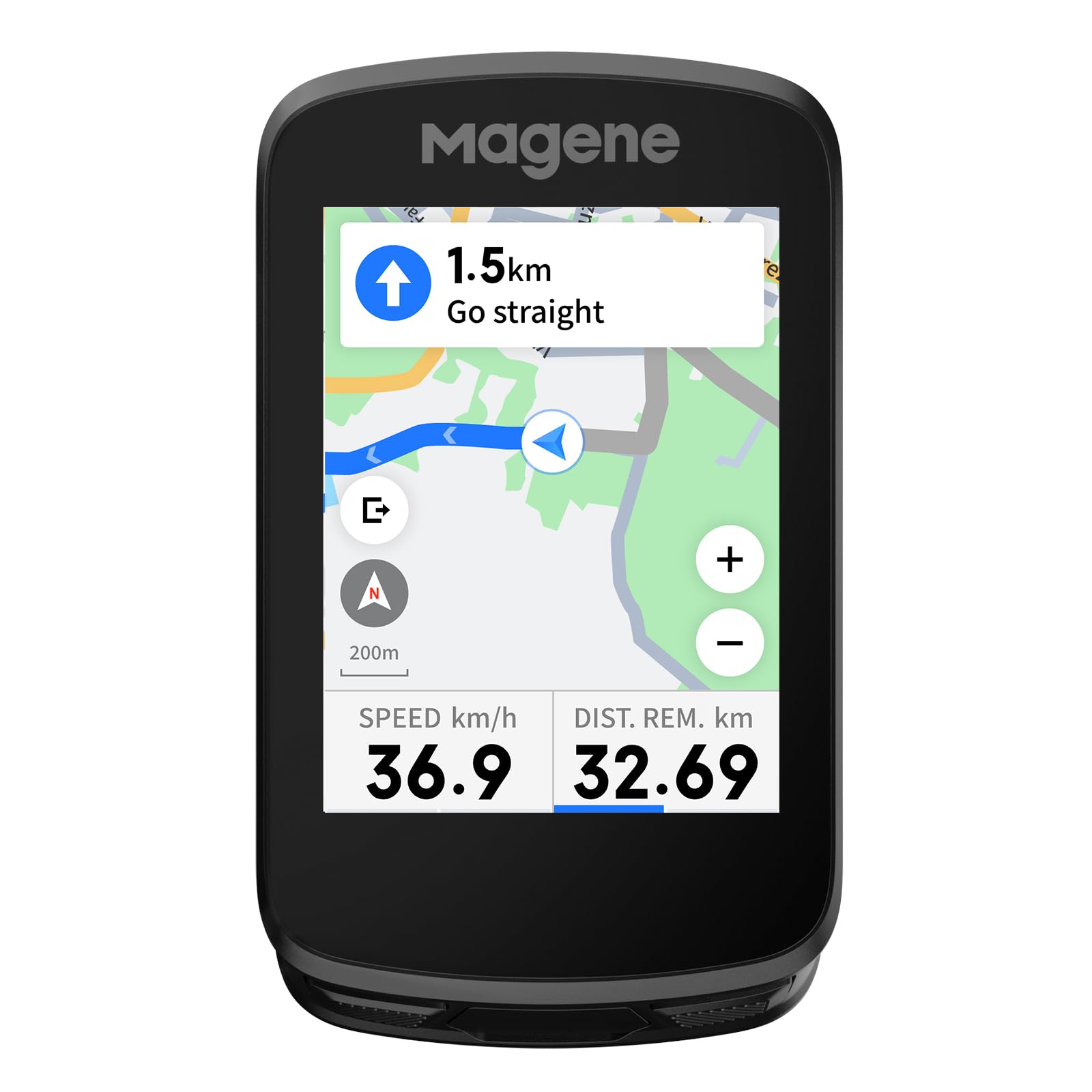
The Magene C506 is a smart navigation tool that locks GPS in just 5 seconds.
With a 2.4-inch color touchscreen and an Airoha chipset (the processor that handles GPS calculations), the Magene C506 achieves precise GPS positioning in as fast as 5 seconds — significantly quicker than the 10-second lock reported for the XOSS G+. It supports Bluetooth and Wi-Fi dual protocols, and its WiFi data upload is 28 times faster than Bluetooth alone. You can download free global maps directly to the device and get turn-by-turn navigation, making it a strong competitor to the Beeline Velo 2 for route-finding.
The C506 connects to 9 device types via ANT+ and Bluetooth, including speed sensors, heart rate monitors, power meters, smart trainers, and electronic shifting systems like SRAM eTap and Shimano Di2 (wireless gear shifters). Its Smart Riding Assistant controls Magene tail lights without your phone and sends hydration and energy reminders. Battery life is 24 hours in endurance mode. Owners mention it is accurate and customizable, though the app can be slow and the map download process feels unpolished. One owner reported the touchscreen sometimes needs multiple presses.
Navigator pros
- 5-second GPS lock
- Turn-by-turn offline navigation
- Wi-Fi 28x faster than Bluetooth
- 9 sensor types supported
Navigator cons
- App can be slow and poorly translated
- Map download is not intuitive
- Touchscreen responsiveness varies
Get this when: you want fast GPS lock, downloadable maps, and broad sensor support in a compact package.
skip it if: you prefer a simple, no-app setup like the entry-level COOSPO BC26.
5. Beeline Velo 2

The simplest way to navigate unfamiliar roads without staring at your phone.
If your main goal is turn-by-turn directions without all the training metrics, the Beeline Velo 2 is the easiest pick. It uses sensor fusion for higher location accuracy, which reduces reliance on your phone signal, and its compass mode shows a simple arrow pointing toward your destination so you can ride with freedom. Importing routes from Komoot or Strava works smoothly — one reviewer calls it a “perfect touring companion” for long rides.
The Velo 2 is water-resistant and connects to iOS and Android via the free companion app. It has a single control method — a touch pad — that is glove-friendly. Customers note the audio beeps for turns can be hard to hear in traffic, and the initial integration with Strava can feel clunky. The Velo 2 is focused on navigation, so it does not pair with speed, cadence, or heart rate sensors like the XOSS G+ or COOSPO BC26 do.
Navigation strengths
- Simple, intuitive turn-by-turn
- Compass mode free-riding
- smooth Komoot/Strava import
- Glove-friendly touch pad
Where it falls short
- No sensor support (HR, cadence, speed)
- Only 11 hours battery life
- Audio beeps may be quiet in traffic
- Setup not intuitive for all users
Best suited for: touring cyclists and riders who explore new routes and care more about directions than detailed performance data.
pass on it if: you want to track heart rate, cadence, or power with sensors.
6. XOSS G+ GPS Bike Computer

A budget-priced computer that still supports heart rate and cadence sensors.
The XOSS G+ is one of the few entry-level computers that support both ANT+ and Bluetooth sensor protocols, letting you pair heart rate monitors and cadence sensors (sold separately). Its 1.8-inch LCD display with automatic backlight makes for easy reading, though it is notably smaller than the 2.3-inch screen on the COOSPO BC26.
Reviewers point out the GPS lock is fast (“in less than 10 seconds”) and the device works well under tree cover on mountain bikes. The XOSS G+ is IPX7 waterproof, so rain is not an issue. It syncs to Strava through the XOSS app. One customer observed the GPS occasionally averages the heading in twisty terrain, and a different buyer had persistent Bluetooth pairing issues with a Pixel 3XL. The overall value is strong compared with computers that cost twice as much, but start with the COOSPO BC26 if you want something simpler and lighter.
Where the value lives
- ANT+ and Bluetooth sensor support
- 25-hour battery life
- IPX7 waterproof
- Fast GPS lock under 10 seconds
Where you compromise
- 1.8-inch screen is the smallest here
- Weighs 101 grams — the heaviest
- Some Bluetooth pairing issues reported
Grab it when: you need budget-friendly ANT+ support for sensors but still want a reliable GPS track.
Pick something else if: a lightweight build or a bigger screen is a priority for you.
7. COOSPO BC26 Cycling Computer

The lightest, simplest GPS computer for riders who just want the basics.
At only 54 grams, the COOSPO BC26 is the lightest computer in this roundup — nearly half the weight of the XOSS G+. It is aimed squarely at entry-level riders who want accurate speed, distance, time, and altitude tracking without sensor pairing or complex setup. The 2.3-inch LCD display with auto backlight is easy to read, and shoppers say excellent battery life and fast satellite connection. The BC26 is IPX7 waterproof, so you can ride through rain without worry.
This computer uses a Dual GPS positioning sensor and syncs.fit files (a standard ride-data format) to Strava via the CoospoRide app. There is a max speed alarm you can set, and the display is visible through polarized sunglasses. The trade-off: the BC26 does not support pairing with any external sensors (no heart rate, cadence, or speed sensor), so it cannot track indoor riding either. The extension mount is sold separately. For pure, fuss-free outdoor tracking, it is tough to top at this tier, but it’s not for you if you plan to add sensors later.
Why it wins for starters
- Just 54 grams — the lightest pick
- 2.3-inch screen with auto backlight
- 25-hour battery life
- Max speed alarm and Strava sync
What you cannot do
- No sensor support (HR, cadence, speed)
- No indoor riding mode
- Extension mount sold separately
Start here if: you are new to cycling computers and just want a super-light, no-fuss device that tracks outdoor rides accurately.
Pass on this if: you already own sensors or plan to train with heart rate and cadence data.
Understanding the Specs
Battery Life
This is the number that determines how often you have to stop and plug in. A 40-hour battery means you can ride for four 10-hour days on a single charge, covering centuries or multi-day tours without a power bank. An 11-hour battery is fine for one long Saturday ride but needs charging every night. If you commute 30 minutes each way, any battery over 20 hours will last you a month or more between charges.
GPS and Satellite Support
More satellite systems mean faster, more accurate positioning. A computer that supports GPS plus GLONASS, Galileo, BeiDou, and QZSS (like the iGPSPORT BSC100S) will lock your position in open sky as well as under tree cover and near tall buildings. Multi-band GNSS, found on the Garmin Edge 540, goes even further by using multiple frequencies from the same satellite to correct errors from the atmosphere, making it the best choice for dense forests or urban canyons.
Screen Type and Size
Size is measured diagonally. A 2.6-inch screen gives you room for 6-8 data fields plus a map, while a 1.8-inch screen forces you to scroll through pages. “Sunlight-readable” segment LCD screens, or “memory-in-pixel” (MIP) displays found on the COOSPO and iGPSPORT, use a reflective layer so they get brighter in sunlight rather than washing out. Color TFT touchscreens (Magene C606) look gorgeous but consume more power and can be dimmer in direct sun.
ANT+ and Bluetooth
These are the two wireless protocols a computer uses to talk to external sensors like heart rate monitors, cadence sensors, speed sensors, and power meters. ANT+ allows you to connect multiple sensors simultaneously (a power meter plus a heart rate strap plus a speed sensor, for example), while Bluetooth typically connects to your phone for syncing rides to Strava. If you want to see real-time cadence or heart rate on your handlebars, make sure the computer supports ANT+ or Bluetooth sensor pairing.
FAQ
Can a bike computer work without a phone nearby?
Will any of these computers give me turn-by-turn directions like a car GPS?
What does ANT+ mean and do I need it?
How long do these bike computers last before the battery dies?
Will a bike computer mount on any handlebar?
Can I use a bike computer indoors on a smart trainer?
Do these computers sync with Strava automatically?
What is the difference between the Magene C506 and C606 V2?
Are bike computers waterproof?
How accurate are the GPS tracks on these budget computers?
Final Thoughts: The Verdict
Across the board, the bicycle computers winner is the iGPSPORT BSC100S because its 40-hour battery and 2.6-inch anti-glare screen cover the essentials for long rides while staying affordable. If you want advanced training analysis with personalized coaching, grab the Garmin Edge 540. And for the most intuitive turn-by-turn navigation without the complexity, the standout is the Beeline Velo 2.
How We Picked
We do not accept paid placement, and we did not hands-on test every unit. Instead, we match each pick to a real buyer and use-case by comparing the manufacturers’ published specifications against the patterns in verified customer reviews — so you get each pick’s real strengths and trade-offs instead of marketing copy.
Sources & Methodology
Specifications: manufacturer listings and product documentation. Review insights: verified customer reviews, as of July 2026. Pricing: not shown on this page (it changes often); check the current price via the retailer link.
As an Amazon Associate, Gadgets Feed earns from qualifying purchases. This does not affect which products we feature.
Product prices and availability are accurate as of the date/time indicated and are subject to change. Any price and availability information displayed on Amazon at the time of purchase will apply to the purchase of this product. As an Amazon Associate I earn from qualifying purchases.
CERTAIN CONTENT THAT APPEARS ON THIS SITE COMES FROM AMAZON. THIS CONTENT IS PROVIDED "AS IS" AND IS SUBJECT TO CHANGE OR REMOVAL AT ANY TIME.
Amazon and the Amazon logo are trademarks of Amazon.com, Inc. or its affiliates.