
A saddle that feels right at mile five can be punishing at mile fifty. A frame geometry that feels sporty around town might leave your lower back screaming after a century ride. Choosing a bicycle for long-distance touring, endurance road riding, or extended commutes demands a focus on fit, drivetrain range, and fatigue-reducing features that shorter rides simply don’t test. The wrong choice turns a day of exploration into a lesson in discomfort; the right one lets the miles slip away effortlessly.
I’m Min — the co-founder and writer behind Gadgets Feed. This guide is the result of many hours spent analyzing frame materials, gear ratios, ergonomic touch points, and the real-world breakpoints where comfort meets efficiency for endurance cyclists.
I’ve compared component specs, read hundreds of verified rider accounts, and weighed each model’s ability to handle varied terrain and long days in the saddle. What follows is a curated, no-fluff guide to the best bicycle for long distance, designed to help you make an informed, lasting purchase.
How To Choose The Best Bicycle For Long Distance
Selecting a long-distance bicycle involves balancing the three pillars of endurance cycling: fit, drivetrain capability, and material science. A machine optimized for a 20-mile cruise is a different animal from one built to eat up 100 miles of mixed pavement. Focus on the areas that reduce fatigue over hours of riding, not just peak speed.
Fit and Frame Geometry
Endurance geometry places the rider in a more upright position compared to an aggressive race bike. This reduces strain on the lower back, neck, and shoulders — the areas that fail first on long days. Look for a taller head tube, a shorter top tube, and a wheelbase that provides stability at speed. A mismatch here is the single most common reason long-distance riders sell their bikes within a year.
Drivetrain and Gear Range
A wide gear range is non-negotiable for long distance. Compact cranksets (50/34T) paired with an 11-34T cassette give you the low gears to spin up sustained climbs without grinding your knees and the high gears to hold speed on flats. Counting the number of speeds is less important than the ratio spread itself — a well-spaced 11-speed is more useful than a tight-ratio 12-speed.
Material: Aluminum vs. Carbon vs. Steel
Aluminum frames offer the best strength-to-weight ratio at moderate cost but transmit more road vibration. High-modulus carbon fiber frames and forks actively dampen vibration, preserving energy over hours of riding, at a premium. Steel provides excellent compliance and durability but adds noticeable weight. For pure endurance, carbon fork legs are a worthwhile upgrade regardless of the main frame material.
Quick Comparison
On smaller screens, swipe sideways to see the full table.
| Model | Category | Best For | Key Spec | Amazon |
|---|---|---|---|---|
| SAVADECK A7L Carbon | Road | Performance Endurance | Shimano 105/Ultegra Di2 | Amazon |
| SAVADECK Blade R8 Ultegra Di2 | Road | Elite Distance | 7.72 kg (17 lb) | Amazon |
| SAVADECK Carbon Disc (SORA) | Road | Entry-Level Speed | 9.6 kg (21.1 lb) | Amazon |
| Tommaso Imola | Road | Sport / Fitness | Shimano Claris 24-Speed | Amazon |
| Schwinn GTX Comfort Hybrid | Hybrid | Casual / Mixed Surface | 21-Speed / Suspension Fork | Amazon |
| sixthreezero EVRYjourney | Hybrid | Upright Comfort | 7-Speed / Step-Through | Amazon |
| Heybike Cityscape 2.0 | E-Bike | Assisted Commute | 50-Mile Range (Assist) | Amazon |
| Gotrax Dolphin | E-Bike | Short / Daily Trip | 30-Mile Range (PAS 1) | Amazon |
| Vivi Electric Bike | E-MTB | Hilly / Urban Assisted | 45-50 Mile Range (Assist) | Amazon |
| Heybike Ranger 2.0 | E-Fat Bike | All-Terrain Assisted | 65-Mile Range (Assist) | Amazon |
| Aipas M1 Pro | E-MTB | High Speed / Off-Road | 85-Mile Range (Assist) | Amazon |
In‑Depth Reviews
1. SAVADECK A7L Carbon Road Bike
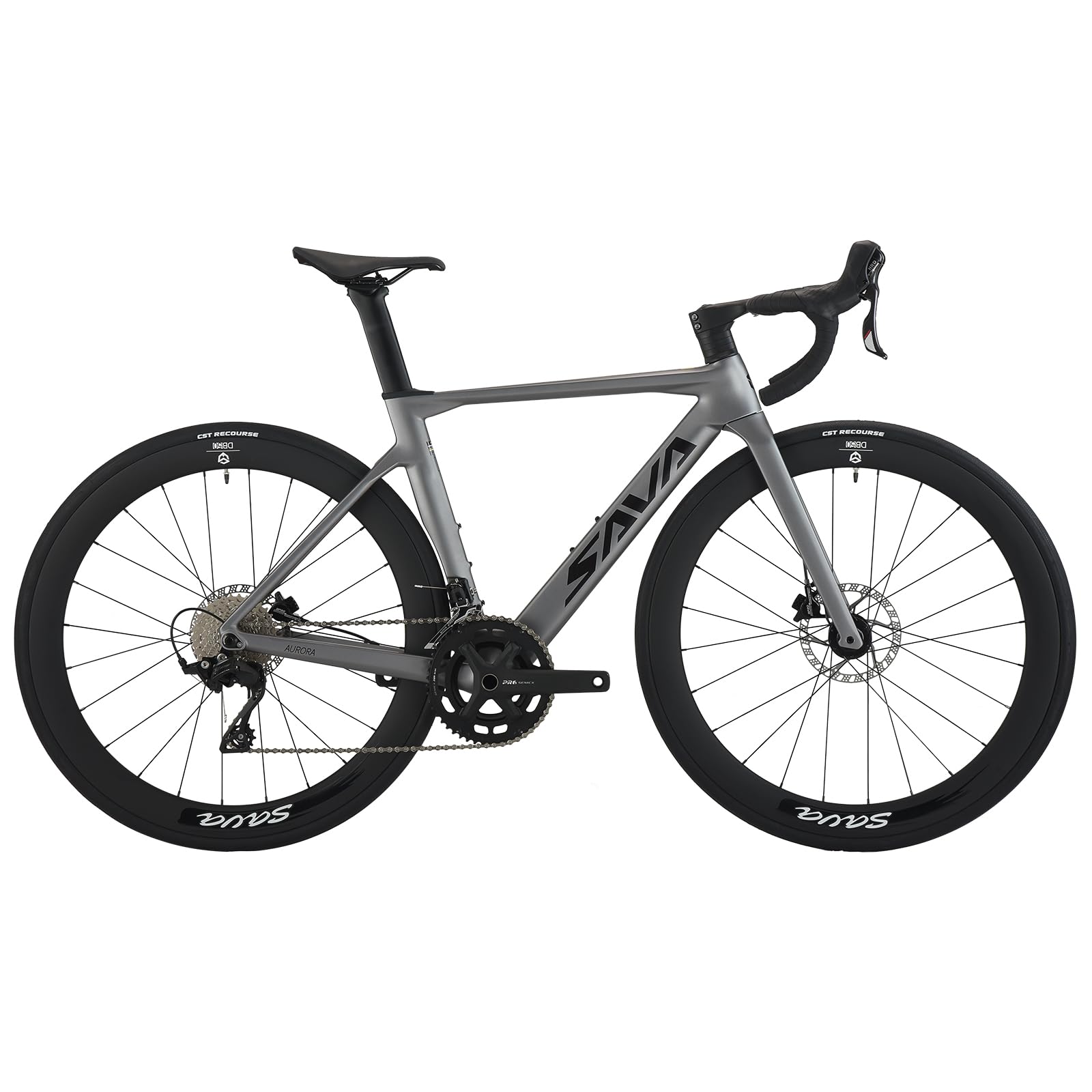
The A7L is built around a T800 carbon frame that brings the complete bike weight down to 8.9 kg. This is a meaningful number for long-distance riders — every kilogram saved on the bike is energy conserved over 100 miles. The fully internal cable routing is not just aesthetic; it reduces aerodynamic drag and protects cables from grit during long, dirty rides. Paired with a 700x25C carbon wheelset, this machine rolls efficiently on pavement.
The Shimano 105 R7100 24-speed groupset provides a wide, reliable gear range that can handle sustained climbs without demanding a pro-level cadence. Hydraulic disc brakes give consistent stopping power in wet or descending conditions, a real safety advantage on unfamiliar routes. The geometry leans toward endurance rather than pure aggression — the frame absorbs road vibration, preserving your hands and lower back.
Riders have reported smooth shifting out of the box and a comfortable ride that invites longer days. Some noted that the saddle is a personal preference item and the pedals are basic, but these are standard swap-outs on any new bike. For the spec level — full carbon, 105 groupset, hydraulic discs — this is a serious distance tool at a mid-range investment.
Why it’s great
- Ultra-light T800 carbon frame (8.9 kg) reduces fatigue over long miles.
- Shimano 105 24-speed drivetrain with hydraulic disc brakes offers precise, all-weather control.
- Internal cable routing improves aerodynamics and reduces maintenance.
Good to know
- Stock saddle and pedals are basic; most riders will upgrade them for distance comfort.
- Assembly requires mechanical aptitude; brakes and derailleurs may need fine-tuning.
- The aggressive geometry may not suit riders seeking a very upright posture.
2. SAVADECK Blade R8 Ultegra Di2
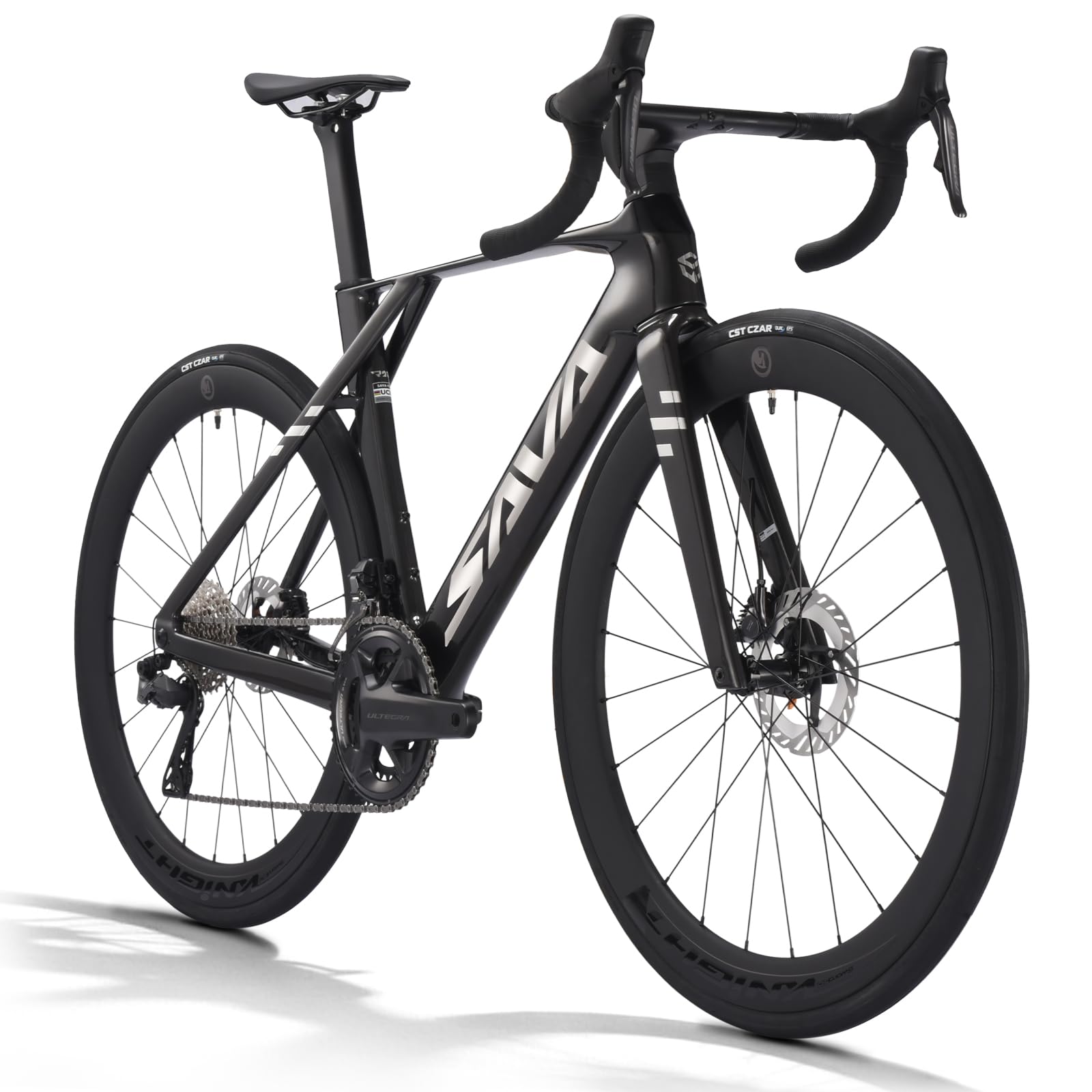
The Blade R8 pushes into premium territory, tipping the scales at just 7.72 kg. It achieves this with a T1000 carbon frame — a higher modulus fiber than the T800 used in many competitor bikes — stiffer where it needs to be for power transfer, and more compliant where it contacts the rider. The complete system includes carbon rims and a carbon seatpost, each chosen to shave grams without sacrificing durability.
The standout feature is the Shimano Ultegra Di2 R8170 electronic groupset. Di2 delivers instantaneous, consistent shifts under load — no cable stretch, no missed gears on a climb. For a rider logging metric centuries, this removes a significant physical and mental distraction. The hydraulic disc brakes offer one-finger modulation, meaning less hand fatigue on long, technical descents.
Aerodynamic tube shaping and fully internal routing are wind-tunnel-tested, granting a few free watts at speed. The bike arrives 90% pre-assembled; most owners report a 15-minute setup. This is the choice for the dedicated endurance rider who wants pro-level performance and the absolute lowest weight the mid-premium market can offer.
Why it’s great
- Ultralight 7.72 kg T1000 carbon frame — one of the lightest in its class.
- Shimano Ultegra Di2 electronic shifting for flawless, fatigue-free gear changes.
- Wind-tunnel-optimized aerodynamics deliver meaningful speed gains on flats.
Good to know
- Assembly instructions are sparse; you will rely on YouTube and E-Tube app for Di2 setup.
- No stock pedals or high-quality saddle included — budget for replacements.
- Spare parts availability for the frame and specific components can be limited.
3. SAVADECK Carbon Disc Road Bike (SORA)

At 9.6 kg, this SAVADECK is a genuine entry point into carbon endurance riding. The frame uses Toray T800 carbon and includes a matching carbon fork and carbon seatpost — key areas where weight and vibration dampening matter most. The 700x25C Continental tires roll fast on pavement and offer good puncture resistance for the miles ahead.
The Shimano SORA R3000 18-speed drivetrain is a proven, durable groupset. It lacks the slick precision of 105, but it shifts reliably and offers enough gear range — especially with a compact crankset — to handle moderate hills and long flats. The cable-actuated disc brakes are a step up from rim brakes in wet conditions, though they require more hand force than hydraulic systems.
Owners consistently praise the ride quality and the weight compared to aluminum alternatives. A few note the assembly requires careful tuning of the front derailleur and brakes. For the budget-conscious rider who wants a carbon frame and is willing to spend time on adjustments, this is an excellent foundation for endurance cycling.
Why it’s great
- Full T800 carbon frame, fork, and seatpost for weight savings and vibration dampening.
- Shimano SORA drivetrain offers reliable shifting for the price point.
- Continental tires provide good grip and puncture resistance.
Good to know
- SORA is a heavier, less precise drivetrain than 105 or Ultegra.
- Cable-actuated disc brakes are less powerful than hydraulic brakes.
- Assembly requires significant mechanical tuning; a trip to a bike shop may be needed.
4. Tommaso Imola Sport Bike

The Tommaso Imola is a sport road bike built around a 6061 aluminum frame and a full Shimano Claris 24-speed drivetrain. The frame is well-constructed, with clean welds and durable paint that hold up to regular use. The geometry is slightly more relaxed than a pure racing bike, making it a solid option for riders building distance endurance without breaking the bank.
The Claris groupset provides a wide 24-speed range (compact 50/34T crankset with an 11-32T cassette), which gives enough low-end gearing for hill climbing and enough top-end for sustained flats. The cable disc brakes offer controlled stopping, though they need more lever pressure than the hydraulic setups found on pricier bikes. The bike rolls on double-wall alloy rims that are durable if not light.
Customer feedback highlights the value — many riders note it compares favorably to entry-level bikes from major brands costing significantly more. Common notes: the saddle is firm (a standard swap for distance riders), and the included pedals are basic. The bike ships mostly assembled, but the derailleurs and brakes benefit from a shop tune-up. For a durable, ride-ready aluminum machine, the Imola covers serious ground.
Why it’s great
- Shimano Claris 24-speed drivetrain offers a very wide gear range for hills.
- 6061 aluminum frame is durable and well-finished.
- Excellent value compared to similar spec bikes from larger brands.
Good to know
- Stock saddle is hard; most riders will want to replace it for long rides.
- Cable disc brakes require more hand effort than hydraulic discs.
- Assembly instructions could be clearer; a professional tune is recommended.
5. Schwinn GTX Comfort Adult Hybrid

The Schwinn GTX is a dual sport hybrid with a lightweight aluminum frame and a suspension fork. The 700c wheels and multi-terrain tires let you comfortably roll on pavement, gravel, and light trails — a useful versatility for long-distance riders who don’t stick to pure road routes. The 21-speed gearing uses a triple crankset, offering a very low gear for steep climbs.
Mechanical disc brakes provide reliable stopping power in wet or dusty conditions. The suspension fork (60-80mm travel) adds a layer of comfort on rough sections, though it adds weight and some energy loss on climbs. The geometry is more upright than a road bike, which relieves pressure on the wrists and lower back, making it a good fit for casual endurance touring or commuting.
Feedback from owners is mixed on assembly quality — many report needing to adjust derailleurs and brakes out of the box. The saddle is average and the shifters are twist-grip, which some riders find less intuitive than trigger shifters. For the rider who wants a comfortable, do-it-all platform that can handle mixed surfaces and spin up long hills, the GTX is a strong hybrid choice.
Why it’s great
- Suspension fork and multi-terrain tires add comfort on mixed surfaces.
- Triple crankset provides very low climbing gears.
- Upright geometry reduces back and neck fatigue.
Good to know
- Suspension fork adds weight and saps some pedaling efficiency.
- Twist-grip shifters are less precise than trigger shifters for many riders.
- Assembly may require professional tuning for optimal shifting and braking.
6. sixthreezero EVRYjourney Men’s Bike

The EVRYjourney uses a foot-forward geometry that places your feet further ahead than a traditional bike. This design mimics a walking stride and engages your leg muscles differently, reducing pressure on the lower back and allowing a very upright posture. It is not the fastest machine, but it is one of the most comfortable for riders who want to cover distance without strain.
The 7-speed drivetrain is limited compared to the 21+ speed options on other bikes. It is best suited for flat to gently rolling terrain — steep hills will challenge the available gear range. The 26-inch semi-slick tires roll smoothly on pavement and hard-packed surfaces. The included rear rack, fenders, and padded saddle make it ready for light touring right out of the box.
Customer feedback emphasizes the comfort — several riders report being able to ride 20+ miles without back pain where other bikes caused issues. The assembly is moderately involved, particularly aligning the fenders. The 7-speed is adequate for casual distance riding but may leave you wishing for more gears on extended hills.
Why it’s great
- Foot-forward geometry provides exceptional lower back and shoulder comfort.
- Includes rear rack, fenders, and padded saddle for immediate touring readiness.
- Aluminum frame is lightweight and corrosion-resistant.
Good to know
- 7-speed drivetrain lacks the range for steep, sustained climbs.
- Assembly requires time and care, especially with fender alignment.
- Paint is prone to scratches from light contact.
7. Heybike Cityscape 2.0 Electric Bike
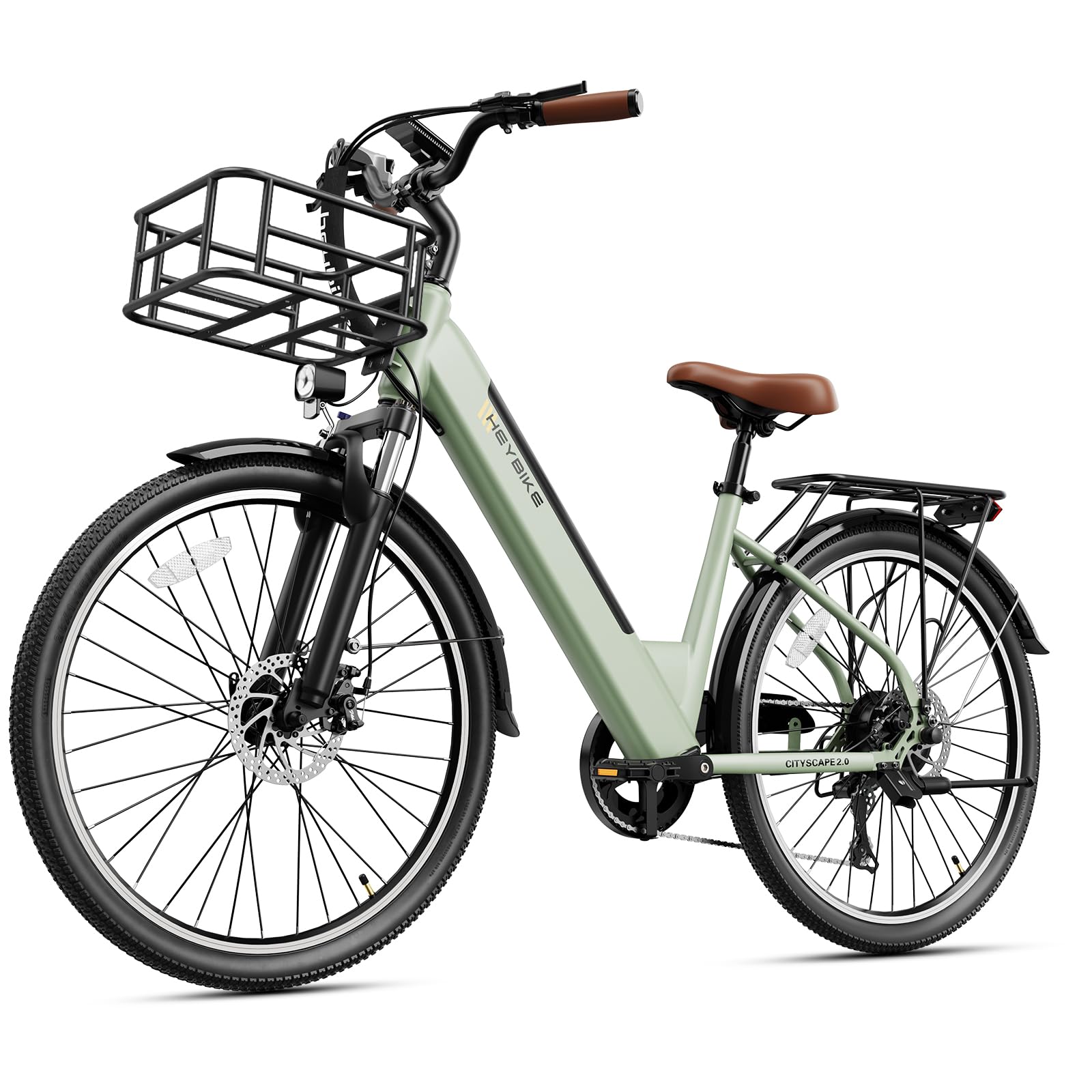
The Cityscape 2.0 is an electric commuter bike with a 500W brushless motor (1200W peak) and a 468Wh UL-certified battery. It claims up to 50 miles of range in pedal-assist mode, making it a viable option for long distance commuting or mixed routes. The 26-inch puncture-resistant tires and front suspension add comfort on broken pavement.
The 7-speed drivetrain is supplemented by the motor, which effectively gives you electronic hill-climbing ability. The throttle mode allows you to cover miles without pedaling when fatigue sets in. The included rear rack can handle 264 lbs of cargo. An LCD display shows speed, battery, and assist level.
Owners report it handles potholes and urban terrain well. Some note the brakes can be noisy and the assembly instructions are confusing. The battery is removable for convenient charging. For the rider who wants electric assistance to extend their range or flatten hills, the Cityscape 2.0 offers solid specs at a mid-range price.
Why it’s great
- 500W motor with 50-mile pedal-assist range covers significant territory.
- Puncture-resistant tires and front suspension improve comfort.
- UL-certified battery and removable design for safety and convenience.
Good to know
- Assembly instructions are poorly organized; online videos are helpful.
- Brakes can be noisy and may require adjustment out of the box.
- The bike is heavy, making manual pedaling or transport difficult without power.
8. Gotrax Dolphin Electric Bike
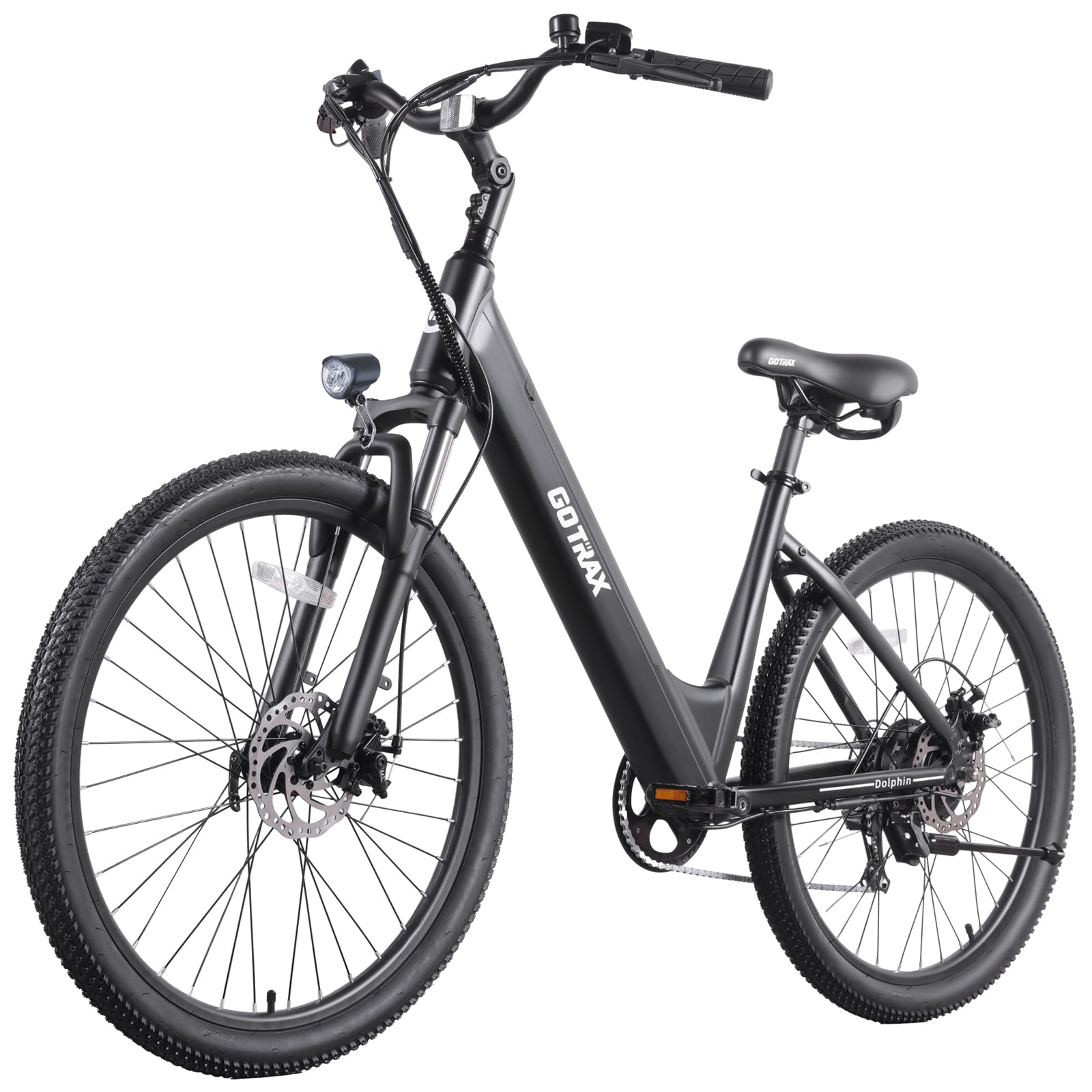
The Gotrax Dolphin is a step-thru e-bike with a 350W motor (500W peak) and a 280.8Wh battery. It offers up to 30 miles in pedal-assist mode, which is realistic for daily commutes or shorter-distance tours. The 26-inch tires and front suspension fork provide a stable, comfortable ride on paved surfaces.
The Shimano 7-speed drivetrain pairs with five pedal-assist levels, giving you control over how much the motor helps. A boost mode adds an extra push at low speed (3.7 mph) for getting started. The dual disc brakes offer reliable stopping power. The bike weighs in on the heavier side for a non-foldable e-bike, but the step-thru frame makes mounting easy.
Owner satisfaction is generally high for the price, with many noting the ride is smooth and the battery holds up well over time. A hard saddle is a common complaint, easily solved with a gel cover. Assembly is straightforward, though brakes may need minor adjustment. For an affordable electric commuter, the Dolphin covers daily needs without fuss.
Why it’s great
- UL-certified battery and five pedal-assist levels offer flexibility.
- Step-thru frame makes it accessible for a wide range of riders.
- Reliable Shimano 7-speed drivetrain.
Good to know
- Battery range is more suited to commutes than all-day touring.
- Stock saddle is very hard; a gel cover is a worthwhile upgrade.
- Some units may arrive with misaligned handlebars or loose components.
9. Vivi Electric Folding Bike
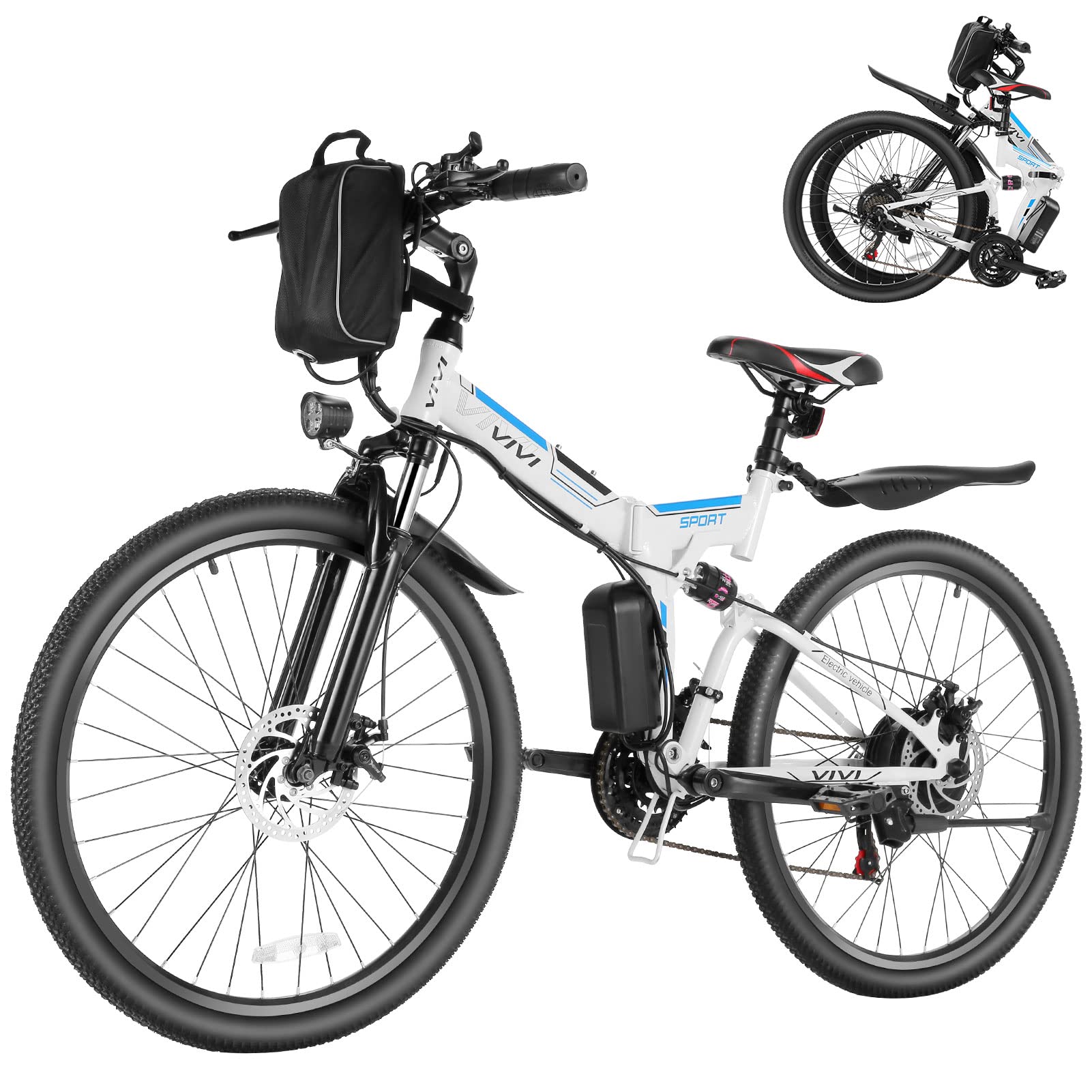
The Vivi is a folding electric mountain bike with a 48V 500W motor and a claimed 45-50 mile range in pedal-assist mode. It features dual suspension (front fork and rear shock), a 21-speed drivetrain, and mechanical disc brakes. The folding design makes it practical for storage in small apartments or car trunks.
The 26-inch anti-slip tires handle varied terrain including gravel, dirt, and pavement. Four working modes (throttle, pedal-assist, cruise control, and no-power) give the rider full control. The removable battery can be charged on or off the bike, a useful security feature.
Owners report the bike is powerful enough for steep hills and provides a comfortable ride thanks to the dual suspension. Assembly can be challenging with the included instructions, and a few riders noted issues with brake cables or customer service responsiveness. For the price, the Vivi offers an impressive feature set for a folding e-bike.
Why it’s great
- Dual suspension and 21-speed drivetrain provide comfort and range.
- Foldable design is convenient for storage and transport.
- Four riding modes offer flexibility for different conditions.
Good to know
- Assembly instructions are poor; expect a multi-hour setup process.
- Customer service responsiveness has been inconsistent.
- The bike is heavy; the folding mechanism adds weight without reducing it dramatically.
10. Heybike Ranger 2.0 Foldable E-Bike

The Ranger 2.0 is a fat-tire folding e-bike with a 20-inch by 4-inch tire setup and a peak motor output of 1400W. It reaches 28 mph on throttle and has an assisted range of up to 65 miles. The 600Wh removable battery is the largest in its direct price bracket, fueling serious exploration.
The fat tires provide exceptional traction on sand, snow, mud, and loose gravel, making it a true all-terrain machine. The front suspension fork and oversized saddle add comfort over rough ground. A step-thru frame improves accessibility. The folding frame still lets it fit in a car trunk.
Riders consistently report powerful acceleration and a stable ride. The bike is heavy, and the folding mechanism can be stiff. Battery life is praised as being realistic to the claim. For the long-distance rider who wants to leave the pavement behind, the Ranger 2.0 opens up possibilities that a road bike cannot.
Why it’s great
- 20×4 inch fat tires provide unmatched off-road traction.
- 1400W peak motor and 65-mile range cover serious ground.
- Step-thru design and folding frame are highly practical.
Good to know
- Very heavy; moving it without power is a workout.
- Folding mechanism requires significant force to operate.
- Taller riders may find the fat tires increase standover height, making mounting harder.
11. Aipas M1 Pro Electric Bike
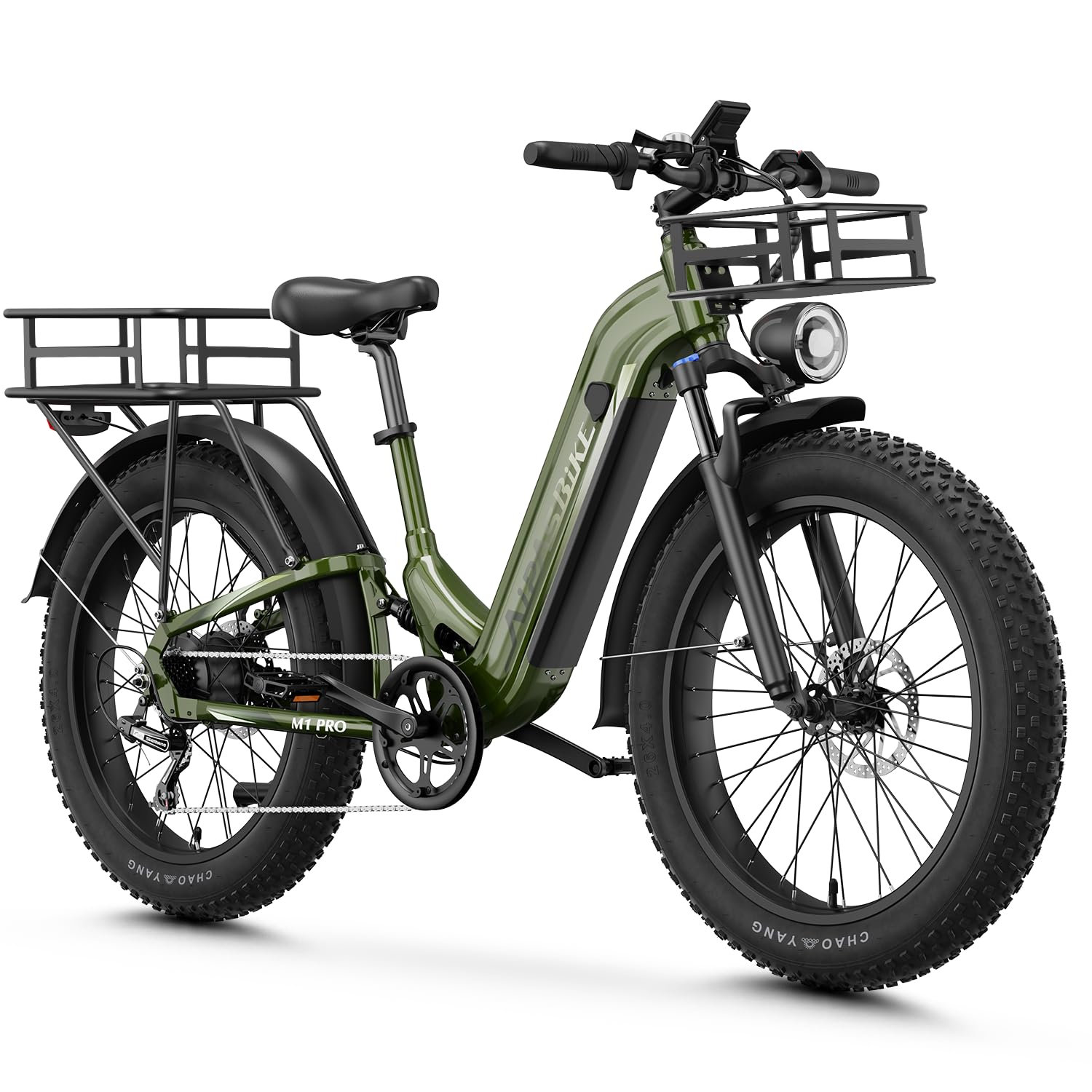
The Aipas M1 Pro is built around a 1800W peak motor (110Nm torque) and a 48V 17.5Ah battery, delivering a top speed of 36 mph and an impressive range of up to 85 miles in pedal-assist mode. It features a full suspension system — lockable front fork and rear shock — along with 26×4.0 inch fat tires for serious off-road capability.
The 7-speed drivetrain and five riding modes (throttle, pedal-assist, cruise, normal, walk) offer complete control over the riding experience. The step-thru frame is designed for accessibility, and the included rear basket adds cargo utility. The LCD display includes a USB charging port for devices.
Owner feedback is very positive, highlighting the bike’s stability, power, and comfortable full suspension. The bike is heavy, and the range claim of 85 miles is under optimal conditions — real-world mixed-use is closer to 50 miles. The mechanical disc brakes are adequate but not hydraulic, requiring more maintenance. For the rider who wants maximum power and range in an electric fat bike, the M1 Pro delivers.
Why it’s great
- 1800W peak motor and 85-mile range are class-leading for the price.
- Full suspension and fat tires absorb any terrain.
- Step-thru frame and USB charging port add real-world convenience.
Good to know
- Heavy build; difficult to transport or lift without ramps.
- Range drops significantly at high speeds or in full throttle.
- Mechanical disc brakes require more frequent adjustment than hydraulic.
FAQ
What is the ideal gear ratio for long-distance cycling?
Is an aluminum or carbon frame better for long rides?
How important is a suspension fork for distance?
Final Thoughts: The Verdict
For most users, the best bicycle for long distance is the SAVADECK A7L Carbon because it combines a high-modulus T800 carbon frame, a responsive 105 groupset, and hydraulic disc brakes into a package that balances weight, comfort, and cost for serious endurance riding. If you prioritize the lightest possible weight and electronic shifting for absolute precision on long days, the SAVADECK Blade R8 Ultegra Di2 is the superior choice. And for riders who want the comfort of an upright, foot-forward position without climbing hills under their own power, the sixthreezero EVRYjourney offers exceptional fatigue-free touring.