
The gap between wanting to ride and actually riding is usually a twenty-minute drive to a sweaty, crowded spin studio. An indoor bike brings that friction down to zero — you walk into the next room, clip in, and start burning calories before your motivation has a chance to fade. The challenge is separating the silent, stable machines from the wobbly ones that creak under load and squeak after a month.
I’m Min — the co-founder and writer behind Gadgets Feed. I’ve spent dozens of hours dissecting the specs, customer feedback, and build-quality benchmarks of today’s exercise bikes to find which ones actually hold up under daily sweat and high-resistance sprints.
Whether you need a quiet belt-driven model for apartment living or a heavy-duty frame that stays planted during out-of-the-saddle climbs, this guide highlights the best bike for exercise across different budgets and body types, with no fluff and no filler.
How To Choose The Best Bike For Exercise
An exercise bike is a multi-year investment in your health, and the cheapest option will often cost you more in frustration and repairs down the road. Here are the three make-or-break factors that determine whether a bike becomes a daily companion or an expensive clothes rack.
Resistance Type: Magnetic vs. Felt Pad
The single biggest differentiator between a bike and a bike is how it creates resistance. Felt pad systems press a brake pad against the flywheel — they wear out over time, produce friction dust, and create a rubbing noise that gets louder as the pad degrades. Magnetic resistance uses opposing magnets that never touch, which means zero wear, virtually silent operation below 25 dB, and consistent feel year after year. For any bike that will sit in a shared living space, magnetic resistance is the baseline you should not compromise on.
Frame Weight and Rider Capacity
Stability during high-cadence sprints comes from a heavy, well-braced frame. A bike that weighs under 50 pounds will often wobble when you stand out of the saddle, especially at higher resistance levels. Look for a total unit weight above 60 pounds and a published maximum rider capacity of at least 300 pounds. The combination of a low center of gravity and wide stabilizer feet keeps the bike planted on hardwood, tile, or carpet without needing a mat underneath.
Adjustability Range and Pedal Compatibility
A bike that doesn’t fit your body geometry will cause knee pain, hip discomfort, or lower back strain within two weeks. The seat post should offer at least 7 height settings, and the seat itself should slide fore and aft to dial in the correct knee-over-pedal position. Handlebars need both height and fore-aft adjustment to support upright recovery positions and aggressive forward-leaning sprints. For pedal compatibility, dual-sided pedals with SPD clips on one side and standard toe cages on the other give you the freedom to use cycling shoes or regular sneakers without swapping hardware.
Quick Comparison
On smaller screens, swipe sideways to see the full table.
| Model | Category | Best For | Key Spec | Amazon |
|---|---|---|---|---|
| Schwinn IC4 | Premium | App integration & 100 resistance levels | 112 lbs / 330 lbs capacity / 100 levels | Amazon |
| Keiser M3 | Premium | Commercial build quality & zero maintenance | 85 lbs / 300 lbs capacity / 100 levels | Amazon |
| LFEYYD D57602 | Premium | Heavy-duty frame with heart rate monitoring | 80 lbs / 400 lbs capacity / 25 dB | Amazon |
| Pooboo W216 | Mid-Range | Recumbent comfort with arm exerciser | 80 lbs / 400 lbs capacity / 20 dB | Amazon |
| Yesoul S3 | Mid-Range | Smart resistance with app classes | 68 lbs / 350 lbs capacity / 100 levels | Amazon |
| Merach S26 | Mid-Range | Zwift-compatible with micro-adjustment | 62 lbs / 300 lbs capacity / 25 dB | Amazon |
| Merach MR-S36L2 | Mid-Range | Infinite resistance via app for varied training | 66 lbs / 330 lbs capacity / 25 dB | Amazon |
| Wenoker JC318 | Budget | App connectivity on a tight budget | 350 lbs capacity / magnetic / LCD | Amazon |
| Lacuffy S1-Pro | Budget | 32 magnetic levels at entry-level price | 43 lbs / 300 lbs capacity / 32 levels | Amazon |
In‑Depth Reviews
1. Schwinn Fitness IC4 Indoor Cycling Bike

The Schwinn IC4 hits the sweet spot where build quality, smart features, and price converge. The 112-pound steel frame eliminates any wobble during standing sprints, while the magnetic resistance system delivers 100 micro-adjustable levels that let you dial in exactly the right tension for warm-ups, steady-state endurance rides, or simulated hill climbs. The full-color LCD console tracks heart rate, speed, distance, RPM, and calories without needing a tablet, though the bike also works seamlessly with Peloton, Zwift, and the JRNY app for guided classes.
Dual-sided pedals come with SPD clips on one side and standard toe cages on the other, so you can ride in cycling shoes or regular sneakers without swapping hardware. The race-style seat is firm but supportive, and both the seat and handlebars adjust vertically and fore-aft to accommodate riders from roughly 5’2″ to 6’3″. The included 3-pound dumbbells, tablet holder, water bottle cage, and USB charging port make this a complete home studio package.
Assembly takes about an hour with clear instructions, and owners report the belt drive staying whisper-quiet even after hundreds of miles. The only trade-off is that the console’s speed and calorie calculations run slightly optimistic compared to a power meter — consider using a separate heart rate armband for precise data if you train by the numbers.
Why it’s great
- 100 magnetic resistance levels provide precise tension control for every training phase
- 112-pound frame stays planted during high-cadence sprints with no wobble
- Works with Peloton, Zwift, and JRNY apps for structured workouts
Good to know
- Console speed and calorie data run about 30% higher than a power meter would show
- Tablet holder is fixed at one angle and cannot be adjusted for glare
- Assembly manual is sparse — a YouTube build guide is strongly recommended
2. Keiser M3 Indoor Cycle Raven Black

The Keiser M3 is the indoor cycle you’ll find in high-end spin studios for a reason — it’s built to survive thousands of rides with almost no maintenance. The magnetic resistance system has zero wearing parts, so there are no pads to replace, no cables to tighten, and no friction dust to clean. The 85-pound frame is compact enough (26″ by 26″) to fit in tight spaces, yet rigid enough to handle riders up to 300 pounds without a hint of flex during out-of-the-saddle surges.
Resistance is controlled through an infinitely variable lever, not numbered detents, which gives you the freedom to blend between levels as smoothly as a real road climb. The LCD display shows RPM, watts, speed, distance, and calories, and it pairs with a heart rate chest strap for continuous pulse tracking. Owners routinely report these machines lasting over five years with zero repairs — the first owner in our dataset logged 500+ rides before selling the bike in like-new condition.
The pedal system uses Look Delta clips, which means you’ll need compatible cycling shoes or an adapter for SPD pedals. Assembly takes about two hours and requires a few specific tools, but Keiser’s customer service is responsive if any part arrives damaged. If your budget allows for it, the M3 is the last exercise bike you will ever need to buy.
Why it’s great
- Zero-wear magnetic system means no pad replacements or maintenance for years
- Compact 26-inch footprint fits in apartments and home corners easily
- Infinitely variable resistance lever mimics real road climbing feel
Good to know
- Pedals use Look Delta clips — require cycling cleats or an SPD adapter
- Monitor is not Zwift-compatible; you will need a separate speed/cadence sensor
- Delivery can be rough — inspect the frame immediately for shipping damage
3. LFEYYD D57602 Exercise Bike
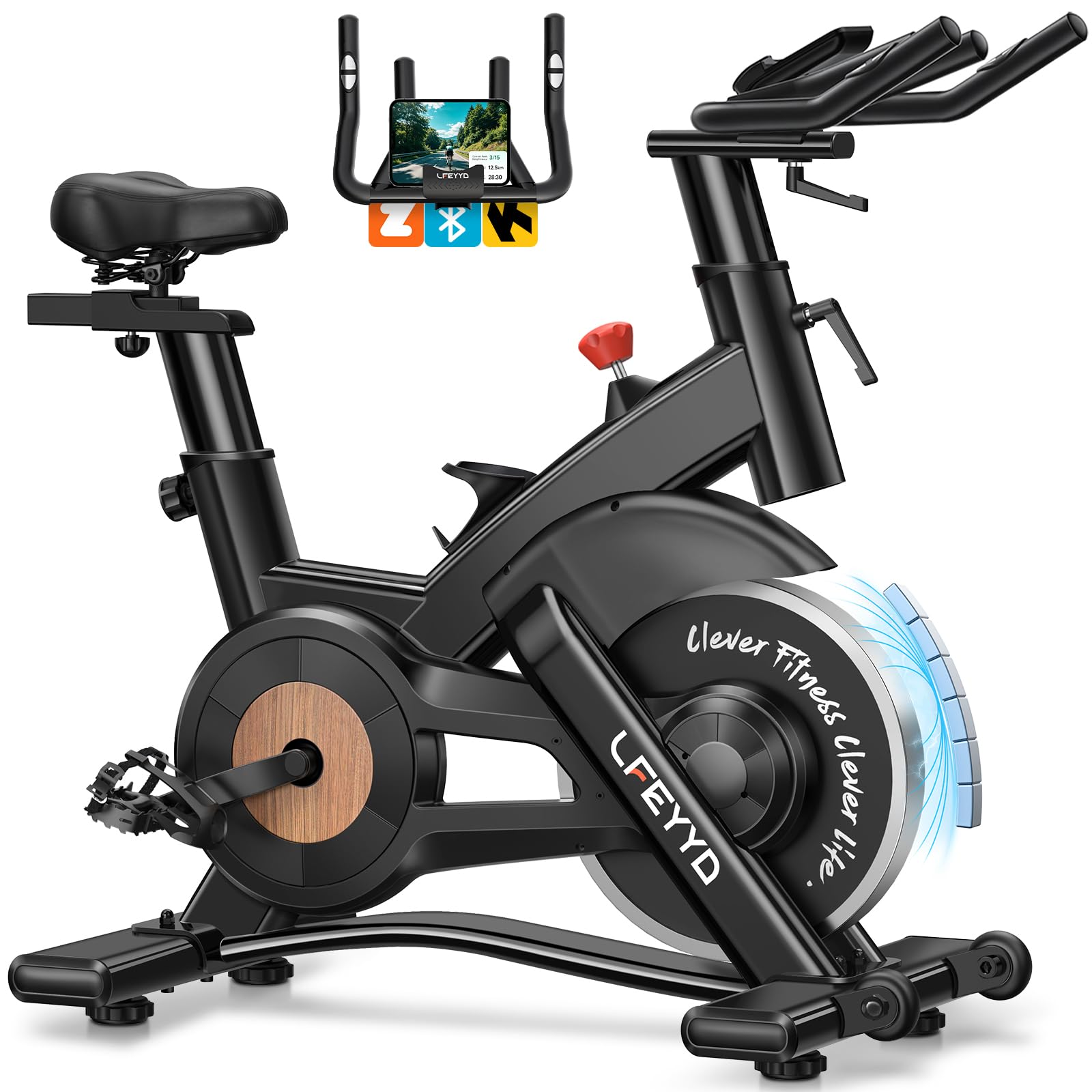
The LFEYYD D57602 goes after a specific buyer: someone who needs a frame that can handle intense, heavy use without any wobble. The 80-pound reinforced steel frame and five anti-slip feet give it a 400-pound maximum rider capacity — one of the highest in this comparison. The magnetic resistance system operates below 25 dB, so early-morning sessions won’t wake anyone else in the house, and the belt drive eliminates the chain noise that plagues older friction-brake bikes.
A unique advantage here is the integrated handlebar pulse sensors, which let you track heart rate without strapping on a chest band. The multi-function LCD shows time, speed, distance, calories, and pulse, and the bike pairs with Zwift and Kinomap for virtual routes and structured training. The 4-way seat adjustment includes a 2.4-inch horizontal slide, which is rare at this price level and critical for dialing in proper knee alignment.
Assembly takes about an hour with the included tools, and the bike arrives 80 percent pre-assembled. The main complaint across owner reviews is that the digital display buttons are small and stiff — you’ll want to set your metrics before the ride starts rather than fiddling mid-workout. For larger riders or anyone who prioritizes dead-solid stability, this is the most confidence-inspiring build in the mid-premium tier.
Why it’s great
- 400-pound maximum rider capacity with a thick reinforced steel frame
- Handlebar pulse sensors track heart rate without extra wearable gear
- 2.4-inch seat horizontal slide allows precise knee-over-pedal alignment
Good to know
- LCD display buttons are small and hard to press during a workout
- Unit weighs 80 pounds — moving it upstairs requires a helper
- App connectivity setup can be finicky on the first pairing attempt
4. Pooboo W216 Recumbent Exercise Bike
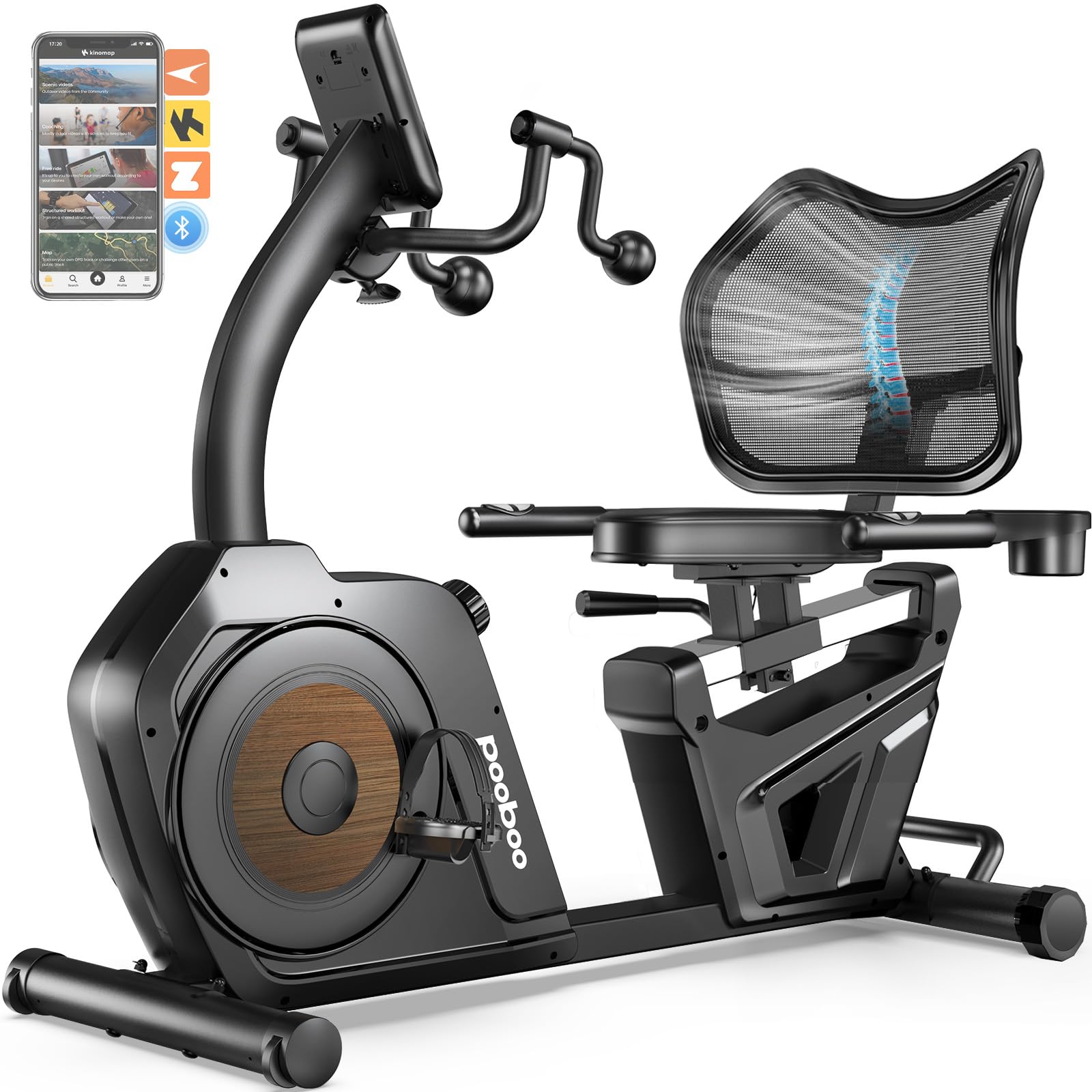
Recumbent bikes serve a distinct need: they support the lower back with a full mesh-back seat and position the pedals in front of the rider, reducing hip flexion and lower back strain compared to upright bikes. The Pooboo W216 takes this further with a dual-motion arm exerciser — the handlebars move with your arms while you pedal, engaging upper-body muscles for a full-body calorie burn. The 15-pound flywheel and belt drive keep operation at just 20 dB, making this the quietest bike in the roundup.
The adjustable sliding seat rail offers 18.5 inches of travel, accommodating riders up to 6’3″ with plenty of legroom. The pedal straps have eight hole positions on each side, so different shoe sizes stay locked in securely. The LCD monitor tracks speed, distance, time, calories, odometer, and pulse, and the built-in sensor pairs with Kinomap and the Zt app for ride logging and virtual courses.
At 80 pounds, the W216 is heavy but easy to move thanks to built-in transport wheels and a tail carry handle. The breathable mesh backrest prevents sweat buildup during longer sessions, and the 8-level resistance knob is simple enough for older adults or physical therapy patients to use without confusion. The only notable downside is that the large LCD monitor lacks a backlight, making it difficult to read in dim light without an external lamp.
Why it’s great
- Dual-motion arm exerciser engages upper body simultaneously with pedaling
- Breathable mesh backrest supports the lower back and reduces sweat buildup
- 20 dB belt drive is the quietest operation in this comparison
Good to know
- LCD monitor display has no backlight and is hard to read in low light
- Resistance knob has only 8 levels, limiting fine-grained tension control
- Seat adjustment rail is plastic-based and may feel less premium than steel
5. Yesoul S3 Black Exercise Bike

Yesoul has carved out a reputation for delivering smart-bike features at a price that undercuts the big names. The S3 uses a magnetic resistance system with 100 micro-adjustable levels controlled through a resistance knob that also acts as an emergency brake — press it down to stop the flywheel instantly. The bike connects via Bluetooth to the Yesoul fitness app, which streams hundreds of on-demand and live classes with real-time metric tracking including RPM, cadence, heart rate, and power output.
The frame supports up to 350 pounds and uses carbon steel construction that keeps the bike stable during high-intensity intervals. The 10-inch tablet mount sits at eye level, and the dual-sided pedals come with SPD clips and toe cages for versatile shoe compatibility. The overall footprint is 41 by 32 inches — slightly larger than a yoga mat — and the transport wheels make it easy to roll into a corner between rides.
Assembly takes about 30 minutes since the bike ships 70 percent pre-assembled. Owners consistently praise the whisper-quiet belt drive and the smoothness of the magnetic resistance curve, though the stock seat is criticized as uncomfortable for rides longer than 45 minutes. The handlebars also lack fore-aft adjustment, which can make it difficult for very tall or very short riders to find an ideal reach position.
Why it’s great
- 100 magnetic resistance levels provide granular tension control for any fitness level
- Yesoul app offers hundreds of live and on-demand classes with real-time metrics
- Emergency brake knob stops the flywheel instantly for added safety
Good to know
- Stock seat becomes uncomfortable on rides longer than 45 minutes
- Handlebars only adjust vertically, not fore-aft, limiting fit for extreme heights
- Transport wheels feel flimsy and may bend if the bike is rolled over door thresholds
6. Merach S26 Exercise Bike
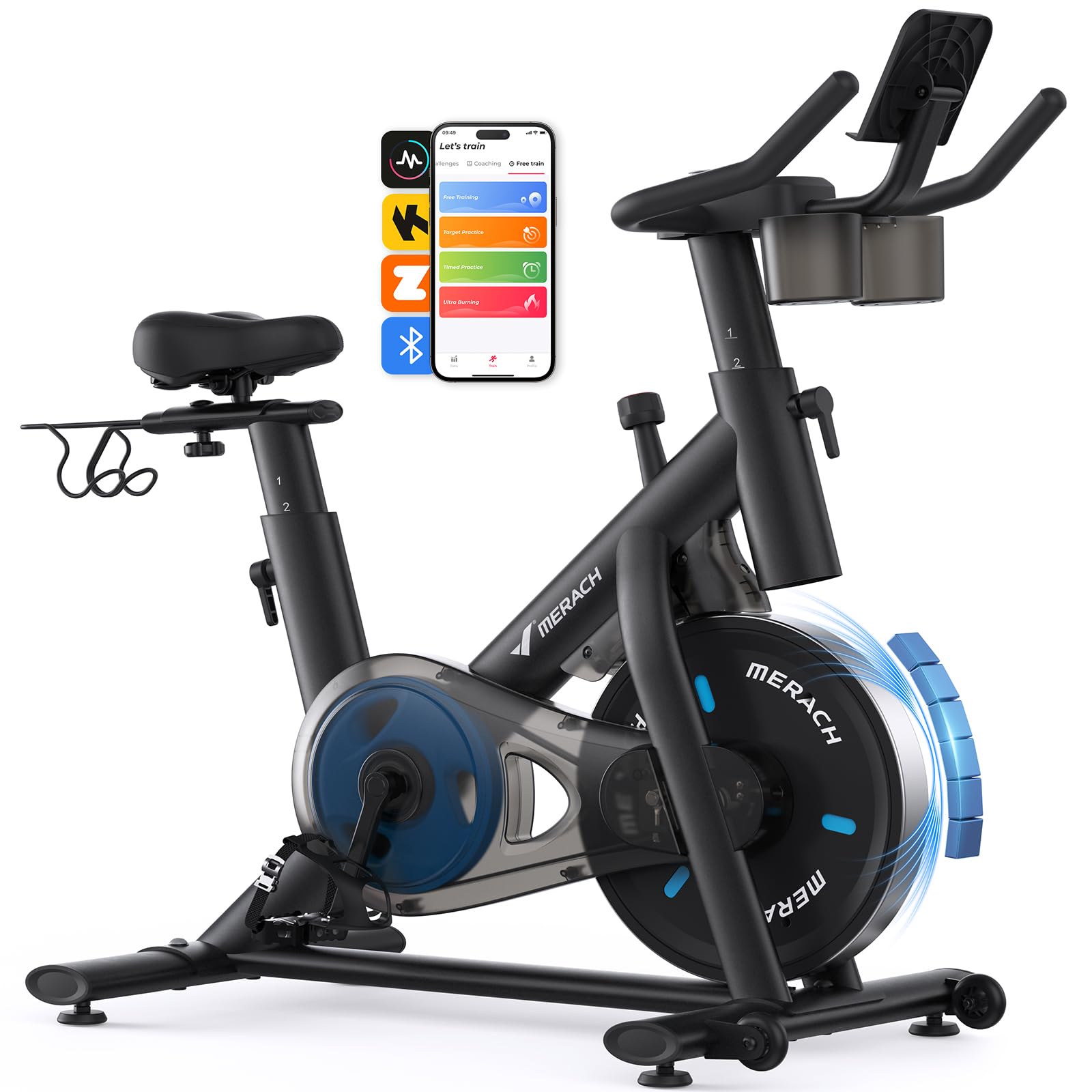
The Merach S26 targets riders who want to connect their bike to Zwift, Kinomap, or the Merach app for structured training and virtual racing. The magnetic resistance system uses an inertia-enhanced cast iron flywheel that operates at under 25 dB, and the 0-100 percent micro-adjustment lever lets you dial in resistance from a gentle warm-up at 20 percent to a simulated 10-percent grade at full lock. The reinforced inverted triangle frame with 2.00mm steel is 40 percent more stable than standard home-bike frames, according to the manufacturer’s testing.
The 4-way seat adjustment and 2-way handlebar adjustment cover riders from 4’8″ to 6’2″, and the toe cages adjust to fit any shoe size via strap-based tension. An integrated dumbbell rack, iPad holder, and dual water bottle holders make this a complete training station. The LED display shows speed, time, distance, calories, and RPM, and the Bluetooth connection syncs data with Google Fit and Apple Health for a unified view of your activity.
Owner feedback highlights that the power data from the S26 is within 10 percent of a dedicated power meter, which is impressive at this price point. However, the 8 resistance levels are only shown inside the Merach app — the physical display does not show which level you are on, which can be frustrating during manual rides. The pedals also lack freewheeling, meaning the cranks keep spinning if you stop pedaling, which takes a few rides to get used to.
Why it’s great
- Power data accuracy within 10% of a dedicated power meter, great for Zwift racing
- 40% more frame stability than standard exercise bikes due to reinforced inverted triangle design
- Connects to Google Fit, Apple Health, Zwift, and Kinomap for unified tracking
Good to know
- Resistance level is only visible in the app, not on the physical display
- Pedals lack freewheeling — cranks keep spinning when you stop pedaling
- Seat may slip forward if the locking knob is not tightened fully
7. Merach MR-S36L2 Exercise Bike
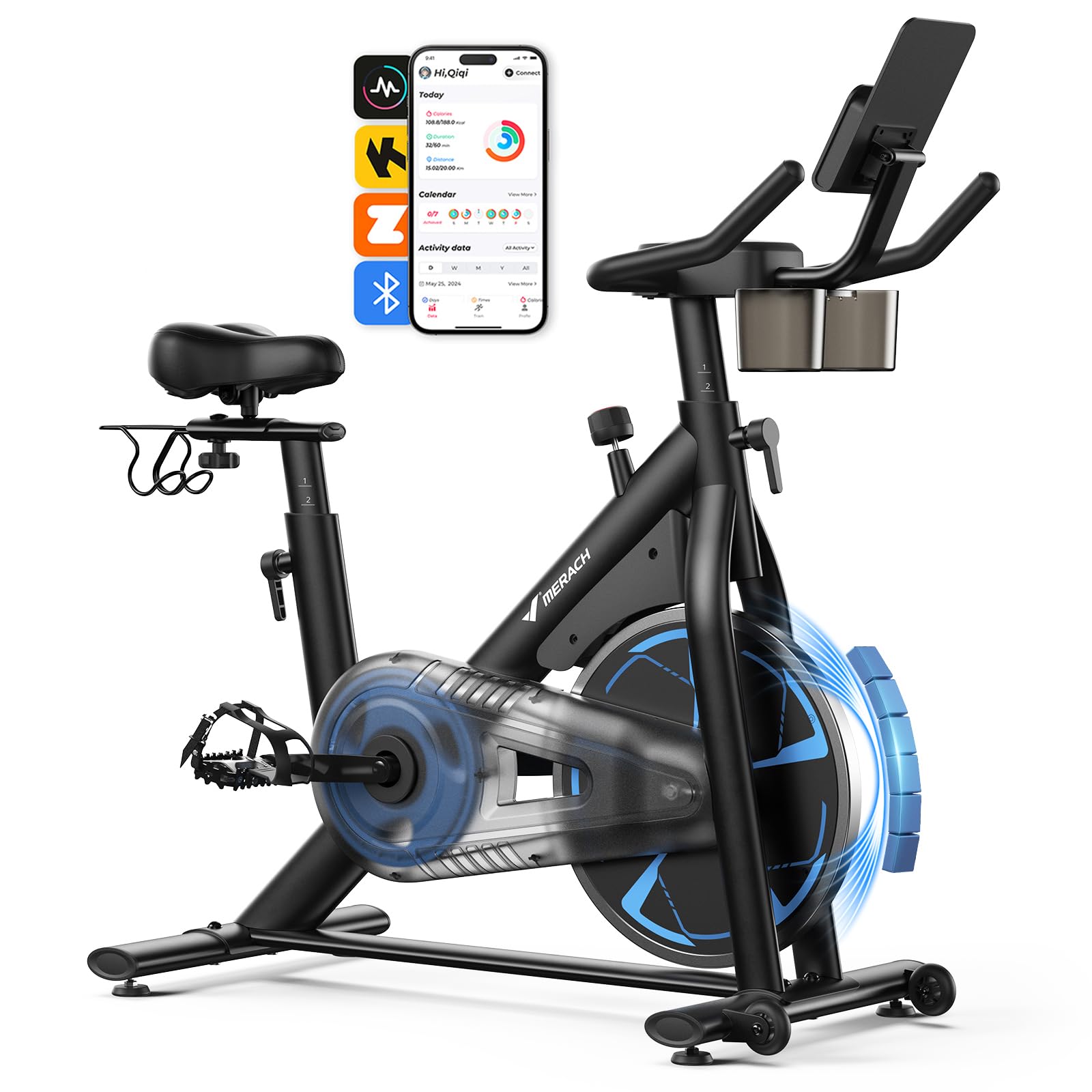
The Merach MR-S36L2 takes a different approach to resistance control — rather than discrete numbered levels, it offers infinite variability from 0 to 100 percent through the Merach app. This means you can slide smoothly from a recovery spin at 15 percent to a max-effort climb at 90 percent without any notchiness. The dual-triangle frame supports up to 330 pounds and stays stable even during high-cadence out-of-the-saddle efforts, while the 25 dB belt drive keeps the noise floor low enough for apartment living.
The high-density foam seat cushion is wrapped in wear-resistant PU leather and contoured to distribute pressure evenly — a genuine improvement over the hard, narrow seats found on most budget bikes. The 2-way adjustable handlebars and 4-way adjustable seat fit riders from 4’8″ to 6’4″, making this one of the most height-inclusive options on this list. The Merach app syncs with Google Fit and Apple Health, and the bike connects via Bluetooth for real-time tracking of resistance level, distance, time, and calories.
Assembly takes about an hour with the included tools and video instructions. Owners with family members of different heights appreciate the tool-free adjustments, though one reviewer noted that the distance readout shows double the actual distance traveled. The Bluetooth connection can also be finicky — some users report that the resistance level stops displaying in the app after a few rides, requiring a re-pair to fix. For the price, the S36L2 delivers a very smooth ride with excellent adjustability, but the app dependency for resistance feedback is a real limitation.
Why it’s great
- Infinite resistance variation through the app — no notches, no limits
- High-density foam seat evenly distributes pressure for longer comfortable rides
- Fits riders from 4’8″ to 6’4″ with tool-free 4-way seat and handlebar adjustments
Good to know
- Distance readout can show double the actual distance traveled
- Bluetooth connection may drop resistance data after several rides
- App requires an account and phone connection to control resistance granularly
8. Wenoker JC318 Exercise Bike
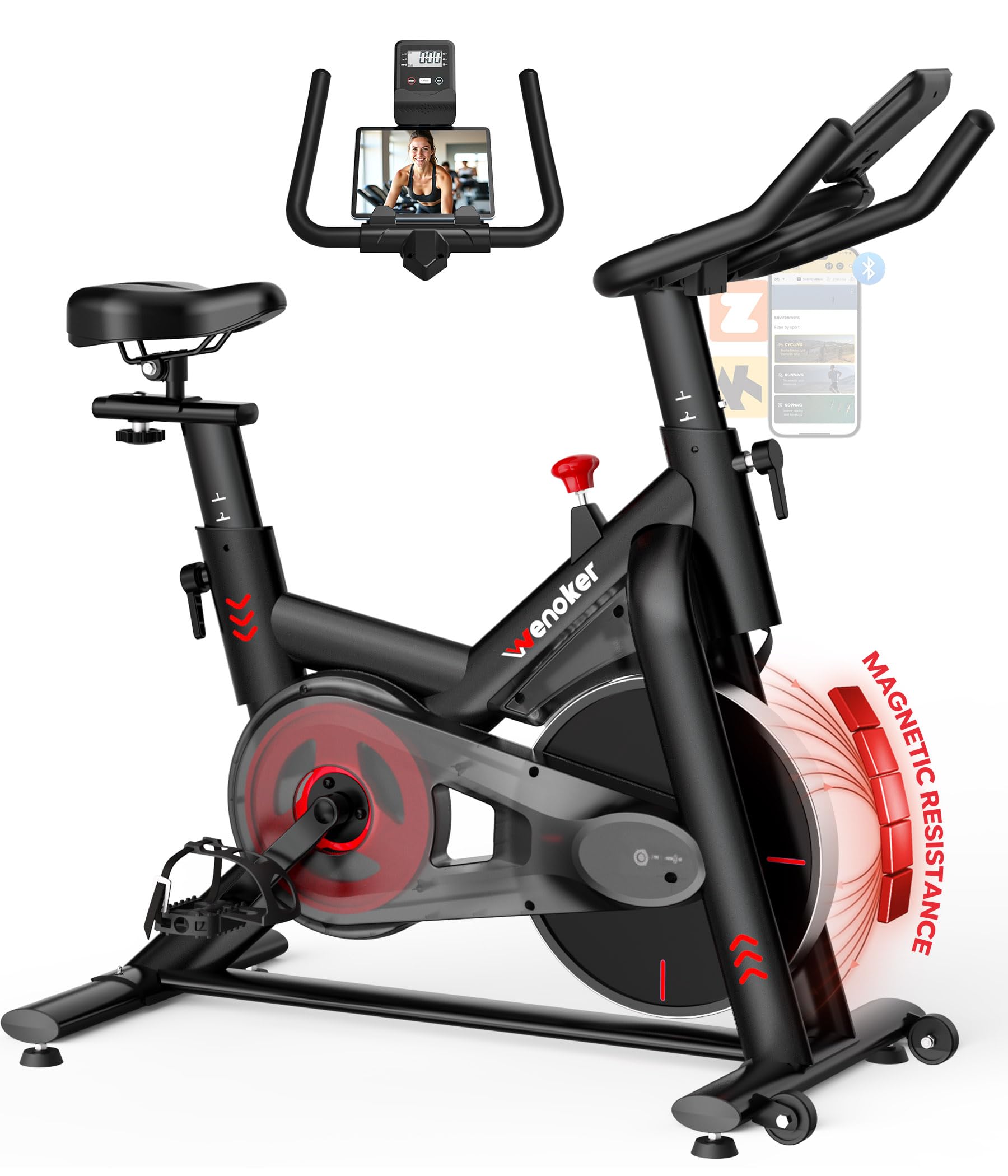
The Wenoker JC318 is the most affordable magnetic-resistance bike in this list that also includes app connectivity, making it a strong entry-level option for budget-conscious buyers who still want smart features. The reinforced steel frame supports up to 350 pounds and uses wide stabilizer feet to minimize wobble during steady-state rides, though aggressive sprinters may notice some frame flex at maximum effort. The belt-driven magnetic system operates quietly enough for apartment use, and the LCD screen tracks time, speed, distance, and calories at a glance.
App connectivity is the standout feature at this price point — the bike pairs with popular fitness apps to record ride data and add a motivational layer to indoor training. The adjustable seat supports multiple height and fore-aft positions, though the handlebars are fixed in height, which limits fit customization for taller riders. Assembly is straightforward at 20-30 minutes, and the package includes clear instructions and all necessary tools.
Owners consistently describe the JC318 as an excellent value, with many appreciating the smooth resistance curve and quiet operation. The main compromises are the seat comfort — several reviewers describe the stock saddle as small and firm — and the lack of a phone or tablet holder, which means you will need to rig your own solution to follow along with app classes.
Why it’s great
- App connectivity at an entry-level price point for ride tracking and motivation
- 350-pound max capacity from a reinforced steel frame for larger riders
- Magnetic belt drive stays quiet and requires no pad maintenance
Good to know
- Stock seat is small and firm — most owners replace it after the first week
- No integrated tablet or phone holder for following app classes
- Handlebars are fixed height, limiting fit options for very tall users
9. Lacuffy S1-Pro Indoor Cycling Bike
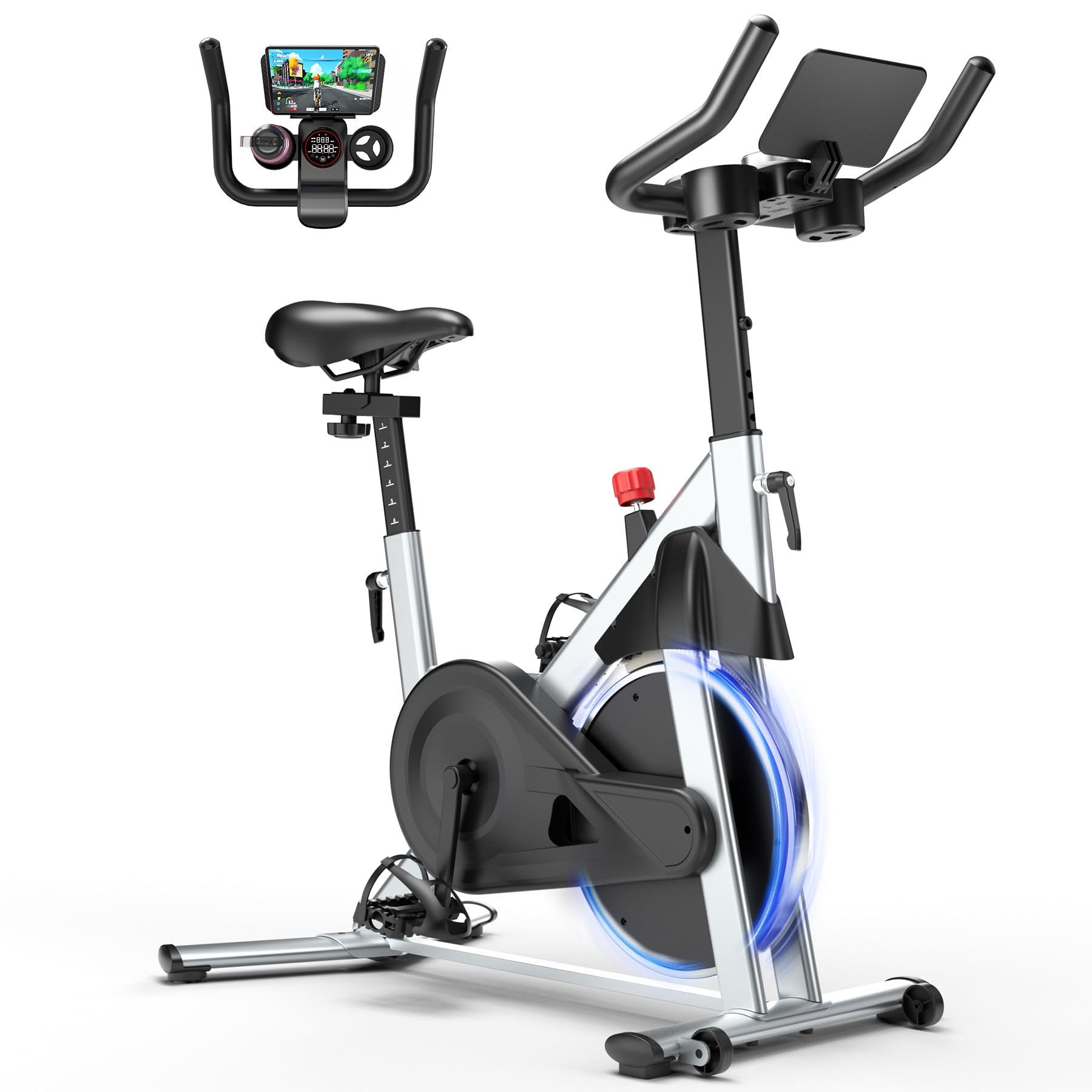
The Lacuffy S1-Pro is the budget king of this roundup, packing 32 magnetic resistance levels into a sub-44-pound package at an accessible price point. The resistance curve goes from a light breeze at level 1 to a steep mountain grind at level 32, and each detent is hardware-calibrated so that your “level 10” today feels the same as your “level 10” a year from now. The belt drive keeps noise under 25 dB, allowing midnight or early-morning sessions without disturbing the household.
The 6.61-pound flywheel is lighter than the premium options, but it provides enough momentum for smooth pedaling at moderate cadences. The 7-level height adjustments on the seat and handlebars accommodate riders from 5’1″ to 5’11”, though taller users may find the range limiting. The heavy-duty steel frame supports up to 300 pounds, and the cage pedals include adjustable straps to keep your feet secure during HIIT intervals.
Assembly is straightforward with the included instructions, and the built-in transport wheels make it easy to roll the 43-pound bike into storage. Owners praise the quiet operation and stable feel, though some note that the seat is on the firmer side — a gel seat cover solves that for under . The S1-Pro is the best choice for anyone who wants a magnetic, belt-driven bike at the lowest possible entry point without sacrificing resistance quality.
Why it’s great
- 32 hardware-calibrated magnetic resistance levels provide consistent tension over years
- Under 25 dB belt drive is quiet enough for shared apartments and late-night rides
- 43-pound weight with built-in wheels makes it easy to move and store
Good to know
- 6.61-pound flywheel is lighter than premium models, less momentum at low cadence
- Height range tops out at 5’11” — taller riders may feel cramped
- Seat is firm; most users add a gel cover for rides over 30 minutes
FAQ
Is magnetic resistance better than felt pad resistance for a home exercise bike?
What flywheel weight do I need for effective cardio training?
Can I use my Zwift or Peloton subscription with a non-branded exercise bike?
How much space do I need to set up an exercise bike at home?
What maintenance does a magnetic exercise bike require?
Final Thoughts: The Verdict
For most users, the best bike for exercise winner is the Schwinn IC4 because it combines a rock-solid 112-pound frame, 100 magnetic resistance levels, and full app compatibility at a price that undercuts smart-bike competitors by hundreds of dollars. If you want commercial-grade durability that will outlast every other component in your home gym, grab the Keiser M3. And for a recumbent design that protects the lower back while engaging the upper body through the arm exerciser, nothing beats the Pooboo W216.