
Our readers keep the lights on and my morning glass full of iced black tea. As an Amazon Associate, I earn from qualifying purchases.
Specs are compiled from manufacturer listings and verified buyer reviews and can change over time — please confirm the key details on the product page before buying.
Finding a home exercise bike that doesn’t rattle the floorboards or squeak through every pedal stroke is half the battle. You need something sturdy enough for daily use, quiet enough for a shared wall apartment, and adjustable enough that your whole household can hop on.
I’m Min — the founder and writer behind Gadgets Feed. This guide is built by comparing the manufacturers’ published specifications and the patterns across verified customer reviews, so you get each pick’s real strengths and trade-offs instead of marketing spin.
These nine picks cover upright, recumbent, and folding styles so you can find the exact bike for home exercise that fits your space, your knees, and your fitness level without guesswork.
Our Picks at a Glance

How To Choose The Best Bike For Home Exercise
The right bike for your home depends on three things: resistance type, frame style, and rider fit. Magnetic resistance is almost silent and requires no maintenance — ideal for apartments. Friction or felt-pad systems are cheaper but wear out and can squeak over time. Frame style matters just as much: upright bikes mimic a road position and take up less floor space, while recumbent bikes support your lower back with a wide seat and a backrest, making them a favorite for seniors or anyone nursing a sore lower back.
Weight Capacity and Build Quality
A heavier frame with a high weight limit — 300 lb or more — generally means less wobble at high cadence. Look for steel frames with a triangle reinforcement design if you plan on sprinting or standing while pedaling. A bike that flexes under load will feel unstable and can develop creaks after a few months.
Resistance Range and Adjustability
More resistance levels give you finer control over workout intensity. A bike with 8 to 16 levels lets a beginner warm up gently and a more experienced rider push into a climb-style effort. If you are sharing the bike with family, look for quick-adjust knobs or levers so nobody fights with the settings between sessions.
Seat and Handlebar Adjustability
A seat that moves both up and down (vertical) and forward and back (horizontal) is a must for households with different leg lengths. A non-adjustable seat can make rides painful after 15 minutes. Handlebars should also move vertically so you can find a riding posture that doesn’t strain your shoulders or lower back.
Quick Comparison
| Model | Best For | Resistance Type | Max Rider Weight | Flywheel / Frame | Amazon |
|---|---|---|---|---|---|
| Wenoker Magnetic★ Best Overall | Best Overall | Magnetic | 250 lb | Steel, compact | Amazon |
| Marcy FoldableSpace-Saver Pick | Budget Compact | Manual Magnetic | — | Steel, foldable | Amazon |
| DMASUN OrangeHigh-Capacity Choice | High Capacity | Magnetic | 330 lb | 35 lb flywheel | Amazon |
| Exerpeutic Foldable | Compact Value | 8-level Magnetic | 300 lb | Steel, 39 lb | Amazon |
| YOSUDA Pro | App Integration | Magnetic | 300 lb | 25 lb flywheel | Amazon |
| MERACH S26 | Smart App Features | Magnetic | 300 lb | Steel, 62 lb bike | Amazon |
| pooboo W216 | Full Body Workout | 8-level Magnetic | 400 lb | 15 lb flywheel | Amazon |
| MERACH S19 | Premium Recumbent | Magnetic | 330 lb | 6.6 lb flywheel | Amazon |
| Schwinn 130 | App Ecosystem | 16-level Magnetic | 300 lb | Perimeter-weighted | Amazon |
In‑Depth Reviews
1. Wenoker Magnetic Stationary Bike
Our pick — over 4.5★ from 950+ verified ratings; the strongest balance of quality and price.
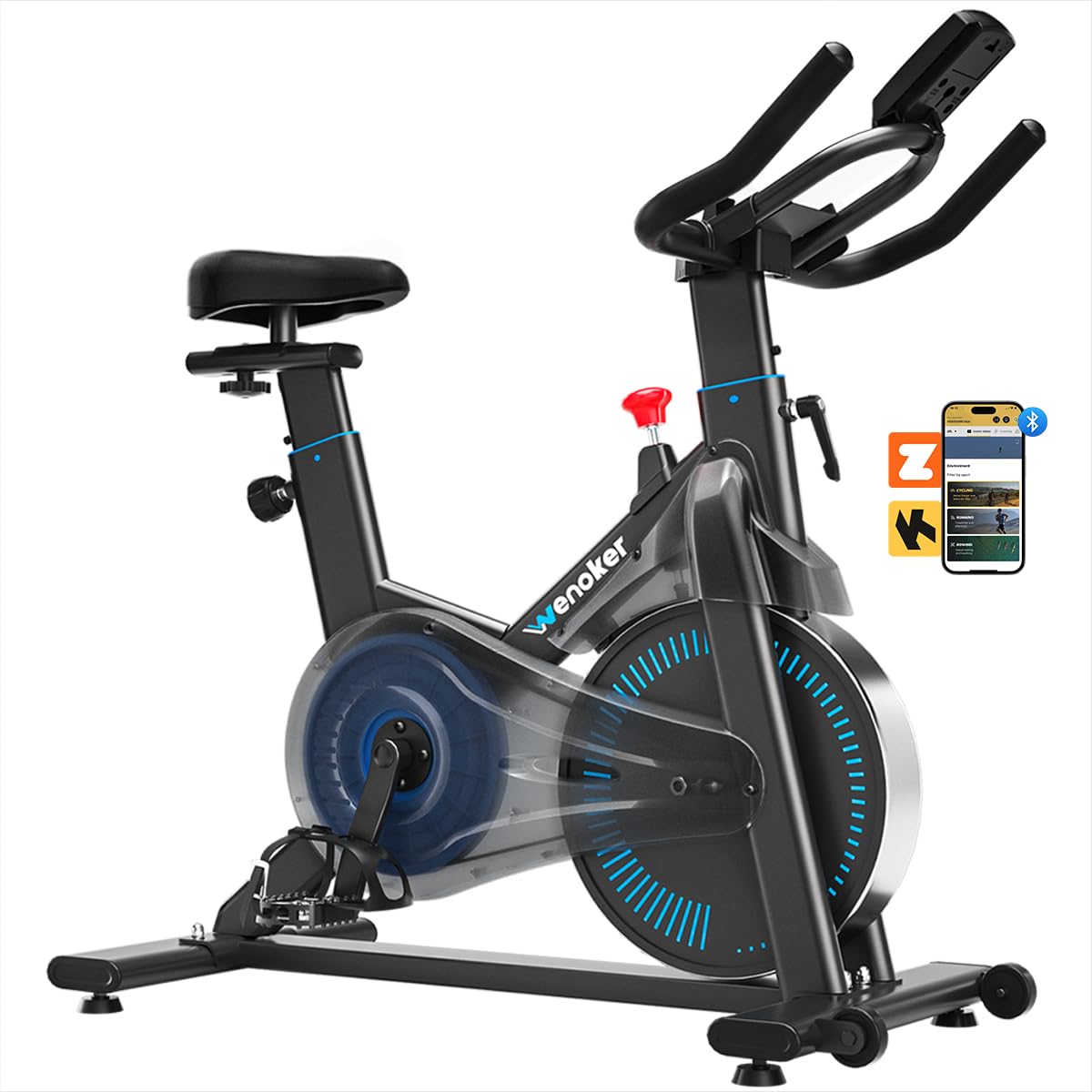
A near-silent, app-friendly bike that feels stable at full effort without taking over your living room.
This bike hits the balance for anyone who wants a smooth, quiet ride without spending a fortune. The magnetic resistance stays under 25dB — quiet enough for a dorm room or an early-morning session while the house sleeps. It is a crowd favorite, holding a 4.8-star average across more than 900 ratings, and the consensus is clear: owners consistently praise the build quality and how easy it is to put together.
The frame supports up to 250 lb with a reinforced steel triangle design that minimizes wobble. Riders from 4’6″ to 5’8″ will find a comfortable fit thanks to the 4-way adjustable seat and adjustable handlebars. Unlike the Marcy foldable below, this Wenoker also connects to Zwift and Kinomap — you can follow guided routes and track your stats through those apps. The digital monitor shows time, speed, distance, and calories, while the built-in tablet holder lets you watch shows on the go. Assembly takes about 20 minutes, and the included transport wheels make it easy to roll into a closet when you are done.
The honest trade-off here is the plastic seat bolt area. Some buyers report that while the bike feels solid at 250 lb, the bolt assembly near the seat can feel fragile compared to the rest of the frame. Keep the seat post tightened and you will be fine, but it is note if you plan on very aggressive pedaling. The bike also suits riders up to 5’8″ — taller users may find the leg extension limited.
Rider-First Design
- Ultra-quiet magnetic resistance under 25 dB — no disturbance during late-night rides
- Zwift and Kinomap integration for app-guided workouts and scenic routes
- Roughly 80% pre-assembled, with most owners finishing in about 20 minutes
Room for Caution
- Seat bolt area uses plastic parts that can feel fragile under heavier riders
- Best fit caps at 5’8″, limiting leg extension for taller users
Who it’s for: Home exercisers who want a compact, near-silent bike that works with popular fitness apps.
Think twice if: You are over 5’8″ or weigh near 250 lb and plan on hard daily sprints — the seat hardware may be a weak point.
2. Marcy Foldable Upright Exercise Bike
A foldable upright bike that disappears into a closet when guests come over.
The Marcy NS-653 is built for tight quarters. Its frame folds down to roughly half its assembled size, and the built-in transport wheels let you roll it into a corner without lifting. The manual magnetic resistance has variable levels — no preset clicks, just a knob that tightens smoothly. The LCD tracks distance, time, speed, and calories burned, giving you the basics without any app tie-ins.
Owners who bought this for knee rehab or post-surgery recovery found the low entry point and quiet operation to be a big plus. The pedals are counterweighted with adjustable foot straps, so your feet stay planted during the ride. But here is the honest catch: stability gets mixed reactions. Some find it very stable, while others report wobble at higher resistance. The handlebars sit close to the seat, which can make mounting a bit awkward — you essentially have to straddle the frame before lowering yourself down. The builders note that assembly took them more than two hours with two people, so set aside a chunk of time.
At 50 lb, it is lighter than most bikes here, which helps portability but also means it can feel less planted than a heavier steel frame. The resistance knob has no numbered settings — just a plus and minus — so replicating a specific workout from day to day requires feel rather than precision.
Why It Shrinks Your Space
- Folds to save floor space when not in use — plus transport wheels for easy rolling
- Quiet manual magnetic resistance suitable for apartments and shared walls
- Counterweighted pedals with adjustable foot straps keep feet secure
Where It Wobbles
- Mounting requires straddling the frame — not ideal for limited mobility
- Resistance knob offers no numbered clicks, making repeatable workouts a guessing game
Best for: Apartment dwellers who need a bike that folds flat and can be stashed away.
Look elsewhere if: You want a rock-solid frame at higher resistance levels or quick, tool-free assembly.
3. DMASUN Exercise Bike
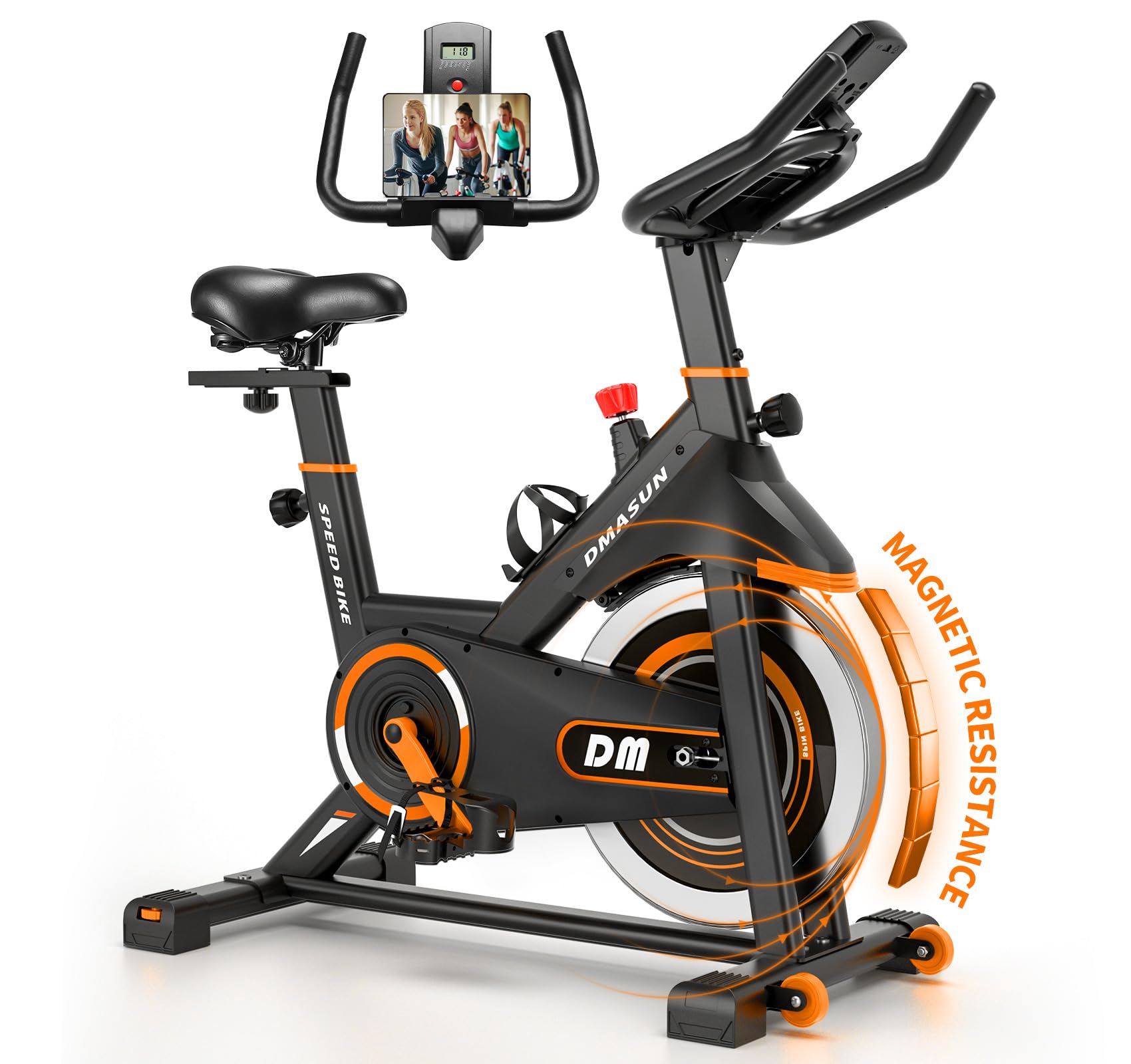
A 35-pound flywheel that keeps your momentum locked through every sprint and climb.
The DMASUN throws a serious amount of steel at the stability problem. It carries a 35 lb solid flywheel and an alloy steel frame that supports up to 330 lb, making it among the most weight-capacious upright bikes at this price. The magnetic resistance offers 100 levels — from a 0-20% warm-up all the way to 75-100% muscle-building resistance — so you are never stuck between settings that feel too easy or too hard. Owners describe the ride as nearly silent, measuring under 20 dB in testing.
Unlike the Marcy above, this bike avoids the wobble complaints. The frame uses thicker alloy steel than most competitors, and the four non-slip rubber foot covers keep the base planted on hardwood or tile. Assembly is about 70% pre-completed, and most owners mention finishing in 30 minutes or less. The seat cover and anti-loosening pedal nuts come standard — a direct fix for two of the most common stationary-bike complaints. The digital monitor tracks time, speed, distance, and calories, and it is compatible with Wahoo sensors for cadence data and with SPD pedals if you want to clip in.
The biggest real-world complaint is the handlebars. They adjust up and down, but they do not tilt forward or backward, so smaller riders may have to lean forward to reach them. The display is basic — no Bluetooth or app connectivity beyond the third-party sensor compatibility. If you are set on Zwift or a dedicated fitness app, the Wenoker or YOSUDA above offer a smoother experience.
Where It Excels
- 35 lb flywheel delivers consistent momentum and a road-like feel at any cadence
- 100-level magnetic resistance covers everything from a gentle warm-up to a hard climb
- 330 lb weight capacity makes it suitable for larger riders and families
One Limitation
- Handlebars do not tilt — shorter riders may need to lean forward to reach
Reach for this if: You want a heavy-duty, high-capacity bike with a buttery flywheel that won’t break the bank.
skip it if: App connectivity is a priority — this bike sticks to basic screen data and third-party sensors.
4. Exerpeutic Foldable Upright Bike
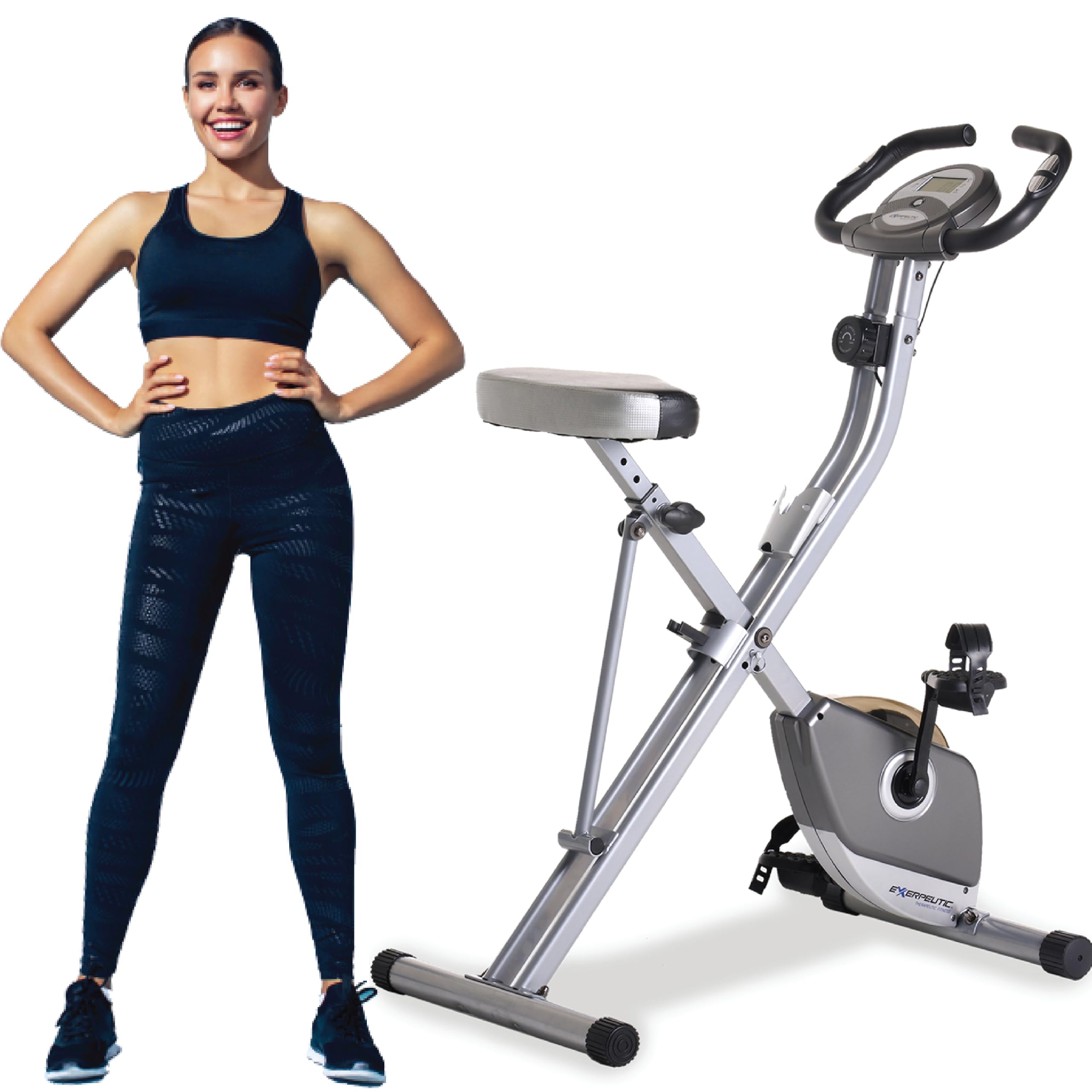
The best-selling folding bike that has logged millions of miles across thousands of living rooms.
With over 23,000 ratings and a 4.6-star average, this Exerpeutic is the most-reviewed bike in this list — that kind of volume tells you it delivers consistently for the price. It has an 8-level magnetic control system with a 3-piece high-torque cranking system that delivers a smooth pedaling motion. The frame weighs 39 lb and supports up to 300 lb, with a hand pulse monitor on the handlebars and larger pedals with safety straps. The LCD screen is 3.5″ by 1.5″, showing distance, calories, time, and speed. When folded, the bike shrinks to about half its assembled footprint — 20″ D x 22″ W x 55.5″ H.
Quality and assembly are the top-cited positives, with owners praising the quiet operation and the comfortable large seat that sits upright. Riders from 5’3″ to 6’1″ are accommodated by the adjustable seat cushion. However, some customers note durability issues over time — belts that snap after two years of consistent use, or a left pedal nut that jams. The resistance maxes out at level 8, which is adequate for light-to-moderate cardio but may leave advanced riders wanting more. There is no included tablet holder or water bottle cage, so you will need to buy those separately.
The folding mechanism is convenient but not instant — you have to remove a pin to fold and unfold it, which makes it better for occasional storage than daily stashing. The seat adjustment also requires you to dismount, so dialing in the perfect height mid-ride is not possible.
Value champ: Thousands of owners agree this is the gold standard of budget-friendly folding bikes — just plan on adding a tablet mount and expect occasional belt maintenance after heavy use.
The right pick if: You want a proven, low-cost upright for moderate daily cardio and the ability to fold it away.
Not for you if: You need high resistance for intense training, a tablet holder, or a zero-maintenance drivetrain.
5. YOSUDA Exercise Bike Pro
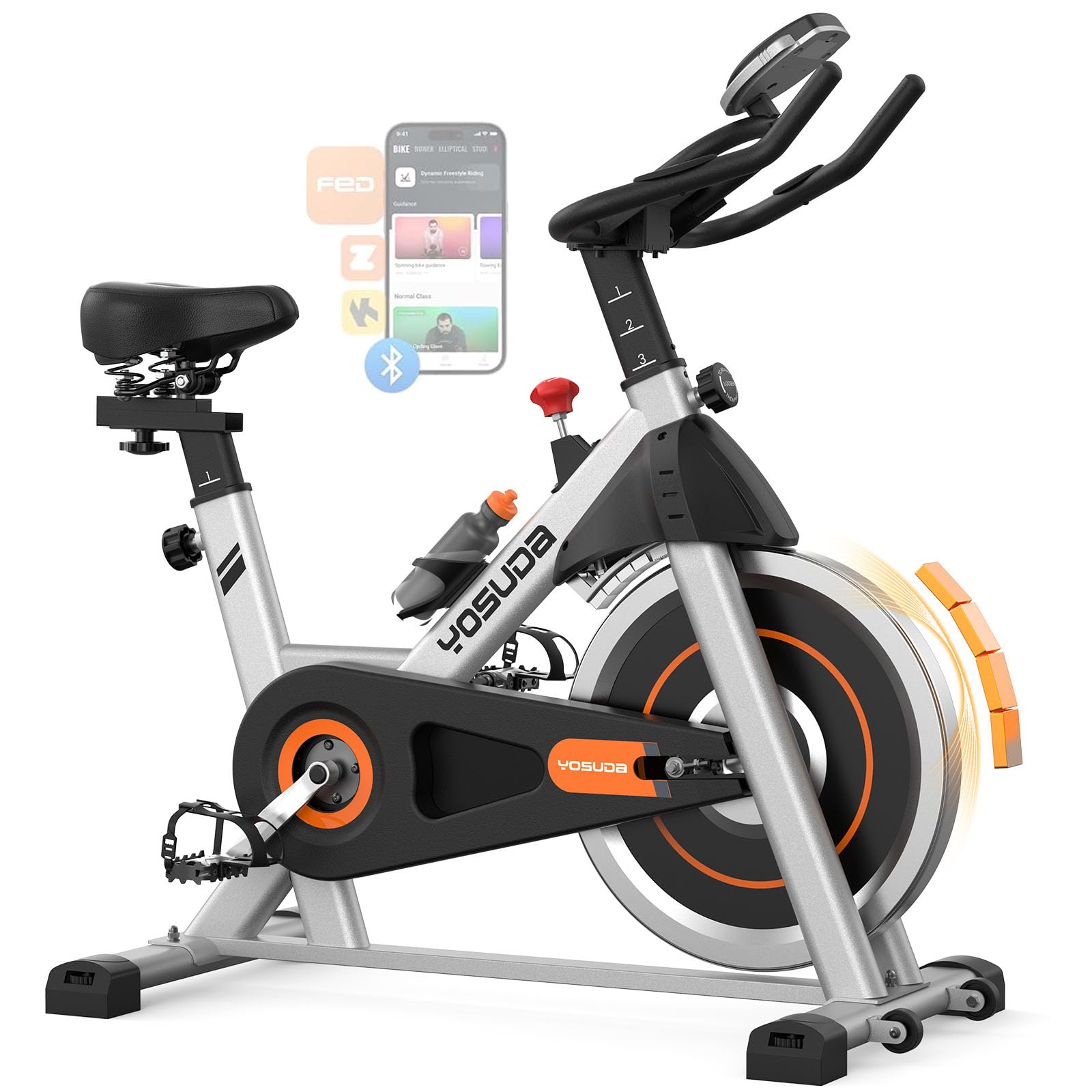
A 25-pound flywheel with exclusive app coaching for guided rides that keep you pushing.
This YOSUDA uses a magnetic resistance system that stays at about 20 dB — quiet enough for shared walls. The 25 lb balanced flywheel eliminates the dead spots that cheap bikes have, so the pedal stroke feels smooth and continuous whether you are grinding uphill or spinning fast. Riders from 4’8″ to 6’2″ are accommodated by a 4-way adjustable seat. The dual-triangle steel frame holds up to 300 lb with no visible flex. Bluetooth pairs with the YOSUDA app for real-time tracking of time, speed, distance, and calories, plus trainer-led workouts. It also arrives 80% pre-assembled, with most owners finishing setup in under 30 minutes.
Owners generally praise the ride quality and value, calling the drivetrain and flywheel feel “exceptional”. But several recurring complaints surface: the stock seat is uncomfortable for rides longer than 15 minutes (most owners swap it or add a gel cover), the included iPad holder feels cheap, and the resistance mechanism in some units wore out after 6 to 12 months of steady use. The seat slider offers minimal adjustment range, so very tall riders may find the fore-aft position limiting. The bike is also heavy — about 60 lb — and the single-direction transport wheels make maneuverability awkward.
Compared to the DMASUN above, the YOSUDA offers better app integration — the DMASUN sticks to a basic screen while the YOSUDA pairs with a smartphone and guided workouts. But the DMASUN feels more durable over the long haul with its 35 lb flywheel and thicker steel.
Strong ride, soft spots: The flywheel and frame are excellent, but the seat and durability of the resistance system are the weakest links — plan on a seat cushion and budget for potential mid-term repairs.
Go for it if: You want an app-connected bike with a smooth, heavy flywheel and are willing to upgrade the seat.
Pass if: You expect years of zero-maintenance use or need precise, infinite resistance adjustment.
6. MERACH S26 Exercise Bike
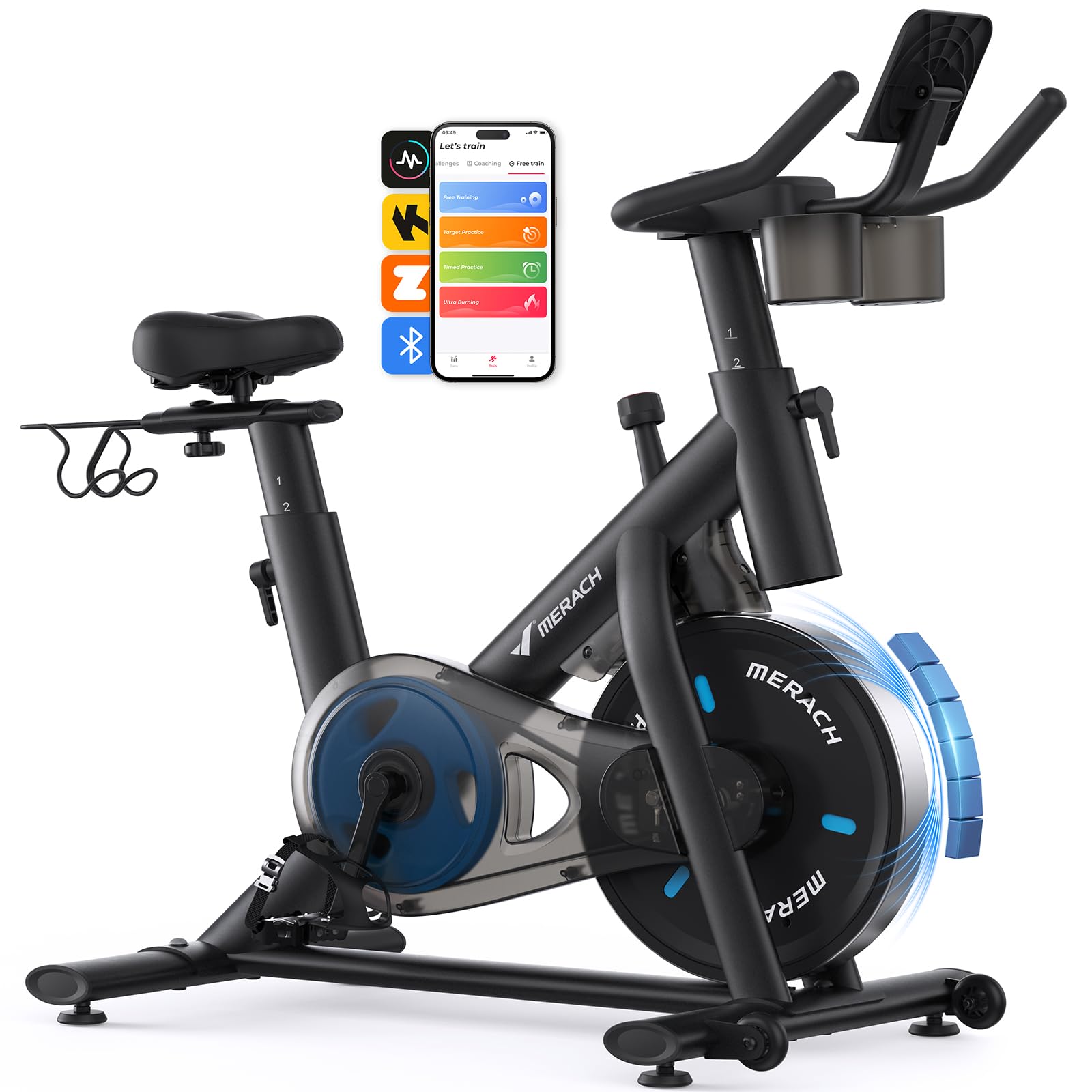
A 62-pound steel frame with its own fitness app, dumbbell rack, and whisper-quiet magnetic drive.
The MERACH S26 is built for a structured home gym setup. The reinforced inverted triangle frame uses 2.00mm thick steel and supports up to 300 lb. The magnetic resistance system stays under 25 dB, making it apartment-friendly. what separates it is the built-in dumbbell rack: you can keep a pair of light weights on the bike and incorporate upper-body moves while pedaling. The dual water bottle holders, adjustable 4-way seat, and 2-way handlebars accommodate riders from 4’8″ to 6’2″.
The MERACH app tracks real-time metrics — distance, time, calories — and pairs with Google Fit, Apple Health, KINOMAP, and Zwift. Owners consistently rate quality as the top aspect (with over 100 positive mentions), and the assembly is straightforward. However, the seat comfort divides opinion nearly equally: about 50 owners flagged it as uncomfortable, with several saying they needed to add a gel pad. The seat itself is a mixed bag — some find it perfectly fine for 30-minute sessions, others say it is rock-hard. The resistance knob offers 0-100% but the actual detents are limited to 8 levels, so fine-tuning may feel slightly coarse compared to the DMASUN’s 100-range system.
Compared to the YOSUDA above, this MERACH has stronger build quality (a 62 lb total bike weight vs YOSUDA’s 60 lb) and the unique dumbbell rack. But the YOSUDA’s 25 lb flywheel is heavier than the MERACH’s cast iron wheel, giving the YOSUDA a slight edge in momentum on climbs.
Feature-rich ride: The dumbbell rack is a genuine differentiator for simultaneous cardio and strength work, but plan on a seat upgrade if you are sensitive to firm padding.
Best for: Home gym users who want app integration plus the ability to work arms and legs together.
Think twice if: A comfortable stock seat matters to you — budget extra for a cushion.
7. pooboo Recumbent Exercise Bike
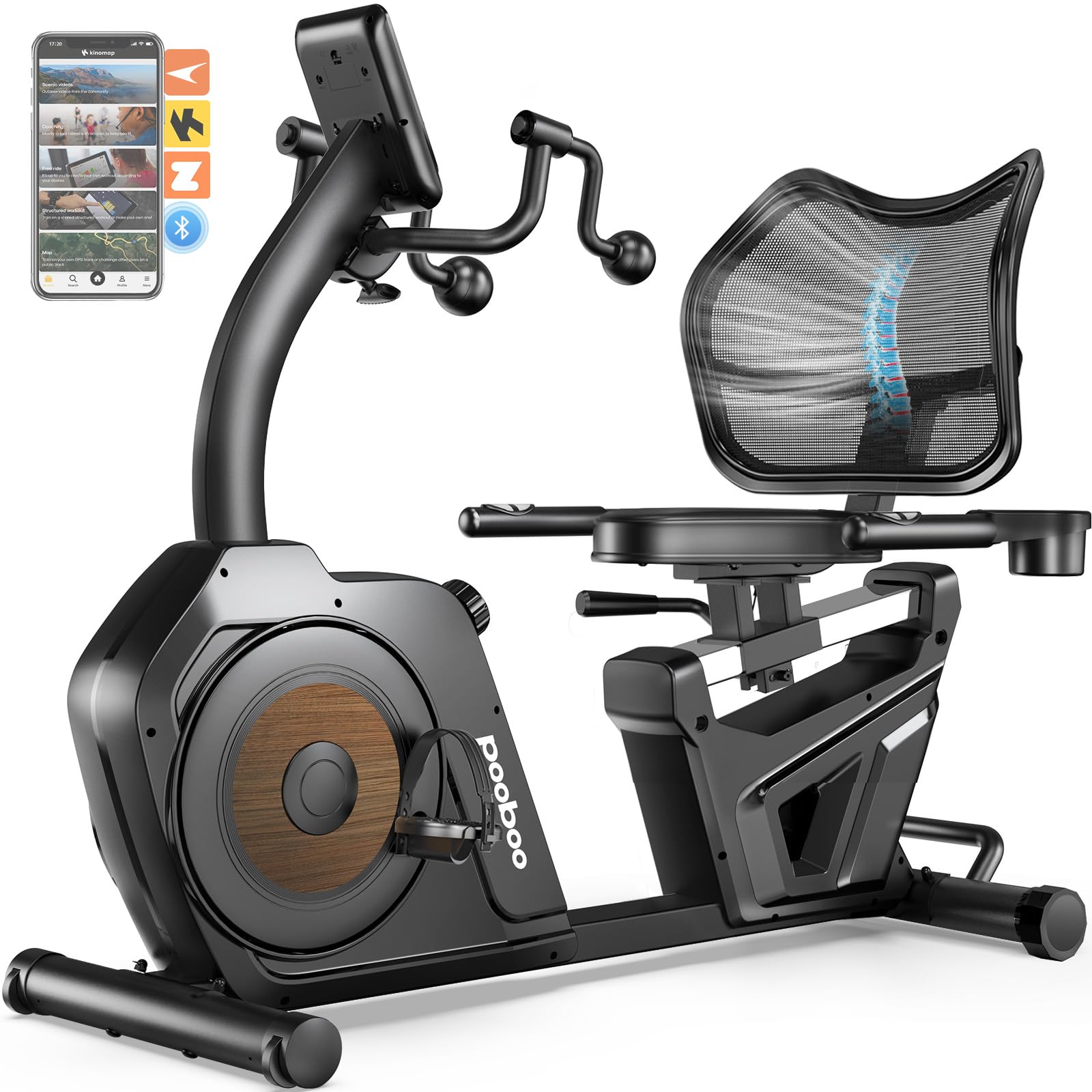
A recumbent bike that works your arms and legs simultaneously, with a 400-pound frame to match.
This pooboo is a light-commercial-grade recumbent that stands apart from every upright on this list. The one-piece steel frame supports 400 lb — the highest capacity here — and the 15 lb flywheel runs on a belt drive that stays at about 20 dB. The standout feature is the hand-cranked arm exerciser: you can move your arms forward and backward while the pedals turn, giving you a simultaneous upper- and lower-body workout. The seat slides on a rail up to 18.5 inches, and the breathable mesh backrest is shaped to support the spine. Riders up to 6’3″ can get a comfortable leg extension.
Assembly is the top-cited positive by a wide margin — over 80 owners found it easy, praising the clear instructions and 80% pre-assembled frame. The ergonomic backrest is a particular hit with owners who have lower back pain or are recovering from surgery. The LCD monitors speed, distance, time, calories, odometer, and pulse, and it is compatible with KINOMAP and Zt Smart Fitness apps. Transport wheels and a tail carry handle make moving the 80 lb machine less of a chore than its weight suggests.
The real-world trade-off involves the arm exerciser handles: they spin freely but have no independent resistance adjustment. You get a full-body range of motion, but the arm effort is limited to what your legs are already doing. The monitor also lacks a backlight, making it hard to read in dim rooms.
All-hands-on-deck: The arm handles add a genuinely useful upper-body component, and the 400 lb frame is the most accommodating here — just know the arm resistance is not adjustable independently.
Reach for this if: You want a recumbent with a high weight limit, back support, and the ability to work both arms and legs.
pass on it if: Independent arm resistance is a must, or you prefer a backlit screen.
8. MERACH S19 Recumbent Bike
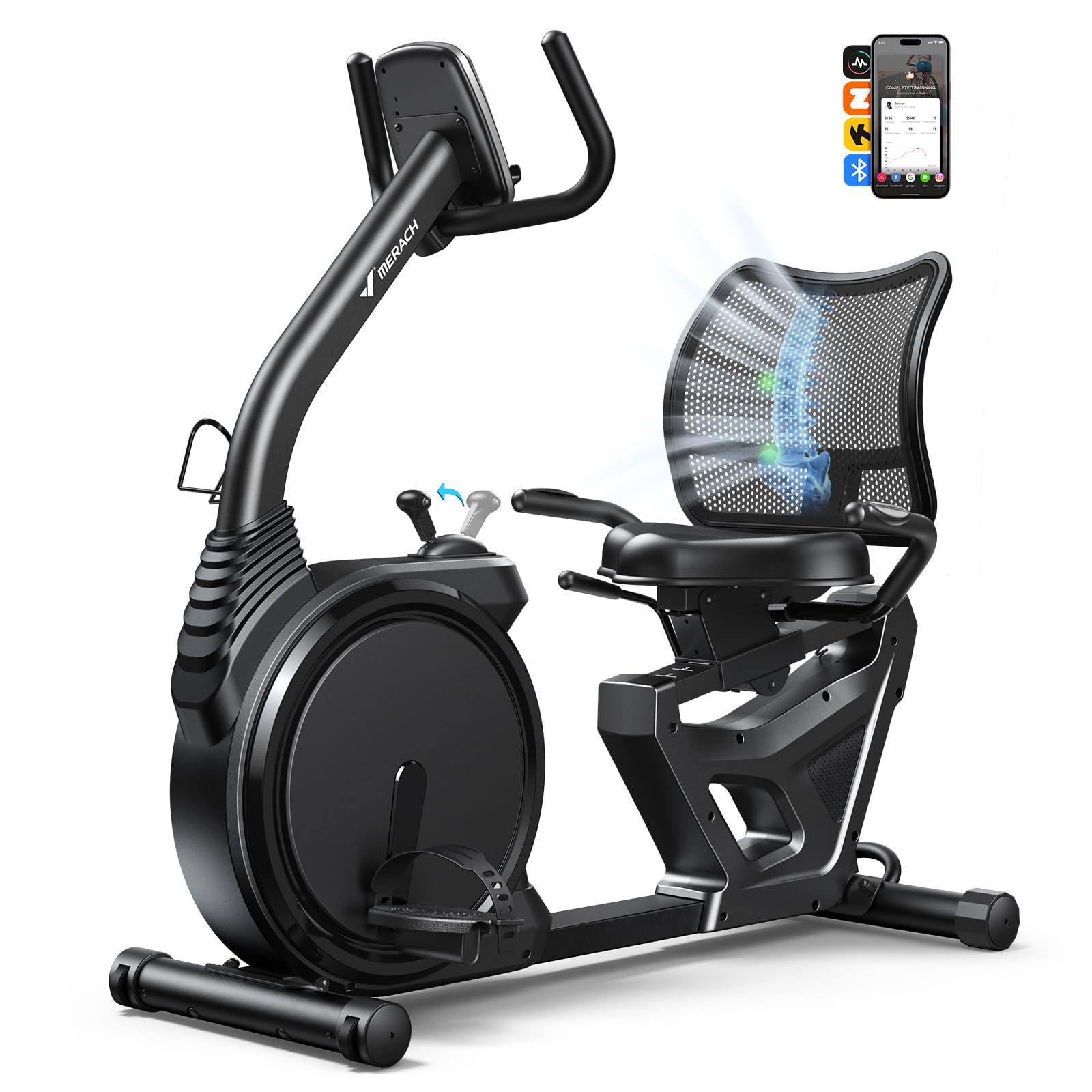
A car-style shift lever for quick resistance changes and a 330-pound frame that stays planted on any floor.
The S19 is a higher-end recumbent that simplifies the ride experience. Instead of a twist knob, it uses a car-style shift lever with 8 click-in levels — you can drop two resistance levels mid-pedal without fumbling. The frame supports 330 lb, and the total bike weight is 84.9 lb, giving it a heavy, planted feel that does not slide on hardwood. The thick, breathable mesh backrest and the padded seat can be adjusted across 8 positions, and the frosted handlebars resist sweat buildup. The LED display shows time, distance, speed, calories, and heart rate (via handle pulse sensors).
Assembly is the most-praised feature (over 160 positive mentions), with most owners completing it in under 30 minutes. The build quality earns consistent raves — the frame feels commercial-grade, and the quiet dual-belt drive system uses a 6.6 lb perimeter-weighted flywheel that stays silent even at high cadence. The Bluetooth connectivity works with the MERACH app for tracking and with the FantomFite app for gamified workouts. Riders from 5’2″ to 5’10” find the seat and pedal positioning comfortable, though taller users note the seat rail is shorter than expected.
The seat comfort is again a split opinion: several owners found the seat too firm and added a cushion for longer sessions. The pedal size is on the smaller side, which some users with larger feet found restrictive. The heart rate sensors require you to maintain consistent grip pressure, so readings can be jumpy compared to a chest strap.
Commercial feel, one compromise: The car-style lever and solid build put this a step above typical home recumbents, but the stock seat may need a pad for comfort on 45+ minute rides.
Best for: Riders who want a heavy, stable recumbent with quick lever-based resistance adjustment and app connectivity.
Look elsewhere if: You are over 5’10” or have very large feet — the seat rail and pedal area are on the compact side.
9. Schwinn Fitness 130 Upright Bike
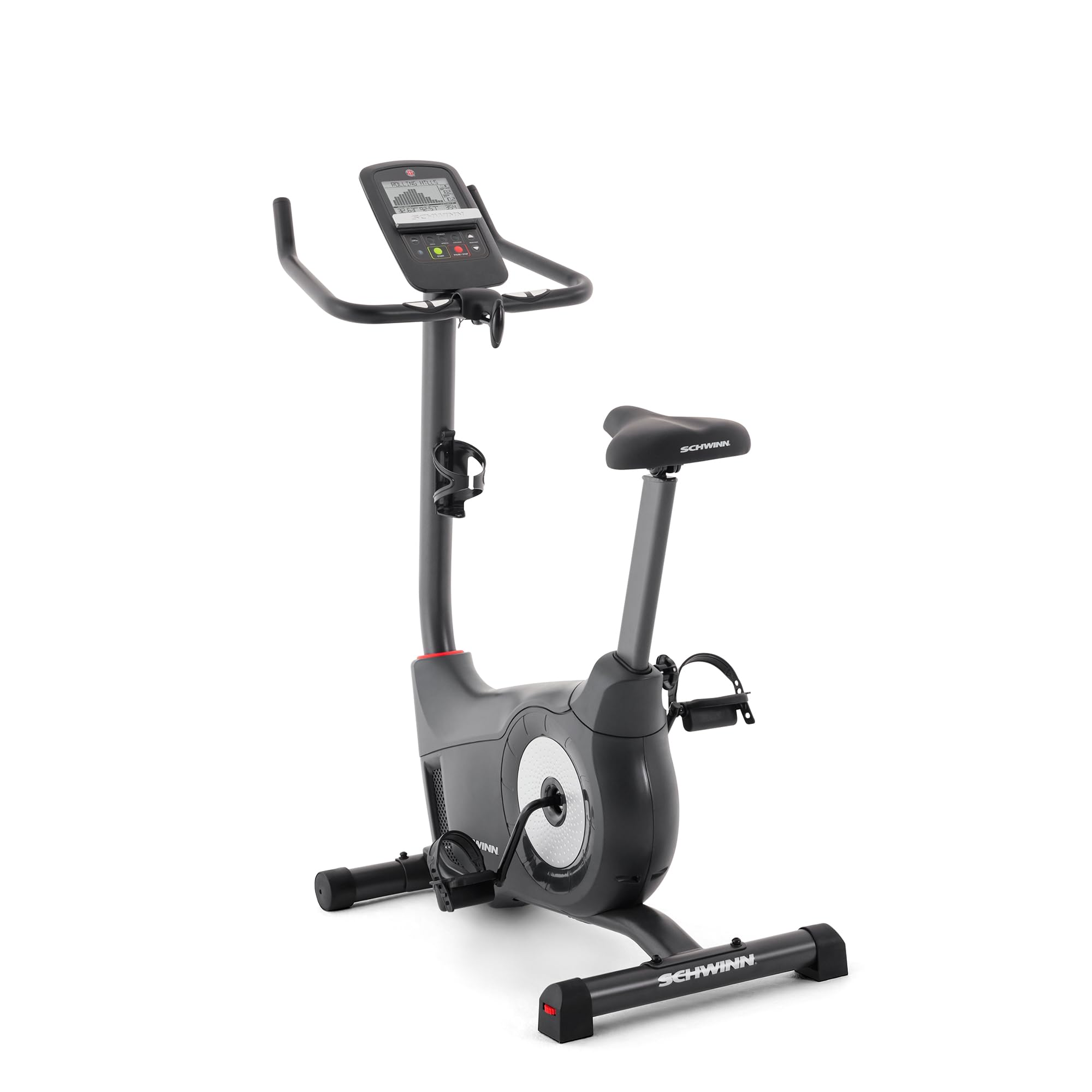
Bluetooth-connected riding with 40+ virtual routes and 13 preset programs in the 130 classic frame.
The Schwinn 130 is a dedicated upright bike for people who want structured workouts. It offers 16 levels of magnetic resistance — the widest range on this list — and a 5.5-inch LCD that displays 13 workout programs. Bluetooth connectivity lets you pair with popular apps: “Explore the World” offers 40+ global routes that auto-adjust resistance to your speed, and Zwift adds over 1,000 structured workouts and 80+ virtual routes. The high-inertia, perimeter-weighted flywheel is designed for a smooth and quiet pedal stroke. The ergonomic grip heart rate handle and a telemetry heart rate receiver give you multiple ways to track your pulse.
Owners consistently praise the smooth, quiet belt drive and the sheer variety of built-in programs — you can pick a manual mode, a preset interval routine, or connect to Zwift for a guided ride. Performance is the top-cited positive. However, comfort gets mixed reviews: some find the foam comfort seat perfectly fine, while others call it painful on the sit bones after 20 minutes. The resistance system can be sensitive to automatic control from third-party apps, and the Bluetooth pairing process can be finicky (you have to hold the button for 3 seconds and manually select “SCH130” as a power source).
Compared to the DMASUN above, the Schwinn offers a 16-level system vs DMASUN’s 100 levels, so the Schwinn gives broader steps between resistances. But the Schwinn’s app integration — Zwift, Explore the World — is far deeper than the DMASUN’s sensor-only compatibility. The downside is that those app features require paid subscriptions (Zwift and Explore the World both charge monthly). The hand-grip heart rate sensors are narrow enough that some owners find them awkward to hold for extended periods.
App-powered riding: The 16 resistance levels and Zwift compatibility make this the most versatile upright for structured training, but the stock seat is polarizing and the app subscriptions add recurring cost.
Choose this if: You want a Bluetooth-enabled upright with deep Zwift and Explore the World integration and a wide resistance range.
Pass if: You want a one-time purchase with no subscription fees, or you need a bike with infinite fine-adjustment resistance.
Understanding the Specs
Magnetic Resistance
Magnetic resistance uses magnets placed near a metal flywheel to create drag. Unlike friction pads that rub against the wheel and eventually wear down, magnets never touch anything — so the system stays silent and requires no maintenance. This is the gold standard for home bikes because you can ride early in the morning or late at night without waking anyone up. Look for a bike that advertises magnetic or “silent magnetic” resistance; any bike that mentions felt pads or wool pads uses a friction system that will need replacement parts over time.
Flywheel Weight
The flywheel is the heavy disc inside the bike that keeps spinning when you stop pedaling. A heavier flywheel (15 lb to 35 lb) creates more momentum, which means the pedal stroke feels smoother and more like riding a real bike on a flat road. A light flywheel (under 10 lb) tends to have “dead spots” — moments in each pedal revolution where the motion feels jerky or sluggish. If your goal is a natural, road-like feel, aim for a flywheel over 20 lb. If you are doing low-cadence rehab work, a lighter flywheel is perfectly fine and makes the bike easier to move.
FAQ
What is the difference between an upright bike and a recumbent bike?
How much space do I need for a home exercise bike?
Do I need a bike with app connectivity?
What weight capacity should I look for?
How long does it take to assemble a home exercise bike?
What is the difference between magnetic and fan resistance?
A home exercise bike can support weight loss when used consistently at moderate to high intensity.
How do I maintain my exercise bike to make it last longer?
Final Thoughts: The Verdict
If you want one dependable pick, the bike for home exercise winner is the Wenoker Magnetic Bike because it combines near-silent resistance, Zwift/Kinomap connectivity, and speedy 20-minute assembly at a crowd-favorite price. If you want a high-capacity upright with a 35 lb flywheel that shrugs off 330 lb, grab the DMASUN. And for a recumbent with arm-exerciser handles and a 400 lb frame that coddles a sore back, the pooboo W216 is the one to reach for.
How We Picked
We do not accept paid placement. Every pick is matched to a real buyer and a real use-case; we do not hands-on test units.
Sources & Methodology
Specifications: manufacturer listings and product documentation. Review insights: verified customer reviews, as of July 2026. Pricing: not shown on this page (it changes often); check the current price via the retailer link.
As an Amazon Associate, Gadgets Feed earns from qualifying purchases. This does not affect which products we feature.