
Our readers keep the lights on and my morning glass full of iced black tea. As an Amazon Associate, I earn from qualifying purchases.
If you’re trying to find a bike a teenage boy will actually ride—rather than one that sits in the garage—you need to match the wheel size, brakes, and frame toughness to what he wants to do. Whether that’s dirt jumps, neighborhood cruising, or skate-park tricks, a bad choice looks great online but feels flimsy after one hard landing.
I’m Min — the founder and writer behind Gadgets Feed. This guide is built by comparing the manufacturers’ published specifications and the patterns across verified customer reviews, so you get each pick’s real strengths and trade-offs instead of marketing spin.
Every recommendation here focuses on 20-inch or 24-inch wheels, honest build quality, and the kind of brakes and gearing that suit a growing rider.
Quick Picks
- WEIZE Freestyle BMX Bike, 20 inch — Best Overall
- cubsala Freestyle BMX Bike, 20 Inch Yaphet-K — Best for Tricks
- cubsala 20 Inch Beginner BMX Bike Echo — Best Value
- JOYSTAR Brockway Freestyle Kids BMX Bikes 20″ — Best Looking
- JOYSTAR 20 Inch Contender Kids’ Mountain Bike — Best for Trails
- Glerc 20 Inch Kids Skyline Mountain Bike — Best for Hills
- cubsala 20 Inch BMX Race Bike Trident — Budget Champion
How To Choose The Best Bike For Teenager Boy
The two biggest mistakes are picking a wheel size based on age tags instead of actual height, and assuming a cheap bike from a big-box store will survive park sessions. Here are the four specs that separate a good teenage bike from a frustrating one.
Wheel Size: 20 Inches vs 24 Inches
This is the single most important fit decision. A 20-inch wheel fits riders roughly 4’0″ to 5’8″ tall and is the standard for BMX trick bikes. A 24-inch wheel suits riders from about 4’4″ to 6’2″ and feels more stable at speed on pavement or trails. Choosing by the rider’s inseam (the inside leg measurement) rather than the suggested age range is much more reliable.
Brake Type: V-Brake, U-Brake, Caliper, or Disc
For a BMX trick bike, a rear U-brake or caliper brake is standard—lightweight and simple, but not as strong in wet conditions. For a mountain bike that will see dirt, mud, or downhill sections, a disc brake (either mechanical or hydraulic) delivers much better stopping power in all weather. V-brakes (linear pull brakes) are a common middle ground: good enough for pavement and light trails, and easier to maintain than disc brakes.
Frame Material: Hi-Ten Steel vs Chromoly vs Carbon Steel
Almost every bike in this price range uses Hi-Ten steel (high-tensile steel) or carbon steel. These are heavy but very durable—they can take a beating at the skate park without cracking. Chromoly steel is lighter and stronger but typically found on bikes costing significantly more. For a teen who will ride hard, a heavy but tough steel frame is actually an advantage; it survives the learning phase without bending.
Gearing: Single Speed vs Multi-Speed
Single-speed drivetrains are standard on BMX trick bikes—they remove complexity, require almost no maintenance, and provide direct power for jumps and spins. Multi-speed bikes (typically 7 to 21 gears) are better if the teen will ride up hills, cover longer distances on pavement, or mix off-road terrain with casual cruising. The catch is more maintenance and more things that can go wrong if the bike is left outside in the rain.
Quick Comparison
On smaller screens, swipe sideways to see the full table.
| Model | Best For | Wheel Size | Brake Type | Speeds | Amazon |
|---|---|---|---|---|---|
| cubsala Yaphet-K | Trick riders who want a 360 rotor | 20 inch | Aluminum U-brake | 1 | $259.99Amazon |
| WEIZE Freestyle BMX | All-around BMX beginners | 20 inch | Linear Pull (V-brake) | 1 | $159.99$189.99PrimeAmazon |
| JOYSTAR Brockway | First BMX for younger teens | 20 inch | Caliper | 1 | $179.99Amazon |
| JOYSTAR Contender | Dual-suspension trail riding | 20 inch | Linear Pull (V-brake) | 1 | $179.99Amazon |
| Glerc Skyline | Longer rides with hills | 20 inch | Disc | 21 | from $199.99Amazon |
| cubsala Trident | Race-style BMX on pavement | 20 inch | V-brake | 1 | $209.99$219.99Amazon |
| cubsala Echo | Budget-friendly beginner BMX | 20 inch | Rear U-brake | 1 | $169.99Amazon |
In‑Depth Reviews
1. WEIZE Freestyle BMX Bike, 20 inch

A 20-inch freestyle BMX that lets you spin the handlebars full circle without tangling the brake cables.
The 360-degree rotor (a special cable-routing system inside the headset that allows full handlebar rotation) is the defining feature here. It matters for bar spins and other advanced tricks. Unlike the cubsala Echo, where the handlebar can’t rotate 360° due to the brake line, the WEIZE is built from the ground up for freestyle. The single-speed drivetrain (170mm one-piece forged steel cranks, 32T chainring and 16T freewheel) removes gear complexity. Buyers report that “rear brakes were hard to put in but I was able to figure it out,” so prepare for a slightly tricky rear brake setup during assembly.
Wide 20×2.40-inch tires (about 2.4 inches wide) grip pavement and absorb bumps from small jumps. The V-brakes deliver instant stopping power for precise control. At 20 inches, it fits riders from 4’0″ to 5’8″, meaning a tall 12-year-old or a short 15-year-old can both ride it. The silver frame looks clean, but the custom brake cable routing means finding spare parts later might take some hunting.
Why it’s great
- 360-degree rotor enables real freestyle tricks without cable damage
- Four pegs included so you can start grinding and stalling right away
- One-piece forged steel cranks handle repeated hard landings
Good to know
- Rear brake assembly is fiddly; owners mention it takes patience to get right
- Custom brake cable design means replacement parts may not be standard
Best for: A teen who wants to learn bar spins and basic skate-park tricks without outgrowing the bike in one season.
Skip if: You want a bike for longer pavement rides or hill climbing—the single speed and BMX geometry aren’t comfortable for distance.
2. cubsala Freestyle BMX Bike, 20 Inch Yaphet-K

A gold-framed freestyle BMX that has been ridden hard for over a year and is still going strong, according to buyers.
The cubsala Yaphet-K shares the same 360-degree rotor (allowing full handlebar spins) as the WEIZE, but uses an aluminum U-brake instead of V-brakes. Multiple customers note a consistent downside: “Excellent bike, except for the brakes. They will not lock the tire up.” Even a professional bike shop couldn’t improve the braking force, so this is a bike for tricks and flatland moves, not high-speed stopping. The Hi-Ten steel frame has a 20.5-inch top tube length and includes four pegs.
One buyer who owns nine bikes called this his favorite, praising the low rolling resistance and easy pedaling. The 165mm one-piece crank with a 25T chainring gives good acceleration for quick bursts at the skate park. The aluminum single-wall 36H rims (36 spokes) with a 9T cog sealed-bearing cassette rear hub keep the wheels spinning smoothly. The downside: no kickstand is included, and the stock seat is mediocre. For a teen focused on freestyle rather than cruising, this holds up very well.
Why it’s great
- 360-degree rotor for full bar spins, same as premium freestyle bikes
- Four BMX pegs included for grinding and stalling
- Sealed-bearing cassette rear hub reduces maintenance over time
Good to know
- Brakes are notably weak even after professional adjustment
- No kickstand included and the stock saddle is uncomfortable for seated riding
Best for: A teen who mainly rides skate parks and flatland tricks and can accept minimal braking force.
Skip if: He needs reliable stopping power for street riding or downhill sections.
3. cubsala 20 Inch Beginner BMX Bike Echo
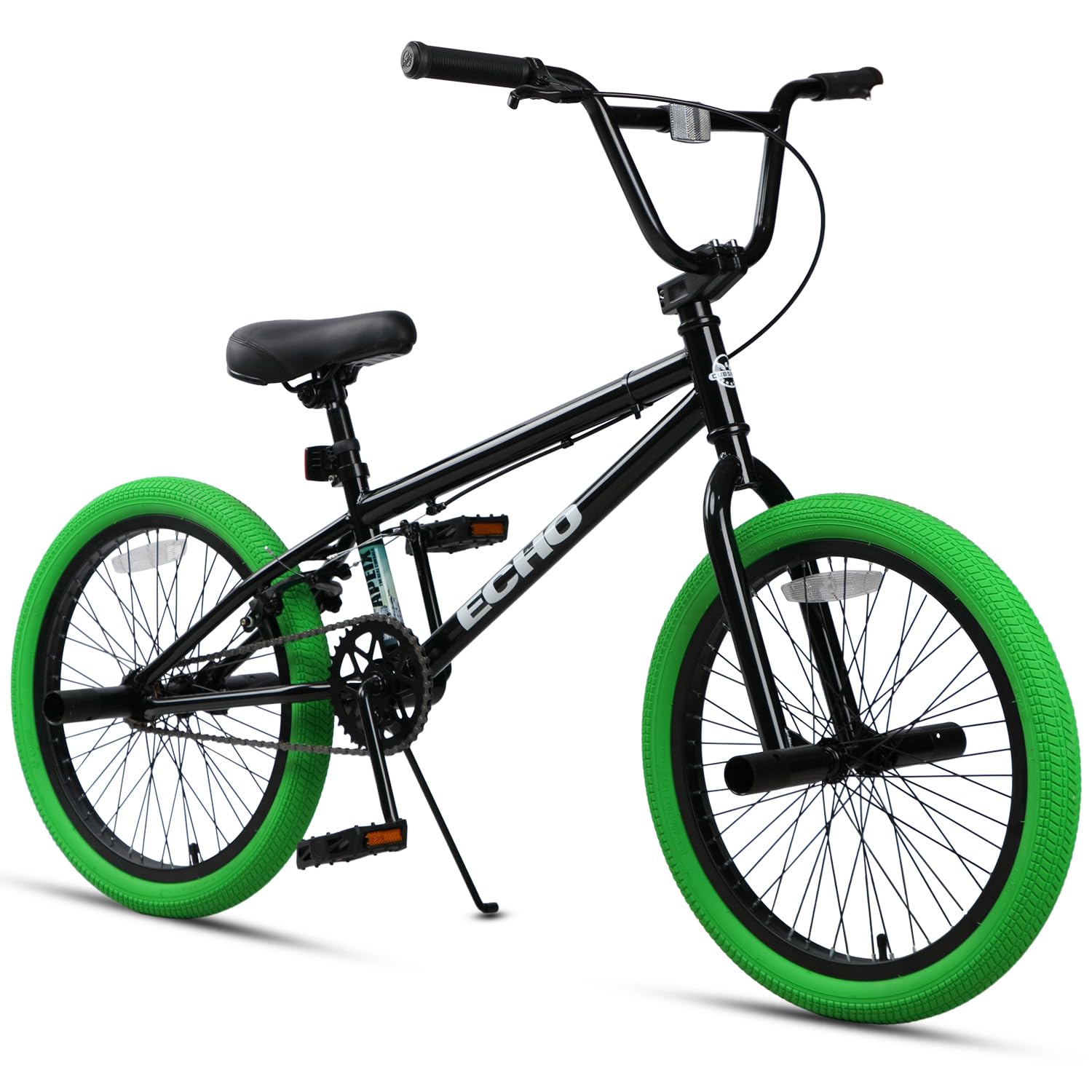
A beginner BMX with green tires and a frame that reviewers point out rivals bikes costing three times more.
The cubsala Echo is the most affordable entry-level BMX in this lineup, yet buyers consistently call the build quality excellent. The high-tensile steel frame and rear U-brake keep things simple. One buyer wrote: “Handlebar can’t rotate 360° due to brake line”—so this bike lacks a rotor, meaning no bar spins. It comes with four pegs, a tool kit, gloves, and reflectors. Shoppers say the assembly is very easy, comparing it to IKEA furniture.
The 20-inch version fits riders 4’0″ to 6’2″, an unusually wide range. The single-speed drivetrain with a rear U-brake is straightforward and low-maintenance. A detailed review points out that the screw-on pegs leave no room to tighten the axle bolts, meaning the wheels are held by the pegs themselves. Some buyers swap in aftermarket pegs to fix this. For a teen just starting BMX, this bike gives a solid, durable platform at a fair price.
Why it’s great
- Exceptional build quality for the price; buyers report it rivals bikes costing three times more
- Very easy assembly with all tools and gloves included
- Includes four pegs for basic grinding and passenger riding
Good to know
- No 360-degree rotor, so bar spins are not possible
- Screw-on pegs can loosen the axle nuts; aftermarket pegs are a better long-term solution
Best for: A younger teen or beginner who wants a reliable, easy-to-assemble BMX for learning basic tricks without spending a lot.
Skip if: Your son wants to do bar spins or freestyle tricks that require a 360-degree rotor.
4. JOYSTAR Brockway Freestyle Kids BMX Bikes 20″

A colorful 20-inch BMX that owners mention is way better quality than anything at Walmart.
The JOYSTAR Brockway comes in multiple bright color options including green and purple. It’s designed for younger teens (4’0″ to 4’8″ for the 20-inch version). The single-speed drivetrain uses a 165mm one-piece crank with a 36T chainring and a rear caliper brake. Buyers warn: “Brakes very poor, pads wear fast, rims wobble quickly.” The caliper brake is simple but not as powerful as the V-brakes on the WEIZE or the U-brake on the cubsala Echo.
One buyer received a bike with a “front wheel slightly warped on first unit; second unit near-perfect,” suggesting the quality control on wheel trueness is inconsistent. The bike weighs less than expected according to buyers, which is good for learning tricks but may feel less planted at speed. The 20×2.125-inch tires (about 2.125 inches wide) are narrower than the WEIZE’s 2.40-inch tires. It includes a kickstand, two pegs (fewer than most competitors), and DIY decals. The limited lifetime warranty adds peace of mind.
Why it’s great
- Multiple vivid color options including purple and green
- Lighter than expected, which helps with learning tricks and carrying up stairs
- Limited lifetime warranty on the frame
Good to know
- Brake pads wear quickly and the stopping power is weak
- Front wheel may arrive slightly warped; possible quality-control inconsistency
Best for: A younger teen who wants a colorful, lightweight bike for casual street riding and light tricks.
Skip if: You need reliable, powerful brakes or a bike that can handle aggressive skate-park sessions.
5. JOYSTAR 20 Inch Contender Kids’ Mountain Bike

A single-speed mountain bike with front and rear suspension that softens bumps on gravel and dirt.
Unlike every other pick on this list—which are BMX-style—the JOYSTAR Contender is a true dual-suspension kids’ mountain bike. It has a front suspension fork and a rear spring shock that absorb bumps for a smoother ride. The 20×2.125-inch pneumatic tires (air-filled tires you pump up) provide good traction in wet and dry conditions. The frame is hi-ten steel, and the bike weighs 26.5 pounds, which is heavier than the BMX options but expected for a mountain bike with suspension.
Buyers praise the build quality and shock absorption, but one reviewer who does 5-6 miles daily notes the seat is “uncomfortable for long rides; gel cover recommended.” The single-speed drivetrain is unusual for a mountain bike—it limits hill climbing ability. The dual handbrakes (front and rear linear-pull V-brakes) provide consistent stopping. Unlike the Glerc Skyline, which has 21 gears for tackling hills, this bike is best for flat to gently rolling trails. The kickstand and fenders are included, making it a practical neighborhood trail bike.
Why it’s great
- Dual suspension (front fork + rear spring shock) smooths out gravel and light trail bumps
- Thick, puncture-resistant tires handle pavement and packed dirt well
- Includes fenders and kickstand for practical everyday use
Good to know
- Single-speed drivetrain struggles on any significant hill
- Stock saddle is uncomfortable for rides longer than 30 minutes; a gel cover helps
Best for: A teen who rides gravel paths, packed dirt trails, and neighborhood pavement but doesn’t need hill-climbing gears.
Skip if: He needs to climb steep hills or ride longer distances where multiple gears make a difference.
6. Glerc 20 Inch Kids Skyline Mountain Bike
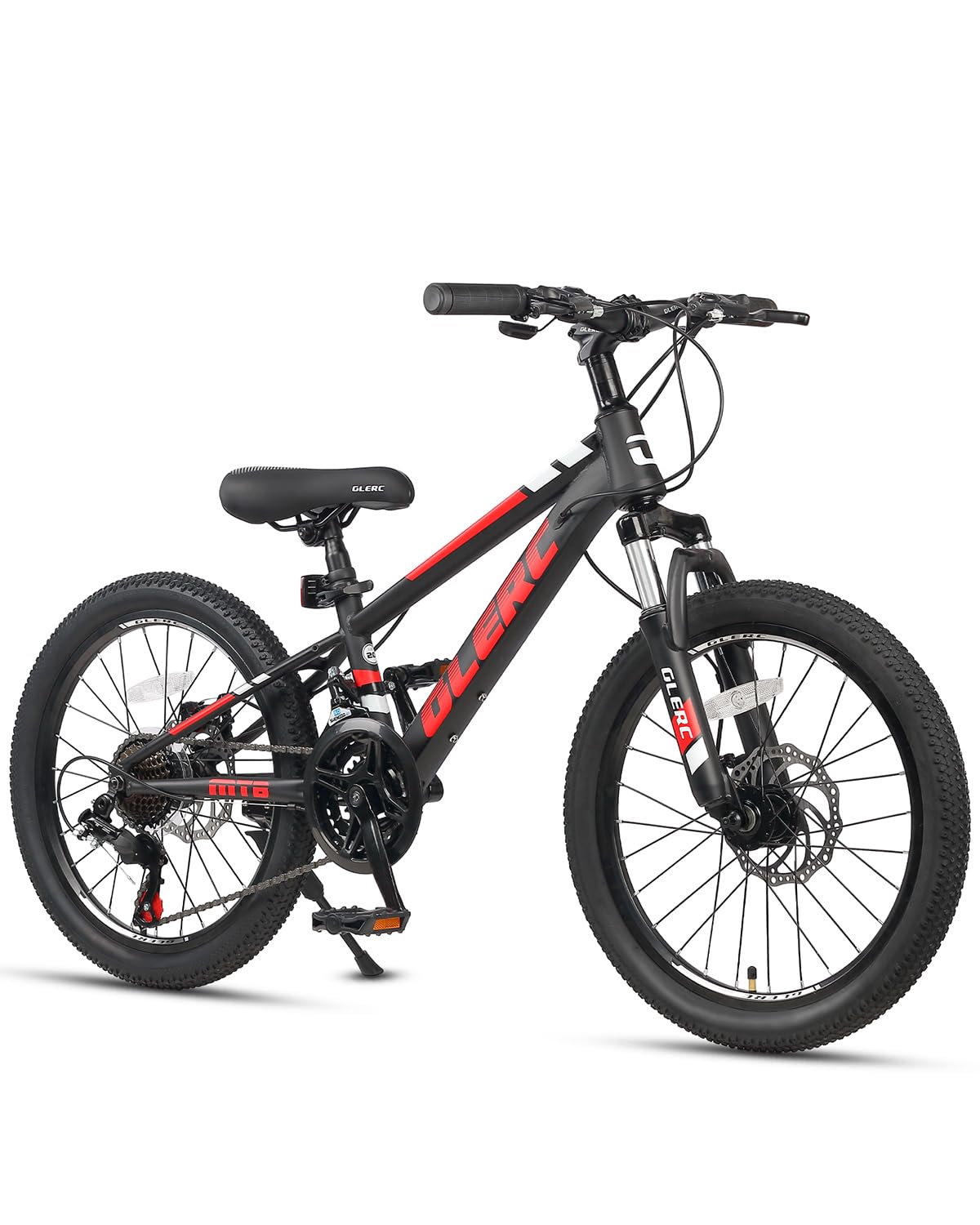
A 21-speed mountain bike with disc brakes that stop reliably in rain or on loose dirt.
The Glerc Skyline is the only multi-speed bike in this lineup, featuring a 21-speed trigger-shifter drivetrain (the rider clicks a lever to shift gears up or down) with a front and rear derailleur. This gear range is a major advantage over the single-speed JOYSTAR Contender if your teen rides hills regularly. The disc brakes provide much stronger stopping power in wet or muddy conditions compared to the V-brakes on the JOYSTAR mountain bike. The front suspension fork absorbs shock from rough terrain.
At 30 pounds, it is noticeably heavier than the BMX options. The high carbon steel frame is sturdy but hefty. One reviewer noted the bike is “crooked” with a wheel alignment issue, so checking alignment during assembly is important. Buyers generally praise the quality and smooth ride. The 20-inch wheel version fits children ages 6-12 and 45-55 inches tall. The plush seat and adjustable handlebar height give room for growth. The alloy disc brakes are mechanical (cable-actuated), not hydraulic, so they require periodic cable adjustment.
Why it’s great
- 21-speed gearing handles steep hills and longer rides that single-speed bikes can’t
- Disc brakes provide reliable stopping power in wet or muddy conditions
- Adjustable handlebar and plush saddle improve comfort as the rider grows
Good to know
- Heavier than BMX alternatives at 30 pounds
- Wheel alignment issues reported on some units
Best for: A teen who needs hill-climbing gears and rides in varied weather where disc brake performance matters.
Skip if: He wants a lightweight bike for tricks or skate-park riding—the weight and derailleurs get in the way.
7. cubsala 20 Inch BMX Race Bike Trident
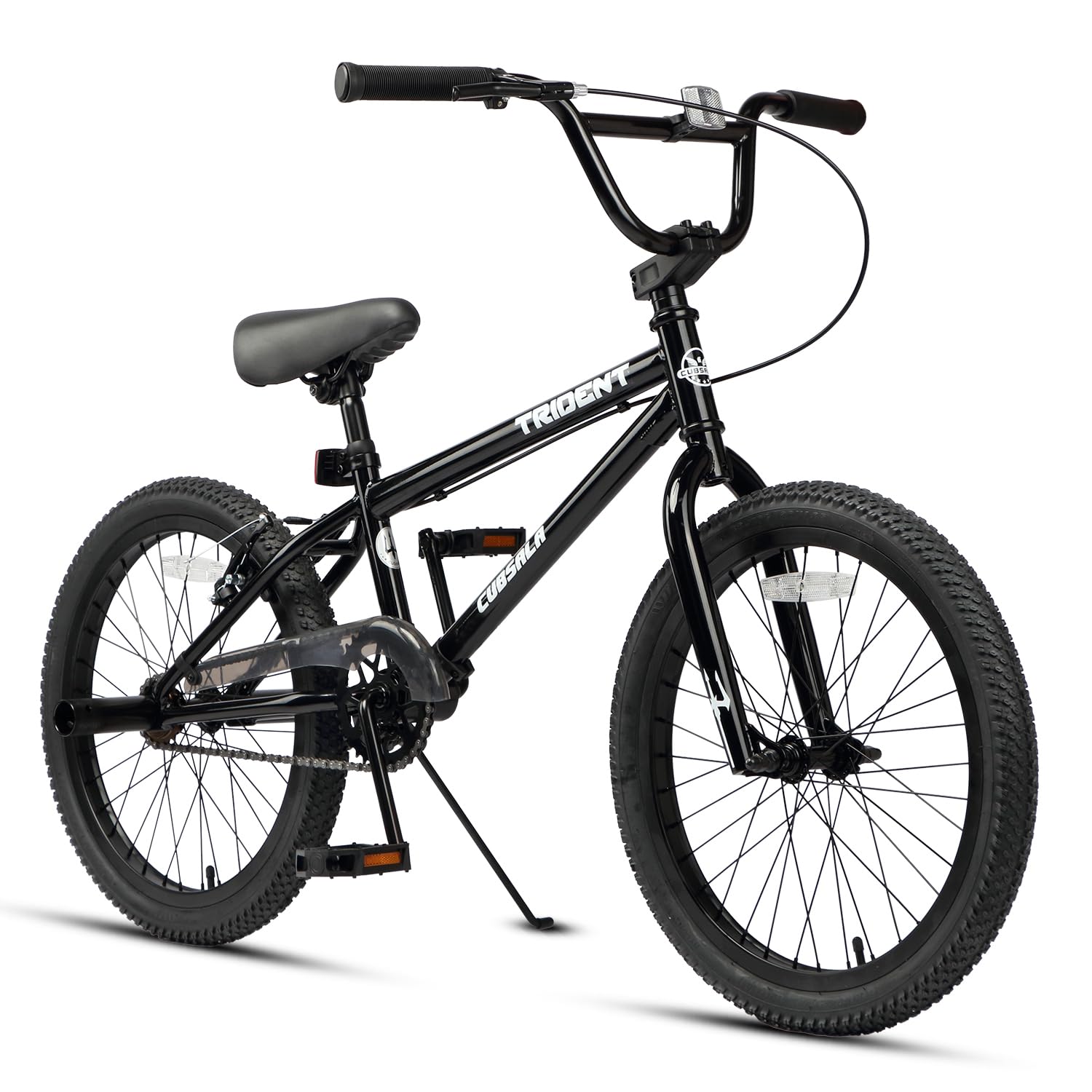
A BMX race bike with a gold trident design that a 13-year-old said is “really good” and very durable, per his parent.
The cubsala Trident is a single-speed BMX race bike with a Hi-Ten steel frame and a rear V-brake. Unlike the freestyle BMX bikes above, this one is designed for speed on pavement and dirt tracks rather than tricks. It includes only two pegs (the Echo and Yaphet-K include four). A buyer whose son received this bike reports the 13-year-old loves it. The unique gold trident frame design stands out from all-black alternatives. Assembly takes under 10 minutes according to multiple buyers.
The V-brake is adequate for controlled stops on pavement. One buyer mentioned the packaging had a large hole but the bike was undamaged. The Trident features a chain guard and a kickstand for practicality. The 20-inch wheel fits riders 4’0″ to 6’2″, an unusually wide range that accommodates growing teens. The simple drivetrain and V-brake mean low maintenance. The biggest limitation: no 360-degree rotor, so bar spins aren’t possible. For a teen who wants a cool-looking, fast, and simple bike for neighborhood riding, this delivers without extra parts.
Why it’s great
- Unique gold trident race design stands out from typical black BMX bikes
- Very easy, fast assembly—customers note under 10 minutes
- Chain guard and kickstand included for practical everyday use
Good to know
- No 360-degree rotor, so bar spins and advanced freestyle tricks aren’t possible
- Only two pegs included (fewer than the Echo or Yaphet-K)
Best for: A teen who wants a stylish, simple, and fast BMX for pavement cruising and dirt-track riding without trick complexity.
Skip if: He wants to learn freestyle tricks that require a 360-degree rotor or four pegs.
Understanding the Specs
Brake Types: U-brake, V-brake, Caliper, and Disc
The brake type directly affects stopping power and maintenance frequency. A U-brake is lightweight and common on BMX trick bikes, but it has less stopping force than a V-brake (linear pull brake). A caliper brake is even simpler but often the weakest of the four. A disc brake (either mechanical cable-actuated or hydraulic fluid-actuated) provides the strongest, most consistent stopping power in wet or muddy conditions. For a bike that will mainly ride skate parks and pavement, a U-brake or V-brake is sufficient. For trails and hills, a disc brake is a meaningful safety upgrade.
360-Degree Rotor vs Standard Headset
A 360-degree rotor is a special cable-routing system inside the headset (the part that connects the handlebars to the frame). It lets the handlebars spin all the way around without twisting or damaging the brake cables. This is essential for bar spins and advanced freestyle BMX tricks. Bikes without a rotor (like the cubsala Echo or Trident) cannot spin the handlebars full circle without tangling or breaking the cables. If your teen wants to learn tricks, a bike with a rotor is worth the extra cost. If he just wants to ride, a standard headset is simpler and cheaper to maintain.
FAQ
What size bike should I get for a 13-year-old boy?
Is a single-speed BMX bike good for a teenager?
How long does a Hi-Ten steel frame BMX bike last?
Can I add a 360-degree rotor to a BMX bike that didn’t come with one?
What is the difference between a BMX bike and a mountain bike for a teen?
Are disc brakes worth it on a teenager’s bike?
How do I know if a 20-inch bike is too small for my teenage son?
What tools do I need to assemble a teenager’s BMX bike?
Which is better for a 14-year-old boy: BMX or mountain bike?
How hard is it to build a bike that comes 85% pre-assembled?
Final Thoughts: The Verdict
For most teenage boys who want to learn tricks and ride at the skate park, the WEIZE Freestyle BMX is the best choice because its 360-degree rotor and four pegs give a real freestyle capability that entry-level BMX bikes lack. If your teen wants a lightweight freestyle bike and can accept weak brakes, the cubsala Yaphet-K is a strong alternative with proven long-term durability. For a teen who needs to climb hills and ride in wet weather, the Glerc Skyline with its 21 speeds and disc brakes is the clear choice.
How We Picked
We do not accept paid placement, and we did not hands-on test every unit. Instead, we match each pick to a real buyer and use-case by comparing the manufacturers’ published specifications against the patterns in verified customer reviews — so you get each pick’s real strengths and trade-offs instead of marketing copy.
Sources & Methodology
Specifications: manufacturer listings and product documentation. Review insights: verified customer reviews, as of June 2026. Pricing: not shown on this page (it changes often); check the current price via the retailer link.
As an Amazon Associate, Gadgets Feed earns from qualifying purchases. This does not affect which products we feature.
Product prices and availability are accurate as of the date/time indicated and are subject to change. Any price and availability information displayed on Amazon at the time of purchase will apply to the purchase of this product. As an Amazon Associate I earn from qualifying purchases.
CERTAIN CONTENT THAT APPEARS ON THIS SITE COMES FROM AMAZON. THIS CONTENT IS PROVIDED "AS IS" AND IS SUBJECT TO CHANGE OR REMOVAL AT ANY TIME.
Amazon and the Amazon logo are trademarks of Amazon.com, Inc. or its affiliates.