
Indoor cycling without a proper stand turns your living room into a sweat-soaked, wobbly hazard zone where every hill simulation ends with a bike toppling sideways into your couch cushions. The right bike trainer stand anchors your rear wheel, applies real resistance, and lets you hammer out structured workouts or Zwift climbs without leaving the house — but the wrong one will have you fighting noise complaints, tire slippage, and a flimsy frame that creaks under power.
I’m Min — the co-founder and writer behind Gadgets Feed.
Whether you are a weekend Zwifter upgrading from a wheel-on brick or a first-time buyer searching for a truly reliable bike trainer stand that won’t rattle your floorboards, this guide isolates the four core specs that define a good purchase: resistance type, weight capacity, noise output, and foldability.
How To Choose The Best Bike Trainer Stand
The single biggest mistake new buyers make is ignoring resistance type and assuming all stands feel the same. A magnetic unit gives you discrete, adjustable resistance levels but can feel artificial and clicky. A fluid stand uses a sealed impeller spinning in oil — the resistance builds smoothly and progressively, exactly like pedaling up a real climb. Your choice should mirror your training goals: structured interval work tolerates magnetic curves, while road-feel fidelity demands fluid.
Resistance Type — Magnetic vs Fluid vs Smart
Magnetic trainers use permanent magnets that move closer to a spinning metal flywheel. They offer a fixed number of resistance settings, typically five to eight. Fluid trainers rely on a rotor churning through silicone oil; resistance increases exponentially with speed, which means harder efforts feel heavier without any manual adjustment. Smart trainers (electromagnetic) can change resistance automatically via Bluetooth or ANT+ FE-C based on virtual terrain from apps like Zwift or Rouvy. For most riders, fluid delivers the best real-world feel per dollar, while smart is the choice for app-driven structure.
Noise Level — Your Roommate Will Thank You
A bike trainer stand’s noise is measured in decibels at a standard speed, often 20 mph. Fluid units typically hover around 68–72 dB — comparable to a conversation or background TV. Magnetic units can be several decibels louder because the magnetic drag generates a whirring hum. Tire choice drastically affects noise: knobby mountain bike tires can turn a quiet fluid stand into a loud drone, whereas slick trainer tires or road slicks cut perceived noise by nearly half. If you live in an apartment or share walls, prioritize a fluid stand and budget for a dedicated trainer tire.
Stability and Weight Capacity
A stand’s frame material and geometry define how stable the bike feels when you stand on the pedals. Look for steel or stainless steel frames with M-shaped or pyramid legs. Weight capacity matters less as an absolute number than as a proxy for frame rigidity — a stand rated for 300 lbs will feel more planted under a 200-lb rider than a stand rated for 220 lbs. Rubber or gear-like adjustable feet caps also prevent walk and protect hardwood floors. A front wheel riser block (included or separate) levels the bike and improves handling feel during seated climbs.
Quick Comparison
On smaller screens, swipe sideways to see the full table.
| Model | Category | Best For | Key Spec | Amazon |
|---|---|---|---|---|
| Saris M2 Smart | Smart | App-based training | Electromagnetic / 1500W max | Amazon |
| Alpcour Fluid | Fluid | Smooth progressive resistance | Fluid / 300 lb capacity | Amazon |
| Saris Fluid2 | Fluid | Quiet road-like ride | Fluid / 69 dB at 20 mph | Amazon |
| Elite Cubo Power Fluid | Fluid | Low noise, small footprint | Fluid / Elastogel roller | Amazon |
| Sunlite F-2 Magnetic | Magnetic | Budget-friendly entry | Magnetic / 8 resistance settings | Amazon |
| Topeakmart Magnetic | Magnetic | Sturdy build, easy storage | Magnetic / 264 lb capacity | Amazon |
| Goplus Magnetic | Magnetic | Affordable 8-level resistance | Magnetic / 220 lb capacity | Amazon |
In‑Depth Reviews
1. Saris M2 Smart Indoor Electromagnetic Resistance Bike Trainer

The Saris M2 is a wheel-on smart trainer that uses electromagnetic resistance to deliver a controlled, consistent workout with +/-5% power accuracy. It connects via dual ANT+ FE-C and Bluetooth, making it Zwift-certified out of the box. The unit peaks at 1500W at 20 mph — more than enough for sprint workouts and simulated climbs. Noise is rated at 69 dB, which is comparable to a normal conversation, and the steel quick-release skewer fits most standard road and mountain bike frames.
Setup requires power, and the instructions are sparse — several users reported needing a YouTube video to sort orientation of the tension knob and legs. The unit weighs 20 lbs, so it is not the most portable, but the foldable legs help with closet storage. Calibration via the Saris app is mandatory for accurate power readings, and some Android users noted compatibility hiccups with the proprietary app. Once dialed in, the electromagnetic unit holds resistance without slipping, even during 700W+ sprints.
For riders who want app-driven structure — Zwift, Rouvy, FulGaz — the M2 is the most affordable smart trainer that actually works reliably. The thru-axle conversion is not officially supported, which limits compatibility with some newer disc-brake frames. A minor but important quirk: do not overtighten the yellow tension knob until it clicks; that will damage the roller mechanism.
Why it’s great
- Zwift-certified with ANT+ FE-C and Bluetooth for seamless app integration
- Electromagnetic resistance holds precise power curve without slipping
- Foldable design for reasonable storage
Good to know
- Poor instruction manual — assembly requires external video guidance
- No thru-axle adapter included; not compatible with 12mm frames
- Must calibrate via app before each ride for accurate power
2. Alpcour Fluid Bike Trainer Stand

The Alpcour Fluid uses an impeller spinning in silicone oil to create progressive resistance that increases as your cadence rises — no manual resistance knob to fiddle with. The frame is built from heavy-duty stainless steel with a dual-lock tension system and anti-slip rubber pads, giving it a stable feel even when you are out of the saddle. It includes a front wheel riser block and a carry bag, making it genuinely portable despite the fluid unit’s weight.
Noise levels hover around 70 dB — audible but not intrusive, especially with music or headphones. The resistance curve is relatively gentle until you push past roughly 160W, after which it ramps up quickly. Some stronger cyclists noted that maintaining a hard workout requires keeping speed above 20 mph, which can be challenging on a mountain bike with low gearing. Setup involves one bolt and a provided wrench, though a few units arrived with missing bolts or broken front blocks.
For its price, the Alpcour Fluid offers the best entrance into fluid resistance without the smart-trainer premium. The included carry bag is genuinely useful for those who need to store the stand between sessions. It fits most 26–29 inch and 700c wheels, but fat tire bikes are excluded.
Why it’s great
- Progressive fluid resistance mimics outdoor climbing feel
- Stainless steel frame with rubber pads stays planted at high effort
- Comes with front wheel riser and carry bag
Good to know
- Low resistance until ~160W threshold, may be limiting for strong riders
- Some units have missing components — inspect package immediately
- Front wheel riser block can break under repeated use
3. Saris Fluid2 Indoor Bike Trainer
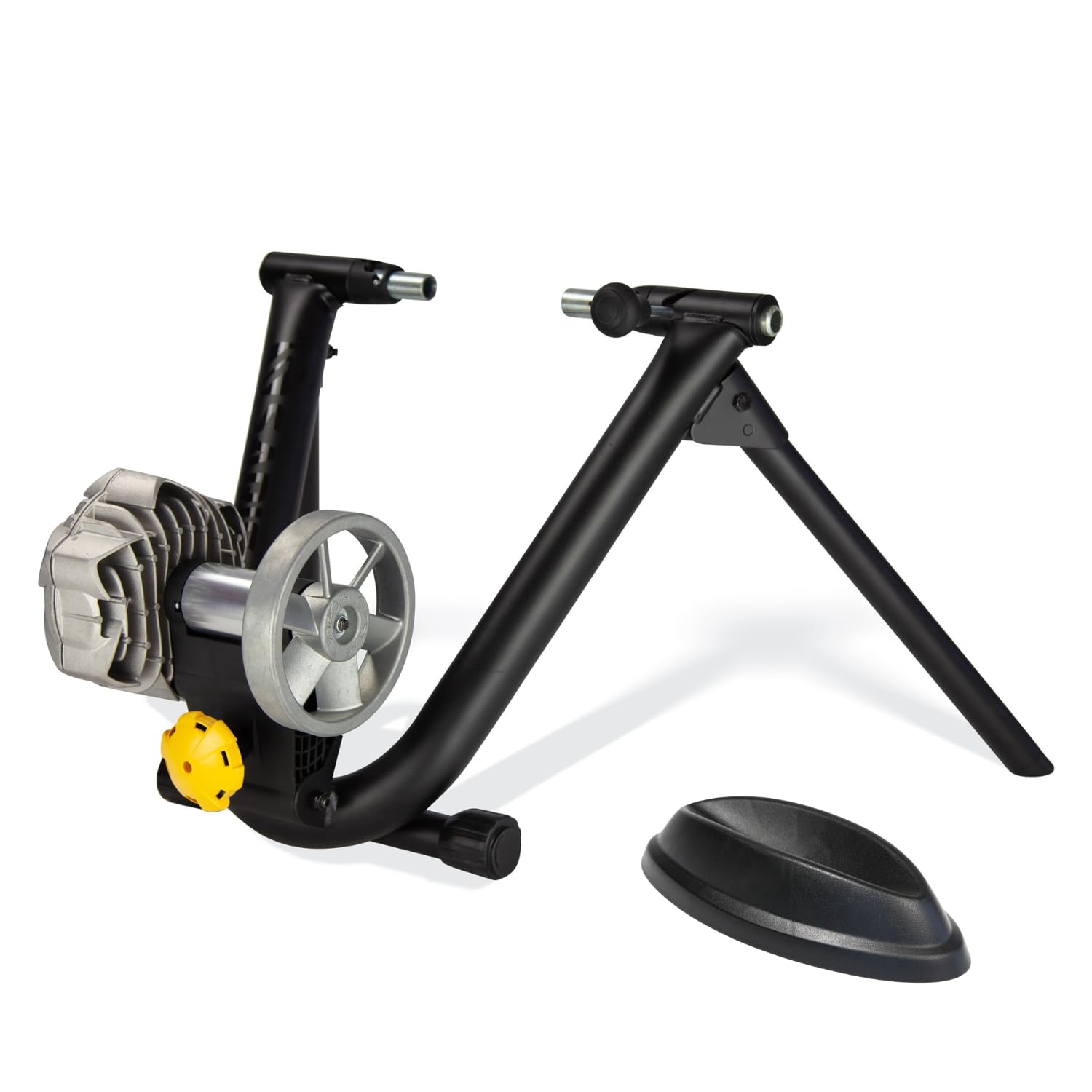
The Saris Fluid2 is one of the quietest non-smart trainers on the market, thanks to its patented precision-balanced flywheel and sealed fluid resistance unit. Noise is rated at 69 dB, and rider reports consistently praise the lack of mechanical whir — the loudest sound you hear is your own drivetrain. The resistance is smooth and linear, increasing naturally with pedal force, which makes it feel far more like real asphalt than any magnetic unit at this price.
Assembly can be counterintuitive: the beveled tube end must slide in first, and the orientation of the fan and power unit matters. Several users had to watch a YouTube walkthrough to avoid frustration. The legs fold but are stiff — this is not a stand you will want to fold and unfold daily. The skewer seats somewhat shallowly, and the locking mechanism is initially very stiff, requiring force to engage. Once set up, it is stable enough for standing sprints, though a trainer pad or carpet is recommended to damp floor vibration.
For Zwift or Rouvy use, you will need a separate speed or cadence sensor because the Fluid2 is not a smart trainer. It is built to last, with an aluminum frame and Saris’ reputation for fluid-unit longevity. If your goal is a no-fuss, quiet, road-like feel without app integration, this is the stand to beat.
Why it’s great
- Extremely quiet operation — drivetrain noise is louder than the unit
- Progressive fluid resistance indistinguishable from real road
- Durable aluminum frame with stable platform
Good to know
- Not a smart trainer — needs external sensor for app power data
- Legs are stiff; not ideal for frequent folding
- Instructions are poor; assembly requires online video reference
4. Elite Unisex Cubo Power Fluid Trainer

The Elite Cubo Power Fluid is a compact, fluid-based trainer built with 50 mm reinforced steel tubes and a wide contact base for maximum stability. Its unique feature is the Elastogel roller, which Elite claims reduces noise by 50% and tire wear by 20% compared to standard steel rollers. The unit is also smart-ready — you can add the Misuro B+ sensor to convert it into a non-interactive smart trainer for app-based workouts.
Setup is straightforward thanks to the Fast Fixing lock system, but the unit arrives with a carbon steel frame that feels rock-solid even under aggressive pedaling. The fluid resistance is progressive and smooth, though some users noted that it works best with road bikes — recumbent trikes with 20-inch wheels fit, but stability can be an issue. A few units arrived with broken rubber feet, which can be reattached, but it is a minor quality-control annoyance.
At a folded size of 22.8 inches long, this folds flatter than most fluid trainers, making it a strong choice for tight storage spaces. It is not for beginners — the progressive resistance ramps quickly, and the unit has minimal vibration damping. Noise is impressively low; riders report the drivetrain is louder than the trainer itself.
Why it’s great
- Elastogel roller reduces noise and tire wear significantly
- Folds flatter than most fluid trainers for storage
- Smart-ready via Misuro B+ adapter
Good to know
- Some units arrive with broken rubber feet
- Not ideal for beginners — resistance can ramp abruptly
- 20-inch wheel compatibility may reduce stability
5. Sunlite F-2 Magnetic Indoor Bicycle Trainer
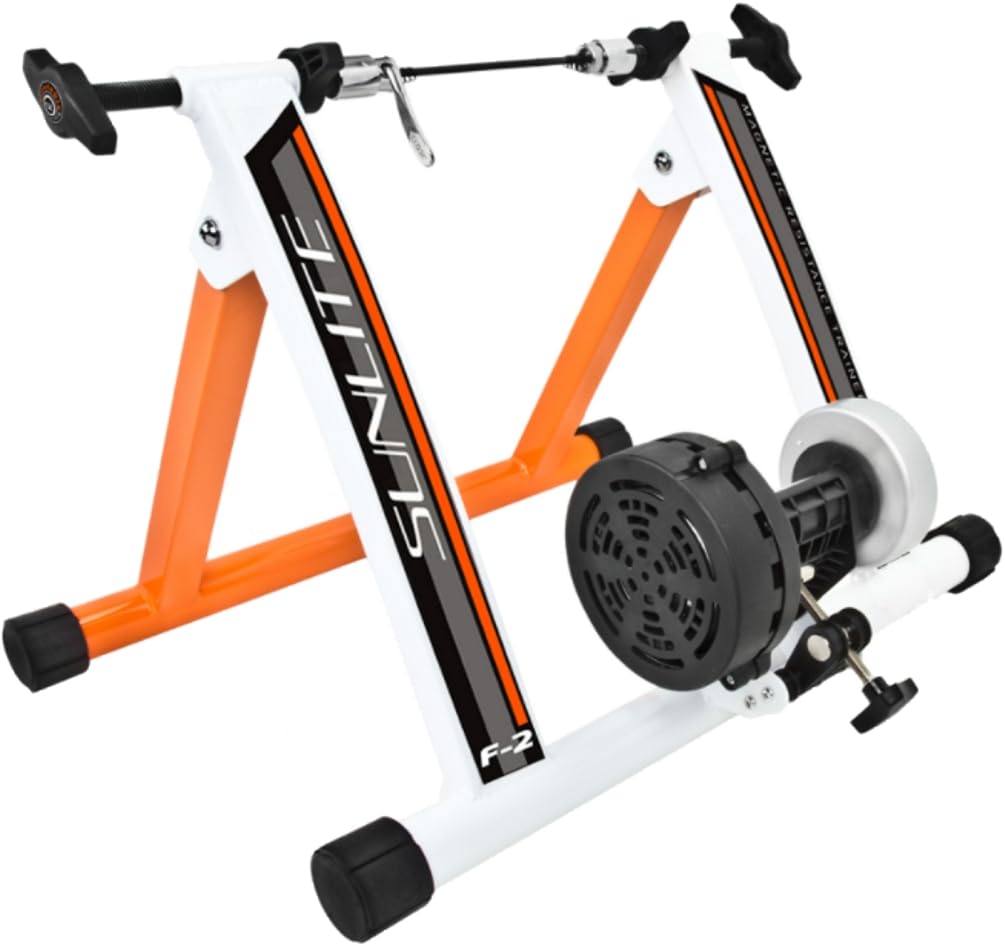
The Sunlite F-2 is a no-frills magnetic trainer that uses gear-based resistance control — you shift your bike’s rear derailleur through its cassette to increase or decrease load. The steel frame is stout and folds for storage, and setup takes roughly 15 minutes with no tools required for basic assembly. It fits tires 26 inches and up, including most mountain and hybrid bikes.
Noise is the biggest compromise here. Knobby tires generate a loud whir comparable to a hand mixer, but switching to slick tires drops the noise substantially. The magnetic resistance is discrete rather than progressive — each gear change produces a noticeable step in load rather than a smooth curve. The unit does not include a front wheel riser, so the bike sits nose-down unless you add one. Several users reported that the base may not support riders over 200 lbs comfortably; the frame flexes noticeably during standing efforts.
For casual riders logging 2–25 miles per session, the F-2 works well. The included quick-release skewer is standard, and the magnetic unit offers consistent tension for steady-state cardio. It is loud, limited in max resistance, and lacks the polish of fluid trainers, but it is one of the simplest ways to turn a bike into an indoor machine.
Why it’s great
- Very quick setup — about 15 minutes without tools
- Solid steel frame at an entry-level cost
- Gear-based resistance offers wide range through bike cassette
Good to know
- Loud with knobby tires; requires slick tire for quiet operation
- No front wheel riser included — bike sits angled down
- Frame flex may be uncomfortable for riders over 200 lbs
6. Topeakmart Magnetic Bike Trainer Stand

The Topeakmart Magnetic trainer stands out for its M-shaped frame design and gear-like adjustable feet caps that let you level the stand on uneven floors. The frame is constructed from powder-coated high carbon steel and supports up to 264 lbs, making it one of the more robust mid-range magnetic options. It folds down to a flat profile (21.5 x 7 x 17.3 inches) for storage and includes a front wheel support block.
Noise is a known trade-off: with a hybrid tire, the unit is noticeably loud, especially in higher gears. Switching to a slick tire like Panaracer Gravelking brings volume down to acceptable levels. The magnetic resistance offers a single continuous curve rather than discrete levels, which some riders prefer for its smoother feel. Setup is straightforward, and the unit feels sturdy enough for experienced cyclists who need a reliable winter base trainer.
One important limitation: this trainer is designed for quick-release axles only. Thru-axle adapters are not included and must be purchased separately. Several users noted that the front wheel stand could be more stable, but overall, the Topeakmart delivers solid build quality for its price tier.
Why it’s great
- M-shaped steel frame with adjustable leveling feet for stability
- Folds flat for compact storage
- Includes front wheel support block
Good to know
- Noisy with hybrid tires; slick tires are almost mandatory
- Quick-release only — no thru-axle adapter included
- Front wheel stand may feel less secure at speed
7. Goplus Magnetic Bike Trainer Stand

The Goplus Magnetic trainer offers eight discrete resistance levels controlled by a manual knob, making it one of the most adjustable budget-tier stands available. The pyramid-shaped steel frame supports up to 220 lbs and folds flat without tools. Assembly takes under 15 minutes, though the sparse instructions require some guesswork. The dual-lock system includes a quick-release lever and a tension knob for securing the bike.
Resistance cables can obstruct the rear pedal stroke depending on bike geometry, which is an ergonomic annoyance for taller riders. The metal resistance cylinder gets very hot after 30 minutes of continuous use and emits a burning rubber smell that fades over time. Noise is significant — multiple users described it as loud enough to be disruptive in shared living spaces — and the unit works best with slick tires to mitigate some of the whir. Fat tire bikes and folding bikes are explicitly not compatible despite the wheel-size claim.
For the price, the Goplus delivers functional magnetic training with more resistance steps than most competitors at this level. It works for casual riders who want simple indoor cardio without investing in fluid or smart tech. Just be prepared for noise and the faint burning smell during break-in.
Why it’s great
- Eight discrete resistance levels for fine-grained load control
- Folds flat for storage without tools
- Quick and simple assembly process
Good to know
- Loud operation — not suitable for quiet spaces without slick tires
- Resistance cable can obstruct rear pedal stroke
- Metal cylinder gets hot; burning smell during initial use
FAQ
Can I use a mountain bike with knobby tires on a fluid trainer without damaging the roller?
Do I need a front wheel riser block for a bike trainer stand?
How do I know if my thru-axle bike is compatible with a wheel-on trainer?
Final Thoughts: The Verdict
For most users, the bike trainer stand winner is the Saris M2 Smart because it combines Zwift-certified electromagnetic resistance with dual-band connectivity and a stable frame at a compelling price. If you want a smooth, road-like feel without the smart-trainer premium, grab the Alpcour Fluid — it offers progressive fluid resistance and a stainless steel frame that stays planted. And for a dead-simple, quiet non-smart option, nothing beats the Saris Fluid2, which delivers the most authentic outdoor riding simulation in this lineup.