
The leap from wobbly toddler to confident rider starts with the right two-wheeled machine. At three years old, kids are ready to develop core balance and steering instincts, but a bike that’s too heavy, too tall, or equipped with the wrong feature set can turn that excitement into frustration. The narrow subcategory of bikes for this age group demands a precise balance: a lightweight frame, a low standover height, and a design that either prioritizes gliding first or offers a seamless conversion from trike to balance bike.
I’m Min — the co-founder and writer behind Gadgets Feed. I’ve spent hundreds of hours analyzing the technical specifications, customer feedback, and real-world performance data of dozens of toddler bikes to identify which models actually deliver on their promises for this critical developmental stage.
Whether you prioritize a convertible 5-in-1 system, a premium lightweight balance bike with an extended lifespan, or a character-themed pedal bike with training wheels, this guide breaks down the technical specs and real-world feedback to help you find the absolute best bikes for 3 year olds that match your child’s size and skill level.
How To Choose The Best Bikes For 3 Year Olds
Selecting a bike for a three-year-old is not about picking the coolest color or the lowest price tag. It is about matching the bike’s geometry and weight to your child’s current physical development. Three-year-olds vary wildly in height, confidence, and coordination, so the single most important factor is inseam measurement and total bike weight.
Inseam Over Age
Manufacturers list age ranges as a rough guide, but a child’s inseam — the length from their crotch to the floor while standing barefoot — dictates whether they can safely plant both feet flat on the ground. For a balance bike, the ideal minimum inseam is about 12 inches. For a pedal bike with training wheels, the child should be able to straddle the top tube with both feet flat. Always measure before buying.
Balance Bike vs. Training Wheels
Balance bikes teach the core skill of gliding and steering without the complication of pedaling. Most children who master a balance bike between ages 2 and 4 can transition directly to a standard pedal bike by age 4 or 5 without ever needing training wheels. Training wheels, by contrast, teach pedaling first but allow the child to lean incorrectly, often delaying true balance development. For a three-year-old who has never ridden, a balance bike or a convertible model is almost always the superior path.
Weight Matters More Than You Think
A typical 3-year-old weighs between 30 and 35 pounds. A bike that weighs 10 pounds is manageable; a bike that weighs 17 pounds represents over half the child’s body weight and becomes exhausting to steer, stop, and lift. Lightweight aluminum frames under 6 pounds give young riders the control they need, while heavier steel frames are more durable but require more effort. For this narrow category, every pound counts.
Quick Comparison
On smaller screens, swipe sideways to see the full table.
| Model | Category | Best For | Key Spec | Amazon |
|---|---|---|---|---|
| Strider 12 Pro | Balance Bike | Lightweight performance, ages 1-5 | 5.6 lbs aluminum frame | Amazon |
| XJD Girls Bike | Pedal Bike | First pedal bike with accessories | 12/14/16-inch wheel options | Amazon |
| KRIDDO 2-in-1 (2-5 yrs) | 2-in-1 Trike/Balance | Growing with 2-step fold | Seat height 11-17 inches | Amazon |
| Retrospec Cub | Balance Bike | Durable puncture-proof tires | Seat height 11-14.5 inches | Amazon |
| Nickelodeon Blue’s Clues | Pedal Bike | Character-themed first bike | 12-inch wheels, 17.4 lbs | Amazon |
| KRIDDO 2-in-1 (18m-3yrs) | 2-in-1 Trike/Balance | Entry-level 2-in-1 conversion | 110 lb max rider weight | Amazon |
| LOL-FUN 5-in-1 | Convertible Trike | Ultimate multi-mode starter | Carbon steel body, 8.6 lbs | Amazon |
In‑Depth Reviews
1. Strider 12 Pro Bike

The Strider 12 Pro is the gold standard in the balance bike category, and for good reason. Its ultralight aluminum frame weighs just 5.6 pounds — light enough that a three-year-old can easily lift it, turn it, and carry it over obstacles. The seat adjusts from 11 to 17 inches on the standard post, and the included XL post extends it to 19 inches, giving this bike a lifespan from age 1 all the way to 5 years.
The flat-free foam rubber tires eliminate the hassle of punctures entirely, and the tool-free seat and handlebar adjustments mean you can tweak the fit in seconds as your child grows. The footrests encourage proper gliding posture, and the lack of a drivetrain or braking system simplifies the learning process to pure balance and steering. There are no training wheels to remove and no pedals to trip over.
Customer feedback consistently highlights how children who master the Strider transition to a pedal bike in under an hour — some as quickly as 15 minutes. The only downsides are the premium price point, which reflects the quality of materials, and a minor ergonomic complaint about the bottom of the seat post contacting the child’s legs at the lowest setting. For the fastest path to riding independence, this is the benchmark.
Why it’s great
- Extremely lightweight aluminum frame at 5.6 lbs
- Dual seat posts provide an 11 to 19-inch adjustment range
- Puncture-proof foam tires require zero maintenance
- Tool-free adjustments and footrests for proper form
Good to know
- Premium price reflects the high-end materials
- Seat post bottom may contact legs when fully lowered
- No brake or pedal mechanism by design
2. XJD Girls Bike for Toddlers
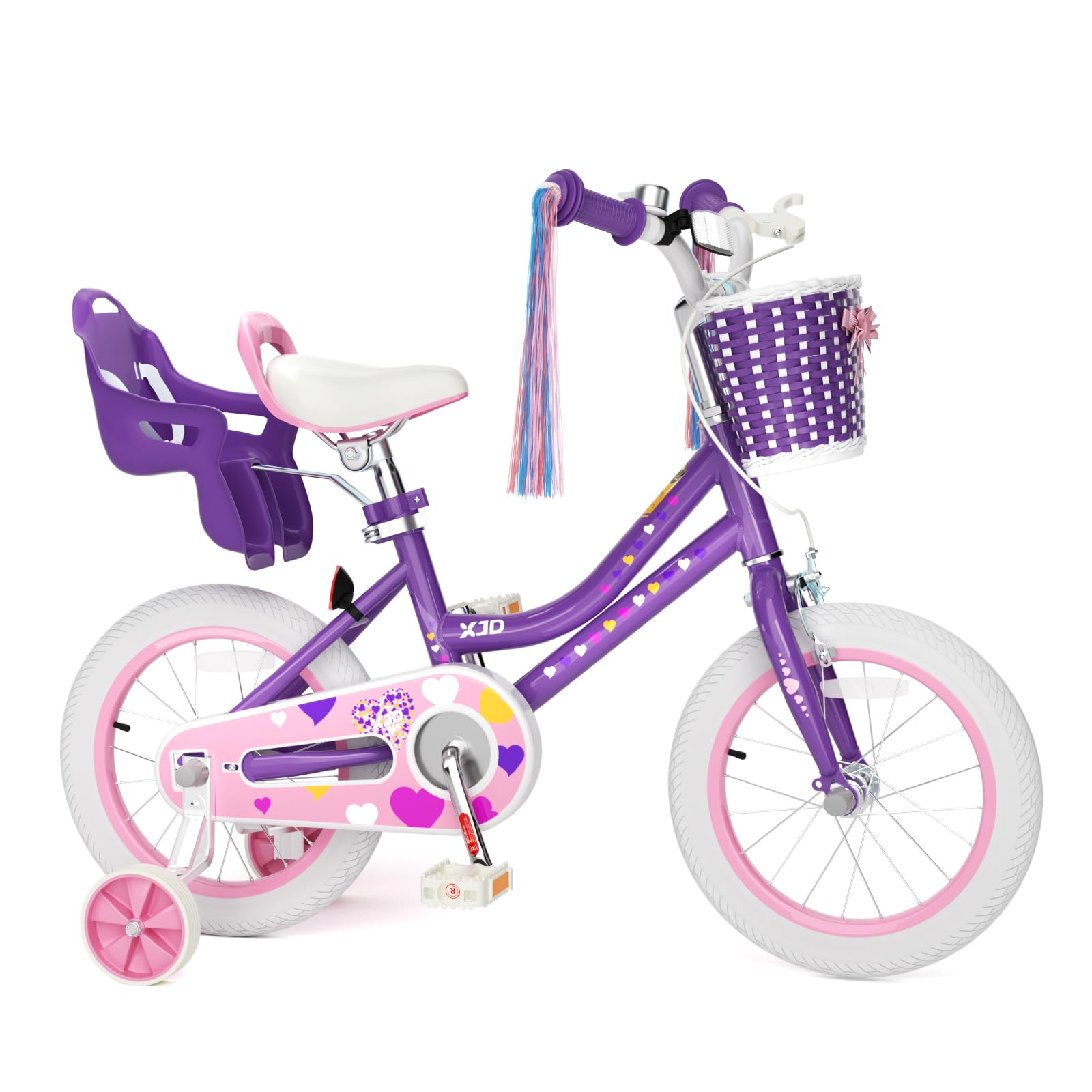
The XJD Girls Bike is designed specifically for children who are ready to pedal, and it comes with features that turn a simple bike ride into a full imaginative adventure. The 12-inch wheel version fits inseams starting at 32 inches, making it appropriate for a typical three-year-old, but the bike also comes in 14-inch and 16-inch sizes to accommodate growth up to 9 years old. The single-speed drivetrain keeps things simple for little legs.
What sets this model apart is the included accessory package: a handlebar basket for hauling treasures, streamers for visual feedback, and a dedicated doll seat with a securing strap. The Hi-Ten steel frame is sturdy and built to take the bumps of sidewalk riding, while the rubber off-road tires provide good traction on both pavement and packed dirt. The handbrake offers real stopping power, and the enclosed chain guard prevents clothes or fingers from getting caught.
Assembly is straightforward with the included tool kit, and the removable training wheels provide a safety net for initial pedaling attempts. The bike arrives 85% pre-assembled. Some parents note that the handlebar grips are on the smaller side, which is actually a plus for smaller hands. For a three-year-old who wants streamers, a basket, and a baby doll passenger, this bike delivers the full experience without feeling flimsy.
Why it’s great
- Includes basket, streamers, and doll seat as standard
- Three wheel size options (12/14/16 inches) for growth
- Handbrake provides stopping control for beginners
- 85% pre-assembled with clear instructions
Good to know
- Steel frame is heavier than aluminum balance bikes
- Training wheels can tilt on uneven ground
- Doll seat strap is simple plastic, not padded
3. KRIDDO 2-in-1 (Ages 2-5)

This larger KRIDDO 2-in-1 model targets the 2-to-5-year-old range, making it a perfect fit for a three-year-old who still has room to grow. The bike functions as a balance bike with the pedals removed and stored in the integrated rear slot, or as a tricycle with the pedals attached. The transition is truly tool-free — you just snap the pedals in or out, and lift or drop the rear training wheels.
A notable feature unique to this model is the front headlight, which provides visibility in low-light conditions and adds an element of fun for evening rides. The 2-step quick fold mechanism compresses the bike for storage in a trunk or closet, and the easy-carry seat makes it simple to transport. The carbon steel frame is sturdy and supports up to 110 pounds, though the bike itself weighs in at a manageable level for a preschooler to maneuver.
Assembly takes about 15 minutes with the provided hand tool. The stitched soft grip handles are comfortable for small palms, and the seat adjusts to a range that accommodates both a short 2-year-old and a taller 5-year-old. Some parents note that the pedals in trike mode can be slightly far forward for shorter legs, but this is typical of convertible designs that prioritize longevity over perfect initial fit. For a bike that starts as a balance trainer and ends as a pedal trike, this is a solid mid-range investment.
Why it’s great
- Tool-free conversion between balance and trike modes
- Integrated front headlight for safety and fun
- Folds in two steps for compact storage
- Pedal storage slot prevents lost parts
Good to know
- Pedal position may feel forward for shorter toddlers
- Wheels are plastic rather than pneumatic rubber
- Seat clamp requires periodic tightening
4. Retrospec Cub Toddler Balance Bike

The Retrospec Cub is a dedicated balance bike that strips away complexity in favor of pure, durable function. Its alloy steel frame is built to withstand repeated drops and scrapes, yet it maintains a manageable 10-pound weight. The seat adjusts from 11 to 14.5 inches using a quick-release clamp, which covers the typical inseam range of an 18-month-old through a 3-year-old perfectly.
The airless puncture-proof tires are the standout technical feature here. They eliminate the possibility of a flat tire and provide a smooth ride across pavement, grass, and hard-packed dirt without needing inflation. The low center of gravity design and rounded edges reduce the risk of tip-overs and sharp-contact injuries, which is critical for a child who is still learning how to steer and stop by dragging their feet.
Assembly takes about 15 minutes with standard tools, and the included stickers let the child personalize the frame. The coaster brake on some versions provides simple stopping, but many parents prefer the simpler no-brake version for the youngest riders. Over a year of use, owners report the bike holds up well with no degradation in the foam tires or frame. For a budget-friendly option that does not compromise on durability, the Cub delivers exceptional value per inch of usable seat height.
Why it’s great
- Puncture-proof tires require zero maintenance
- Low standover height boosts rider confidence
- Quick-release seat adjustment is tool-free
- Sturdy steel frame survives heavy use
Good to know
- Steel frame is heavier than premium aluminum models
- Seat adjustment range ends at 14.5 inches
- Some versions include a coaster brake that may confuse beginners
5. Nickelodeon Blue’s Clues & You Kids Bike

For the three-year-old who is already obsessed with a favorite TV character, the Nickelodeon Blue’s Clues & You bike turns the learning-to-ride experience into an immediate play session. The 12-inch wheels are designed for children between 28 and 38 inches tall, and the single-speed drivetrain keeps things simple. The coaster brake stops the bike when pedaling backward, which is intuitive for most toddlers.
The signature feature is the handlebar-mounted mailbox storage compartment — a small plastic box that flips open so kids can collect leaves, rocks, or imaginary mail. The included handlebar plate and decals reinforce the theme. However, some owners note that the decorative elements, especially the front picture frame, are flimsy and may not survive a serious tumble. The alloy steel frame is sturdy, but the total bike weight of 17.4 pounds is on the heavier side for a small three-year-old to maneuver independently.
Assembly requires basic tools and about 20 minutes, though the instructions are slightly generic and the picture frame attachment point requires zip ties if not pre-drilled. The removable training wheels provide initial stability, and the seat post adjusts to accommodate growth. For a child whose motivation comes from chasing Blue’s Clues, this bike is a delightful bridge between screen time and physical activity.
Why it’s great
- Mailbox storage compartment adds imaginative play
- Coaster brake is intuitive for beginners
- Character theme boosts excitement to ride
- Removable training wheels for progression
Good to know
- Heavy steel frame at 17.4 lbs
- Plastic decorative parts are fragile
- Assembly instructions don’t perfectly match hardware
6. KRIDDO 2-in-1 (Ages 18m-3yrs)

This smaller KRIDDO 2-in-1 model targets the younger end of the three-year-old spectrum, with an official age range of 18 months to 3 years. Its versatile design switches between tricycle mode for maximum stability and balance bike mode for skill development. The detachable pedals store neatly under the rear seat, solving the common problem of losing small parts during the transition.
The stowable training wheels are a clever touch — they can be flipped up when the child is ready to try balance mode and dropped down again for reassurance. The customizable plate allows kids to add their own stickers or decals, fostering a sense of ownership. The soft seat is comfortable for longer rides, and the quick-release fixtures make seat and handlebar adjustments tool-free.
Despite its 110-pound maximum weight rating, the bike itself is light enough for a toddler to haul around. Assembly is straightforward with a video guide. The most common feedback from buyers is that the wheels are plastic rather than rubber, which means the ride is less cushioned on uneven surfaces and the bike can skid on wet pavement. For indoor and smooth sidewalk use, however, the ride quality is perfectly adequate for the target age group.
Why it’s great
- Stowable training wheels flip up or down flexibly
- Pedals store in a dedicated slot under the seat
- Customizable plate encourages personalization
- Tool-free adjustability for growing toddlers
Good to know
- Plastic wheels feel less stable on grass or gravel
- Maximum age of 3 years limits long-term use
- Front steering can feel stiff initially
7. LOL-FUN 5 in 1 Toddler Tricycle

The LOL-FUN 5 in 1 pushes the concept of a convertible bike to its logical extreme, offering five distinct riding modes: parent-push tricycle, regular tricycle, balance bike, wide-tire bike, and scooter-like glider. The tool-free assembly lets you press buttons to switch between configurations in under a minute, and the telescoping parent steering handle provides adult control during early outings. This is ideal for the cautious parent who wants to maintain hands-on guidance.
The carbon steel body feels tough and stable, and the upgraded extra-wide wheels handle both indoor and outdoor terrain. The sawtooth thickening handle design absorbs some vibration, and the 50-degree steering limit prevents over-rotation that could cause a spill. The bike is designed for children from 10 months up to 4 years, with a maximum load of 66 pounds. The seat height is fixed, which some parents note as a limitation — once the child outgrows it, the bike cannot grow further.
Customer reviews consistently praise the build quality and the ease of switching between modes, particularly the telescoping handle that turns naturally without the fixed-front-wheel design found on cheaper models. The bright paint and polished edges add to the premium feel. The main trade-off is the limited vertical growth — a tall three-year-old may find the bike too small before they have fully mastered pedaling. For families who want a single device that serves from baby’s first steps through the tricycle stage, this is the most versatile option on the list.
Why it’s great
- Five riding modes in one tool-free system
- Parent steering handle turns the front wheel naturally
- Extra-wide wheels work indoors and outdoors
- 50-degree steering limit prevents over-rotation
Good to know
- Fixed seat height limits use to about 3-4 years
- Too small for an average-sized preschooler
- Front steering is initially stiff for toddlers alone
FAQ
Should I get a balance bike or a tricycle for my 3 year old?
How do I measure my child’s inseam for a bike?
Are training wheels helpful or harmful for a 3 year old?
What wheel size is best for a 3 year old?
What is the lightest bike I can get for my 3 year old?
Final Thoughts: The Verdict
For most families, the best bikes for 3 year olds winner is the Strider 12 Pro because its ultralight aluminum frame and dual seat posts provide the fastest path to riding independence with the widest usable age range. If your child wants streamers, a basket, and a doll seat, grab the XJD Girls Bike. And for the ultimate multi-mode starter that grows from a parent-push trike to a balance bike, nothing beats the LOL-FUN 5-in-1.