
Our readers keep the lights on and my morning glass full of iced black tea. As an Amazon Associate, I earn from qualifying purchases.
Specs are compiled from manufacturer listings and verified buyer reviews and can change over time — please confirm the key details on the product page before buying.
Deer hunting is won in the last ten minutes of legal light, when a buck is just a grey shape slipping between trees. The right binoculars turn that grey shape into a clear image with enough detail to judge antlers before you commit to a shot. Every pick here is a 10×42 or 12×50 model screened on clarity, low-light gathering, weather sealing, and all-day carry comfort.
I’m Min — the founder and writer behind Gadgets Feed. This guide is built by comparing the manufacturers’ published specifications and the patterns across verified customer reviews, so you get each pick’s real strengths and trade-offs instead of marketing spin.
You need binoculars that hold up in rain, fog, and a freezing treestand, and this roundup separates the glass that delivers from the ones that fog up on you.
Our Picks at a Glance


How To Choose The Best Binoculars For Deer Hunting
Deer hunting glass has one job: turn a distant shape into a clear, identifiable animal in bad light. That job depends on a few specs you can compare without being an optics engineer.
Magnification and lens size
The first number is magnification, the second is the diameter of the front lens in millimeters. A 10×42 pulls subjects 10 times closer with a 42mm objective lens gathering light. Higher magnification like 12×50 reaches further but gets heavier and harder to hold steady without a rest. For most deer hunting, 10×42 is the balance most buyers land on.
Low-light performance
Deer move at dawn and dusk, which is exactly when cheap glass goes dark. The exit pupil (the diameter of the beam of light leaving the eyepiece) tells you how much light reaches your eye. All the 10×42 models here share a 4.2 millimeter exit pupil, which fills the average human pupil in dim conditions. Coatings on the lenses matter too — fully multi-coated glass transmits more light than single-coated.
Field of view and eye relief
Field of view is how wide a scene you see at a distance, measured in feet at 1000 yards or in degrees. A wider field makes it easier to track a moving buck through brush. Eye relief is the gap between your eye and the eyepiece where the full image is visible — critical if you hunt with glasses, since too little relief blacks out the edges. Look for roughly 15 millimeters or more.
Weather sealing and build
Hunting means rain, snow, and temperature swings. Waterproof and fog-proof construction comes from O-ring seals plus purging the inside with a dry gas. Rubber armor protects the body and gives a non-slip grip when your hands are wet or cold. A tripod adapter thread is a bonus for long glassing sessions from a stand.
Quick Comparison
| Model | Best For | Magnification | Eye Relief | Field of View | Amazon |
|---|---|---|---|---|---|
| Vortex Diamondback HD★ Best Overall | Overall quality and light gathering | 10×42 | 15 mm | 330 ft | Amazon |
| Nikon PROSTAFF P3Premium Pick | Brand trust at a fair price | 10×42 | 15.7 mm | 367 ft | Amazon |
| ZEISS Conquest HDXTop Performer | Edge-to-edge sharpness and build | 10×42 | 18 mm | 345 ft | Amazon |
| Leupold BX-4 Pro Guide HD | Maximum reach at 12×50 | 12×50 | — | 6.84° | Amazon |
| Bushnell Engage X | IPX7 waterproofing with EXO coating | 10×42 | 18 mm | 6.5° | Amazon |
| Bushnell PowerView BoneCollector | Camo budget pick for the field | 10×42 | 17.5 mm | 293 ft | Amazon |
| Vortex Triumph HD | Eyeglass-friendly budget value | 10×42 | 17 mm | 0.67° | Amazon |
| Celestron Outland X | Budget glass with wide views | 10×42 | 15 mm | 306.81° | Amazon |
| Athlon Talos G2 HD | Wide field hunting on a budget | 10×42 | 17.9 mm | 371 ft | Amazon |
In‑Depth Reviews
1. Vortex Diamondback HD 10×42 Binoculars
Our pick — over 4.5★ from 3,500+ verified ratings; the strongest balance of quality and price.
The crowd favorite that turns the grey dusk corridor into a bright, color-true scene
Sitting in a treestand as the light fails, the Diamondback HD is the pair that keeps showing you detail instead of fading to black. The secret is the dielectric coating on the prisms, which reflects more light to your eye for bright, color-accurate images right at the edge of legal shooting light. Add fully multi-coated lenses that anti-reflective-coat every air-to-glass surface, and the low-light story only gets stronger.
Owners consistently call out the quality and sheer clarity before anything else — with several hundred people praising the build and over 150 more citing value for money. That is not a fluke: the rugged aluminum body wears rubber armor for a secure, non-slip grip, and argon purging plus O-ring seals make it water and fog proof. Hunters describe it as small, lightweight, and clear, which is exactly the combination you want on a long hike in.
On the other hand, the eye relief measures 15 millimeters, and the twist-up eyecups adjust for glasses wearers, so you can dial in a comfortable view either way. The package includes a GlassPak harness and case so the binoculars ride against your chest, ready for a quick raise. Vortex backs it with a fully transferable lifetime VIP Warranty that replaces or repairs any damage or defect — no receipt drama down the road.
Why hunters pick it
- Dielectric-coated prisms deliver bright low-light views
- Argon purged and O-ring sealed against water and fog
- Fully transferable lifetime warranty covers damage
- Rubber armor gives a secure grip in wet weather
What to weigh first
- Eye relief of 15 mm is workable for glasses but not class-leading
- Premium pricing puts it above the entry tier
The verdict: This is the all-round benchmark for deer hunters who want lasting optical quality and a warranty that never runs out.
Look elsewhere if: You are shopping on a strict budget — the value story lives in the mid-range and up.
2. Nikon PROSTAFF P3 10×42 Binocular
A trusted name that keeps a deer field sharp in your hands all day
Nikon brings its optical pedigree to the deer woods with the PROSTAFF P3, a 10×42 that gathers light through large objective lenses for images that stay vivid at dawn and dusk. The silver-alloy prism coating preserves lifelike color across the full visible spectrum, and the multilayer-coated lenses cut reflections while boosting brightness and contrast — so that buck quartering away in the shadows still shows its outline.
The build quality earns serious praise, with owners repeatedly calling out the solid Nikon craftsmanship and the clarity of the view. It is rugged without being a burden: the fiberglass-reinforced polycarbonate body wrapped in rubber armor shrugs off knocks while the ergonomic shape stays balanced for extended glassing. Reviewers report seeing individual feathers at 50 feet and enjoying a crisp view from stadium nosebleed seats — the same clarity that reads a deer’s antler tines in a field.
Weather is handled with O-ring seals and nitrogen gas purging, keeping the interior clear through rain, snow, and rapid temperature swings. The turn-and-slide eyecups and 15.7 millimeters of eye relief make it easy to view with or without glasses, and the smooth central focus wheel snaps targets into focus fast. The only honest gripe from owners is that the lens covers are not great — a minor annoyance next to the all-day viewing comfort.
The honest read: Nikon glass at a mid-range price, with silver-alloy prism coating that keeps color true from first light to last.
One real caveat: the stock lens covers feel flimsy to several owners — budget for a replacement pair if they annoy you.
3. ZEISS Conquest HDX Binoculars 10×42
The alpha glass where edge-to-edge sharpness decides a shot in the last light
When the budget stretches to the premium shelf, the ZEISS Conquest HDX is the pair that owners describe as seeing animal details at longer distances than they expected. Its 90% light transmission keeps images bright even in low light, while ED glass (extra-low dispersion glass that reduces color fringing), aspheric lenses (curved to reduce distortion), and FieldFlattener Technology hold sharpness all the way to the edge of the view — no blurry rim where that buck is about to step out. Color stays true-to-life through the ZEISS T* coating (a multi-layer anti-reflective coating), especially in twilight.
The magnesium housing wrapped in full rubber armoring keeps it lightweight and durable, sealed waterproof and fogproof with nitrogen purging so it survives a downpour on the ridge. A fast focus wheel needs only 1.3 rotations to go from close brush to a distant field line, which matters when an animal appears and you have seconds. The LotuTec coating sheds water and dirt so rain beading off the lens does not ruin your sight picture.
Owners note a short adjustment period to the 10x view if they are used to 8x binoculars, with some initial eye fatigue that fades as you adapt. The ergonomics and eyecups earn repeated praise, and the adjustable, removable eyecups plus a locking diopter make setup precise. One owner flagged rough shipping packaging, but the Zeiss foam kept the glass safe — a delivery complaint, not an optics one.
The trade-off framed: You pay a serious premium for the last few percent of twilight performance and edge sharpness.
Who it is for: The hunter who wants the brightest, most forgiving view in the decisive low-light minutes.
4. Leupold BX-4 Pro Guide HD Binoculars, 12x50mm Gen 2

The 12×50 that reaches across canyons and still comes out featherweight
For hunters who glass big country, the BX-4 Pro Guide HD steps up to 12×50 — more magnification and a larger 50mm objective lens to pull distant deer out of the landscape. Owners are emphatic that it outperforms a spotting scope because you get to use both eyes, with visibility reported out to 400 yards. The open-bridge, dual-hinge design keeps it remarkably light at 1.8 pounds, so the reach does not punish your neck on a full day.
The Leupold Elite Optical System drives high light transmission and glare reduction, and the Guard-ion lens coating sheds water, dirt, and fingerprints so your view stays clear in wet brush. Hunters report it gathers light well at dusk — exactly when a buck slips across an open meadow. Buyers also describe the image as clear with no weird color aberrations, which is rare praise for high-magnification glass.
Being a 12×50, steady hands or a rest help at full reach, and the individual-focus-plus-center-focus setup rewards a deliberate user. The shadow gray body reads as premium and the 100% waterproof, fogproof sealing means weather is never an excuse to head home. Leupold’s customer care is the kind of backup that keeps owners loyal — this is the pair you buy once and use for a decade of seasons.
The decisive edge: Doubles as a spotting scope replacement at 1.8 pounds, with 400-yard verified reach in owner use.
Who should pause: Anyone who struggles to hold 12x steady without a rest or a tree to brace against.
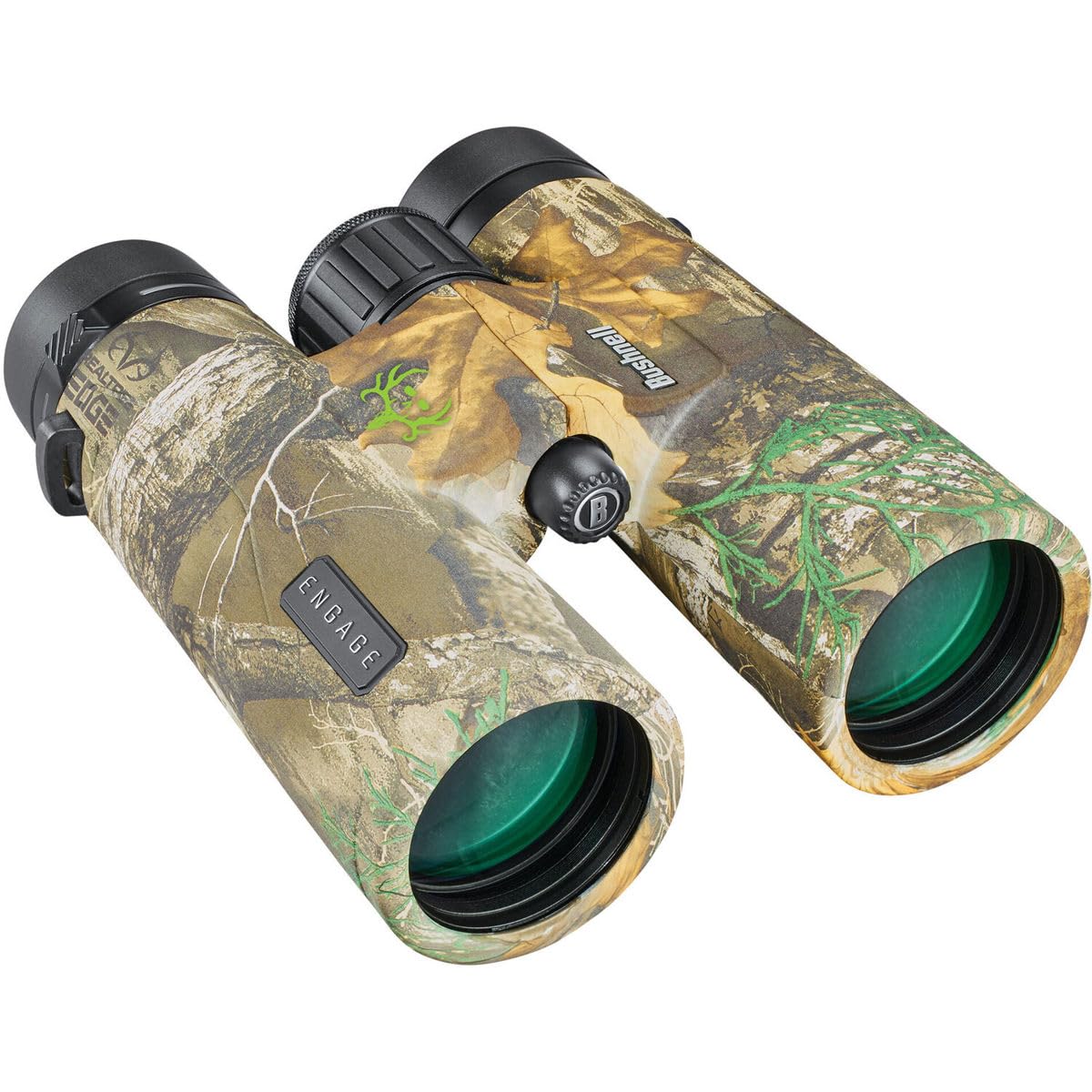
5. Bushnell Engage X 10x42mm Binoculars
Bushnell’s EXO coating and IPX7 rating shrug off a soaking ridge line
When the forecast is ugly but the rut is on, the Engage X brings Bushnell’s exclusive EXO Barrier — a permanent exterior coating that repels water, oil, fog, dust, and debris, so raindrops bead off instead of smearing your view. Add the IPX7 waterproof rating (meaning it survives immersion in water up to 1 meter for 30 minutes) and this 10×42 keeps a clear, vibrant image right through a downpour or a creek crossing. It tips the scales at a featherweight 2 pounds, easy to carry all day.
The fully multi-coated, all-glass lenses deliver clarity and brightness that owners describe as the best they have owned, with easy spotting of birds and deer at distance. The twist-up eyecups make it simple to set the perfect image with or without glasses, and the 18 millimeters of eye relief is generous for eyeglass wearers. Its enhanced low-light performance gives you an edge in those crucial dusk moments when deer start moving.
There is one mixed note in the feedback: the focus mechanism — some owners find it smooth and precise, others find it confusing until they get the hang of it. It is a learning curve, not a defect. The package includes a neck strap, carrying case, and quick start guide, and the lifetime Ironclad Warranty protects your investment. For a mid-range price, this is serious weather-ready value.
Built for the elements
- EXO Barrier coating repels water, oil, and dust
- IPX7 waterproof rating survives submersion
- 18 mm eye relief suits eyeglass wearers well
- Only 2 pounds for all-day carry
One thing to learn
- Focus mechanism draws mixed owner feedback until mastered
Reach for this if: You hunt wet country and want permanent lens protection plus a true waterproof rating.
Look elsewhere if: You want a focus wheel that feels intuitive from the first twist.
6. Bushnell PowerView 10×42 BoneCollector Binoculars, Realtree Edge Camo

Camo-clad budget glass that spots a doe without emptying your wallet
The PowerView BoneCollector wraps the classic Bushnell recipe in Realtree Edge camo, purpose-built for hunters who want to disappear into the timber. Multi-coated optics (lenses with multiple anti-reflective layers) pull in a serious amount of light for clear, vibrant images even in low light, and buyers report crisp zoom that is great for hunting — one even spotted a doe mid-season with them. At 22 ounces and 5.5 inches long, it is compact enough to ride in a pack or around your neck all day.
The diamond-cut grip texture on the sides gives you a secure, comfortable hold, while the oversized focus wheel sharpens the image with a simple twist. Even wearing gloves, the diamond-cut grips on the focus wheel and diopter let you dial in settings precisely, and the twist-up eyecups adjust fast for quick target acquisition. A 17.5 millimeters of eye relief keeps the view comfortable for glasses wearers, and it is tripod compatible for steady glassing from a stand.
There is an honest split in owner feedback on durability — plenty find it very durable, but some note it does not last long with regular hard use, and a few see slight edge distortion at full zoom. That is the trade-off at this price: excellent clarity for the money, but the optics sit below the high-end tier. For a budget-conscious hunter or a first pair, the quality-for-cost story is hard to argue with.
The budget read: Real world-tested clarity and a glove-friendly focus wheel at an entry-level price.
One honest doubt: longevity under daily hard use draws mixed owner reports — treat it as a dependable value, not a lifetime heirloom.
7. Vortex Triumph HD 10×42 Binoculars

Vortex quality at an entry price, with the most glasses-friendly eye relief here
The Triumph HD is the gateway into Vortex’s world, and at this price it is a revelation for budget hunters. Its HD optical system and fully multi-coated lenses deliver crisp, color-accurate views that owners describe as among the best they have owned, with solid performance even in lower light. Owners mention excellent 10×42 clarity in a lightweight body that is easy to adjust, with a durable pouch included — value that is hard to top in this tier.
what separates it is the 17 millimeters of eye relief (the distance from your eye to the eyepiece where you still see the full image), which beats the 15 millimeters on both the Celestron Outland X and the more expensive Vortex Diamondback HD above it. For eyeglass wearers, that extra room means you see the full image without blacked-out edges — a real comfort win on a long sit. The polycarbonate chassis with full rubber armor makes it shockproof and gives a better grip, and nitrogen purging (filling the tube with nitrogen to prevent internal fogging) keeps it waterproof and fog proof.
The 10×42 format balances reach and stability, and smooth focus earns consistent praise. Owners note it works best on a tripod for long-range viewing, and the included harness is handy even if some find it a touch cumbersome. It is a compact size that suits smaller hands, which makes it a great loaner pair or a first binocular for a young hunter joining the stand.
What wins people over
- 17 mm eye relief leads the budget field for glasses users
- HD optics punch above the price in clarity
- Nitrogen purged, waterproof, and fog proof
- Compact size is great for smaller hands
The catch to know
- Harness design feels cumbersome to some owners
The value verdict: The smart budget pick — especially for eyeglass wearers who need the extra relief without the premium price.
Who might skip: Hunters wanting a tripod-heavy long-range setup, since it shines most as a handheld all-rounder.
8. Celestron Outland X 10×42 Binoculars for Wildlife & Hunting

A California optics maker’s budget glass with a genuinely wide, easy view
Celestron has built telescopes since 1960, and that optical expertise shows in the Outland X at a budget price. Its multi-coated lenses boost light transmission while high-quality BaK-4 prisms produce sharp, color-accurate images across lighting conditions. Owners repeatedly call it crisp and lightweight with no fogging even in Florida humidity — a meaningful real-world test that the nitrogen purging does its job in rain, snow, or humidity.
What truly stands out here is the view: the field of view is a wide 306.81 degrees, which towers over every other 10×42 on this list and makes tracking a moving buck through brush dramatically easier. You keep more of the landscape in view while following an animal, which is a genuine hunting advantage at this price. The rubber-armored polycarbonate housing shrugs off bumps, and the built-in tripod adapter threads let you mount it for shake-free extended glassing.
Owners praise it as exceeding expectations for the money, with bright, sharp images and a solid feel in hand. The focus mechanism draws one honest mixed note — generally smooth but some find it hard to focus — and an occasional unit has seen the eyepiece armor wear after months. The lifetime US warranty from a California-based company adds real confidence. This is a dependable budget pair that happens to have the widest sweep in the lineup.
The standout spec: its 306.81-degree field of view is the widest on this list, a real tracking edge in thick cover.
The honest caveat: focus stiffness and long-term armor wear appear in a minority of owner reports.
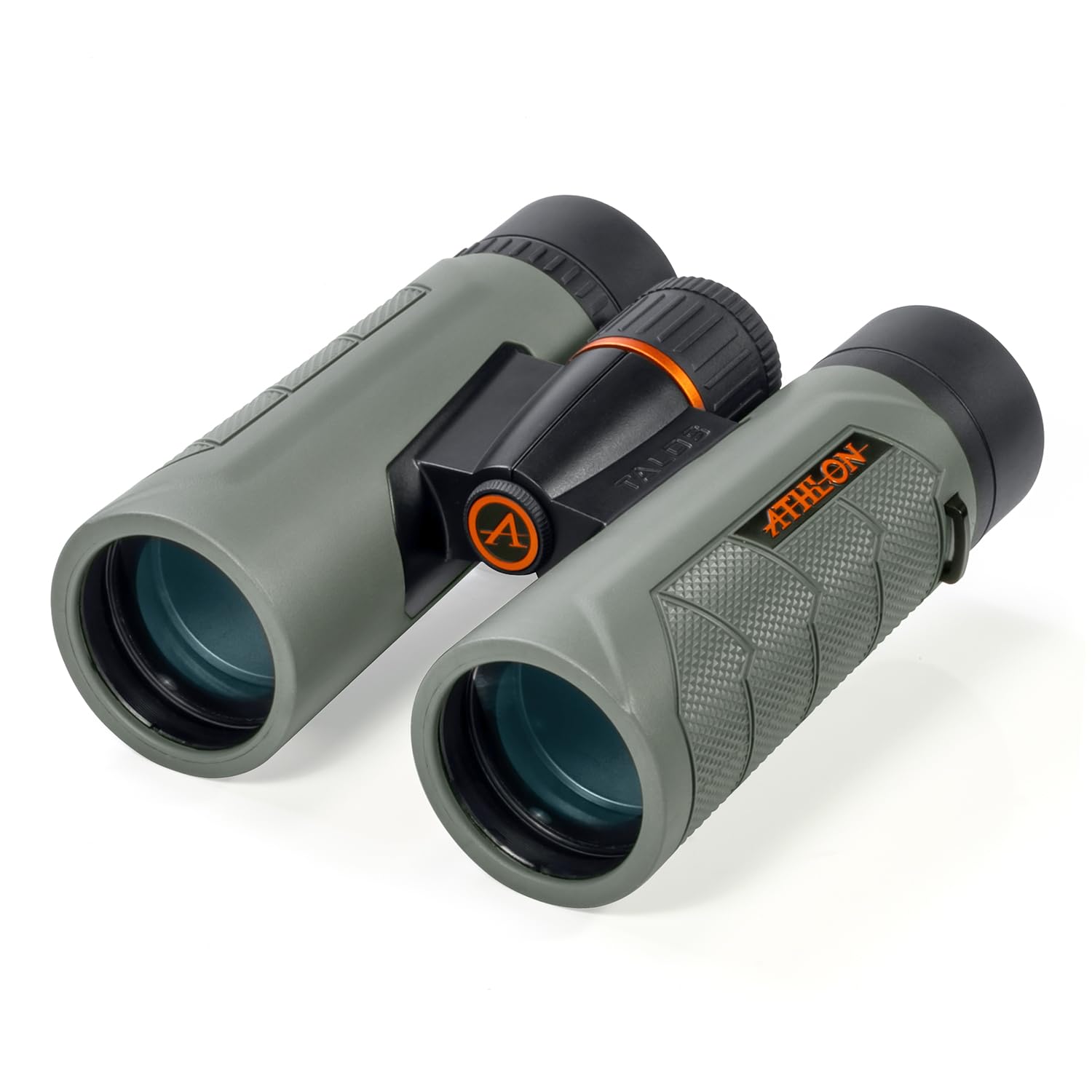
9. Athlon Optics Talos G2 HD 10×42 Binoculars
A wide-field budget sleeper with an eye-relief figure that beats the big names
The Talos G2 HD is the quiet value play on this list, and its specs punch well above the entry-level sticker. The 10×42 configuration with advanced fully multi-coated lenses delivers bright, sharp images with strong color fidelity and contrast for picking out distant subjects. Its 371-foot field of view at 1000 yards is the widest of any 10×42 here, giving you a genuinely broad sweep for scanning a ridge line or following a deer on the move.
The rugged rubber-coated body is built to handle regular outdoor use while keeping the weight practical for extended carry, listed at just 1.3 pounds. Owners call the optics very clear and like the rubber coating for grip.
One point to weigh: this model has a very small owner base so far, so the long-term reputation is less proven than the household names on this list. The water resistance comes from waterproofing construction, which covers the essentials for a fair-weather hunt. As a family-friendly option, Athlon bills it as suitable for both adults and kids, making it a solid choice for introducing a young hunter to the sport without a big investment.
Who it fits: The value-focused hunter or family who wants the widest field and the most glasses-friendly eye relief for the least money.
Reach for it: if the proven track record of the bigger brands matters more to you than the spec sheet numbers.
Understanding the Specs
Field of view
Field of view is how wide an area you see at a set distance, measured either in degrees or in feet at 1000 yards. A wider field makes it easier to find a deer in the first place and then track it as it moves through cover. It is a genuine trade-off: at the same magnification, a wider field often means a slightly smaller, brighter image in the center. This is why the Celestron Outland X (306.81 degrees) and the Athlon Talos G2 HD (371 feet) feel so different in the field from a narrower, more magnified view — you trade a little reach for a lot of scan.
Eye relief
Eye relief is the distance between your eye and the eyepiece where you still see the full image. If you wear glasses while hunting, you need roughly 15 millimeters or more so the view does not black out at the edges. Numbers like 15 mm on the Vortex Diamondback HD, 15.7 mm on the Nikon PROSTAFF P3, 17 mm on the Vortex Triumph HD, 17.9 mm on the Athlon Talos G2 HD, and 18 mm on both the ZEISS Conquest HDX and Bushnell Engage X tell you exactly how forgiving each pair will be. It is the single most important spec for eyeglass wearers and the one most beginners ignore.
FAQ
Is 10×42 the best magnification for deer hunting?
What does a larger eye relief number mean for me?
Why does field of view matter when tracking a moving deer?
Will these binoculars fog up in cold weather?
What is the exit pupil and why does it matter for low light?
Can I use these binoculars while wearing glasses?
How heavy is too heavy for binoculars on a deer hunt?
Do I need a tripod for high-magnification binoculars?
Is a higher price binocular actually worth it for deer hunting?
What is the difference between multi-coated and fully multi-coated lenses?
Final Thoughts: The Verdict
For most deer hunters, the binoculars for deer hunting winner is the Vortex Diamondback HD because its dielectric-coated prisms (mirror-like coatings that reflect more light) keep the image bright in the low light where deer actually move, and the fully transferable lifetime warranty removes any worry about a costly field accident. If you want the extra reach of a 12×50 that doubles as a spotting scope, grab the Leupold BX-4 Pro Guide HD. And for a budget-conscious hunt, the Vortex Triumph HD brings the same brand’s quality and the best glasses-friendly eye relief in its price class — the crowd favorite at the top is the one most owners keep reaching for.
How We Picked
We do not accept paid placement. Every pick is matched to a real buyer and a real use-case; we do not hands-on test units.
Sources & Methodology
Specifications: manufacturer listings and product documentation. Review insights: verified customer reviews, as of September 2026. Pricing: not shown on this page (it changes often); check the current price via the retailer link.
As an Amazon Associate, Gadgets Feed earns from qualifying purchases. This does not affect which products we feature.