
Standard binoculars force glasses wearers into a frustrating trade-off: roll down the stiff rubber eyecups and lose half your peripheral view, or keep them up and scratch your lenses. It’s a compromise that kills the very clarity you bought the optics to see. The real solution isn’t about adapters or hacks — it’s about specific, non-negotiable measurements in the design itself.
I’m Min — the co-founder and writer behind Gadgets Feed. I’ve spent hundreds of hours cross-referencing optical specifications, exit-pupil diameters, and eye-relief figures to identify which binoculars actually accommodate prescription eyewear without forcing you to choose between comfort and a full field of view.
This guide cuts past the marketing noise to deliver hard spec comparisons — diopter ranges, twist-up eyecup travel, and nitrogen sealing — that define the binoculars for glasses wearers worth your time.
How To Choose The Best Binoculars For Glasses Wearers
Selecting a pair of binoculars when you wear glasses comes down to three measurable parameters that most spec sheets bury. Ignore the marketing promises about “clarity” and look for these numbers first — they determine whether you see the full circle or a restricted porthole.
Eye Relief: The Hard Number You Can’t Ignore
Eye relief is the distance from the ocular lens to the point where the image is in focus. For glasses wearers, the target is 17 millimeters or more. Anything less, and your frames push your eye too far back, forcing you to roll the eyecups down and lose light and edge definition. The Nikon Monarch M5 delivers a class-leading 19.5mm of usable eye relief, making it one of the most comfortable options for thick frames.
Twist-Up Eyecups vs. Fold-Down Design
Twist-up eyecups with multiple click stops give you precise control over how far your eye sits from the lens. You can dial them to a partial stop that accommodates your frames without bottoming out. Fold-down rubber cups are binary — they’re either in your way or completely flattened, reducing optical performance. Every product on this list uses twist-up eyecups, ensuring you can fine-tune the distance.
Exit Pupil Size and Low-Light Performance
The exit pupil is the diameter of the light beam hitting your eye, calculated by dividing the objective lens by the magnification. A 5mm exit pupil (like the 8×42 Nikon Monarch M5) is ideal for glasses wearers because it accounts for slight misalignment between the eyepiece and your pupil. The larger the exit pupil, the more forgiving the binoculars are of your eye position — critical when your glasses create that extra gap.
Quick Comparison
On smaller screens, swipe sideways to see the full table.
| Model | Category | Best For | Key Spec | Amazon |
|---|---|---|---|---|
| Nikon Monarch M5 8×42 | Premium | All-day wildlife with glasses | 19.5mm eye relief | Amazon |
| ZEISS Terra ED 10×42 | Premium | Fast-focus birding with frames | 18mm eye relief | Amazon |
| Nikon TRAVELITE EX 10×25 | Mid-Range | Ultra-compact travel pair | 14mm eye relief | Amazon |
| Celestron Outland X 10×50 | Mid-Range | Stargazing with glasses | 17.4mm eye relief | Amazon |
| Vortex Copperhead HD 10×42 | Mid-Range | Rugged field use with specs | 17mm eye relief | Amazon |
| Bushnell H2O Xtreme 10×42 | Mid-Range | Wet-weather boating or hiking | 17mm eye relief | Amazon |
In‑Depth Reviews
1. Nikon Monarch M5 8×42
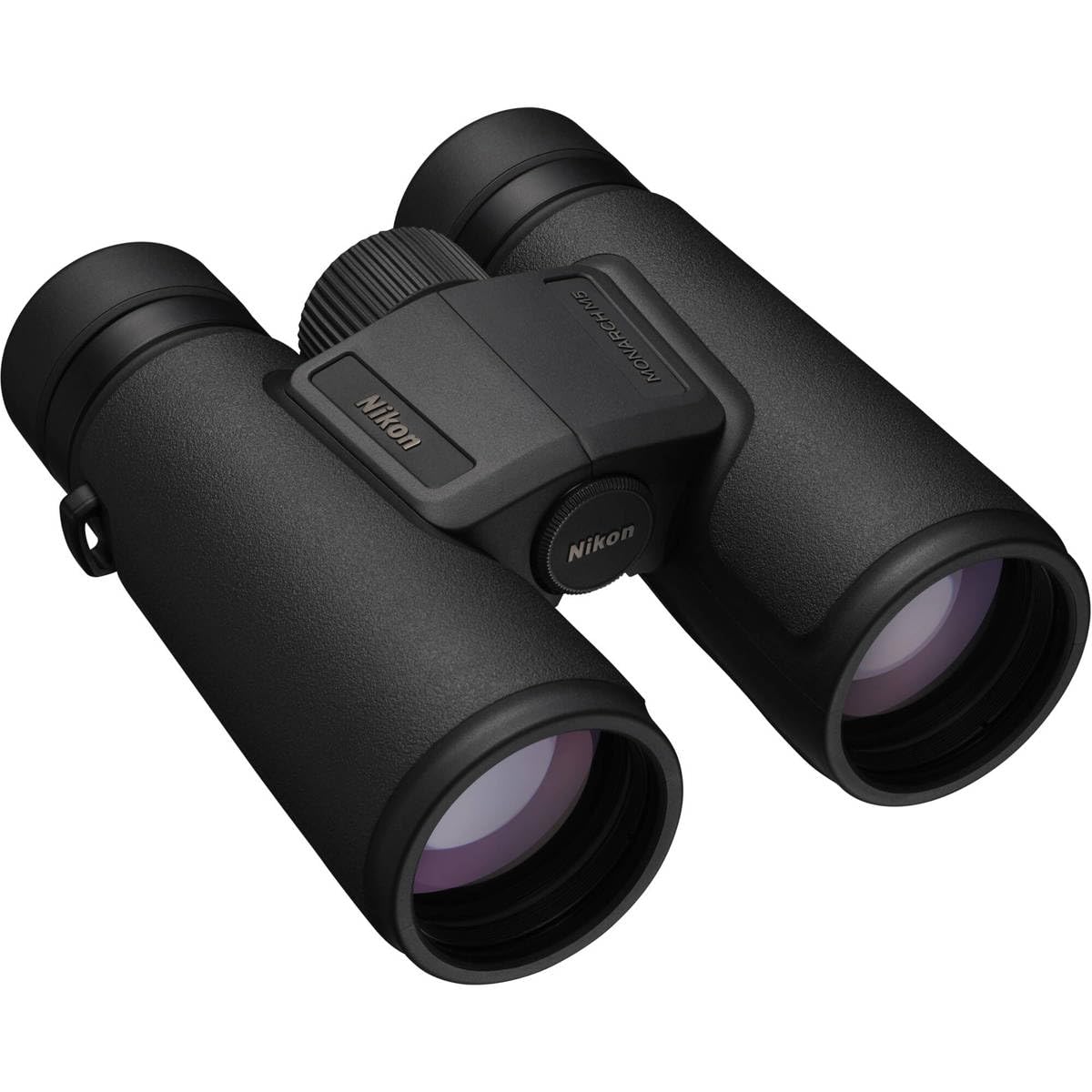
The Nikon Monarch M5 delivers the longest eye relief in this roundup at 19.5mm, meaning even chunky acetate frames won’t trim your field of view. The 42mm objective and dielectric-coated prisms push light transmission high enough to maintain color accuracy in dawn and dusk conditions, which is exactly when glasses wearers often struggle with glare and contrast.
Extra-low dispersion (ED) glass cuts chromatic aberration effectively — a real advantage when scanning forest canopies where green fringe between branches is a common annoyance. The twist-up eyecups have three click stops, letting you dial in a comfortable distance for your specific frame thickness without bottoming out or losing seal.
The only physical trade-off is the closed-bridge design makes the housing slightly wider than some open-bridge competitors, but the weight is balanced well enough for hour-long birding sessions. The central focus knob is large and smooth, though the texture is glossy enough that wet fingers may slip during rain.
Why it’s great
- Highest eye relief (19.5mm) in class for total frame accommodation
- ED glass virtually eliminates chromatic aberration at edges
- Dielectric coating delivers true-to-life colors even in low light
Good to know
- Slightly wider closed-bridge housing takes more space in a pack
- Central focus knob can be tricky to grip with wet hands in rain
2. ZEISS Terra ED 10×42

The ZEISS name carries weight for a reason — the Terra ED uses a hydrophobic multi-coating that maintains 88% light transmission even when rain or spray hits the lenses. With 18mm of eye relief, it sits comfortably behind most frames without requiring the eyecups to be fully collapsed, preserving the full 330-foot field of view at 1,000 yards.
The fast-focus wheel is the standout mechanical feature: your index finger lands naturally on it, and the throw from near to infinity is shorter than almost any competitor at this tier. For glasses wearers who shift between distant birds and close trail markers, that speed reduces the time your hand spends hunting for the focus collar.
The fiberglass-reinforced polycarbonate casing keeps the weight down to a very manageable level, though the chassis does flex slightly under firm grip pressure compared to full magnesium builds. The case and neoprene strap are genuinely premium — better than what most mid-range binoculars ship with.
Why it’s great
- Fast-focus wheel with instinctive finger placement for rapid adjustments with glasses
- Hydrophobic coating sheds rain and maintains clear views in wet weather
- Lightweight polycarbonate build reduces neck fatigue on long walks
Good to know
- Polycarbonate chassis feels slightly less rigid than metal alternatives
- 10x magnification requires a steadier hand on the focus wheel
3. Athlon Optics Midas G2 UHD 10×50
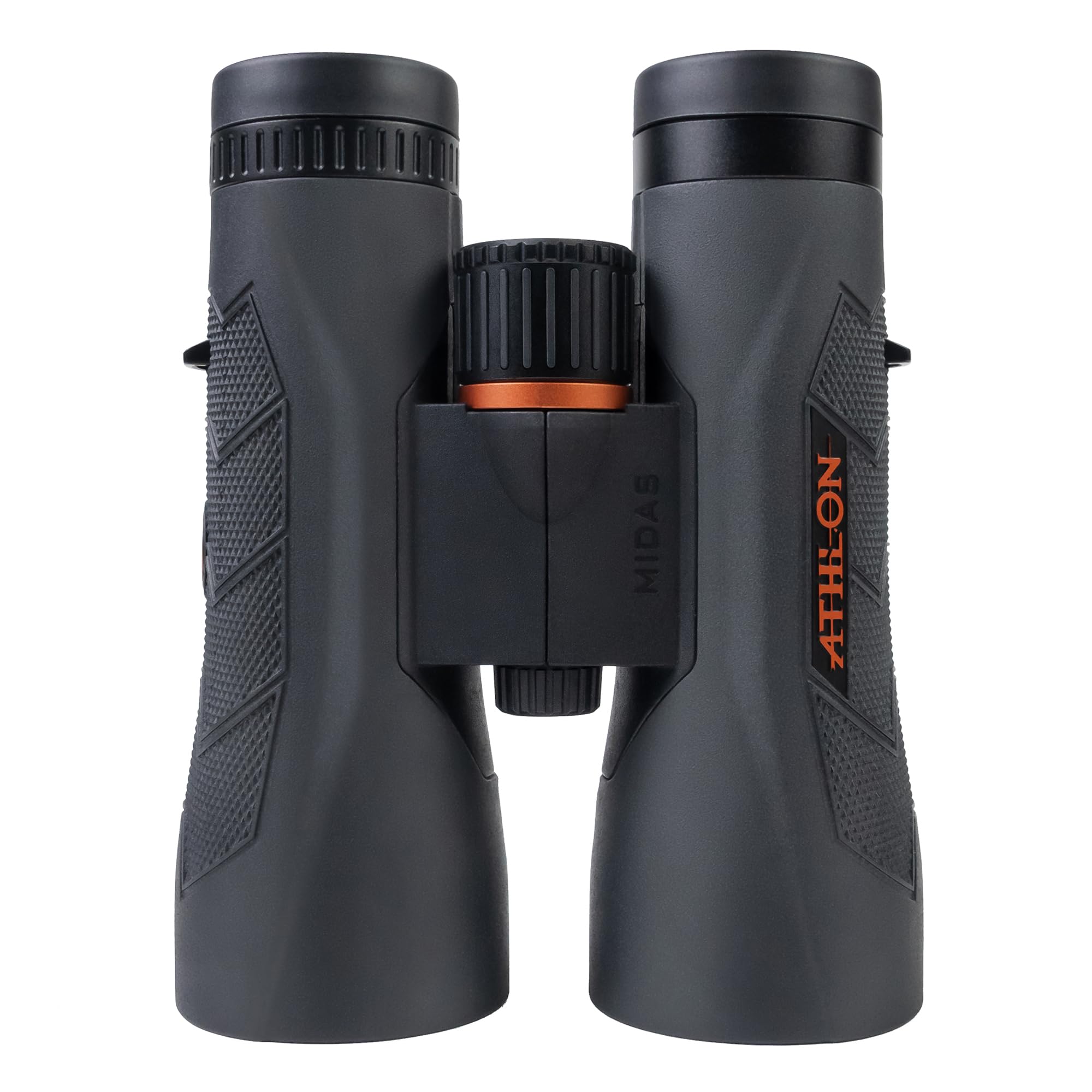
The Athlon Midas G2 UHD uses extra-low dispersion glass with a dielectric prism coating that reflects over 99% of light, producing an image sharp enough to read distant license plates or spot individual leaf veins. The 16.9mm eye relief is slightly below the 17mm comfort threshold, but the twist-up eyecups offer a wide range of intermediate stops that let you compensate for the gap with careful adjustment.
The magnesium chassis is a clear winner if weight matters — it cuts roughly 35% of the mass compared to aluminum builds, making the 10×50 configuration feel closer to a standard 42mm binocular. The XPL coating on the exterior lenses is genuinely effective at repelling dirt and oil, meaning fewer cleaning passes if your glasses press against the rubber armor.
The diopter adjustment range of ±5 diopters is unusually generous, accommodating significant differences between your left and right eye correction. The field of view at 6.5 degrees is narrower than some 42mm competitors, so scanning wide landscapes requires more head movement, but the edge-to-edge sharpness makes up for it.
Why it’s great
- Wide ±5 diopter range for strong prescription differences between eyes
- Magnesium chassis is exceptionally lightweight for a 50mm objective
- XPL coating resists dirt and scratches from glass frames
Good to know
- Eye relief at 16.9mm is tight for very thick frames
- Narrower field of view requires more scanning at distance
4. Nikon TRAVELITE EX 10×25

If portability is your non-negotiable, the Nikon TRAVELITE EX slips into a jacket pocket without bulging. The 25mm objective lens and 2.1mm exit pupil are inherently less forgiving for glasses wearers — the 14mm eye relief means you’ll likely need to collapse the twist-up eyecups fully to see the full image, which reduces contrast and introduces edge vignetting.
Nikon’s multilayer coating and aspherical eyepiece lenses do mitigate some of the brightness loss, delivering sharp central resolution that rivals many larger binoculars in good daylight. The die-cast aluminum body with rubber armor feels much more substantial than the weight suggests, and the click-type diopter adjustment stays locked in place no matter how many times you stuff it in a bag.
The travel convenience comes at a real optical cost: the 4.2-degree field of view is narrow, and light transmission drops sharply in overcast conditions. This is a daytime companion for opera balconies or quick sightseeing stops, not a low-light birding tool.
Why it’s great
- Ultra-compact and lightweight — easily fits in a jacket pocket
- Click-stop diopter stays locked through rough travel
- Die-cast aluminum body with rubber armor feels durable for the size
Good to know
- 14mm eye relief requires fully collapsed eyecups for most glasses
- Narrow field of view and lower light transmission limit low-light use
5. Celestron Outland X 10×50

The Celestron Outland X 10×50 delivers a 17.4mm eye relief figure that clears most frames comfortably, combined with a 5mm exit pupil that makes centering your eye forgiving. The 50mm objective lenses pull in enough light for stargazing and pre-dawn birding, and the multi-coated BaK-4 prisms produce a crisp image with realistic color reproduction.
The twist-up eyecups have two defined stops, which give you good adjustability for different frame thicknesses. The tripod-adapter threads in the chassis are a rare inclusion at this level, allowing you to mount the binoculars for extended deer flyover or astronomy sessions without the image shake typical of handheld 10x50s.
The polycarbonate housing is nitrogen-purged and O-ring sealed for full waterproof and fogproof performance, but the rubber armor is thinner than premium brands, exposing harder plastic underneath if you set it down on rough ground. The included neck strap is serviceable but not padded, so heavier 50mm weight becomes noticeable after 30 minutes of hiking.
Why it’s great
- Large 5mm exit pupil forgives minor centering errors behind glasses
- Built-in tripod adapter threads for shake-free stargazing sessions
- Full waterproof and fogproof with nitrogen purging
Good to know
- Thin rubber armor offers less drop protection than premium builds
- Unpadded neck strap makes the 50mm weight felt on longer carrying
6. Vortex Copperhead HD 10×42

The Vortex Copperhead HD sits at the entry-level end of the premium spectrum with a 17mm eye relief that clears many standard frames. The HD optical system improves color fidelity and edge sharpness over non-HD competitors in its tier, and the fully multi-coated lenses maximize light transmission through the 42mm objectives.
The adjustable eyecups twist up and down with a positive click, though the travel range is shorter than the Monarch M5, meaning thicker frames may require a partial collapse. The rubber armor offers a secure grip in wet conditions, and the included GlassPak harness distributes weight across both shoulders rather than the neck.
Vortex’s unlimited lifetime warranty is the real draw here — it covers defects and damage for any reason, transferable to future owners. The image sharpness falls slightly behind the Athlon and ZEISS when comparing edge-to-edge clarity directly, and the 6.4-degree apparent field of view is narrower than the Celestron’s 63-degree apparent FOV.
Why it’s great
- Unconditional lifetime warranty at a strong price-to-value ratio
- HD glass delivers improved color fidelity compared to standard optics
- GlassPak harness included for comfortable all-day carry with glasses
Good to know
- Short eyecup travel may require full collapse for very thick frames
- Narrower field of view than some competitors at the same price tier
7. Bushnell H2O Xtreme 10×42

The Bushnell H2O Xtreme is built for wet environments — the O-ring sealed design with nitrogen purging means it can handle rain, spray, and accidental submersion without internal fogging. The 17mm eye relief meets the baseline for glasses, and the twist-up eyecups are clearly designed to accommodate frames without excessive fumbling.
The fully multi-coated glass surfaces mark a real upgrade from earlier H2O models, improving contrast and brightness noticeably at dawn and dusk. The BaK-4 prisms ensure sharp central resolution, though the 6.8-degree field of view feels slightly claustrophobic compared to the Celestron’s apparent wider view.
Missing a tripod adapter socket is the biggest functional gap — if you plan to mount these for extended scanning, you’ll need to look elsewhere. The rugged rubber design with soft grips is comfortable in the hand even when wet, but the neck strap is thin and not padded, making longer carries less pleasant.
Why it’s great
- Full IPX7 waterproofing with O-ring sealed, nitrogen-purged build
- Fully multi-coated glass upgrades contrast over standard H2O series
- Rugged rubber grips stay secure in wet conditions
Good to know
- No tripod adapter socket limits stable long-duration use
- Unpadded neck strap is uncomfortable for extended hiking
FAQ
Can I use any binoculars with glasses by just rolling down the eyecups?
What is the minimum eye relief I should look for as a glasses wearer?
Do I need more powerful magnification if I wear glasses for distance?
Final Thoughts: The Verdict
For most users, the binoculars for glasses wearers winner is the Nikon Monarch M5 8×42 because its 19.5mm eye relief and ED glass deliver the widest, sharpest image without forcing you to choose between frames and field of view. If you want ultra-compact portability for travel, grab the Nikon TRAVELITE EX 10×25. And for stargazing or low-light pursuits where a wide exit pupil and tripod compatibility matter, nothing beats the Celestron Outland X 10×50.